ISSN(Online): 2319-8753 ISSN (Print): 2347-6710
I
nternational
J
ournal of
I
nnovative
R
esearch in
S
cience,
E
ngineering and
T
echnology
(A High Impact Factor, Monthly, Peer Reviewed Journal)
Visit: www.ijirset.com
Vol. 7, Issue 10, October 2018
Age and Gender Estimation using Deep
Residual Learning Network
Avinash N.Pawar, Prof.R.K.Agrawal
Lecturer, Department of Instrumentation, IOPE Lonere Tal-Mangaon (Raigad), Maharashtra, India Associate Professor, Department of EXTC, SNJB’s COE Chandwad (Nashik), Maharashtra, India
ABSTRACT: Deep neural networks have demonstrated excellent performances in recognizing the age and gender on human face images. The different methodologies of enhancing age and gender estimation coordinate with the leftover learning are researched throughout the paper. It has been demonstrated that the relapse display is superior to anything the arrangement show in genuine age estimation. In addition, we have demonstrated that the remaining association enhances the execution in the profound system by limiting the debasement, and our proposed show yields enhanced execution.
KEYWORDS: CNN, Deep Residual learning, residual connections, ResNet
I. INTRODUCTION
Age and gender data is essential for promoting and showcasing, where organizations need to utilize distinctive procedures for various gatherings. Among various strategies in age and gender estimation, the work in was the main strategy receiving profound neural systems and they demonstrated enhanced execution contrasted and conventional component based techniques. The proposed strategy depends on this work; in any case, we expand the work by utilizing lingering taking in squares from Resnet. Age and genderual orientation assume basic jobs in social cooperations. Dialects save distinctive greetings and punctuation rules for men or ladies, and all the time extraordinary vocabularies are utilized while tending to older folks contrasted with youngsters. Notwithstanding the fundamental jobs these properties play in our everyday lives, the capacity to consequently gauge them precisely and dependably from face pictures is still a long way from addressing the necessities of business applications. This is especially bewildering while considering late cases to super-human abilities in the related errand of face acknowledgment.
With the fast development of face acknowledgment calculation, its sub inquires about zones, for example, age/genderual orientation arrangement looks into are likewise picking up consideration. As the maturing procedure isn't the equivalent for everybody and it relies upon a few factors, for example, genderual orientation, race, living propensities, and so forth., it is even troublesome notwithstanding for human to figure a man's age by taking a gander at his photo. A similar story is legitimate for age classifier systems. Age and gender orientation assume crucial jobs in social associations. Dialects save diverse greetings and language structure rules for men or ladies, and all the time unique vocabularies are utilized while tending to senior citizens contrasted with youngsters. In spite of the fundamental jobs these traits play in our everyday lives, the capacity to consequently appraise them precisely and dependably from face pictures is still a long way from addressing the requirements of business applications. This is especially confounding while considering ongoing cases to super-human capacities in the related undertaking of face acknowledgment.
Amid the most recent decade, the calculations in view of CNN are presently supplanting the regular picture handling and PC vision calculations. The GPU advancements additionally helped CNNs to get further and more profound to accomplish better outcome. Yet, some of ongoing works have demonstrated that going further isn't generally a smart thought, for instance [3] proposed a more extensive CNN with expanded size of open fields which acquired very
ISSN(Online): 2319-8753 ISSN (Print): 2347-6710
I
nternational
J
ournal of
I
nnovative
R
esearch in
S
cience,
E
ngineering and
T
echnology
(A High Impact Factor, Monthly, Peer Reviewed Journal)
Visit: www.ijirset.com
Vol. 7, Issue 10, October 2018
II. LITERATURE REVIEW
Paper [1], researches the different procedures of enhancing age and sexual orientation estimation coordinate with the remaining learning. It has been demonstrated that the relapse show is superior to anything the characterization display in genuine age estimation. Also, they have demonstrated that the lingering association enhances the execution in the profound system by limiting the debasement, and our proposed display yields enhanced execution. Two imperative ends can be produced using paper [2] results. Initially, CNN can be utilized to give enhanced age and sexual orientation order results, notwithstanding considering the considerably littler size of contemporary unconstrained picture sets marked for age and sex. Second, the effortlessness of our model infers that more detailed frameworks utilizing additionally preparing information may well be able to do significantly enhancing outcomes past those revealed here. [4] This paper proposes new Residual systems of Residual systems (RoR) engineering for high-goals facial pictures age and sexual orientation order in nature. Two unobtrusive systems, pre-preparing by sex and preparing with weighted misfortune layer, are utilized to enhance the execution of age estimation. Pre-preparing on ImageNet is utilized to reduce over-fitting. Additionally adjusting on IMDB-WIKI-101 is to learn the highlights of face pictures. By RoR or Pre-RoR with two instruments, we acquire new best in class execution on Audience informational collection for age gathering and sexual orientation characterization in nature. A GE and sex, two of the key facial traits, play exceptionally primary jobs in social cooperation, making age and sex estimation from a solitary face picture a vital errand in wise applications, for example, get to control, human PC communication, law requirement, promoting insight and visual reconnaissance, and so forth [5].
In detail, [3] work thinks about four well known neural system designs, examines the impact of pretraining, assesses the power of the considered arrangement pre-processing by means of cross-strategy test set swapping and naturally pictures the model's expectation techniques in given pre-processing conditions utilizing the ongoing Layer-wise Relevance Propagation (LRP) calculation. Our assessments on the testing Adience benchmark demonstrate that reasonable parameter introduction prompts an all encompassing view of the info, repaying artefactual information portrayals. With a mix of basic pre-processing steps, we achieve best in class execution in sexual orientation acknowledgment.
Lingering associations are basically associations between a layer and layers after the following. This thought is plainly shown in the graph beneath:
ISSN(Online): 2319-8753 ISSN (Print): 2347-6710
I
nternational
J
ournal of
I
nnovative
R
esearch in
S
cience,
E
ngineering and
T
echnology
(A High Impact Factor, Monthly, Peer Reviewed Journal)
Visit: www.ijirset.com
Vol. 7, Issue 10, October 2018
In the outline over, the plain system essentially sends data over starting with one layer then onto the next, data about the past condition of the picture is exceptionally restricted and all initiations must be founded on the new highlights, the lingering associations then again takes the future guide from layer t and adds it to the yield of layer t + 2.
This is identical to taking in the remaining capacity y = f(x) + x
In direct feed forward systems without lingering associations, a layer T just depends on information at layer T — 1 with
layer T - 1 encoding the result of all the past layers, then again, leftover associations look more remote into the past, putting into thought data from layer T — 2.
This exceptionally basic however intense thought empowered the creators to prepare over a 100 layers connect with expanding precision. It is imperative that while the creators initially thought to be lingering associations as being essential for profundity, future work has demonstrated that leftover systems can enhance the execution of both shallow and profound neural systems. This concurs with our delineation of lingering capacities as enhancing precision by giving adequate information about the first condition of the information. In picture acknowledgment, VLAD is a portrayal that encodes by the leftover vectors regarding a word reference, and Fisher Vector can be detailed as a probabilistic variant of VLAD. Them two are ground-breaking shallow portrayals for picture recovery and characterization. For vector quantization, encoding lingering vectors [17] is appeared to be more compelling than encoding unique vectors. In low-level vision and PC illustrations, for understanding Partial Differential Equations (PDEs), the generally utilized Multigrid strategy reformulates the framework as sub problems at numerous scales, where each sub problem is in charge of the leftover arrangement between a coarser and a better scale. An option in contrast to Multigrid is various levelled premise preconditioning, which depends on factors that speak to lingering vectors between two scales. It has been demonstrated that these solvers meet substantially quicker than standard solvers that are uninformed of the remaining idea of the arrangements. These techniques recommend that a decent reformulation or preconditioning can improve the streamlining.
III. RESIDUAL LEARNING
Rather than trusting every few stacked layers specifically fit a coveted basic mapping, we unequivocally let these layers fit a lingering mapping. Formally, indicating the coveted hidden mapping as H(x), we let the stacked nonlinear layers fit another mapping of F(x):= H(x)−x. The first mapping is recast into F(x) +x. We conjecture that it is simpler to
streamline the lingering mapping than to enhance the first, unreferenced mapping. To the extraordinary, if a personality mapping were ideal, it is simpler to push the leftover to zero than to fit a character mapping by a heap of nonlinear layers.
ISSN(Online): 2319-8753 ISSN (Print): 2347-6710
I
nternational
J
ournal of
I
nnovative
R
esearch in
S
cience,
E
ngineering and
T
echnology
(A High Impact Factor, Monthly, Peer Reviewed Journal)
Visit: www.ijirset.com
Vol. 7, Issue 10, October 2018
The detailing of F(x) +x can be acknowledged by feed forward neural systems with "easy route associations" (Fig. 1). Alternate route associations are those avoiding at least one layers. For our situation, the alternate route associations just perform personality mapping, and their yields are added to the yields of the stacked layers (Fig. 3.1). Character alternate way associations include neither additional parameter nor computational multifaceted nature. The whole system can even now be prepared end-to-end by SGD with back engendering, and can be effortlessly actualized utilizing basic libraries (e.g., Caffe) without altering the solvers.
Give us a chance to think about H(x) as a hidden mapping to be fit by a couple of stacked layers (not really the whole net), with x meaning the contributions to the first of these layers. On the off chance that one speculates that different nonlinear layers can asymptotically estimated convoluted functions2, at that point it is identical to guess that they can asymptotically surmised the lingering capacities, i.e., H(x) − x (expecting that the info and yield are of similar
measurements). So instead of anticipate that stacked layers will surmised H(x), we unequivocally let these layers estimated a remaining capacity F(x):= H(x) − x. The first capacity in this manner progresses toward becoming F(x) +x.
Albeit the two structures ought to have the capacity to asymptotically rough the coveted capacities (as conjectured), the simplicity of learning may be extraordinary.
This reformulation is propelled by the strange wonders about the corruption issue. As we talked about in the presentation, if the additional layers can be developed as personality mappings, a more profound model ought to have preparing mistake no more prominent than its shallower partner. The debasement issue recommends that the solvers may experience issues in approximating personality mappings by various nonlinear layers. With the lingering learning reformulation, if character mappings are ideal, the solvers may basically drive the weights of the different nonlinear layers toward zero to approach personality mappings.
IV. METHODOLOGY
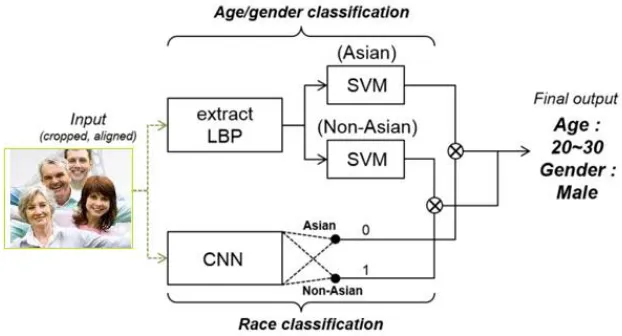
Our proposed network architecture is used throughout our experiments for both age and gender classification. It is illustrated in Figure 3. The face detectors such as find faces in input images and the detected faces are cropped and resized to 224 x 224, and these pre-processed images are fed to the network having residual learning blocks.
Figure 3: block diagram of proposed system
ISSN(Online): 2319-8753 ISSN (Print): 2347-6710
I
nternational
J
ournal of
I
nnovative
R
esearch in
S
cience,
E
ngineering and
T
echnology
(A High Impact Factor, Monthly, Peer Reviewed Journal)
Visit: www.ijirset.com
Vol. 7, Issue 10, October 2018
weighted sum of the outputs of the two age networks. The method in divided the range of age into 8 classes and approached the problem as a classification task. However, since the aging is continuous process rather than discrete, grouping the range of age into 8 classes can be debatable. For these reasons, our model estimates age with regression and uses mean absolute error for the loss function of the model.
Convolutional Neural Network (CNN) - Deep Learning
Convolutional neural network (ConvNets or CNNs) is one of the main categories to do images recognition, images classifications. Objects detections, recognition faces etc., are some of the areas where CNNs are widely used.
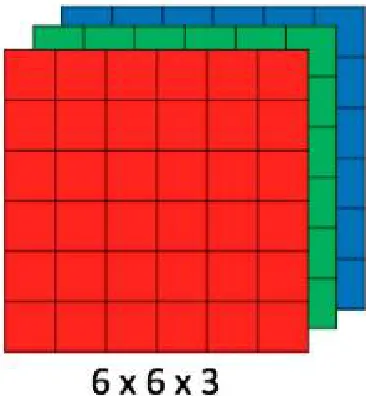
CNN image classifications takes an input image, process it and classify it under certain categories (Eg., Dog, Cat, Tiger, Lion). Computers see an input image as array of pixels and it depends on the image resolution. Based on the image resolution, it will see h x w x d( h = Height, w = Width, d = Dimension ). Eg., An image of 6 x 6 x 3 array of matrix of RGB (3 refers to RGB values) and an image of 4 x 4 x 1 array of matrix of grayscale image.
Ethnically, deep learning CNN models to train and test, each input image will pass it through a series of convolution layers with filters (Kernals), Pooling, fully connected layers (FC) and apply Softmax function to classify an object with probabilistic values between 0 and 1. The below figure is a complete flow of CNN to process an input image and classifies the objects based on values.
ISSN(Online): 2319-8753 ISSN (Print): 2347-6710
I
nternational
J
ournal of
I
nnovative
R
esearch in
S
cience,
E
ngineering and
T
echnology
(A High Impact Factor, Monthly, Peer Reviewed Journal)
Visit: www.ijirset.com
Vol. 7, Issue 10, October 2018
Convolution Layer: Convolution is the first layer to extract features from an input image. Convolution preserves the relationship between pixels by learning image features using small squares of input data. It is a mathematical operation that takes two inputs such as image matrix and a filter or kernal
Figure 5: Image matrix multiplies kernel or filter matrix
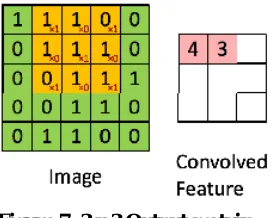
Consider a 5 x 5 whose image pixel values are 0, 1 and filter matrix 3 x 3 as shown in below
Figure 6: Image matrix multiplies kernel or filter matrix
Figure 7: 3 x 3 Output matrix
ISSN(Online): 2319-8753 ISSN (Print): 2347-6710
I
nternational
J
ournal of
I
nnovative
R
esearch in
S
cience,
E
ngineering and
T
echnology
(A High Impact Factor, Monthly, Peer Reviewed Journal)
Visit: www.ijirset.com
Vol. 7, Issue 10, October 2018
V. CONCLUSION
In this paper, we have researched the different methodologies of enhancing age and sex estimation coordinate with the leftover learning. It has been demonstrated that the relapse display is superior to anything the arrangement show in genuine age estimation. In addition, we have demonstrated that the remaining association enhances the execution in the profound system by limiting the debasement, and our proposed show yields enhanced execution.
REFERENCES
[1] Age and Gender Estimation using Deep Residual Learning Network SeokHee Lee Jaewon Moon SepidehsadatHosseiniHyung Il Koo Hyuk Jin Kwon Nam Ik Cho 978-1-5386-2615-3/18/$31.00 ©2018 IEEE
[2] Gil Levi and Tal Hassner“Age and Gender Classification using Convolutional Neural Networks”
[3] IEEE Transactions on Latex Class Files, Vol. Xx, No. X, August 2017 1 Age Group and Gender Estimation in the Wild with Deep RoR Architecture Ke Zhang, CeGao, LiruGuo, Miao Sun, Xingfang Yuan, Tony X. Han, Zhenbing Zhao, Member and Baogang Li
[4] R. Rothe, R. Timofte, and L. Gool, “Deep expectation of real and apparent age from a single image without facial landmarks,” International Journal of Computer Vision. 2016.