Performance of Concrete Using Paper Sludge
Ash and Foundry Sand
Anil Kumar1, Devika Rani2
Assistant Professor, Department of Civil Engineering, NMAMIT, Nitte, Karkala, Udupi, Karnataka, India1
PG Student, Department of Civil Engineering, NMAMIT, Nitte, Karkala, Udupi, Karnataka, India2
ABSTRACT: Due to increase in construction activities there is increase in demand for concrete, which leads to
overuse of natural resource. Hence, conservation of natural resources is necessary thing. Among the wastes generated it is presumed that 10%-15% of wastes are hazardous and increasing at the rate of 2% - 5% per year, resulting in environmental pollution and effect to living beings. These wastes can be utilized as alternative construction material, so that it would be one of the consistent ways of disposal. This paper attempts to study the strength parameters such as compressive and tensile strength of Paper Sludge Ash (5%, 10%, and 15%) as a partial replacement of cement and Foundry Sand (20%, 40% and 60%) as a partial replacement of fine aggregate for a design mix of M25.
KEYWORDS: Paper Sludge Ash (PSA), Foundry Sand (FS), Compressive Strength, Tensile Strength.
I. INTRODUCTION
1.0. General
In this rapid moving era focus on infrastructure development has been increased. Concrete is a prominent premier mixture in civil engineering whose manufacturing process consists of ingredients like cement, aggregates, water and admixtures. Concrete is such an innovative material which could be used to achieve few important qualities such as strength, durability, impermeability, fire resistance and abrasion resistance. Since there is an increase in demand for concrete it is expected to see the scarcity of raw materials available in nature such as river sand and coarse aggregate. Due to growth in industrialization large amount of wastes are been generated. Hence the reuse of this waste material can be enhanced. In order to avoid these circumstances, the wastes which are disposed from industries and agricultural sectors could be used as an alternative building material, so that the conservation of natural resources and disposal of harmful wastes can be reduced. In the present work, Paper Sludge Ash (PSA) is used as substitute for cement and foundry sand (FS). It is used as substituent for fine aggregate. Both the materials used here are the waste generated in industries. If such materials are found suitable in concrete making both reduction in cost of construction material as well as safe disposal of waste materials can be achieved.
1.1. Paper Sludge Ash
Table 1: Chemical Composition of Paper Sludge Ash
Silicon Dioxide 59.47%
Calcium Oxide 8.69%
Alumina and Ferric Oxide 10.45%
Magnesium Oxide 3.13%
1.2. Foundry Sand
The Indian Foundry Industry is well established. According to the recent World Census of Castings, USA, India Ranks as 2nd largest casting producer producing estimated 7.44 Million Tons of various grades of Castings as per International standards. Foundry sand is a by product of both ferrous and non-ferrous metal casting industry. Because of its high thermal conductivity of silica sand it is used for moulding process in foundry. The physical and chemical properties depend on the casting process involved in foundries. The raw sand used is of higher quality than river sand used in construction site. Mainly this silica sand rely upon the bentonite clay to act as binding .This sand is used for number of times before it becomes a by product
.
II. LITERATURE REVIEW
2.0. General
Based on several experimental studies have been carried out on the concrete by the partial replacement of cement with Paper Sludge Ash and the partial replacement of fine aggregate with Used Foundry Sand. Strength parameters such as compressive strength, tensile strength and flexural strength were studied and obtained test results will be compared with the conventional concrete. The main aim of this section is to present an overview of research work carried out by various researchers in the field of Waste Foundry Sand and paper sludge ash. Rajgor and Pitroda(2013) studied the use of Paper industry waste (Hypo Sludge) as a supplementary cementitious material used in concrete. The percentage of replacement was 10-70% by weight of cement. Result showed an increase in strength by increase in content of hypo sludge, but max strength achieved at the 30% replacement. Sumit A. Balwik and S.P Raut (2015) studied the use of paper-mill pulp in concrete formulations as an alternative to landfill disposal. The cement had been replaced by waste paper sludge in the range of 5% to 20% by weight for M-20 and M-30 mix. Required amount of the waste paper pulp and water were used and concrete mixtures were produced and compared in terms of slump and strength with the conventional concrete. Siddique et al. (2008) investigated the mechanical property of concrete by using foundry sand. Required strength is achieved when fine aggregate was replaced by 30% foundry sand. Basar and Nuran
(2012)studied the potential re-use of waste foundry sand (WFS) in ready mixed concrete (RMC) production. Regular
sand was replaced with five percentages (0%, 10%, 20%, 30%, 40%) of WFS by weight and solidification/stabilization process was applied to all concrete mixtures. Various tests were carried out, and the results indicated that the addition of WFS as partial replacement of sand more than 20% reduced the strength performance and density and also increased the water absorption ratio of the concrete mixtures.
III.MATERIALS USED
3.1. Cement:
The OPC 43 Grade cement (Vasavadatta Birla Shakti) is used throughout the work. The cement used is fresh and without lumps. Various test results are shown below.
Table 2: Physical Properties of Cement
Sl.no. Test conducted Results Requirements as per IS:8112-1989
1 Normal consistency 28% Not specified
2 Initial setting time 120 minutes Shall not be less than 30 minutes 3 Final setting time 320 minutes Shall not be less than 600minutes
4 Specific gravity 3.12 3.15
3.2. Fine Aggregate:
The test were conducted as per IS 2386(Part III)1963, the fine aggregate Used in the present work is 4.75mm down size with a specific gravity of 2.63,water absorption 2.88%,Fineness Modulus 3.32 and under grading Zone III 3.3. Coarse Aggregate
The tests were conducted as per IS 2386 (part 3):1963, the used size coarse aggregate are of crushed angular type 20mm and down size aggregate with a specific gravity of 2.71, water absorption 0.6% and fineness modulus 3.91. 3.4. Paper Sludge Ash:
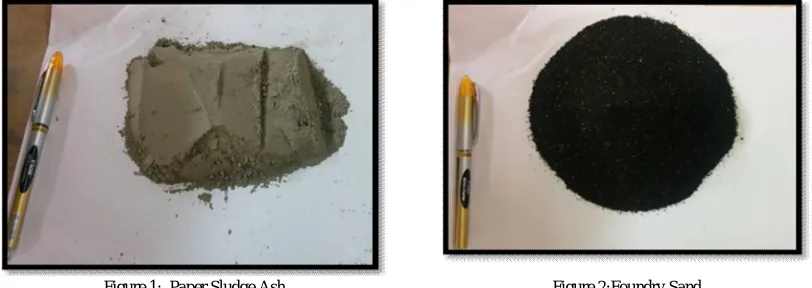
Paper Sludge Ash which is ash grey in colour is collected from Mangalore Paper Mills, Talapady.
Table 3: Physical Properties of Paper Sludge Ash
Sl.no. Characteristics Obtained values
1. Appearance Powder
2. Fineness (90 micron sieve) 9.0 %
3.5. Foundry Sand:
Foundry sand which is obtained from Lamina Foundry Ltd. Nitte is black in colour and from the physical test results it was found specific gravity is 2.36, water absorption 15.789% and grain fineness index 56.55.
Figure 1: Paper Sludge Ash Figure 2:Foundry Sand
Table 4: Mix proportion
Grade Cement
(kg/m3)
Fine aggregate (kg/m3)
Coarse aggregate (kg/m3)
Water (litre/m3)
M25 1 1.95 3.16 0.42
Table 5: Types of Mix Variation and their designation
Type of Mix Description
CC Conventional Concrete
FS1 Fine Aggregate is Replaced by 20% FS
FS2 Fine Aggregate is Replaced by 40% FS
FS3 Fine Aggregate is Replaced by 60% FS
PSA1 Cement is Replaced by 5% PSA
PSA2 Cement is Replaced by 10% PSA
IV.EXPERIMENTAL RESULTS
4.1. General:
Properties of concrete incorporating Paper sludge ash and foundry sand at various replacements of cement and fine aggregate were studied and results are compared with conventional mix.
4.2. Split Tensile Strength:
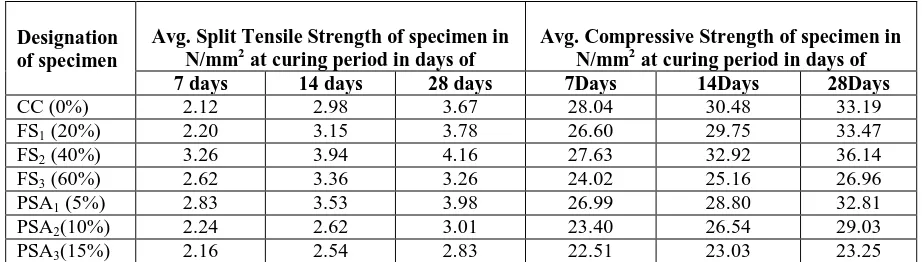
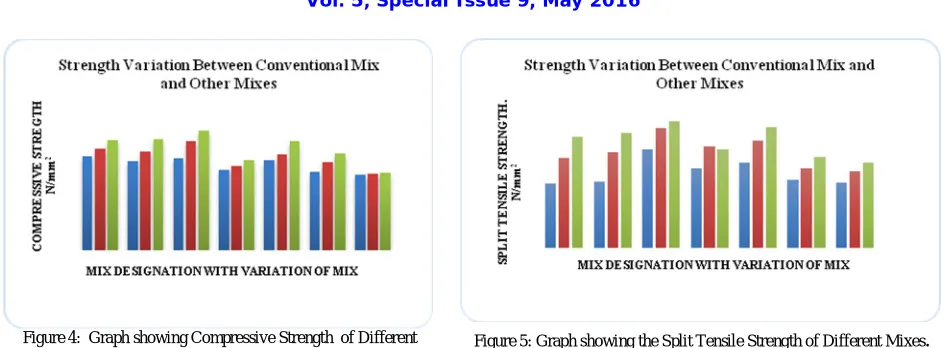
The split tensile test is an indirect method to determine the tensile strength of concrete. The tests were carried for different replacement level of cement by Paper Sludge Ash(5%, 10% and 15%) and fine aggregate by foundry sand (20%, 40% and 60%) for different curing periods i.e., 7 ,14 and 28 days. The strength of 14 mixes for 7, 14 and 28 days is shown in table 12 and these results were graphically represented in figure 5.
Figure 3: Split Tensile Test
4.3. Compressive Strength:
The strength developed is assessed by maturity testing, an effective way of assessing the strength of concrete at specified period in days. In the present work strength of concrete were evaluated for different replacement level of cement by Paper Sludge Ash(5%, 10% and 15%) and fine aggregate by foundry sand (20%, 40% and 60%) for different curing periods i.e. 7, 14 and 28 days. The strength of these mixes for 7,14and 28 days is shown in table 12 and these results were graphically represented in fig 4.
Table 6:- Results of Split Tensile and Compressive Strength of Different Mixes
Designation of specimen
Avg. Split Tensile Strength of specimen in
N/mm2 at curing period in days of
Avg. Compressive Strength of specimen in
N/mm2 at curing period in days of
7 days 14 days 28 days 7Days 14Days 28Days
CC (0%) 2.12 2.98 3.67 28.04 30.48 33.19
FS1 (20%) 2.20 3.15 3.78 26.60 29.75 33.47
FS2 (40%) 3.26 3.94 4.16 27.63 32.92 36.14
FS3 (60%) 2.62 3.36 3.26 24.02 25.16 26.96
PSA1 (5%) 2.83 3.53 3.98 26.99 28.80 32.81
PSA2(10%) 2.24 2.62 3.01 23.40 26.54 29.03
Figure 4: Graph showing Compressive Strength of Different
Mixes Figure 5: Graph showing the Split Tensile Strength of Different Mixes.
V. CONCLUSION
As per the results obtained based on the characteristics of materials say, Workability of Concrete, Compressive Strength Test, Split Tensile Strength Test and Flexural Strength Test on M25 grade of concrete, made of different mixes with 20%, 40% and 60% replacement level of Waste Foundry Sand and 5%.10% and 15% replacement levels of Paper Sludge Ash, considered for the study the following conclusions are been listed;
Based on the compressive strength of specimen with different replacement level these conclusions were found
i. For the grade of concrete considered for the study, FS2 i.e. the ratio of 60:40 of Conventional Sand, Foundry Sand has
proved to be having optimum ratio which gives maximum Compressive strength of all ratios.
ii. Similarly for the same grade of concrete PSA1 the ratio of 95:5 of cement, Paper Sludge Ash has proved to have an
optimum ratio which gives maximum compressive strength.
iii. Specimen of Conventional Concrete bearing the designation CC resulted in highest compressive strength at 7days, 14days and 28days of curing period, of all the mixes considered for the study.
iv. At the higher replacement levels i.e. at 60% foundry sand replacement, 28 days strength is 8.16% greater than that of CC concrete mix.
v. From the compressive strength of specimen with 60% replacement by Foundry Sand and 15% Paper Sludge Ash sample, FS3 and PSA3 showed least strength for all the curing period considered for the study.
From the discussions of test results on Split Tensile Strength it is concluded that,
i. For the grade of concrete M25 considered for the study, Mix with 40% replacement of foundry sand and 5% replacement of Paper Sludge Ash is the optimum level at which Split Tensile Strength is Maximum.
ii. Mix with 60% replacement of foundry sand and 15% replacement of Paper Sludge Ash gives the least Split Tensile Strength compared to other mix
ACKNOWLEDGMENT
REFERENCES
[1] Mamta B. Rajgor and Jayeshkumar Pitroda, “A Study on Paper IndustryWaste: Opportunity for Development of Low Cost Concrete in IndianContest”, pp. 90-92, 2013.
[2] Tarun R. Naik, Viral M. Patel, Dhaval M. Patel and Mathew P. Tharaniyil,“ Utilization of Used Foundry Sand in Concrete”, Journal of Material in Civil Engineering ,pp 254-263,1994.
[3] Rafat Siddique, Geert De. Schutter and Albert Noumowe, “Effect of UsedFoundry Sand on the Mechanical Properties of Concrete”, Construction of Building Materials, pp. 976-980,2008.
[4] Valeria Corinaldesi,Gabriele Fava ,Maria LetiziaRuello,“Paper Mill Ash as Supplementary Cementitious Material”,vol.23,pp 772-776,2011. [5] Sajad Ahmad,M.IqbalMalik,Muzaffar Bashir Wani,RafiqAhmed,”Study Of Concrete Involving Use Of Waste Paper Sludge Ash as Partial
Replacement Of Cement”, Indian Organization of Scientific Research,,vol.3,pp 06-15,2013
[6] Sumit A Balwaik, S P Raut“ Utilization of Waste PaperPulp by Partial Replacement of Cement in Concrete”International Journal of Engineering Research and Applications, (IJERA) ISSN: 2248-9622, YCCE, Nagpur-10, Maharashtra, India ,2015