VIVIPARY I N MAIZE1
WILLIAM H. EYSTER
Bucknell University, Lew’sburg, Pennsylvania
Received January 6, 1931
TABLE OF CONTENTS
INTRODUCTION. .... ... 574
Origin and descriptio vivipary in maize. ... 575
Inheritance of vivipary in maize.. ... 578
Spurious ratios of normal versus viviparous kernels. . . ... 579
Summary of the genes involved in this study.. . . ... 580
Summary method of presenta . . . 581
581 Linkage relations of viviparyz ... 583
Linkage relations of vivipary3 ... 586
Linkage relations of vivipary, ... 587
The occurrence and nature of ... 587
SUMMARY. ... ... 589
LITERATURE CITED.. ... 590 PAGE
Linkage relations of vivipary,. ...
INTRODUCTION
The continuous development of a plant body from its unicellular in- ception to maturity, without the intervention of a period of dormancy, is called vivipary. I n viviparous plants, the embryos develop into seedlings even while the seeds are still contained in the fruits of the parent sporo- phyte. Similarly, spores may develop into gametophytes without under- going a period of dormancy.
Viviparous maize plants were described in an earlier publication (EYSTER 1924a) under the name “primitive sporophyte.” This name was suggested by the fact that the sporophytes of all non-seed-bearing plants, which presumably are more primitive than seed-bearing plants, are nor- mally viviparous. Since “primitive sporophyte” as well as such terms as “defective kernel” and “premature germination,” which have been used in referring to maize sporophytes that apparently do not undergo a dor- mant period, are ambiguous and misleading, it seems best to use the bo- tanically correct term in describing this phenomenon, namely, vivipary.
Viviparous maize plants first occurred in pedigreed cultures grown a t the UNIVERSITY OF MISSOURI Agricultural Experiment Station, and with few
1 Contributions from the Botanical Laboratory of B U C ~ ~ N E L L UNIVERSITY. Paper number 1. The contributionswhich are to issue from the newly established Botanical Laboratoryof BUCKNELL UNIVERSITY are made possible by the generosity of BUCKNELL UNIVERSITY in providing time and facilities for investigational work, and are dedicated to DOCTOR NELSON F. DAVIS whose unselfish interest and cooperation serve as a constant inspiration.
VIVIPARY I N MAIZE 575
exceptions lacked completely the chloroplastid pigments. The close as-
sociation between vivipary and albino seedlings was regarded by EYSTER (1924a) as being due to separate but closely linked genes, while MANGELS-
DORF (1926) prefers to believe that physiological correlation is a more
plausible explanation of the absence of chloroplastid pigments in the vivip- arous plants. That linkage and not physiological correlation is respon- sible for the close relationship between vivipary and albinism was demon- strated by self-fertilizing a large number of plants heterozygous for vivip- ary and albinism. Among the many albinotic viviparous seedlings oc- curred a few green viviparous seedlings which have been regarded as cross- overs. When these green seedlings were removed to the soil, they grew to maturity and gave rise to a chlorophyll-bearing strain of viviparous maize. In another paper by EYSTER (192413) it was shown that a t least two genes induce vivipary in maize.
While the first of the above-mentioned papers was in press, descriptions of what appear to be vivipary in maize were published by LINDSTROM (1923) in a paper concerned with “Endosperm defects” and by MANGELS-
DORF (1923) as “Germinating seeds.” According to MANGELSDORF, “ger-
minating seeds” are characterized by the failure of the embryo to go into the resting stage. Since germination implies dormancy, it is obvious that “germinating seeds” does not correctly apply to the character described. Later MANGELSDORF (1926) adopted the term “premature germina- tion” and differentiated genetically different types largely on the basis of the stage of endosperm development a t which germination begins. Just how it was determined when dormancy began and ended in each case, and that dormancy was not completely inhibited by the gene which is as- sumed to produce premature germination is not stated.
More recently MANGELSDORF (1930) has presented a more extensive study of “premature germination.” To explain the numerical results ob- served in various stocks, fifteen genes have been called into service. The descriptions of the different types of “premature germination” are based entirely upon time of germination and the degree of development of the chloroplastid pigments. To what extent these differences may have been caused by other genes and by environmental factors does not seem to have been determined.
ORIGIN AND DESCRIPTION O F VIVIPARY I N MAIZE
Vivipary has occured in a number of different and unrelated strains of maize. No attempts have been made to determine the nature of the origin of vivipary in any of the strains.
576 WILLIAM H. EYSTER
So far as observations have been made, viviparous maize plants have a continuous development from the fertilized egg to the mature plant so that dormancy and germination are not involved. The development of the
FICCRI: 1.-.\n ear of maize homozygous for viviparyl showing the viviparous embryos in various stnges of development.
VMPARY IN MAIZE 577
plastid pigments develop normally are transferred to soil, they develop into mature plants. A maturing ear of a homozygous viviparous plant is shown in figure 1. Although the embryos of all kernels are homozygous for vivipary, they are in different stages of development. Some of the em-
!
c
.J
"-c
FIGURE 2.-Mature plants which are homozygous for viviparyl.
bryos are hurrying into the seedling stage, while others are still so small that the kernels appear to contain non-viviparous embryos. It would be impossible to characterize vivipary in maize on the basis of a definite re- lationship between a stage in endosperm development and the appearance
5 78 WILLIAM H. EYSTER
of the plumule and radicle of the developing seedling as has been done by
MANGELSDORF in differentiating the different types of “premature ger- mination.”
Viviparous maize plants have been growing continuously through con- secutive generations, without a period of dormancy in the seed stage, for three years. The fourth continuous generation of viviparous maize1 is shown in figure 2. These viviparous plants apparently grew as vigorously as non-viviparous plants belonging to the same strain.
INHERITANCE OF VIVIPARY I N MAIZE
Vivipary in maize is inherited as a simple Mendelian recessive char- acter, and is brought into expression by a number of different genetic factors. The genes for vivipary which have been studied are indicated by the symbols Vpl, V p 2 , V p s , and V p Q . The effect of each of these genes is to inhibit dormancy and cause the sporophyte to undergo continuous de- velopment from the fertilized egg to the mature sporophyte, as is char- acteristic of the sporophytes of non-seed-bearing plants. The time of the appearance of the plumule and radicle outside of the pericarp varies with changes in the genetic constitution of the individual. Vivipary, has been studied in pure cultures and in various hybrid combinations, and it has been found that in some stocks the seedlings are quite large a t the time of maturity of the ear, while in others they are so small that they often do not even burst through the pericarp at the time of kernel maturity.
In F2 progenies segregating viviparyl, 24026 kernels were classed as having normal and 8336 as having viviparous embryos. These results show
a deviation of 220
k
53 kernels from the expected frequencies. Backcross progenies involving vivipary, yielded 1709 kernels with normal and 1726 kernels with viviparous embryos. The deviation between the observed and expected frequencies in these backcrosses is 8.5 f 51 kernels.Viviparyz
Fz progenies segregated 2625 kernels with normal and 959 kernels with viviparous kernels. This is a deviation of 63 f 17.5 kernels from the ex- pected frequencies. Intercrosses between viviparyl and viviparyz yielded normal plants, which, when self-fertilized, produced normal and vivip- arous kernels in the relation of 9 : 7. These results indicate that viviparyl and viviparyz are caused by genes having their loci in different chromo- somes.
Vivipary 3
VIVIPARY IN MAIZE 579
viviparous embryos. This is a deviation of 25 _+ 8.91 kernels from the ex- pec ted frequencies.
Viviparyl
Up to the present time a single Fz progeny involving viviparyr has been studied. This progeny included 214 kernels with normal and 109 kernels with viviparous embryos. These results represent a deviation of 28
k
6.85 kernels from the frequencies that were to be expected.The identity of the different genes for vivipary has been determined by their linkage relations as is shown in a later section of this paper.
SPURIOUS RATIOS OF NORMAL VERSUS VIVIPAROUS KERNELS
The wide variation in the stage of development of the viviparous em- bryos at the time of the maturity of the ear as indicated by the hardened endosperm is due in part to inherent genetic factors and in part to ex- ternal environmental factors, especially moisture. By harvesting homozy- gous viviparous ears prematurely and drying them by blowing air over them by means of an electric fan, it has been possible to induce some or all of the embryos of such ears to become dormant. So, also, when the maturing ears of normal strains of maize are exposed to abnormally moist condi- tions, there is a tendency for the embryos to continue their development. Whether the embryos actually undergo a period of dormancy under these conditions is an open question.
There appears to be a greater tendency for the kernels which are heter- ozygous for vivipary than for the homozygous normal kernels to germinate on ears which are maintained under moist conditions. Accordingly, when ears which are heterozygous for vivipary are exposed to moist conditions, there may be an excess of viviparous kernels due to the germination of some of the heterozygous kernels which, under drier conditions, would have remained dormant.
In the study of the effect of premature drying on viviparous embryos, R-testers homozygous for shrunken endosperm and viviparyl were used. The self-fertilized ears
af
these plants were harvested and dried while the kernels were still immature. Accidental contaminations by pollen from other plants in the field could be recognized by (1) non-shrunken endo- sperm, and (2) colored aleurone.The self-fertilized ears of plants which are homozygous for vivipary, and the R-aleurone color factor and homozygous for the other genes necessary for the development of colored aleurone bear, with rare exceptions, nor- mal kernels with colored aleurone and viviparous kernels with colorless aleurone. The recombinations of these characters, due to crossing over,
580 WILLIAM H. EYSTER
occurred with a frequency of less than two per thousand kernels. I n the study of the effects of premature drying and of increased moisture, re- spectively, the colored kernels from the self-fertilized ears could be re- garded as homozygous non-viviparous and heterozygous viviparous, while the colorless kernels were, with rare exceptions, homozygous for vivipary. Induced dormancy of viviparous kernels under dry conditions and ger- mination of normal kernels under moist conditions give rise to all sorts of numerical ratios between normal and viviparous kernels, even when vivip- aryl alone is concerned. The spurious ratios thus obtained varied from
328 non-viviparous : 1 viviparous to 1 non-viviparous: 2.3 viviparous ker- nels. These results emphasize the importance of exercising extreme cau- tion in the liberal and wholesale assumption of multiple factors, with and without linkage, in explaining observed numerical relationships.
The viviparous kernels, which have been forced into dormancy by arti- ficial drying, germinate when they are exposed to suitable growth con- ditions. A number of viviparous plants which had undergone a period of induced dormancy were grown to maturity and, when self-fertilized, pro- duced viviparous kernels exclusively, thus showing that they actually were homozygous for viviparyl.
I n like manner, germinating kernels with colored aleurone in which vivip- ary was induced by maintaining the maturing ear under moist conditions were transferred to soil and the plants grown to maturity. The self-fer- tilized ears of these plants produced kernels with dormant and viviparous embryos in the relation of 3 : 1, thus indicating that vivipary had been in- duced in heterozygous plants.
SUMMARY O F GENES USED I N THIS STUDY
The genes referred to in this study belong to linkage groups as indicated below.
Group
I
I1
I11
V VI11
Gene Character
t
Sh
VP4
Colorless aleurone Shrunken endosperm Viviparous embryo
.
Golden plant gr Colorless aleurone
Viviparous embryo
VMPARY IN MAIZE 581
SUMMARY METHOD OF PRESENTATION OF THE DATA
The data are presented in summary form only, and are grouped into tables, where possible, to save space. The detailed data are on file in the laboratory of the writer and will be furnished upon request.
LINKAGE RELATIONS OF VIVIPARY 1
The gene for viviparyl is very closely linked with the
R
aleurone color gene as shown by the data in table 1 and the illustration in figure 3.FIGURE 3.-A self-fertilized ear of a plant which was heterozygous for viviparyl and colored aleurone. Note that the colored kernels have dormant and the colorless kernels viviparous em-
bryos due to the very dose linkage between the R-aleurone color factor and the V,I factor for
vivipary.
Viviparyl and colored aleurone
Plants heterozygous for
V,,
andR
and homozygous for all other geneswhich
are necessary for the development of colored aleurone were back-582 WILLIAM H. EYSTEB
crossed reciprocally with homozygous viviparous R-testers. The results of
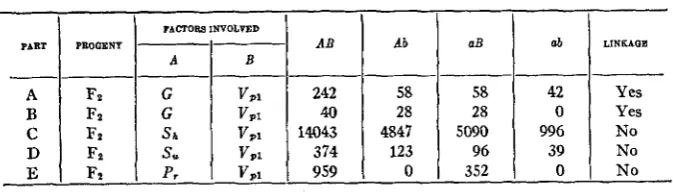
these backcrosses are given in table 1 A. Only 5 kernels among the 3435
which resulted from the backcrosses had the segregating characters in re- combinations. These results indicate a linkage with 0.15 percent crossing over.
A B
c
D
TABLE 1
Tests involving vivijaryl and aleurone color factors.
COLORED ALEURONE COLORLESS ALEURONE PART
1
N A T m OF TEE TESTSBackcross involving R a n d VP1 1707 3 2 1723
Ft progenies involving R and VP1 6070 23 19 2092 Flprogenies involving R, C, and VP1 5783 27 1871 2670 FZ progenies involving R , C, A , and Vpl 5326 39 4957 3485
FACTON INVOLVED
PART PROGENY
-~
AB AbA B
---___-___--
A Fz G V P 1 242 58
B Fz G VPl 40 28
D Fz S, VPl 374 123
E F.t p , V P l 959 0
C Fz s b Vpi 14043 4847
The close linkage shown by the backcross data is substantiated by
F 1
data involving (1) R and V p l as given in table lB, (2) R , C, and V p l as given in table lC, and (3) R, C, A , and V,, as given in table 1D.Vivipary, and golden plant
According to
LINDSTROM
(1917,1918), there is approximately 23 percent crossing over between R and G. As Vpl is very closely linked with R, it should show approximately the same linkage with G as R does.As yet only limited data on the relationship between V p l and G are available and are given in table 2A and B. The data in table 2A represent an Fz progeny in the coupling series, while the data in table 2B represent a
aB ab LlNKAQB
58 42 Yes
28 0 Yes
5090 996 N O
96 39 No
352 0 No
VrVIPARY I N MAIZE 58 7
FACTORS I N V O L ~ D
A B
PART PROQENY ~ _ _ _
-______-
A Fz v p z p , B Fa V P a P, C Fa V p a Ret D F2 V p a SCi E Fa V p a Rea
G Fa V P S Ya
F F% Vpa
Viviparyl and shrunken endosperm
The results of Fz progenies which segregated vivipary, and shrunken endosperm are given in table 2C. There is a marked tendency for homo- zygous viviparous embryos to become dormant in the seed stage when the endosperm is homozygous shrunken, and this may be caused by a more rapid withdrawal of water from the embryo as the kernel approaches ma- turity. By allowing for the tendency of shrunken endosperm to inhibit vivipary, we find the data indicate that vivipary, and shrunken endosperm are inherited independently.
Vivipary 1 and sugary endosperm
Viviparyl is inherited independently of sugary endosperm as indicated by the Fz data given in table 2D.
Vivipary, and purple aleurone
Fz data on the relationship between
V p l
and P, are given in table 2E. Since all of the kernels which had viviparous embryos had colorless aleu- rone due to the very close linkage between V P l and R, they could not be classified with respect to theP,
gene. The relation ofP, to
p ,
among the kernels which have non-viviparous embryos and colored aleurone indicates that P, and V p l are inherited independently.LINKAGE RELATIONS OF VIVIPARY2
Viviparyz, so far as can be determined by ordinary observation, is phenotypically indistinguishable from viviparyl and is the expression of a gene in chromosome VIII.
Viviparyz and purple aleurone
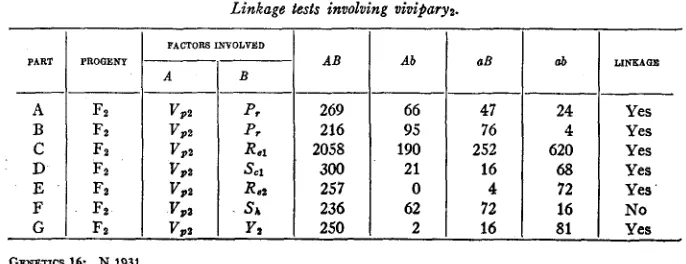
The results from Fz progenies which segregated viviparous embryos and red aleurone color are given in table 3A and B. A represents V P z and
P,
inTABLE 3
AB Ab aB ab
269 66 41 24
216 95 76 4
2058 190 2.52 620
300 21 16 68
2.57 0 4 72
236 62 72 16
250 2 16 81
584 WILLIAM H. EYSTER
coupling series and B in repulsion series. These results indicate. a linkage between V p 2 and
P,
with approximately 30 percent crossing over.V i v i p a r y z and reduced endosperm
Reduced endosperm1 and reduced endospermz are genetic variations in kernels of maize in which the amount of endosperm which is formed is greatly reduced, and are the expressions of genes which have their loci in chromosome VI11 as shown by EYSTER (in press).
The results of F z progenies segregating vivipary, and reduced endo- sperml are given in table 3C, and indicate a linkage between these char- acters with approximately 15.5 percent crossing over.
V i v i p a r y z and reduced endospermz
F z progenies involving vivipary, and reduced endospermz are given in table 3E. These data indicate a linkage between V p z and Re2 with 1.2 per- cent crossing over.
V i v i p a r y , and scarred endosperml
This pair of characters was found to be linked with 9.6 percent crossing over as shown by the F z data given in table 3D. This linkage is in agree- ment with the genetic correlation between SC1 and
P,
previously reported by EYSTER (1926).V i v i p a r y , and shrunken endosperm
A single F z progeny which segregated viviparyz and shrunken endo- sperm indicates that the genes for these two characters segregate inde- pendently. The observed frequencies of this progeny are given in table 3F.
Viviparyz and yellow endospermz
One of the progenies which segregated normal and viviparous kernels also segregated yellow and white endosperm. A striking feature of this progeny was that practically all of the yellow kernels were non-viviparous while almost all of the kernels with white endosperm were viviparous, thus suggesting a linkage between the factors for vivipary and white endo- sperm. The F z data on this relationship, as given in table 3G, indicate a linkage between V p z and Y z with approximately 5.3 percent crossing over.
V i v i p a r y , and colored aleurone
VIVIPARY IN MAIZE 585
RandC *
A , R, and C A, R, and C A,R,andC
TABLE 4
Fa progenies involving colored aleurone and various chromosome V I I I characters.
VPZ VPZ sc1 yz PART - A B C D FACTOBS INVOLVED
A B
SO1 P,
R e l S h
R a2 s h Re1 y2
FACTORB INVOLVED
Colored Aleurone
1
Chromo: VI11Character A A B 105 939 198 243 I Ab
--
46 294 63 15 aB 43 346 55 22 A B 318 164 151 188 2 66 17 68 A b 226 157 45 59Y e s
No No Yes aB 97 32 165 171 ab 85 52 44 47
Scarred endosperm1 and colored aleurone
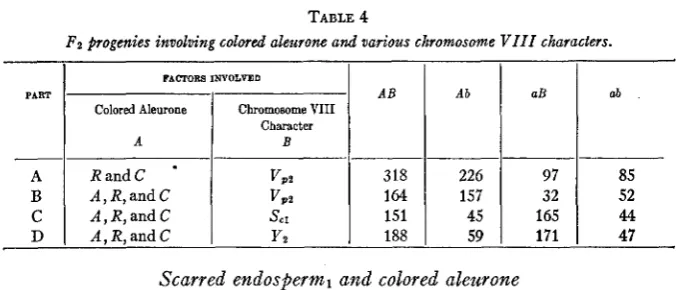
One of the pedigrees which segregated for scarred endosperml also seg- regated kernels with colored and colorless aleurone in the ratio of 27 : 37,
thus showing that all three factors for aleurone were involved. The data, which are given in table 4C, indicate that Scl segregates independently of the aleurone color factors.
Yellow endosperm2 and colored aleurone
One of the progenies which segregated yellow endosperm2 also segre- gated. colored and colorless aleurone in the ratio 27 : 37, thus showing that the A , C, and R aleurone color genes had been involved. The observed frequencies, given in table 4D, indicate that yellow endosperm2 is inherited independently of aleurone color.
Scarred endosperm and purple aleurone
The data given in table SA, representing an F2 progeny which segre- gated scarred endosperml and purple aleurone, indicate a linkage between Scl and
P,
with approximately 20.7 percent crossing over.Reduced e n d o s p e r m and shrunken endosperm
The F2 data on this relationship are given in table SB, and indicate
that R,1 and
S A
segregate independently. It is difficult to distinguish be- tween non-shrunken and shrunken endosperm when the kernels are homo-TABLE 5
Miscellaneous linkage tests involving chromosome V I I I characters.
PART A B C D GENEIICS 16: LINKAQQ
586 WILLIAM H. EYSTER
zygous for reduced endosperml. This difficulty is responsible for the wide deviation between the observed and expected frequencies of reduced ker- nels with non-shrunken and shrunken endosperm as given in table
5B.
Reduced endospermz and shrunken endosperm
FZ data showing that these two characters are inherited independently are given in table 5C.
Reduced endosperm and yellow endosperm
Since both of these characters are linked with vivipary,, it was to be ex- pected that they would show a linkage with each other. Fz data on this relationship are given in table SD, and indicate a linkage between Re* and Yz with about 11.3 percent crossing over.
The yellow endosperm referred to above is phenotypically and geno- typically different from the pale yellow endosperm which has been shown by EYSTER (1924a) to be linked with vivipary. It is obviously different also from the yellow endosperm described by CORRENS (1901) and more recently by others, as the latter has its locus in chromosome V as indicated by its linkage relations with
Pi
and other genes known to be located in this chromosome. The yellow endosperm described in this paper for the first time has been named yellow endospermz and the gene conditioning its development is designated by the symbol Yz.Vivipary, and vivipary,
The F1 kernels between viviparyl and viviparyz contain embryos which become dormant in the seed stage. Fz progenies yielded a total of 1492 kernels with dormant and 1034 kernels with viviparous embryos. These frequencies represent a deviation of 71 5 16.8 kernels from the 9:7 ratio which was expected. These results indicate that viviparyl and vivipary, are genetically different though phenotypically alike, and that they are inherited independently.
,
LINKAGE RELATIONS OF VIVIPARY3
Viviparous strains of maize, which are not phenotypically different from those which have already been described in which vivipary is linked with sugary endosperm, have been found recently in my cultures. The ob- served frequencies are as follows: 1107 kernels with starchy endosperm and dormant embryo, 175 kernels with starchy endosperm and viviparous embryo, 164 kernels with sugary endosperm and dormant embryo, and 274 kernels with sugary endosperm and viviparous embryo. These re- sults are in close agreement with calculated frequencies on the basis of
VIVIPARY IN MAIZE 587
MANGELSDORF (1926) states that Gel, one of his genes for premature germination, appears to be linked with sugary endosperm with about 40 percent crossing over. This linkage is, however, only inferred by him. It is possible that V p s and the Gel represent the same gene.
LINKAGE RELATIONS OF VIVIPARYi
Vivipary, is the expression of a gene which has its locus in chromosome I a t approximately 11.8 crossover units from the gene for shrunken en- dosperm. Unfortunately only a single Fz progeny concerned with the re- lationship between vivipary., and shrunken endosperm are available a t the present time. More extensive observations have been made but the data are not available. In the Fz progeny there were 200 kernels with non- shrunken endosperm and dormant embryo, 22 kernels with non-shrunken endosperm and viviparous embryo, 14 kernels with shrunken endosperm and dormant embryo, and 87 kernels with shrunken endosperm and vivip- arous embryo. These results are in close agreement with calculated fre- quencies on the basis of linkage between Vtp4 and Sh with 11.8 percent
crossing over.
THE OCCURRENCE AND NATURE OF VIVIPARY I N THE PLANT KINGDOM
The almost universal occurrence of vivipary among the most simple plants leads to the general conclusion that vivipary is a fundamental and primitive characteristic of plants, and that dormancy has been acquired as a result of genetic changes in the course of phylogenetic development. Plants which changed genetically in such ways that vivipary became in- hibited by unfavorable growth conditions were able to survive periods which are unfavorable to vegetative growth. As a result of the genetic changes which made possible this adaptive response, plants have been able to invade and occupy terrestial habitats where the conditions are not always optimum, or even favorable, for growth.
The occurrence of vivipary in maize as an inherited character is direct evidence that vivipary and dormancy are controlled by genetic as well as environmental factors. The identification of four different genes for vivip- ary in maize in this preliminary study is evidence that dormancy has been induced by a large number of genes in the course of phylogenetic de- velopment.
Dormancy occurs in all of the great divisions of the plant kingdom, due, no doubt, to the interaction of genetic and environmental factors. It has been acquired in spores which develop into gametophytes, and in various sporophytic structures as (1) the zygote or fertilized egg in many algae and
588 WILLIAM H. EYSTER
fungi, (2) the embryo sporophyte as in most spermatophytes, and (3) modi- fied stems as tubers of Solanum tuberosum and buds of trees and shrubs.
Vivipary is generally characteristic of both gametophyte and sporo- phyte of the liverworts. In Pellia and Fegatella, the spores even germinate within the sporangia.
In mosses the spores develop directly into gametophytes and fertilized eggs into sporophytes without the intervention of a period of dormancy. The spores of Dicnemon and Eucalptodon, two related genera of mosses, grow into multicellular plant structures while they are still within the sporangia. These structures are easily visible to the unaided eye, and are flat on one surface and three-pointed on the other. Similar multicellular bodies have been observed in Cleistostoma ambigua, Cryphaea macrospora,
and Cryphaea grecillinia.
Germination of the spores within the sporangia of liverworts and mosses makes possible a shortening of the protonemal development outside the capsule. This is an important characteristic in epiphytic species since a multicellular body will lose water less rapidly than a filamentous proto- nema. It is probable that the germination of the spores while they are with- in the sporangium is caused by genetic factors, and has been retained as a permanent character in species which are aided thereby in the reproduc- tion of new individuals.
In some species of pteridophytes the spores pass through a dormant period before developing into gametophytes, in others they germinate as soon as they are exposed to favorable conditions outside of the sporan- gium, while in still others the spores germinate within the sporangia. The development of the gametophytes within the sporangia is especially char- acteristic of the species which grow in moist situations. The sporophytes of the pteridophytes are normally viviparous, as the fertilized egg grows directly into a mature sporophyte without the intervention of a period of dormancy.
VIVIPARY IN MAIZE 589
Widely scattered among both monocotyledonous and dicotyledonous angiosperms occur plants which bear sporophytes which forego the period of dormancy in the embryonic stage of development. Only a few of the more outstanding examples can be mentioned here. According to GOEBEL (1923) this type of vivipary is characteristic of the genera Rhizophora, Bruigera, and Ceriops. The embryos of the species of Rhizophora are ex- traordinary because of the extreme development of the stock-like hypo- cotyl which in many plants is a half meter long. After the embryo is well developed, it drops off the parent plant and rapidly gains a foothold in the muddy ground. In other genera, as Avicenna, the embryos grow into seed- lings within the maturing ovary and have stiff upwardly-bent hairs which serve to attach the seedlings to the soil.
Among the monocotyledonous angiosperms may be mentioned the aroid, Cryptocoryne. The ovules of this aroid have two integuments and the outer, after fertilization, grows into a body composed of loosely ar- ranged parenchyma cells in which the continued development of the em- bryo takes place. The embryo finally falls from the parent plant enclosed by the thin outer integument and is prepared to make a rapid growth into the soil (GOEBEL 1897).
The occurrence of vivipary in maize as genetic variations indicates that this phenomenon is not limited to plants which normally grow in wet places, though viviparous plants have survival value only in habitats where the conditions for continued growth prevail.
SUMMARY
1. Vivipary, the continuous development of the sporophyte in maize, is determined by genetic factors and is strongly influenced in its expression by environmental factors.
2. Four genes for vivipary have been identified by their linkage rela- tions. Data are presented which indicate that the locus of Vpl is in chro- mosome 11, that of V p 2 is in chromosome VIII, that of V p 3 is in chromo- some 111, and that of V p 4 is in chromosome I.
3. By varying the environmental conditions of the maturing ears of plants which are homozygous and heterozygous for a single factor pair for vivipary, normal and viviparous phenotypes have been produced in practically all possible numerical relationships. These results warn against the liberal assumption of multiple factors,’with and without linkage, to account for unusual numerical ratios.
4. Data are given which indicate the approximate locus of each of the genes for vivipary, and show that the genes for reduced endosperml, re-
590 WILLIAM H. EYSTER
duced endospermz, scarred endosperml, and yellow endospermz have their loci in chromosome VIII.
5 . Vivipary is regarded as a primitive plant character which, by the in-
teraction of genetic factors and unfavorable growth conditions, may be inhibited. This temporary inhibition of growth is called dormancy. The ability to pass through a period of dormancy has enabled plants to utilize habitats where unfavorable growth conditions alternate with favorable conditions and has been important undoubtedly in the successful invasion of plants from aquatic into terrestial habitats.
6. Vivipary occurs in all of the great divisions of the plant kingdom, but naturally persists only among plants which live in moist habitats. Viviparous plants are not adapted for passing through unfavorable growth periods and do not persist, therefore, among plants that are exposed to such conditions, as, for example, maize.
LITERATURE CITED
CORRENS, C., 1901 Bastarde zwischen Maisrassen mit besonderer Beriichsichtigung der Xenien. EYSTER, WILLIAM H., 1924a A primitive sporophyte in maize. Amer. J. Bot. 11: 7-14.
Bibl. bot. 53: 1-161.
1924b A second factor for primitive sporophyte in maize. Amer. Nat. 58: 436-439. 1926 Chromosome VI11 in maize. Science 64: 22.
(In press) Heritable characters of maizCReduced endosperm. J. Hered.
1923 Organographie der Pflanzen. Zweite Auflage, Teil 111. Verlag v. Gustav. Fischer. 1218-
L~NDSTROY, E. W., 1917 Linkage in maize: aleurone and chlorophyll factors. Amer. Nat. 51:
GOEBEL, K., 1897 Cryptocoryne, eine lebendig gebarende Aroidee. Flora 83: 426. 1220.
225-237.
1918 Chlorophyll inheritance in maize. Cornel1 Agric. Expt. Sta. Mem. 13: 7-88.
1923 Heritable characters of maize: Endosperm defects-Sweet defective and flint defective.
MANGELSDORF, P. C., 1923 The inheritance of defective seeds in maize. J. of Hered. 14: 119-125. 1926 The genetics and morphology of some endosperm characters in maize. Connecticut
1930 The inheritance of dormancy and premature germination in maize. Genetics 16:
J. Hered. 14: 126-135.