ISSN(Online): 2320-9801
ISSN (Print): 2320-9798
I
nternational
J
ournal of
I
nnovative
R
esearch in
C
omputer
and
C
ommunication
E
ngineering
(An ISO 3297: 2007 Certified Organization) Vol. 3, Issue 4, April 2015
Implementation of Logo Matching &
Recognition System Based on Context
Dependency for Image & Video
Ku. Prachi Jivan Dikey, Prof. N. N. Mandaogade
PG Student, Dept. of EXTC, GHRCEM, Amravati, Maharashtra, India
HOD, Dept. of EXTC, GHRCEM, Amravati, Maharashtra, India
ABSTRACT: In this paper we present a implementation of logo retrieval in images and videos. The wide range
application of visual data from Companies, Institution, Individuals and Social system like Flickr, YouTube is for diffusion and sharing of images and Video. There are several issues in processing of visual data from an image which was corrupted by noise or subjected to any transformation and also its accuracy in matching Logos are some of the emerging research issues currently. To overcome this problem we have proposed a new class of similarities based on Context Dependent algorithm which enhances the performance in terms of accuracy in logo matching and computation time. Through this paper, the design of Logo matching and recognition which is important for brand advertising and surveillance applications is proposed.
KEYWORDS: Logo Matching, Logo recognition, Content dependant similarities, Logo images.
I. INTRODUCTION
Logos we see hundreds of them every day. We see them so much that we often don’t even think about them. But years of work and millions of dollars go into even the simplest logos, and sometimes the layers of hidden
meanings can be hard to believe. Logo retrieval from images is a challenging problem with potentially wide
commercial applications. Most of such applications require real-time indexing and retrieval of logo images with high accuracy. Graphic logos are a special class of visual objects extremely important to assess the identity of something or someone. In industry and commerce, they have the essential role to recall in the customer the expectations associated with a particular product or service.
ISSN(Online): 2320-9801
ISSN (Print): 2320-9798
I
nternational
J
ournal of
I
nnovative
R
esearch in
C
omputer
and
C
ommunication
E
ngineering
(An ISO 3297: 2007 Certified Organization) Vol. 3, Issue 4, April 2015
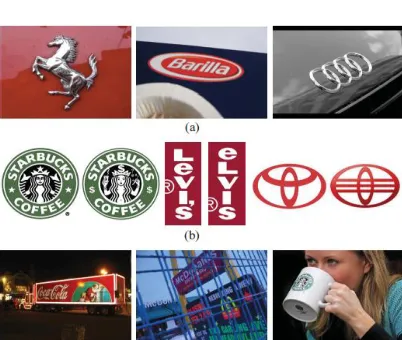
Figure 1 (a) Examples of popular logos depicting real world objects, text, graphic signs, and complex layouts with graphic details. (b) Pairs of logos with malicious small changes in details. (c) Examples of logos displayed in real world images in bad light conditions, with
partial occlusions and deformations.
II. RELATED WORK
Until now work on logo detection and recognition was concerned with providing some automatic support to the logo registration process. The system check whether other registered logos in archives of millions, exist that have similar appearance to the new coming logo image, in order to ensure that it is sufficiently distinctive and avoid confusion [3]. Kato’s system was among the earliest ones. It converts a normalized logo image to a 64 pixel grid, and calculated a global feature vector from the frequency distributions of edge pixels. Recently, Wei et al. [6] presents a different solution, where logos were described by global Zernike moments, local curvature and distance to centroid. Other methods have used different global descriptors of the full logo image either accounting for logo contours or exploiting shape descriptors such as shape context. This method assume that a logo picture is fully visible in the image, is not corrupted by noise and is not subjected to transformations. According to this, they cannot be applied to real world images. Hichem Sahbi, Lamberto Ballan, in their paper they proposed the validity of method through extensive experiments on the challenging MICC-Logos dataset. This method overtakes, by 20%, baseline as well as the state of the art matching /recognition procedures [7].Sami M. Halawani1 and Ibrahim A. Albidewi in their research work aimed at the specific class of complicated objects, i.e. logo. The progress, particularly in this field, is still at extensive research work level, due to infinite varieties of shapes and classes which are used. Essentially, the algorithm proposed is based on Principle Component Analysis (PCA) approach. In this technique, the PCA is used to extract the features, kept inherent in the normalized pattern for later matching process. The experiment had shown that, the minimum number of weights needed to perform a correct recognition is seventeen. However, for the purpose of image reconstruction, this number is not enough to build a visible image [8]. Hichem Sahbi, Lamberto Ballan, in their paper they presented the validity of method through extensive experiments on the challenging MICC-Logos dataset.This method overtakes, by 20%, baseline as well as the state of the art matching /recognition procedures. [1].
ISSN(Online): 2320-9801
ISSN (Print): 2320-9798
I
nternational
J
ournal of
I
nnovative
R
esearch in
C
omputer
and
C
ommunication
E
ngineering
(An ISO 3297: 2007 Certified Organization) Vol. 3, Issue 4, April 2015
cascade of classifiers across multiple image [5].David S. Doermann, Ehud Rivlin and Isaac Weiss In their work, they present a multi-level staged approach to logo recognition which uses global invariants to prune the database and local a fine invariants to obtain a more refined match. They obtain an invariant signature which can be used for matching under a variety of transformations.Their work provide a method of computing Euclidean invariants, and show how to extend them to capture similarity, a fine and projective invariants when necessary. They implement feature detection, feature extraction and local invara'ant algorithms and successfully demonstrate the approach on a small database[4].
III. SYSYEM DESIGN & WORKING
In this section we introduce a novel multiple-logo matching and detection algorithm based on a new class of similarity functions referred to as context dependent. Our approach is based on designing a similarity measure, involving interest points, which takes into account not only their intrinsic visual features but also their context and spatial configurationFinally, we will show the validity of the method through extensive experiments on challenging logo images. This thesis is a part of a larger project focused on the analysis of images, to examine whether it contains logos, and if so, to recognize them.
A) Test Collection
The collection is the starting point for testing our hypothesis and making the tests. It's necessary to look for a complete logos resource, where there are not only images, but all the related meta-data as brand name, URL, tags and many other details. These information are important for the project, because we want to know all it is possible on the brands: when a logo is detected, the goal is also to show that logo is original or fake.
B) Logo detection and recognition
What is a logo? It's a name, symbol or trademark designed for an easy recognition. Thus, given a generic image, the goal of the project is to compare its content with all the brands in a database and identify which ones match with input image. Moreover, we will try to locate the logo in the input image, obtaining the correct position. To better understand how it's structured this work, it's necessary split the main process in two parts: the first one is the data collections preparation, a large set of logos and images for training and testing, and the second one is the real application. This part is resumed in the following steps:
C) Features Extraction
To describe what is the meaning of Feature Extraction it is better digress a little bit. The goal of this project and, more in general, of a video retrieval works, is to detect something of unique, or more descriptive, in an image and than use this kind of information to compare it with other images. To do this it is necessary a comparison measure to reduce the number of variables under consideration.
D) System Design
The system modules are:
Preprocessing
Feature extraction
Interest point recognition
Logo matching
1) Pre-processing
ISSN(Online): 2320-9801
ISSN (Print): 2320-9798
I
nternational
J
ournal of
I
nnovative
R
esearch in
C
omputer
and
C
ommunication
E
ngineering
(An ISO 3297: 2007 Certified Organization) Vol. 3, Issue 4, April 2015
components. Pre-processing is an important technique which is usually carried out to filter the noise and to enhance the image before any processing
2) Feature extraction
Energy:Calculate energy feature of image..
Text:Find an unique underlying characteristics of textures.
Edge:Edges correspond to large discontinuities in the image.
3) Interest point recognition
Intersection point between two or more edge segments. The context and orientation of the interest points are considered. Context refers to the 2D spatial coordinates and Orientation refers to the angle of the interest points. Interest point recognition is based on edges and curvature of the logo images.
4) Logo matching
MAching of features is takes place in this procedure.
E) Image Segmentation
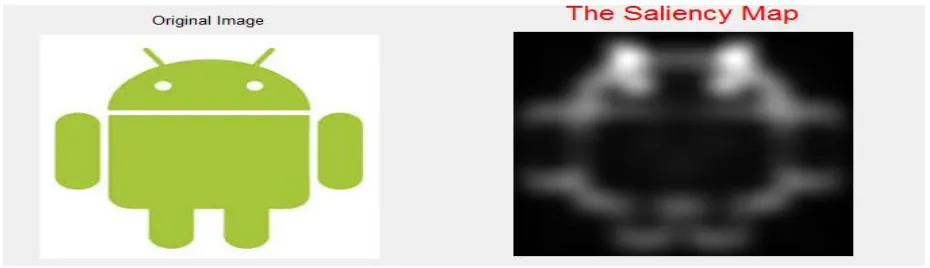
Segmentation means extracting the area of use. Segmentation subdivides an image into constituent regions or objects that have similar features according to a set of predefined criteria. Segmentation is the process of identifying components of the image. Segmentation involves partitioning an image into groups of pixels which are homogeneous with respect to some criteria. Here for segmentation saliency map technique is used, in which first of all entropy of the image is calculated. then it is converted into frequency domain. Gaussian filtering is applied to the extracted image to soothing the surface. Then we get the output of saliency map technique which is a region of logo.
Figure 2: Saliency mapped output
F) Image Matching
ISSN(Online): 2320-9801
ISSN (Print): 2320-9798
I
nternational
J
ournal of
I
nnovative
R
esearch in
C
omputer
and
C
ommunication
E
ngineering
(An ISO 3297: 2007 Certified Organization) Vol. 3, Issue 4, April 2015
G) Data base evaluation or testing
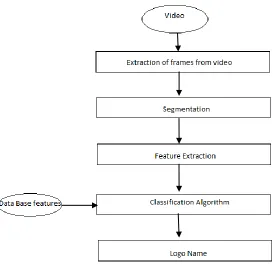
After a video clip is input, we detect a video logo by using a frame differencing based approach and prior knowledge to detect video logos with the aid of a logo database.
Figure 3: Flowchart of DB evaluation and Testing
After obtaining the rectangular region of the video logo, we refine it to obtain the logo outline. Once the precise logo region is obtained, we remove the logos by using either a matching based overlapping technique. For instance, logo detection based on frame difference computation has the capability to detect the logos on frames with motion but it cannot detect them on static frames. In order to detect logos under realistic static conditions, we employ a logo database in order to search for them by using a KNN approach. In order to improve the accuracy of detection, we assume that the probabilities of logo appearing at the four corners of the video frames are higher than at the center. We combine this prior knowledge with a neural network based local feature classifier. The primary reason for using two approaches to erase logos from video frames is that the result of matching based overlapping approach is not satisfactory if the motion of the logo region is insufficient to expose the region underneath. Another reason is that if the logo region is too large, the overlapping will result in observable edges for the video region. Hence, the video inpainting approach provides an effective alternative for logo erasure
ISSN(Online): 2320-9801
ISSN (Print): 2320-9798
I
nternational
J
ournal of
I
nnovative
R
esearch in
C
omputer
and
C
ommunication
E
ngineering
(An ISO 3297: 2007 Certified Organization) Vol. 3, Issue 4, April 2015
IV. RESULT AND ANALYSIS
In our dissertations we have evaluated logo matching and recognition based on context dependency for image and video. The results are obtained by testing some original and fake test image. By applying algorithm on image and video it shows either the image is original or fake. Following are the results perform on the logo of Airtel Samsung.Figure 4 & 5 shows the results.
Figure 4:Result on Fake logo of Samsung
ISSN(Online): 2320-9801
ISSN (Print): 2320-9798
I
nternational
J
ournal of
I
nnovative
R
esearch in
C
omputer
and
C
ommunication
E
ngineering
(An ISO 3297: 2007 Certified Organization) Vol. 3, Issue 4, April 2015
V. FUTURE SCOPE
Further extensions of this work include the Smartphone application of logo retrieval in videos & images. Also processing time can be reduced in future. Further accuracy can be increase.
VI. CONCLUSION
A novel logo detection and localization approach is introduced on a new class of similarities referred to as context dependent. Logo matching is important nowadays to detect non-authorized use of logos. Logo detection used to be done in high quality images only. But using the proposed method, logos with partial occlusion can also be detected and the accuracy of logo recognition is also high.
REFERANCES
[1] Sahbi H. and BallanL,”Context Dependent Logo Matching and Recognition”, Member, IEEE, Giuseppe Serra,
and Alberto Del Bimbo, Member, IEEE, 2013.
[2] Matas J. and Chum O.,”Robust wide-baseline stereo from maximally stable extremal regions”, Image Vis. Comput., Vol. 22 No. 10, pp. 761–767 , 2004.
[3] J. Schietse, J. P. Eakins, and R. C. Veltkamp, “Practice and challenges in trademark image retrieval,” in Proc. ACM Int. Conf. Image Video Retr., Amsterdam, The Netherlands,pp. 518–524,2007.
[4] David S. Doermann, Ehud Rivlin and Isaac Weiss,”Logo Recognition Using Geometric Invariants”,Document Processing Group, Center for Automation Research University of Maryland, College Park,2007.
[5] Guangy Zhu,Doermann D,,”Logo Matching for Document Image Retrival Document Analysis and Recognition” ICDAR’09,10th International Conference on DOI:10.11.09 ICDAR 2009.
[6] C.-H. Wei, Y. Li, W.-Y. Chau, and C.-T. Li, “Trademark image retrieval using synthetic features for describing global shape and interior structure,” Pattern Recognit., vol. 42, no. 3, pp. 386–394, 2009.
[7] Sahbi H. and Ballan L,”Context Dependent Logo Matching and Recognition”, Member, IEEE, Giuseppe Serra, and Alberto Del Bimbo, Member, IEEE, 2013.