Performance Analysis of an Implementation of
Random Linear
Network Coding (RLNC)
Renita Blossom Monteiro
PG Scholar, Dept. of ISE, NMAMIT, Nitte, Udupi, Karnataka, India
ABSTRACT: Network coding is a modern technique that has captured the interest of experts in Information theory and telecommunications field because of increase in throughput, robustness and decrease of energy consumption. Network coding has various application in security, video transmission etc. In this paper we aim to learn the features of network coding through the implementation of Random Linear Network Coding for a specific network. Simulation results show the encoding and decoding of a message through the network. The source node sends an image through the intermediate nodes to the destination. Network coding is applied at intermediate nodes. The entire simulation was simulated in MATLAB environment.
KEYWORDS: RLNC; P2P; Galois field; peer-to-peer networks.
I. INTRODUCTION
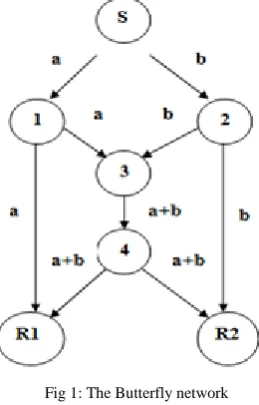
Network Coding is a recent technique that changes the traditional idea of routing, because the intermediate nodes can perform the linear combinations of incoming packets for each output node. This technique was introduced by R.Ahlswede.et.al [3] showing that the network coding can be used in networks where throughput is major factor. It can be explained clearly with the following butterfly example [1].
Fig 1: The Butterfly network
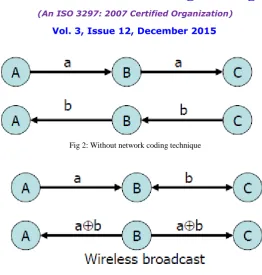
Fig 2: Without network coding technique
Fig 3: With network coding
In figure 2 the network coding technique is not applied and hence node A sends the packet a to node C through node B,in the same way node C sends the packet b to node A through node B and hence each node needs to send the packet separately resulting in four transmissions. But in figure 3 the use of network coding reduces the transmissions to three from four which implies that network coding method is more feasible and efficient.
II. RELATED WORK
Ahlswede et al [3] in their work proposed network coding as a method of sharing resources by allowing the intermediate nodes to combine the packets before sending it to the next-hop.In [4] the throughput and delay analysis was done using the random linear technique for single-hop networks.It was done using the coding window size and network size. In [5] the random-linear network coding was applied for two sources and a single destination node using direct and indirect method through the intermediate node to combine the packets from two source nodes. In [6] the work proposed is distributed random linear network coding in which the error probability decreases gradually with the code length. In [7] pseudo-random network coding scheme was proposed to address the feedback problems. In this coding scheme the coding coefficients are defined for transmission packets and an index is placed in the packet header to decode the packets at receiving side. In [8] the network coding is explained in terms of security, this paper mainly focuses on the threat posed at intermediate nodes rather than the external sources.
The rest of the paper is as follows: section 3 explains the network coding overview wherein the types and techniques are explained. Section 4 explains the implementation of RLNC. Here the image is being transmitted from the source node and the image is received at the destination nodes, network coding is applied at intermediate nodes. In section 5 the results of the simulation is being evaluated and the analysis is done for throughput and delay parameters. The future research and the contributions are mentioned in section 6.
III.OVERVIEW OF NETWORK CODING
improved throughput, reduced bandwidth utilization over the older techniques. Network coding is based on a simple min-cut max flow theorem, which states that the maximum flow value is equal to the minimum cut capacity [10].
A. Benefits of network coding
[a] Security
Network coding is more secure since the linear combinations of data are transmitted an intruder cannot decode it efficiently [11]. If an intruder gets the combinations it may be tedious to decode since the linear combinations are not known. Hence the data can be securely transmitted through the network.
[b] Throughput
In today’s network throughput is an important factor. With the use of this method the data can be sent in same amounts as traditional routing. The time required to send the data is also in less amounts. This method can be applied to any kind of network without changing the hardware implementations. Hence the time can be saved by sending the large amounts of data in less time.
[c] Robustness
With the help of random network coding the network can be more robust. Since the different combinations are being used single link failure may not result in more problems.
B. Types of Network Coding
[a] Linear Network coding
Linear network coding is the simplest form of method that can be used to transmit the data [12]. It uses the simplest EX-OR operation to send the data. The original message can be decoded easily if linear independent combinations are known. Hence this type of method is widely used for data transmission. It can be easily explained with the help of following example.
Two messages X and Y are XOR together to get the final combined message: X ⊕ Y= Z
Using the combined message Z and the original message X the remaining message can be decoded as follows: Z ⊕ X=Y
[b] Random linear Network Coding
In this method the linear combinations are used. Each sending node makes linear combinations of the message to be transmitted and sends it to the destination node [13]. The destination node must then decode the original message after it has received all combinations. This method can be considered as secure since the intruder cannot decode the original message until all combinations are received. The following example illustrates it:
The combinations received: (X ⊕ Y ⊕ Z) (X ⊕ Z) (Y ⊕ Z) Message decoded: (X ⊕ Y ⊕ Z) ⊕ (Y ⊕ Z) = X
Message decoded: (X ⊕ Z) ⊕ X = Z
Message decoded: (X ⊕ Y ⊕ Z) ⊕ X ⊕ Z = Y
The disadvantage of the method is the receiver need to wait until all combinations are received.
[c] Logical Network Coding
Is similar to linear network coding since the arithmetic formula is used to combine the messages.
[d] Physical layer network coding
In this method network coding is done using the electromagnetic transmission waves. The positive and negative parts of electromagnetic transmission waves are used to encode the message.
IV.IMPLEMENTATION
Galois fields [14] (finite fields) and work with them. All functions are within the GF Communications Toolbox for MATLAB itself the main function used is gf (X, q), which creates an array with GF (2q) elements, with q an integer between 1 and 16, by a matrix X. The result will be an array GF [15].
The task of the simulator is open any file (.png, .pdf, .txt, etc.), read the data it contains and enter them in a column vector. This column vector will be the message sent to the network according to the techniques of RLNC. Target node will decode the received messages and rebuild (if can) the original message.
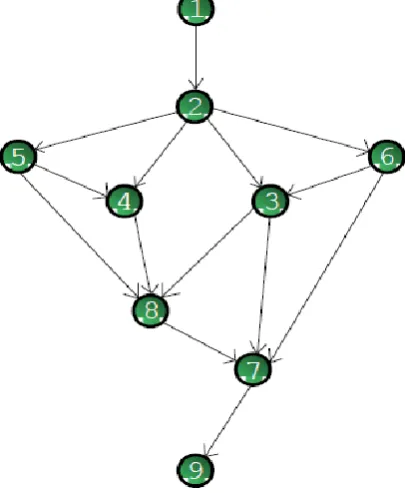
The figure 4 network is taken as an example to demonstrate RLNC which is acyclic network without delays and with unit capacity. A .png image was sent through the network.
Fig 4: Acyclic office network
Node 2 is the real source node and node 7 is real destination node. Nodes 1 and 9 are imaginary because it receives and sends signals over the imaginary channels 1 and 9. The nodes 5, 4,3,6,8 are intermediate nodes where network coding is applied. The network shares 4 matrices (G_TX / G_RX / Y_TX / Y_RX). These matrices preserve its vector information and encoding vector of the various nodes. G_TX is the matrix that preserves the vector encoding that is transmitted. G_RX preserves the vector encoding received and same for Y_TX and Y_RX. Each row of these matrices corresponds to its child node, while the columns correspond to the outputs of the node. For node 2 which has one input and four outputs then at the end of the computation will have G_TX {} 2, 1...4 carriers.
Fig 5: Column vector of graph
The figure 5 is the matrix for graph in figure 4.The block size used is 3 and node_final value is 7.The value of q is 10 and the parameter n is defined as n = size (M, 1).
V. EVALUATION
The image file is being sent from source node 2 and is being received at destination node 7 only if the matrix of the original message is equal to the received message. Intermediate nodes take the encoding vector and vector information from input channels and saving them in a matrix H and J, respectively. If there are no encoding / vector information input then it imposes or = 1, in such a way as to indicate that the current node does not need to do any computation. The end node, will take this encoding and information vector received by solving the system of equations to find original image. The code checks if the size of these vectors is equal to “block ". If yes, then the image is received correctly. The figure 6 shows the image that is sent at the sender and received at the receiver, by looking at the figure it is clear that with the help of network coding the original image is retrieved as it is.
Sent image Received image
Fig 6: Images sent and received
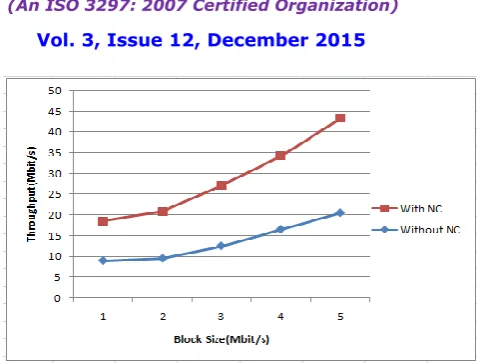
Fig 7: Throughput versus block size
VI.CONCLUSION AND FUTURE WORK
In this paper, we have presented the use of network coding by sending an image through an acyclic network, directional without delays and with unit capacity. We have used the MATLAB simulator as the development environment. The simulator has been infact possible to see the operation of transmission with this technique and other related improvements such as increase in throughput and robustness of the network. Network coding can be an interesting field of research for different applications like peer-to-peer networks increasing the transmission rates and reducing the energy consumption. As a future work the same can be implemented for other networks
REFERENCES
1. Christina Fragouli and Emina Soljanin, “Network Coding Fundamentals” Foundations and Trends R in Networking Vol. 2, No. 1 (2007) 1–133,2007.
2. Marek Konieczny,”Network coding in wireless environment”, TKK T-110.5190 Seminar on Internetworking 2008-04-29/30.
3. R. Ahlswede, N. Cai, S. R. Li, and R. W. Weung, “Network information flow,” IEEE Trans. on Inform. Theory, vol. 46, no. 4, pp. 1204– 1216, Jul. 2000
4. B. T. Swapna, Atilla Eryilmaz "Throughput-Delay Analysis of Random Linear Network Coding for Wireless Broadcasting", IEEE, and Ness B. Shroff, Fellow, IEEE 20 Jan 2011.
5. Amjad Saeed Khan and Ioannis Chatzigeorgiou “Performance Analysis of Random Linear Network Coding in Two-Source Single-Relay Networks", School of Computing and Communications, Lancaster University, United Kingdom, 19 March 2015.
6. Tracey Ho, Ralf Koetter,David R. Karger, Michelle Effros,Jun Shi, and Ben Leong "A Random Linear Network Coding Approach to Multicast", IEEE TRANSACTIONS ON INFORMATION THEORY, VOL. 52, NO. 10, OCTOBER 2006.
7. Cheng-Chih Chao, Ching-Chun Chou, Hung-Yu Wei "Pseudo Random Network Coding Design for IEEE 802.16m Enhanced Multicast and Broadcast Service",IEEE 2010.
8. Lu´ısa Lima, Muriel Medard, Jo˜ao Barros "Random Linear Network Coding: A free cipher?” 2005.
9. Marek Konieczny,"Network coding in wireless environment", TKK T-110.5190 Seminar on Internetworking, 2008-04-29/30.
10. Ricardo Bassoli, Hugo Marques, Jonathan Rodriguez, Kenneth W. Shum and Rahim Tafazolli, "Network Coding Theory: A Survey", IEEE COMMUNICATIONS SURVEYS & TUTORIALS, ACCEPTED FOR PUBLICATION, IEEE 2013.
11. Matsuda, Noguchi, Takine,”A survey of network coding and its applications”, IEICE TRANS.Commun VolE94-B No3 March 2011. 12. www.en.wikipedia.org/wiki/Linear_network_coding.
13. Tracey Ho,” A network coding tutorial”, Centre for the Mathematics of Information, California Institute of Technology.
14. www.mathworks.com/MATLAB gf - Math Works India.html.
15. http://it.wikipedia.org/wiki/MATLAB.
BIOGRAPHY