PRIMARY SCHOOLS IN KIAMBU COUNTY, KENYA
EUNICE WANJIRU KAMAU
E55/22943/2010
A THESIS SUBMITTED FOR THE DEGREE OF MASTERS OF EDUCATION (SPECIAL NEEDS EDUCATION) IN THE SCHOOL OF EDUCATION OF
KENYATTA UNIVERSITY
DEDICATION
To the Almighty God who helped me accomplish this project and my entire family for
ACKNOWLEDGEMENT
I am grateful to Kenyatta University and particularly to my supervisors Prof. G. Karugu
and Dr. Madrine King’endo for imparting to me the knowledge and for their tireless and
unwavering support throughout this work. I also wish to express my gratitude to my
fellow students for their moral support whenever I consulted them throughout the trying
periods of this study. I wish to thank my family in a very special way for their love,
encouragement and support during the most trying moments. Mrs. Eunice Onyango for
TABLE OF CONTENTS
DECLARATION………. Error! Bookmark not defined.
DEDICATION……….. iv
ACKNOWLEDGEMENT……… v
LIST OF TABLES……… ix
LIST OF FIGURES………... x
ABBREVIATIONS AND ACRONYMS……….. xi
ABSTRACT………... xii
CHAPTER ONE: INTRODUCTION ……… 1
1.1 Background to the Study………. 1
1.2 Statement of the Problem………. 5
1.2.1 Purpose of the Study……… 6
1.3 Study Objectives………. 6
1.4 Research Questions………. 6
1.5 The Significance of the Study………. 7
1.6 Delimitation and Limitation of the Study……… 7
1.6.1 Delimitation……….. 7
1.6.2 Limitation……….. 8
1.7 Assumption of the Study………. 8
1.8 Theoretical and Conceptual Framework………. 9
1.8.1 Theories Guiding the Study………. 9
1.8.2 Conceptual Framework……… 11
1.9 Definition of Terms……… 13
CHAPTER TWO: LITERATURE REVIEW………..………….. 14
2.0 Introduction……….. 14
2.2 Impacts of VAW on Children’s Academic Performance……… 15
2.3 Common Coping Strategies to Assist Affected Children by VAW……….... 18
2.4 Strategies and Intervention for Reduction of Violence against Women……….. 20
2.5 Summary of Literature Review……… 22
CHAPTER THREE: METHODOLOGY……….……… 24
3.0 Introduction……….……… 24
3.1 Research Design……….………. 24
3.1.1 Variables……….………. 24
3.1.1.1 Independent Variables……….……….. 24
3.1.1.2 Dependent Variables………..………... 24
3.2 Location of the Study……….……… 25
3.3 Target Population……….……… 25
3.4 Sampling Technique and Sample Size………..……….. 25
3.4.1 Sampling Techniques……… 25
3.4.2 Sample Size………. 26
3.5 Research Instruments……….. 26
3.6 Pilot Study……… 27
3.6.1 Validity………. 27
3.6.2 Reliability………. 28
3.7 Data Collection Techniques……… 28
3.8 Data Analysis………. 28
3.9 Logistic and Ethical Considerations………... 29
CHAPTER FOUR: DATA PRESENTATION, ANALYSIS AND DISCUSSION………. 30
4.1 Introduction……….. 30
4.2 Response Rate………. 30
4.4 Causes and Forms of Violent Behavior in Homes……….. 33
4.5 Impact of Domestic Violence on Children’s Academic Performance………. 37
4.6 Coping Strategies………. 38
4.7 Intervention Measures………. 40
CHAPTER FIVE: SUMMARY, CONCLUSION AND RECOMMENDATIONS……… 44
5.0 Introduction………. 44
5.1 Summary of the Major Findings………. 44
5.2 Conclusion………... 47
5.3 Recommendation for Further Study……… 48
REFERENCES……….………. 49
Appendix I: Child Mapping……….….………….. 55
Appendix II: Women Interview Schedule……….………. 56
Appendix III: Questionnaire for Teachers……….. 57
Appendix IV: Interview Schedule for Children’s Officer………. 60
Appendix V: Research Authorization Letter ……….………. 61
LIST OF TABLES
Table 3.1: Sampling matrix……….……….. 26
Table 4.1: Responses by the respondents ………..…….……… 30
Table 4.2: Coping mechanisms adopted………..……. 38
LIST OF FIGURES
Figure 1.1: Ecology of Human Nature………. 9
Figure 1.2: Effects of violent behavior against women on their children’s academic performance……….. 11
Figure 4.1: Gender of the respondents………. 31
Figure 4.2: Prevalence of domestic violence……… 32
Figure 4.3: Frequencies of children witnessing domestic violent behavior……….. 35
Figure 4.4: Effect of witnessing domestic violence on school going routine……….. 36
Figure 4.5: Impact of exposure to domestic violence on academic performance…………. 37
ABBREVIATIONS AND ACRONYMS DEVAW Declaration on Elimination of Violence against Women DHS Demographic Health Survey
DV Domestic Violence
FIDA International Federation of Women Lawyers GBV Gender Based Violence
IPV Intimate Partner Violence
IWD International Women’s Day
KDHS Kenya Demographic Health Survey
NACADA National Campaign against Drug Abuse Authority PTSD Post Traumatic Sleep Disorder
UN United Nations.
UNCEDAW United Nations Conventions on the Elimination of all Forms of Discriminations against Women
UNFPA United Nations Population Fund
UNICEF United Nations Children’s Education Fund. VAW Violence Against Women
WHO World Health Organization
ABSTRACT
CHAPTER ONE INTRODUCTION
The background related to the study has reviewed the extent and occurrences of violence
against women and its effects on women and children globally. It highlights information
on violence against women and how their children are exposed to the violence either
directly or indirectly in many ways internationally, Africa, East Africa and Kenya
respectively.
1.1 Background to the Study
Violent behavior against women continues to be a global challenge since it is
characterized by death, injuries, psychological, emotional torture in addition to social
economic disruption of the victim’s means of livelihood. Of late, though there has been a
lot of concern about domestic violence in both developed and developing countries the
greatest victims of the violence are women and children (Mouzos & Makkai, 2004).
Women are more likely to experience more severe ongoing partner violence (Bagshaw,
Brown, Wendt, Campbell, McInnis, Tinning, Batagol, Sifris, Tyson, Baker, & Fernandez
Arias, 2010), which impacts negatively on their children’s holistic growth and
development, it is therefore acknowledged as a violation of the basic human rights of
women and their children. It is important to note that women also do commit violence
against men, but there are great differences in the nature and context of this violence
committed by male to women. In Canada, 6% of the 19 million Canadian spouses were
victims of domestic violence whereby female victims (60%) are more likely than (40%)
male victims to experience recurring incidences of violence, and three times more likely
found to experience high rate of severe abuse, threats, intimidation and fear (Bagshaw et
al, 2010).
Children who live in families where domestic violence occurs are exposed to these
violence and abuse in many ways. They could be directly affected by the abuse, or even
accidentally harmed, their lives could be disrupted by being moved or separated from
parents, or even used by the batterer to manipulate or gain control over the victim, they
are likely to be abused also. The exposure to domestic violence is widespread globally
and is associated with many forms of child maltreatment (UNICEF, 2006). Most women
who reported experiences of partner violence in their life were caring for their children
during the violent relationship (Australian Bureau of Statistic, 2006). This is a threat to
the child’s physical health as well as the academic performance either through witnessing
or being a victim of the violence (Indermaur, 2001). VAW has become so rampant that
World Health Organization considers it a serious cause of death and injury among
women and children (WHO, 2005). This has become significantly a public health issue
which affects millions of people globally each year (Graham-Bernan, 2009) leading to
negative effects.
In United States over 15 million children lived in families where intimate partner
violence had occurred at least in the past years and over 7 million children lived in
families in which serious partner violence occurred (Whitefield, Anda, Dube & Felittle,
2003). A study done in the US in 2007 found out that, 38% of the incidences of intimate
partner relationship which involved female victims had children below 12 years residing
in the same household (Catalano & Shannan, 2007). In a single day in US, 16,458
National Network to End Domestic Violence, 2009) found out. This is an indication that
either children witness or even experience domestic violence (FIDA, 2004) and this could
harm them psychologically and emotionally leading to underperformance in schools.
In Africa it is estimated that 85 to 114 million women and girls have been physically and
emotionally abused (Statistics Canada, 2011). In Ghana there are all kinds of violence
against women and children in the society which is part of everyday experiences. This
has subsequent effects on children growing up in those homes where women defilement,
assault, sexual harassment, rape and battering are regular experiences and not reported or
if reported very little attention is given, this reinforces the perpetrators of violence in
many homes making the affected mothers unable to protect themselves and their children
due to their own powerlessness within their home and society (Lapirerre, 2010). This is
worsened by lack of protective laws, limited formal services, financial constrains, and
empowerment and even fear of stigma (Garcia-Moreno, Janzen HAFM, Watts, Ellsberg,
Hewe, 2005) which intensifies the suffering of women and their children. Creating a
global need is therefore important to identify the various forms and causes of violence as
well as addressing them accordingly for the interest of mothers and their children
(UNFPA, 1999).
In Zambia, Demographic and Healthy survey indicated that 59% of women reported
gender violence since the age of 15 years (Kishor & Johnson, 2004). According to World
Health Organization (2005), cases of domestic violence are on increase in African
countries. Many African Government and non Government entities have identified
gender based violence as an issue deserving immediate legislative attention and general
This is an indication that, the fight against gender based violence continues and
appropriate intervention strategies need be put in place for the well being of mothers and
their children.
In the East African countries being a woman correlates with unequal access to income,
physical assets, education and lack of negotiating power in relationship which results to
VAW occurring in high proportion (Carbus, 2003). VAW is a social concern with serious
negative consequences that needs to be addressed because unlike other forms of violence,
it is inflicted by persons known to the woman and in most instances in their own
environment. It is among the most unrecognized human rights violation that puts both the
individual woman and the entire societies at a deficit. This calls for government and
non-governmental organizations to intervene and address the pervasive causes and problems
of VAW. Although the East African Countries have their own histories, culture, and
policies they hold similar views of a woman’s role and place in the society and this
contribute to the magnitude of the problem as VAW is socially accepted and tolerated in
these countries (Kenya Demographic Health Survey, 2003).
In Kenya VAW comes in various forms in different communities and remains an issue of
great concern. Cases of fatal attacks against spouses have been on the increase across the
country (Nation News Paper, July 22, 2014). It is not only a problem to victims and their
children but also for the Kenyan society as a whole. According to The Kenyan Police
Statistics (2005), VAW is steadily on the increase. KDHS (2003) reported that 50% of
Kenyan women experience some form of violence with only one in four going for help
after a violent attack. International Federation of Women Lawyers (2004) describes
women have been physically violated within their homestead. It is a concern that up to
60% cases go unreported due to the culture of silence surrounding VAW which not only
affects women in Kenya but also exposes many children to violence.
Doyle (2011) was concerned of the social problems in the families in Kenya including
Kiambu County. In Githunguri primary schools there has not been any laid down coping
strategies to cater for the affected children neither are there any formal assessment
procedures to identify children of domestic violence. The Penal Code (Amendment) Act
No. 16 of 1993 by the general assembly was intended to prevent, protect the victims and
warn the perpetrators of the violence and ensure systematic support for the victims of the
crimes but little has been done for domestic violence is still prevalent in our society
(Kenya Health and Domestic Survey, 2008/ 2009). The Kenyan Children’s Act 2001
clarifies that children affected and exposed to domestic violence are vulnerable children
in need of special attention. Although studies have been done on violence against women
much has not been achieved due to the culture of silence and stigmatization surrounding
this sensitive topic making collection of related data challenging (Buchaman, Hunt,
Bretherton, and Brean, 2001). This instigates the researcher’s interest into the study on
whether violence behavior against women has any impact on children’s academic
performance in Githunguri Sub-County primary schools Kiambu County.
1.2 Statement of the Problem
Children who witnessed their mothers suffering have been affected negatively in their
social and academic performance (Stephens & Mc Donald, 2000). These children
experience the same level of negative psychosocial outcomes as children who are directly
physically abused (Bagshaw et al., 2010). This leads to crisis in emotional and behavior
investigate the effects of violent behaviors against women on their children’s academic
performance with an aim of laying strategies to address these negative impacts.
Furthermore, domestic violence goes on unabatedly and the study sought to investigate
effects of violence against women and its implications to their children’s academic
performance in Githunguri Sub-county, Kiambu County Kenya.
1.2.1 Purpose of the Study
The purpose of this study was to investigate violent behavior against women and its
effect on the academic performance of their children in selected primary schools in
Kiambu county Kenya.
1.3 Study Objectives
The study objective sought to:
i. Identify causes and main forms of violent behaviors against women its effect on
the academic performance of their children.
ii. Examine the impacts of violent behaviors against women on their children’s
academic performance in primary schools.
iii. Assess the common coping strategies applied by schools to help children who are
victims of violent behavior against women.
iv. Establish appropriate interventions strategies of addressing negative impact of
violent behavior against women and its effects on children.
1.4 Research Questions
This study seeks to answer the following question:
i. What are the causes and forms of violent behaviors against women in Githunguri
ii. What are the impacts of violent behavior against women on their children’s
academic performance in primary schools in Githunguri District?
iii. Which are the common coping strategies applied by schools to help children who
are victims of violent behavior against women in Githunguri District, Kiambu
County?
iv. What are the appropriate intervention strategies of addressing negative impact of
violent behavior on women and its effects on children?
1.5 The Significance of the Study
Gender based violence problem is a national issue and may not be limited to the area in
which the study is intended to be done. It is hoped that the findings of this study may be
utilized by teachers and educational practitioners in identifying various emotional
behavior disorders in children and their probable causes. The study may also create
awareness to relevant stakeholders on the need for training teachers on special education
so as to cater for various special needs in children. The findings may also sensitize the
parents on the impact of domestic violence on children and the need for living in
harmony. The study findings may also be utilized by the policy makers on the need to
implement and practice laws relating to the rights of women and children and come up
with programs for helping the affected. It may also form a basis for future research on
violent behaviors among women and its impact on children’s academic performance.
1.6 Delimitation and Limitation of the Study 1.6.1 Delimitation
The study was affected by the attitudes of the respondents since the subject at hand was
of the abuse. Some learners were suspicious of their privacy being interfered with while
others were young to give correct and relevant information.
1.6.2 Limitation
Due to limited time to conduct the study, the study was confined to Githunguri
sub-county, Kiambu County, Kenya covering selected schools and children in the district.
The informant scope group included head teachers, guidance and counseling teachers,
affected children, parents, Assistant Chiefs or Chiefs, Children Rights Officers and the
local village elders. The study focused on various forms of violence behavior on women
and its effects on school going children. It also identified intervention measures to
address the affected. The study was confined to the causes and forms of violent behaviors
against women, the impact of violence behavior on children’s academic performance and
the intervention strategies employed to cope with these impacts.
1.7 Assumption of the Study
The study was based on the following assumptions that:
1. Violent behavior against women affects the academic performance of children.
2. The interventions strategies put in place in schools to assist children who are
affected by violence against women are not adequate.
3. It would be safe for the researcher to collect the needed data from the study
location.
4. There would be enough respondents to participate in the study and will be
1.8 Theoretical and Conceptual Framework 1.8.1 Theories that Guide the Study
The study was guided by the Ecological theory formulated by Bronfenbrennar (1977). It
is based on multiple related elements of individuals, communities, institutions and
cultures as exemplified by the Ecology of Human Nature diagram.
Figure 1.1: Ecology of Human Nature
Source: Adapted from the ecological model by Heisse (1998)
Based on the theory (Riger, Raja, Camach, 2002) stresses that Victims behavior is not
only shaped by her upbringing but also the environmental factors such as the batterer’s
reactions from those around her and the resources available to her. This reciprocal
interplay includes Microsystems such as the neighborhood or the workplace, ecosystem
such as the broader social influence of media and macro system which are ideologies and
or law. This means that the changes on one strata result in changes to others. For example
mandatory reporting of partner abuse creates changes in institutions, creating change in
neighborhood, families and individuals.
From a social learning perspective by Albert Bandura (1977) violent behavior as a form
of communication displayed by parents or guardians in childhood may possibly
determine whether individuals later perpetrate violence in heterosexual and homosexual Society Community Relationship
relationships. Parents or guardians behavior is an expectation of what is within the
family. Thus children learn to be violent by observing their intra-family aggressive
behaviors. Children are exposed to aggressive and violent behavior by it being exposed in
their surrounding community. According to this perspective, (Diamond Muller, 2004)
found out that each generation learns to be violent by being a participant in a violent
family and the situation is further reinforced by the society. The social learning process is
accomplished by important mechanisms which are modeling and reinforcement.
Modeling is an important tool in learning behavior, since children learn by watching and
imitating others. Reinforcement occurs when certain behavior is rewarded and others are
punished. In relation to ecological theory, the interconnectedness of its elements from an
individual, society, institutions and culture and through modeling, imitation and also
reinforcement can determine the child’s learnt behavior which could either be positive or
negative. This leads the researcher to investigate whether violent behaviors against
women within their ecological system has any influence on their children’s emotional
behavior disorder which could affect their learning leading to poor academic performance
1.8.2 Conceptual Framework
Figure 1.2: Effects of violent behavior against women on their children’s academic performance
Source: Researcher’s own
Different forms of VAW could manifest negatively to the children, leading to poor
academic performance. However, if intervention is given children are likely to cope and
their academic performance improves. On the other side, where there is no violence,
learning is effective and the children achieve positively in the academic performance.
The Ecological Model of violence against women adopted from Heisse (1998) guides in
understanding the causes, effects, forms and extent of VAW experienced by looking at
the interplay of personal, situational and socio-cultural factors as represented in figure
A B
VAW Experiences Physical Mental Sexual Emotional Behavioral Effects and manifestation Aggression School absenteeism Drug abuse Withdrawal Poor
concentration
Poor academic performance
No violence
Nurturing of children Provision
Mentorship
Effects
School retention Good concentration Socialization Friendly Good grades
retention
Good academic performance Coping mechanism
Counseling
Life skills
Enhancement of the law
Community education program
1.1. The innermost circles represent the biological and personal history that each
individual brings into her relationship. The second circle represents the immediate
context in which abuses takes place frequently, the family or other intimate or
acquaintances relationship. The third circle represents the institutional and social
structures both formal and informal, in which relationships are embedded-
neighborhoods, workplace, social networks and peers groups. The fourth outmost circle is
the economic and social environment and cultural norms. The negative consequence of
the abuse goes beyond sexual and reproductive health, to their overall health, to the
welfare of their children whose effects and manifestation could lead to negative behavior
disorders that would result to poor academic performance, unless they get support
1.9 Definition of Operational Terms
Academic Performance: The extent to which a student, teacher or institution has achieved the educational goals.
Guidance Counseling: The means by which one individual helps another to clarify his or her life situation and to decide upon further line of action.
Domestic violence: Refers to any act physical, psychological, emotional, sexual, economical or financial abuse against a member(s) within the family.
Gender Based Violence: Refers to any act of violence that result in, or is likely to result in physical, sexual or psychological harm or suffering to women, including threats
such as coercion or arbitrary deprivation of liberty, whether occurring in public or
private.
Physical violence: Any acts or omission committed within the framework of the family by one of its member that undermines the life, the bodily or psychological
integrity or the liberty of another member same family or that seriously harms the
development of or her personality
Sexual violence: Any sexual act, attempt to obtain a sexual act, unwanted comment or advance, or act to traffic a person’s sexually using coercion, threats of harm or
physical force by any person regardless of their relationship to the victim in any
setting including but not limited to home or work place.
Violence against women: Any act of gender based violence that result in, or is likely to result in physical, sexual or psychological harm or suffering to women, including
threats such as coercion or arbitrary deprivation of liberty, whether occurring in
public or private
CHAPTER TWO LITERATURE REVIEW
2.0 Introduction
The literature related to the proposed study has been reviewed thematically based on the
theories. It begins with the literature on causes and main forms of violent behavior
against women, the effect violent behaviors against women has on their children’s
academic performance in schools, assessment of the common coping strategies applied
by schools to help victims of violence has been put into consideration and it also tries to
establish appropriate intervention measures put in place to addressing the negative
impacts it has on women and their dependants who are school going children.
2.1 Forms and Causes of Violence Against Women
Women continue to be victims of various forms of violence. It is taken as a natural
occurrence whereby it is neither recognized, nor reported and has been accepted as part
of life. Violence against women takes place within families and it is mostly committed by
men who are either partners, ex-partners or even known to the woman (Bagshaw et al,
2011). It could occur from the very start of life to old age and it is administered in
different forms such as physical, sexual, psychological and also economical ((Krug,
Dahlberg, Mercay, Lozono, 2002). Women also experience violence within the family or
even in the community whereby it is committed by strangers or even non-family
members. There is Lack of comprehensive programmes on the preference of VAW
especially in developing countries although research confirms its persistence
(WHO/FIGO Pre-Congress Workshop on VAW, 2005). The decision to eliminate VAW,
as adopted by United Nations General Assembly (1993) identifies VAW as a critical area
government, international community and civil society since it is a violation of human
rights and a form of discrimination against women.
Prevalence rate of violent behaviors against women vary from one nation to another but it
has been described as on an upward rise. Population based survey from 48 countries in
the world noted that 10-69% of women report experiencing some type of physical
violence by intimate partner which the World Health Organization considers as a serious
cause of death and injury among women and children (WHO, 2005).
Lack of power and control due to social norms in both social and private roles is
considered as some of the root causes of VAW. Women have been subjected to restricted
and limited freedom which inhibits there choices of economic opportunities and this
undermines their status which is a violation of human rights (Krug et al, 2002). Women
are socialized to accept and even tolerate it as they remain silent about the experiences
(Zimmerman, 1994). Apart from impoverishing the woman, their families and the nation,
violent behavior against women also put the children at risk of health problems, poor
school performance and behavioral disturbances. Although research has been done and
programs put in place to address the menace of VAW, more still is required as it has been
noted to be globally on the increase putting women and their children to untold suffering.
This arouses the researcher’s interest into investigating its forms and causes with an aim
to address its negative impacts that continue to be experienced by the innocent children
threatening their school performance in Githunguri Sub-County.
2.2 Effects of VAW on Children’s Academic Performance
Violence against women is a significantly public health issue that affects many women
women but also has adverse consequences for the survival and well being of children. An
estimate of 275 million children globally experience violence in their homes (UNICEF,
2006). In Canada 10.5 per 1000 children were exposed to domestic violence (The
Canadian Study of Reported Child Abuse and Neglect, 2003). A study conducted in US
among 4500 children who had experiences of witnessing partner violence showed that
over 50% had been maltreated either physically, psychologically, custodial interferences
or even sexually assaulted (Hamby, Frinkelhor, Turner, & Ormrod, 2010). Even though
the abuse may not be directed to the children, its effects may result to emotional, physical
and behavioral ramifications during childhood and in later years (Barr & Parret, 2001).
Infants exposed to violent behaviors will experience post traumatic sleep disorders
(PTSD), have feeding problems, experiences sleep disorders, cries a lot and loose
developmental skills (Carpenter & Stacks, 2009). Consequently, the delayed
developmental milestones will negatively influence mental development as well as
acquisitions of academic skills.
Majority of children from violent homes aged below six years show clinical levels of
internalized and externalized behavior problems ranging from depression, hyperactivity,
anxiety or even portrays poor concentration when separated from their mothers (Hamby,
Frinkelhor, Turner, & Ormrod, 2009). As the mother and child seek protection or are
migrated to safety, this could lead to multiple and interrelated negative effects affecting
the child’s social and academic achievements (Kitzmann, Gaylord, Holt, & Kenny,
2003). These children may in turn become aggressive, are hardly accepted by peers,
and incarcerated by others is very high (Dunlap, Strain, Carta, Convoy, Smih, Kern,
Hemmeter, Timm, McCart, Sailor, Markey, Markey, DLaridieri,, Sowel, 2006) .
Children witnessing or experiencing domestic violence score in the low-average range on
measures of intelligence (Vaughn, Levy, Coleman, & BES, 2002). They have a problem
with chronic school failure, below average grades, grades retention, low high school
graduation rates, drop outs and absenteeism. Those with externalizing disorders have a
high risk of school failure as well as difficult in concentrating and doing school work
(Kerr, & Nelson, 2006). Others will experience unwanted remembering of traumatic
events, traumatic avoidance and traumatic arousal symptoms. Additionally, suicide
among these depressed children and youth has become a major concern within the
society. Studies have put forward that more than 90% of children and adolescence who
have committed suicide had emotional behavior disorder mostly due to lack of loving
nurturing relationship with at least one parent, maternal rejection or even family neglect
which translated to negative behavior outcome (Barr & Parre, 2001).
As adults, children who witness or experience violence between parents are two times
more likely to become abusive towards their own spouses later in live or even remain in
abusive relationship (Hambly et al., 2010). Despite the high rates of violence against
women and its terrible consequences to the children who are affected negatively right
from birth all through their life till adulthood, the problem has not had a workable
solution. This call for an investigation focusing on the probable effects VAW could have
on the unseen victims’ academic performance with an intention of getting along life
solution to women and their children in Githunguri District Kiambu. Conversely, if
adequate measures are not taken, the children will remain poor academic achievers and
2.3 Common Coping Strategies to Assist Affected Children by VAW
Violent behavior against women has been suspected as a contributing factor to poor
academic performance and a cause to various behavior disorders in primary schools in
Githunguri District Kiambu County, certain coping strategies need to be put in place. The
government has acknowledged children with emotional behavior disorder as children
with special needs. Specially trained teachers are being deployed in regular schools to
cater for various special needs although they are hardly enough for all the schools in the
district thus leaving some learners in need of the service unattended. The special need
teachers identifies the affected children, develops a screening tool that would identify the
specific need for early intervention and also come up with individualized educational
program assessment framework for the child in need of various services (McGee, 2000).
Children in conflicts families just like their mothers are reluctant to disclose domestic
violence to professionals. Their concern for confidentiality may prevent them from
approaching teachers or other authority (Buckley, Holt, and Whelan, 2006). These
children and young people are likely to seek help from friends, friend’s parents and other
family members (McGee, 2000). The disclosure serves to break down the secrecy that
perpetuates domestic violence, reduce the experience of violence and its impact on
children’s behavior. Although the primary schools in Githunguri District have indentified
guidance and counseling departments to cater for the children as they ensure their
confidentiality, many of the teachers do not have the required training. Additionally some
of the set departments are not operational.
Some children will not talk to anyone about their problems at home. This may be because
of fear of violence, fear of the consequences of talking about problems (for example,
of distrust, not feeling anyone can help, and possible stigma surrounding problems. Boys
in particular may find it hard to talk about problems and they are more likely to leave
talking to someone until nearer crisis point than girls. Many children may use avoidance
or distraction as a coping strategy when there are problems at home (McGee, 2002). The
school curriculum has included life-skills as non examinable subject where learners are
equipped with virtues of daily living and how they can manage issues in their lives and
these helps them open up and discuss their problems as they are assisted accordingly.
Children and young people need to talk about domestic violence and have their
experiences acknowledged and validated, this should be done in confidentiality and in
discreet setting (Buckley et al; 2006).This helps to purge embarrassment and fear of
being bullied by peers or friends in school and avoid stigmatization (Barter, 2009). In
Githunguri District Kiambu County the children rights office undertake legal processes to
ensure that women and their children receive the required services as they are protected
from further violence. However the District is served by only one office which is not able
to handle every need of the women and child who require the services. As coping strategy
children should also be involved in making their decisions. This is done by use of
narrative elaborations where children between 6-11years are involved in cue cards
showing scenes representing family member actions, emotions and resolution events, the
cards trigger discussions and help the child open up and discuss their experiences and
this could reduce the impact of violence on their behavior (Faller, 2003).
In schools as a prevention of further impact of violence to children, creation of further
awareness of domestic violence in the wider community is taken into consideration.
groups such as male perpetrators may be the most effective approach, although in some
communities attitudes and behavior are resistant to change and especially those that holds
strong traditional conceptions of gender roles and patriarchal have been slow to change
(Stanley, Miller, Foster, & Thomson, 2009). Family life education could be done through
parent school meetings where family life counselors are invited to address the parents in
schools and also at the community meetings. This leads to the investigation whether there
are coping strategies applied to assist women affected by violent behaviors whose effects
could be defective to their children’s academic performance in primary schools in
Githunguri, Kiambu County.
2.4 Intervention Strategies for Reduction of Violence against Women
In spite of the many challenges faced by many nations in the world in enacting and
implementing reforms to combat gender-based violence, the African continent has made
significant progress in recent years by identifying VAW as an issue deserving immediate
legislative attention and general public awareness (United Nations General Assembly,
1991; Jejeebhoy, 1998). There should be a practice based recommendation from family
law reforms that introduces tools and systems for screening families for domestic
violence to facilitate early identifications and referrals (Kaspiew, Gray, Weston,
Moloney, Hand, & Qu, 2009a). Though there have been many grassroots efforts, such as “All against Violence” campaigns many programs are largely implemented by non-
governmental organizations (NGOs) which have been noted to be minimal as they are
donor funded, this creates a need for the Kenyan government to actively come up with
preventive and protective programs on VAW.
At the international level, Kenya ratified the United Nations Conventions on the
country also signed on to the International human rights instruments that prohibit VAW,
including United Nation Convention against Torture (UNCAT) among others as it
supports the universal Declaration on the Elimination of Violence Against Women
(DEVAW, 1983). These commitments obligate Kenya to safeguard women and girls
from all forms of violence (Houben, 2003). In 2004 through an act of parliament, Kenya
established and launched the National Commission on Gender and Development that
advised the government on all gender issues, but it lacked constitutional guarantees when
it came to issues of personal and customary law which allowed discriminatory practices
against women and consequently perpetuates of VAW (Kameri, 2001). Amnesty
International in 2002 report, gave evidence of how legal process results in many
injustices when it comes to VAW.
Women and children affected by domestic violence are in need of protection and shelter
from abusive relationships. In Kenya such services are limited. The only shelter that
offers free services was established in 1996 and managed by Women Rights Awareness
Program (WRAP) in Nairobi, where all women in need of protection from abusive
relationship are referred. It provides post-rape therapy, counseling and support women
with cases in court. The WRAP shelter is limited in many ways and accommodates a
small number of women at a period of six weeks. This limited service gives a woman
hardly enough time to reorganize themselves. The shelter also faces challenges in
funding, The Sunday Nation Newspaper, 11th march 2007, exposing many women to
privately run commercial hostels which are beyond the reach of the majority who need
the services. It should be the obligation of the government to provide such support for
victims of VAW. Unfortunately the absence of a policy framework on the same implies
In Kenya just like many other parts of Africa there exist patriarchal systems where
culture is usually evoked to justify VAW. Customary practices and some aspects of
traditions are often the cause of VAW and influence its continuation. Traditional gender
roles that requires a man to assume powers as the woman is socialized to be passive and
be submissive and accept violence as part of her life (Kimeri, 2001). Since culture and
traditional practices have been pointed out as major contributing factor to violation
against women, there is an urgent need to address harsh phenomenon directed towards
women. Media in Kenya and many other parts of the world has been used as a tool for
change by not only reflecting the values of a society but also by shaping them. The media
reports events, inform, entertain and even educate (Makhoha, 2003).Through increased
reporting the media creates awareness campaigns i.e. the annual sixteen day of activism
against gender violence and international women’s day (IWD), media provided free air
time and media space at a subsidized rate. Media enhances the reality surrounding VAW
and draws attention to VAW as an important and serious problem that needs to be
addressed. The researcher wants to establish whether there are laid done strategies and
intervention measures to combat violent behaviors against women with an aim of
reducing its effects on academic performance of their children in Githunguri primary
schools Kiambu Kenya.
2.5 Summary of Literature Review
The foregoing review has exemplified that, VAW has been a widespread phenomenon
that happens every day in all social and ethnic groups and affects the woman physically,
sexually and psychologically. Its prevalence rates are on an upward rise in different
nations leading to dysfunctional families with adverse consequences for the survival and
relation in public and private sphere, discriminatory cultural norms and economic
inequalities. These not only affect women, but also put children at risk of health
problems, poor school academic performance and behavior disturbances. The
government acknowledges children with emotional behavior disorders as children with
special needs, various coping strategies have been put in place. Special needs teachers to
identify and give early intervention have been posted in schools, there is also guidance
and counseling teachers to cater for the emotional needs of the children but they are
hardly enough to cater for the affected children and also their mothers. In Kenya limited
studies have been carried out to address the menace and especially its influence to the
children in Rural Kenyan settings like in Kiambu County. Therefore, the current study
will focus on investigating the causes and forms of violent behavior against women and
their effects on children’s academic performance in primary schools in Githunguri
District, Kiambu County Kenya. The study arises out of the fact that there are scarce
CHAPTER THREE METHODOLOGY 3.0 Introduction
This chapter describes the methods that were employed in fulfillment of the research
objectives. It entails the research design, study variables, location of the study, target
population, sampling techniques and sample size, research instruments, pilot study,
validity, reliability, data collection techniques, data analysis and presentation, the logistic
and ethical considerations.
3.1 Research Design
The study was conducted using descriptive research design. Both qualitative and
quantitative approaches were applied. The qualitative aspect helped the researcher to
interpret the relationship between the study variables, while the quantitative aspect
extended the range of evidence on the topic under study. This helped the researcher to
verify what has been learnt from other literature.
3.1.1 Variables
3.1.1.1 Independent Variables
The independent variables were; aggression, school absenteeism, drug abuse, withdrawal,
poor concentration
3.1.1.2 Dependent Variables
The dependent variables were: school retention, good academic performance and
3.2 Location of the Study
The study was conducted in selected private and public primary schools in Githunguri
District, Kiambu County. Githunguri district is one of the four districts in Kiambu
County. It is approximately 40 km from Nairobi city. The district was selected due to the
rising incidences of domestic violence and the poor academic performance as compared
to other districts in the county. The locale was accessible to the researcher.
3.3 Target Population
According to the records of 2012/2013 children’s right office Githunguri District, the
target population of Githunguri Location is, 100 indentified learners from violated
mothers in the 13 primary schools, 75 mothers, 13 teachers, 1 chief/village elder and 1
child rights officer in the district totaling to 190 participants. The learners gave first-hand
information from what they witness and experience. The mothers of these children
enlightened on the forms and causes of violence they experience while the teachers
discussed the observed behaviors and the academic performance on these children. The
area Chief as well as the Children Right Officer in the district helped in identifying and
confirming the reported cases of violence against women in the district.
3.4 Sampling Technique and Sample Size 3.4.1 Sampling Techniques
Identified women from reported cases 2012/2013 of VAW from the children’s rights
office were purposively sampled. The records were also used to purposively trace the
children of the abused mothers and also the various schools they attend in Githunguri
location. The class Teachers or guidance and counseling teachers were also purposively
Extreme case sampling was used for the chiefs and the Children Right Officer as their
offices receive and documents cases of gender violence and acts on the same.
3.4.2 Sample Size
The sample size consisted of 5 primary schools. A total of 25 students were interviewed 5
from each school. 5 Guidance and counseling teachers from the schools with affected
children of domestic violence participated in the study. Chief/sub chief from the location
where the schools are located were interviewed. The children’s rights officer in the
district and 15 mothers affected by violence were included totaling to 47 participants
which is more than 20% of the population in the study location and is an adequate sample
study.
Table 3.1: Sampling Matrix
Category Target Population Sample Size
Learners 100 25
Mothers 75 15
G/C Teachers 13 5
Chief 1 1
Child right officer 1 1
TOTAL 190 47
3.5 Research Instruments
The data used for this study was collected from two main sources; secondary data and
primary data. Secondary data was from literature reviewed from books, journals
magazines, and internet and past research reports. For Primary data the study adopted
establish forms and causes of violent behaviors against women and their effects to
academic performance of learners in primary schools in Githunguri District Kiambu
County. Children affected by violence at home, through child-mapping were involved in
focus group discussion where they freely interacted on their experiences as the researcher
observed their behavior. Questionnaires were used to elicit responses from the
respondents for the purpose of statistical analysis. They were developed and mainly
administered to the women and class or guidance and counseling teachers. Structured and
likert type of questions were mainly used to collect information. Children Rights Officers
were subjected to interviews to find out the extent and effects of the violent behavior
against women.
3.6 Pilot Study
Pilot study was conducted in Miiri Primary school in Githunguri District, Kiambu
County. The school had been selected because it provided an environment and population
similar to the intended population for the proposed study. The purpose of piloting was to
discover any weaknesses in the instruments, and elicit comments from respondents that
would assist in improvement and modifications of the instruments before the main
research was done. The population of the pilot study consisted of 1 children’s officer, 3
class teachers or guidance and counseling teachers, 10 identified affected learners, the school’s head teacher and the mothers of the identified learners. These participants were
excluded in the actual study.
3.6.1 Validity
A pilot study was carried out to establish were the test measured was it was intended to
3.6.2 Reliability
The consistency of the scores were compared by administering the same test twice to the
same group as a reliable coefficient was calculated to indicate the relationship between
the set of scores obtained.
3.7 Data Collection Techniques
Data was collected from the sampled respondents in the 5 primary schools in Githunguri
Location. The questionnaires were distributed to the guidance and counseling teachers
/class teacher who were to respond to the tabulated questions. The responses were
collected within a period of one week. Learners were subjected to interactive discussion
of experiences in violent homes and the people they live with. The teacher used cue card
and pictures that provoked their emotions as other body languages were observed.
Mothers who have been identified as victims of domestic violence by the children’s
officer or even the teachers were subjected to the structured and non-structured interview
schedules that helped provoke them to freely talk on violence at home and it challenges.
The children right officer was also interviewed with the help of structured interview
guide on issues affecting violated mothers and their children, the interview schedule also
addresses issues on their safety and legal matters.
3.8 Data Analysis
The researcher ensured data collected was processed so as to correct errors that were
identified in the raw data. Codes and scales from the responses were created, summarized
and analyzed. All these were presented in simple tables of frequency distributions, graphs
and percentages to facilitate quick reference for analysis. Qualitative data was organized
descriptively into themes, coded and presented in a narrative form to give the researcher
research questions. Conclusion and recommendations were made in relation to the effects
of violent behavior on women and its effects on their children’s academic performance in
primary schools in Githunguri District, Kiambu County.
3.9 Logistic and Ethical Considerations
The researcher obtained an introduction letter from the graduate school Kenyatta
University addressed to the National Council for Science and Technology seeking
authority to conduct the research in Kiambu County Githunguri District. The researcher
then sought consent from the subjects. Subjects were informed of the nature of the
research in clearly understandable language. Informed consent was also documented and
CHAPTER FOUR
DATA PRESENTATION AND ANALYSIS
4.1 Introduction
This chapter presents the findings under the research questions that guided the study. The
study was of descriptive nature and thus the data was largely analyzed using percentages
and presented using descriptive methods; that is, pie charts, bar graphs and tables.
4.2 Response Rate
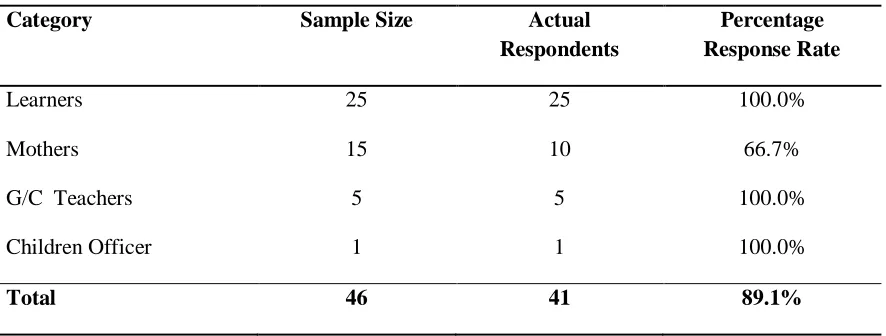
A sizable number of the respondents targeted gave their responses to the research
instruments. Table 4.1 shows the statistics of the respondents who gave their responses.
Table 4.1: Responses by the Respondents
Category Sample Size Actual
Respondents
Percentage Response Rate
Learners 25 25 100.0%
Mothers 15 10 66.7%
G/C Teachers 5 5 100.0%
Children Officer 1 1 100.0%
Total 46 41 89.1%
According to Table 4.1, the actual respondents was 41 in relation to the sample size
which was 46. This was an average response rate of 89.1% which was considered
4.3 Sample Demographics
This section analyses the characteristics of the subject of the study. The researcher sought
to determine the gender of the respondents of the study. The findings of the study were as
tabulated in Figure 4.1.
Figure 4.1: Gender of the respondents
Figure 4.1 shows that most of the respondents 57.14% were female while male
respondents accounted for 42.86%. The results indicate that there is violence to both men
and women as shown but the preference is more in women.
The study further sought to establish proportion of the children who come from homes
1 to 3 0%
3 to 5 0%
5 to 7 60% More than 7
40%
Figure 4.2: Prevalence of domestic violence
In the schools visited, it was found out that most of the teachers (60%) had between 5 and
7 children who come from homes where there is domestic violence, 40% had more than 7
children who come from homes where there was domestic violence in their classes. None
of the teachers had less than 5 children coming from homes where there was domestic
violence in their classes. The findings were corroborated to the mother’s, most of who
reported that they experienced domestic violence in their homes very frequently. The
findings thus indicate that domestic violence was very rampant in the location of study.
On the forms of behavior portrayed by the children who come from homes where there
was domestic violence, the researcher asked the teachers to state the forms of behavior
that such children portrayed. The teachers cited withdrawal, depression, hyperactivity,
anxiety, poor concentration and aggressive behavior as the most common forms of
behavior portrayed by the children who come from homes where there was domestic
4.4 Causes and Forms of Violent Behavior in Homes
Objective one sought to establish the possible causes and forms of violent behavior that
occur in most of the homes. When asked to identify the causes and the forms of violent
behavior witnessed in most homes, four respondents attributed their violence to drug and
substance abuse; they had these to say,
1st …my husband always comes home very late at night drunk and insists that he should not be questioned.
2nd …he secretly smoked bhang and sniffed tobacco
3rd …my husband’s drinking has made him too weak to do any work 4th …he drinks and sells alcohol and bhang
Three of the respondents attributed their domestic violence to economic disparities, these
was what they said:
1st …every time he secures a loan my husband abandons my children and I and goes to live with another woman in town
2nd `…he has refused to provide for the family 3rd …he has refused me to be in any employment
Two of the respondents have attributed their domestic violence to power struggle. They
said:
1st …he controls my pay slip and does not want me to handle any money
2nd …he regularly fights me and my children as he demands to know who he was in the family.
One respondent attributed her domestic violence to discrimination against women. She
said:
…he always told me that my duty in their family is to give birth, bring up the children and work for the family.
From the respondents voices who were interviewed on 24th and 25th march 2015 most of
the respondents attributed domestic violence to drug abuse followed by economic
disparities, power struggles within the family and lastly to discriminatory cultural norms.
power relation and pervasive discrimination between men and women in both public and
private spheres (United Nations, 1993), patriarchal disparities of power, discriminatory
cultural norms and economic inequalities which deny woman’s human rights and
perpetuate violence (Krug et al, 2002). This together with the fact that women are
socialized to accept, tolerate and even rationalize it as they remain silent about the
experiences (Zimmerman, 1994) increase the chances of domestic violence when the
women appears to resists the roles expected of them.
On the forms of domestic violence, the researcher requested the respondents to say the
most common forms of domestic violence experienced. Four of the respondents described
their experiences as physical violence. Their statements being as follows;
1st …my husband usually beats me when he comes home drunk 2nd …he calls me all sorts of abusive names as he fights me
3rd …many times at night my children and l are woken and closed outside in the cold when he came home drunk
4th …if he finds food cooking its hit and spilt all over as he fights everyone
Three of the respondents’ statement reflected psychological torture.
1st …he always eat out claiming that am not capable of cooking for a husband 2nd …he refuses to talk to me for no genuine reason
3rd …he usually compares my beauty with other women and says am unkempt
Two of the respondents’ statement revealed sexual harassment
1st …he demand for sex in the presence of the children 2nd …he accuses me of adultery
One respondent’s statement reflected economic struggle within the family
…he refuses to provide for his family needs
From the statements made by the respondents as interviewed on 24th and 25th of March
2015 most mothers experienced cases of physical violence in their homes followed by
violence takes many forms. These findings are supported by (Bagshaw et al, 2011) who
argues that wide form of domestic violence includes physical, sexual, physiological and
economic violence. In addition, the cases of domestic violence can occur from the very
start of life, through childhood, marriage, and into old-age (Krug et al., 2002).
On the frequency of children witnessing domestic violence in their homes, children gave
the responses as summarized in Figure 4.3.
Figure 4.3: Frequencies of children witnessing domestic violent behavior
The information in Figure 4.3 indicates that most 39%, of the children witnessed
domestic violence in their homes frequently, 31% always, 25% rarely and only 5% of the
children witnessed domestic violence very rarely. The findings indicated that the chances
of children witnessing domestic violence are high. This implied that domestic violence
impacts on a large number of children and the impact was big owing to the high
When asked whether witnessing domestic violence affects the children’s school going
routine, Figure 4.4 summarizes the responses obtained.
Figure 4.4: Effect of witnessing domestic violence on school going routine
As displayed in Figure 4.4, most mothers 90% were of the opinion that children’s school
going routines are affected after witnessing domestic violence and only 10% of the
parents were of the contrary opinion. The findings therefore imply that children’s
education is affected when they witnessed domestic violence in their homes. The findings
were supported by UNICEF (2006) which report that an estimate of 275 million children
globally experience violence in their homes. Further, the findings concur with those of
Barr & Parret (2001) that even though the abuse may not be directed to the children, its
effects may result to emotional, physical and behavioral ramifications during childhood
and in later years and may be expressed in the academic achievements and even when
4.5 Impact of Violence on Children’s Academic Performance
Objective two sought to determine whether and to which extent the adverse effects of
exposure of domestic violence to children is replicated in their academic achievements.
Figure 4.5 displays the responses obtained when the teachers were asked to state whether
children who experience domestic violence in their homes are adversely affected
academically.
Figure 4.5: Impact of exposure to domestic violence on academic performance
The findings indicate that most of the respondents (80%) said that children who witness
domestic violence in their homes are adversely affected academically and only, 20%
were of the opinion that the children were not adversely affected academically. Further,
the teachers were asked to identify the nature of impact that exposure to domestic
violence has on children’s academic performance. Most of the teachers cited chronic
school failure, attainment of below average grades, poor grade retention, incomplete
homework, absenteeism, poor concentration and school dropouts as the negative effect of
Vaughn, Levy et al., (2002) that children witnessing or experiencing domestic violence
score in the low-average range on measures of intelligence. In addition, Kerr, et al.,
(2006) opines that children who witnessed domestic violence have a problem with
chronic school failure, below average grades, grades retention, low high school
graduation rates, drop outs and absenteeism. Those with externalizing disorders have a
high risk of school failure as well as difficult in concentrating and doing school work.
4.6 Coping Strategies Applied By Schools
Objective three sought to identify the type of coping strategies adopted by children who
are exposed to domestic violence. The mothers were asked to identify ways through
which children who are exposed to incidents of domestic violence cope with their peers
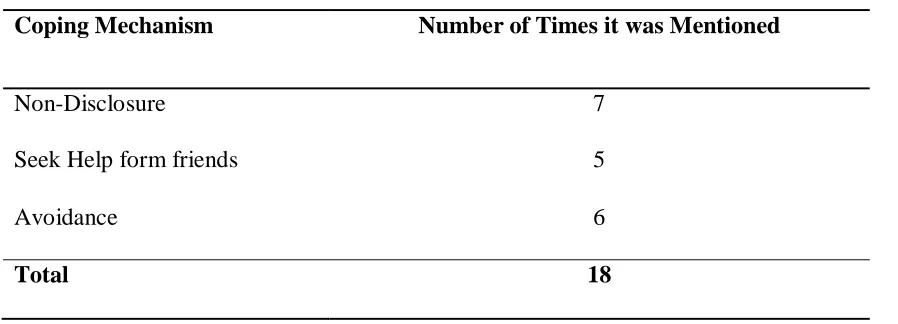
both at home and at school. Table 4.2 lists down the coping mechanisms cited.
Table 4.2: Coping Mechanisms Adopted
Coping Mechanism Number of Times it was Mentioned
Non-Disclosure 7
Seek Help form friends 5
Avoidance 6
Total 18
From the respondents’ voices in Table 4.2, non-disclosure is the most common coping
mechanism adopted by the pupils followed by seeking help from friends and avoidance
respectively. The findings were supported by those of Buckley et al; (2006); McGee,
(2002) who posit that children in conflicts families just like their mothers are reluctant to
confidentiality may prevent them from approaching teachers or other authority. This is
supported by Buckley et al; (2006) who said that these children and young people are likely to seek help from friends, friend’s parents and other family members. The authors
are of the opinion that disclosure serves to break down the secrecy that perpetuates
domestic violence, creates awareness of learners experience of violence and its impact on
their children’s behavior.
Buckley et al; (2007) underscores the importance of guidance and counseling program in
helping children develop good coping strategies, they posit that this helps to purge
embarrassment and fear of being bullied by peers or friends in school and avoid
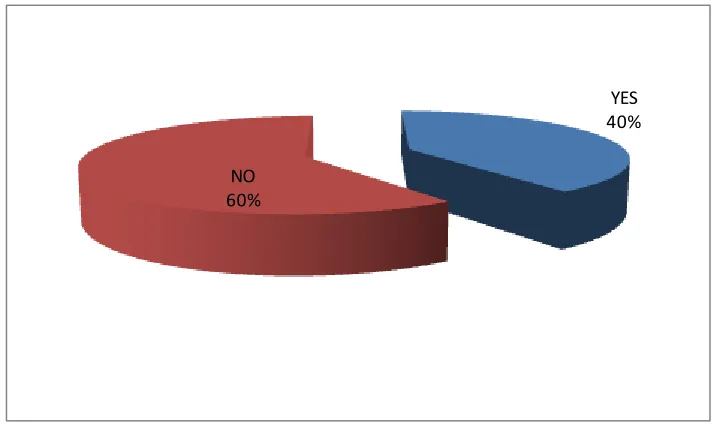
stigmatization. The study sought to establish whether the schools have operational
guidance and counseling program to cater for the children exposed to domestic violence.
The responses were as summarized in Figure 4.6.
YES 40%
NO 60%
Figure 4.6: Presences of Guidance and Counseling Program
Information on Figure 4.6 indicates that in majority of the schools (60%) there are no