© 2015, IJCSMC All Rights Reserved
734
Available Online atwww.ijcsmc.comInternational Journal of Computer Science and Mobile Computing
A Monthly Journal of Computer Science and Information Technology
ISSN 2320–088X
IJCSMC, Vol. 4, Issue. 6, June 2015, pg.734 – 740
RESEARCH ARTICLE
An Effective Resource & Infrastructure
Supervision of Result System (ERIS-RS)
for QoS in Cloud Computing
1
Faraz Ur Rehman Quazi,
2Nishant Sinha
1P.G. Student, M.E. Information Technology, Medi-Caps Institute Of Science & Technology, A.B.Road
Pigdamber, Rau Indore, India
Mobile: 9806886806
Abstract - Cloud computing is a business solution based environments which supports scalable computing on demand for the end user. Here the users demanded QoS resources can be provided with the help of cloud models. Mainly the models deal with infrastructure, platform and software with distributed and parallel processing plays the multiplexer role. The system primarily uses virtualization technology to cope with the computing needs. By using virtualization dynamic resource requirements can be handled with service optimizations. Sometimes this dynamic resource handling suffers from the performance and utilization issues due to their heterogeneous environments and availability. For effectively allotting the resources to different process, they must be analyzed previously for detecting their occupancy and residual means. Servers are continuously monitored for detection of overutilization and underutilization for understanding the loads of the system. Over the last few decades the grid has evolve form Globus based system to Nephele architecture for processing the parallel and distributed jobs. This work suggests the improved QoS scheduling and job execution environments for traditional resource handling approach using ORM-DS (optimized Resource Management Decision System). It also manages and monitors the dynamic allocation and deallocation. The proposed approach is having 7 step process model starts with client request and ends with the gird based resources to the applications as per the requirements. It is based on hierarchical structure of their utilizations with a heuristics support for decision making. In future the trace driven simulations and experimental results demonstrates the good performance.[1,2]
Keywords - Resource Handling, Cloud Computing, Grid Computing, Effective Resource & Infrastructure Supervision of Result System (ERIS-RS), QoS (Quality of Service).
I. INTRODUCTION
QoS as the dispersed model and handling is getting ubiquity is the business sector, dealing with cloud is obligatory. Asset administration is imperative and complex issues in distributed computing environment. It gets to be more intricate when assets are dispersed topographically with heterogeneous environment and are dynamic in nature. [3]
There is a need of distributed computing that reacts to different demands all the more rapidly. For that there are different methodologies proposed beforehand to enhance asset gathering in view of criteria, for example, defer, transmission capacity and semantics to choose the assets all the more rapidly and fittingly. Alongside that they likewise give the new introduction of applying diverse booking strategy on these parallel mists. Managing these shifting asset appeal and gadgets are termed as the territory of element asset portions (DRA). QoS manages the virtualization of machines which cloud be moved successfully on any host for serving the parallel preparing. Virtual machine screens is the controlling component intended for treatment of the element asset prerequisites of the cloud. It ought to likewise bolster the versatile nature and can have the capacity to extend or pack according to the administration necessities. The element results affirmed that the virtual machine which stacking gets to be too high it will naturally moved to another low stacking physical machine without administration intrude. What's more, let aggregate physical machine stacking coming to adjust. It is however vague whether this procedure is suitable for the current issue and what the execution ramifications of its utilization are.
This work underlines on tractable answer for booking applications in people in general cloud. In the same system gets to be substantially less practical in a half breed cloud setting because of high comprehend time differences. In the cloud model is relied upon to make such practice superfluous by offering programmed scale all over because of burden variety. It additionally saves money on power which adds to a critical segment of the operational costs in expansive server farms. The arrangement likewise incorporates an arrangement of heuristics that anticipate over-burden in the framework adequately while sparing vitality utilized. It follows driven reenactment and analysis results show that our calculation accomplishes great execution.[4]
Unwavering quality is one of the basic objectives of any appropriated framework. Typically equipment dependability is accomplished through repetition of gear. In Cloud the basic programming innovation offers more than equipment based dependability. The Cloud administration programming resubmits a vocation to substitute machines if there should arise an occurrence of disappointments or for some situation a basic work's various examples are executed over diverse machines.[5]
II. LITERATURE SURVEY
Models Amid the most recent couple of decades there are different methodologies created and dissected for planning purposes. Beginning with the working framework improvements took after by Cloud arranged methodologies and the late backing from distributed computing. Among them those which are relating with the work is taken around here as writing study and compressed as:
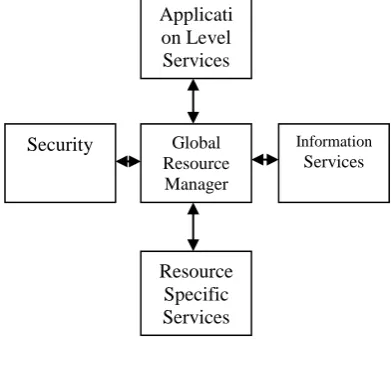
In the paper [6] the circulated assets' taking care of is measured for elite applications. These applications utilize high velocity systems to incorporate supercomputers, expansive databases, archival capacity gadgets, propelled visualization gadgets, and/or logical instruments to shape arranged virtual supercomputers or meta-PCs. The Globus framework is expected to accomplish a vertically incorporated treatment of utilization, middleware, and system. A low-level tool compartment gives essential instruments, for example, correspondence, confirmation, system data, and information access. These components are utilized to build
Applicati on Level Services
Resource Specific Services
Security Information
Services Global
Resource Manager
(GRM)
Figure 1: Cloud Based Global Resource Management
© 2015, IJCSMC All Rights Reserved
736
different larger amount meta-figuring administrations, for example, parallel programming instruments and schedulers. The objective with the paper is to fabricate an Adaptive Wide Area Resource Environment (AWARE), a coordinated arrangement of more elevated amount benefits that empower applications to adjust to heterogeneous and rapidly evolving meta-processing situations.
The paper [7] proposed a Condor-G device which is upgraded structure with specific alterations in Globus instrument to control the sudden development in figuring and stockpiling assets. It permits clients to tackle multi-area assets as though they all have a place with one individual space. Predominantly it manages work administration, asset choice, security, and adaptation to non-critical failure. It serves three prerequisites for actualizing the Clouds:
(i) They need to have the capacity to find, get, and dependably oversee computational assets alterably, over the span of their regular exercises.
(ii) They would prefer not to be irritated with the area of these assets, the components that are obliged to utilize them, with staying informed regarding the status of computational assignments working on these assets, or with responding to disappointment.
(ii) They do think about to what extent their undertakings are prone to run and how much these errands will cost.
In this manner the Condor-G framework influences the critical advances that have been attained to lately in two particular regions: (1) security, asset revelation, and asset access in multi-space situations, as bolstered inside the Globus Toolkit, and (2) administration of processing and outfitting of assets inside a solitary managerial area, particularly inside the Condor framework. The client characterizes the assignments to be executed; Condor-G handles all parts of finding and procuring proper assets, paying little mind to their area; starting, observing, and overseeing execution on those assets; recognizing and reacting to disappointment; and informing the client of end. The outcome is a capable apparatus for dealing with a mixed bag of parallel reckonings in Cloud situations. [8]
The paper [9] covers a portion of the propelled themes with Cloud advancement, for example, execution of virtualization in working frameworks. It is helpful in numerous situations: server combining, virtual test situations, and for Linux aficionados who still can't choose which conveyance is best. One of its late advancement illustration are Kernel-based Virtual Machine, or kvm, is another Linux subsystem which influences these virtualization expansions to include a virtual machine screen (or hypervisor) ability to Linux. Utilizing kvm, one can make and run various virtual machines. These virtual machines show up as ordinary Linux forms and incorporate flawlessly with whatever remains of the framework.
Dryad [10] is a broadly useful dispersed execution motor for information parallel applications that consolidates computational vertices with correspondence channels to shape a dataflow diagram. Dryad runs the application by executing the vertices of this chart on an arrangement of accessible PCs, conveying as fitting through records, TCP pipes, and imparted memory FIFOs. The vertices gave by the application designer are very basic and are normally composed as successive projects with no string creation or locking. Concurrency emerges from Dryad planning vertices to run all the while on different PCs, or on numerous CPU centers inside a PC. The application can find the size and situation of information at run time, and adjust the chart as the reckoning advances to make effective utilization of the accessible assets. The Dryad execution motor handles all the troublesome issues of making a huge circulated, simultaneous application: booking the utilization of PCs and their CPUs, recuperating from correspondence or PC disappointments, and transporting information between vertices.
The paper [12] addresses the issue of planning simultaneous occupations on bunches where application information is put away on the figuring hubs. This setting, in which booking processings near to their information is pivotal for execution, is progressively normal and emerges in frameworks, for example, MapReduce, Hadoop, and Dryad and numerous Cloud-figuring situations. This paper presents an effective and adaptable new system for booking simultaneous disseminated employments with fine-grain asset imparting. The booking issue is mapped to a diagram information structure, where edge weights and limits encode the contending requests of information territory, decency, and starvation-opportunity, and a standard solver figures the ideal online calendar as per a worldwide expense model. The paper additionally gives an assessment usage of this structure, called as Quincy. It improves decency when reasonableness is asked for, while considerably enhancing information territory.
III. PROBLEM DEFINITION
Cloud gives a self designed registering with gigantic information underpins by appropriated and parallel handling. For applying the things for all intents and purposes the circulated ideas are concentrated on altogether. It predominantly incorporates matrix and cloud based innovations where the asset and their heap enhancements relies on upon different variables and needs to be overseen all the while. Among them most helpful is asset taking care of and assignments because of its heterogeneous executions. Successful asset taking care of is the key territory of work for element portion and taking care of utilizing parallel preparing. Presently, in the wake of contemplating the different exploration articles, there are different course of work had been found.[13] Majorly the ranges where the greater part of the distributed computing execution for asset usage depends are burden appropriation, overseeing and checking assets, planning and employment lining, doable asset gauges with application needs and so on. The cloud asset administrations and element solicitation taking care of for assets depends of booking and recuperations.[14,15] In planning the main considerations which assumes an imperative part in change of parallel handling is asset revelation, framework choice & work execution. Among them are the imparting of assets among numerous clients, the reliance in the middle of errands and the conceivable utilization and creation of vast information sets. As a component of the asset portion issue one may likewise need to consider parallel applications and their uncommon needs, for example, what number of processors and what sort of system interconnects are expected to acquire great execution.[16] There are a portion of the distinguished zone of work is identified as the issue may be:
Situation: Existing methodologies does not manages the element data mapping. Because of that the execution environment needs with complete data accessibility for controlling the element asset assignment and reallocation. Data needed for complete examination of asset uses are:
(i) Load
(ii) Job Queue Length (iii) Job Submission Servers (iv) Data Transfer Server
(v) Constrained Scheduling Information's
Subsequently for viably measuring and foreseeing the assets improvements above elements are important which leads towards changes in burden shirking, asset taking care of and planning and will handle concealed mapping.
IV. PROPOSED SOLUTION
This Overseeing assets dependably drives towards enhancing the gadget conditions and will raises the standard of the framework. For outsider flexible figuring offered by cloud, improving the assets with their ceaseless observing is an essential errand. Despite the fact that, the straightforward choices in some cases demonstrates high multifaceted nature for fine grained access control of information. Along these lines, if the inhabitance of the assets are not measured and checked frequently, it will debase the future execution of client's application arrangements. This work points towards determining the above issues of asset administration utilizing a novel Effective Resource Supervision of Result System (ERS-RS)
© 2015, IJCSMC All Rights Reserved
738
The QoS issue of booking has been intended for static, homogeneous group setups and ignores the specific way of a cloud. Therefore some processing may include the advantages connected with the viable and element asset administrations. Cloud planning includes booking of assets over distinctive and scattered areas. This may include asset seeking on various regulatory areas to achieve a solitary machine or a solitary managerial area for numerous or single asset. As specified before we are centering our examination on Cloud scheduler or agent which needs to settle on booking choices on a situation where it has no influence over the neighborhood assets and this planning is nearly connected with GIS.
Description of Model :
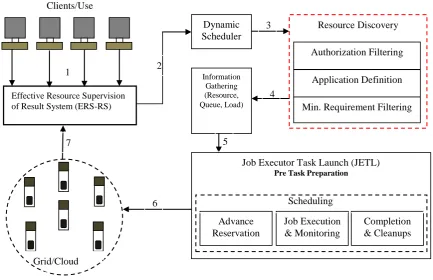
The proposed model or ERS-RS is a seven stage model includes demand, disclosure, data preparing, undertaking and occupation administration, asset group administration and the complete choice for powerful examination. The step insightful operations are given as:
Step 1 : Client or the client makes the introductory solicitation to the framework. It implies the application has asked for specific assets for QoS.
Step 2 : ERS module and choice making framework gets this solicitation and performs asset planning through a scheduler. As the necessities may differ with time thus the scheduler is of element nature.
Step 3 : The dynamic scheduler later on advances the solicitation to asset revelation module. This module begins its operations with approval separating which includes the confirmation of the client submitting occupation. This decides the entrance of client on the craved asset. This method is very little not quite the same as the conventional method for remote approval i.e. the employment would not be allowed to execute if the client has no entrance on that asset. The following venture after approval is the particular of the necessities given by the client. This may incorporate some static data, for example, working framework or much element data, for example, memory. Yet in the Cloud environment it is exceedingly conceivable that application prerequisites may change as indicated by the coordinated target asset e.g. contingent upon the framework structural planning the memory and registering necessities may change. After approval and prerequisites detail, next step includes the filtration of assets which don't meet the base necessity criteria of client application.
Effective Resource Supervision of Result System (ERS-RS)
Clients/Use rs
1 2
Resource Discovery
Authorization Filtering
Application Definition
Min. Requirement Filtering Dynamic
Scheduler
Information Gathering (Resource, Queue, Load)
3
4
5
Grid/Cloud Server
Job Executor Task Launch (JETL)
Pre Task Preparation
Advance Reservation
Job Execution & Monitoring
Completion & Cleanups Scheduling
6 7
Toward the end of this step the scheduler will have the rundown of the assets for subtle element examination and revelation.
Step 4 : QoS based stage incorporates gathering of this data as for a few parameters of lining demand, burden and asset accessibility.
Step 5 : This aggregate data is later on gone to employment agent undertaking dispatch (JETL) motor. It does the pretask arrangement needed for element asset taking care of and making their employment in a planned way. Amid this planning three more sub operation are performed which holds the asset needed for particular application to stay away from gridlocks. Next is the occupation agent and observing which measure the execution of gadget with solicitation to process size. Last is the brief document cleaning for passing all the transitional record.
Step 6 : The above distinguished results are changed to the physical asset networks for administration the applications demands.
Step 7 : Finally an article containing all the asset, their execution surroundings and their planned direction is return back to the ERS choice framework for administration the clients requests.
These steps are fundamentally the same to the steps included in customary registering standard. In any case these steps are completed considering the extremely dynamic nature of Cloud environment. So by watching the above proposed system on starting test outcome component's we can undoubtedly improve the capacities of Cloud through the ERS-RS approach.
V. CONCLUSION
The above work builds up an ERS-RS asset portion framework that can keep away from over-burden in the framework adequately for QoS while minimizing the quantity of servers and different gadgets utilized. The work had likewise acquainted an idea with measure the uneven usage of a server. By minimizing underutilizations and over-usages through our planned modules, change is normal in multi-dimensional asset imperatives and provide effective QoS.[17]
ACKNOWLEDGEMENT
Through this acknowledgement, I express our sincere gratitude to all those people who have been associated with this paper and have helped us with it. I sincerely thank to respected sir Mr. Nishant Sinha, Guide who have cooperated with me at different stages during the preparation of the paper.
REFERENCES
[1] A. F. Leite, C. Tadonki, C. Eisenbeis, T. Raiol, M. E. M. T. Walter and A. C. M. A. D. Melo, ”Excalibur:
An Automatic Cloud Architecture for Executing Parallel Applications”, ACM, ISSN: 978-1-4503-2714-5/14/04, April 2014, doi: 10.1145/2592784.2592786
[2] M.S.B.Pridviraju & K.Rekha Devi, “Exploiting Dynamic Resource Allocation for Query Processing in the
Cloud Computing”, in International Journal of Computer Science and Information Technologies (IJCSIT), ISSN: 5206 – 5209, Vol. 3 (5) , 2012,
[3] K.Krishna Jyothi , “Parallel Data Processing for Effective Dynamic Resource Allocation in the Cloud”, in International Journal of Computer Applications (0975 – 8887) Volume 70– No.22, May 2013
[4] Yagız Onat Yazır, Chris Matthews, Roozbeh Farahbod, Stephen Neville, Adel Guitouni, Sudhakar Ganti and Yvonne Coady,”Dynamic Resource Allocation in Computing Clouds using Distributed Multiple
Criteria Decision Analysis”, in IEEE July 2010, E-ISBN : 978-0-7695-4130-3 [5] Ian Foster and Carl Kesselman, “Globus:A Metacomputing Infrastructure Toolkit”, yInformation Sciences
Institute, University of Southern California.
[6] James Frey, Todd Tannenbaum, Miron Livny, Ian Foster and Steven Tuecke, “Condor-G: A Computation
Management Agent for Multi-Institutional Grids”, University of Wisconsin Argonne National Laboratory,Madison.
[7] Ewa Deelmana, Gurmeet Singha, Mei-Hui Sua, “Pegasus: A framework for mapping complex scientific
workflows onto distributed systems”, Scientific Programming, IOS Press, ISSN:1058-9244/05, 2005 [8] Avi Kivity, Yaniv Kamay, Dor Laor, Uri Lublin and Anthony Liguori, “kvm: the Linux Virtual Machine
© 2015, IJCSMC All Rights Reserved
740
[9] Michael Isard, Mihai Budiu, Yuan Yu, Andrew Birrell and Dennis Fetterly, “Dryad: Distributed
Data-Parallel Programs from Sequential Building Blocks”, in ACM, doi: 978-1-59593-636-3/07/0003, 2007 [10]Yuan Yu, Michael Isard, Dennis Fetterly, Mihai Budiu, Úlfar Erlingsson, Pradeep Kumar Gunda and Jon
Currey, “DryadLINQ: A System for General-Purpose Distributed Data-Parallel Computing Using a
High-Level Language”, in 8th USENIX Symposium on Operating Systems Design and Implementation
[11]Michael Isard, Vijayan Prabhakaran, Jon Currey, Udi Wieder, Kunal Talwar and Andrew Goldberg,
“Quincy: Fair Scheduling for Distributed Computing Clusters”, in Microsoft Research, Silicon Valley — Mountain View, CA, USA
[12]Hung-chih Yang, Ali Dasdan, Ruey-Lung Hsiao and D. Stott Parker, “Map-Reduce-Merge: Simplified
Relational Data Processing on Large Clusters”, in ACM, doi: 978-1-59593-686-8/07/0006, 2007
[13]Chaiken, R., Jenkins, B., Larson, P., Ramsey, B., Shakib, D., Weaver, S., and Zhou, “SCOPE: Easy and
Efficient Parallel Processing of Massive Data Sets”, in PVLDB, 2010
[14]Ioan Raicu1, Ian T. Foster and Yong Zhao, ―Many-Task Computing for Grids and Supercomputers‖, in IEEE, ISSN: 978-1-4244-2872-4/08, 2008
[15]Daniel Warneke and Odej Kao, “Nephele: Efficient Parallel Data Processing in the Cloud”, in ACM, ISSN: 978-1-60558-714-1/09/11, 2009
[16]Dominic Battré, Stephan Ewen and Fabian Hueske, “Nephele/PACTs: A Programming Model and
Execution Framework for Web-Scale Analytical Processing”, ACM, ISSN: 978-1-4503-0036-0/10/06, 2010 [17]Daniel Warneke and Odej Kao, “Exploiting Dynamic Resource Allocation for Efficient Parallel Data