Available online: https://edupediapublications.org/journals/index.php/IJR/ P a g e | 1578
Location Tracking System: CAN and Wi-Fi-based Implementation in
Automobiles
Ayush Sharma1, Mamta Mittal*,2,Aakash Saini3 Shweta Singh4, Siva Sai Pavan5
1,3,4Department of Electronics and Communication Engineering
Maharaja Surajmal Institute of Technology, GGSIPU, New Delhi, India
2Department of Computer Science and Engineering
G.B. Pant Govt. College of Engineering, GGSIPU, New Delhi, India * Corresponding Author: [email protected]
Abstract—This paper deal with the integration
of CAN with the latest communication technology of Internet Of Things between two nodes. The application of digital data acquisition includes a real-time data transfer from a GPS Sensor and further transmission the retrieved data via CAN Bus and finally displaying it over the internet through the technology of Internet of Things.The Controller Area Network (CAN) is a serial, asynchronous, multi-master communication protocol which is mainly used for the interconnection of electronic modules,especially in automation based industries. The paper also elucidates how CAN provides the user the ability to implement automotive applications ensuring high data integrity along with high data rates up to 1 Mbits/sec. The main aim of the paper is to integrate the knowledgeof Internet of Things with embedded systems. This concept virtually encapsulates every possible requiredobject under a single network where the connected objects could communicate among themselves resulting in a highly efficient interconnected system aiming at improvising human life and related tasks.
Keywords—CAN Bus, Internet of Things, location tracking
1. INTRODUCTION
The ARM® Cortex®-M4 is a powerful processor regarding its processing capabilities. The processor is capable of manipulation some floating operations, efficient signal processing operations, high-efficiency processing and requires low dynamic power. The CAN or Controller Area network is a powerful alternative to the complex wirings within the complex systems for implementing serial
communication, especially in automation based industries. Combining the abilities of the ARM-based processors and utilities of CAN Communication, one could easily develop high
efficient subsystems. Considering such
conventional systems, the major limitation lies in the communication protocols and technologies used. Replacing the conventional wired connections with wireless communication technology could turn such conventional systems or subsystems into highly reliable and much more efficient solutions which could have the ability to communicate via theinternet or wireless means.
In work done by Perry et al. [1], there has been a description of theinternet of thingsand the methodology for its implementation.There has been a study on the implementation of CAN communication for avehicle-based communication network in publications by Wei et al. [2]. A paper by Meinel et al. [3] implements and explains the CAN bus messages transfer among computer systems via the internet in the form of digital data. There has been an extensive study and implementation of CAN-bus communication among hardware structuresin work done by Cao et al. [4]. An ideal approach for navigation and tracking has been addressed by Seitz et al. [5] via Wi-Fi networks. In the research by Liu et al. [6], wireless-enabled tracking methodology has been explained
Section 2 casts the light on the literature survey, the detailed information on the CAN network, IOT along with hardware and software implemented for the research work has been illustrated under this
section. Proposed design and control
Section 4 concludes the paper while highlighting thefurther scope of the work done in the future.
2. LITERATURE SURVEY
2.1 CAN NETWORK
The CAN bus, which plays the role of the physical transmission medium interconnects the CAN nodes which includes CAN interfacing of the
nodes in the manner of a line topology. In certain scenarios, the star bus topology is preferred completely depending on the requirements. Bus transmission resistors are used at the ends of the transmission lines where the hardware transmission line includes an unshielded twisted pair cable based on the symmetrical signal transmission. The maximum number of CAN Nodes is defined by the ISO 11898 and the fixed number is set as 32. Typical schematic of a CAN is depicted in figure 1.
Figure1: CAN Network Schematic
2.2 CAN BUS & IOT
The CAN Network transmission involves the concept of “differential signal transmission” which helps in reducing the interference voltages. Considering the broader aspect of the CAN Bus, we have following two transmission media:
A: CAN High B: CAN Low
The idea of using twisted pairs originated from the fact that twisting causes the reduction of magnetic fields. Moreover, termination resistors help in reduction of reflections. The characteristic impedance of the CAN Line plays the role of a key parameter. ISO 11898-2 corresponds to high speed
CAN whereas, ISO 11898-3 corresponds to the low speed. Extending the idea protocol decomposition, the CAN Protocol is also decomposed in several essential layers.
Available online: https://edupediapublications.org/journals/index.php/IJR/ P a g e | 1580
The most recent and highly developing wireless communication technology is the very “Internet of Things”. Connect your things to the internet and you have your internet of things. The sensor part of the IOT network captures the data the user requires, the network connectivity ensures the connection between the sensor and the client and the storage, which is the cloud service keeps that data in unprocessed or sometimes in a processed manner.
2.3 HARDWARE
STM32F407: One of the powerful ARM
Cortex-based board with 32 bit RISC Cortex-based system working with a frequency of 72MHz. With advanced communication interfaces of I2C & SPI, including USART & UART, the board could be utilized ideally for communication purposes.
NEO-6M: Features in NEO-6M makes it highly
reliable as GPA sensor. The sensor could be well used with a battery operated devices which provides user numerous options regarding connectivity. Major applications of the stated GPS sensor includes detection of real-time position and manipulating them and displaying the current orientation of the device.
MCP2551: The MCP2551 ensures the
connectivity between the CAN controller and the physical bus of the subsystem and thus, acts as the interface between the two. The exact requirement of such interface arises with the fact that the digital signals from the CAN controller need to be converted to the form such that the signals could be transmittedto the bus unit. Additional features including the support for 1Mbps operation, compatibility with 12v and 24v units
ESP 8266-12: Implementing wireless shall
require a network solution. This network solution shall play an essential role in hosting the application over the web. The same, when implemented as a wifi adapter, could successfully provide the internet access to possible all the microcontroller based system.
Other than this, there has been an extensive use of protocols, specifically communication protocols and two of them have been discussed as follows.
MQTT: This protocol is one of the essential
communication standards which stands for “MQ Telemetry Transport” which is a messaging protocol with features including being simple, fast and lightweight. A small, yet powerful protocol works with the aim of assuring the delivery of messages and could be well implied over the more recent technologies of M2M (Machine-to-Machine) and IOT(Internet Of Things). Ideally, requirements with lesser capabilities and low-bandwidth necessities are very much suitable for the stated protocol.
Universal Synchronous Asynchronous
Receiver Transmitter (USART): One of the best
approach to implement thefull-duplex technique of exchange of data via the methodology of NRZ asynchronous serial data format. All major communication types have been supported via USART which includes synchronous one-way communication and Half-duplex Single-wire communication, as well as multiprocessor communications.
2.4 SOFTWARES
Along with hardware components and the protocols implementation, software is equally essential for any subsystem/system designing. The work proposed by the paper includes following software types for the development of automobile location tracking system.
Keil IDE: This development tool [7] majorly
deals with the issues faced by the embedded software developers. The built-in examples enable the users to have a great start with the tool.
The debugger simulates the on-chip peripherals with ahigh level of accuracy which helps in
understanding the overall working and
configurations to a great extent. The simulation-based analysis enables the user to understand the system’s configuration and the user also gets the flexibility to test the applications on avirtual basis.
Arduino IDE: Arduino [8], being lightweight
and easy to program, is extensively used for numerous applications. This paper deals with the
ESP8266.Certain factors like therobust language of Arduino, fast speed, reliable, and freeware makes Arduino a very safe and ideal choice for the work the paper is dealing with.
Use of Arduino not only fulfills the requirements of the paper, but will also play a crucial role in thecontext of the future scope of the related field. Modifying the system and modeling it as a user-controlled system could provide much more efficient usage.
3PROPOSED DESIGN AND FLOW CHART
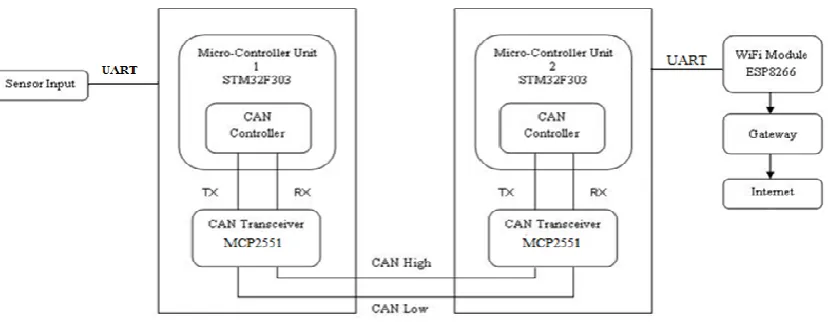
As per the block diagramis shown in figure 2, NEO-6M GPS SENSOR is used as the sensor which sends data periodically to the controller. This sensor is using serial communication i.e. UART to send the position of the vehicle to the STM32F407 microcontroller development board.
Figure 2: Block Diagram of the proposed model
This sensor data is sent to the first CAN node. CAN implementation require CAN controller which is also present on the development board. Another requirement is CAN transceiver which is MCP2551 connected to the controller. ESP8266 Wi-Fi module (Node-MCU) is interfaced to second CAN node (another STM board) which is connected to thegateway. One hotspot is used as the gateway to transfer the data to the Internet.
Two CAN nodes are connected through CAN bus which includes a set of twisted pair wires and two 120ohms terminating resistors at both ends. Each node involves a specific level of procedure
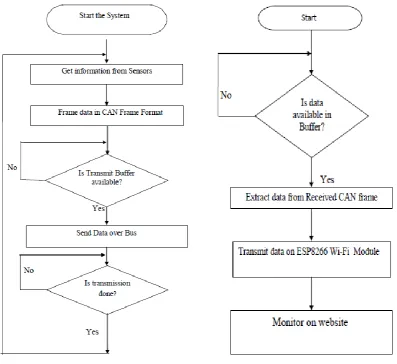
which could be well interpreted via a flowchart. Each node has been represented regardingflowchart as shown.
For node A, once the system is started, the sensor information is retrieved. Then, once the data has been framed, the system shall check for the available for the buffer, till it retrieves the positive response, the system shall keep on checking.
Later, the data has been sent over the bus and the final check on the completion of the transmission is checked. The check over the transmission is continuously verified each time the data has been sent over the bus.
Available online: https://edupediapublications.org/journals/index.php/IJR/ P a g e | 1582
Figure 3(a): Node A flowchart Figure 3(b): Node B flowchart
Now, considering the node B, first the data availability in the buffer is checked. In case the data is not available, the buffer is re-checked, but on the contrary in case the data is there, the data is then extracted from the CAN frame. This retrieved data is then transmitted to the wi-fi module (ie:ESP8266) and this data is finally monitored over the web. The flowchart for the node B is given as follows.
4. CONCLUSION
In this paper, inputs have been taken from GPS sensor which is sent using UART protocol to NGX
LPC1768 Blueboard, where a robust CAN network is implemented. Keil uVision software has been used for programming. CAN transceivers MCP2551 has been implemented for communicating between the LPC1768 and STM32F407 Discovery boards. Data from the STM32F407 Discovery board has been sent via UART to ESP8266 Wi-Fi module (NodeMCU). Programming for ESP8266-12 Wi-Fi module using MQTT protocol has been done using Arduino IDE software. Data from ESP8266 Wi-Fi
module has been sent to the broker
A further extension of this research work can be manipulating and controlling the system from a remote place from the information collected from sensors. This work can help the cab services like Uber, Ola, etc. to keep track of their drivers.
REFERENCES
[1] Perry S., Roda C. (2017) The Internet of Things. In: Human Rights and Digital Technology. Palgrave Macmillan, London
[2] Wei Z., Yang Y., Li T. (2016) Authenticated
CAN Communications Use Standardized
Cryptographic Techniques. In: Bao F., Chen L., Deng R., Wang G. (eds) Information Security Practice and Experience. ISPEC 2016. Lecture Notes in Computer Science, vol. 10060. Springer, Cham
[3] Meinel C., Sack H. (2014) Communication Fundamentals in Computer Networks. In: Digital Communication. X.media.publishing. Springer, Berlin, Heidelberg.
[4] Cao X. (2018) Verification of CAN-BUS Communication on Robots Based on Xmas. In:
Xhafa F., Patnaik S., Zomaya A. (eds) Advances in Intelligent Systems and Interactive Applications. IISA 2017. Advances in Intelligent Systems and Computing, vol. 686. Springer, Cham
[5]Seitz J. et al. (2011) Wi-Fi Attitude and Position Tracking. In: Heuberger A., Elst G., Hanke R. (eds) Microelectronic Systems. Springer, Berlin, Heidelberg
[6] Liu X., Sen A., Bauer J., Zitzmann C. (2008) A Software Client for Wi-Fi Based Real-Time Location Tracking of Patients. In: Gao X., Müller H., Loomes M.J., Comley R., Luo S. (eds) Medical Imaging and Informatics. Lecture Notes in Computer Science, vol. 4987. Springer, Berlin, Heidelberg.
[7]ARM KEIL, 1986 µVision® IDE of ARM KEIL
for windows x32 and x64 available:
http://www.keil.com/
[8] ARDUINO 1.8.5, 2017 by Arduino for Windows x32, x64 and Linux available: