Available online: https://edupediapublications.org/journals/index.php/IJR/ P a g e | 4036
Improvement of Value Procedures in Fixture Design by Lean
Assembling Techniques
Baloji Badavath & Dr. M. Indira Rani
Research Scholar JNTU Hyderabad MIST College, Sathupalli [email protected]
Assoc. Prof.
Mechanical Engineering JNTUH College of Engineering Hyderabad (Autonomous College) [email protected]
ABSTRACT:
This work presents an integral system for machining fixture layout design and optimization. The optimization module of this system allows determination of optimal positions of locating and clamping elements, which provides required accuracy and surface quality, while at the same time guarantees design of collision-free fixtures. The design module performs selection of required fixture elements based on a set of predefined production rules. Adequate criteria for the selection of fixture elements are defined for locating, clamping, tool guiding, and tool adjustment elements, as well as for fixture body elements, connecting elements and add-on elements. The system uses geometry and feature work-piece characteristics, as well as the additional machining, and process planning information. It has been developed to accommodate machining processes of turning, drilling, milling, and grinding of rotational and prismatic work-pieces. A segment of output results is also shown. Finally, conclusions are presented with directions for future investigation.
Keywords: artificial intelligence; fixture; process
planning
1.0INTRODUCTION:
Available online: https://edupediapublications.org/journals/index.php/IJR/ P a g e | 4037
is to become more efficient. This could be achieved by Lean Manufacturing. It helps us to achieve best quality, lowest cost, and shortest lead time through the elimination of waste. Waste is „anything other than the minimum amount of equipment, materials, parts, space, and worker‟s time, which are absolutely essential to add value to the product. line is related to over production, inventory, defects, transportation, motion, waiting which increases lead time. Lead time for a process decides cycle time for the product (Cycle time is the time required to complete single unit). Hence by using Lean Manufacturing methods we can optimize cycle time. This paper focuses on optimization of cycle time by line balancing. Lean Manufacturing, also called Lean Production, is a set of tools and methodologies that aims for the continuous elimination of all waste in the production process. The main benefits of this are lower production costs; increased output and shorter production lead times. More specifically, some of the goals include: In today‟s manufacturing environment, assembly work is routinely characterized by short production cycles and constantly diminishing batch sizes, while the variety of product types and models continues to increase. Constant pressure to shorten lead times adds to these demands and makes the mix truly challenging, even for the most innovative manufacturers. The ability to respond quickly to rapidly changing customer demands requires the use of manufacturing systems that can be re-configured and expanded on the fly, and which can accommodate advances in assembly techniques without making any initial manufacturing investments obsolete. Lean manufacturing, an approach that depends greatly on flexibility and workplace organization, is an excellent starting point for companies wanting to
take a fresh look at their current manufacturing methods. Lean techniques are also worthy of investigation because they eliminate large capital outlays for dedicated machinery until automation becomes absolutely necessary. Indeed, the concept of lean manufacturing represents a significant departure from the automated factory so popular in recent years. The “less is better” approach to manufacturing leads to a vastly simplified, remarkably uncluttered environment that is carefully tuned to the manufacturer‟s demands. Products are manufactured one at a time in response to the customer‟s requirements rather than batch manufactured for stock. The goal is to produce only the quantity required and no more. And since limited numbers of parts are produced, it may be necessary to change processes during the day--to accommodate different.
DEFINING OF LEAN:
Available online: https://edupediapublications.org/journals/index.php/IJR/ P a g e | 4038
and floor space than a traditional operation. These improvements are accomplished by eliminating non-value added activities, shortening manufacturing lead times, improving product flow, and establishing a process of continuous improvement
Cycle Times: Reduce manufacturing lead times
and production cycle times by reducing waiting times between processing stages, as well as process preparation times and product/model conversion times. Inventory levels: Minimize inventory levels at all stages of production, particularly works-in progress between production stages. Lower inventories also mean lower working capital requirement
2.0LITERATURE REVIEW:
As the customer needs product at higher quality, shorter delivery time, higher customer service level and lower price; companies adopt continuous productivity and quality improvement to survive in the increasingly competitive world market. To cater to this, line balancing and kaizen are effective approaches to improve the productivity and quality.
Aasheet Kumar et al. [1] have made use of
these approaches to improve the productivity on a Wire Harness. Assembly line of a company manufacturing wire harnesses for automobiles. They calculated balance rate before and after improvement to show the reduction in manpower requirement and increase in output. They also focused assembly line balancing and sequencing is an active area of optimization research in operations management.
Sandip K. Kumbhar et al. [2] studied the
analysis method like Process analysis, Work analysis, Motion analysis and Takt time for calculation the rate at which the product is required and calculated Takt time before and after the Kaizen. The cost of operation is reduced considerably. Optimization of cycle time study is helpful for low cost automation and bench marking activity at industry production improvement level.
Juthamas Choomlucksanaa et al. [3] had
improved manufacturing sheet metal stamping process to demonstrate how lean manufacturing can help improve work efficiency. Lean and other improvement tools and techniques such as visual control, Poka-Yoke, and 5s were applied to help companies identify areas of opportunity for waste reduction and improve the efficiency of production processes. Studies of the company processes showed that the deburring and polishing processes tend to create the most non-value added activities and should be addressed as quickly as possible.
Jafri Mohd Rohani et al. [4] implemented lean
manufacturing. They had used Value Stream Mapping (VSM) to improve the production line of a color industry for identification and elimination of wastes by using team formation, product selection, conceptual design, and time-frame formulation through takt time calculation.
Zupan H. et al. [5] optimized production line by
Available online: https://edupediapublications.org/journals/index.php/IJR/ P a g e | 4039
performance some further steps of the process optimization by using the improved simulation model are performed. The results of the combination of the line balancing and further process optimization raise the production rate of the process enormously, which is obvious from the research results of this paper.
Mr. Silva et al. [6] studied the recent adoption is
Lean Manufacturing in Apparel industry in Sri Lanka. The apparel industry faced considerable changes as a result of the removal of Multi Fiber Agreement in 2005. Delivering high quality garments at low cost in shorter lead times are the major challenges faced by the apparel manufacturers. In 2008, global recession badly affected almost all the apparel manufacturing industries in the world. Due to that demand for the low cost garments are increased by the customers. In order to face this global challenge, most of the local apparel manufacturers have adopted lean manufacturing techniques.
3.0METHODOLOGY:
FIXTURE POSITIONING PRINCIPLES:
In machining process, fixtures are used to keep work pieces in a desirable position for operations. The most important criteria for fixturing are work piece position accuracy and work piece deformation. A good fixture design minimizes work piece geometric and machining accuracy errors. Another fixturing requirement is that the fixture must limit deformation of the work piece. It is important to consider the cutting forces as well as the clamping forces. Without adequate fixture support, machining operations do not conform to designed tolerances. Finite element analysis is a powerful tool in the resolution of
some of these problems Common locating method for prismatic parts This method provides the maximum rigidity with the minimum number of fixture elements. A work piece in 3D may be positively located by means of six points positioned so that they restrict nine degrees of freedom of the work piece. The other three degrees of freedom are removed by clamp elements. An example layout for 2D work piece based 3-2-1 locating principle is The number of locating faces must not exceed two so as to avoid a redundant location. Based on the 3-2-1 fixturing principle there are two locating planes for accurate location containing two and one locators. Therefore, there are maximum of two side clamping‟s against each locating plane. Clamping forces are always directed towards the locators in order to force the work piece to contact all locators.
GENETIC ALGORITHM BASED FIXTURE LAYOUT:
Available online: https://edupediapublications.org/journals/index.php/IJR/ P a g e | 4040
layout. Since the GA deals with only the design variables and objective function value for a particular fixture layout, no gradient or auxiliary information is needed The flowchart of the proposed approach is given Fixture layout optimization is implemented using developed software written in Delphi language named GenFix.
INTRODUCTION TO DESIGN OF
FIXTURES:
Clamping need to be strong and rigid enough to hold the blank firmly during machining
Clamping should be easy, quick and consistently adequate
Clamping should be such that it is not affected by vibration, chatter or heavy pressure
The way of clamping and unclamping should not hinder loading and unloading the blank in the jig or fixture
the clamp and clamping force must not damage or deform the work piece
clamping operation should be very simple and quick acting when the jig or fixture is to be used more frequently and for large volume of work
clamps, which move by slide or slip or tend to do so during applying clamping forces, should be avoided
clamping system should comprise of less number of parts for ease of design, operation and maintenance
.the wearing parts should be hard or hardened and also be easily replaceable clamping force should act on heavy
part(s) and against supporting and locating surfaces
clamping force should be away from the machining thrust forces
clamping method should be fool proof and safe
4.0 results
Available online: https://edupediapublications.org/journals/index.php/IJR/ P a g e | 4041
Temperature variance at fixture 2
Temperature variance 3 at fixture
Effective stress of the fixture 1
Effective stress of the fixture 2
Available online: https://edupediapublications.org/journals/index.php/IJR/ P a g e | 4042
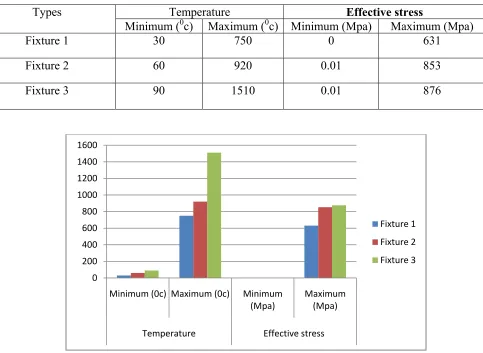
Table fixture maximum and minimum values
Types Temperature Effective stress
Minimum (0c) Maximum (0c) Minimum (Mpa) Maximum (Mpa)
Fixture 1 30 750 0 631
Fixture 2 60 920 0.01 853
Fixture 3 90 1510 0.01 876
Conclusions:
The investigation, presented in this paper, allowed formulation of basic prerequisites for the development of knowledge base which encompasses more functional groups of fixture elements, and reliable rules for the selection of fixture elements. Beside the selection of elements for locating and clamping, also featured by the existing CAFD systems, the proposed system additionally allows selection of: fixture body elements, tool guiding elements, tool aligning elements, connecting elements,
and a substantial number of add-on elements. In order to widely use the developed system for automated fixture design, it is necessary to complete the building of its knowledge base. Special attention should be focused on the development of additional production rule for the selection of securing elements (add-on elements), and elements for bridging height and length distances (add-on elements). The kinetic model of fixture considers work piece as a rigid, not elastic, body. In other words, the kinetic model does not allow for work piece deformations. Instead of examining all possible
0 200 400 600 800 1000 1200 1400 1600
Minimum (0c) Maximum (0c) Minimum (Mpa)
Maximum (Mpa) Temperature Effective stress
Available online: https://edupediapublications.org/journals/index.php/IJR/ P a g e | 4043
requirements, this investigation is focused on defining a general framework. Once the framework is established, it will be possible to identify, study, and integrate all other requirements into the proposed system.
References:
1. Aasheet Kumar et al. Combined contact elasticity and finite element-based model for contact load and pressure distribution calculation in a frictional work piece-fixture system. International Journal of Advanced Manufacturing Technology. 39, pp. 78-88. 2. Sandip K. Kumara et al. Deformation control through fixture layout design and clamping force optimization. International Journal of Advanced Manufacturing Technology. 38, pp. 860-867.
3. Jut Hamas Choomlucksanaa et al. Multi-objective optimization design of a fixture layout considering locator displacement and force– deformation. International Journal of Advanced Manufacturing Technology. 67, 5- 8 pp. 1267-1279.
4. Jafri Mohd Rohani et al. The application of neural networks in fixture planning by pattern classification. Journal of Intelligent Manufacturing. 8, pp. 307-322.
5. Zupan H. et al. a case-based reasoning fixture design method. Framework and indexing mechanisms. Journal of Computing and Information Science in Engineering. 6, pp. 40-48.
6. Mr. Silva et al. Using CBR to develop a VR based integrated system for machining fixture design. Assembly Automation. 30, pp. 228-239.