Electronic Thesis and Dissertation Repository
7-17-2017 10:00 AM
Data Science Solution for User Authentication
Data Science Solution for User Authentication
Anas Ibrahim
The University of Western Ontario
Supervisor
Dr. Abdelkader Ouda
The University of Western Ontario
Graduate Program in Electrical and Computer Engineering
A thesis submitted in partial fulfillment of the requirements for the degree in Master of Engineering Science
© Anas Ibrahim 2017
Follow this and additional works at: https://ir.lib.uwo.ca/etd
Part of the Computer Engineering Commons
Recommended Citation Recommended Citation
Ibrahim, Anas, "Data Science Solution for User Authentication" (2017). Electronic Thesis and Dissertation Repository. 4871.
https://ir.lib.uwo.ca/etd/4871
This Dissertation/Thesis is brought to you for free and open access by Scholarship@Western. It has been accepted for inclusion in Electronic Thesis and Dissertation Repository by an authorized administrator of
Abstract
User authentication is considered a key factor in almost any software system and is often
the first layer of security in the digital world. Authentication methods utilize one, or a
combination of up to two, of the following factors: something you know, something you have
and something you are. To prevent serious data breaches that have occurred using the traditional
authentication methods, a fourth factor, something you do, that is being discussed among
researchers; unfortunately, methods that rely on this fourth factor have problems of their own.
This thesis addresses the issues of the fourth authentication factor and proposes a data
science solution for user authentication. The new solution is based on something you do and relies
on analytic techniques to transfer Big data characteristics (volume, velocity and variety) into
relevant security user profiles. Users’ information will be analyzed to create behavioral profiles.
Just-in-time challenging questions are generated by these behavioral profiles, allowing an
authentication on demand feature to be obtained. The proposed model assumes that the data is
received from different sources. This data is analyzed using collaborative filtering (CF), a
learning technique, that builds up knowledge by aggregating the collected users’ transaction data
to identify information of security potential. Four use case scenarios were evaluated regarding
the proposed model’s proof of concept. Additionally, a web based case study using MovieLens
public dataset was implemented. Results show that the proposed model is successful as a proof
of concept. The experiment confirms the potential of applying the proposed approach in real life
as a new authentication method, leveraging the characteristics of Big data: volume, velocity and
variety.
Dedication
This thesis is dedicated to my mother for her constant encouragement and support
throughout my life and educational career. I also dedicate this thesis to my sister, who has
been my best friend, where she stood by my side whenever I needed her. I thank you for
the love, support, and unwavering belief in me. Without you, I would not be the person I
Acknowledgments
This thesis is the result of a hard work and very busy research program, which would not
have been possible without the support of a many of people.
I am very thankful to Prof. Abdelkader Ouda, who provided thorough and helpful support
with a close guidance throughout my masters’ research program. He has given me invaluable
insight into many areas of study relating to software engineering. He has been my supervisor and
my friend.
Many thanks to my friends and colleagues for their support and help during my masters’
List of Abbreviations
NIST National Institute of Standards and Technology
DSA Data Security based Analytics
BDA Big data-driven Authentication
JitHDA Just in time Human Dynamics
SaaS Software as Service
FP Frequent Pattern
KBA Knowledge-based authentication
PR Page Rank
RS Recommender Systems
CF Collaborative Filtering
SR Social Recommendation
HF Hybrid Filtering
(PR) Precision and Recall
Table of Contents
Abstract ... i
Dedication ... ii
Acknowledgments... iii
List of Abbreviations ... iv
List of Figures ... viii
List of Tables ... x
Chapter 1 ... 1
1. Introduction ... 1
1.1 Hypothesis... 2
1.2 Methodology ... 2
1.3 Contribution ... 3
1.4 Thesis Outline ... 4
Chapter 2 ... 6
2. Background ... 6
2.1 Literature Review... 6
2.2 Big data-based Authentication Framework ... 10
2.3 Data Security-based Analytics (DSA) ... 11
2.4 Human Dynamics Insight and Metrics (BDA, JitHDA) ... 12
2.5 Big data-driven Authentication as a Service ... 12
2.6 Summary ... 12
Chapter 3 ... 14
3. Innovative Data Authentication Model ... 14
3.1 IDA Model Workflow... 15
3.2 Behavioral types and Big data analytics ... 18
3.2.3 Adaptable Mechanism and Machine Learning ... 22
3.3 General Discussion ... 24
3.4 Use Case study ... 27
3.5 Summary ... 30
Chapter 4 ... 32
4. Hybrid-based Filtering Approach for User Authentication ... 32
4.1 Related work ... 33
4.1.1 Web Page Ranking ... 33
4.1.2 Amazon Product Recommendation ... 34
4.1.3 Social Recommendation ... 34
4.1.4 News Content Recommendation... 34
4.2 Hybrid-based Filtering Approach for User Authentication ... 37
4.2.1 The learning Component... 40
4.2.2 The Listening and Challenging Components ... 43
4.3 Summary ... 44
Chapter 5 ... 45
5. Evaluation ... 45
5.1 Methodology ... 45
5.2 Use Case Scenarios ... 46
5.2.1 Scenario I ... 46
5.2.2 Scenario II ... 48
5.2.3 Scenario III... 49
5.2.4 Scenario IV ... 49
5.3 Case Study ... 52
5.3.2 Case Study: Model Definition ... 54
5.4 Summary ... 71
Chapter 6 ... 72
6. Conclusion and Future Work ... 72
6.1 Conclusion ... 72
6.2 Future Work ... 73
Bibliography ... 75
Appendix A ... 81
Appendix B ... 82
List of Figures
Figure 2.1 The three authentication factors ... 7
Figure 2.2 The main components of Big data-based user authentication framework ... 11
Figure 3.1 IDA model workflow ... 16
Figure 4.1 Activity workflow ... 37
Figure 4.2 Authentication Model Work-flow ... 39
Figure 4.3 Classification and Comparison Algorithm ... 42
Figure 5.1 Sample authentication process ... 51
Figure 5.2 Model Chain Construction ... 55
Figure 5.3 Prediction Model Work flow ... 56
Figure 5.4 Precision and Recall for popularity model ... 61
Figure 5.5 Precision and Recall for popularity model ... 61
Figure 5.6 Precision and recall of Item Similarity Model ... 62
Figure 5.7 Precision and recall of Item Similarity Model ... 63
Figure 5.8 Recall comparison between Item Similarity and popularity similarity ... 64
Figure 5.9 Precision comparison between the two models ... 65
Figure 5.10 User accessibility authentication ... 67
Figure 5.11 Wrong Answer submission example ... 68
Figure 5.12 Answering a different question that is generated based on the user's data ... 68
Figure 5.14 what user 7000 watched ... 70
List of Tables
Table 3.1 IDA behavioral analysis... 26
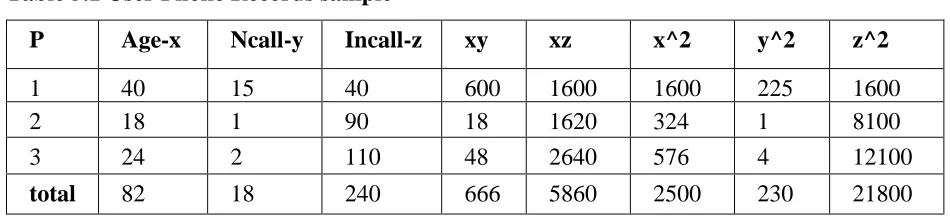
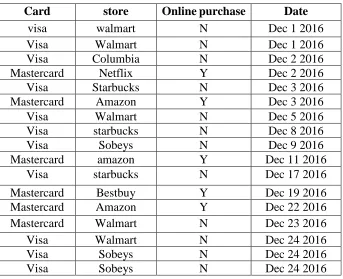
Table 5.1 User Phone Records sample ... 47
Table 5.2 Purchase activity records sample ... 48
Table 5.3 Alice's records ... 50
Table 5.4 Built up knowledge on what Alice most likely will watch ... 50
Table 5.5 Irregular behavior recorded ... 51
Table 5.6 Parameters used to train the CF models ... 53
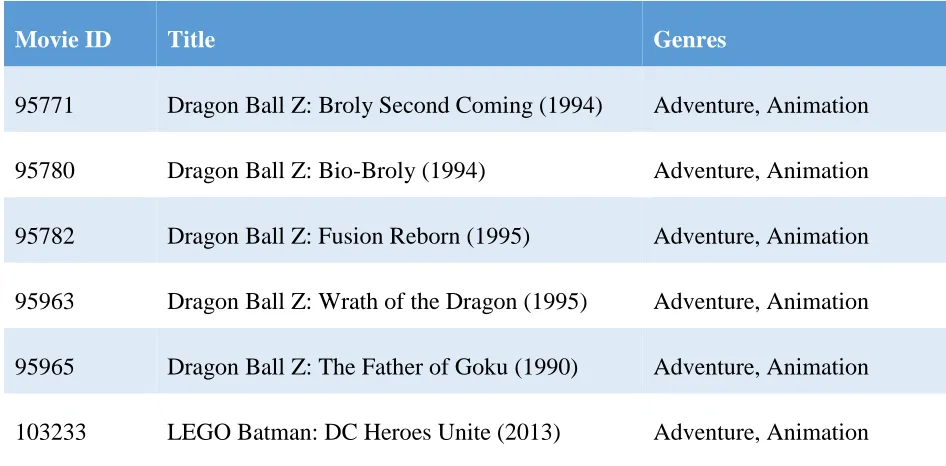
Table 5.7 Item Dataset Sample ... 53
Table 5.8 Action Dataset Sample... 54
Table 5.9 Precision and Recall for user similarity model ... 60
Table 5.10 Precision and recall of Item Similarity Model ... 62
Table 5.11 Recall comparison between the two models ... 63
Chapter 1
1.
Introduction
User authentication is considered a key factor in almost any software system and is often
the first layer of security in the digital world. NIST defines electronic authentication as the process
of establishing confidence in user identities electronically presented to an information system [19].
Authentication is a process that consists of two steps: (1) Identification step, where presenting and
identifier to the security system, and (2) Verification step, where presenting or generation
authentication information that corroborates the binding between the entity and the identifier [20].
However, all systems that have been designed and implemented haven’t proven to be fool proof
against attacks and as a result users’ information and money has been stolen.
Therefore, this shows the need to find and explore different models that overcome the
security weaknesses the current approaches have. To help alleviate the perceived issues of
gained from studying authentication systems, it will be possible to address the concerns and
requirements of users, to ensure the privacy of data, as well as money.
Our work proposes a Big data based user authentication as a new approach that leverages
the power of Big data analytics to develop a fertile field for the next generation user authentication.
This new approach relies on “something you do”-based verification methods, where the users’
dynamic behaviors are analyzed in order to generate real-time uniquely identifiable information to
generate unique dynamic challenging questions to authenticate them. Hence, creating an
“authentication on demand” system that will be used when needed.
1.1
Hypothesis
The hypothesis is that a new solution should be proposed because the current authentication
methods aren’t foolproof against attacks. To confirm whether the hypothesis is true or not, we
should investigate the current authentication methods, and prove the needs of a new authentication
model. The next step is to attempt to develop a new model that will address the concerns of users
and meet the security standards of digital systems.
1.2
Methodology
To achieve the desired authentication model, different steps will be taken. First an
investigation of current authentication models will be completed focusing on systems and
approaches that are already in use in the real world. The authentication systems will be analyzed
for their strengths and weaknesses as well as addressing those with weaknesses. A new approach
model will then be analyzed with existing theoretical tools. Once the model has been successfully
analyzed and shown that it meets the desired goal, we can be certain that it has met the stated
hypothesis. The new model will also need to ensure the security and privacy of users’ data. It will
need to handle Big data, clean the dataset, create user profiles, process and analyze the data
received, identify information of security potential and generate dynamic challenging questions.
The model will need to show that it achieves the goal in authenticating users while being able to
handle users’ data and profiles, and being simple and user friendly.
1.3
Contribution
This thesis proposes a new solution to the issues brought about by leveraging the
characteristics of Big data and the use of learning techniques. The solution focuses on developing
a secure, user friendly system by analyzing users’ information and classifying them into behavioral
profiles with the use of learning algorithms. The new solution is also brought about by the
integration of learning techniques to be used in identifying information of security potential, that
can be used in generating the challenging questions. The proposed authentication model will be
developed, so that for each of these generated profiles, a real-time (i.e., just in time) set of
challenging questions will be prepared. These questions cover all actions that explicitly represent
an instantaneous specific user’s behavior. the novelty of this approach is that these questions will
be chosen in a way that the security and usability requirements are maintained. “Security” because
each question is issued only once to protect the users’ responses from being compromised. This
overcomes the pitfalls of knowledge-based authentication (KBA) methods, described in the
literature section. Note that, users’ profiles are generated from endless source of users’ information
complete the challenge.
1.4
Thesis Outline
The remainder of the thesis is organized as follows:
• Chapter 2 provides a literature review about current authentication systems being used with their strengths and weaknesses analyzed. This chapter also provides a background of the
related work done on the 4th factor of authentication and systems that dubbed this factor.
An analysis and investigation was done to show why we needed to find a new novel
solution for user authentication.
Chapter 2 also introduces the framework for next generation user authentication that is
useful in understanding our proposed work, and explains briefly how our proposed work
relates to its second component.
• Chapter 3 describes the first solution proposed, the IDA model. It first presents the workflow of the proposed model and then describes the data types, behavioral
characteristics that define how the system will behave. Furthermore, chapter 3 discusses
about the adaptable mechanisms and machine learning techniques that will be used to build
up knowledge and classify profiles. A general discussion is then presented with a use case
study to demonstrate how the system might work if implemented.
• Chapter 4 starts by presenting related work on recommender systems and how the investigation of RS led us to seek collaborative filtering as part of the second solution
then discussed in more details, with the three main components of the proposed system
explained.
• Chapter 5 shows how the proposed solution can be put to use by demonstrating different use case scenarios that could take place in the real world. It also presents a case study where
an experiment has been done to show an implementation where the proposed approach can
also be used.
Chapter 2
2.
Background
Digital authentication has always been used to establish confidence in user identities
electronically presented to an information system. To address this matter and users’ concerns about
their privacy, we need to properly understand how the current systems work and overcome their
weaknesses. This will help develop acceptable systems that will meet the users’ and clients’ needs
in digital authentication. Overcoming these weaknesses will create a more secure system and will
help protect confidential information.
The objective of this chapter is to provide background information about the current systems
in use with their weaknesses analyzed, which made us seek this topic to find a new novel solution.
2.1
Literature Review
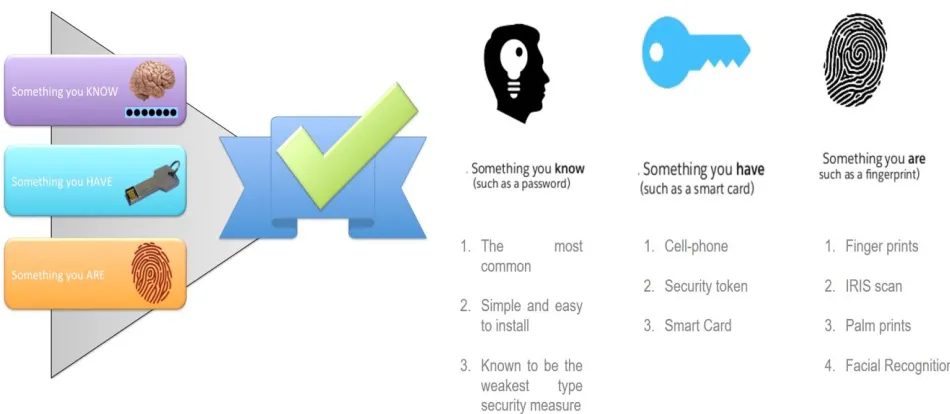
Authentication has always been a key factor in any software system. The different
authentication models that are used are classified based on three factors, “Something you know”,
authentication method is the most common method of something you know. It is the simplest and
easiest mechanism that can be installed over an insecure network. Yet, it is also known to be the
weakest type of security measure for authentication. “Something you have” model is based on
something the user has, such as smartcards and security tokens. Users have to present what they
possess to an information system to prove his/her identity. However, cards can be easily
duplicated, and security tokens can be stolen [47]. “Something you are” is based on biometric traits
verification that vary between fingerprints, retina scan, palm prints, facial recognition, speech
recognition, to walking posture [22]. The problem that faces biometric authentication systems is
the high cost of equipment needed, and that human traits are impossible to be replaced if
compromised. And in the newest smartphones, fingerprint security is considered one of the
weakest security measure for a mobile phone, where researchers were able to bypass systems and
fake users’ identities [25][50] [51].
embarrassment, where hackers had managed to steal personal records of 233 million users, with
usernames, passwords, phone numbers and physical addresses compromised [27]. In 2008 a denial
of service (DoS) attack cost Amazon around $3.6 million when their servers were down for 2 hours
[23]. With the new fingerprint technology used in mobile phones, a demonstration showed that the
phone’s biggest vulnerability is the fingerprint [25][50][51]. On the other hand, multi factor
authentication seemed to provide stronger security, yet attackers found ways to bypass such
systems. In 2013, $46.5 million were stolen from a bank that relied on two factor authentication
[24].
A new factor of authentication “something you do” is introduced as an alternative to the
first three factors [21]. In this regard, research is being carried on user dynamic biometric, where
user’s behavioral patterns are studied. Behaviors such as voice pattern recognition, handwriting,
and typing rhythms. University of Regensburg collaborated with Germany based company Psylock
GmbH [26] and released an authentication software that focuses on person’s typing behavior.
Thus, verifying a user based on their typing behavior on a computer keyboard. Valuable work has
been done in designing, implementing, and evaluating the dynamic biometric-based authentication
techniques [31][32][49] that promise to provide secure user authentication. Yet these methods have
issues in either scalability or performance requirements. A second system that uses users’
behaviors is multi factor authentication system-MACA. A user has to use username-password
mechanism as a first step and then a user profile is built with information captured about him/her
where it will be used to assess the difference in the information during a second log-in attempt.
The system uses two factors that are not secure. A username-password approach is the weakest
On the other hand, RSA presented risk-based authentication system; an implementation for
“something you do” [33]. Risk based authentication system assesses risk score for users trying to
access the system. Once a risk score exceeds a certain limit, a user may be required to provide a
higher level of authentication. But risk-based authentication system hasn’t proven to be foolproof
to Denial of Service (DoS) attack [28][48]. As a result, this shows the need to find and explore
different models that overcome these security weaknesses.
Another implementation approach for “something you do” commonly referred to as
Knowledge-based authentication (KBA) that is mostly used in financial institutions or websites
[39]. KBA is an authentication scheme in which the user is asked to answer at least one “secret”
question. This question is brought using either static or dynamic methods. In static methods, the
question is chosen from a pre-defined set of question/answer pairs, example; “where did you spend
your honeymoon?” or “Who was your favorite teacher?”. However, in dynamic methods, the
question is generated from information within a person’s credit history or public records, example;
“What is the credit limit of your credit card ending 1234?” or “What was your street address when
you were 10 years old?” It is obvious that, if someone has shared that information on a social
media site, the answer can be easily guessed.
Recently, a new user authentication framework has been proposed [10], where the author
presented a new perspective in utilizing the authentication factor “something you do”. This
framework leverages the characteristics of Big data to provide accurate patterns of users’
behaviors. Where Big data is defined by the 3Vs; volume, velocity and variety [40][41][43]. And
Big data generally describes datasets which cannot be perceived, stored and processed by classical
The first direction sought resulted in proposing a model that studies the behaviors of users and
classifies them into behavioral profiles. This will be discussed in more detail in chapter 3. While
the second direction sought lead us to approach the problem in a slightly different way. The second
solution proposed relies CF which is similar to the technique used in recommender systems where
real life applications take advantage of machine learning; that is defined as the field of study that
gives computers the ability to learn without being explicitly programmed”. And now it is the
combination of several disciplines such as statistics, information theory, theory of algorithms,
probability and functional analysis [30][45]. This is discussed in more details in chapter 4.
The following section introduces and discusses the new framework for next generation user
authentication where the concept behind our work was built on.
2.2
Big data-based Authentication Framework
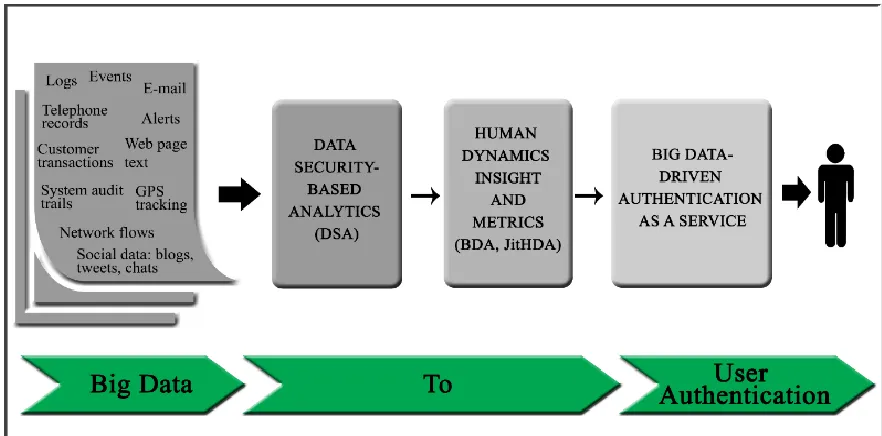
Recently, a framework for next generation user authentication has been proposed [10]. This
framework investigates the development of a new authentication system that utilizes Big data
analytics based on “something you do” verification. Analytic tools will be used to study and
analyze changes in user behavior and data. This analysis will allow to generate real-time
information about users. Whenever identifiable information is captured, organizations will be able
to authenticate users and provide the decisions as a service to different internet-based applications.
Figure 2.2 The main components of Big data-based user authentication framework
2.3
Data Security-based Analytics (DSA)
Organizations capture and analyze big datasets in real-time, but to be able to do that,
organization will have to use tools that manage Big data’s 3Vs (velocity, volume and variety)
[40][41][43].Volume or the size of data, where the grand scale and rise of data outstrips traditional
store and analysis techniques. Variety makes Big data really big, where data comes from variety
of sources and has three types: structured, semi structured and unstructured. And velocity is
required not only for Big data but also all processes. Big data should be used as it streams into
organization in order to maximize its value [40][42][43]. As such, the first component of this
framework; Data Security-based Analytics (DSA). DSA leverages large scale data processing
engines such as Spark [36] and Hadoop [37], utilize Splunk and Hadoop power, and define criteria
The outcome of DSA will be clustered into human dynamic based information, where
profiles will be created based on actions of humans and their behaviors. This task is managed by
the second component of the framework, the Big data-driven authentication tool (BDA). BDA tool
assembles human dynamics into security user profiles. These profiles will be used as security
profile input to a just in time human dynamic authentication engine (JitHDA). JitHDA is main tool
in BDA component, where it will generate random set of challenging questions, with one question
relate to actions performed by a user. the purpose of the randomness is to create a certain level of
uncertainty. The randomness or uncertainty will prevent any attacker from acquiring knowledge
about which question relates to a certain user, which in return will protect user privacy. This
technique will allow BDA tool to perform a security just in time challenge to authenticate the user
[10].
2.5
Big data-driven Authentication as a Service
The third component of the framework is a tool that promotes Software as a Service (SaaS)
authentication tool. Since the framework relies on Big data, this will not only allow to authenticate
organization’s own users but also to authenticate users for other applications on the cloud.
2.6
Summary
This chapter provides first a literature review and background about current authentication
systems and their weaknesses. It also presents the new factor of authentication “Something you
do”, that has been dubbed in recent work. We have investigated and analyzed the systems that
investigate a new novel approach for user authentication. Moreover, we presented the related work
Chapter 3
3.
Innovative Data Authentication
Model
Big data has revolutionized the way the world uses data. An important process used is to
study human behavior and provide ads, recommendations based on what a user is looking for,
searching for, and watching when using the digital world.
The traditional method of authentication in computing is the challenge-response
mechanism. The investigation of Big data and behavior showed that we are able to take advantage
of Big data characteristics, that are volume, velocity and variety to recognize patterns and identify
behavioral characteristics. The behavioral characteristics can be used as a shared secret between
two parties, so that one party asks a question as a challenge and the other party must reply with a
The first direction that have been addressed during our investigation of the big-data based
authentication framework lead us to propose an innovative data authentication model (IDA). A
model that leverages the characteristics of Big data and learning techniques such as, association
learning and classification to create behavioral user profiles and identify information of security
potentials.
3.1
IDA Model Workflow
The first proposed solution is the result of the investigation of the second component of the
Big data-based authentication framework described in chapter 2 section 2.2. The proposed model
aims to recognize users’ information and classify them into behavioral profile. The classification
done will be used in generating challenging questions to authenticate users.
There are two main activities involved to achieve this goal; (i) create user profiles to study
human dynamics and behavior, analyze user behaviors and actions, and classify user behavior
Figure 3.1 IDA model workflow
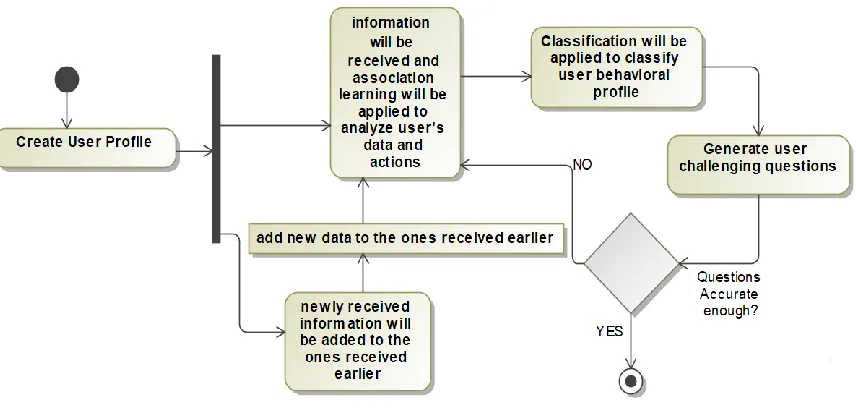
Figure 3.1 shows the activities in IDA, where information will be received from DSA, so
that a user profile will be created that contains data of security identification potentials. After
profiles are created, a learning algorithm will be applied to start with the process of data analyzing
and classification. The first algorithm is association learning, it will be used to analyze users’
information and recognize patterns about users’ behaviors, dynamics and actions, and to build up
knowledge to help categorize users’ personalities into different personality types. Personality type
is the collection of characteristics and traits that are determined by specific pattern of human
behavior, and it is distinguished by the behavioral tendencies people have and actions they make
[46]. Research has shown that personalities vary between 16 types from adventurer, entrepreneur
to strategic, extrovert and others [29][46]. Once actions and behaviors are analyzed, classification
algorithm will be used to categorize user profiles into behavioral profiles that identify behavioral
The next step that follows is generating user unique, non-repeated challenging questions to
authenticate users. Questions consists of real time events and situations that reflect recent
behaviors of users. The questions generated should be accurate to proceed to the authentication
process, if not a revised version will override the older one by iterating through the whole process
again; analyzing information, classifying profiles and then generating challenging questionnaire.
A certain threshold for questions and information accuracy is set to detect whether the information
analyzation process should be repeated or not. The threshold is set according to the percentage of
occurrence of a certain behavior(s) over time that can be used in security identification, such as an
irregular behavior made during a certain day of the week, or a comparison of two orders that
arrived on different dates when purchased at the same time. The advantage of the unique,
non-repeated questions is that they are not susceptible to social engineering [38], where this method is
used to bypass security systems using static general questions. For example, questions used in
email verification process and account login as additional type of security measure. Social
engineering is a common way intruders use to retain information to bypass security systems and
customers’ accounts that use a static security measure. It is the art of exploiting the weakest link
of information security systems; the people who are using them [38]. Users are manipulated
through various methods to release information that results in intruders performing unauthorized
actions.
Since data is changing and dynamic; building knowledge through association learning, user
profiling and classification, and generating challenging questions, makes the relation between the
three tasks interrelated.
The following section describe the detailed components of the above model. In section 3.1
learning that will aid in user profiling to help in generating security questions in real time.
3.2
Behavioral types and Big data analytics
Many systems utilize user profiles for different purposes. For example, one primary and
main uses of user profiles are in recommendation systems [35], that rely on the searching habits
of the users. Organizations like Facebook use user profiles to find potential friends based on
relationships and groups joined, while LinkedIn takes advantage of skills and professional
information stated by users’ profiles to recommend potential employees/employers. Behavioral
and personality profiles are studied to reach an accurate assessment of persons’ behavioral
characteristics. The profiles are studied since they reflect an individual’s attitude toward the
external world and the direction of general interest. Most of the known personality types are
categorized according to Carl Jung’s research [29][46]. C. Jung first developed the theory that
individuals each have psychological type based on the behavioral tendencies they have. This type
of study increases the ability to classify user profiles based on relevant information about people,
related and recognized patterns in users’ actions and behavior.
The following subsection shows and describes in more detail the type of data that system
will analyze in order to move to the next process of creating behavioral profiles.
3.2.1
Data types
User profiling has been used in many systems from social networks, to recommendation
systems, which shows that is effective and useful analyzing users’ data. However, to create the
profiles depend on variety of information that identify each individual. For instance, IP address(s),
device profile, email address(s), location(s) and check-ins, calendar, web surfing history and
mobile activity, purchase activities, movie(s)/TV show(s) ratings, medical history, languages used,
activity based on time stamp and time zone, news feeds and follow-ups; that vary from sports,
technology, politics, business, to arts, style, food, fashion, etc.
• IP address: on the Internet, one geolocation approach is to identify the subject party's IP address, then determine what country; including down to the city and post/ZIP code level
• Location: Sharing location is highly important. It reveals different routes a person takes on daily basis, or various places and/or events a user attends. This shows the importance of using
location in security identification.
• Web history: Refers to the list of web pages a user has visited recently—and associated data such as page title, keywords searched, and time of visit—which is recorded by web
browser software as standard for a certain period of time. Which all can be used to generate
security questions to authenticate users.
• Purchase activities: shows what stores a user go to, what brands a user likes, and marketing ads that interest him/her.
• TV shows/Movie/ online streaming: indicates what type of movies and TV shows that a user likes, what is his/her taste in genre, such as action, adventure, drama, comedy, etc.
And what topics did the online streaming search include, which can be used in the
disease a user is dealing with. This can be used in the authentication process whenever
questions are generated.
• News feed: varies from sports, politics, technology, to science, news, arts, or any sort of news feed user follows or subscribes to. With which data can be used to recognize what a user is
interested in.
3.2.2
Behavioral Types and Classification
Research has been done by scientists to allow them to accurately categorize personality,
character, and behavioral types of people into different categories [29][46]. Research and studies
have been done by C. Jung who first developed the theory that indicates that individuals each have
psychological type based on the behavioral tendencies they have. This type of study increases the
ability to categorize user profiles based on relevant information about people, related and
recognized patterns in users’ actions and behavior.
For our proposed work, we have specified different behavioral types; based on the different
personality types studied in [46], to match our needs in building behavioral profiles. These types
will help in building up knowledge about each user using the adaptable mechanisms of machine
learning; that will be discussed in section 3.3, to help identify irregular behavior of users. The
following categories describe each type of behavioral category that will be used in the first
proposed approach.
• Extravert/social: individuals with such personality type are social, open, outgoing, has numerous contacts with others, and prefer communicating in groups. They are often seen in
• Introvert: individuals energized by solitary, focused on their jobs, prefer one on one conversations instead of group communication. Also individuals with such behavior prefer
quietness to finish their work. study, research, etc.
• Athletic/Sporty: refers to individuals who tend to have behaviors that relate to sports, such as attending sport games, follow sport feeds, have gym or any sport subscriptions.
• Adventurer: refers to those who tend to have adventurous behavior, such as going on trips, fishing, camping, buying tools that relate to such things. It would also include individuals
who tend to try new things, such as new cuisine for example.
• Smoker/non smoker
• Workaholic/not: refers to individuals that spend too much time working. It can be determined by how much extra time they spend at work weekly, and if they still follow up on work while
they are off shift or on a vacation.
• Shopaholic/not: includes individuals that are considered to be addicted to shopping. It can be shown through the number and type of purchases made within a specified period of time.
• expert/fan: depends on interests and the time spent in doing a task or activity. It can be revealed based on when an individual started a particular behavior/task/action, such as work,
hobby, cuisine, attending motor shows, etc.
• Student-researcher-worker: it depends on the type of occupation an individual has. For instance, attending School X, researcher at school X, lab Y, or any sort of facility. Worker
depending on job, might be blue collar, white collar, knowledge worker/intellectual.
The following section will present the adaptable mechanism that will be used. As
behavioral profiles to identifying information of security potential.
3.2.3
Adaptable Mechanism and Machine Learning
Data mining is the process of processing huge amount of data to discover insights and build
knowledge from big datasets [52]. The goal of data mining is to extract information from a data
set and transform it into understandable structure for further use. Machine learning is the field of
study where computers are able to learn without being programmed [45]. And it is a combination
of several disciplines such as statistics, information theory, theory of algorithms, probability and
functional analysis [45]. An example often cited is the algorithmic classification of email into spam
and non-spam messages without user intervention. In the context of user profiling, machine
learning can be used for learning user behavior by identifying patterns. Machine learning is used
to explore and analyze dataset to produce useful, reliable results through learning from hidden
relationships. Different types of algorithms have been proposed for machine learning and Big data
analytics. Such as, clustering, association learning, and classification [36].
The following subsections will discuss in more details the learning techniques that will be
used in the proposed solution.
3.2.3.1
Association Learning
Through different machine learning techniques, useful data can be aggregated to produce
accurate challenging questions for authentication. One of the learning techniques that will be used
is Association learning. Association learning is a method for discovering interesting relations
a supermarket would build the knowledge that if a customer buys cheese and dough together, s/he
is most likely to also buy pizza sauce.
Different association learning algorithms has been proposed to recognize frequent patterns
in different data sets. For example, using FP-Tree algorithm [37] [53]. The frequent-pattern tree
(FP-tree) is a compact structure that stores quantitative information about frequent patterns in a
database. FP-tree algorithm starts by one scan of database to identify the set of frequent items. The
FP-tree as the tree structure is defined as follows:
1 Iterate through user profile and specify the minimum occurrence of set of actions
2 Check for specified patterns that relate to behavioral actions
3 Count and find the frequency of occurrence of the specified patterns
4 Prioritize the patterns and actions based on occurrence
The FP growth algorithm is used to mine the data analyzed and find a complete set of
frequent patterns to identify the behavioral actions of a user.
The output of association learning, will be the input of data classification learning method.
Data classification plays a role in categorizing users’ behavior actions into behavioral profiles.
Section 3.2.3.2 will present more details about classification.
3.2.3.2
Data Classification
Data classification is the problem of identifying to which of categories an observation
belongs. For example, the system might assign a user one or a combination of classifications such
to serve our goal in categorizing data, where the classification process will take place as follows:
Iterate through user profiles and set a minimum group priority
2 Check the output of the association learning for the patterns identified
3 Link/group the patterns into categories
4 Count the frequency of each occurrence in each group
5 Prioritize the groups and actions based on occurrence
6 Compare group priority to the minimum threshold set and order them accordingly
7 Classify profiles according to group priorities
The process of classification is used to help determine behavioral profiles in order to help
the system identify information of security potentials. As a result, the irregular behaviors that have
been flagged will be used to generate unique challenging questions as a challenge for a user to
pass.
The following section presents a general discussion of our proposed work. The discussion
will walk through the general process of IDA model, and will show how it answers the hypothesis
that has been presented.
3.3
General Discussion
To understand the general work flow of the proposed work it is worthwhile to review what
the outcome we are looking for. Data is fast changing, large in volume and diverse, thus resulting
dynamic questions to challenge users. The questions that will be generated will be simple, direct
and straight forward, rather than the static questions that are used in current authentication systems.
For example, sample of questions that are generated for a social, extravert worker classified profile,
would be as follows:
1. What are the names of restaurants you went to twice in the last two months on “Richmond”
street?
2. Name two to four cities where the organization you work for opened offices in during the
last month?
3. Name a café/restaurant you made a purchase from two days ago, that is located within two
blocks from your work location.
4. What website you used to place an online order using a visa credit card on the day Blue
Jays game took place on July 18th?
Every Behavioral profile will have a set of unique non-repeated challenging
questions that change with time. In order to authenticate a user, s/he should be able to
identify the actions and behaviors s/he made during a specific period of time, and answer
the question(s) accordingly. So, an intruder who is trying to access an account will have to
answer dynamic challenging questions that are generated on regular basis, through which
only the user knows their answers.
The below table shows how dynamic data can be used to link user information and
IP address Location Web browsing history Purchase activity Medical history TV Shows/ online streaming News feed
Extravert x x x x x
Introvert
Athletic/Sporty x x x
Adventurer x x x
Smoker/non x
workaholic x
shopaholic
Expert/fan x x x
Student/researcher/worker x x
Patient diagnosed with illness
x x
The analysis of the table shows how different profiling information is integrated with
profile classification. For example, five profile attributes reveal that this user is extravert, into
sports or sporty and adventurer. IP address and location shows that s/he attends different events in
different places. Assume that, an IP address is recorded during mobile phone activity and its
location is identified through the signal captured by phone carrier’s towers on the last weekend of
June, revealed that a user called Mike attended London festival from noon till 4 PM, and he spent
the evening at a well-known restaurant in downtown, then afterwards the night was spent at a mud
spa “Novo Spa” that is known to be a place where people have some leisure time after a long
weekend. Secondly, the user’s news feed and location attributes show that Mike is into sports. For
example, Mike has attended different sport events during the past 2 months when the “Toronto
Raptors” had their game against Cleveland; where his location was stored by cell towers. On the
basketball games. Moreover, web browsing history, purchase activity, TV shows and news feed
showed that the user is interested in different groups that arrange outdoor activities, like camping,
fishing, food tasting, painting and photography workshops, etc. As an example, the user watched
a series of YouTube videos about wild life, setting up tents, protection against bears, and videos
about water painting, portraits and landscape pictures, and so on. Studying and analyzing a table
that links user data to user classification will contribute in the challenging question generation
process. For example, from the below table different information of security potential can be used
in asking about different places the user attended, what type of sports the user likes, what kind of
purchases the user made (cloths, books, tickets for different events, equipment, etc.). All of which
can be used in the authentication mechanism.
3.4
Use Case study
An innovative data authentication model (IDA) has been proposed as an outcome of the
investigation about BDA tool in order to provide a concrete implementation of representing user
dynamic behaviors.
The following scenario illustrates how IDA works, starting from creating user profiles, to
studying and classifying human dynamics and generating questionnaire with security potentials to
authenticate users. Mike Ross leaves home daily from 8 am from area with postal code “NxY xCy”
and returns back at 5:30 pm as recorded by cell towers (through signals from his phone). His route
is to a street known to be a banking street in downtown. His purchases and electronic receipts; that
contain the time and date of purchases, show that every two to three months, a purchase is made
from Hugo Boss store; in Toronto Eaton Center, and two online orders were placed last week. That
enable their users to turn on location and GPS services, to check in places individuals visit and got
to, and share it on social media, so can cell phone carries, through cell towers. This information
can certainly provide us with useful data about them. Through association learning, discovering
relations between variables, for example, having a location record of a banking street on week
days from 8 to 5:30 pm, and having receipts from Hugo Boss store, indicates that Mike works at a
bank. And through classification algorithm, information analyzed will reveal that Mike buys suits
and he is a professional employee. Analyzing the information given through different machine
learning techniques; buying from Hugo Boss every period of time, attending a route to work that
is known as a banking street, all provide a conclusive result that Mike is a professional employee
in a bank. Having information from various sources will provide useful information about users,
which will allow for the creation of a dynamic user profile. Once user profile is classified or
categorized into certain classification, the system will have enough information to generate a set
of questions with which some of security potentials to use in the authentication process. A set of
questions that could be generated are as follows:
• Name the store you went to on the beginning of this month to buy a suit.
• Name the route you took this Tuesday instead of the regular route you take on weekdays to work.
• Which package was received using express shipment last week?
The challenging questions generated are dynamic due to the fact that information are changing on
hourly, daily, weekly basis. Answering a question(s) that relate to the actions Mike does ensures
the authenticity of the person Mike claiming to be.
In contrast to a lot of two factor authentication systems tend to use static questions for extra
security in case of repetitive failure in username/password authentication. The type of questions
used (1) are easy to answer and exploit the system if an intruder has a certain level of knowledge
in social engineering, (2) and are limited to information related to birthday, favorite pet, favorite
restaurant, best friend name etc, as in:
• What is the name of your best friend?
• What is the name of your first pet?
• When is your birthday?
• What is the name of your high school?
What differentiates IDA’s challenging questions and having a set of general questions is
the dynamic data that allow to analyze fresh information from actions and behaviors made in an
hourly, daily, weekly basis, etc. where users will have to answer unique, non-repeated
questionnaire that tackle actions that took place in a particular day and time, and that reflect an
unusual behavior that occurred and happened for a period of time and required an extra attention
from the user. The challenging question used will not be used in any other session when trying log
in or gain access to a system, due to the fact that data is changing in an hourly basis, behaviors and
actions will be processed on a regular basis to ensure the uniqueness of questions asked, where
any intruder trying to gain access to an account won’t be able to do so, even when trying to log in
asked once). In case the user is not able to answer the question asked, s/he can change the question
just as simple as in forgetting the password mechanism where a user can change the general
question used to be answered to the next one s/he remembers.
3.5
Summary
In this chapter, IDA model is proposed as an implementation of the BDA tool, the second
component of the next generation user authentication framework. Building and disclosing accurate
user profiles can be highly effective in providing a new user authentication tool. Using Big data
techniques; data analytics and machine learning, that play an important role in: (1) building and
creating user profiles and building up knowledge, (2) linking profiles to different categories.
Where association learning algorithm is used to discover relations and patterns in datasets and
build up knowledge, and classification algorithm is used in the process of identifying to which set
of categories an observation belongs. The third task in the IDA model is to generate on the fly
unique challenging questions based on the dynamic data analyzed and the classification made.
Thus, real time authentication process; comprised of studying user behavioral profiles and
generating challenging questions, is the main goal of the IDA model, that leverages the
characteristics of Big data to provide a new alternative of “something you do” authentication
factor.
During our continuous investigation, an enhanced solution has been proposed. The
enhanced solution will take advantage of recommender systems, and learning techniques behind
Chapter 4 introduces recommender systems, types and related work. And discusses in more
details a hybrid-based filtering approach for user authentication that is the result of the earlier
research and investigation of IDA and Big data, and the leaning techniques behind recommender
Chapter 4
4.
Hybrid-based Filtering Approach
for User Authentication
Traditional methods of authentication rely on a challenge-response mechanism. The
investigation of IDA model showed that we are able to take advantage of Big data to recognize
patterns and identify behavioral characteristics. The behavioral characteristics can be used as a
shared secret between two parties, so that one party asks a question as a challenge and the other
party must reply with a correct answer as a response.
The second direction that have been taken during our investigation of the IDA model lead
us to propose a hybrid-based filtering approach for user authentication. A model that utilizes the
characteristics of CF to create user profiles and identify information of security potentials.
Collaborative filtering showed to be very practical in many real-world applications. This will be
4.1
Related work
Recommendation systems (RS) are systems that offer or predict users’ preferences [54].
Recommender systems are used and utilized for different purposes and in different areas. Areas
such as movie recommendation, article recommendation, products, books, news, financial
services, music, etc. the goal of recommender systems is to recommend a new service(s) to users
after considering several attributes. These attributes rely on previous references or users with
similar interests.
RS utilize learning algorithms to study users’ information and recommend a service. The
following sections presents and discusses some of the most known recommender systems.
4.1.1
Web Page Ranking
Web page ranking recommendation system is a system that aims at providing the best websites
that could be relevant for the search query provided by a user. the most known webpage ranking
recommendation system is Google’s search engine. Google search uses “PageRank” algorithm
[13] as one of the algorithms and factors to rank websites in their search engine. PageRank works
by counting the number of links and checking the quality of links to a page to determine a rough
estimate of how important a website is. Where important websites are likely to receive more links
from other websites. Basically, it measures the importance of website pages, based on links from
other websites. This algorithm is aided by different algorithms (perform link analysis) such as
Amazon’s algorithm takes into account, (1) regular actions and behaviors, (2) current
virtual shopping cart, and (3) different users with similar past. Note that, regular actions and
behaviors: consists of purchases and ratings of products. Amazon’s approach matches user’s
purchased and rated item(s) to similar items, where customers tend to buy or purchase items
together, when compared with customers that bought item A and purchased along with it item B
[15]. It also takes into account the current shopping cart a user has, what items s/he is interested
in, and what are possible items that would interest her/him that are related to what is in the cart
[16].
4.1.3
Social Recommendation
Social networks use collaborative filtering, the same algorithm used by amazon, but instead
of items, it is used to filter and recommend friends, groups and other sort of connections that a user
may be interested in [17]. Networks such as Facebook and LinkedIn examine the connections
between a user and their friends, their behavior (such as tags, likes, comments, groups and pages
they follow), checking certain profiles more than once, all are monitored by an automated system
which then studies the data and provide recommendation accordingly.
4.1.4
News Content Recommendation
Different recommendation approaches are used in this type of systems such content
recommendation, collaborative filtering, and hybrid based filtering [18]. Some of the known news
content recommendation services are offered by Outbrain and Taboola (the world’s two largest,
used in news content recommendation are, content-based recommendations, collaborative
filtering, and hybrid filtering.
4.1.4.1
Content Recommendation
Content recommender systems recognize articles based tags associated with them [18]. A
system would recognize that a user read about sports for example, and then recommends other
sports articles. It is similar to a librarian that knows what a user is reading and where his/her
interests are and points him/her toward sections with similar topics. Some advanced content based
filtering use natural language processing to better understand what an article is about. For example,
the New York times uses a natural language processing technique called latent dirichlet allocation
that allows it to know what an article is about by counting the number of times a certain word
appears, and compares it to other articles. It then categorizes an article into different topics
depending on the words used. For example, 50% science and technology, 20% environment.
4.1.4.2
Collaborative Filtering (CF)
Systems that use CF recommend content based on a user past reading habits and compares
his/her history with people with similar history, or with similar interests. As in the given example
above about the librarian, a librarian who knows the user’s interests are similar to another student
or customer, can recommend that user to read a book that the other customer liked. Typically, it
Hybrid filtering combines both content-based and collaborative filtering to give a
recommendation based on both content of an article, and the person who is reading. For example,
Outbrain combines contextual algorithms, behavioral algorithms, and personal algorithms to serve
a good recommendation. Contextual algorithms analyze the context the user is reading now and
searches for similar content and topics. Behavioral algorithms that learn behaviors of groups of
users. For example, saving records of the most visited documents in a site, the most rated
documents, the ones most shared, etc. adding to that the content people read and liked in the earlier
times. Personal algorithms learn the look up the history of a user, or group of people, and gives
recommendations that is related to their interests.
Chapter 4 presents the second solution where the proposed model investigates the
utilization of some learning algorithms used in RS to create and classify user profiles, analyze their
information, build up knowledge to compare current actions with predicted actions, and generate
challenging questions, to authenticate users in real time and on demand. In other words, if RS have
the assumption that people who buy X also buy Y, if a user u was among those people, yet u did
not buy Y, RS will recommend u to buy it. However, in our model if we have the same assumption,
we will build a knowledge that it is normal for a user u to buy Y, yet if u bought Z instead, the
model will interpret it as a unique action and the system will generate a dynamic question to
4.2
Hybrid-based Filtering Approach for User Authentication
The proposed solution is the result of the investigation of the second component of the Big
data-based authentication framework described in chapter 2 section 2.2, and the IDA model
discussed in chapter 3 section 3.1. The proposed model aims to recognize users’ information and
create user profiles. This is followed by applying learning techniques such as collaborative filtering
to identify irregular behavior to generate challenging questions to authenticate users.
For this purpose, our approach has two main activities – Figure 4.1 - that are involved to
achieve this goal.
Figure 4.1 Activity workflow
These activities are modified version of the one proposed in chapter 3. The first activity is
receiving information from various sources to create users’ profiles to study human dynamics and
on demand to authenticate users.
The two activities described in section 4.1 are decomposed into three main components,
where the first activity of the model is decomposed into the learning component, and the second
activity is decomposed into the listening, and challenging components. The model triggers on the
event of user’s data received and the corresponding user’s profiles created/modified - Figure 4.2.
The three components integrate to achieve one common purpose that is to predict the user’s u
behavior based on the similarities, check his/her neighboring users v behaviors, based on time
performed and whether they were occurred previously or not. Hence the model would be able to
identify whether these actions lead to regular or irregular behavior so that the challenging questions
can be accurately created on demand. The detail explanation of the model components is presented
The learning component starts on the receiving of the user’s data for the first time, to
classify information into two categories, old and new based on the time stamps of the actions.
Every action has a time stamp associated with it, so a time range will be set in order to classify
information into new if the time stamp lies in the time range T set, otherwise will be classified as
old. “T” will be automatically updated on a regular basis, based on the real date and time, in order
to accurately classify data into the correct category. Based on algorithm 1, the proposed model will
start by classifying data based on timestamps, the information will then be checked if done before
and keep track of how many times it was done.
This process is similar to Netflix and Gmail’s systems, that takes into consideration
different attributes to learn about every user. where Netflix’s system works on providing the best
recommendation regarding TV shows and/or movies for each and every user to watch. The main
problem with Netflix to solve is to find shows/movies that are compelling to view. To do so,
Netflix’s system and algorithms take into consideration various attributes. Some of these attributes
are, personalized video ranker (PVR), top N video ranker, trending now, continue watching, page
generation (row selection and ranking). As well as, evidence selection that define Netflix
experience, and search, where searching is the process when a user looks for something (20% of
recommendation is based and influenced by what a user looks for). Combining all these features
together the algorithms used make up the complete Netflix recommender system. Similarly, the
proposed model will take advantage of various attributes such as, actions’ time stamps, actions
related to navigation and commute (including location at different times during a day, week,
month), purchase activities (including way of paying), online search history, online streaming
number of times a certain action(s) has been made, and classify based on the frequency of actions.
The more frequent the more common a behavior will be.
The third step in the learning component is to apply collaborative filtering technique to
calculate similarity between a user u and neighboring users v, and predict how a user will behave
compared to users with similar behavior. The objective of using collaborative filtering is to predict
how likely a user will perform a certain action in the future based on the similarity with
4.2.2
The Listening and Challenging Components
The Listening component comes to play by checking irregular behavior either by analyzing
and comparing a user’s own behavior (check scenario II), or by calculating similarity and
predicting an action (scenario I and III). When the user’s action is marked as irregular by the
listening component, the challenging components start to generate unique challenging question to
authenticate the user u.
In order to predict future behavior, the model compares actions of a user u, actions and
behaviors for all users’ v combined. Similar to Gmail’s inbox, the model compares newly received
information with predicted information to determine whether the new actions analyzed are
irregular or not, and will keep learning and update the set of behaviors classified by calculating
similarities between users and actions. To calculate the similarity between a user “u” and group of
users “v” (where v will be assumed a user that consists of group of users) we will use Pearson
correlation [43][44] equations (1) and (2); please check appendix for the derivations. Pearson
correlation is the covariance of two variables divided by the product of their standard deviations
[44].
𝑠𝑖𝑚 (𝑋, 𝑌) =
Σ𝑖=1𝑚 (𝑋𝑖− 𝑋̅)(𝑌𝑖− 𝑌̅)√Σ𝑖=1𝑚 (𝑋𝑖− 𝑋̅)2 √Σ
𝑖=1 𝑚 (𝑌
𝑖− 𝑌̅)2
(1)
√𝑛Σ𝑋𝑖2−(Σ𝑋𝑖)2√𝑛Σ𝑌𝑖2− (Σ𝑌𝑖)2
Where N is number of users or items being considered based on the matrix built, x is the score of
1st attribute, y is the score of 2nd attribute, where actions will be represented by numeric values,
to calculate the similarity which is defined by the Pearson correlation (1) - (2). The output value
of the Pearson correlation lies between -1 and 1 (the closest the value to 1 the more similar two
users are).
4.3
Summary
This chapter proposed a comprehensive framework and describes a hybrid model for user
authentication and the components of the new model architecture. It also introduces and overview
of the function of each component the rely on Big data’s characteristics and the adaptable
mechanisms that take advantage of the learning techniques. In addition, it shows how to take
advantage of recommender and prediction systems and how they will to generate unique dynamic
Chapter 5
5.
Evaluation
This chapter discusses the methodology that has been investigated with regard to
recommender systems and learning techniques to recognize behavior characteristics in users’ data,
and presents different use case scenarios and a case study to illustrate the experiment that has been
conducted. The experiment done used MovieLens public dataset. And the implementation done
was customized to handle the data that we have.
5.1
Methodology
The authentication model that has been proposed is an outcome of the investigation about
recommendation systems in order to provide a concrete implementation of user dynamic
behaviors. The following scenarios illustrate how the proposed model should work, from receiving
information, and analyzing them, to generating challenging questions. Due to the fact that we
weren’t able to get data from different sources to evaluate the accuracy of the proposed model, we