International Journal of Computer Science and Mobile Computing
A Monthly Journal of Computer Science and Information Technology
ISSN 2320–088X
IJCSMC, Vol. 4, Issue. 3, March 2015, pg.265 – 270
RESEARCH ARTICLE
Triple Encryption Method on Password for
Secured Cloud Data Storage in Mobile
S.UMADEVI@YASODHEI, D.NIRMAL DEV, K.SAKTHIVEL
Computer Science & Engineering (CSE), IFET College of Engineering, India
Abstract— Cloud Computing is a new era in the world of computer. Cloud computing is a recently evolved computing terminology or metaphor based on utility and consumption of computing resources. Cloud computing is based on client-server architecture. Cloud computing involves deploying groups of remote servers and software networks that allow centralized data storage and online access to computer services or resources.it is highly vulnerable because in last 3 months itself 10 celebrities private cloud server has been hacked due to many issues like data authenticity , integrity , data hiding and availability. In this paper we introduce a mechanism to provide secure data. We combine two algorithm Blowfish and AES to provide security to password and data in cloud computing.
Index Terms— Cloud computing, Blowfish, AES
I. INTRODUCTION
Cloud computing is a term which is used to refer a model of network computing where a program or application
runs on a connected server or servers rather than on a local computing device such as a PC, like the traditional client
III. METHODS OF SECURITY IN CLOUD COMPUTING
A. Advanced Encryption Standard (AES)
AES is based on the Rijndael cipher developed by two Belgian cryptographers, Joan Daemen and Vincent Rijndael, who submitted a proposal to NIST during the AES selection process. Rijndael is a family of ciphers with different key and block sizes. AES has been adopted by the U.S. government and is now used worldwide. It supersedes the Data Encryption Standard (DES), which was published in 1977. The algorithm described by AES is a symmetric-key algorithm, meaning the same symmetric-key is used for both encrypting and decrypting the data. AES became effective as a federal government standard on May 26, 2002 after approval by the Secretary of Commerce. AES is included in the ISO/IEC 18033-3 standard. AES is available in many different encryption packages, and is the first publicly accessible and open cipher approved by the National Security Agency (NSA) for top secret information when used in an NSA approved cryptographic module (see Security of AES, below).
High-level description of the algorithm
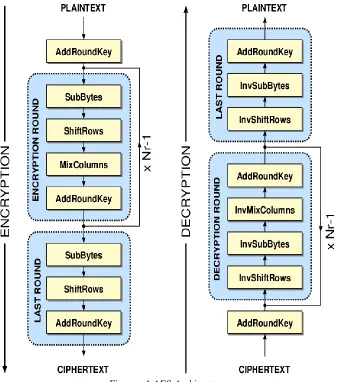
KeyExpansions—round keys are derived from the cipher key using Rijndael's key schedule. AES requires a separate 128-bit round key block for each round plus one more.
InitialRound
o AddRoundKey—each byte of the state is combined with a block of the round key using bitwise xor.
Rounds
o SubBytes—a non-linear substitution step where each byte is replaced with another according to a lookup table.
o ShiftRows—a transposition step where the last three rows of the state are shifted cyclically a certain number of steps.
o MixColumns—a mixing operation which operates on the columns of the state, combining the four bytes in each column.
o AddRoundKey. Final Round (no MixColumns) o SubBytes
o ShiftRows o AddRoundKey.
Until May 2009, the only successful published attacks against the full AES were side-channel attacks on some specific implementations. The National Security Agency (NSA) reviewed all the AES finalists, including Rijndael, and stated that all of them were secure enough for U.S. Government non-classified data. In June 2003, the U.S. Government announced that AES could be used to protect classified information.
Figure – 1 AES Architecture
Performance
High speed and low RAM requirements were criteria of the AES selection process. Thus AES performs well on a wide variety of hardware, from 8-bit smart cards to high-performance computers.
1.On a Pentium Pro, AES encryption requires 18 clock cycles per byte, equivalent to a throughput of about 11 MB/s for a 200 MHz processor. On a 1.7 GHz Pentium M throughput is about 60 MB/s.
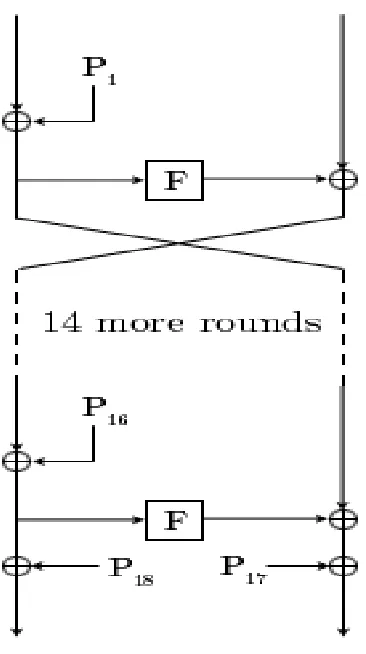
Figure – 2 The Feistel structure of Blowfish
Blowfish's key schedule starts by initializing the P-array and S-boxes with values derived from the hexadecimal digits of pi, which contain no obvious pattern (see nothing up my sleeve number). The secret key is then, byte by byte, cycling the key if necessary, XORed with all the P-entries in order. A 64-bit all-zero block is then encrypted with the algorithm as it stands. The resultant ciphertext replaces P1 and P2. The same ciphertext is then encrypted again with the new subkeys, and
the new ciphertext replaces P3 and P4. This continues, replacing the entire P-array and all the S-box entries. In all, the
Blowfish encryption algorithm will run 521 times to generate all the subkeys - about 4KB of data is processed.
IV. OVERALL DESIGN OF PROPOSED WORK
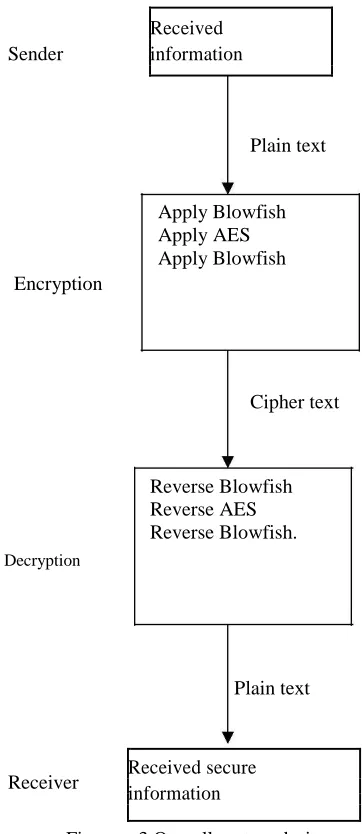
In our proposed work we provide security by implementing two algorithm Blowfish and AES together to cloud network. To implement these three algorithm we use Asp.net as a platform.
Sender
Received information
Plain text
Apply Blowfish Apply AES Apply Blowfish Encryption
Cipher text
Reverse Blowfish Reverse AES Reverse Blowfish.
Decryption
Plain text
REFERENCES
[1] Garima Saini, ―Triple Security of Data in Cloud Computing‖
In International Journal of Computer Science and Information Technologies, Jun-2014.
[2] Chao Yang, ―A novel triple Encryption Scheme for Hadoop based cloud computing‖, in Emerging intelligent data and web technologies, IEEE, Sep- 2013.
[3] Patidar, S ―Survey on cloud computing‖, in Advanced computing and communication technologies , IEEE , Jan- 2012..
[4] M. Vijayapriya, ―Security algorithm In Cloud Computing: Overview‖/ International Journal of Computer Science & Engineering Technology(IJCSET)
[5] Rashmi Nigoti, Manoj Jhuria & Dr. Shailendra Singh,‖ A Survey of Cryptographic algorithms for Cloud Computing.In International Journal of Emerging Technologies in Computational and Applied Sciences(IJETCAS), ISSN(print) 2279-0047, ISSN(online):2279-0055. [6] B.Arun & S,K. Prashanth, ― Cloud Computing Security Using Secret Sharing Algorithm‖ in Indian Journal of Research, ISSN-2250-1991,
Volume:2|Issue: 3| March 2013.
[7] Approach to Hide Text in Images Using Steganography‖
In International Journal of advanced Research in Computer Science and software Engineering, ISSN: 2277 128X, Volume 3, Issue 4, April 2013.