“Study on Consequence of Artificial Sand and Aggregate on
Compressive Strength and Workability of Concrete”
RAVIRAJ DASHORE, ARPIT CHAWDA
ABSTRACT
Structures are founded with concrete and steel materials mainly. Concrete is a main
constituent of the Civil Engineering structures. Traditionally, concrete is mixture of cement,
sand and aggregate. Properties of the sand and aggregate affect the durability and
performance of concrete, so aggregate is an essential component of concrete. The most
commonly used fine aggregate is natural river sand and coarse aggregate is stone quarry.
Scarcity of good quality Natural River sand due to depletion of resources and restriction due
to environmental consideration has made concrete manufactures to look for suitable
alternative fine aggregate.
One such alternative is “Artificial sand” namely if graded by means may also be called as
manufactured sand. In many parts of India, good natural river sand is not available and this
makes manufacturing of good quality of concrete very difficult.
In this dissertation work an attempt has been made to determine and verify experimentally
the effect of artificially graded sand and demolished concrete structural aggregates on
compressive strength and workability of concrete. Artificial sand is manufactured from
crushing of local chury, stone chips and demolished concrete fines while the artificial
aggregates are prepared from demolished structures.
In the first phase of the study, the specimen of standard cube of (150 mm x 150 mm x 150
mm) was used to determine the compressive strength of concrete with natural sand and
stone aggregates. The specimens were tested for each nominal mix and definite water
cement ratio. Three cubes were prepared for obtaining average of 7, 14 and 28 days strength
of concrete.
x 150 mm) was used to determine the compressive strength of concrete with artificial sand
with full replacement and demolished concrete structure aggregates. The specimens were
tested for each nominal mix and definite water cement ratio. Three cubes were prepared for
obtaining average of 7, 14 and 28 days strength of concrete.
Results were obtained and summarized to compare the nominal mix strength of traditional
concrete with artificial concrete analytically as well as are compared graphically. The
conclusions were made for the understanding the effect of artificial concrete in terms of
strength and workability over traditional concrete.
INTRODUCTION
Structures are founded with concrete and steel materials mainly. Concrete is a main
constituent of the Civil Engineering structures. It is becoming the backbone of
infrastructural development of whole world. Concrete has capacity to enhance its properties
with the help of other suitable constituents. The concrete is the most important construction
material, which is manufactured at site. It has the advantage of being formed into any
desired shape most conveniently. As an importance of the use of waste materials, number of
research is currently being conducted concerning the use of artificial sand in increasing the
workability and strengthening of reinforced cement concrete and plain cement concrete
members.
In the first set, natural sand and stone aggregates rom quarry sites is used to manufacture
concrete for M15, M20 and M25 grade of concrete. For the determination of mix design
various properties of concrete ingredients is conducted in the laboratory and results are
recorded. For obtaining far more accurate results at least three samples are made for each
grade of mix and then average value is taken for comparative study.In the second set,
artificial sand and demolished aggregate is used to manufacture concrete for M15, M20 and
M25 grade of concrete. For the determination of mix design various properties of concrete
ingredients is conducted in the laboratory and results are recorded. For obtaining far more
accurate results at least three samples are made for each grade of mix and then average
value is taken for comparative study.In all sets of reading an attempt is made for keeping
strength using slump cone test apparatus and compression testing machine. Effect on
workability and strength with variation in the quantity of artificial sand are studied from
experimental data obtained for 7 days, 14 days and 28 days.
OBJECTIVES OF STUDY
On the basis of the recent trends in development in manufacturing of concrete and its
ingredients the following becomes the part of study in the dissertation:
To provide alternative to natural sand by replacing it with 100% artificial sand
and aggregate for different concrete mix.
To determine the effect of workability on compressive strength of concrete.
To determine the compressive strength of concrete of different mixes once for
natural sand and thereby replacing natural sand 100%.
To determine the compressive strength of concrete of different mixes by
grading of artificial coarse aggregate.
To obtain graphically comparison of concrete for different mix.
To draw graphical comparisons between different grades of concrete for improvement in workability and compressive strength of concrete.
To draw conclusions about improvement in the workability and strength of concrete. To draw inferences for further scope in this direction.
METHODOLOGY
Methodology is the process of performing any work in proper manner i.e. step by step
procedure of work.
This procedure of methodology is shown in following steps;
a) Procurement of material
b) Material testing
c) For specific gravity and Fineness
d) Arriving mix proportion
e) Cube Casting
g) Strength test 7 days
h) Result and Discussion
The specimen of standard cube of (150 mm x 150 mm x 150 mm) was used to
determine the compressive strength of concrete. Three specimens were tested for 7, 14 and
21 days with varying proportion of manufactured sand replacement. The constituents were
weighed and the materials were mixed in a mixer. The mixes were compacted with the help
of tamping rod. The specimens were de molded after 24 h, cured in water for 7, 14 and 28
days, and then tested for its compressive strength as per Indian Standards.
RESULT AND DISCUSSION
After the example of standard 3D square of (150 mm x 150 mm x 150 mm) was utilized to
decide the compressive quality of cement. Three examples were tried for 7, 14 and 28 days
with differing extent of fabricated sand substitution. The constituents were weighed and the
materials were blended in a blender. The blends were compacted with the assistance of
taping bar. The examples were de formed after 24 h, cured in water for 7, 14 and 28 days,
and after that tried for its compressive quality according to Indian Standards. Taking after
results were gotten and:
Abridged beneath
S No
Mix W/C Ratio
Slump (mm)
For Natural Sand: Average Compressive Strength in N/mm2
7 Days Avg. 14 Days Avg. 28 Days Avg.
1 M15 0.5 110
15.28
15.44
20.15
20.25
24.00
24.02
15.64 20.45 23.90
15.78 20.30 24.40
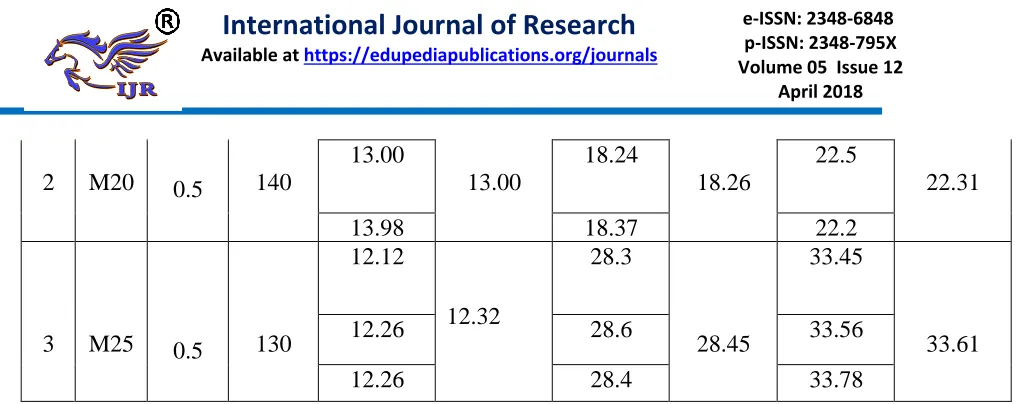
2 M20 0.5 140
13.00 13.00 18.24 18.26 22.5 22.31
13.98 18.37 22.2
3 M25 0.5 130
12.12 12.32 28.3 28.45 33.45 33.61
12.26 28.6 33.56
12.26 28.4 33.78
Table 1: Compressive Strength of Concrete with Natural Sand.
MIX 7 days N/mm2 14 days N/mm2 28 days N/mm2
M15 15.44 20.25 24.02
M20 13.00 18.26 22.31
M25 12.32 28.45 33.61
S
No
Mix W/C
Ratio
Slump
(mm)
For Artificial Sand: Average Compressive Strength in N/mm2
7 Days Avg. 14 Days Avg. 28 Days Avg.
1 M15 0.5 110
15.78 15.82 20.25 20.64 24.00 24.60
16.14 20.85 24.00
15.88 20.70 25.80
2 M20 0.5 140
14.00 14.10 19.16 19.78 23.2 23.08
14.18 19.52 23.28
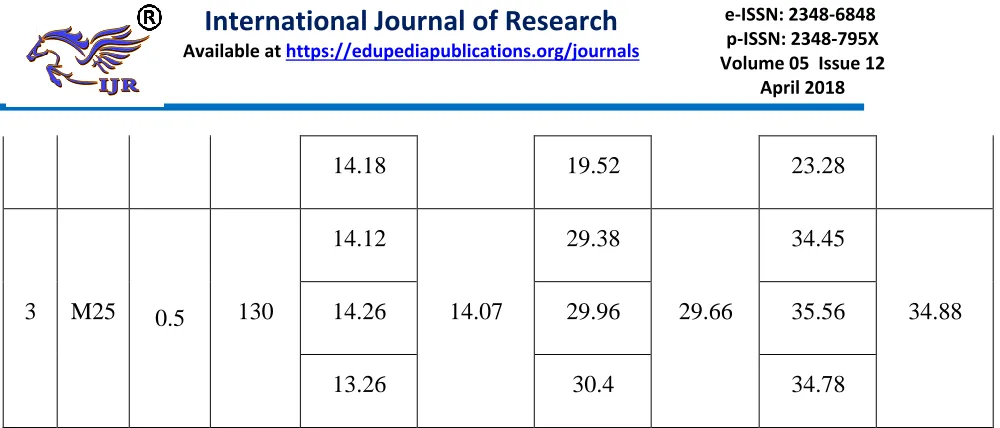
3 M25 0.5 130
14.12
14.07
29.38
29.66
34.45
34.88
14.26 29.96 35.56
13.26 30.4 34.78
Table 2: Compressive Strength of Concrete with Artificial Sand.
MIX 7 days N/mm2 14 days N/mm2 28 days N/mm2
M15 15.82 20.64 24.60
M20 14.10 19.78 23.08
25
20
15
7 days
14 days
28 days
10
50 Natural Sand Artificial Sand
7 days 13 14.1
14 days 18.26 19.78
28 days 22.31 23.08
Fig2: Graphical Comparison for M20 Grade of Concrete
Ave
rage
C
o
mpres
sive
S
trengt
h
in
40
35
30
25
7 days
20 14 days
28 days
15
10
0
Natural Sand Artificial Sand
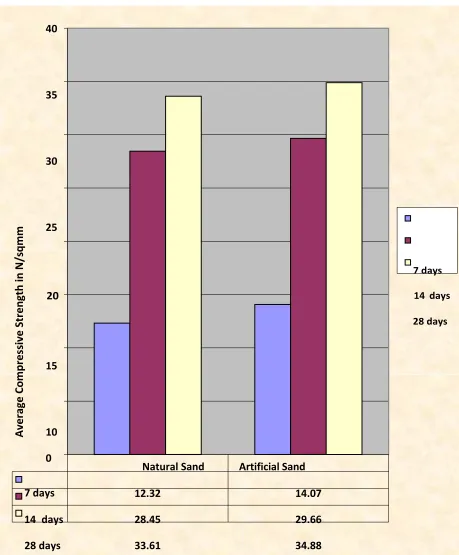
7 days 12.32 14.07
14 days 28.45 29.66
28 days 33.61 34.88
Fig 3: Graphical Comparison for M25 Grade of Concrete
Ave
rage
C
o
mpres
sive
S
trengt
h
in
WORKABILITY
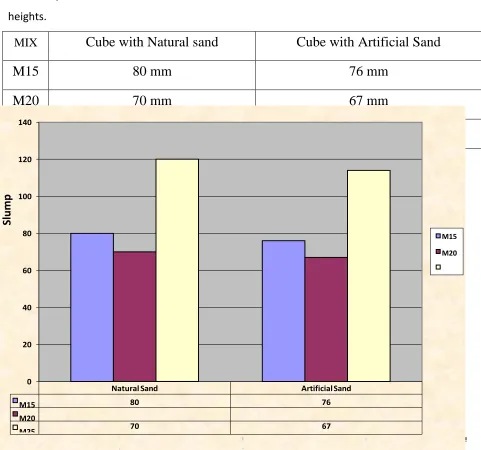
The workability of the mixes was determined using a slump cone test having
same water cement ratio for all the three mix design (M15, M20, and M25).
Workability by
Slump Cone Test
Table 5: Cube
with slump
heights.
MIX
Cube with Natural sand
Cube with Artificial Sand
M15
80 mm
76 mm
M20
70 mm
67 mm
M25
140120 mm
114 mm
120
100
80
60
40
20
0
M15 M20 M25
Natural Sand 80
70
Artificial Sand 76
67
M15
M20
M25
Fig 4: Graphical comparison of workability of concrete
CONCLUSION
In Case of 100% replacement of natural sand by artificial sand, it is found that the compressive strength of the concrete for all
grades increases.
Bonding strength increases due to fineness of artificial sand.
Increase in bonding strength results to increase in stiffness.
Workability reduces slightly with the replacement of natural sand by artificial sand.
To increase the workability plasticizer can be used.
Results show that the river sand can be fully replaced by artificial sand.
Proves to be economical in terms of availability.
Concrete with artificial sand and aggregates design results are satisfactory.
Cube strength of Narmada sand concrete is found to be less then artificial sand. Workability is more in case of natural sand made concrete as compared
to artificial sand. Results obtained after validation were satisfactory.
REFERENCES
[1] Dr. S. Elavenil, Prof. B. Vijaya, “Manufactured Sand, A
[2] Prof. M.R.Chitlange, Dr. P.S. Pajgade, Dr. P.B. Nagarnaik,
“Experimental Study of Artificial Sand Concrete”, First International
Conference on Emerging Trends in Engineering and Technology.
[3] Vinayak Supekar, Dr.Popat Kumbhar. “Properties of Concrete
by Replacement of Natural Sand with Artificial Sand”, International Journal
of Engineering Research & Technology (IJERT), Vol. 1 Issue 7, September -
2012.
[4] Prof. Wakchure, M.R., Er Shaikh A.P. “Effect of Types of Fine
Aggregate on Mechanical Properties of Cement Concrete”, International
Journal of Modern Engineering Research (IJMER), ISSN: 2249-6645, Vol.2,
Issue.5, Sep-Oct. 2012 pp-3723- 3726.
[5] Leila Zeghichi, Zeid Benghazi and Laid BaaliForman,
“Comparative Study of Self Compacting Concrete with Manufactured and Dune Sand”, Journal of Civil Engineering and Architecture, ISSN 1934-7359,
USA, Oct. 2012, Volume 6, No. 10 (Serial No. 59), pp. 1429–1434.
[6] B.P. Hudson, Manufactured Sand for Concrete. [Pg7]
[7] Nimitha Vijayaraghavan and A S Wayal, “Effects of
Manufactured Sand on Compressive Strength And Workability Of
Concrete”, International Journal of Structural and Civil Engineering Research,
ISSN 2319 – 6009, Vol. 2, No. 4, November 2013.
[8] A. Navaneethakrishnan, Prof. V.M. Shanthi, “Experimental Study
of Self Compacting Concrete (SCC) Using Silica fume”, International
Journal of Emerging Trend in Engineering and Development, ISSN 2249-