Scholarship@Western
Scholarship@Western
Electronic Thesis and Dissertation Repository
8-4-2015 12:00 AM
Relationships between the Dark Triad and Delayed Gratification:
Relationships between the Dark Triad and Delayed Gratification:
An Evolutionary Perspective
An Evolutionary Perspective
Holly M. Baughman
The University of Western Ontario Supervisor
Tony Vernon
The University of Western Ontario Graduate Program in Psychology
A thesis submitted in partial fulfillment of the requirements for the degree in Master of Science © Holly M. Baughman 2015
Follow this and additional works at: https://ir.lib.uwo.ca/etd Part of the Personality and Social Contexts Commons
Recommended Citation Recommended Citation
Baughman, Holly M., "Relationships between the Dark Triad and Delayed Gratification: An Evolutionary Perspective" (2015). Electronic Thesis and Dissertation Repository. 3276.
https://ir.lib.uwo.ca/etd/3276
This Dissertation/Thesis is brought to you for free and open access by Scholarship@Western. It has been accepted for inclusion in Electronic Thesis and Dissertation Repository by an authorized administrator of
Relationships between the Dark Triad and Delayed Gratification: An Evolutionary Perspective
Holly M. Baughman
Graduate Program in Psychology
A thesis submitted in partial fulfillment of the requirements for the degree of
Master of Science
The School of Graduate and Postdoctoral Studies The University of Western Ontario
London, Ontario, Canada
ABSTRACT
The Dark Triad (i.e., psychopathy, narcissism, and Machiavellianism) is a cluster of socially aversive personality traits that account for the “darker” side of human behavior. While traditional views have focused on the maladaptive nature of these traits, recent work in the field of evolutionary psychology suggests these traits may be adaptive in terms of self-serving behavior. The Dark Triad traits may also be a manifestation of a particular life strategy that an individual engages in; one that is characterized by immediate gratification and risk-taking. The present study examined links between the Dark Triad traits and ability to delay gratification in a sample of 364 undergraduate students (136 males). Psychopathy was the most strongly linked to an inability to delay gratification, followed by Machiavellianism and narcissism. Sex also moderated these relationships, such that women who scored high on Machiavellianism were less likely to delay gratification than men; however, these associations were no longer significant when a more conservative Bonferroni correction was applied. Findings are discussed within the evolutionary framework of Life History Theory.
Table of Contents
ABSTRACT... ii
ACKNOWLEDGMENTS... v
CHAPTER 1: INTRODUCTION AND LITERATURE REVIEW... 1
1.1 Introduction... 1
1.2 Life History Strategies and the Dark Triad... 5
1.3 The Dark Triad and Delayed Gratification... 8
1.3.1 Psychopathy: Recklessness and Impulsivity... 10
1.3.2 Narcissism: Overconfidence and Motivation... 10
1.3.3 Machiavellianism: Strategic Planning... 11
1.4 The Dark Triad and Honesty Humility... 12
1.5 The Present Study... 14
CHAPTER 2: METHOD... 14
2.1 Participants and Procedure... 14
2.2 Materials... 15
CHAPTER 3: RESULTS... 18
3.1 Descriptive Statistics and Sex Differences... 18
3.2 Zero-Order Correlations and Multiple Regression... 23
3.3 Moderation... 27
CHAPTER 4: GENERAL DISCUSSION AND CONCLUSION... 28
4.1 General Discussion... 28
4.2 Measurement Issues with the Dark Triad... 32
4.4 Conclusion... 35 REFERENCES... 37 TABLE 1: Descriptive Statistics and Sex Differences... 20 TABLE 2: Intercorrelations between the Dark Triad Variables and Zero-Order
Correlations with Honesty-Humility... 21 TABLE 3: Intercorrelations between the Delayed Gratification Variables... 22 TABLE 4: Zero-order Correlations (and Partial Standardized Regression
Coefficients) of the Dark Triad Measures Predicting Delayed
Acknowledgements
CHAPTER ONE: INTRODUCTION AND LITERATURE REVIEW 1.1 Introduction
There is considerable debate in the literature regarding models of personality, primarily involving the issue of how many personality factors are necessary to
account for individual differences in behavior. Historically, theories have ranged from one (e.g., Rushton & Irwing, 2009), to three (e.g., Eysenck, 1967), to five (e.g., Goldberg, 1990; Zuckerman, Kuhlman, Thornquist, & Kiers, 1991), to six (e.g., Lee & Ashton, 2004), and even to sixteen (e.g., Cattell, 1957) factors. The Five Factor Model (FFM; McCrae & Costa, 1987) is currently the most prominent framework used to explain individual differences in personality. It consists of five personality dimensions: Openness, Agreeableness, Conscientiousness, Extraversion, and
Neuroticism. Despite substantial evidence to support the FFM (e.g., Costa & McCrae, 1996; McCrae & Costa, 1987; McCrae & John, 1992), it has been criticized for inadequately capturing a wide range of traits, particularly those malevolent in nature (Paunonen & Jackson, 2000; Veselka, Schermer, & Vernon, 2012). Given this limitation and the increasing interest in examining the “darker” side of human nature (see Personality and Individual Differences, 2014, Volume 67), alternative
personality traits such as the Dark Triad have been proposed.
The Dark Triad is a cluster of three sub-clinical personality traits:
traits (Paulhus & Williams, 2002; Lee & Ashton, 2005) and each has been linked to unique behavioral outcomes and social influence tactics (for a review see Furnham, Richards, & Paulhus, 2013; Jonason & Webster, 2012).
Psychopathy is considered to be the “darkest” of the three traits (Rauthmann & Kolar, 2012) and is characterized by emotional instability, impulsivity, shallow affect, and callous emotionality (Jonason, Kaufman, Webster, & Geher, 2013a; Jonason, Lyons, Bethell, & Ross, 2013b; Jones & Paulhus, 2011b; Hare, 1985). Psychopathic individuals employ tactics of manipulation and use relationships for personal gain (Hare, 1985; 2003). They also engage in impulsive and destructive behaviors without consideration for the consequences of their actions either on themselves or on others (Hare, 2003).
Those who score high on psychopathy have impairments in passive avoidance learning, such that they are unable to learn from aversive experiences (Blair et al., 2004; Newman & Kosson, 1986) and continue to commit antisocial acts with a high risk of being caught (Cleckley, 1976). Psychopathy is strongly linked to violence, criminal conduct, and recidivism (Hare, 1996; 1999; Leistico, Salekin, DeCoster, & Rogers, 2008), as well as a wide range of socially aversive behaviors, including substance abuse and dependence (Hemphill, Hart, & Hare, 1994), deviant sexual activity (Lalumière & Quinsey, 1996; Visser, Pozzebon, Bogaert, & Ashton, 2010), and reactive and instrumental types of aggression (Jones & Paulhus, 2011; Porter & Woodworth, 2006). These associations with dysfunctional impulsivity and criminality are what differentiate psychopathy from the other traits.
& Kolar, 2012) and is characterized by feelings of grandiosity, dominance, and superiority (Emmons, 1984). A central feature of narcissism is self-enhancement, such that narcissistic individuals have biased and inflated self-views that function to maintain their self-esteem (John & Robins, 1994). Thus, narcissism may be adaptive in some cases (Paulhus, 1998), as evidenced by its positive links with trait emotional intelligence (Petrides, Vernon, Schermer, & Veselka, 2011), self-esteem (Zeigler-Hill, 2006) subjective well-being (Rose & Campbell, 2004), and life expectancy (Jonason, Baughman, Carter, & Parker, 2015). In the mating context, narcissistic individuals are perceived as more attractive and are more successful in acquiring short-term mates than are non-narcissists (Holtzman & Strube, 2010; Jonason, Li, Webster, & Schmitt, 2009; Jonason, Valentine, Li, & Harbeson, 2011).
Although narcissism may be a milder trait with regards to antisocial behavior compared to psychopathy and Machiavellianism, it is also related to undesirable behaviors. For example, narcissists are more likely to be aggressive when their ego is threatened, although this is typically confined to reactive (vs. proactive) and relational (vs. physical) types of aggression (Baumeister, Bushman, & Campbell, 2000;
Machiavellianism is represented by glib social charm, manipulativeness, and a lack of conventional morality (Christie & Geis, 1970). Machiavellian individuals employ social tactics, such as charm and seduction, to exploit others for personal gain (Jonason & Webster, 2012). There are many conceptual similarities between
Machiavellianism and psychopathy (e.g., Smith & Griffith, 1978; McHoskey, Worzel, & Szyarto, 1998), such as disagreeableness, manipulativeness, and low empathy (Ali, Amorim, & Chamorro-Premuzic, 2009; Lee & Ashton, 2005).
Moderate to strong correlations have been reported between Machiavellianism and psychopathy (Jakobwitz & Egan, 2006; McHoskey et al., 1998; Paulhus &
Williams, 2002). Nevertheless, they are considered distinct constructs. Machiavellianism, unlike psychopathy, is not associated with recklessness,
impulsivity, and criminality (see Jones, 2014). Machiavellianism is also linked to a flexible and manipulative mating style that facilitates relationship maintenance, unlike psychopathy, which characterized by a more impulsive and aggressive strategy that increases mating opportunities (Jonason & Kavanagh, 2010). Behavioral genetics research has also found that individual differences in Machiavellianism alone are attributable to shared environmental factors (e.g., within family processes), in addition to genetic factors, whereas psychopathy and narcissism are influenced by genetic and non-shared environmental factors (Vernon, Villani, Vickers, & Harris, 2008).
characterized by selfishness and immediate gratification (Figueredo et al., 2005; Jonason, Koenig, & Tost, 2010a; Jonason, Li, & Teicher, 2010b; Jonason, Webster, Schmitt, Li, & Crysel, 2012). However, traits within the Dark Triad may only be advantageous in certain contexts in which self-serving, goal-directed behavior is relevant. Those who score high on the Dark Triad traits benefit from short-term behaviors because these render them unpredictable and able to avoid detection (Jonason & Webster, 2012; Wilson, Near, & Miller, 1996). For example, high Dark Triad individuals are more likely to get ahead of others in the workplace and obtain positions of leadership (Babiak & Hare, 2006; Furnham, 2010; Hogan & Hogan, 2001). They are also more successful in short-term mating efforts (Jonason et al., 2009; 2011) and employ a variety of social strategies to manipulate others for
personal gain (Jonason & Webster, 2012). These individuals, are however, perceived as undesirable in long-term relationships where mutual exchange is necessary for relationship maintenance (Campbell & Foster, 2002; Foster, Shrira, & Campbell, 2006; Jonason et al., 2009). Therefore, the Dark Triad can be viewed as having a selfish and exploitative interpersonal style that is high on agency (i.e., getting ahead) and low on communion (i.e., getting along), which accommodates an individual’s short-term motives (Jones & Paulhus, 2010a). The present study will adopt a functional view of the Dark Triad by providing links within the evolutionary framework of Life History Theory.
1.2 Life History Strategies and the Dark Triad
resources for survival and reproduction. According to this theory, organisms must adopt a reproductive strategy that is either focused on somatic effort (i.e., allocating resources to continued survival) or reproductive effort (i.e., allocating resources to mating). This can also be described as a trade-off between current and future reproduction. How an organism makes this trade-off constitutes its life history strategy. This theory has also been modified to understanding individual differences in human behavior (Rushton, 1985).
There is a wide array of costs and benefits associated with adopting a
particular life strategy (Figueredo et al., 2006). For instance, those who invest largely in somatic effort are considered as having a slow life strategy, characterized by secure attachment and long-term mating tactics (Griskevicius, Tybur, Delton, & Robertson, 2011; Figueredo et al., 2005). In contrast, those who invest predominantly in
reproductive effort are considered to have a fast life strategy, manifesting as socially undesirable tendencies that focus on individual efforts towards immediate
gratification. This may be manifested by limited self-control and impulsivity (Jonason & Tost, 2010; Jones & Paulhus, 2011b), a lack of foresight and planning for the future (Figueredo, Vásquez, Brumbach, & Schneider, 2007; Jonason et al., 2010a) as
well as by behaviors involving short-term sexual relations (Jonason et al., 2009; 2011), gambling (Crysel, Crosier, & Webster, 2013; Jones, 2013), and risk-taking (Jonason, et al., 2015). These correlates of a fast life strategy have also been linked to the Dark Triad traits.
Life history strategies manifest in various psychosocial markers and
suggests the Dark Triad traits are indicators of a fast life strategy (Figueredo et al., 2005). In particular, this link appears to be strongest in psychopathy, and to a lesser extent in Machiavellianism and narcissism. However, attempts to link
Machiavellianism to indicators of a fast life strategy have yielded inconsistent results (Figueredo et al., 2005; Jonason et al., 2009; 2010a; Jonason & Kavanagh, 2010; Jonason & Tost, 2010; McDonald, Donnellan, & Navarrete, 2012). These
inconsistencies may be the result of difficulties associated with defining and measuring the construct. The Mach-IV is the most widely used measure of
Machiavellianism, despite concerns of construct validity, outdated item content, and dimensionality (Fehr, Samson, & Paulhus, 1992; Jones, in press). Compared to the other traits, narcissism does not map well onto most components that would
constitute a fast life strategy (Jonason et al., 2010a). Some aspects of narcissism (i.e., leadership/authority, grandiose exhibitionism, fearless dominance) are characteristic of a slow life strategy, which are linked to attributes such as confidence, high self-esteem, social dominance, and low anxiety. The entitlement/exploitativeness dimension of narcissism, however, is characteristic of a fast life strategy and is associated with low self-control and an exploitative interpersonal style (McDonald et al., 2012). In general, the Dark Triad traits embody a life strategy that is depicted by selfishness, exploitiveness, and risk-taking.
women are faced with the adaptive issue of identifying men who are able to invest in their offspring, whereas men are confronted with the issue of identifying
reproductively valuable women (Buss, 1995). Parental investment theory has proven useful in explaining these differences in humans. According to this theory, men allocate substantially fewer resources to parenting their offspring than do women (Bjorklund & Kipp, 1996). As a result of differences in reproductive efforts, women have greater inhibitory control than do men (Bjorklund & Shackelford, 1999). However, this may be specific to evolutionary contexts pertaining to survival and mating. For example, men are more likely to have an unrestricted sociosexuality, short-term sexual relationships, and a greater preference for multiple partners (Jonason et al., 2009). Men also score higher on the Dark Triad traits than women (Jones & Paulhus, 2014). It is more advantageous for men to have traits such as the Dark Triad and to engage in short-term behaviors because they acquire more benefits and suffer fewer costs than women do (Buss, 2009; Figueredo et al., 2006; Jonason et al., 2012).
In order to better integrate the Dark Triad within the life history framework, the present study will directly assess the relationship between the Dark Triad traits and delayed gratification across three measures of the Dark Triad. A secondary aim of this study is to replicate sex differences in the Dark Triad traits and delayed
gratification, as well as to determine whether these relationships are moderated by sex of the participant.
1.3 The Dark Triad and Delayed Gratification
long-term interests. For instance, short-term interests may provide immediate benefits but be associated with long-term costs. For an average person, the immediate
consequences of a decision weigh more heavily than the long-term consequences (Ainslie, 1992). The ability to resist smaller, short-term gains in favor of greater, long-term gains is referred to as the delay of gratification (Hoerger, Quirk & Weed, 2011). Research on this construct emphasizes the contribution of personality traits towards the tendency to place less value on long-term interests (e.g., Hirsh, Morisano, & Peterson, 2008; Funder, Block, & Block, 1983; Mishra & Lalumière, 2011).
traits and future discounting were masked. Second, the use of a single-item monetary scenario to assess future discounting may have contributed to poor reliability and does not capture the multidimensionality of the construct. Therefore, it is important to investigate possible relationships between each of the Dark Triad traits and the ability to delay gratification using a more reliable measure of the latter.
1.3.1 Psychopathy: Recklessness and impulsivity. Psychopathy is associated with taking unnecessary risks for minimal gain (Cleckley, 1976). Psychopathic
individuals are described as having a weak Behavioral Inhibition System (BIS) and a normal Behavioral Activation System (BAS), suggesting an inclination towards reward and insensitivity to punishment (Lykken, 1995). They are also high in sensation-seeking tendencies, which further contribute to their risk-taking behaviors (Blackburn, 1969; Horvath & Zuckerman, 1993). Psychopathy is also linked to dysfunctional impulsivity (Jones & Paulhus, 2011b), which is described as an inability to resist smaller immediate gains over larger delayed gains (Ainslie, 1975). This lack of inhibition and motivation towards immediate emotional gratification may influence decision-making processes (Crone, Vendel, & van der Molen, 2003) and lead to reckless and self-destructive behaviors (Jones, 2013). Neuroimaging studies have also found that psychopathy is linked to impairments in brain areas involving emotional processing and decision-making, such as the amygdala and orbitofrontal cortex (Mitchell, Colledge, Leonard, & Blair, 2002; Yang, Rain, Narr, Colletti, & Toga, 2009). Thus, it would be expected that, relative to the other traits, psychopathy is the most strongly linked to an inability to delay gratification.
stems from an attempt to regulate a high, fragile self-esteem that must be constantly reinforced (Zeigler-Hill, 2006). Thus, narcissistic individuals behave in ways to immediately satisfy their ego needs, while downplaying long-term consequences (Morf & Rhodewalt, 2001). This inclination towards immediate gratification may explain why narcissism is associated with impulsivity and risk-taking (Campbell, Goodie, & Foster, 2004; Jones & Paulhus, 2011b).
There is a clear distinction between impulsivity in psychopathic and narcissistic individuals. Psychopathic impulsivity is attributable to poor impulse control (Jones & Paulhus, 2011b), whereas narcissistic impulsivity is related to overconfidence and unrealistic optimism (Paulhus, Harms, Bruce, & Lysy, 2003) and unrelated to limited self-control (Jonason & Tost, 2010). Narcissism is associated with strong approach and weak avoidance motivations (Foster & Trimm, 2008), sensation-seeking tendencies (Emmons, 1981), as well as cognitive biases in risk taking assessment (Foster, Shenesey, & Goff, 2009). As such, narcissistic individuals engage in self-destructive behaviors with little concern for others (Vazire & Funder, 2006), such as gambling (Jones, 2013) and financial risk-taking (Foster, Reidy, Misra, & Goff, 2011). Given the reward-seeking and impulsive nature of narcissism, it is likely that those who are high in this trait are unable to delay gratification.
gratification, as supported by its relationships with poor self-control (Jonason & Tost, 2010). It is linked to low conscientiousness and low agreeableness (Lee & Ashton, 2005), which in turn are associated with sensation-seeking (Zuckerman, 1994) and short-term mating behaviors (Schmitt, 2004; Schmitt & Shackelford, 2008). Machiavellianism is also related to risky decision-making, individually and within group settings (Rim, 1966), and these individuals make such decisions in order to minimize losses and maximize gains (Weinstein & Martin, 1969).
Recent work suggests that Machiavellianism may differ from psychopathy in terms of short-term and long-term deception tactics (Jones, 2014). Whereas
however, are derived from self-report assessment and have not looked at the unique variance of Machiavellianism that is not shared with psychopathy.
1.4 The Dark Triad and Honesty-Humility
Researchers have attempted to identify the underlying core of the Dark Triad in order to explain the overlap between them. Features that the Dark Triad have in common include manipulativeness and callousness (Jones & Figueredo, 2015), disagreeableness (Paulhus & Williams, 2002; Jacobwitz & Egan, 2006), a fast life history strategy (Jonason et al., 2009; Jonason et al., 2010a), and facets of the HEXACO personality model (Lee & Ashton, 2006; Lee et al., 2013). All of these links have received empirical support; however, it has been argued that the Honesty-Humility factor of the HEXACO best accounts for the common variance in the Dark Triad (Book, Visser, & Volk, 2015).
The HEXACO model was proposed by Lee and Ashton (2004) as an
al. 2013; Spain, Harms, & Lebreton, 2014; Visser, Pozzebon, & Reina-Tamayo, 2014). The Dark Triad traits and Honesty-Humility are strongly related, with
correlations ranging from -.53 to -.72 (Lee & Ashton, 2005), and all three of the Dark Triad traits load onto the Honesty-Humility factor (Lee & Ashton, 2005). Therefore, it will be important to control for the overlap between these constructs in order to determine whether the Dark Triad traits can predict delayed gratification over and above Honesty-Humility.
1.5 The Present Study
Much of the evidence to support the relationship between the Dark Triad and delayed gratification is indirect, as demonstrated by its links with related constructs, such as self-control, impulsivity, and risk-taking. To date, Jonason et al. (2010a) provide the only direct assessment of this relationship in the form of future
discounting, but methodological issues render their findings less than adequate. As such, the purpose of the present study is to address the limitations of Jonason et al. (2010a) and to resolve certain inconsistencies in the literature. This will be
accomplished by (1) using a reliable and valid measure of delayed gratification, (2) examining each of the Dark Triad traits in relation to delayed gratification rather than a single composite measure, (3) using multiple measures of the Dark Triad to
compare the differences in results among them, and (4) examining sex differences and moderation by sex of the participant.
Psychopathy and narcissism are linked to impulsivity and risk-taking
Predictions of the relationship between Machiavellianism and delayed gratification are exploratory. It is also expected that the links between the Dark Triad and delayed gratification will be stronger in men than women.
CHAPTER TWO: METHOD 2.1 Participants and procedure
This study was approved by The University of Western Ontario Non-Medical Research Ethics Board (see Appendix A). A sample of 364 undergraduates (136 males) from the University of Western Ontario took part in this study. Their ages ranged from 17 to 41 (M = 18.49, SD = 1.83). Participants were directed to the website FluidSurvey, where they read a letter of information and provided their informed consent. They subsequently completed the online survey. Upon completion of the study, participants were debriefed and compensated with course credit. This study took approximately one hour to complete.
2.2 Materials
Psychopathy. The Self-Report Psychopathy Scale-III (SRP-III; Paulhus,
Neumann, & Hare, in press) is a 64-item measure of psychopathy. Participants rate on a 5-point Likert scale (1 = Strongly disagree; 5 = Strongly agree) their agreement to statements such as, “I rarely follow the rules” and “I enjoy doing wild things”. The
narcissistic tendency (e.g., “I am going to be a great person”), while the other is not (e.g., “I am no better or worse than most people”). The NPI-16 has desirable
psychometric properties and has demonstrated findings that are comparable to its 40-item counterpart (del Rosario & White, 2005; Raskin & Hall, 1979).
Machiavellianism. The Mach-IV (Christie & Geis, 1970) is a 20-item of Machiavellianism. Participants indicate their agreement on a 5-point Likert scale (1 = Strongly disagree; 5 = Strongly agree) to statements such as, “It is wise to flatter important people”. The Mach-IV has demonstrated sufficient internal consistency (α
= .70 to .76) and validity (Panitz, 1989; Wrightsman, 1991).
Short-form measures of the Dark Triad. The Short-Dark Triad (Jones & Paulhus, 2014) is a 27-item measure of the Dark Triad traits. Participants indicate their agreement on a 5-point Likert scale (1 = Strongly disagree; 5 = Strongly agree) with statements reflective of narcissism (e.g., “People see me as a natural leader”), Machiavellianism (e.g., “It’s not wise to tell your secrets”), and psychopathy (e.g., “People who mess with me always regret it”). This measure has good psychometric
properties, with Cronbach’s alphas ranging from .68 to .74 (Jones & Paulhus, 2014). The Dirty Dozen (Jonason & Webster, 2010) is a 12-item measure of the Dark Triad traits. Participants rate their agreement to various statements on a 5-point Likert scale (1 = Strongly disagree; 5 = Strongly agree). Items are averaged to create four-item indices of narcissism (e.g., “I tend to want others to admire me”),
Machiavellianism (e.g., “I have used flattery to get my way), and psychopathy (e.g., “I tend to be callous or insensitive). Studies have reported good psychometric
alphas ranging from .63 to .79 for the subscales and .83 for the overall measure (Jonason & Webster, 2010).
Dark Triad trait composites. In order to control for differences in results across the Dark Triad measures, scores for all three measures of the Dark Triad described above were averaged to create three standardized composite scores; one each for psychopathy (α = .76), narcissism (α = .61), and Machiavellianism (α = .66). Correlations among all measures of the Dark Triad ranged from .49 to .76 for
psychopathy, .38 to .66 for narcissism, and .43 to .53 for Machiavellianism. A Principal Components Analysis was conducted for each set of Dark Triad measures excluding the composite measure, separately by trait. All three measures of
Machiavellianism loaded onto a single factor that explained 64.27% of the variance (Eigenvalue = 1.93), with factor loadings ranging from .76 to .82. All three measures of psychopathy loaded onto a single factor that explained 73.27% variance
(Eigenvalue = 2.20), with factor loadings ranging from .77 to .91. All three measures of narcissism loaded onto a single factor that explained 67.38% of the variance (Eigenvalue = 2.02), with factor loadings ranging from .73 to .88.
Honesty-Humility. The Honesty-Humility subscale of the HEXACO-60 (Ashton & Lee, 2009) contains 10 items that are assessed on a 5-point Likert scale (1 = Strongly disagree; 5 = Strongly agree). Participants indicate their agreement to statements such as, “Having a lot of money is not especially important to me”. This measure has favorable psychometric properties, with internal reliability coefficients ranging from .76 to .80 (Ashton & Lee, 2009).
participants completed the Delaying Gratification Inventory (DGI; Hoerger et al., 2011). The measure contains 35-items on a 5-point Likert scale (1 = Strongly disagree; 5 = Strongly agree) and yields scores on five domains of behavior and a composite score: Food (e.g., “I can resist junk food when I want to”), physical pleasures (e.g., “I am able to control my physical desires”), social interactions (e.g., “Usually I try to consider how my actions affect others”), money (e.g., “I manage my money well”), and achievement (e.g., “I am capable of working hard to get ahead in life”). The DGI has demonstrated strong internal consistency (α = .71 to .91) and
test-retest reliability (Hoerger et al., 2011).
CHAPTER THREE: RESULTS 3.1 Descriptive Statistics and Sex Differences
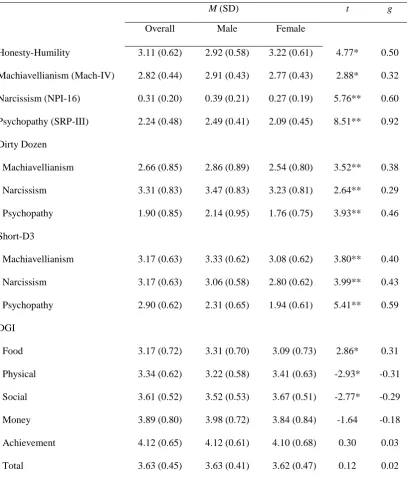
Descriptive statistics and sex differences for measures of the Dark Triad, Honesty-Humility, and delayed gratification are presented in Table 1. Men scored higher than women on all of the Dark Triad traits. Whereas no sex differences were found for the DGI composite, men reported that they were less likely than women to delay gratification in the physical and social domains. Women reported that they were less likely to delay gratification in the food domain. Given the gender imbalance in this sample, Hedge’s g is reported for effect size instead of Cohen’s d. These findings
did not differ across the measures.
subscales of the DGI (α = .60-.67) and the Honesty-Humility subscale of the HEXACO (α = .66) were lower than what has been reported in previous research
Table 1. Descriptive Statistics and Sex Differences
M (SD) t g
Overall Male Female
Honesty-Humility 3.11 (0.62) 2.92 (0.58) 3.22 (0.61) 4.77* 0.50
Machiavellianism (Mach-IV) 2.82 (0.44) 2.91 (0.43) 2.77 (0.43) 2.88* 0.32
Narcissism (NPI-16) 0.31 (0.20) 0.39 (0.21) 0.27 (0.19) 5.76** 0.60
Psychopathy (SRP-III) 2.24 (0.48) 2.49 (0.41) 2.09 (0.45) 8.51** 0.92
Dirty Dozen
Machiavellianism 2.66 (0.85) 2.86 (0.89) 2.54 (0.80) 3.52** 0.38
Narcissism 3.31 (0.83) 3.47 (0.83) 3.23 (0.81) 2.64** 0.29
Psychopathy 1.90 (0.85) 2.14 (0.95) 1.76 (0.75) 3.93** 0.46
Short-D3
Machiavellianism 3.17 (0.63) 3.33 (0.62) 3.08 (0.62) 3.80** 0.40
Narcissism 3.17 (0.63) 3.06 (0.58) 2.80 (0.62) 3.99** 0.43
Psychopathy 2.90 (0.62) 2.31 (0.65) 1.94 (0.61) 5.41** 0.59
DGI
Food 3.17 (0.72) 3.31 (0.70) 3.09 (0.73) 2.86* 0.31
Physical 3.34 (0.62) 3.22 (0.58) 3.41 (0.63) -2.93* -0.31
Social 3.61 (0.52) 3.52 (0.53) 3.67 (0.51) -2.77* -0.29
Money 3.89 (0.80) 3.98 (0.72) 3.84 (0.84) -1.64 -0.18
Achievement 4.12 (0.65) 4.12 (0.61) 4.10 (0.68) 0.30 0.03
Total 3.63 (0.45) 3.63 (0.41) 3.62 (0.47) 0.12 0.02
Note.g is Hedge’s g for effect size.
* p < .01, ** p < .001.
NPI-16 = Narcissistic Personality Inventory-16; SRP-III = Self-Report Psychopathy Scale-III;
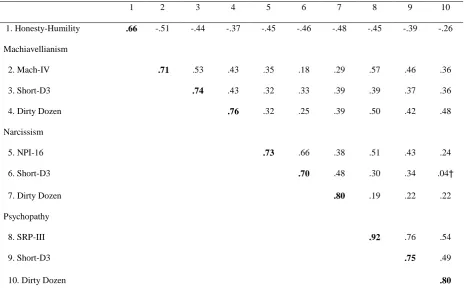
Table 2. Intercorrelations among the Dark Triad Variables and Honesty-Humility
1 2 3 4 5 6 7 8 9 10
1. Honesty-Humility .66 -.51 -.44 -.37 -.45 -.46 -.48 -.45 -.39 -.26
Machiavellianism
2. Mach-IV .71 .53 .43 .35 .18 .29 .57 .46 .36
3. Short-D3 .74 .43 .32 .33 .39 .39 .37 .36
4. Dirty Dozen .76 .32 .25 .39 .50 .42 .48
Narcissism
5. NPI-16 .73 .66 .38 .51 .43 .24
6. Short-D3 .70 .48 .30 .34 .04†
7. Dirty Dozen .80 .19 .22 .22
Psychopathy
8. SRP-III .92 .76 .54
9. Short-D3 .75 .49
10. Dirty Dozen .80
Note. All correlations are significant at the .001 level, with the exception of the correlation between the narcissism subscale of
the Short-D3 and psychopathy subscale of the Dirty Dozen†. Cronbach’s Alpha for each subscale is reported along the diagonal.
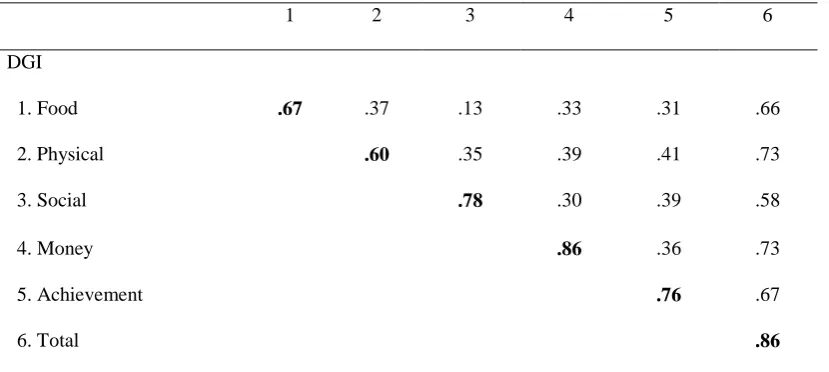
Table 3. Intercorrelations among the Delayed Gratification Variables
1 2 3 4 5 6
DGI
1. Food .67 .37 .13 .33 .31 .66
2. Physical .60 .35 .39 .41 .73
3. Social .78 .30 .39 .58
4. Money .86 .36 .73
5. Achievement .76 .67
6. Total .86
Note. All correlations are significant at the p < .01 level.
Cronbach’s Alpha for each subscale is reported along the diagonal.
3.2 Zero-Order Correlations and Multiple Regression
Correlations of all three measures of the Dark Triad with delayed gratification were compared using Steiger’s z test, which evaluated whether two dependent
correlations are significantly different (Steiger, 1980). On average, the patterns of correlations between the Dirty Dozen and delayed gratification were more similar with the original measures (MSteiger’s z = 2.37, SDSteiger’s z = 1.72) than were the
Short-D3 (MSteiger’s z = 2.87, SDSteiger’s z = 1.47); however, this difference was negligible.
With regards to each of the Dark Triad traits, the Machiavellianism subscale of the Dirty Dozen and Mach-IV demonstrated, on average, more similar patterns of correlations with delayed gratification (MSteiger’s z = 2.00, SDSteiger’s z = 1.12) than the
Short-D3 and Mach-IV (MSteiger’s z = 3.92 , SDSteiger’s z = 0.73). The narcissism subscale
of the Dirty Dozen and the NPI-16 also demonstrated more similar patterns of correlations with delayed gratification (MSteiger’s z = 1.20, SDSteiger’s z = 1.39) than was
found with the Short-D3 and NPI-16 (MSteiger’s z = 2.16, SDSteiger’s z = 1.87). However,
the opposite was found for psychopathy, as the Short-D3 and SRP-III were correlated more similarly with delayed gratification (MSteiger’s z = 2.36, SDSteiger’s z = 0.87) than
were the Dirty Dozen and SRP-III (MSteiger’s z = 3.90, SDSteiger’s z = 1.56). A comparison
of the brief measures of the Dark Triad demonstrated that the Short-D3 and Dirty Dozen exhibited more similar relationships with delayed gratification than they did with the original measures for Machiavellianism (MSteiger’s z = 1.60, SDSteiger’s z = 0.92),
narcissism (MSteiger’s z = 1.27, SDSteiger’s z = 1.03), and psychopathy (MSteiger’s z = 2.05,
SDSteiger’s z = 1.09). Given these differences in results, standardized composite scores
the following analyses.
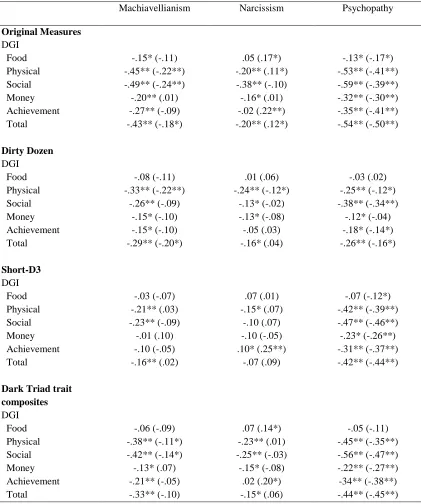
Zero-order correlations and standardized partial regression coefficients of the Dark Triad traits predicting delayed gratification are reported in Table 4. Each of the Dark Triad traits was entered into a multiple regression as predictors of delayed gratification. Results in Table 4 are separated for each measure of the Dark Triad, including the Dark Triad trait composite scores. Across all measures of the Dark Triad traits, psychopathy was the strongest predictor of delayed gratification, followed by Machiavellianism and narcissism. However, narcissism was only a significant predictor of the delayed gratification composite when measured with the NPI-16 and Short-D3, whereas Machiavellianism was only a significant predictor of the delayed gratification composite when measured with the Mach-IV and Dirty Dozen. With regards to the standardized Dark Triad composite scores, the
psychopathy trait composite was the only significant predictor of the inability to delay gratification. The narcissism and Machiavellianism trait composites did not contribute significantly after controlling for the shared variance among the traits.
Honesty-Humility using partial correlations, with the exception of the link between the Machiavellianism trait composite and the Physical subscale of the DGI, as well as the link between narcissism trait composite and the Achievement subscale of the DGI1.
Table 4. Zero-order Correlations (and Standardized Partial Regression Coefficients) of the Dark Triad Measures Predicting Delayed Gratification
Machiavellianism Narcissism Psychopathy
Original Measures DGI
Food -.15* (-.11) .05 (.17*) -.13* (-.17*)
Physical -.45** (-.22**) -.20** (.11*) -.53** (-.41**) Social -.49** (-.24**) -.38** (-.10) -.59** (-.39**) Money -.20** (.01) -.16* (.01) -.32** (-.30**) Achievement -.27** (-.09) -.02 (.22**) -.35** (-.41**) Total -.43** (-.18*) -.20** (.12*) -.54** (-.50**)
Dirty Dozen DGI
Food -.08 (-.11) .01 (.06) -.03 (.02)
Physical -.33** (-.22**) -.24** (-.12*) -.25** (-.12*) Social -.26** (-.09) -.13* (-.02) -.38** (-.34**) Money -.15* (-.10) -.13* (-.08) -.12* (-.04) Achievement -.15* (-.10) -.05 (.03) -.18* (-.14*) Total -.29** (-.20*) -.16* (.04) -.26** (-.16*)
Short-D3 DGI
Food -.03 (-.07) .07 (.01) -.07 (-.12*)
Physical -.21** (.03) -.15* (.07) -.42** (-.39**) Social -.23** (-.09) -.10 (.07) -.47** (-.46**)
Money -.01 (.10) -.10 (-.05) -.23* (-.26**)
Achievement -.10 (-.05) .10* (.25**) -.31** (-.37**) Total -.16** (.02) -.07 (.09) -.42** (-.44**)
Dark Triad trait composites DGI
Food -.06 (-.09) .07 (.14*) -.05 (-.11)
Physical -.38** (-.11*) -.23** (.01) -.45** (-.35**) Social -.42** (-.14*) -.25** (-.03) -.56** (-.47**) Money -.13* (.07) -.15* (-.08) -.22** (-.27**) Achievement -.21** (-.05) .02 (.20*) -34** (-.38**) Total -.33** (-.10) -.15* (.06) -.44** (-.45**) * p < .05 ** p < .001.
3.3 Moderation
Sex of the participant was examined as a moderator of the relationships between the Dark Triad trait composites and the delayed gratification subscales. There was a negative link between Machiavellianism and the DGI composite in females (r = -.45, p < .001), however this was absent in males (r = -.15, ns), (Fisher’s z = 2.93, p < .01). In females, Machiavellianism was negatively correlated with the Food subscale of the DGI (r = -.22, p < .01), whereas this was absent in males (r = .10, ns), (Fisher’s z = 2.78, p < .05). The negative correlation between Machiavellianism and the Physical subscale of the DGI was significantly stronger in females (r = -.44, p < .001) than in males (r = -.24, p < .01), (Fisher’s z = 1.97, p < .05), whereas the negative correlation between psychopathy and the Physical subscale of the DGI was significantly stronger in males (r = -.50, p < .001) than in females (r = -.33, p < .001), (Fisher’s z = 1.79, p < .05). In women, there was a negative association between Machiavellianism and the Money subscale of the DGI (r = -.23, p < .01), whereas this was absent in males (r = -.03, ns), (Fisher’s z = 1.76, p < .05). Lastly, there was a negative link between Machiavellianism and the
Achievement subscale of the DGI in females (r = .31, p < .001) but not in males (r = -.07, ns), (Fisher’s z = 2.16, p < .05)2.
2 All of these comparisons were not significant after applying a Bonferroni correction
CHAPTER FOUR: GENERAL DISCUSSION AND CONCLUSION 4.1 Discussion
The present study directly examined relationships between the Dark Triad and delayed gratification as a replication and extension of previous work (Jonason et al., 2010a). It also adopted an evolutionary framework that views the Dark Triad traits as being linked to particular life history strategies, which are also evident in one’s ability to delay gratification. By using multiple measures of the Dark Triad, this study had the unique ability to compare their relative predictive validities and to observe instances when different measures yielded different patterns of results. Thus, this research makes a valuable contribution to both theoretical issues, by furthering our understanding of the Dark Triad and its behavioral correlates, and to practical, measurement-related issues.
more likely to engage in decision making that involves high-risk and high-payoffs to obtain an immediate reward.
Narcissism was related to an inability to delay gratification at the bivariate level, which is consistent with predictions. Studies have found that those who score high on narcissism do not have the behavioral inhibition that is necessary for long-term goal attainment (Vazire & Funder, 2006). This may be attributable to inaccurate risk taking assessments that emphasize overconfidence for immediate rewards (Campbell et al., 2004; Foster & Trimm, 2008), as well as high sensation-seeking tendencies and high BAS/low BIS motivational systems (Miller et al., 2009). Interestingly, this association became positive after controlling for the shared variance among the traits, suggesting that narcissism in and of itself is associated with the ability to sacrifice immediate rewards in order to obtain future rewards. An interpretation of the bivariate correlations suggests that narcissism is reflective of a fast life strategy, as measured by delayed gratification.
Machiavellianism was related to an inability to delay gratification. However, this relationship was only observed for the Mach-IV and Dirty Dozen. There have been several attempts to link Machiavellianism to a particular life strategy, all of which have yielded inconsistent results. Whereas prior studies have found that Machiavellianism is depicted by strategic planning and long-term motivations (Jones, 2014; Jones & Paulhus, 2009), the present study found that these individuals are inclined towards immediate gratification; a clear indicator of a fast life strategy. Recent work has demonstrated that individuals who score high on Machiavellianism are highly sensitive to rewards and less sensitive to punishment (Birkás, Csathó, Gács, & Bereczkei, 2015). This is further supported by fMRI studies that have reported individuals who score high on Machiavellianism show increased neural activity in brain areas involved in reward sensitivity, emotional control, and reward-related decision making (Bereczkei, Deak, Papp, Perlaki, & Orsi, 2013; Verbeke et al., 2011). The trait composite score was related to an inability to delay gratification in the social domain. Given their cynical views of human nature and readiness to perceive others as distrustful (Fehr et al., 1992), it is expected that Machiavellian individuals are less willing to prioritize the needs of others before their own, and even more so when an immediate reward is salient.
predictive of one’s ability to assess a given situation from an emotionally detached viewpoint and to apply cognitive heuristics to make accurate predictions about future rewards (Bereckzei et al., 2013). There is growing evidence to support the view that Machiavellians may be flexible in terms of adopting a wide range of social strategies to obtain a reward (Jonason & Webster, 2012; Wilson, Near, & Miller, 1998). Findings in the present study suggest that Machiavellian individuals employ an opportunistic strategy that is self-focused and are more likely to make immoral decisions when rewards are salient. As such, their primary motivations are to prioritize situations that maximize higher rewards. However, these individuals may also employ “slower” strategies, such as altruism and cooperation, when it is necessary to disguise their selfish intentions for goal attainment (Bereczkei, Birkás, & Kerekes, 2010; Mesko, Lang, Czibor, Szijjarto, & Bereczkei, 2014). It is possible that Machiavellian individuals may adopt both fast and slow life strategies depending on the circumstances.
long-term strategizing (Jones, 2004), it may equip men and women differently with regards to their ability to delay gratification. However, all of these associations were no longer significant when a Bonferroni correction was applied. The Bonferroni procedure, however, has been subject to a number of criticisms, notably that it is overly conservative and reduces statistical power (Perneger, 1998). Moreover, because the obtained pattern of results can be theoretically justified, it seems unlikely that it is simply the result of a Type I error
We replicated sex differences in the Dark Triad traits and the ability to delay gratification. Consistent with previous research, men scored higher than women on all of the Dark Triad traits (see Furnham et al., 2013). Men were also less likely to delay
gratification than women in the physical and social domains. In general, women are more likely to delay gratification than men, though this advantage is small (Silverman, 2003). From an evolutionary perspective, it is more beneficial for men to have traits like the Dark Triad and engage in a fast life strategy because they have less obligation to long-term mating efforts than women do (Bjorklund & Kipp, 1996). Men generally have fewer selective and supportive relationships, which may influence their ability to delay
gratification, specifically in mating and social contexts. 4.2 Measurement Issues with the Dark Triad
Machiavellianism was not a significant predictor of the delay gratification composite score had the Short-D3 been used. Using multiple measures of the Dark Triad allowed us to control for such differences by using standardized composite scores, which resulted in a more reliable prediction of delayed gratification. To our knowledge, this is the first study to employ and to compare all three measures of the Dark Triad in this way.
Previous research has found stronger convergent and incremental validity between the Short-D3 and the original measures of the Dark Triad, as compared to the Dirty Dozen (Jonason & Webster, 2010; Maples, Lamkin, & Miller, 2014). In the present study, the Dirty Dozen measure demonstrated weaker convergent validity with the original Dark Triad measures and Honesty-Humility. It demonstrated good internal consistency reliability, however, this is likely attributable to repetitive wording of item content (i.e., “I tend to manipulate others to get my way” and “I have used deceit or lied to get my way”). Moreover, the Dirty Dozen has been criticized for its brevity and the
limited range of behaviors captured by items. For instance, items on the psychopathy subscale of the Dirty Dozen do not include impulsivity and interpersonal antagonism (Miller et al., 2012), which likely resulted in its significantly weaker links with delayed gratification. Previous work also found that links between the Dirty Dozen and other measures of personality are weaker than those found with the SRP-III (e.g., Jonason & McCain, 2012; Jonason & Luévano, 2013; Miller et al., 2012). The same criticism may be applied to the Short-D3, because its items are not reflective of a vulnerable narcissism component (Maples et al., 2014). This may be why larger differences in correlations were found between the Short-D3 and NPI-16 than with the Dirty Dozen and NPI-16.
cynical attitudes, which instead load onto the psychopathy subscale. As such, the
Machiavellianism subscale of the Dirty Dozen is more strongly correlated with the SRP-III than with the Mach-IV (Carter, Campbell, Muncer, & Carter, 2015), which was also found in this study. Interestingly, contrary to previous work that suggests a stronger concordance between the Short-D3 and Mach-IV, the present study found that the relationships between Machiavellianism and delayed gratification were more similar for the Dirty Dozen and Mach-IV. Furthermore, the correlations between the Dirty Dozen and Short-D3 appear to be more similar to each other than with the original measures, suggesting that differences between the abbreviated measures may not be as radical as formerly thought. Although the Dirty Dozen should not necessarily be discounted as a valid measure of the Dark Triad, it should be used cautiously while acknowledging its limitations. These findings underlie the importance of obtaining as broad a sampling of the behaviors that make up these higher-order constructs.
4.3 Limitations and Future Directions
Dark Triad traits. Furthermore, research would benefit from conducting these analyses to examine the facets of narcissism and psychopathy in predicting delayed gratification. Another limitation is that all of these assessments were self-report in nature. This may have particularly been an issue in the measurement of delayed gratification, as self-report measures are susceptible to social desirability. Thus, it is common for studies to employ experimental paradigms to assess behavioral tendencies of delayed gratification, whereby participants choose between a smaller immediate reward and a larger delayed reward (e.g., Mischel, 1974). On the other hand, self-report measures are less time consuming than behavioral tasks and evaluate an aggregation of behaviors across multiple situations. Moreover, there is stronger convergent validity among self-report measures than behavioral measures (Duckworth & Kern, 2011). Therefore, it is important for future work to obtain data from both self-report and behavioral assessments.
4.4 Conclusion
The present study makes a valuable theoretical contribution towards
understanding the constellation of traits known as the Dark Triad. The Dark Triad traits embody aspects of slow and fast life strategies (Lyons & Rice, 2014; McDonald et al., 2012), as indicated by their links with delayed gratification. Generally speaking, the “darker” aspects of the Dark Triad—psychopathy and to a lesser extent
Machiavellianism—embody a fast life strategy that is characterized by immediate
gratification. Given the inconsistencies in the literature with respect to Machiavellianism,
however, it is important to take into consideration that Machiavellians may be
particularly adept at adopting either a fast or a slow strategy when circumstances indicate
almost all of these relationships remained significant after controlling for
References
Ainslie, G. (1975). Specious reward: a behavioral theory of impulsiveness and impulse
control. Psychological Bulletin, 82, 463-496.
Ainslie, G. (1992). Picoeconomics: The strategic interaction of successive motivational
states within the person. Cambridge, England: Cambridge University Press.
Ali, F., Amorim, I. S., & Chamorro-Premuzic, T. (2009). Empathy deficits and trait
emotional intelligence in psychopathy and Machiavellianism. Personality and
Individual Differences, 47, 758-762.
Ames, D. R., Rose, P., & Anderson, C. P. (2006). The NPI-16 as a short measure of
narcissism. Journal of Research in Personality, 40, 440-450.
Ashton, M. C., & Lee, K. (2001). A theoretical basis for the major dimensions of
personality. European Journal of Personality, 15, 327-353.
Ashton, M.C., & Lee, K. (2009). The HEXACO-60: A short measure of the major
dimensions of personality, Journal of Personality Assessment, 91, 340-345.
Babiak, P., & Hare, R. (2006). Snakes in suits. New York, NY: Regan Books.
Baumeister, R. F., Bushman, B. J., & Campbell, W. K. (2000). Self-esteem, narcissism,
and aggression: Does violence result from low self-esteem or from
threatened egotism? Current Directions in Psychological Science, 9, 26-29.
Bereczkei, T., Birkás, B., & Kerekes, Z. (2010). The presence of others, prosocial traits, Machiavellianism: A personality × situation approach. Social Psychology,
Bereczkei, T., Deak, A., Papp, P., Perlaki, G., & Orsi, G. (2013). Neural correlates of Machiavellian strategies in a social dilemma task. Brain and Cognition, 82, 108- 116.
Bjorklund, D. F., & Kipp, K. (1996). Parental investment theory and gender differences in the evolution of inhibition mechanisms. Psychological Bulletin, 120, 163-188. Bjorklund, D. F., & Shakelford, T. K. (1999). Differences in parental investment
contribute to important differences between men and women. Current Directions in Psychological Science, 8, 86-89.
Birkás, B., Csathó, Á., Gács, B., & Bereczkei, T. (2015). Nothing ventured nothing gained: Strong associations between reward sensitivity and two measures of Machiavellianism. Personality and Individual Differences, 74, 112-115.
Bjorkqvist, K., Osterman, K., & Lagerspetz, K. M. J. (1994). Sex differences in covert aggression among adults. Aggressive Behavior, 20, 27-33.
Blackburn, R. (1969). Sensation seeking, impulsivity, and psychopathic personality.
Journal of Consulting and Clinical Psychology, 33, 571-574.
Blair, R. J. R., Mitchell, D. G. V., Leonard, A., Budhani, S., Peschardt, K. S., &
Newman, C. (2004). Passive avoidance learning in individuals with psychopathy:
Modulation by reward but not by punishment. Personality and Individual
Differences, 37, 1179-1192.
Brunell, A. B., Staats, S., Barden, J., & Hupp, J. M. (2011). Narcissism and academic
dishonesty: The exhibitionism dimension and the lack of guilt. Personality and
Bukowski, W. M., Schwartzman, A., Santo, J., Bagwell, C., & Adams, R. (2009).
Reactivity and distortions in the self: Narcissism, types of aggression, and the
functioning of the hypothalamic-pituitary-adrenal axis during early adolescence.
Development and Psychopathology, 21, 1249-1262.
Buss, D. M. (1995). Psychological sex differences: Origins through sexual selection.
American Psychologist, 50, 164-168.
Buss, D. M. (2009). How can evolutionary psychology fully explain personality and
individual differences? Perspectives on Psychological Science, 4, 359-365.
Campbell, W. K., & Foster, C. A. (2002). Narcissism and commitment in romantic
relationships: An investment model analysis. Personality and Social Psychology
Bulletin, 28, 484-495.
Campbell, W. K., Foster, J. D., & Brunell, A. B. (2004). Running from shame or reveling
in pride? Narcissism and the regulation of self-conscious emotions. Psychological
Inquiry, 15, 150-153.
Campbell, W. K., Goodie, A. S., & Foster, J. D. (2004). Narcissism, confidence, and risk attitude. Journal of Behavioral Decision Making, 17, 297-311.
Carter, G. L., Campbell, A. C., Muncer, S., & Carter, K. A. (2015). A Mokken analysis of the Dark Triad ‘Dirty Dozen’: Sex and age differences in scale structures and issues with individual items. Personality and Individual Differences, 83, 185-191. Cattell, R. (1957). Personality and motivation structure and measurement. New York, NY: World Book Company.
Cleckley, H. (1976). The mask of sanity (5th ed.). St. Louis, MO: Mosby.
Costa, P., & McCrae, R. (1996). Toward a new generation of personality theories: Theoretical contexts for the five-factor model. In J. S. Wiggins (Ed.), The five factor model of personality: Theoretical perspectives (pp. 51-87). New York, NY: Guilford Press.
Crone, E. A., Vendel, I., & van der Molen, M. W. (2003). Decision-making in
disinhibited adolescents and adults: Insensitivity to future consequences or driven by immediate reward? Personality and Individual Differences, 35, 1625-1641.
Crysel, L. C., Crosier, B. S., & Webster, G. D. (2013). The Dark Triad and risk behavior.
Personality and Individual Differences, 54, 35-40.
del Rosario, P. M., & White, R. M. (2005). The Narcissistic Personality Inventory: Test-
retest stability and internal consistency. Personality and Individual Differences,
39, 1075-1081.
Duckworth, A. L., & Kern, M. L. (2011). A meta-analysis of the convergent validity of
self-control measures. Journal of Research in Personality, 45, 259-268.
Emmons, R. A. (1981). Relationship between narcissism and sensation seeking.
Psychological Reports, 48, 247-250.
Fehr, B., Samson, D., & Paulhus, D. L. (1992). The construct of Machiavellianism: Twenty years later. In C. D. Spielberger & J. N. Butcher (Eds.), Advances in personality assessment (Vo1.9, pp. 77-116). Hillsdale, NJ: Erlbaum.
Figueredo, A. J., Vásquez, G., Brumbach, B. H., & Schneider, S. M. R. (2007). The K- factor, covitality,and personality: A psychometric test of Life History Theory. Human Nature, 18, 47-73.
Figueredo, A. J., Vásquez, G., Brumbach, B. H., Schneider, S. M. R., Sefcek, J. A., Tal, I. R., et al. (2006).Consilience and Life History Theory: From genes to brain to reproductive strategy. DevelopmentalReview, 26, 243-275.
Figueredo, A. J., Vásquez, G., Brumbach, B. H., Sefcek, J. A., Kirsner, B. R., & Jacobs,
W. J. (2005). The K-factor: Individual differences in life history strategy.
Personality and Individual Differences, 39, 1349-1360.
Foster, J. D., Reidy, D. E., Misra, T. A., & Goff, J. S. (2011). Narcissism and stock
market investing: Correlates and consequences of cocksure investing. Personality
and Individual Differences, 50, 816-821.
Foster, J. D., Shenesey, J. W., & Goff, J. S. (2009). Why do narcissists take more risks? Testing the roles of perceived risks and benefits of risky behaviors. Personality and Individual Differences, 47, 885-889.
Foster, J. D., Shrira, L., & Campbell, W. K. (2006). Theoretical models of narcissism,
sexuality, and relationship commitment. Journal of Social and Personal
Foster, J. D., & Trimm, R. F. (2008). On being eager and uninhibited: Narcissism and
approach-avoidance motivation. Personality and Social Psychology Bulletin,
34, 1004-1017.
Funder, D. C., Block, J. H., & Block, J. (1983). Delay of gratification: Some longitudinal
personality correlates. Personality Processes and Individual Differences, 44,
1198-1213.
Furnham, A. (2010). The elephant in the boardroom: The causes of leadership derailment. Basingstoke, England: Palgrave MacMillan.
Furnham, A., Richards, S. C., & Paulhus, D. L. (2013). The Dark Triad of personality: A 10 year review. Social and Personality Psychology Compass, 7, 199-216.
Goldberg, L. R. (1900). An alternative “description of personality”: The big-five factor
structure. Journal of Personality and Psychology, 59, 1216-1229.
Griskevicius, V., Tybur, J. M., Delton, A. W., & Robertson, T. E. (2011). The influence of mortality and socioeconomic status on risk and delayed rewards: A life history approach. Journal of Personality and Social Psychology, 100, 1015-1026.
Hare, R. D. (1985). Comparison of procedures for the assessment of psychopathy. Journal of Consulting and Clinical Psychology, 53, 7-16.
Hare, R. D. (1996). Psychopathy a clinical construct whose time has come. Criminal Justice and Behavior, 23, 25-54.
Hare, R. D. (1999). Psychopathy as a risk factor for violence. Psychiatric Quarterly, 70, 181-197.
Hare, R. D. (2003). The Hare Psychopathy Checklist-Revised. Toronto, ON:
Hemphill, J. F., Hart, S. D., & Hare, R. D. (1994). Psychopathy and substance use.
Journal of Personality Disorders, 8, 169-180.
Hirsh, J. B., Morisano, D., & Peterson, J. B. (2008). Delay discounting: Interactions between personality and cognitive ability. Journal of Research in Personality, 42, 1646-1650.
Hoerger, M., Quirk, S. W., & Weed, N. C. (2011). Development and validation of the Delaying Gratification Inventory. Psychological Assessment, 23, 725-738. Hogan, R., & Hogan, J. (2001). Assessing leadership: A view from the dark side. International Journal of Selection and Assessment, 9, 40-51.
Holtzman, N. S., & Strube, M. J. (2011). The intertwined evolution of narcissism and
short-term mating: An emerging hypothesis. In W. K. Campbell & J. D. Miller
(Eds.) The handbook of narcissism and narcissistic personality disorder:
Theoretical approaches, empirical findings, and treatments (pp. 210-220).
Hoboken, NJ: Wiley.
Horvath, P., & Zuckerman, M. (1993). Sensation seeking, risk appraisal, and risky behavior. Personality and Individual Differences, 14, 41-52.
Jakobwitz, S., & Egan, V. (2006). The dark triad and normal personality traits. Personality and Individual Differences, 40, 331-339.
Jonason, P. K., Baughman, H. M., Carter, G. L., & Parker, P. (2015). Dorian Gray without his portrait: Psychological, social, and physical health costs associated with the Dark Triad. Personality and Individual Differences, 78, 5-13.
Jonason, P. K., Kaufman, S. B., Webster, G. D., & Geher, G. (2013a). What lies beneath the Dark Triad Dirty Dozen: Varied relations with the Big Five. Individual Differences Research, 11, 81-90.
Jonason, P. K., Koenig, B., & Tost, J. (2010a). Living a fast life: The Dark Triadand Life
History Theory. Human Nature, 21, 428-442.
Jonason, P. K., Li., N. P., & Czarna, A. Z. (2013c). Quick and Dirty: Some psychosocial
costs associated with the Dark Triad in three countries. Evolutionary Psychology,
11, 172-185.
Jonason, P. K., Li, N. P., & Teicher, E. A. (2010b). Who is James Bond?: The Dark Triad
as an agentic social style. Individual Differences Research, 8, 111-120.
Jonason, P. K., Li, N. P., Webster, G. D., & Schmitt, D. P. (2009). The Dark Triad:
Facilitating a short-term mating strategy in men. European Journal of
Personality, 23, 5-18.
Jonason, P. K., Lyons, M., Baughman, H. M., & Vernon, P. A. (2014). What a tangled
web we weave: The Dark Triad traits and deception. Personality and Individual
Differences, 70, 117-119.
Jonason, P. K., Lyons, M., Bethell, E. J., & Ross, R. (2013b). Different routes to limited
empathy in the sexes: Examining the links between the Dark Triad and empathy.
Jonason, P. K., & McCain, J. (2012). Using the HEXACO model to test the validity of
the Dirty Dozen measure of the Dark Triad. Personality and Individual
Differences, 53, 935-938.
Jonason, P. K., & Tost, J. (2010). I just cannot control myself: the Dark Triad and self-
control. Personalityand Individual Differences, 49, 611-615.
Jonason, P. K., Valentine, K. A., Li, N. P., & Harbeson, C. L. (2011). Mate-selection and the Dark Triad: Facilitating a short-term mating strategy and creating a volatile environment. Personality and Individual Differences, 51, 759-763.
Jonason, P. K., & Webster, G. D. (2010). The dirty dozen: A concise measure of the Dark Triad. Psychological Assessment, 22, 420-432.
Jonason, P. K., & Webster, G. D. (2012). A protean approach to social influence: Dark Triad personalities and social influence tactics. Personality and Individual Differences, 52, 521-526.
Jonason, P. K., Webster, G. W., Schmitt, D. P., Li, N. P., & Crysel, L. (2012). The
antihero in popular culture: A Life History Theory of the Dark Triad. Review of
General Psychology, 16, 192-199.
Jones, D. N. (2013). What’s mine is mine and what’s yours is mine: The Dark Triad and
gambling with your neighbor’s money. Journal of Research in Personality, 47,
563-571.
Jones, D. N. (2014). Predatory personalities as behavior mimics and parasites: Mimicry-
Jones, D. N. (in press). The nature of Machiavellianism: Distinct patterns of misbehavior. In V. Zeigler-Hill & D. K. Marcus (Eds.), The dark side of personality.
Washington, DC: American Psychological Association.
Jones, D. N., & Figueredo, A. J. (2013). The core of darkness: Uncovering the heart of the Dark Triad. European Journal of Personality, 27, 521-531.
Jones, D. N., & Paulhus, D. L. (2009). Machiavellianism. In M. R. Leary & R. H. Hoyle (Eds.), Individual differences in social behavior (pp. 93-108). New York, NY: Guilford.
Jones, D. N., & Paulhus, D. L. (2010a). Differentiating the Dark Triad within the
interpersonal circumplex. In L. M. Horowitz & S. N. Strack (Eds.), Handbook of interpersonal theory and research (pp. 249-267). New York, NY: Guilford. Jones, D. N., & Paulhus, D. L. (2010b). Different provocations provoke aggression in psychopaths and narcissists. Social Psychological and Personality Science, 1, 12-18.
Jones, D. N., & Paulhus, D. L. (2011b). The role of impulsivity in the Dark Triad of
personality. Personality and Individual Differences, 51, 679-682.
Jones, D. N., & Paulhus, D. L. (2014). Introducing the Short-Dark Triad (SD3): A brief measure of dark personality traits. Assessment, 21, 28-41.
Kowalski, R. M. (2001). Behaving badly: Aversive behaviors in interpersonal
relationships. Washington, DC: American Psychological Association.
Lalumière, M. L., & Quinsey, V. L. (1996). Sexual deviance, antisociality, mating
effort, and the use of sexually coercive behaviors. Journal of Personality and
Lee, K., & Ashton, M. C. (2004). Psychometric properties of the HEXACO personality
inventory. Multivariate Behavioral Research, 39, 329-358.
Lee, K., & Ashton, M. C. (2005). Psychopathy, Machiavellianism, and narcissism in the
Five Factor Model and the HEXACO model of personality structure. Personality
and Individual Differences, 38, 1571-1582.
Lee, K., & Ashton, M. C. (2006). Further assessment of the HEXACO Personality
Inventory: Two new facet scales and an observer report form. Psychological
Assessment, 18, 182-191.
Lee, K., & Ashton, M. C., Wiltshire, J., Bourdage, J. S., Visser, B. A., & Gallucci, A.
(2013). Sex, power, and money: Prediction from the Dark Triad and Honesty-
Humility. European Journal of Personality, 27, 169-184.
Leistico, A. M. R., Salekin, R. T., DeCoster, J., & Rogers, R. (2008). A large-scale meta-
analysis relating the Hare measures of psychopathy to antisocial conduct. Law
and Human Behavior, 32, 28-45.
Lykken, D. T. (1995). The antisocial personalities. Mahwah, NJ: Erlbaum.
Lyons, M. & Rice, H. (2014). Thieves of time? Procrastination and the Dark Triad of
personality. Personality and Individual Differences, 61-62, 34-37.
Maples, J. L., Lamkin, J., & Miller, J. D. (2014). A test of two brief measures of the Dark
Triad: The Dirty Dozen and Short-Dark Triad. Psychological Assessment, 26,
326-331.
McCrae, R. R., & Costa, P. T., Jr. (1987). Validation of the five-factor model of
personality across instruments and observers. Journal of Personality and Social
McCrae. R. R., & John, O. P. (1992). An introduction to the Five-Factor model and its applications. Journa1 of Personality, 60, 175-215.
McDonald, M. M., Donnellan, M. B., & Navarrete, C. D. (2012). A life history approach
to understanding the Dark Triad. Personality and Individual Differences, 52,
601-605.
McHoskey, J. W., Worzel, W., & Szyarto, C. (1998). Machiavellianism and psychopathy.
Journal of Personality and Social Psychology, 74, 192-210.
McNulty, J. K., & Widman, L. (2014). Sexual narcissism and infidelity in early marriage.
Archives of Sexual Behavior, 43, 1315-1325.
Mesko, N., Lang, A., Czibor, A., Szijjarto, L., & Bereczkei, T. (2015). Compete and
compromise: Machiavellianism and conflict resolution. Electronic Journal of
Business Ethics and Organizational Studies, 19, 14-18.
Miller, J. D., Campbell, W. K., Young, D. L., Lakey, C. E., Reidy, D. E., Zeichner, A., &
Goodie, A. S. (2009). Examining the relations among narcissism, impulsivity, and
self-defeating behaviors. Journal of Personality, 77, 761-794.
Miller, J. D., Few, L. R., Seibert, L. A., Watts, A., Zeichner, A., & Lynam, D. R. (2012).
An examination of the dirty dozen measure of psychopathy: A cautionary tale
about the costs of brief measures. Psychological Assessment, 24, 1048-1053.
Mischel, W. (1974). Processes in delay of gratification. Advances in Experimental Social
Psychology, 7, 249-292.
Mishra, S., & Lalumière, M. L. (2011). Individual differences in risk-propensity:
Associations between personality and behavioral measures of risk. Personality