ISSN 2286-4822 www.euacademic.org
EUROPEAN ACADEMIC RESEARCH Vol. I, Issue 12/ March 2014
Impact Factor: 3.1 (UIF) DRJI Value: 5.9 (B+)
Relationship between Time Management and
Extroversion
MUZAMMER HUSSAIN BS Petroleum and Gas Engineering,
BUITEMS, Quetta Pakistan SYED NISAR AHMED
BUITMES, Quetta Pakistan MOHAMMAD TARIQ (Corresponding author: [email protected]) Department of Petroleum and Gas Engineering BUITEMS, Quetta Pakistan
Abstract:
The purpose of the study was to examine the relationship between time management and Extroversion. A questionnaire was used in order to analyze primary data collection. The result of the study revealed that Time management and extroversion are positively associated with each other. It also revealed that extrovert people can manage time and attain their goals in very efficient manner. 99 % of extrovert people can manage time efficiently. The intensity of the relationship also depends upon the environment in which they work.
Key words: Time management, Extroversion
Introduction
Rohail Khan, Syed Nisar Ahmad, Mohammad Tariq, Muhammad Farooq- Impact of Emotional Stability on Job Satisfaction
and how long they take to complete (Deasun 2012). Time management is the problem of everyone from low level to high level jobs and even of private business people. Time is often said, is a unique resources which can neither be replenished or renewed such as money, once it is gone then it’s gone (Smith 1994). Extrovert people are those who can be very social and excitement – seeking and warmth. And the extrovert people are more likely to be accepted by the society (Akbar Salehi 2010). The extrovert people social situation more rewarding then introvert. Extrovert people are likely to manage their time. Researchers are therefore in quest that what type of environment provided to extrovert to achieve their goals in appropriate manner. Extroverts are often confident and intelligent. They often want to change the world rather think about it. They are understandable and accessible and they communicate openly and they response quickly and not wasting the time.
There is reasonable amount of studies the relationship between time management and extroversion because why the extrovert manage time very well why not the introvert and why not the ambivert. The extrovert people are more likely to gain energy from the others people usually feel out of extrovert personality and their confident which is good thing for career and time.
Rohail Khan, Syed Nisar Ahmad, Mohammad Tariq, Muhammad Farooq- Impact of Emotional Stability on Job Satisfaction
Sometimes it can feel almost impossible to do everything that we need to do. Now the question is how to plan the time. The main thing is the prioritization.
This study will help the policy maker that what kinds of peoples are best for their project and business. It will also help researchers that what kind of environment is provided to introvert and ambivert people to make their time more precious and get benefit from their personality. This will also help the researcher to analysis their research on organization employees and other public rather than students.
Literature Review:
Time management
Dr. Mark Groskrentz (2013) argued that time management is a process through which a person with a pre-determined sequence and / or schedule time management perform every day activities such for school or work and to complete responsibilities.
Rohail Khan, Syed Nisar Ahmad, Mohammad Tariq, Muhammad Farooq- Impact of Emotional Stability on Job Satisfaction
management are numerous, it helps monitor time, help plan time, create discipline and are important aspect is planning ahead. Harri Jussilla (2008) explains that time management is a skill to help and individual to manage his time to accomplish his task, reach his goal and still make time for himself. Time is constraint but also a condition of operating within a didactic system, time is necessary tool for every management, every process, and every institution.
Extroversion
Peter Hills and Michal Argle (March 2001) explains that extroversion is primarily a measure of sociability and social relationships are a self–evident source of happiness and extroversion is associated with happiness as is usually found. But the correlation of other personality difference, particularly those related to life satisfaction were greater.
Akbar Salehi, (2010) explained in his research paper that the teacher who is extrovert is more likely to be accepted by the student instead of introvert and the student have more likely to take classes and gain something more from the teacher. The extrovert teacher is also capable of spending happy life and those teachers who have friendly relationship with student have a good standard instead of introvert. D. Smith (Dec 2000) explains that extroverts find social situation more rewarding then introvert not because they are more sociable but because they are more sensitive to the rewards interests in most situations.
Link between time management and extroversion
Rohail Khan, Syed Nisar Ahmad, Mohammad Tariq, Muhammad Farooq- Impact of Emotional Stability on Job Satisfaction
from people. Extroverts find their energy is sapped when they spent too much time alone. They recharge by being so to do. Although they spent their time with community to keep himself up to date but from community and environment they get energy to gain his goal in a better way as compared to an introvert.
Rohail Khan, Syed Nisar Ahmad, Mohammad Tariq, Muhammad Farooq- Impact of Emotional Stability on Job Satisfaction
H1: Extroversion is positively related to Time management. H0: Extroversion is not positively related to Time management.
Methodology:
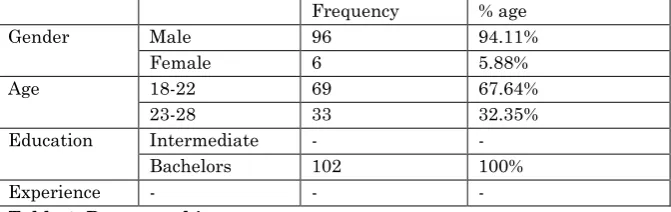
For this study primary data was collected from 102 University (Baluchistan University of Information Technology, Engineering and Management Sciences – BUITEMS, Quetta, Pakistan) students. Self explanatory questionnaire was used and distributed among both gender of students (table 1). The response rate was 100 %. The questionnaire contains 23 items out of which 17 items were for time management and 6 items were for Extroversion. Extroversion items were adopted and adapted from the questionnaire of big five personality traits of John and Srivastava (1999). Out of other personality traits question only extroversion is selected. The reason for which is discuss in the literature above. The time management items were selected from time management inventory. The reliability values of the scale are shown in the correlation metrics (table 2). To test the hypothesis, regression and correlation analysis were used.
Model of the study
Time management Extroversion
Frequency % age
Gender Male 96 94.11%
Female 6 5.88%
Age 18-22 69 67.64%
23-28 33 32.35%
Education Intermediate - -
Bachelors 102 100%
Experience - - -
Rohail Khan, Syed Nisar Ahmad, Mohammad Tariq, Muhammad Farooq- Impact of Emotional Stability on Job Satisfaction
Correlations
TM1 TM2 TM3 TM4 TM5 TM6 TM7 TM8 TM9 TM10 TM11 TM12 TM13 TM14 TM15 TM16 TM17 EV1 EV2 EV3 EV4 EV5 EV6 TM1 Pearson
Correlation 1 .446** .085 .022 -.041 .200* .082 .234* .114 -.013 .254* .116 .221* .198* .131 .270** .157 .311** .197* .046 .235* .121 .191 Sig.
(2-tailed) .000 .398 .826 .683 .043 .414 .018 .252 .896 .010 .245 .026 .046 .188 .006 .115 .001 .048 .648 .017 .225 .055 N 102 102 102 102 102 102 102 102 102 102 102 102 102 102 102 102 102 102 102 102 102 102 102 TM2 Pearson
Correlation .446** 1 .088 .115 .204* .060 .192 .044 .144 .201* .143 .081 .246* .220* .098 .209* .204* .268** .160 .222* .269** .194 .223* Sig.
(2-tailed) .000 .378 .249 .040 .547 .054 .659 .149 .043 .151 .420 .013 .026 .328 .035 .039 .006 .108 .025 .006 .051 .024 N 102 102 102 102 102 102 102 102 102 102 102 102 102 102 102 102 102 102 102 102 102 102 102 TM3 Pearson
Correlation .085 .088 1 .468** .233* .229*
-.259**.114 .162 .227* .129 .259** .135 .021 .098 .150 .031 .066 .053 .138 .107 .127 .110 Sig.
(2-tailed) .398 .378 .000 .019 .021 .008 .255 .103 .022 .195 .009 .176 .836 .329 .132 .757 .509 .600 .168 .285 .202 .269 N 102 102 102 102 102 102 102 102 102 102 102 102 102 102 102 102 102 102 102 102 102 102 102 TM4 Pearson
Correlation .022 .115 .468** 1 .398** .224* -.147 .175 .104 .126 .116 .131 .067 .064 .140 .046 -.096 .105 .044 .149 .093 .046 .108 Sig.
(2-tailed) .826 .249 .000 .000 .024 .139 .079 .298 .207 .245 .189 .503 .521 .160 .645 .337 .293 .661 .134 .355 .643 .278 N 102 102 102 102 102 102 102 102 102 102 102 102 102 102 102 102 102 102 102 102 102 102 102 TM5 Pearson
Correlation -.041 .204* .233* .398** 1 .135 .064 .115 .130 .258** .071 .195* .234* .255** .144 .100 -.018 .134 -.140 .151 .116 .207* .081 Sig.
Rohail Khan, Syed Nisar Ahmad, Mohammad Tariq, Muhammad Farooq- Impact of Emotional Stability on Job Satisfaction
TM6 Pearson
Correlation .200* .060 .229* .224* .135 1 .030 .003 .153 .245* .194 .358** .189 .235* .288** .223* -.114 .131 .111 .017 .321** .202* .230* Sig.
(2-tailed) .043 .547 .021 .024 .175 .766 .980 .125 .013 .050 .000 .058 .017 .003 .024 .252 .188 .265 .864 .001 .042 .020 N 102 102 102 102 102 102 102 102 102 102 102 102 102 102 102 102 102 102 102 102 102 102 102 TM7 Pearson
Correlation .082 .192
-.259**-.147 .064 .030 1 -.026 .182 -.074 .102 -.079 .265** .318** .073 .111 .002 .161 .116 .121 .313** .277** .077 Sig.
(2-tailed) .414 .054 .008 .139 .522 .766 .793 .067 .457 .308 .427 .007 .001 .468 .266 .981 .106 .246 .225 .001 .005 .439 N 102 102 102 102 102 102 102 102 102 102 102 102 102 102 102 102 102 102 102 102 102 102 102 TM8 Pearson
Correlation .234* .044 .114 .175 .115 .003 -.026 1 .155 .092 .198* .113 .158 .033 .015 .099 -.029 -.015 .066 .084 .033 -.022 .156 Sig.
(2-tailed) .018 .659 .255 .079 .252 .980 .793 .120 .357 .046 .260 .113 .744 .885 .321 .776 .884 .510 .401 .742 .824 .118 N 102 102 102 102 102 102 102 102 102 102 102 102 102 102 102 102 102 102 102 102 102 102 102 TM9 Pearson
Correlation .114 .144 .162 .104 .130 .153 .182 .155 1 .190 .125 .193 .103 .192 .140 .308** -.020 .199* .130 .230* .112 .083 .118 Sig.
(2-tailed) .252 .149 .103 .298 .192 .125 .067 .120 .056 .209 .052 .305 .054 .159 .002 .844 .045 .193 .020 .263 .407 .236 N 102 102 102 102 102 102 102 102 102 102 102 102 102 102 102 102 102 102 102 102 102 102 102 TM10 Pearson
Correlation -.013 .201* .227* .126 .258** .245* -.074 .092 .190 1 .195* .298** .038 .287** .277** .179 .077 .149 .109 -.030 .019 -.012 .006 Sig.
(2-tailed) .896 .043 .022 .207 .009 .013 .457 .357 .056 .049 .002 .707 .003 .005 .072 .441 .136 .275 .765 .849 .909 .954 N 102 102 102 102 102 102 102 102 102 102 102 102 102 102 102 102 102 102 102 102 102 102 102 TM11 Pearson
Correlation .254* .143 .129 .116 .071 .194 .102 .198* .125 .195* 1 .334** .243* .110 .347** .212* .078 .081 .286** .119 .121 .250* .289** Sig.
Rohail Khan, Syed Nisar Ahmad, Mohammad Tariq, Muhammad Farooq- Impact of Emotional Stability on Job Satisfaction
N 102 102 102 102 102 102 102 102 102 102 102 102 102 102 102 102 102 102 102 102 102 102 102 TM12 Pearson
Correlation .116 .081 .259** .131 .195* .358** -.079 .113 .193 .298** .334** 1 .189 .095 .297** .275** .024 .031 .203* .038 .128 .037 -.008 Sig.
(2-tailed) .245 .420 .009 .189 .050 .000 .427 .260 .052 .002 .001 .057 .341 .002 .005 .811 .757 .040 .708 .199 .708 .940 N 102 102 102 102 102 102 102 102 102 102 102 102 102 102 102 102 102 102 102 102 102 102 102 TM13 Pearson
Correlation .221* .246* .135 .067 .234* .189 .265** .158 .103 .038 .243* .189 1 .459** -.012 .099 .050 .129 .203* .343** .240* .379** .054 Sig.
(2-tailed) .026 .013 .176 .503 .018 .058 .007 .113 .305 .707 .014 .057 .000 .901 .324 .616 .197 .040 .000 .015 .000 .592 N 102 102 102 102 102 102 102 102 102 102 102 102 102 102 102 102 102 102 102 102 102 102 102 TM14 Pearson
Correlation .198* .220* .021 .064 .255** .235* .318** .033 .192 .287** .110 .095 .459** 1 .211* .182 -.009 .260** .154 .195* .332** .241* .015
Sig. (2-tailed)
.046 .026 .836 .521 .010 .017 .001 .744 .054 .003 .271 .341 .000 .034 .067 .932 .008 .122 .049 .001 .015 .878
N 102 102 102 102 102 102 102 102 102 102 102 102 102 102 102 102 102 102 102 102 102 102 102 TM15 Pearson
Correlation .131 .098 .098 .140 .144 .288** .073 .015 .140 .277** .347** .297** -.012 .211* 1 .205* .154 -.113 .259** -.082 .069 -.011 .112 Sig.
(2-tailed) .188 .328 .329 .160 .149 .003 .468 .885 .159 .005 .000 .002 .901 .034 .039 .122 .259 .009 .410 .491 .914 .263 N 102 102 102 102 102 102 102 102 102 102 102 102 102 102 102 102 102 102 102 102 102 102 102 TM16 Pearson
Correlation .270** .209* .150 .046 .100 .223* .111 .099 .308** .179 .212* .275** .099 .182 .205* 1 .146 .220* .148 .185 .171 .167 .092 Sig.
(2-tailed) .006 .035 .132 .645 .315 .024 .266 .321 .002 .072 .033 .005 .324 .067 .039 .142 .026 .137 .062 .085 .093 .356 N 102 102 102 102 102 102 102 102 102 102 102 102 102 102 102 102 102 102 102 102 102 102 102 TM17 Pearson
Rohail Khan, Syed Nisar Ahmad, Mohammad Tariq, Muhammad Farooq- Impact of Emotional Stability on Job Satisfaction
Sig.
(2-tailed) .115 .039 .757 .337 .860 .252 .981 .776 .844 .441 .434 .811 .616 .932 .122 .142 .669 .087 .756 .507 .319 .392 N 102 102 102 102 102 102 102 102 102 102 102 102 102 102 102 102 102 102 102 102 102 102 102 EV1 Pearson
Correlation .311** .268** .066 .105 .134 .131 .161 -.015 .199* .149 .081 .031 .129 .260** -.113 .220* .043 1 .184 .419** .177 .135 .373** Sig.
(2-tailed) .001 .006 .509 .293 .179 .188 .106 .884 .045 .136 .419 .757 .197 .008 .259 .026 .669 .064 .000 .076 .176 .000 N 102 102 102 102 102 102 102 102 102 102 102 102 102 102 102 102 102 102 102 102 102 102 102 EV2 Pearson
Correlation .197* .160 .053 .044 -.140 .111 .116 .066 .130 .109 .286** .203* .203* .154 .259** .148 .170 .184 1 .407** .133 .158 .087 Sig.
(2-tailed) .048 .108 .600 .661 .162 .265 .246 .510 .193 .275 .004 .040 .040 .122 .009 .137 .087 .064 .000 .183 .112 .384 N 102 102 102 102 102 102 102 102 102 102 102 102 102 102 102 102 102 102 102 102 102 102 102 EV3 Pearson
Correlation .046 .222* .138 .149 .151 .017 .121 .084 .230* -.030 .119 .038 .343** .195* -.082 .185 -.031 .419** .407** 1 .281** .395** .245* Sig.
(2-tailed) .648 .025 .168 .134 .131 .864 .225 .401 .020 .765 .234 .708 .000 .049 .410 .062 .756 .000 .000 .004 .000 .013 N 102 102 102 102 102 102 102 102 102 102 102 102 102 102 102 102 102 102 102 102 102 102 102 EV4 Pearson
Correlation .235* .269** .107 .093 .116 .321** .313** .033 .112 .019 .121 .128 .240* .332** .069 .171 .067 .177 .133 .281** 1 .580** .172 Sig.
(2-tailed) .017 .006 .285 .355 .244 .001 .001 .742 .263 .849 .226 .199 .015 .001 .491 .085 .507 .076 .183 .004 .000 .083 N 102 102 102 102 102 102 102 102 102 102 102 102 102 102 102 102 102 102 102 102 102 102 102 EV5 Pearson
Correlation .121 .194 .127 .046 .207* .202* .277** -.022 .083 -.012 .250* .037 .379** .241* -.011 .167 .100 .135 .158 .395** .580** 1 .326** Sig.
Rohail Khan, Syed Nisar Ahmad, Mohammad Tariq, Muhammad Farooq- Impact of Emotional Stability on Job Satisfaction
EV6 Pearson
Correlation .191 .223* .110 .108 .081 .230* .077 .156 .118 .006 .289** -.008 .054 .015 .112 .092 -.086 .373** .087 .245* .172 .326** 1 Sig.
(2-tailed) .055 .024 .269 .278 .417 .020 .439 .118 .236 .954 .003 .940 .592 .878 .263 .356 .392 .000 .384 .013 .083 .001 N 102 102 102 102 102 102 102 102 102 102 102 102 102 102 102 102 102 102 102 102 102 102 102 **. Correlation is significant at the 0.01 level (2-tailed).
*. Correlation is significant at the 0.05 level (2-tailed).
Rohail Khan, Syed Nisar Ahmad, Mohammad Tariq, Muhammad Farooq- Impact of Emotional Stability on Job Satisfaction
Results and Discussion:
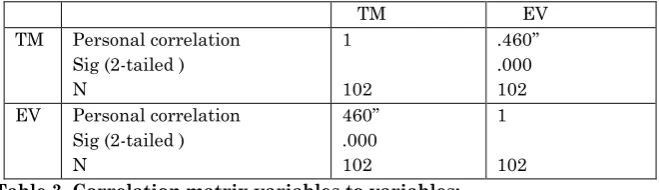
The correlation among the two variables namely Time management and Extroversion was checked the result of which is reported in the correlation matrix (table 3). Both the variables are highly correlated with each other. Throughout the analysis, time management is denoted by TM and extroversion is denoted by EV.
TM EV TM Personal correlation
Sig (2-tailed ) N
1
102
.460’’ .000 102 EV Personal correlation
Sig (2-tailed ) N
460’’ .000 102
1
102
Table 3. Correlation matrix variables to variables:
“Correlation is significant at 0.01 level”
Table 3 shows the correlation matrix. The table shows that the correlation intensity of TM with TM is 100 % and correlation intensity with EV is .466’’ and the significant value (p-value) is .000, which shows that it is in the range of -1 to 1, which shows that it is significantly correlated at 0.01 level. And the N shows the number of observation. The correlation shows that Extroversion is positively related to time management. The degree of association between time management and extroversion is 000 at the 0.01 level which is always positive.
Regression Analysis
Rohail Khan, Syed Nisar Ahmad, Mohammad Tariq, Muhammad Farooq- Impact of Emotional Stability on Job Satisfaction
Variables B t-stats Sig
EV .382 5.175 . 000
R Square =21.1% Adjusted R –Square = 20.3%
Table: 4 : Regression analysis :
“Correlation is significant at 0.01 levels”
The above table reveals that the coefficient of EV is .382’ which is positive and highly significant at 0.01 level of significance and will show that the increase in one unit in extroversion will cause the increase of 382 in time management. The t-stats of Extroversion is 5.175 which also shows that result is highly significant. The overall fit of Models is 21.1% (adjusted R-square =20.3%). Hence Extroversion is found to be positively associated with time management and accepting the H1 hypothesis.
Recommendations and practical implications:
Following are the recommendation drawn from the results: Organization would provide such kind of environment
for the extrovert in which they can easily attain their goals.
Organization would provide opportunity to extrovert people to manage time in efficient manner.
Organization would assign right duty to right people so that no one has difficulty in managing the time.
Organization should hire extrovert people for their project as the extrovert people are very forceful and warmth so they can achieve the long term objective in proper time.
Organization should put the extrovert people in the middle level management because they are so sociable and communicating and they should solve the problem in appropriate time and manner.
Rohail Khan, Syed Nisar Ahmad, Mohammad Tariq, Muhammad Farooq- Impact of Emotional Stability on Job Satisfaction
In this study there are many limitations such as:
1. Major limitation is the number of sample distributed. Future research is directed to carry out the research on large number of sample so that the result is more efficient.
2. Another limitation is the time and resource. The data is collected only from university students. In future research the collected data should belong to peoples from all fields of life.
3. Next limitation is that this study is only on single personality (extroversion) traits with the time management and future research should be taken in comparison with other personality traits of a person. 4. This study is mainly based on male student and future
research should also include female students.
5. Ongoing study is in the Baluchistan province. Future study is directed to be taken in other provinces of Pakistan and as well as in other countries of the world.
Conclusion:
The result of this study revealed that time management and extroversion is positively related to each other. An extrovert person is succeeded in every field of life. Every organization must welcome extrovert peoples to get more efficient result because they manage their time very well.
BIBLIOGRAPHY:
Antonioni, A. 1998. “Relationship between big five personality factors and conflict management styles.” International
journal of conflict management 9(4): 336-355.
Rohail Khan, Syed Nisar Ahmad, Mohammad Tariq, Muhammad Farooq- Impact of Emotional Stability on Job Satisfaction
psychology 32: 12-17.
Cockburn, A. 1994. “Teacher’s experience of time.” British
journal of educational studies. 42: 375-386.
Groskreutz, M. 2013. “Time management problem.”
Encyclopedia of Autism spectrum disorders 23: 24-28.
Hendrickson, G. and Huskey, J. 1993. “Extroversion is a factor of conditional achievement in the fifth and sixth grades of elementary school.” The journal of educational
research 25: 5-13.
Joshanloo, M. and Afshari, S. 2011. “Big five personality traits and self-esteem as predictors of life satisfaction in Iranian Muslim University.” Journal of happiness
studies 12: 105-113.
Karsten, L. and Leopold, J. 2003. “Time and management, the need for hora management.” Personnel Review 32 (4): 405-421.
Lemke, E., Leicht, K. and Miller, J. 1974. “Role of ability and extroversion in concept attainment of individuals trained in Heterogeneous or Homogeneous Personality groups.” The journal of educational research 87: 202-204. O´ Conchu´ir, Deasu´n. 2012. Overview of the PMBOK1 Guide.
3rd Ed. Heidelberg: Springer-Verlag Berlin.
Rankin, E. F. and Franklin, E. F. 1963. “Reading test reliability and validity as a function of introversion-extroversion.”
Journal of Developmental reading 6: 106-117.
Slaven, G. and Totterdell, P. 1993. “Time management training does it transfer to the work place?” Journal of
Managerial Psychology 8: 20-28.
Stanton, N., Mathews, G. and Graham, N. 1991. “The OPQ and the Big Five.” Journal of Managerial Psychology 6: 25-27.
Youngxin. Z. and Gouqing. Y. 2000. “Gender differences of China’s managers in time management.” Women in