BIROn - Birkbeck Institutional Research Online
Brownlow, Richard and Capuzzi, Stefano and Helmer, Sven and Martins,
Luciana and Normann, Immanuel and Poulovassilis, Alexandra (2015) An
ontological approach to creating an Andean Weaving Knowledge Base.
Journal on Computing and Cultural Heritage 8 (2), ISSN 1556-4673.
Downloaded from:
Usage Guidelines:
Please refer to usage guidelines at
or alternatively
An Ontological Approach to Creating an Andean
Weaving Knowledge Base
RICHARD BROWNLOW∗, STEFANO CAPUZZI∗, SVEN HELMER∗∗, LUCIANA MARTINS∗,
IMMANUEL NORMANN∗, AND ALEX POULOVASSILIS∗,∗Birkbeck, University of London;∗∗Free University of Bozen-Bolzano
Andean textiles are products of one of the richest, oldest and continuous weaving traditions in the world. Understanding the knowledge and practice of textile production as a form of cultural heritage is particularly relevant in the Andean context due to erosion of clothing traditions, reuse of traditional textiles on commodities targeted at the tourism market, and loss of knowledge embedded in textile production. “Weaving Communities of Practice” was a pilot project that aimed to create a knowledge base of Andean weaving designed to contribute to curatorial practice and heritage policy. The research team gathered data on the chain of activities, instruments, resources, peoples, places and knowledge involved in the production of textiles, relating to over 700 textile samples. A major part of the project has been the modelling and representation of the knowledge of domain experts and information about the textile objects themselves in the form of an OWL ontology, and the development of a suite of search facilities to be supported by the ontology. This paper describes the research challenges faced in developing the ontology and search facilities, the methodology adopted, the design and implementation of the system, and the design and outcomes of a user evaluation of the system undertaken with a group of domain experts.
Categories and Subject Descriptors: H.3.7 [Information Systems]: Information retrieval—Digital libraries; I.2.4 [Computing Methodologies]: Artificial Intelligence—Knowledge representation formalisms and methods; J.4.m [Computer Applications]: Social and behavioral sciences—Anthropology/Ethnography
Additional Key Words and Phrases: knowledge base development,ontologies,weaving traditions
ACM Reference Format:
ACM J. Comput. Cult. Herit. 0, 0, Article 0 ( 2011), 30 pages.
DOI=10.1145/0000000.0000000 http://doi.acm.org/10.1145/0000000.0000000
The “Weaving Communities of practice” project (seehttp://www.weavingcommunities.org) was supported by the U.K. Arts and Humanities Research Council (AH/G012180/1) from 2009 to 2013. It was based at the Centre for Iberian and Latin American Visual Studies (CILAVS) at Birkbeck, University of London, in collaboration with the London Knowledge Lab at Birkbeck and the Instituto de Lengua y Cultura Aymara (ILCA), La Paz. This paper focusses on the research challenges faced in representing the knowledge of the domain experts and information about the textile objects themselves in the form of an OWL ontology, and the development and evaluation of the search facilities supported by this ontology.
Authors’ address: Birkbeck, University of London, Malet Street, London WC1E 7HX, U.K.; and, for Sven Helmer, Free Uni-versity of Bozen-Bolzano, Piazza Domenicani 3, 39100 Bolzano, Italy. Authors’ emails: [email protected], [email protected], [email protected], [email protected], [email protected], [email protected] (corre-sponding author).
Permission to make digital or hard copies of part or all of this work for personal or classroom use is granted without fee provided that copies are not made or distributed for profit or commercial advantage and that copies show this notice on the first page or initial screen of a display along with the full citation. Copyrights for components of this work owned by others than ACM must be honored. Abstracting with credit is permitted. To copy otherwise, to republish, to post on servers, to redistribute to lists, or to use any component of this work in other works requires prior specific permission and/or a fee. Permissions may be requested from Publications Dept., ACM, Inc., 2 Penn Plaza, Suite 701, New York, NY 10121-0701 USA, fax+1 (212) 869-0481, or [email protected].
c
2011 ACM 1556-4673/2011/-ART0 $10.00
1. INTRODUCTION
Andean textiles are products of one of the richest, oldest and continuous weaving traditions in the world. As the Pacific coastal regions of Peru, Chile and Ecuador are amongst the world’s driest, many of these ancient fabrics are still extremely well preserved and these archaeological specimens provide a rich source of information about ancient Andean weaving techniques and structures [Bird et al. 1985; D’Harcourt 2002; Stone-Miller 1994; Dransart and Wolfe 2011]. Also encoded in the weavings is information about the ancient use of land and resources, and regional and historical identities [Arnold 2012; Silverman 2008].
Understanding the knowledge and practice of textile production as a form of cultural heritage is particularly relevant in the Andean context, for several reasons [Arnold and Espejo 2013]. First, ur-banisation is eroding the knowledge of clothing traditions, especially those linked to rural areas and the idea of being ‘Indian’. Second, the import of second-hand clothes and fabrics is undermining the regional production of cloth. Third, the recent trend of re-using traditional textiles as decorations on commodities (e.g. shoes and bags) branded as ‘indigenous’ and targeted at the tourism market leads to the fragmentation of the original products, thus causing the loss of the knowledge embedded in the product as a whole. Last, higher wages in the agro-industry sector are attracting workers to that sector, to the detriment of the traditional farming associated with textile production.
The “Weaving Communities of Practice” was a pilot project bringing together a multidisciplinary and transnational team of ethnographers, linguists, archaeologists, museum curators, weavers, art historians, cultural geographers and computer scientists with the aim of creating a knowledge base of Andean weaving designed to contribute to current curatorial practice and heritage policy. The project’s qualitative approach took into account weaving terminology currently found in the Andean languages of Aymara and Quechua, obtained through a working group of Andean linguists and native language speakers. Additionally, small weaving models of techniques found in museum collections were pre-pared by the project’s textile team. Based on this research, a new terminological model was developed, requiring a revision of existing textile records held in museums, both in the Andean region and else-where. A 20-page form specially designed by the project domain experts captures data relating to the complex chain of activities, instruments, resources, peoples, places and knowledge involved in the pro-duction of textiles [Arnold and Espejo 2010a; 2010b; 2012; 2013; Martins et al. 2013]. Primary data was gathered in the Aymara, Quechua, Spanish and English languages.
The innovative approach adopted and the translation work required necessitated a highly labour-intensive data gathering process in museums selected by the significance of their collections and their willingness to collaborate with the project team. Focusing principally on warp-faced weave (faz de urdimbre), which has created the most complex textiles in the Andes, the domain experts gathered in-formation relating to over 700 textile samples, ranging from the Archaeological period (1800 BC – 1535 AD) to the Historical (1535 – 1900 AD) and Contemporary (1900 – present) periods, with production sites across Bolivia, Chile and Peru [Arnold and Espejo 2013].
graphical editors to help document different kinds of textile structures and techniques [Gyory 2012; Martins et al. 2013].
The contributions of this paper are:
—the methodology and processes used for developing the ontology — to the best of our knowledge, this is the first time that ontological modelling has been undertaken for the domain of Andean weaving; —the technical approaches used to implement the ontology and search facilities;
—the design and outcomes of a user evaluation study conducted with a group of domain experts to assess the usability and usefulness of the ontology and the search facilities.
Related Work.There are many publicly available digital textile archives world-wide. For example, the American Textile History Museum (http://www.athm.org/) and the TEXMEDIN digital library (http://www.texmedindigitalibrary.eu/) offer keyword search over their extensive collections of tex-tiles; the Textile Museum of Canada (http://www.textilemuseum.ca/) offers keyword search while also supporting browsing facilities according to textile type, region, materials, techniques, and period; and the University of Leeds International Textile Archive (ULITA) (http://ulita.leeds.ac.uk/) offers keyword search over a textiles collection organised according to several regions (European, Egyptian, Indian, Indonesian, Japanese etc.) but offers no section on Andean weaving. None of these resources captures the specific context of Andean textiles, whereas our archive is searchable by specific textile structures and weaving techniques unique to South America.
Ontologies allow the representation of both explicit and implied concepts and relationships relevant to a particular domain [Gruber 1993], and ontologies are being developed in many fields in order to provide standard terminologies and classifications for knowledge representation and sharing within communities. In the context of textile domains, ontologies targeted at the textile production indus-try are discussed in [Duque et al. 2009], while an ontology describing traditional Malay textiles is presented in [Nasir and Noor 2011]. However, to our knowledge, our project is the first that has under-taken ontological modelling for the domain of Andean weaving.
Outline of the paper.The remainder of the paper is structured as follows. The next section high-lights the major research challenges we faced in undertaking this work. Section 3 describes the method-ology and technical approaches employed for developing the ontmethod-ology and search facilities. Section 4 gives an overview of the overall system and details of how the search facilities were implemented. Section 5 describes the design and conduct of a user evaluation of the system with a diverse group of domain experts. In Section 6 we discuss and analyse the results of this user evaluation and how the users’ feedback was used to improve the system. In Section 7 we summarise the work reported here, highlighting achievements and identifying several areas of future work.
2. RESEARCH CHALLENGES
knowledge related to textiles. For example, many museum collections and databases catalogue textiles following an art historical approach that focusses on iconography, patterns and colour, often omitting information about weaving techniques and structures, or their archaeological, historical and cultural associations [Martins et al. 2013]. Consequently, both the knowledge model and the data gathered for our project were rapidly evolving, particularly in the early stages of the research.
Due to these challenges we opted to develop an ontology rather than a relational database, or other structured database, to represent the domain knowledge and the data being gathered. An ontology gives more flexibility in integrating both domain knowledge and data as this becomes available and evolves. Moreover, an added advantage of ontologies is that formal reasoning can be applied to validate the evolving knowledge model.
The fact that our ontology was evolving throughout the project also had an effect on eliciting the functionality that would be required by users for the search facilities that it would support, as these facilities could not be decided upon until the ontology had itself reached a reasonably stable state. Moreover, the complexity of the knowledge domain meant that the user requirements relating to the search facilities were initially ill-defined, and highly dynamic and evolving as well.
In addition, we encountered problems such as cognitive mismatch between the domain experts and the computer scientists on the project (different groups understanding and describing the same real-world concept in different ways), and also modelling imprecision (occasionally the real real-world is just too complex to be mapped precisely into a computer model); these issues are also identified and discussed in [Gaˇsevi´c et al. 2009] as applying more generally to ontology development projects.
It therefore quickly became apparent that the ill-defined and changing software requirements ruled out a traditional, sequential software development methodology for developing the ontology and the search facilities that it would support, and that an iterative development approach would be needed in which domain experts participated in the requirements, design and evaluation aspects of the software development throughout the project.1
3. METHODOLOGY
Due to the interdisciplinary context and the complexity of a project such as this, it was clear that no single ontology development methodology would be sufficient. In fact, even for more traditional domains there is a lack of standardised processes. Nevertheless, there are attempts to formalise and integrate best practices. In our case we used a blend of different techniques that also appear in existing ontology development methodologies. We first give a brief overview of existing frameworks and their relation to our approach in Section 3.1 and then provide a description of our methodology in Section 3.2.
3.1 Existing Ontology Development Methodologies
A well-known methodology for ontology development is METHONTOLOGY [Fernandez-Lopez et al. 1997], which consists of six phases (specification, conceptualisation, formalisation, integration, imple-mentation, and maintenance) and four activities (planification, acquiring knowledge, documenting, and evaluating). Due to the exploratory nature of our project, it was not possible to start off with a de-tailed specification. The specification became available step by step after progressing with other parts of the development, which meant that an adaptive and agile style of planning had to be adopted. Al-though the documentation has been revised and made it available via the project website (seehttp:
1The main domain experts involved in the project were Denise Y. Arnold (lead domain expert, anthropologist, Director of ILCA,
//www.weavingcommunities.org/textile-processes), in hindsight using a full-fledged SKOS (Simple Knowledge Organisation System) may have been preferable. Other aspects of our methodology, how-ever, are closer to the METHONTOLOGY framework. Before the implementation of our ontology in OWL [Bechhofer et al. 2009], a conceptualisation phase using yED graphs [yWorks 2013] was under-taken by the lead domain expert. The activity of acquiring knowledge played a central role and is described in more detail in Section 3.2. Integration of existing ontologies did not take place in our project. Towards the start of the project we did study CIDOC-CRM (http://www.cidoc-crm.org/), an ontology that provides a rich structure for describing the concepts and relationships relevant to the general cultural heritage domain. After studying this ontology and discussing it intensively with the domain experts, it became apparent that it was not appropriate for our project. Wanting to emphasise the view of communities of practice, we found CRM too museum-centric. Additionally, CIDOC-CRM completely lacks concepts to describe the textiles and techniques of Andean weaving and its context.
Another relevant methodology is UPON (Unified Process for ONtology building) [Nicola et al. 2005], which applies the Rational Unified Process to developing ontologies. This approach distinguishes five workflows (requirements, analysis, design, implementation, and test) and four phases (inception, elab-oration, construction, and transition). While we adopted the iterative and incremental elements of UPON, we did not strictly follow its workflows and phases. Again, due to the exploratory nature of our project, the specification of the requirements was spread out over more time than is common. Neverthe-less, important parts of other workflows, such as identification of relevant terms (analysis), bottom-up refinement of concepts and their relations (design), and testing the system using competency questions (test), were also part of our approach.
Finally, we also investigated the On-To-Knowledge Methodology (OTKM) [Sure et al. 2003], but found it too focused on the corporate and enterprise domains.
3.2 Overview of Our Approach
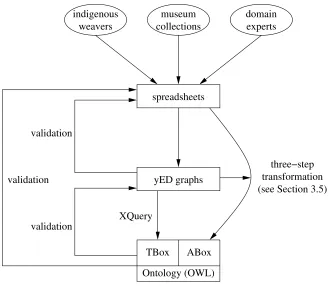
Figure 1 gives an overview of the whole ontology development process, the artefacts created, and the tools used.
In the first phase of the project (about 21 months) the domain experts gathered and analysed a large amount of data, most of it recorded in spreadsheet form, since this was a tool they were already familiar with.
In the next phase, the lead domain expert modelled the domain using yED graphs [yWorks 2013]. The reason for choosing to represent the ontological information contained implicitly within the spread-sheets in this intermediate visual form (rather than progressing directly to an ontology representation) was the greater ease, for the non-computer scientists on the project, of understanding and correcting the complex inter-relationships between concepts than would have been possible by moving directly to a more formal ontology representation.
After the completion of the yED graphs, we transformed them into the OWL ontology language [Bech-hofer et al. 2009] by writing XQuery-based scripts to generate the T-Box, which is the terminological component of the ontology (i.e. containing the model of the domain). Here another advantage of using yED becomes evident: it is possible to directly process yED graph data using XQuery, as its file format uses the graphml markup language. The A-Box, which is the assertional component of the ontology (i.e. containing the data itself), was created directly from the spreadsheet data using a three-step approach that we detail in Section 3.5 below.
three−step transformation (see Section 3.5) indigenous
weavers
museum collections
domain experts
spreadsheets
Ontology (OWL) TBox ABox XQuery
validation
validation
validation yED graphs
Fig. 1. High-level overview of the ontology development process
check the consistency of the artefacts constructed in successive phases and to correct any inconsisten-cies between them.
In Sections 3.3 to 3.6 below we discuss in more detail the methods of data gathering, domain mod-elling and ontology development. We then discuss in Section 3.7 the methods for developing the search facilities supported by the ontology.
3.3 Data Gathering
The data was collected incrementally by the project domain experts in collaboration with several muse-ums holding extensive Andean textile collections2. It was sometimes necessary for the project domain
experts to make return visits to a museum, in order to view specimens not available in previous visits or to clarify points of ambiguity.
The project domain expert teams also visited communities in the Andes in places such as Qaqachaka, Bolivar, Sacaca and Mollo in Bolivia, Puno, Pitumarca and Chawaytiri in Peru, and Colchane and Pisigacarpa in Northern Chile, interviewing active weavers, observing their techniques and styles, and examining their weavings. This information was complemented by historical research on linguistic terms [Arnold and Espejo 2013].
2The Museo Nacional de Etnograf´ıa y Folklore and the Museo Nacional de Arqueolog´ıa de Bolivia in La Paz, Bolivia; the Museo
[image:7.630.158.487.125.411.2]The knowledge elicitation process was greatly helped by having an expert weaver, Elvira Espejo, as a member of the project team, who was able to directly examine textile artefacts to gain first-hand information about their attributes. The fact that the domain experts were continuing to collate information and gain new insights as the project progressed affirmed our design decision to opt for the flexibility of an iterative development of an ontology.
During several project workshops and visits, interviews and informal meetings were held with sev-eral other domain experts to discuss and affirm the validity of the data being gathered3.
The outcome of this extensive data gathering phase ultimately consisted of approximately 30 differ-ent spreadsheets, containing about 1000 rows in total. They include descriptions of 700 differdiffer-ent textile objects in terms of type, size, form, colour, iconography, weaving techniques, structure, and archaeolog-ical and cultural associations. Also captured was data referring to museum collections and descriptions of the production process of the raw materials. The coverage and content recorded in the spreadsheets changed considerably during this period of data gathering, demanding constant information exchange between domain experts (DEs) and knowledge engineers (KEs) across two continents, which was all the more challenging due to different time zones and languages involved. There were several trips be-tween the DEs and the KEs, a Wiki repository was set up to exchange information (using Mediawiki), Skype meetings were held regularly, and monthly summary reports were also exchanged between the DEs and KEs.
Due to the sheer amount of data being gathered, the project team opted to transform the domain knowledge into an ontology incrementally, prioritising the content of the different spreadsheets. Two key spreadsheets were identified and given the highest priority: the ProductoTextil spreadsheet, which stores information about the textile objects, and the Vocabulary spreadsheet, which contains a com-plete set of permissible words and phrases that can be used within the textile descriptions in Produc-toTextil (excluding numbers and free-text descriptions).
3.4 Domain Modelling
At the end of the data gathering period, the information in the spreadsheets relating to key concepts, properties, relationships and example instance data was re-represented visually by the lead domain expert using the yED freeware tool [yWorks 2013]. The domain modelling was undertaken in Spanish in the first instance, with specialist terminology also being recorded in the Andean languages Aymara and Quechua. RDF support for localisation (usingrdfs:label) was subsequently utilised in order to support English translations of the main modelling concepts.
When modelling real-world concepts there are often different options in making choices about which modelling constructs to use. One recurring decision was whether to model a concept as a class or as an individual. When domain experts express their knowledge in sentences such as “X is a Y”, this could mean that X is a subclass of a class Y or that X is an instance of a class Y. For some entities, such as physical entities, resolving the ambiguity was straightforward: physical entities are clearly individuals e.g. stating that “the Victoria & Albert Museum is a museum”. For non-physical entities however, it is sometimes less obvious. For example, when faced with the statement “red is a colour” should we model the colour “red” as a class or as an instance? Depending on the context, both may be plausible: if we interpret “red” as a family of shades of red, then modelling it as a class makes more sense; however, if we think of a specific shade of red, e.g. having a certain RGB value, then this could be represented as
3Ann Pollard Rowe, from the Textile Museum in Washington D.C., Sophie Desrosiers, from the ´Ecole de Hautes ´Etudes en
an individual. A pragmatic approach to this problem was developed and followed by the project team, with the following heuristics being used as guidelines for the domain modelling:
—to be modelled as classes:
—all entities that are families of things; for example, the family of all kinds of red colours;
—all entities that need to be conceptually differentiated further; for example, a collective term for a set of styles, cultural affiliations, techniques, structures, motifs;
—to be modelled as individuals:
—all physical entities; for example, museums, countries, persons (e.g. donors);
—all non-physical entities that cannot have instances or subclasses; for example the most specific colours, most specific styles, most specific cultural affiliations, most specific techniques, most spe-cific structures, most spespe-cific motifs;
—irrelevant instances of classes should not be modelled, for example:
—there should only be a colour individual of a certain RGB value in the ontology if there is a textile object that displays this colour;
—only countries, museums and people that are relevant in the context of the project should be recorded in the ontology;
—no individuals are modelled relating to animals, materials, fibres or threads.
The yED diagrams produced by the lead domain expert were of two types — those relating to con-cepts, properties and the relationships between them (corresponding to the terminological component, or T-Box, of the ontology) and those relating to instance data (corresponding to the assertional compo-nent, or A-Box, of the ontology). About 25 diagrams were produced in total. The number of concepts in each diagram ranged from 10 to 300; the number of class/superclass relationships from 10 to 300 and the number of properties from 5 to 100.
An iterative process of validation of the yED diagrams and the spreadsheets then followed, under-taken collaboratively with the lead domain expert. Inconsistencies within the diagrams, and between the diagrams and the spreadsheet data, were identified and corrected. A set of XQuery-based valida-tion scripts were developed to compare each spreadsheet with the Vocabulary spreadsheet, producing a report of the vocabulary inconsistencies. These reports were used to manually correct the spread-sheets and the yED diagrams as necessary. The overall aim of this iterative validation and correction process was to ensure that the modelling of the knowledge domain within the yED diagrams and the spreadsheets was consistent and captured as closely as possible the consensus amongst experts in the Andean Weaving field.
At the end of this process of validation of the yED diagrams and spreadsheets, work began on devel-oping the ontology and the search facilities that it would support.
3.5 Ontology Development
The ontology representation language chosen was OWL Lite, which is a sublanguage of OWL [Bech-hofer et al. 2009]. OWL Lite, as well as OWL, has several advantages: it is a widely accepted standard ontology language, includes all the modelling primitives required by the project, and is supported by numerous open source software tools. A major feature is its formal semantics, allowing formal reason-ing over OWL/OWL Lite descriptions. Although OWL Lite has certain restrictions concernreason-ing expres-siveness compared to OWL, it guarantees termination and efficiency of reasoning processes. Moreover, the constructs included in OWL Lite, which provide the basic building blocks for constructing subclass hierarchies, are sufficient for our purposes.
existential/universal restrictions or role axioms, apart from transitivity. The final versions of the T-Box yED diagrams were automatically transformed into an OWL representation by developing XQuery scripts that took yED graphml files as input and produced RDF/XML files as output. For example, the RDF fragment below was the outcome of an automatic transformation process (using XQuery scripts) defining subclass axioms between various classes of periods(the identifiers Period 1, Period 39, etc. were automatically generated by our scripts). For ease of readability, we use the OWL Manchester syntax [Horridge et al. 2006] to describe parts of the ontology:
Class: Period_1 Annotations:
rdfs:label "Period"@en, rdfs:label "Periodo"@es
Class: Period_39 Annotations:
rdfs:label "Periodo Arqueol´ogico"@es, rdfs:label "Archaeological period"@en SubClassOf: Period_1
Class: Period_40 Annotations:
rdfs:label "Historical period"@en, rdfs:label "Periodo Hist´orico"@es SubClassOf: Period_1
Class: Period_41 Annotations:
rdfs:label "Periodo Contempor´aneo"@es, rdfs:label "Contemporary period"@en SubClassOf: Period_1
The A-Box of the ontology contains only atomic class and role assertions. Only a few facts of the A-Box were represented in the yED graphs (e.g. class assertions about countries), with the majority of the A-Box facts being contained within the spreadsheets. These spreadsheets were transformed into RDF in three steps:
(1) Transforming the spreadsheet data into an equivalent XML format, using XQuery scripts. XQuery was chosen for this purpose due to its powerful querying and transformation capabilities on struc-tured and semi-strucstruc-tured data.
(2) Transforming the initial XML format into an intermediate XML format, using a set of ‘interpreta-tion templates’ that were manually derived from the yED diagrams. The interpreta‘interpreta-tion templates are themselves encoded as XML files and they specify which pairs of columns in the ProductoTex-til spreadsheet constitute a relationship. All cells belonging to one texProductoTex-tile object are automatically grouped into an XML fragment, termed a ‘frame’, representing the relationships between all parts the object as well as relationships between the object and other entities in the knowledge base. (3) Transforming the XML intermediate format into RDF.
of ProductoTextil. Notice that there is a column of ProductoTextil containing the textile ID and one containing the period:
. . . ID place of production . . . chronology period . . .
. . . ILCA ASU004 Ayllu Tinkipaya . . . 1990-2010 AD Republicano Tard´ıo . . . (1900–now)
The following extract of an interpretation template specifies the scheme that relates textile objects to periods:
<subject top-concept="ILCA_textile_object" col="ID"> <predicate name="produced_during">
<object col="period"/> </predicate>
</subject>
This template can be understood as an instruction on how to transform a given line in the spread-sheet into a set of assertions, specifically in this example: ‘Take the value X of the cell from column
ID(attributecol="ID") and assert that (i) X is of typeILCA_textile_object(attributetop-concept= "ILCA_textile_object") and (ii) X is produced_during(<predicate name= "produced_during">) the value of the cell in column period in the same row (attribute col="period")’. Hence, applying this template to the data displayed in the above table yields the following frame representing a class and a property assertion (the identifier Period 38 has been automatically generated;period3093 references the columnperiodof row 3093 in the spreadsheet):
<subject id="ILCA_ASU004" top-concept="ILCA_textile_object"> <predicate name="produced_during">
<object ref="Period_38" register-ref="period3093"> </object>
</predicate> </subject>
The RDF description generated from the above frame fragment in Step 3 is:
Individual: ILCA_ASU004
Types: ILCA_textile_object Facts: produced_during period_38
Using the OWL Ontology Metrics tool from the University of Manchester (http://mowl-power.cs. man.ac.uk:8080/metrics/), we determined the following numbers relating to the ontology (if a certain aspect does not appear in the table, it is not present in the ontology)4:
Aspect Count
Classes 2,616
Object properties 50
Data properties 18
Individuals 44,287
Logical axioms 121,212
SubClass axioms 1,290
Entity annotation axioms 10,425
Class assertion axioms 29,029
Object property assertion axioms 74,319
3.6 Formal Reasoning for Model Validation
A final observation about the ontology development process is that using an ontology language such as OWL to represent the knowledge model makes it possible to apply formal reasoning to validate the model. As an example, we look at an excerpt of the class hierarchy of textile products. This class hierarchy is present within the spreadsheet ProductoTextil, in which every textile product is described using a number of columns, among them columns called type, subclassification, group, subgroup and subsubgroup. The table below shows fragments of two entries from the spreadsheet. This information was used by the domain expert to create a class hierarchy in yED. During this step, the assertion that Apero and Prenda are disjoint was also added, which implies that Costal and Bolsa agropastoril must both be disjoint with Bolsa.
. . . type subclassification group subgroup subsubgroup . . .
. . . Apero Apero de tela Bolsa agropastoril Costal - . . .
. . . Prenda Accesorio Bolsa - - . . .
Transforming this knowledge into OWL allows us to use the HermiT reasoner ( http://hermit-reasoner.com/) of the Prot´eg´e ontology editor (http://protege.stanford.edu/) to validate this part of the ontology. Given below is the model fragment describing the Apero and Prenda class hierarchy:
Class: Textile_1
Annotations: rdfs:label "Producto textil"@es
Class: Textile_2
Annotations: rdfs:label "Apero"@es SubClassOf: Textile_1
DisjointWith: Textile_6
Class: Textile_3
Annotations: rdfs:label "Apero de tela"@es SubClassOf: Textile_2
Class: Textile_4
Annotations: rdfs:label "Bolsa agropastoril"@es SubClassOf: Textile_3
Class: Textile_5
Class Aymara Quechua
Bolsa qha ˜ni, wayaqa, . . . wayaqa, wayu ˜na, . . . Bolsa agropastoril qha ˜ni, wayaqa, . . . wayaqa, wayu ˜na, . . .
Costal wayaqa, kustala, . . . jatun wayaqa, jatun wayqa, . . .
Fig. 2. Excerpt from the Equivalences table associating classes to terms in Aymara and Quechua
SubClassOf: Textile_4
Class: Textile_6
Annotations: rdfs:label "Prenda"@es SubClassOf: Textile_1
DisjointWith: Textile_2
Class: Textile_7
Annotations: rdfs:label "Accesorio"@es SubClassOf: Textile_6
Class: Textile_8
Annotations: rdfs:label "Bolsa"@es SubClassOf: Textile_7
Thus far everything seems fine. However, the domain experts had also modelled relationships be-tween different kinds of textiles via a translation table called “Equivalences” — see Figure 2. In this table, one or more terms in Aymara and Quechua are associated with each class of the class hierar-chy. In order to formalise the domain experts’ interpretation of the “Equivalences” table, each term was modelled as a class on its own. For example, we created a class calledAymara_wayaqa. Furthermore, fol-lowing the domain experts’ view, we defined an equivalence between a class of the class hierarchy and a term class if they appear in the same row of the table. For instance, we haveBolsa = Aymara_wayaqa,
Bolsa agropastoril = Aymara_wayaqaandCostal = Aymara_wayaqa.
A first result of formal reasoning for this model was that several classes of the same branch of the class hierarchy could not be proper subclasses. For instance, Costal was modelled as a subclass of Bolsa agropastoril, but it could not be a proper subclass, since the statementsBolsa_agropastoril = Aymara_wayaqa and Costal = Aymara_wayaqa imply the statement Bolsa_agropastoril = Costal. The interpretation of the Equivalences table for the Aymara term “wayaqa” described above extends the OWL model fragment by the following statements:
Class: Aymara_wayaqa EquivalentTo: Textile_4 EquivalentTo: Textile_5 EquivalentTo: Textile_8
This result helped us to review the domain experts’ interpretation of the Equivalences table, since the intention of the class hierarchy was to imply a proper subclass ordering and not to provide a list of potentially equivalent classes.
[image:13.630.175.473.128.173.2]Formal reasoning led to the conclusion that some classes must be empty in this model, namely those claimed to be equal and subclasses of disjoint top-level classes. For instance, the Equivalences table statesCostal = Aymara_wayaqaandBolsa = Aymara_wayaqaand henceCostal = Bolsa. On the other hand, Costal is a subclass of the top-level class Apero whereas Bolsa is a subclass of the top-level class Prenda and therefore they are disjoint (by the disjointness assumption of top-level classes). In conclu-sion, Costal and Bolsa must be equivalent and disjoint at the same time, i.e. they must be empty in this model. However, this was not intended by the domain experts and had to be resolved.
3.7 Developing the Search Facilities
For the search facilities to be supported, two major use cases were identified: (i) the need for the user to be able to browse through the ontology by navigating through its classification hierarchies; and (ii) the need for the system to be able to support a set of queries each targeting a specific research question that a domain expert may have. Powerpoint mock-ups drawn up by the lead domain expert were initially used as a tool for designing the user interface. The set of queries relating to (ii) were iteratively developed in collaboration with the domain experts and we list them in Appendix C. All of these queries were implemented (the PHP/SPARQL code is listed in the supplementary Appendix D) except for Queries 20 and 21 for which the date of first appearance of a technique or structure is required; these two queries could not easily be supported as time periods are currently represented as strings in the ontology and would need to be remodelled into a date format (we leave this as future work).
Following the production of the final version of the ontology at around month 39 of the project, the last phase of the project involved the development of the search facilities, and their evaluation with a broader group of domain experts, over a period of 6 months. In this phase, although we first implemented individually each of the queries identified for use case (ii) (except Queries 20 and 21), it subsequently became apparent that a more general querying facility would be able to support all of these queries, and more. We therefore designed a new, generic, querying facility that encompasses this more general functionality. We describe this and the browsing facility in more detail in Section 4.
4. SYSTEM IMPLEMENTATION
The website for the whole project has been created using the Plone CMS [Plone Foundation 2013] and can be viewed athttp://www.weavingcommunities.org/. A tab labelled ‘Textile product search’ in the top-level webpage links to a Web Application that we have built on top of the ontology. This application supports the following facilities:
—Textile Browsing: allows the user to browse through different parts of the ontology by navigating through its classification hierarchies. This is use case (i) discussed in Section 3.7.
—Textile Search: allows the user to construct a query relating to one or more attributes of the textile objects as inputs and displaying a selected attribute for the output. This facility provides in a more general way all of the queries relating to use case (ii), except for Queries 20 and 21 — which could not be easily supported, as discussed in Section 3.7; and Query 9 — which required retrieval of the images relating to a single textile object by specifying its Textile ID. This latter query does not fall into the same querying pattern as the rest — since it takes as input an actual Textile ID — and so we supported it via a separate Textile Retrieval facility.
In addition to the ontology and the search facilities which are the topic of this paper, there are also web pages describing the project itself, the textile production chain, learning how to weave, instru-ments used, structures, techniques, and textile heritage.
To use the Textile Browsing facility of the Web Application, the user selects the Textile Browsing option from the main menu at the left-hand side of the user interface — see Figure 3. Having done that, the user can select one of the classification hierarchies listed (Colour, Component, Composition etc.) thereby opening up a sub-menu of subclasses of the selected class. Selecting one of these subclasses leads to the system displaying images within the main pane of the screen of all the textile objects that belong to this subclass. Continuing to select subclasses down a branch of the classification hierarchy repeatedly refines the set of textile objects being shown in the main pane. As a concrete example, suppose the user wishes to see which textiles were produced in the Early Intermediate period. The user first selects the ‘Period’ classification hierarchy, and then the ‘Archaeological period’ subclass of ‘Period’ — at this point, images of all the textile objects belonging to this subclass would be displayed in the main pane. The user refines their search further by selecting the ‘Early Intermediate (200 BC-600 AD)’ subclass of ‘Archaeological Period’. Figure 3 shows the appearance of the screen at this point, together with the results returned (there are 9 textile objects falling into this category).
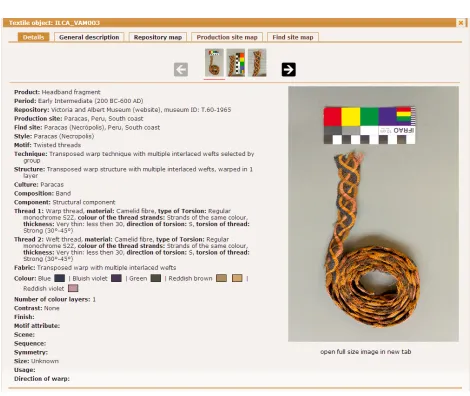
The user can now click on one of the images shown in the main pane and a new pop-up window will appear displaying details of that textile object. For example, clicking on the image in the middle of the second row of Figure 3 results in Figure 4 being displayed in a new window. In this window, the user can see the full data relating to the selected textile object, can zoom into the displayed image, and can browse through all the other images relating to this textile using the right and left arrows at the top of the page. In addition to the default Details tab, there are also tabs that allow the user to see a textual description of the textile object’s composition and structure (General Description), a map showing the location of the collection it belongs to (Repository map), and maps showing the sites were it was produced (Production site map) and found (Find site map). We notice that each of the textile objects is identified by a unique Textile ID which is displayed at the top of the details window e.g. Figure 4 is showing the details of textile object ILCA VAM003.
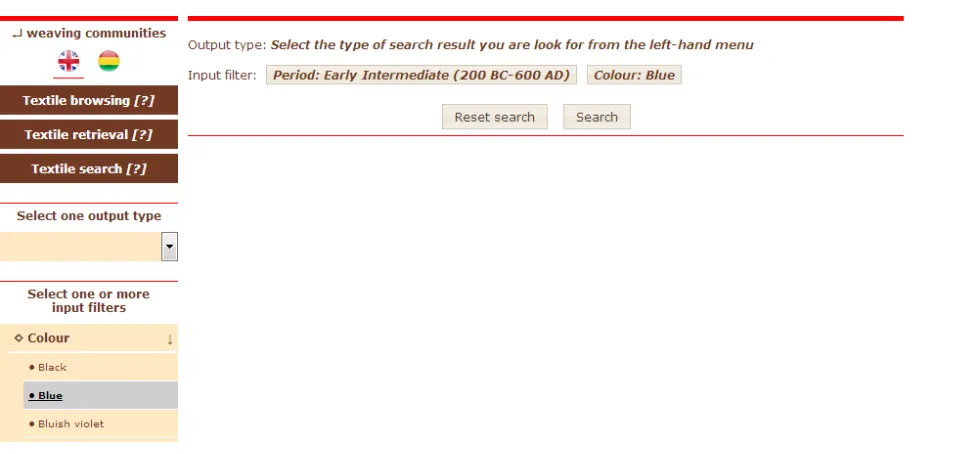
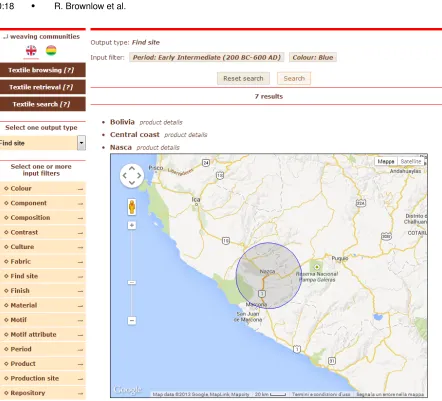
To use the Textile Search facility of the Web Application, the user selects the Textile Search option from the main menu at the left-hand side of the user interface — see Figure 5. This allows the user to set up a more complex query, consisting of a number of query filters and a selected type of query output. For example, suppose the user wishes to know: “What are the Find sites of textile objects produced in the Early Intermediate period and containing the colour blue?” This query has two filters: “produced in the Early Intermediate period” and “containing the colour blue”; and the output is a list of “Find sites”. To set up the first filter, the user selects (in the same way in the Browsing example earlier) Period, then Archaeological period and then Early Intermediate (200 BC-600 AD). To set up the second filter, the user selects Colour and then blue. Figure 5 shows the appearance of the screen at this stage — the input filters are incrementally displayed at the top of the main pane as they are being constructed by the user. To choose the type of output, the user clicks on the pull-down menu under ‘Select one output type’ and then selects Find site. The output type is now displayed too at the top of the main pane.
Fig. 3. The Textile Browsing facility allows the user to explore textiles by navigating through the classification hierarchies. Sources of textile samples clockwise from top left: British Museum [Am1954,05.448]; British Museum [Am1907,0727.4]; Museo Nacional de Arqueologia, La Paz [661]; Victoria and Albert Museum [CIRC.415-1932]; Victoria and Albert Museum [T.60-1965]; Museo Nacional de Etnografia y Folklore, La Paz [19351]. Photographs copyright of the Instituto de Lengua y Cultura Aymara (ILCA), La Paz.
Having set up a query, it is possible to change the type of its output and re-run it. For example, the previous query can be modified to find out “What are the Cultures of textile objects produced in the Early Intermediate (200 BC-600 AD) period and containing the colour blue?” by selecting Culture as the output type and then pressing Search again. It is also possible to modify a query by dropping one of the input filters. For example, our query can be modified to find “What are the Cultures of textile objects containing the colour blue” by clicking on the first filter to delete it and then pressing Search again. It is also possible to add more filters to the current query. By pressing ‘Reset search’ it is possible to set up a new query.
[image:16.630.92.546.128.454.2]Fig. 4. Display of details of a textile object (ILCA VAM003) in the Textile Browsing facility. Source of textile sample: Victoria and Albert Museum [T.60-1965]. Photograph copyright of the Instituto de Lengua y Cultura Aymara (ILCA), La Paz.
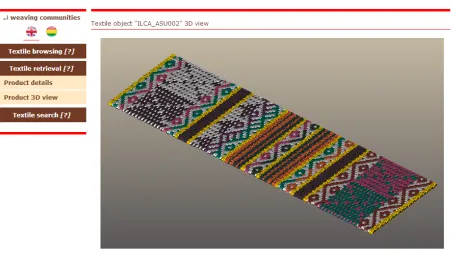
(in alphanumeric order) and the user selects the desired one. The details of the selected textile are then displayed similarly to Figure 4. If the user selects to view a 3D visualisation of a textile, then again the full list of Textile IDs is presented, the user selects the desired one, and the system displays a 3D model of the textile. This model can be manipulated (rotated and zoomed into) by the user to explore its structure and composition. Figure 7 shows an example 3D visualisation of a textile object. This facility is implemented using the JSC3D JavaScript library (http://code.google.com/p/jsc3d/) which exploits the canvas feature of HTML5 to perform rendering and user interactions. The use of JavaScript and HTML5 ensures compatibility with all modern browsers without the need to install any plugins.
[image:17.630.88.558.111.507.2]Fig. 5. The Textile Search Facility, with input filters selected and output type to be selected.
available for application development; and its SPARQL query server, Fuseki, is compliant with the W3C SPARQL 1.1 standard [SPARQL Working Group 2013].
The Web Application was built using PHP following the Model-View-Controller design pattern [Leff and Rayfield 2001]. Fuseki is used as a middleware layer interfacing the application to the ontology. PHP-SPARQL-Lib, which is part of Graphite (http://graphite.ecs.soton.ac.uk/sparqllib/), was used to provide a PHP API to Fuseki. The multimedia resources (e.g. images) are stored on a conven-tional file server, with their filenames being referenced within the ontology. The Browsing and Search results are retrieved and displayed using AJAX calls.
The Web Application supports English and Spanish, both at the user interface level and within the ontology itself. We stress that the user interface menus are generated by reading from the ontology and are not hard-coded, thereby allowing extensibility of the application as the ontology evolves. The data retrieved from the ontology is displayed in the user’s selected language by using an appropriate FILTER statement within the SPARQL queries generated by the application.
When a query is executed, the Controller component of the application sends the query parameters to the Model component, which executes the necessary queries over the Fuseki SPARQL endpoint. Having collected the query results, the Controller calls the View component appropriate for represent-ing them and builds the web page to be displayed by the client web browser.
[image:18.630.90.572.121.348.2]Fig. 6. Display of query results in the Textile Search facility, with input filters and output type selected. The map has been produced using the Google Maps API V3 [Google 2013].
5. USER EVALUATION
We recruited 25 volunteer evaluation participants via our networks of contacts with museums, re-searchers and textile practitioners. None of these people had had any prior involvement with the project, and Appendix A lists their backgrounds. We held several identically structured evaluation sessions each attended by a subset of the full set of participants. Several days before each session, its participants were sent an information sheet describing the aims and format of the session, and a consent form to sign and return. They were also sent the URL of the project website, so as to be able to gain some background into the aims of the project if they so wished (this was optional).
[image:19.630.93.535.101.502.2]Fig. 7. Example of 3D visualization of a textile object (ILCA ASU002) using the Product 3D view option of the Textile Retrieval facility. Source of textile sample: Museo de Arte Indigena in Sucre [130-2007-E-M-PONCHO]. 3D image rendered in Sawu-3D editor developed by the Instituto de Lengua y Cultura Aymara (ILCA), La Paz. Textile image copyright of ILCA.
the Browsing and Search facilities. Participants were invited to add further comments if they wished. (At the time that most of the evaluation sessions were undertaken, the Textile Retrieval facility had not been fully implemented, so this was not included in the evaluation.) At the end of the five tasks, participants were also invited to answer a set of more general questions about the usability and use-fulness of the system. In Appendix B we show the number of participants’ answers falling into each answer category for each of the questions within the activity sheet, as well as the additional comments provided by participants.
[image:20.630.93.545.120.375.2]6. DISCUSSION OF THE USER EVALUATION
Looking first at the results of the Browsing Tasks 1 and 2, we see that 73% of responses were in the ‘Very Easy’ or ‘Easy’ categories, which is very encouraging considering that this was participants’ first use of the system. The percentage of fully correct answers for these tasks was 72%, and of either fully or partially correct answers was 96%. The comments provided by some of the participants pointed to the two main sources of difficulty they had: (i) understanding the technical terms being used in the classification hierarchies, and (ii) navigating through the menu structure. This feedback has led us to subsequently add “hover-over” explanatory text in the user interface for each of the terms in the classification hierarchies and for each of the three main menu items (Textile Browsing, Textile Retrieval and Textile Search).
Participants’ feedback from the first evaluation session also pointed to the possibly different under-standing that different domain experts may have of the term “ontology” (see, for example, the com-ments from Participant 2 in the final question in Appendix B). Thus, although the term “ontology” continued to appear within the participants’ activity sheet, we removed any references to it from the user interface of the system itself for subsequent evaluation sessions.
Looking next at the results of the Search Tasks 3, 4 and 5 we see that overall 82% of answers were fully correct, and 95% either fully or partially correct, reflecting participants’ more accurate usage of the system as they became more familiar with it during the course of the session, despite the greater difficulty of Tasks 3-5 compared with Tasks 1 and 2.
We see that the percentage of responses falling in the ‘Very Easy’ or ‘Easy’ categories increased from 39% in Task 3 to 60% in Task 4 and 75% in Task 5. In parallel, the percentage of responses of ‘Mixed Feelings’ fell from 47% to 26% to 21%, and of ‘Difficult’/‘Very Difficult’ from 14% in Tasks 3 and 4 to 4% in Task 5. These responses reflect participants’ increasing confidence in using the Search facilities of the system. Looking at the comments provided by some of the participants, we see that the main source of difficulty was in navigating through the classification hierarchies in order to find the desired search term; however, participants’ comments also show that these difficulties lessened with increased practice and familiarity. This feedback has led us to subsequently produce a video for the project website which demonstrates usage of the Browsing, Retrieval and Search facilities and contains several examples of navigation through the classification hierarchies (seehttp://www. weavingcommunities.org/textile-product-search).
There was also a comment from one participant saying “Would be easier if you were able to type a search”. Subsequent discussion with that participant revealed that this reflected a desire for a more familiar keyword-based search facility to be supported. Providing such a facility over the ontology would certainly be possible in the longer term, but was out of the scope of the research project timescale and resources.
The textual comments provided by participants to the sixth and seventh questions give specific views on how the system could be used:
—Participant 2: think it could and will be a useful role for people working in this field [cultural studies] or with a strong interest in the topic. Certainly for those with a strong interest in textiles and/or that part of South America it is of considerable interest, particularly to staff, students and researchers based at universities, museums, galleries and so on.
—Participant 3: would show it to young people I work with who are engaged in language and culture maintenance/revitalisation, because of the discussions it would generate about classifying and trans-ferring knowledge which is being lost in their community. It provides an excellent model for thinking about classifying other types of knowledge and has implications, for example, in revitalisation/main-tenance projects with indigenous languages and knowledges. It helps provide an educational tool for institutions which do not have the resources themselves to disseminate knowledge and that repre-sents resource transfer from north to south as well as intellectual cooperation.
—Participant 4: Looking at patterns and structures for inspiration and discovering the culture that they were produced in. For my students I could recommend that they looked at images relating to material, technique, culture and relative to their area of interest. The system provides a window into the textile methodology and design of other cultures.
—Participant 5: new methods of preserving (digitising) objects of material/non-material culture...Using this system gives a wide knowledge about the objects, with the description of smallest details. It would be of interest to archaeologists, anthropologists, in cultural studies, and to IT specialists. —Participant 7: to get full and detailed information on products, including geography, period, design
etc. Anthropologists working in this particular region may use the available information for all sorts of reason, including but not restricted to, studying techniques, motives woven on the products etc. —Participant 10: In archaeology — development of earliest tools, from handaxes onwards. In folk
costume and folk crafts.
—Participant 13: for patterns and information. Textiles studies; museums; different textiles and fash-ion slides.
—Participant 14: I am fascinated in fabric structure so would use this to research it e.g. twining. Also for design ideas — and for colour. Research into any of this subject for teaching purpose; for study; for researching what is going on and where there are gaps in practice today.
—Participant 15: Certainly as interested amateur, with a personal collection of Andean textiles. Could you link in with Ecuador institutions? They have done extensive cataloguing and digitalisation of cultural patrimony over recent years.
—Participant 17: Art and Design students — some material for designs — good photo images.
—Participant 22: I think having access to this database would be of particular usefulness for contem-porary artists who work with and are interested in textiles.
—Participant 23: I can see this tool being useful for those who work in textiles/history/anthropology.
day-to-day terminology to that used within the system as they gained more experience with using the system. Finally, a few people pointed out that the tasks that they were asked to undertake in the eval-uation session may be unrealistically difficult as regards assessing the ease-of-use of the system, since it would in fact be easier for them to use the system when investigating their own questions rather than understanding and carrying out the “test” questions in the activity sheet.
7. CONCLUSIONS
This paper has described work on designing, implementing and evaluating a knowledge base of Andean weaving that aims to contribute to curatorial practice and heritage policy. The paper has focussed on the representation of the knowledge of domain experts and the information about textile objects in the form of an OWL ontology, and the development of a suite of search facilities supported by the ontology. We have discussed the research challenges faced in developing the ontology and search facilities, the methodology adopted, the design and implementation of the knowledge base, and the results of a user evaluation of the system undertaken with a diverse group of domain experts.
Particular research challenges arose from the inherent complexity of the knowledge domain, includ-ing data in the Aymara, Quechua, Spanish and English languages; the fact that the knowledge of the domain experts was evolving as data was being gathered, translated, discussed and debated; and the fact that the domain experts came from several different academic disciplines and national cultures — ethnographers, linguists, archaeologists, museum curators, weavers, art historians and cultural geog-raphers — each with their own perspectives, viewpoints and priorities. These features made the design and development of the ontology and search facilities much more challenging than ontology develop-ment projects in which the domain knowledge is relatively static and represents a single disciplinary viewpoint.
Being able to view digitised textile specimens from a range of different collections, together with the tools offered by the knowledge base for retrieving historical, geographical, archaeological, anthro-pological and material information about them, enables comparison between previously disconnected artefacts, with the potential to foster new insights5. We hope that the system will inspire a new
gener-ation of contemporary weavers in the Andean region through the recovery of ancient techniques, and facilitate more generally exchanges and dialogue between different textile traditions across the world. The methodology and methods adopted for developing the system are generic, and could be applied in other knowledge domains where the views of experts may be incomplete and where the knowledge model may undergo significant changes as domain experts gain new insights during the data gathering phase.
Within the scope of a possible follow-on project, we envision the system being able to incorporate textile collections from other museums and similar institutions and making the knowledge base avail-able to others, thereby expanding its reach and enabling us to test and further develop the approach taken to date. On the technical side this would mean implementing a protocol for exchanging onto-logical data with other systems. We aim to realise this for our system via an interface based on Open Knowledge Base Connectivity (OKBC) [Chaudhri et al. 1998]. OKBC is available on a wide range of platforms, supporting different programming languages, and offering network transparency to users. This of course will depend of further funding and interest of potential partners, which we plan to foster in the near future by holding small workshops with museum curators in London, and through the creation of a discussion forum on the project website for exchanging ideas with interested parties nationally and internationally.
Acknowledgements.We gratefully thank the AHRC for their funding of the project, all the mem-bers of the project team, our museum partners, and all others who have been involved in the project. Particular thanks to Denise Arnold and the team at ILCA for their production of over 700 textile-related artefacts in spreadsheet form, their graphical modelling of the domain knowledge in yED, and their production of over 70,000 digital files (including photographic images and video sequences) pro-viding the content for the overall project website; to Allan Whatmough and the team at Birkbeck’s ITS department for their implementation and ongoing support of the overall project website (beyond the OWL ontology and search facilities that are the topic of this paper) using the Plone CMS; and to all of the participants in the evaluation sessions and the anonymous reviewers of earlier versions of this paper for their thoughtful and constructive feedback.
REFERENCES
APACHESOFTWAREFOUNDATION. 2013. Apache Jena.http://jena.apache.org/.
ARNOLD, D. 2012.El textil y la documentaci´on del tributo en los Andes: los significados del tejido en contextos tributarios. Fondo Editorial de la Asamblea Nacional de Rectores, Lima.
ARNOLD, D.AND ESPEJO, E. 2010a. Ciencia de las mujeres: experiencias en la cadena textil desde los ayllus de Challapata. Inter-American Foundation, Fundaci´on Xavier Alb´o, and Instituto de Lengua y Cultura Aymara, La Paz, Bolivia.
ARNOLD, D.ANDESPEJO, E. 2010b. Hacia una terminolog´ıa andina de las estructuras y t´ecnicas textiles: una introducci´on.
Actas de las V Jornadas Internacionales sobre Textiles Precolombinos, 425–451.
ARNOLD, D.ANDESPEJO, E. 2012.La ciencia del tejer: estructuras y t´ecnicas de faz de urdimbre. Fundaci´on Cultural del Banco Central de Bolivia, Inter-American Foundation, Fundaci´on Xavier Alb´o, and Instituto de Lengua y Cultura Aymara, La Paz, Bolivia.
ARNOLD, D.ANDESPEJO, E. 2013.El textil tridimensional: la naturaleza del tejido como objeto y como sujeto. Inter-American Foundation, Fundaci´on Xavier Alb´o, and Instituto de Lengua y Cultura Aymara, La Paz, Bolivia.
BECHHOFER, S.,VANHARMELEN, F., HENDLER, J., HORROCKS, I., MCGUINNESS, D., PATEL-SCHNEIDER, P.,ANDSTEIN, L. 2009. OWL web ontology language reference.http://www.w3.org/TR/owl-ref/.
BIRD, J., HYSLOP, J.,ANDSKINNER, M. 1985. The preceramic excavations at the Huaca Prieta Chicama Valley, Peru. Anthro-pological Papers of the American Museum of Natural History 62.
CHAUDHRI, V. K., FARQUHAR, A., FIKES, R., KARP, P. D.,ANDRICE, J. P. 1998. OKBC: A programmatic foundation for knowl-edge base interoperability. InProc. of the 15th National/10th Conf. on AI/Innovative Applications of AI (AAAI’98/IAAI’98). AAAI ’98/IAAI ’98. Madison, Wisconsin, 600–607.
D’HARCOURT, R. 2002.Textiles of Ancient Peru and Their Techniques. Dover Publications, Mineola, NY. DRANSART, P.ANDWOLFE, H. 2011.Textiles from the Andes. Interlink Publishing, Northampton, MA.
DUQUE, A., CAMPOS, C., JIMENEZ-RUIZ, E.,ANDCHALMETA, R. 2009. An ontological solution to support interoperability in the textile industry. InEnterprise Interoperability. Vol. 38. Springer, 38–51.
EMERY, I. 2009.The Primary Structures of Fabrics. Thames and Hudson, London.
FERNANDEZ-LOPEZ, M., GOMEZ-PEREZ, A.,ANDJURISTO, N. 1997. METHONTOLOGY: from ontological art towards ontolog-ical engineering. InProceedings of the AAAI97 Spring Symposium. Stanford, 33–40.
GASEVIˇ C´, D., DJURIC´, D.,ANDDEVEDZIˇ C´, V. 2009.Model Driven Engineering and Ontology Development. Springer, Heidelberg. GOOGLE. 2013. Google Maps JavaScript API v3 – Google Developers.https://developers.google.com/maps/documentation/
javascript/.
GRUBER, T. 1993. A translation approach to portable ontology specifications.Knowledge Acquisition 5,2, 199–220.
GYORY, G. 2012. Generic textile structure editor. In3rd Int. Workshop on Human-Computer Interaction, Tourism and Cultural Heritage (HCITOCH 2012). Venice, 180–188.
HORRIDGE, M., DRUMMOND, N., GOODWIN, J., RECTOR, A. L., STEVENS, R.,ANDWANG, H. 2006. The Manchester OWL syntax. InProc. of the OWLED*06 Workshop on OWL. Athens, Georgia.
LEFF, A. AND RAYFIELD, J. 2001. Web-application development using the model/view/controller design pattern. InIEEE Enterprise Distributed Object Computing Conference (EDOC). Seattle, 118–127.
MARTINS, L., HELMER, S.,ANDARNOLD, D. 2013. Exploring weaving structures in the Andes: Reflections on the creation of a digital archive.Visual Resources: An International Journal of Documentation 29,1-2, 59–71.
NICOLA, A. D., MISSIKOFF, M.,ANDNAVIGLI, R. 2005. A proposal for a unified process for ontology building: UPON. InIn Proceedings of 16th International Conference on Database and Expert Systems Applications (DEXA).
PLONEFOUNDATION. 2013. Plone CMS: Open Source Content Management.http://plone.org/. ROWE, A. 1977.Warp Patterned Weaves of the Andes. Textile Museum, Washington.
SILVERMAN, G. 2008.A Woven Book of Knowledge: Textile Iconography of Cuzco, Peru. The University of Utah Press, Salt Lake City.
SPARQL WORKINGGROUP. 2013. SPARQL Query Language for RDF.http://www.w3.org/TR/rdf-sparql-query/.
STONE-MILLER, R. 1994. To Weave for the Sun: Ancient Andean Textiles in the Museum of Fine Arts. Thames and Hudson, London.
SURE, Y., STAAB, S.,ANDSTUDER, R. 2003. On-to-knowledge methodology (OTKM). InHandbook on Ontologies, International Handbooks on Information Systems. Springer, 117–132.
YWORKS. 2013. yED Graph Editor.http://www.yworks.com/en/products_yed_about.html.
A. EVALUATION PARTICIPANTS
Participant 1: Museum curator and researcher Participant 2: Researcher in cultural studies Participant 3: Researcher in indigenous languages Participant 4: Textiles designer and lecturer Participant 5: Researcher in cultural studies
Participant 6: Textiles practitioner, with interest in traditional textile methods Participant 7: Researcher in cultural studies
Participant 8: Textiles practitioner Participant 9: Interested in textiles
Participant 10: Researcher in languages, with interests in heritage and weaving Participant 11: Cultural promoter
Participant 12: Researcher in international studies, with interests in weaving Participant 13: Interested in textiles
Participant 14: Textiles practitioner, with interests in weaving structures
Participant 15: Researcher in Latin American geography, with particular interest in indigenous cul-tures
Participant 16: Textiles practitioner, with particular interest in South American textile traditions Participant 17: Textiles practitioner
Participant 18: Curator of textile-related exhibitions Participant 19: Anthropologist
Participant 20: Anthropologist Participant 21: Artist/researcher Participant 22: Art historian researcher Participant 23: Digital art expert Participant 24: Weaver
Participant 25: Curator of textile-related exhibitions
B. EVALUATION ACTIVITY SHEET AND RESULTS
Tasks Using Ontology Browsing
Start your web browser and connect to the Andean Weaving Ontology at the following URL:
Task 1. What are the styles of textile objects containing the motif “With extended wings”?
Answers: Fully correct: 20 Partially correct: 4 Wrong: 1
very easy mixed difficult very
easy feelings difficult
Specifying the query is 5 8 4 4
Finding the answers is 6 11 3 4
Using the detailed view of each textile object is 13 8
Any other
comment you wish to make
“I would need to spend a long time browsing in order to understand the linguistics comment you and where the search attributes are”
“The menus would be easier to navigate if you were able to “hover” over them and the next set of options appeared next to the current menu”
Task 2. What materials are textile objects with style East Yampara made of? Which of these textile objects include the colour bluish violet? (Please identify them by their textile object catalogue number.)
Answers: Fully correct: 16 Partially correct: 8 Wrong: 1
very easy mixed difficult very
easy feelings difficult
Specifying the query is 3 12 6 2
Finding the answers is 7 9 6 2
Using the detailed view of each textile object is 10 4 3 2
Any other
comment you wish to make
“Being pointed in the right direction in the beginning was a big help.”
“It is not so intuitive and kind of complex to get the answer, in terms that it is not so efficient to look into each product to find the material”
Task 3. What are the techniques used in textile objects produced by the Aymara-Quechua-North Char-cas culture, with complex structural tabular finishing and major contrast?
Answers: Fully correct: 20 Partially correct: 4
very easy mixed difficult very
easy feelings difficult
Specifying the query is 6 15 3 1
Finding the answers is 2 11 8 1 2
Any other
comment you wish to make
“It was difficult because there are so many categories, but I can’t imagine it could be different with all the information you have”
“At the beginning it is not so easy, but once you get familiar it is kind of easy”
“This could be more dynamic, step-by-step filtering whereby options automatically narrow as you click certain criteria”
“I am not familiar with the 3 historical periods enough to be quick on that part of the search. Took a try+fail to find right information — it’s just practice. Once achieved no difficulty.”
“Finding most of the information was pretty straightforward, but the complex structural tabular finishing into felt like it was a little bit too buried/hidden”
“Would be easier if you were able to type a search”
Task 4. What are the colours of the textile objects made with a tubular warp-faced cloth during the Middle Horizon (600-900/1000 AD) period?
Answers: Fully correct: 20 Partially correct: 3 Wrong: 2
very easy mixed difficult very
easy feelings difficult
Specifying the query is 1 12 6 3 1
Finding the answers is 5 12 7 3
Any other
comment you wish to make
“Trying to find right category was experimental. The word ‘cloth’ threw me.”
“Again, to the uninitiated “made” could refer to either material or fabric as an output. Also, it is a little confusing that there are two Middle Horizon categories, initially I chose the wrong one!”
Task 5. What textile products are made of acrylic wool with a balanced weave structure, warped in 1 layer?
very easy mixed difficult very
easy feelings difficult
Specifying the query is 6 11 6 1
Finding the answers is 6 13 4 1
Any other
comment you wish to make
“It will take (me) a long time to find my way around and know what is contained in each attribute. I think I could need definitions of the key words used in the search menus” [N.B. these are actually available, by hovering over each word; and this feature was demonstrated to participants at the beginning of the activity]
“Would say acrylic fibre — acrylic wool can is a contradiction in terms as acrylic is plastic!”
“Again, see above re. confusion of material vs fabric concerning the term “made” ”
“The system does become easier to use once you understand how to search”
General Questions
About the Andean Weaving Ontology
Navigating through the Ontology is very easy mixed difficult very
easy feelings difficult
13 11 1
Accuracy of descriptions on screen is very mostly mixed mostly very
good good quality poor poor
16 7 1
Knowing what to do next is very easy mixed difficult very
easy feelings difficult
3 10 11 1
Understanding the search results is very easy mixed difficult very
easy feelings difficult
12.5 10.5 2
The response time of the system is very mostly mixed mostly very
good good feelings poor poor
24 1
Conclusion
Do you find the system to be a useful tool very useful mixed little not
that you would use? useful feelings useful useful
13 7 3 2
Please add comments of how the system would be useful to you in your role:
—Participant 1: Don’t know whether I’d use it

![Fig. 3.The Textile Browsing facility allows the user to explore textiles by navigating through the classification hierarchies.Sources of textile samples clockwise from top left: British Museum [Am1954,05.448]; British Museum [Am1907,0727.4]; MuseoNacional d](https://thumb-us.123doks.com/thumbv2/123dok_us/8868100.940848/16.630.92.546.128.454/browsing-facility-navigating-classication-hierarchies-clockwise-british-museonacional.webp)