BIROn - Birkbeck Institutional Research Online
Clarke, Richard (2016) Final evaluation report for the Heart of Teesdale
Landscape Partnership. Technical Report. Heart of Teesdale Landscape
Partnership and Durham County Council.
Downloaded from:
Usage Guidelines:
Please refer to usage guidelines at or alternatively
Final Evaluation
Report to the Heritage Lottery Fund
prepared by Richard Clarke for the
Acronyms used in text
AG HoT LP Advisory Group
BCTC Barnard Castle Town Council
CTP Countryside Training Partnership
DCC Durham County Council
DWT Durham Wildlife Trust
ELC European Landscape Convention
HoT Heart of Teesdale Landscape Partnership
HLF Heritage Lottery Fund
IE Independent Evaluator
INNS Invasive non-native species (plant and animal)
LP Landscape Partnership/ Scheme
NE Natural England
PDG HoT LP Programme Delivery Group
TAP Teesdale Action Partnership
TRT Tees River Trust
UTASS Upper Teesdale Agricultural Support Services
Codes used to identify respondents to survey & interviews
PR = Partner representative or project lead
V = Volunteer
PA = Participant in one or more events or activities
NP = Aware of HoT but not involved in activities
NA = Unaware of the HoT until approached as part of this evaluation.
Foreword
By Graham Young, Chair of the Heart of Teesdale Landscape Partnership
The Heart of Teesdale Landscape Partnership has had a significant impact on Teesdale's landscape and people over the last five years. It has been good to be part of a project that has been so well received. The clue is in the title, I guess. It has been a partnership; a partnership of authorities, organisations and people.
We have delivered and enabled others to deliver about 75 projects of amazing diversity (a huge number for a Landscape Partnership). They have ranged from planting bulbs to major enhancements of public areas; from youth projects to work in Care Homes; from archaeological research projects to significant footpath improvements.
Hundreds of dedicated volunteers have battled with invasive species, conducted wildlife surveys and enhanced rights of way. Over a thousand participants have been trained in heritage crafts and skills, learnt about being creative with media and engaged with outdoor activities. We have encouraged local people to get out and get to know their environment and gain a new 'sense of place', to explore the rivers, create better habitats and express themselves in art. We have encouraged people to think and we've made a significant
contribution to public policy review at a national and European level. Community groups, parish councils, farmers, artists and local businesses have all got involved and been inspired to make a difference and hopefully stay engaged in this dynamic landscape we call home.
All this work has been co-ordinated and enabled by the Heart of Teesdale team, a small but dedicated group who have worked beyond the call of duty. We are proud of them and they should be proud of the work they have done and the impact it has had. This report, by an independent evaluator, gives
testimony to that fact: ‘Heart of Teesdale can be counted a significant success’.
Durham County Council has been the 'responsible body' who held the grant from the Heritage Lottery Fund and the many match-funders we have had. They have been very good at allowing the partnership to be directed by all its members and independent individuals. They should be commended for that. On the ground the work has been guided by the invaluable contributions of an Advisory Group who have put in many hours of work. Thanks to you too.
The legacy for the Heart of Teesdale is in each one of the projects supported, it is in the changed
perceptions and new understandings, it is in the development of new ways to manage the landscape and most of all, it is in the heart of each individual involved and their hope for the future.
The Heart of Teesdale Landscape Partnership as we know it has ended, but people's commitment to the dale will not and there will be new initiatives and different ways to ensure the enjoyment and
development of this, our home.
Final Evaluation of the
Heart of Teesdale Landscape Partnership
October 2016
Summary
Introduction: the Heart of Teesdale and its Landscape Partnership
Heart of Teesdale (HoT) is a £2.7m Landscape Partnership (LP) Scheme supported with £1.6m of Heritage Lottery Fund (HLF) grant. Its Vision as embodied in the Project’s Landscape Conservation Action Plan (LCAP) is to
‘inspire people to re-discover the lost landscapes of Teesdale, celebrate its unique beauty and character, and benefit from its rich cultural heritage and potential.’1: ii
The Accountable Body for the scheme is Durham County Council (DCC). Strategic leadership is provided by an Advisory Group (AG) of 15 individuals including representatives of all major project partners and with an independent Chair and Vice-Chair. The scheme is delivered through a programme of some 75 separate projects (including 28 project grants under a Community Initiatives Fund) costed from under £500 to over £300,000, designed to generate outcomes across the four HLF LP programme areas of: natural and cultural heritage conservation; community participation; access and learning; training and skills. Coordination and administration is provided through a full-time LP Manager and four part-time programme staff, with significant inputs in kind from DCC officers. Following a successful application for HLF grant in late 2009 the scheme was developed between April 2010 and June 2011. The delivery phase was launched in November 2011. HLF grant formally ends in October 2016.
The HoT Partnership was originally conceived in part as a response to a recognition that the area has special qualities of national significance which have perhaps been overlooked or ‘lost’ in comparison to neighbouring areas (such as the North Pennines AONB to the north and the Yorkshire Dales to the south and regeneration initiatives around Bishop Auckland that attract more obvious interest from media, visitors, businesses and government) and that these qualities are themselves a significant but sometimes undervalued resource for local residents.
The evaluation context and purpose of this Report
This Report fulfils the requirement of the Heritage Lottery Fund (HLF) for HoT to conduct a Final
Evaluation of its work. But it is intended to be much more than a document for HLF to ‘sign off’ its grant. It is a document for the Partnership as a whole, for participants and volunteers and for a wider public.
leads, partners and the LP team. It also considers what may not have worked so well and the lessons that may be drawn for the future.
In line with HLF’s policy that evaluation should be a continuous process, about ‘improving’ as well as ‘proving’ the Countryside Training Partnership (CTP) was commissioned in late 2013 to work as Independent Evaluator (IE) with the HoT Partnership and LP team to help conduct an ongoing assessment of the Scheme’s progress.
Methods have included the following elements:
Desk research: including examination of a wide range of documents relating to HoT its area and the Partnership.
Liaison with the LP team, Partners and Advisory Group members who have provided information and assistance.
Key Informant Interviews with partner representatives, project leads, volunteers and beneficiaries, both face-to-face and by telephone.
Site visits to a wide range of project locations over eight visits (18 days in total) to the HoT area and participation in six HoT AG meetings and the 2015 Annual Forum.
An evaluation and legacy workshop held at Boldron on 4 June 2014 involving 35 partner representatives and project leads.
Annual Reports to HoT AG and a Mid-Term Evaluation Report presented to the HoT AG in June 2016.
An on-line survey with an e-invitation via the HoT Newsletter and contacts list, resulting in 109 valid returns.
Quantitative data in this Report is based largely on information supplied by the LP team and partners and our evaluation has focused primarily on outcomes and legacy.
Projects, outputs and outcomes
Some key indicators of activity (outputs) include:
9 amenity sites with significantly enhanced quality; 547ha of holdings entered in ELS; 43ha planted with wild bird seed; 17ha of invasive species cleared; 35ha improved through environmental volunteering; 12,334 trees planted; 6,464m hedge and 942m of other boundaries established or restored.
280 landowners or farmers (managing over 10,000ha) engaged, resulting in 18 project grants worth a total of £72,000 plus 6 successful agri-environmental grant applications covering 550 ha worth £82,146 overall plus an additional 14 other grant applications over worth £24,000
16 significant structures repaired/ restored or with enhanced setting including 4 bridges, 2 lime kilns, 2 ancient wells; 175 field barns and other vernacular structures recorded and
documented
48 community-led projects; an estimated 23,113 participants in HoT events and activities over the life of the LP scheme
814 individual volunteers in HoT funded projects, contributing a total of 16,077 volunteer-hours, worth £350,927 in match funding
13 youth groups and 2,117 young people engaged in HoT activities as volunteers or participants
12 businesses engaged including 9 creative media workshops and 3 corporate volunteering sessions
5km of new public rights of way created and 91 km of paths improved, with 75 new hand gates, 44 new signposts and 7 improved stiles
18 new walking trails with 11 new interpretation boards and associated site-based interpretation and/or leaflets or on-line information
14 public exhibitions; 13 significant booklets plus 15 digital publications and 4 websites
26 school visits involving 450 pupils to sites and 8 outreach visits to schools, 53 adult learning activities engaging 648 individuals, plus family and vocational learning activities, cultural and oral history projects, a total of 127 learning activities involving over 1,500 beneficiaries overall.
1,524 individuals with new or enhanced skills through non-accredited training provided as part of project delivery plus 45 individuals involved in ecological monitoring programmes and 10 trained farm building surveyors.
In each of HoT’s (and HLF’s) programme areas our evaluation has found that HoT has ‘made a difference’. This is equally the case in regard to its work with the local community as to its physical works to the area’s natural and cultural heritage.
Physical works involving the area’s historic and cultural heritage have been broadly successful. An early bias of capital works towards the townscape of Barnard Castle has been compensated by a larger number of smaller projects in the surrounding countryside and villages. An
overspend on major capital work has been managed well and has not significantly impacted on funding for other projects.
Public access has featured prominently in HoT including improvements to paths and signage around Barnard Castle and several surrounding areas.
Projects involving natural heritage have been many and varied though locations have been (inevitably) opportunistic. Habitat works (including the control of non-native species) although limited in extent, have significantly improved key locations. Work with local farmers focusing on birds and farm landscapes, has improved areas for wildlife. Schools projects on freshwater ecology have worked well and engaged pupils both at primary and secondary level.
Arts-based projects have also worked well, as have those involving archive or other research and oral history, in all of which a relatively small amounts of grant have yielded significant benefits, reflected in the enthusiasm and testimony of those involved.
Most conservation works have also contributed to physical and/or intellectual access and most have also involved volunteers. These have complemented projects focused on community participation and engagement which has been a significant feature of the scheme.
A prominent element of the HoT scheme has been the Community Initiatives Fund which has supported 28 projects across the HoT area. Whilst some of these have involved only a few individuals, in aggregate they have served to promote HoT as a community based scheme.
Some ‘people’ activities (such as those linking young people with care home residents in exploring their landscape) appear to have been particularly valuable although outcome evidence (in the form of anecdotal reports or case studies) is lacking in some areas.
Administration, delivery and governance
Working at a landscape scale, in partnership, presents significant challenges to management and delivery and these have been magnified in HoT by the large number and variety of individual projects. It is to the credit of all concerned that the challenges have been successfully met. The LP team, working to the HoT Advisory Group and to the DCC Regeneration project managers have applied good oversight, and they have done this in a way which has been open and accommodating. This perception is supported by the responses to our on-line survey and interviews including those of most project leads, volunteers and participants.
Legacy
All project outcomes may count as ‘legacy’ to the extent that they endure beyond the end of the LP scheme. Arrangements for post-project maintenance of physical works to habitats and built features (management plans, maintenance agreements/ responsibility &c) across the whole HoT programme are variable. Safeguards do not necessarily require institutional obligations or legal commitments. For example the engagement of volunteers in the INNS programme as well as in smaller community projects is likely to lead to ongoing informal monitoring; tree planting on private land is likely to secure a
commitment to maintenance beyond the period specified in the Birds and Farm Landscapes grant letters. De facto ownership by DCC or BCTC should help to ensure maintenance of paths and signage.
Volunteering and community engagement have been significant and successful elements of many of the HoT projects. While it seems likely that the commitment of many of those involved is to their specific interest or organisation there is an awareness of the way in which this contributes to a wider landscape framework. Ongoing Legacy discussions, including some held at a local level, will hopefully maintain interest and commitment, including identifying future projects and the resources that may be needed to implement these.
Legacy might, but need not necessarily, involve a successor body or initiative focused primarily on the HoT area. A wider aspect of legacy is the place of HoT within the regional landscape context, in
particular its potential as a ‘hub’ linking the designated landscapes to the north and south with the more developed reaches of the river Tees (now covered by the adjacent new River Tees Rediscovered
Landscape Partnership) downstream to the east. Discussions are still ongoing with a view to a clearer focus on social and economic development in a wider area (roughly corresponding with the old Teesdale District Council boundary) through a body which could seek LEADER and Local Enterprise Partnership funding.
Conclusions
Heart of Teesdale can be counted a significant success in relation to its aims as laid down in the LCAP. This can be attributed in no small measure to three factors. The first is the motivation and enthusiasm of project leads and volunteers who have delivered much of the work. Another is the commitment and focus of the LP team, the support provided by DCC and the leadership of the Advisory Group (in particular its two Chairs) who have steered the project during delivery. Finally the openness of all Partners to working together over a set of common aims which have guided the HoT programme since its inception has meant that HLF grant has been seen as much more than another funding stream to
With relatively modest HLF funding over a diverse range of projects and significant match contribution from partners, HoT has achieved much over a relatively short timescale. A particular feature of HoT is its focus on the area as a cultural landscape. This has helped generate unity of purpose across all elements of the LCAP (not merely those projects involving the arts and creative media) and it has helped foster grassroots engagement. In this regard, HoT has been to the fore in exploring a cultural landscape approach to vernacular landscapes and it is fitting that the end of the LP scheme was celebrated with a highly successful Symposium on ‘Artists, Farmers and Philosophers’ in September 2016.
HLF, HoT partners, project leads and the LP team can take satisfaction in that public money has been well spent and that the tremendous amount of effort and commitment contributed to the scheme has made a difference, both to the area’s natural and cultural heritage and to its communities.
The challenge now is to build on this success to ensure that the improvements to the area’s natural and cultural heritage are maintained, that the enthusiasm and awareness which has been generated does not dissipate, and that the distinctive identity of the Heart of Teesdale remains valued and cherished in the future.
Richard Clarke
October 2016
CEPAR/ CTP
4, Penn Road, London N7 9RD
0207 609 0245
If not supplied with this Summary, the full report can be accessed on the Heart of Teesdale website;
Final Evaluation of the
Heart of Teesdale Landscape Partnership
October 2016
Contents
1
Introduction ... 3
2
The Heart of Teesdale Landscape Partnership ... 5
3
The evaluation context ... 8
3.1 HLF evaluation guidance ... 8
3.2 The
HoT
Evaluation... 9
3.3 Methods ... 9
4
Projects, outputs and outcomes ... 13
4.1 Natural and built heritage conservation ... 15
4.2 Community engagement and participation ... 21
4.3 Access and learning ... 25
4.4 Training and skills ... 30
5
Governance, administration and delivery ... 34
6
Legacy, landscape and lessons learnt ... 37
7
Conclusions ... 41
Acknowledgements
Significant input to this report has been made by many individuals who have contributed to or commented on its contents.
Quantitative data (including financial information) has been provided by the Heart of Teesdale Landscape Partnership team and/or by Durham County Council as lead partner.
Our own assessment has focused principally on outcomes and qualitative data. In this regard the authors would particularly like to thank all those partner representatives, project leads, volunteers and participants and of course the Heart of Teesdale team and Steering Group members as well as individuals from the local community who responded to our questionnaire, took part in interviews, and/ or
welcomed us on site during our visits.
Except where indicated otherwise illustrations in this report are supplied by the Heart of Teesdale Landscape Partnership and reproduced by permission. Other illustrations remain the copyright of their authors.
Richard Clarke
October 2016
CEPAR/ CTP
4, Penn Road, London N7 9RD
[image:11.595.58.539.410.716.2] 0207 609 0245
1
Introduction
Heart of Teesdale (HoT) is a £2.7m Landscape Partnership (LP) Scheme supported with £1.6m of Heritage Lottery Fund (HLF) grant. Its Vision as embodied in the Scheme’s Landscape Conservation Action Plan (LCAP) is to
‘inspire people to re-discover the lost landscapes of Teesdale, celebrate its unique beauty and character, and benefit from its rich cultural heritage and potential.’ 1: ii
The LCAP elaborates this vision in a set of seven principal aims:
1. To re-discover the particular visual qualities of Teesdale drawing on the historic and cultural legacy of artists, scientists and others who have explored the area and foster creativity and imagination through art, crafts and other media
2. To understand the historic value of the local landscape and how it has been shaped over time. 3. To conserve or restore the built and natural features that characterise the area
4. To take action to protect the local environment and wildlife, and increase biodiversity
5. To enhance the quality and amenity value of public and community spaces, key views and settings for enjoyment and learning
6. To engage individuals and communities in learning, training, skills and new technology to understand and interpret the local landscape, traditions and heritage and improve access, especially by those who might be disadvantaged or excluded from activities
7. To promote opportunities for cooperation, mutual support and volunteering within the
community to develop strategies and action so that the benefits of partnership can be sustained long term. 1: ii
All of these aims fit well with the multidisciplinary, multifunctional concept of landscape encapsulated in the European Landscape Convention (ELC), adopted by the Council of Europe in 2000 and applicable to the UK since March 2007. ELC promotes a definition of landscape which usefully underpins the
landscape partnership philosophy: ‘An area, as perceived by people, whose character is the result of the action and interaction of natural and/or human factors’ — a rich concept that encompasses but goes beyond sectoral (geomorphological, ecological, archaeological, historical or aesthetic) approaches. ELC makes it clear that people are at the heart of all landscapes (commonplace and ‘degraded’ as well as eminent) each of which has its own distinctive character and meaning to those who inhabit or visit it.2
The Accountable Body for the HoT scheme is Durham County Council (DCC) and strategic leadership is provided by an Advisory Group (AG) of c. 15 individuals including representatives of all major project partners and with an independent Chair and Vice-Chair.
The scheme is delivered through a programme of some 75 separate projects costed from under £500 to over £300,000, designed to deliver outcomes across the four HLF LP programme areas of: natural and cultural heritage conservation; community participation; access and learning; and training and skills. Coordination and administration is provided through a full-time LP Manager and four part-time programme staff, with significant inputs in kind from DCC officers.
Purpose and structure of this Report
This Report fulfils the requirement of the Heritage Lottery Fund (HLF) for HoT to conduct a Final
Evaluation of its work. But it is not merely intended to enable HLF to ‘sign off’ its grant. It is a document for the Partnership as a whole, for participants and volunteers and for a wider public.
The evaluation has been designed to provide an independent assessment of what HoT projects have delivered (their outputs), what the benefits (outcomes) have been for heritage and people and what lasting impact HoT will have made (its legacy).
Subsequent sections of this Report:
Provide further information regarding HoT, its origins, aims and objectives, and on its partners and projects (Section 2: The Heart of Teesdale Landscape Partnership)
Consider the HLF evaluation and reporting process and the methodology that has been adopted in producing this report (Section 3: The evaluation context)
Examine the component elements of HoT – what was actually done, and what was achieved and what its benefits have been for heritage and people (Section 4: Projects, outputs and outcomes)
Consider the management of HoT (Section 5: Governance, administration and delivery)
Assess the enduring benefits of HoT beyond the end of HLF funding and review some of the things which worked less well or are still outstanding and the lessons that may be drawn (Section 6: Legacy)
[image:13.595.64.532.376.721.2] Briefly summarise this Evaluation and the contents of the Report and (Section 7: Conclusions).
2
The Heart of Teesdale Landscape Partnership
The HoT Partnership was originally conceived in part as a response to a recognition that the area had special qualities of national significance which had perhaps been overlooked or ‘lost’ in comparison to neighbouring areas that attract more obvious interest from media, visitors, businesses and government such as the North Pennines AONB to the north, the Yorkshire Dales to the south, and the major
regeneration focused on Bishop Auckland Castle (itself the recipient of £10m HLF funding) and that for local residents the landscape and its heritage is a sometimes undervalued resource.
Table 1 Timeline and key stages for Heart of Teesdale LP
When What
1889 ‘Forward Barney’ publishes letter in the Teesdale Mercury asking ‘Is Barnard Castle to be the fashionable watering-place of the North?’ Improvements advocated include public walks later to be implemented by the HoT Landscape Partnership (Figure 3).
2003 Countryside Agency Market Towns Initiative. One North-East (Regional Development Agency, abolished 2012) identifies Barnard Castle as a ‘Beacon Town’ (together with Middleton in Teesdale), and key to the area’s development.
2006 Barnard Castle Vision (BCV) established to promote development in the town; in nine years to 2015 BCV attracts £9m of funding to the town.
2007 Michael Rudd ‘Discovery of Teesdale’3 published.
2008 BCV commissions Chris Burnett Associates to prepare a Landscape Appraisal of Barnard Castle and its surrounding area. (Produced April 2009).
2009 Local government reorganisation; Teesdale District Council absorbed in Durham County Council as unitary authority.
Sept Barnard Castle Vision in conjunction with Durham County Council submit a Stage 1 application for the ‘Tees Vale and Barnard Castle Landscape Partnership’ to HLF.
2010 Stage 1 (development)
April Round 1 approval received from HLF with £87,200 development funding towards a total of £139,900.
HoT Steering Group established.
May Charlotte Hursey appointed LP Programme Development Officer. Sarah Smith appointed Community Development Officer.
Community consultations lead to 3 Strategy documents: Community Engagement; Volunteering; Learning and Training 4 as input to the LCAP.
Wider HoT Forum established in parallel with Steering Group.
LP name changed to the ‘Heart of Teesdale Landscape Partnership’. LP area (and Landscape Appraisal) 5 extended. Biodiversity6 and Heritage Audits7 and Digital Media Strategy8 commissioned.
2011
June Round 2 application submitted with LCAP to HLF.
Sept Round 2 Pass received from HLF with funding of £1,895,700.
Nov Formal launch of the HoT Landscape Partnership.
2012
Sept HoT LP Steering Group reconstituted as the LP Advisory Group.
Oct Honia Devlin appointed as (Groundwork) Volunteer Officer (Culture and Heritage) p/t
Kath Marshall-Ivens app’t as (Groundwork) Volunteer Officer (Green and Env Issues) p/t
Nov First HoT Annual Forum and Open Day.
2013
Apr Karen Collins appointed as Volunteer Officer (p/t maternity cover for Kath Marshall-Ivens).
Aug Emma Ashton-Wickett appointed as ‘Paths for all’ project officer.
Sarah Smith returns p/t; Susie Lane appointed as Community Officer p/t.
Dec Countryside Training Partnership appointed as Independent Evaluator.
Oct Susie Lane appointed as Community Officer (p/t, maternity cover for Sarah Smith).
Alex Sijpesteijn replaces Charlotte Hursey as HoT LP Manager.
2014
Jan Graham Young replaces Will Weston as Chair of the HoT Advisory Group.
Sue Berresford retires as DCC Regeneration Manager (but returns as a member of the HoT Advisory Group); Chris Myers, DCC Principal Regeneration Manager becomes the DCC link and Alex’s manager.
June ‘Taking stock and Looking Ahead’ Evaluation and Legacy workshop in Boldron Village Hall.
Oct Sarah returns p/t as Community Officer; Susie stays on also as a Community Officer p/t.
2015
March CTP Interim Evaluation Report submitted to Partnership and Advisory Group.
June WoodFest event attended by over 300 people.
July Susie leaves.
Sept Barnard Castle Vision ends.
Nov HoT Annual Forum attended by 76 people.
March Volunteer thank you event attended by over 70 people.
Karen, Sarah, Honia’s contracts end.
June Draft Final Evaluation Report to HoT PDG and AG.
Sept End-of-scheme Symposium (7-9 September).
Emma’s contract ends.
Submission of Final Evaluation Report to HLF and final HLF grant payment.
[image:16.595.58.539.277.664.2]Oct HoT HLF LP funding and Alex’s contract ends.
3
The evaluation context
This section starts with a summary of HLF’s requirements and guidance in respect of evaluation. It then introduces the purposes of this Interim Report and presents the approach and methods adopted in our work with HoT.
3.1
HLF evaluation guidance
HLF requires that every Landscape Partnership should conduct a Final Evaluation towards the end of its Scheme and submit a satisfactory Report (embodying the results of the Final Evaluation) before it can ‘sign off’ the Scheme and release the final 10% of grant money.9 The Final Report must be an objective evaluation of what has been achieved. Common practice is for independent consultants to be engaged in the process, to a greater or lesser degree.
But this report is also a testimony to the work of all those involved with HoT. It celebrates the Scheme’s successes and considers what difference it has made to the area. It also considers what may not have worked so well and the lessons that may be drawn for the future. It is a document for the Partnership as a whole, for participants and volunteers and for a wider public.
HoT was conceived and developed as a Landscape Partnership under HLF’s third (2008-13) Strategic Plan, during which HLF developed its approach to (and placed increasing emphasis on) effective monitoring and evaluation. Some of these changes include:
Looking beyond outputs (as measures of activity) to outcomes (longer term benefits to heritage and for people) in particular those which endure beyond the end of HLF funding (legacy).
Working with partnerships and project partners, seeing evaluation as a participative process which enhances delivery rather than primarily an external assessment of achievement.
Utilising a wide variety of evidence including qualitative as well as quantitative indicators.
HLF evaluation guidancei makes a distinction between outputs (as measures of project activity supported by HLF grant) and outcomes (their longer-term benefits - to heritage and for people). Legacy comprises those outcomes that endure beyond the end of HLF grant and includes any benefits from working at a landscape scale beyond those generated by individual projects. Whilst outputs can usually be captured by quantitative measures, many ‘people’ outcomes can be expressed only in qualitative terms.
‘Evidence’ may need to include baseline information if the results are to be attributed to Partnership activity and HLF grant. This changing approach is embodied in HLF’s current (20013-18) generic guidance published in October 201210. HLF have also published subsequent evaluation guidance9 following our national evaluation of the Landscape Partnership programme in 201111. The emphasis on outcomes is also contained in informal advice that HLF provides in regard to legacy planning12 as well as in its concern that working at a landscape level should deliver benefits which are more than the sum of the outcomes of individual projects. Our evaluation takes this more recent guidance into account whilst recognising HLF’s evaluation advice as it existed at the time of submission of HoT’s Stage 2 application in 2010 as a reference point.
i
3.2
The
HoT
Evaluation
The Countryside Training Partnership (CTP) was contracted in September 2013 as Independent Evaluator (IE) to provide
‘analysis of progress towards and achievement of the Landscape Partnership in respect of its effectiveness and overall aim to fulfil the objectives of the Landscape Conservation Action Plan (LCAP) which formed the essence of the submission to the Heritage Lottery Fund in 2011’i
The evaluation as a whole comprised four stages starting in January 2014, each with a nominal (i.e. costed) allocation of 12 days, each of Stages 1-3 concluding with a brief interim report summarising the outputs of the work from that stage and containing proposals for the next stage. Each stage involved working with project leads, partners and the LP team and a total of 11 visits were made to the HoT area, each of between 1 and 3 days. Stage 2 included a workshop for all project leads and partners focusing on outcomes and evidence. Stage 3 included an Interim Evaluation report presented to the AG in March 2015. Submission of this Report constitutes the final stage of our evaluation of the scheme.
This aims of this Report are to:
Offer an independent assessment of what the HoT LP scheme has delivered (its outputs), what the benefits (outcomes) have been for heritage and people and what lasting impact HoT will have made (its legacy) for heritage and for people in the HoT area.
Celebrate HoT’s successes and pay tribute to the hard work of volunteers, project leads, partners and the LP team.
Consider what has worked particularly well and what may not have worked so well and the lessons that may be drawn for the future.
3.3
Methods
Quantitative data in this Report is based primarily on information supplied by the LP team and the Report focuses primarily on outcomes and legacy. The approach has comprised the following elements all of which have been conducted in liaison with the LP team, Partnership members, project leads and participants who have provided invaluable information, advice and assistance.
Desk research
This has included a wide range of other material feeding in to, related to or produced by HoT and partner organisations. A key focus has been the HoT LCAP and supporting documents, monitoring spreadsheets produced by the LP team, minutes of AG meetings and other sources including material relating to the HoT area more generally.
Key Informant Interviews
A programme of (telephone and on-site) interviews with individuals who might reasonably be considered to have expert or ‘inside’ knowledge of HoT and its achievements, including the following categories:
HoT team members and project leads
‘Experts’ including those involved in local cultural and natural heritage works
Volunteers and project participants
i
Programme beneficiaries including local businesses
Representatives of funding and partner bodies including the HLF Monitor and Regional Grants Officer.
Site visits
Site visits to a wide range of project locations over eleven visits (18 days in total) to the HoT area has provided valuable supplementary information to the above and enabled us to ‘ground truth’ information secured from other sources.
In addition we have participated in six HoT AG meetings and in the 2015 Annual Forum.
Workshop
An Evaluation and Legacy workshop ‘Taking stock and Looking Ahead’ was held on 4 June 2014 in Boldron Village Hall. 35 partner representatives and project leads took part and a report of that workshop, submitted to the AG on 16 July 2014.
Participant survey
An on-line questionnaire (with hard copies available from the HoT Office) launched in mid-2015 resulted in a total (April 2016) of 109 valid responses. The
questionnaire was designed in sections, each
commencing with a closed question designed to elicit perceptions of or attitudes to aspects of HoT’s objectives and projects, but which importantly then provides the opportunity for (what were sometimes extended) open, narrative responses on the perceived strengths and weaknesses of HoT in regard to each area. No questions were mandatory and ‘skipped’ questions mean that responses to individual questions are generally less than the number of questionnaire respondents overall.
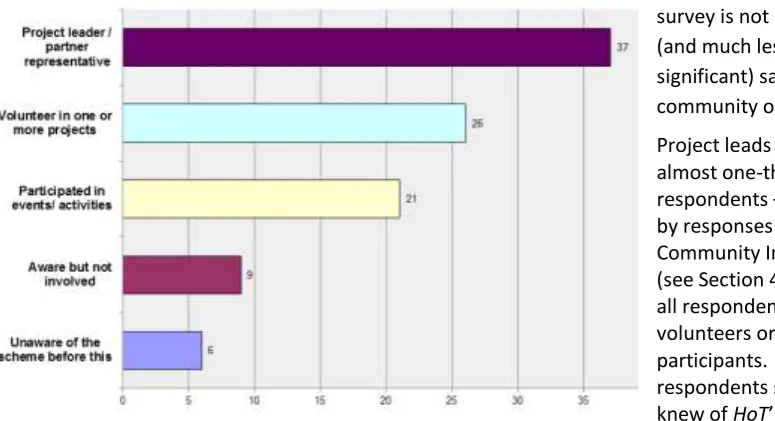
It is important to note that the survey is not a representative (and much less a statistically significant) sample of the community of the HoT area.
Project leads comprised almost one-third of all
[image:19.595.68.211.224.413.2]respondents – a figure inflated by responses from leaders of Community Initiative Projects (see Section 4.2); some half of all respondents were either volunteers or project participants. Just 10 % of respondents stated that they knew of HoT’s existence but
[image:19.595.65.453.563.773.2]haven’t really been involved and 7 % said that they hadn’t been aware of HoT before receiving the questionnaire (presumably forwarded by those who did).
However while the sample is biased to those who have been most closely connected with the HoT scheme and quantitative returns must be treated with caution, the narrative responses received (including those of individuals who had limited engagement with it the scheme, as well as the presence of some critical or hostile comments) suggests that these are likely to be reasonably representative of a wider spread of opinion.
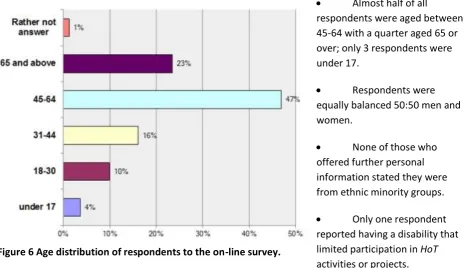
Almost half of all
respondents were aged between 45-64 with a quarter aged 65 or over; only 3 respondents were under 17.
Respondents were
equally balanced 50:50 men and women.
None of those who
offered further personal information stated they were from ethnic minority groups.
Only one respondent
reported having a disability that limited participation in HoT activities or projects.
83% of survey returns were from individuals who live or work in or adjacent to the HoT area; 16% of respondents lived outside the area.
The questionnaire concluded with an invitation to respondents to indicate if they were prepared for us to follow up with a short telephone interview. Remarkably, over half of those who responded to this question (55% or 44 individuals) were willing to do this, and provided their names and contact details for us to do so.
Reports to the HoT Advisory Group and Partnership
[image:20.595.64.530.180.448.2]Annual reports of the evaluation work were submitted at the end of each part of the evaluation. In addition a Mid-Term Evaluation with recommendations for the final 18 months of the LP Scheme was submitted to the HoT AG in June 2016 and secured important feedback from the Partnership.
Figure 7 Above: locations of survey respondents who provided postcodes. A majority came from within the HoT area (with a cluster around Barnard Castle) but several from outside. Collection of postcodes from all volunteers and project participants would have enabled the ‘reach’ of the HoT
scheme to be estimated.
4
Projects, outputs and outcomes
This section considers the achievements of the projects comprising the HoT scheme. Some 26 projects or project groups outlined in the HoT LCAP have resulted in some 75 separately funded projects in the HoT delivery programme (including 28 project grants under the Community Initiatives Fund), monitored by the LP team under the four thematic HLF programme aims as follows:
A. Conserving or restoring the built and natural features that create the historic landscape character
B. Increasing community participation in local heritage
C. Increasing access to, and learning about, the landscape area and its heritage
D. Increasing training opportunities in local heritage skills.
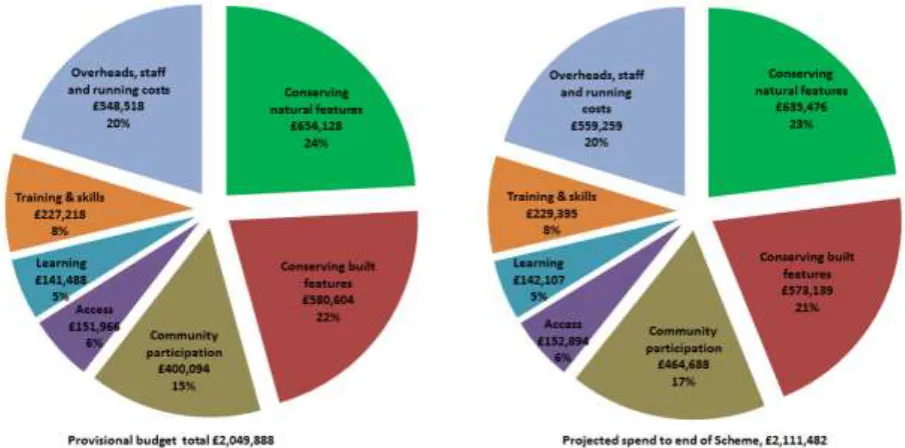
The remainder of this section focuses on HoT project delivery, outputs and outcomes and follows HLF’s (and HoT’s) four thematic programme aims of natural and cultural heritage conservation; community participation and engagement; , access and learning; training and skills. Projected final project cost in each area Figure 8i is close to allocation.
It is important to note however that besides their primary objectives most projects deliver outputs outcomes in several (and sometimes all) programme areas. For example physical conservation projects undertaken by volunteers may enhance access and understanding and improve local skills. Many also included public participation events. The allocation of project to programme areas is therefore
somewhat arbitrary; for example B3 Riverbanks Restoration and the Tees Invasive Species Initiative are
i
[image:22.595.59.512.370.594.2]Data from HoT Finance Report to AG 22 January 2016
both allocated to Programme B (Community) but could easily have been placed in Programme A
(Physical Conservation); conversely several projects in Programme A involve volunteers and training and A5, Paths for All People contributes significantly to outcomes in (and could easily have been placed in) Programme C (Access). Assessment of achievement in relation to LCAP targets is complicated by the large number of projects in the scheme and by significant overlap between them.
Each of sections 3.1 to 3.4 below begins with a brief outline of projects grouped under that section in the LCAP but discussion then focuses on relevant outputs and outcomes across all HoT project activity, irrespective of the programme area under which projects are grouped. Key outputs are identified from the most recent (March 2016) HLF Output Data return, supplemented by additional data from the LP team. Outcomes are based on our own assessment of what has been achieved in each programme area, supplemented by the views expressed by interviewees and on-line survey responses.
Codes used to identify respondents are as follows: PL = project lead or partner representative; V = volunteer; PA = participant in one or more events or activities; NP = aware of HoT but non participant;
[image:23.595.61.532.357.723.2]NA = unaware of HoT until approached as part of this evaluation.
4.1
Natural and built heritage conservation
Projects
More than half of all HoT projects – including seven project groups amounting to 46% of project cost placed under Programme A - involve some form of direct physical conservation or recording of the area’s natural and/or built heritage. Major improvements to a neglected area around the Castle entrance, with green landscaping, improved seating, and re-installation of a mini-golf course (A4. Castle and Scar Top Setting/ A Journey through Teesdale) have provided a new amenity focus for the town. Other works to Barnard Castle open spaces (A2) include revived access and parking with plantings and floodlights in the forecourt of St Mary's Church (Amen Corner), restoration of a Garden of Remembrance and war
memorial adjacent to Galgate, the main eastern access to town and the scarification and reseeding of Upper Demesnes Hay Meadow, a popular public open space. These projects were completed early in the scheme, leading to initial perceptions (redressed by many later projects located in the surrounding countryside) that HoT was overly town-focused. At the same time however they provided momentum and visible evidence of achievement. One project (Scar Top) also went significantly over budget, (emphasising the significance of the built in the financial profile in Figure 5 above).
Paths for All People (A5) has comprised a number of schemes promoting foot paths not just around Barnard Castle but in surrounding villages. Inevitably access projects have been modified as the scheme has progressed. An extension to the Tees Railway Path proved impractical as did a separate (not HLF funded) proposal to create a new steel rope bridge at the site of an old railway viaduct over the Tees north of Barnard Castle which would have allowed HoT to establish a circular walk along each side of the river. At the same time new opportunities have led to project extensions such as improvements to paths, bridges, benches in Flatts Wood (A1) and environmental volunteering and habitat works in Tees Banks Woods (B3 and D6). These have revived a green amenity area for the town including an area on the banks of the Tees known as the Bandstand or Town Beach.
Three project groups in Programme A are directly focused on heritage conservation. Historic Landscapes (A6), delayed by late commissioning an historic landscape study initially planned for the development phase, has included a traditional farm building survey involving
ten volunteers in locating, surveying and recording over 175 key structures in the area under the guidance of a historic buildings consultant. Teesdale Views (A3), involving the identification and restoration of views painted by local artists and installation of marker posts with sculpture, has faced a number of
challenges, including the selection of sites since views have not only changed since painting but that artists sometimes took liberties with landscape features. Issues to do with the ‘ownership’ of sculptures (principally in respect of public liability insurance) remain to be resolved.
had wide community engagement with 115 volunteers involvement both as individuals and as members of other organisations. Volunteer activities have included tree planting, breeding and winter bird surveys, nest box making and monitoring and subsequent ringing of chicks under the national BTO scheme. Visits have been made to local schools where children dissected Barn owl pellets to determine prey species. A number of events have been held for the general public, including a Haymeadows visit, farmer-led farm walks, an Open Farm Sunday, bird watching sessions and talks to local groups, attracting some 750 people in total. The project has produced its own final report (incorporating the results of an end of project questionnaire issued to farmers and helpers which attracted over 40 responses) and its own legacy plan.
Several of the projects in this section are as much to do with improving physical access and visual amenity as with heritage conservation. Several have also delivered significantly in terms of community engagement and training. Conversely a number of projects grouped under programmes B (Community engagement) and C (Access and learning) have delivered significant outputs in terms of physical conservation of the natural and cultural heritage.
Outputs
Outputs below relate to physical works to the area’s natural and built heritage by projects across the whole of the HoT LP scheme.
9 amenity sites with significantly enhanced quality - Flatts Wood, Scar Top, Garden of Remembrance, Demesnes, Cotherstone play area, Amen Corner, Eggleston Abbey, Whorlton Village Garden, Bowes Castle)
17ha of invasive species cleared (Himalayan balsam, Japanese knotweed, Giant hogweed, Rhododendron)
72 wildlife surveys undertaken
267 landowners or farmers engaged with 280 advisory visits made, covering over 10,000ha
18 project grants worth a total of £72,000 awarded, plus 6 successful agri-environmental grant applications covering 550 ha worth £82,146 overall plus an additional 14 other grant
applications over worth £24,000
12,334 trees planted (2,451 within Birds and Farm Landscapes), 43 ha of wild bird seed mix planted (excluding ELS requirements)
6.5km hedge and 942m of other boundary established or restored
16 significant structures repaired/ restored or with enhanced setting including 4 bridges, 2 lime kilns, 2 ancient wells
175 field barns and other vernacular structures recorded and documented.
Outcomes
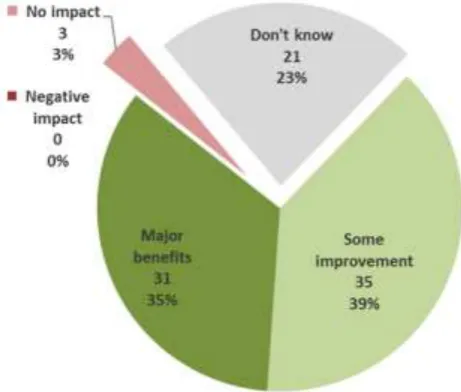
More than a third of respondents to the survey (Figure 10)felt that HoT had secured major improvement to natural features with a further third noting some improvement.
Long term benefits depend on continued monitoring and maintenance. Probably the single most important factor in ensuring that this takes place is the interest and commitment of a large body of volunteers who are likely to continue to monitor sites working with the relevant agencies.
‘monitoring of the otters on the Tees is essential work for helping to understand and try and help the growth of the population of these animals.’ (V)
‘Invasive species control. Worked well so far, but it must be followed up!’ (V)
In the case of INNS control TRT have already equipped a small number of trained volunteers with knapsack sprayers and herbicides.
‘The Tees Invasive Non-Native Species project has had a massive impact on the local environment through removing invasive species and allowing the regeneration of the natural vegetation. It has also raised awareness amongst the general public about invasive species and how to tackle them.’ (PL)
The Demesnes Hay Meadow similarly has a body of volunteers committed to continue management with equipment (scythes, rakes) lodged with BCTC.
‘The Demesne hay meadow appears to be showing encouraging signs of improvements after our input (e.g. spreading 'green hay') and changes in management.’ (PL)
In the case of works to private land, much of the woodland and other habitat improvement is not associated with any formal management agreement beyond those associated with Stewardship conditions, although the Birds and Farm Landscapes project has instituted its own management
agreement with farmers and monitoring during the period of the agreement is being undertaken by the Durham Hedgerow Partnership and Landscape Department of DCC. However the commitment of local farmers to improvements (to which in many cases they had themselves contributed) is likely to secure maintenance beyond any formal agreement and the ‘ownership’ of such works by those on whose land the work has been carried out will be the best guarantee that long-term benefits will be secured.
‘Links with farmers on conservation matters, regularly forming on-going contact and increased awareness by farmers of the importance of wildlife on their land […] at least some of the information passed to farmers will stay with them and develop.’(PL)
Again, volunteer engagement – such as that of the Durham Bird Club which has been monitoring bird populations, and the enthusiasm of local groups such as Trees for Cotherstone is likely to encourage such after-care.
[image:26.595.64.295.78.274.2]One limitation of habitat works in particular was that their locations were of necessity opportunistic, depending on landowner cooperation and support:
‘Habitat restoration projects, probably with the exception of birds and farm landscapes, have been dispersed and not delivered to create a strategic network. Unfortunately, land ownership and attitudes of owners often make this unavoidable.’ (PL)
‘Missed opportunities for long term permanent rough grassland habitats for a range of farmland birds.’ (V)
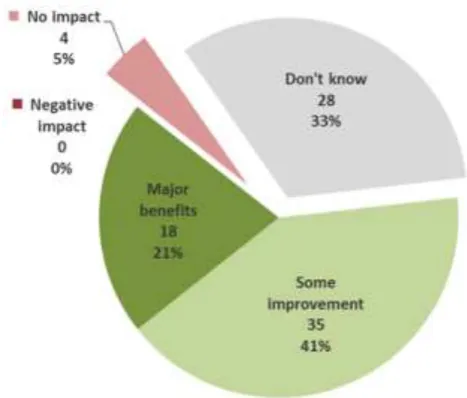
Similar considerations apply to the conservation of archaeological, historic or built features, a similar proportion noted some improvement but the number of individuals noting major
improvement was somewhat less, with a significant number uncertain.
Views expressed regarding historic and built heritage were broadly positive:
‘Scar Top and Castle setting: improvement to an area which needs to be a focal point in the town for locals and visitors.’ (PL)
‘Amen Corner - Has made a real difference to the setting of St Mary's Church and far more
accessible for users.’ (PL)
‘The old Lime Kiln at Barningham has been brought back to its former glory securing a good link back to our past.’ (PA)
‘Restoration of lime kilns - important from a heritage point of view. Increasing knowledge about rock art unique to this area, and making it easier to find.’ (PL)
‘The geo-physical survey of the Roman settlements was a great idea, as it was a non-invasive way of finding out where and how our current land use came to be and the impact the Roman occupation had on our land and therefore can help us to understand the impacts our actions can possibly make on future generations.’ (PL)
‘The project enabled the actual site of the (presumed Roman) well [St Farmin’s] to be discovered, and although agreement to leave the site exposed could not unfortunately be obtained from the landowner, future workers do at least know where it is, and some day permission to complete the project will undoubtedly be granted.’ (PL)
However there some qualified or critical comment, particularly in regard to community archaeology: ‘My personal contacts with local farmers indicate that some are very disappointed that no funds were available for conservation restoration of redundant farm buildings through this scheme. A missed opportunity? Did anyone approach farmers directly to see what they would like to get out of a landscape partnership scheme when it was being set up, or explain what was and was not potentially possible?’ (PL)
A maintenance failure for Scar Top and uncertainties regarding ownership and upkeep of the Memorial Gardens have been addressed but an audit of post-project maintenance across the whole HoT
programme would identify problem areas and the steps that need to be taken to ensure that the benefits of physical works are not dissipated.
[image:27.595.61.295.161.360.2]Community archaeology, potentially one of the most significant programmes in terms of developing engagement with the area’s historic heritage suffered from significant delays but produced some
interesting results as at Brignall where evidence was found of prehistoric farming and its open days were well attended. However the programme also received some criticism:
‘While this area offers lots of rich pickings for archaeology, [it] has never quite come to life, partly it seems by being handled by DCC's archaeology team rather than being outsourced.’ (PL)
[image:28.595.59.539.221.443.2]Many of the archaeological and historic projects I feel were taken out of the hands of those who had initially thought of them and there seems little involvement with local people who work or have an understanding of the area. This includes getting people from outside the area to deliver training and work when there are many local groups and experts. The archaeology programme has been very poorly executed and has had little or no local input.’ (PA)
Figure 12 Barningham Lime Kiln (one of the CIF projects) before (left) and after stabilisation and removal of encroaching scrub (right) with (inset) interpretive plaque
[image:28.595.66.535.507.705.2]Figure 14 Lost Landscapes: YMCA volunteers (left) tend a wild flower garden with Charles Dickens care home residents. (Top right) excavations for sand martin habitat (below) and creating an otter holt
4.2
Community engagement and participation
Projects
Five project groups (comprising a total of 37 individual projects) are listed under this programme area as directly contributing to community awareness, engagement and participation. Of these the Community Initiatives Fund (CIF, B2) has perhaps been one of the most successful (and certainly the most varied) in the HoT programme. With an allocated £101,000, and offering grants of up to £10,000, a total of 28 projects have been funded with an average grant of £5,000. Completed projects have included:
stabilisation of the Barningham Lime Kiln; uncovering St Farmin’s Well in Bowes; habitat management of Kennedy’s Ponds and rhododendron clearance around the ‘Fairy Cupboards’(eroded riverbank
sandstone) in Romaldkirk; restoration of Whorlton Village Garden; a wildlife pond in Green Lane School; a geophysics survey of Boldron village green; publication of a history of Gainford parish, another of Winston and a CD arising from restoration of historic features in Romaldkirk; digitisation of Teesdale Heritage Archives, children writing up Bible stories from stained glass in St Mary’s Church; and bulb planting in Barningham Village Green (at £250 the smallest CIF grant) and around Barnard Castle walls (subsequently part strimmed in error by English Heritage gardeners and replaced by bulbs left over from works to the Memorial Gardens(A2, above).
Riverbanks Restoration and in particular the Invasive Non-Native Species (INNS) eradication programme (B3) has had significant input from volunteers. Four species; Himalayan balsam, Japanese knotweed, giant hogweed and rhododendron all have their most upstream presence within the HoT area and the project is the start of a programme to eradicate them from the highest point and work downstream, using a variety of techniques including cutting, spraying and stem injection. ‘Add-ons’ include access and platforms for disabled anglers using match funding from the Environment Agency.
Another river-focused programme, InvesTEESgate (B4) has focused on local community engagement in historical research, habitat management, survey and recording). 13 volunteers have been trained in the use of backpack electrofishing and nine in invertebrate sampling and surveys have provided data on seven becks in the region. The project provides a community complement to RiverLab (C8, below).
Lost Landscapes (B1), launched in mid-2014 has a target of some 10 sites. Although placed in HoT’s ‘Community’ programme, contractors have been used for works to the larger habitat restoration projects, with volunteers on the smaller ones.
Arts in the Landscape (B5) comprised four projects. Of these, the Groundwork-led VIVA (the Village Identify Village Attractions project) initially struggled to secure engagement from rural communities, then ran well with good participant feedback. A programme of Landscape Painting and Photography Workshops (in the Bowes Museum) received praise from those involved. Two projects in particular have received acclaim in the on-line survey. ArtScapes – a programme of workshops including some for children with disabilities concluded with a well-received exhibition in March 2014. Music at the Heart of Teesdale included included a number of public performances involving orchestra and sword dances, retains a group of enthusiasts keen to continue their activities (including its own website).
attracted over 50 participants. Volunteering has also been a particular feature of many projects with the total number of volunteers in the programme overall topping 800.
Outputs
Measures of activity relating to community awareness and behaviour from these and other projects include:
48 community-led projects funded including 29 through the Community Initiatives Fund
13 youth groups and 2,117 young people engaged in HoT activities as volunteers or participants
40 community groups worked with including 3 village/ parish research projects, 7 cultural tradition, 2 oral history and 1 language project and 14 exhibitions/ displays
An estimated 23,113 participants in HoT events and activities over the life of the LP scheme
814 individual volunteers in HoT funded projects, contributing a total of 16,077 volunteer-hours’ worth £350,927 in match funding
Work with 13 non-traditional or disadvantaged groups involving 95 individuals in HoT projects including 4 care homes, Blind Life Durham, TODYS (autism) as well as efforts to increase access in HoT projects for people with visual impairment or other disability
12 businesses engaged including 9 creative media workshops and 3 corporate volunteering sessions
HoT website with 246 users, features profiles of all projects, regular news updates, downloads including newsletters, events, information on volunteering and the Partnership composition and aims; HoT mailing list of 400 contacts; 31 newsletters produced; over 300 ‘likes’ on Facebook (69% women, 29% men); 763 followers on Twitter with over 1,000 tweets posted.
Outcomes
Of all the ‘programme’ questions in the on-line questionnaire community engagement scored the highest numbers of positive responses —over 90% with 48% entering an opinion that HoT has delivered major benefits, the lowest proportion of ‘don’t knows’ and only one respondent returning no impact.
[image:31.595.59.328.468.686.2]Our interviews – and the survey results- support our own perception that community participation and engagement is one of the strongest aspects of the LP programme. ‘In celebrating the living heritage of rural industry, from food to stone, local people, local organisations and the local press, have all engaged with the Heart of Teesdale on a constant basis. I'd say the overall impact is to have instilled real pride in the quality of the landscapes in which we live and work.’ (PL)
[Memorial Gardens] ‘a great improvement – area was looking a bit run down before. Now people bring their chips at lunchtime. The benches are great to sit out on.’ (V, landlady of B&B in Galgate, for whom volunteer bulb planting introduced her to neighbours she had not previously met).
[Stone Festivals]’ helped convince local people that Heart of Teesdale was for them and
introduced waves of eager primary schoolkids to the joys of stone carving and also to the horizon of sculpture, masonry and skills. (PL)
There has been extensive and positive feedback on a number of individual projects; perhaps most of all from Music at the Heart of Teesdale: ‘my children would no longer be playing their instruments if not for the project’ (PA) is a typical comment from the parent of a participant. In this and other cases the absence of participant profiles, particularly on previous engagement (‘is this the first time you have been involved in anything like this?’, ‘what volunteering have you done before?) makes it difficult objectively to gauge the overall impact of HoT or how inclusive many of these projects are. The impacts on
engagement and participation of ‘people’ focused projects and of community participation more
[image:32.595.71.525.365.705.2]generally can only be fully assessed by follow-up surveys or (better) by evidence of subsequent activity – difficult in particular for small projects (such as many of the CIF initiatives) which are not necessarily good at keeping participants’ records or reporting back.
Figure 18 The Cream Teas Orchestra (above) perform the premiere of 'Rooted - A Teesdale Suite' at The Witham, November 2014. The Music@HeartOfTeesdale project was acclaimed by participants and there is determination to continue beyond the end of HLF funding.
4.3
Access and learning
Projects
Nine HoT project groups (a total of 16 projects overall) are grouped under this head in the HoT LCAP as having physical and/or intellectual access as their main focus.
Trails through Teesdale (C2) links with the Paths programme (A5) and Teesdale Views (A3) and is based on 12 historic and artistic trails (with guided walks) to celebrating the area’s association with (lesser as well as better-known) artists, writers, scientists and explorers. One concern has been the need to avoid duplication of many trails and guides (developed by several different agencies) that already exist.
An Increasing Access Programme (C9) supplemented the physical access focus of other HoT projects by focusing on individuals who may be disadvantaged by background or disability. Examples of activities include a Blind Life Durham guided walk held at Bowes Museum (with a training DVD for museum staff) and monthly craft workshops held for Manor House (YMCA) and Charles Dickens Lodge (assisted living) residents.
Both projects in Teesdale Landscapes Legacy (C3) are hosted by the Bowes Museum. One, the Rokeby: Poetry and Landscape (Scott and Turner) exhibition was professionally curated and well received, providing good promotion for the Bowes (although no visitor numbers or feedback appear to have been collected); however links with other projects and the HoT scheme overall are less clear. The other, a proposed Local Studies Centre, did not materialise, although the Bowes retains plans for a separately funded (and more ambitious) project along these lines for the future.
Heart of Teesdale Creative Media (C4) builds on a Digital Strategy commissioned in HoT’s development phase and included three projects. One, Interpreting the Landscape aimed at developing digital media to support community engagement has been a non-starter, its budget transferred to the Scar Top
overspend; however a film ‘Teesdale through the Seasons’ intended as educational resource for schools and groups, is complete. A God’s Bridge Mentoring Project was directed at aspiring professional artists under tutelage from established figures. Crafts and Skills in the Community (C5) focused on traditional crafts including rag rugs, felt jewellery and knitting. Stone Festivals held in 2013 and 2014 in the grounds of The Bowes Museum were particularly successful, attracting good audiences and local interest.
A Community Archaeology Programme (C7) intended to ‘engage new audiences and volunteers in understanding and carrying out archaeology’ included three projects: Prehistoric Settlements and Prehistoric Rock Art; Deserted and Shrunken Medieval Settlements; and Roman Forts and Civilian Communities. Potentially one of the most valuable programmes linking community engagement to understanding and conservation of the area’s historic heritage, one significant ‘find’ was evidence of prehistoric occupation at a known deserted mediaeval village settlement.
Riverlab (C8) is aimed at national curriculum KS1&2 (primary) schoolchildren, using art to emphasise the importance of water to Teesdale’s heritage and communities. At secondary level, KS3 children had a more practical programme based on classroom aquaria which were seeded with trout or salmon eggs to enable the children to study the hatching and development of fry before they are released back into the river.
Focus on Farming (C6) is aimed at linking the area’s farming economy to community awareness and activity; in addition to village picnics and raising awareness of local food through the Love Food project, it included production of a film ‘Addicted to Sheep’ (fig 17) which has been shown nationally in cinemas (and on BBC4) to critical acclaim. Another project, run by UTASS engaged primary school children with farming seasonality and local food production through farm visits and a variety of learning activities.
As in other areas many of these projects contribute also to outputs under heritage conservation,
community engagement and training. Conversely projects allocated to these areas have also contributed to intellectual or physical access, for example A5 Paths for All People has included installation of 45 new gates, eight of them through HoT’s Donate-a-Gate scheme and 30m of new boardwalk near Fairy Cupboards, installed by volunteers.
Outputs
Assessment of the outputs under this head is complicated by sheer diversity of projects and of the related activities. Some achievements against targets relating to access and learning across the whole of the HoT scheme include:
5 km of new public rights of way created and 91 km of paths improved, with 55 new hand gates, 44 new signposts and 7 improved stiles
18 new walking trails with associated site-based interpretation including 11 new interpretation boards plus leaflets and/or on-line information
14 public exhibitions including a showcase of ArtScapes work, VIVA exhibitions and the finalists in a photography competition
13 significant booklets (e.g. Sweet Winston, with 366 copies sold) plus 15 digital publications and 4 websites
156 school visits to sites involving 450 pupils and 8 outreach visits to schools (11 primary and 3 secondary schools in all) plus 6 teacher training activities
64 adult learning activities engaging 648 individuals, plus 16 family learning activities, cultural and oral history projects, a total of 127 learning activities involving over 1,500 beneficiaries overall.
Outcomes
As with other ‘people’ outcomes monitoring data is relatively sparse. Some exists, for example users of the mini-golf course on Scar Top increased following completion from 3,540 in 2012 to 6,118 in 2013 over a shorter (81 against 90 day) opening – a near doubling from 39 to 76 per day;i unfortunately more recent figures are not available. Other visitor information is also lacking and views of interviewees and of respondents to the on-line survey provide the principal source of outcome evidence.
i