N A N O I D E A
Open Access
Analytical modelling of monolayer graphene-based
ion-sensitive FET to pH changes
Mohammad Javad Kiani
1,2, Mohammad Taghi Ahmadi
1*, Hediyeh Karimi Feiz Abadi
3,4, Meisam Rahmani
1,
Amin Hashim
1and Fauzan Khairi Che harun
1Abstract
Graphene has attracted great interest because of unique properties such as high sensitivity, high mobility, and biocompatibility. It is also known as a superior candidate for pH sensing. Graphene-based ion-sensitive field-effect transistor (ISFET) is currently getting much attention as a novel material with organic nature and ionic liquid gate that is intrinsically sensitive to pH changes. pH is an important factor in enzyme stabilities which can affect the enzymatic reaction and broaden the number of enzyme applications. More accurate and consistent results of enzymes must be optimized to realize their full potential as catalysts accordingly. In this paper, a monolayer graphene-based ISFET pH sensor is studied by simulating its electrical measurement of buffer solutions for different pH values. Electrical detection model of each pH value is suggested by conductance modelling of monolayer graphene. Hydrogen ion (H+) concentration as a function of carrier concentration is proposed, and the control parameter (Ƥ) is defined based on the electro-active ions absorbed by the surface of the graphene with different pH values. Finally, the proposed new analytical model is compared with experimental data and shows good overall agreement.
Keywords:Graphene, Ion-sensitive field-effect transistor (ISFET), pH sensor, Conductance
Background
Graphene has twosp2-bonded carbon atoms, which make its structure apparently look like a honeycomb crystal as seen in Figure 1 [1-3]. Because of its unique properties, graphene has attracted huge interest mainly in the elec-trical, physical, chemical, and even biological fields [4,5].
Nowadays, ion-sensitive field-effect transistors (ISFETs) have caught much attention due to their advantages such as small size and the possibilities for mass production [6,7]. Their short and consistent response times are very favor-able to the electronics industry [8,9]. ISFETs introduce new features such as the integration of data processing and compensation circuits in the similar circuit for this type of sensors [10-12]. By altering the gate material, depositing layers of selective membrane or a bio-recognition element onto the gate, variance of selectivity can be achieved [13,14]. After the process of depositing, the sensors are
now called chemically sensitive FETs [15,16]. Initially, het-erogeneous membranes of silver halides and membranes based on polyvinyl chloride (PVC) have been used for ISFET [17,18]. Due to poor adherence between PVC base membrane and ISFET surface and inconsistent results, sci-entists explore for a new type of membrane [18,19]. That is where photocured polymers, which are compatible with the proposed photolithography techniques, come in [19,20]. They have the properties of a higher adherence string of the salinized ISFET gate's surface [21]. In order to expand ion-selective membranes, numerous polymers such as polysiloxanes, polyurethanes, and different methacrylate-derived polymers have been reported to be good candidates [22,23]. These new polymers show promising results re-garding consistency and longer stability compared to PVC membranes [24]. In addition, almost all effective ion-based ISFETs were developed for clinical analyses and environ-mental applications [24]. Recently, microelectronic ad-vances have been exploited and applied to improve ISFET fabrication methods [25,26]. Because of the electrolyte's ionic properties, electrical parts of ISFETs cannot have contact with liquid and only the gate area is open [27]. * Correspondence:[email protected]
1
Faculty of Electrical Engineering, Universiti Teknologi Malaysia, Skudai, Johor Bahru 81310, Malaysia
Full list of author information is available at the end of the article
Due to its organic nature, the gate material for ISFETs is in-trinsically sensitive to pH changes [28,29]. On the other hand, all enzymes are sensitive to pH changes, but ex-tremely high or low pH values can make these enzymes lose their sensitivity [30,31]. pH is also a main factor in en-zyme stabilities [32]. Each enen-zyme includes a suitable or op-timal pH stability range [30,32]. Apart from temperature and pH, ionic strength can also affect the enzymatic reac-tion [33]. For more accurate and consistent results, each of these physical and chemical parameters must be considered and optimized accordingly [34]. ISFETs can be based on many materials as their detectors such as membranes and graphene [35]. Because of the physical and electrical prop-erties of graphene, it can be applied as a sensing material in the structure of FETs [35]. On the other hand, there are no information on the development and modelling of ion-sensitive FETs, and their potential as ISFET has not been totally studied yet. The reaction between solution with dif-ferent pH values and the surface of graphene has a notable effect on the conductivity of graphene [36]. This means that the detection mechanism of adsorbing the hydrogen ions from solution to carbon-based materials can be clarified as shown in Figure 2. In other words, based on the electron
transfer between ion solutions and graphene surface, an analytical model of the reaction between buffer solution of different pH and graphene is presented.
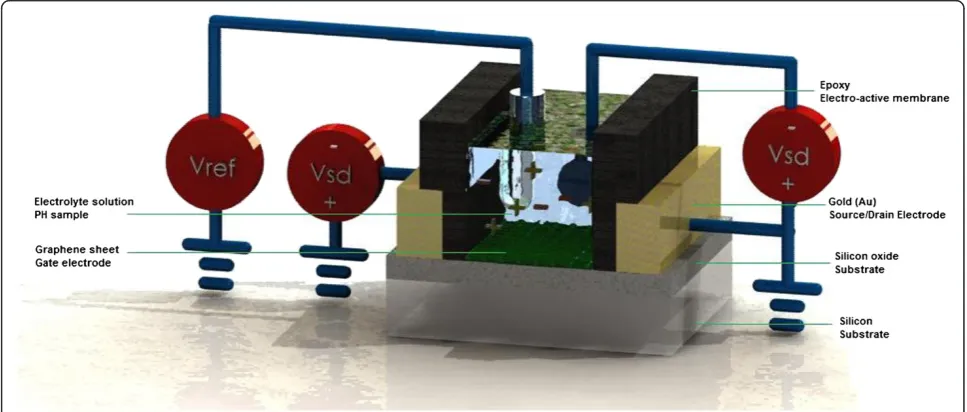
Figure 2 illustrates the detection mechanism of solu-tion with different pH using an ISFET device. Monolayer graphene on silicon oxide and silicon substrate with a deposited epoxy layer (Epotek 302–3 M, Epoxy Techno-logy, Billerica, MA, USA) as an ISFET membrane is pro-posed. In this paper, pH of solution as a gate voltage is replicated due to the carrier injected to channel from it, and also pH as a sensing parameter (Ƥ) is suggested. Fi-nally, the presented model is compared with experimen-tal data for purposes of validation.
Proposed model
The graphene nanoribbon channel is supposed to be com-pletely ballistic for one-dimensional monolayer ISFETs for pH sensing since high carrier mobility has been reported from experiments on graphene [37]. A district of mini-mum conductance versus gate voltage as a basic constant relative to the electron charge in bulk graphite (q) and Planck's constant (h) is defined byG0= 2q2/h[38]. So, the
electron transportation of the graphene channel in ISFET can be obtained by the Boltzmann transport formula [38,39]:
G¼2q
2
h
Zþ1
1
M Eð ÞT Eð Þ df dE
dE; ð1Þ
[image:2.595.57.291.89.161.2]where E is the energy band distribution, T(E) is the average probability of electron transmission in the channel between source and drain which is equal to 1 (T(E) = 1)
[image:2.595.56.540.509.715.2]Figure 1Monolayer graphene atom arrangement with only one atom thickness.
Figure 2Schematic of the proposed structure and the electrical circuit of graphene based-ISFET for pH detection.
Kianiet al. Nanoscale Research Letters2013,8:173 Page 2 of 9
[38] because the ballistic channel is assumed for the ISFET device, f is the Fermi-Dirac distribution function, andM(E) is the number of sub-bands in the ISFET chan-nel as a summation parameter over kpoint which is de-fined as
M Eð Þ ¼3at
2l
4E
3at2β
2
1
2
; ð2Þ
where lis the ISFET channel length, t= 2.7 eV which is the tight-binding energy for the nearest neighbor C-C atoms, andβis the quantized wave vector which can be written as
β¼ ffiffiffiffiffiffiffiffiffiffiffi2π 3acc
p Pi
Nþ1 2 3
; ð3Þ
whereNis the number of dimer lines,Piis the modulation
index, andac−c= 1.42 Å is the distance between adjacent
carbon atoms in the plan. The conductance of the nano-scale material is strongly dependent on both quantizing parameters, which depend on the number of sub-bands, and interface resistance, which is independent of the length [40]. Also, the Fermi-Dirac distribution function is inserted instead of the number of sub-bands in the ISFET channel. So, it is modified as
G¼3q
2
hl
ffiffiffiffiffiffiffiffiffiffiffiffiffiffiffiffiffiffiffiffiffiffi 3πa3t3k
BT p
Z
þ1
0
X1=2
1=ð1þeXηÞ
ð ÞdXþ
Zþ1
0
X1=2
1=ð1þeXþηÞ
ð ÞdX
2 4
3 5:
ð4Þ
In order to simplify the conductance equation, we assumed x = (E −Eg / kBT) andη = (EF −Eg) / kBTas
[image:3.595.58.540.88.262.2]normalized Fermi energy. Consequently, the supposed
[image:3.595.60.539.542.714.2]Figure 3A bipolar transfer curve of the conductance model of graphene-based ISFET.
conductance model of the graphene-based ISFET chan-nel can be written as
G¼3q
2 3πa3t3k BT
ð Þ12
hl I12ð Þ þη I12ð Þη
h i
: ð5Þ
This equation can be numerically solved for different gate voltages. Thus, the proposed conductance model of the performance of the graphene-based ISFET in the nanostructured region by the conductance-voltage char-acteristic is evaluated in Figure 3.
By applying gate voltage between 0.2 and 0.7 V, a bipo-lar characteristic of FET device is monitored since the Fermi energy can be controlled by gate voltage. Based on this characteristic, it is notable that the graphene can be continuously dropped from the p-doped to the n-doped region by the controllable gate voltage. The minimum
conductance is observed at the transition point between electron and hole doping. This conjunction point is called the charge-neutrality point (CNP) [41]. The conduc-tance of the ISFET channel not only is dependent on the graphene structure and operation voltage on the source-drain channel, but also depends on the electrolyte envi-ronment and ion concentration in solution [42,43]. It has been demonstrated that different pH values can affect the ISFET conductance [42].
Before the hydrogen ion concentration was changed in the solution, a natural solution (pure water) with a buffer (pH = 7) was added in the electro-active membrane to measure the dependence of conductance versus gate volt-age. There is a favorable agreement between the proposed model for pH sensing based on graphene and experimental data for non-ionic solution (pH = 7) which are extracted from [42], as can be seen in Figure 4.
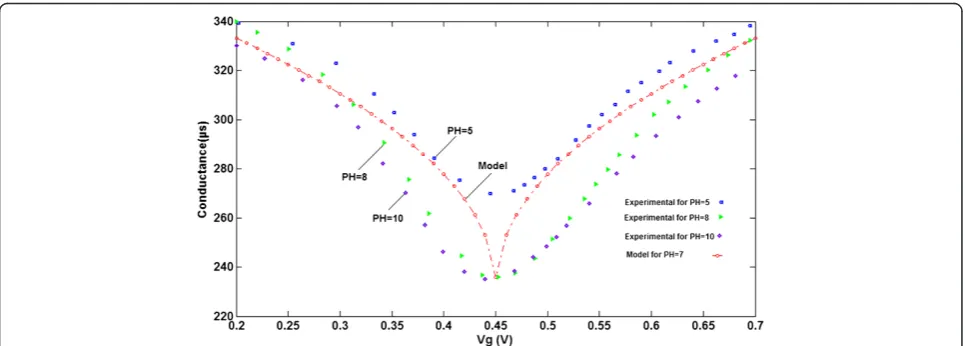
The conductivity of the graphene-based ISFET device is influenced by the number of carriers changing in the channel. A graphene-based ISFET with high sensitivity is applied to detect the different pH values based on con-ductance altering [42]. As can be seen in Figure 5, the conductance of the channel changes due to the binding of hydrogen ions in the solution to the surface of the ISFET channel. When the pH value of the solution rises from 5 to 10, less hydrogen ions will be adsorbed and the sensor will be capable of attracting less ions, leading to changes in the conductance of the graphene-based ISFET, as shown in Figure 6.
Dependent upon the source-drain conductance of the ISFET device, we can write
GwithpH≈pH: ð6Þ
[image:4.595.56.291.89.260.2]The focus of this paper is to present a new model for ISFET to measure pH changes; in other words, the
Figure 5Schematic of hydrogen ion adsorption processes by surface area of single-layer graphene.
Figure 6Comparison between graphene conductance model and extracted experimental data [42] for different pH values.
Kianiet al. Nanoscale Research Letters2013,8:173 Page 4 of 9
[image:4.595.57.540.541.714.2]conductance of the ISFET device as a function of different pH values is simulated and the pH factor (Ƥ) is suggested. Subsequently, for more understanding of the role of hydrogen ion concentration, FET modelling is employed to obtain an equation between the conductance and pH of a solution, where the suggested structure of ISFET is shown in Figure 2 with source and drain as contacts. Ultimately, different pH values can be modelled by the pH of a solution (see the following equation). This means that
Gwith pHcan be shown as a function of pH values:
GwithpH¼ P
PHGwithoutpH; ð
7Þ
where the pH sensing factor (Ƥ) is assumed andPHis the
pH value. In the non-saturation region, the ISFET con-ductance model is shown as a function of gate voltage and
the ideal conductance-voltage relation to the graphene channel of the ISFET device from Equations 5 and 7:
GwithpH¼ P
PH
3q2 3πa3t3k BT
ð Þ1
2
hl I12ð Þ þη I12ð Þη
h i!
:
[image:5.595.61.538.89.469.2]ð8Þ
[image:5.595.305.540.635.733.2]Figure 7G-Vgcharacteristics of proposed conductance model with experimental data [42].For solutions with (a) pH = 5 and (b) pH = 6.
Table 1 Different pH values withƤparameter
Ƥparameter values pH values
0.039105 5
0.035142 6
0.034918 7
0.034662 8
0.034437 9
Figure 8G-Vgcharacteristics of the proposed conductance model with experimental data.For solutions with (a) pH = 8, (b) pH = 9, and
(c) pH = 10.
Kianiet al. Nanoscale Research Letters2013,8:173 Page 6 of 9
So, theG-Vg characteristics of both the model and
[image:7.595.70.291.503.578.2]ex-perimental data of graphene-based ISFET for changing the pH level in solution from 6 to 7 are plotted in Figure 7.
By comparing the suggested ISFET modelling based on the proposed parameter model with experimental data in Figure 7, similar trends can be considered. In order to show all figures without overlapping, each pH value has been plotted respectively in Figure7a,b. In addition, a de-tailed comparison between observed new models per pH is illustrated in Figure 7, which demonstrates acceptable agreement with experimental data. In the suggested model, different pH values is demonstrated in the form of Ƥparameter which is in agreement with the reported data, as shown in Table 1.
Therefore, based on the iteration method in Table 1, the electro-active ions absorbed by the surface of the ISFET channel as a pH sensing factor (Ƥ) can be sug-gested by the following equations:
P¼α1PHβ1 ð9Þ
P¼α2eβ2ð ÞPH ð10Þ
According to the saturation region of the proposed conductance model belonging to the ISFET device, Equation 11 is acceptable for both the saturation behav-ior and experimental data from [42]:
P¼αLnð Þ þPH β ð11Þ
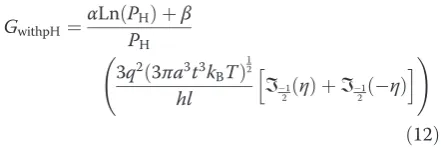
From extracted data, α and β parameters are calcu-lated, where α = 2.7318 and β = 4.5044. Consequently, based on the proposed model of the ISFET device, the conductance versus gate voltage is modified as
GwithpH¼αLnð Þ þPH β
PH
3q2ð3πa3t3kBTÞ
1 2
hl I12ð Þ þη I12ð Þη
h i!
ð12Þ
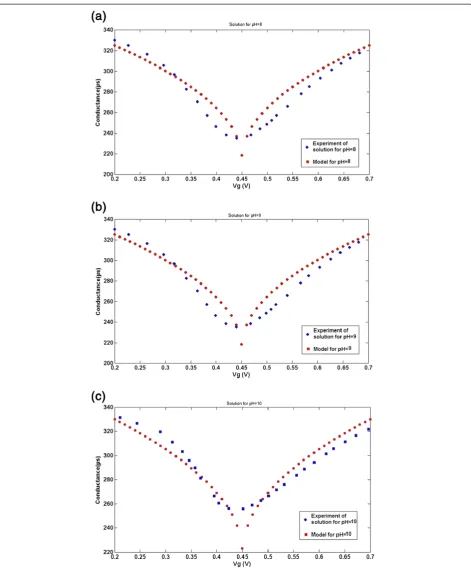
As can be seen in Figure 8, the theoretical G-Vg
char-acteristics of graphene-based ISFET for pH changes from 8 to 10 are plotted.
It is evident that theG-Vg characteristic curve can be
controlled by the pH factor (Ƥ) and also the proposed model of ISFET conductance closely matches with ex-perimental data. In both reported data and theoretical data, the decline of ISFET conductance is noticeable when the pH level increases. Also, the conductance curve is almost symmetric near VCNP, while at a large
carrier concentration of about 350 to 400 μS, a satura-tion behavior is depicted. Comparing both experimental
data and theoretical data depicted in Figure 5 reveals that when the concentration of hydrogen ions changes from pH = 7 to pH = 8, ISFET conductance decreases about 5μS. Also, as shown in Figure 8a,b,c, each graph shows a particular value of pH. For example, when the pH value is 8, it is notable that the model is closer to the blue line (experimental data), and also in the different pH values, we can compare other ion concentrations as well. An innovative analysis of matching models using the different values in experimental data is presented in this work to verify that the conductivity of the graphene-based ISFET is moved down vertically at higher pH values. The ion-sensitive FET structure was used with monolayer graphene prepared by CVD and grown in large size on pieces of p-doped Si covered with a 300-nm substrate to measure pH changes [42]. In this study, one can claim that pH changes in the electro-active mem-brane will significantly and vertically shift the value of conductance in graphene (Gwith pH) that occurred due to
ion adsorption on the surface area of the monolayer graphene sheet of the ISFET channel. Also, it is notable that the temperature remains constant (about 25°C in solution) in the suggested model as the temperature can have an effect on the behavior of the sensing parameter as well.
Conclusions
Graphene withsp2-bonded carbon atoms has considerable potential on bio-sensing materials and electrochemical ap-plications. The emerging potentials of nanostructured graphene-based ISFETs with high sensitivity and ability to readily detect have been applied to electrochemical cataly-sis through pH sensing. The conductance of an ISFET de-vice with different pH values can be displayed by the ion concentration of the solution. In this research, the con-ductance of graphene is assumed as a function of pH levels (Gwith pH≈pH), which shows the pH factor.
Mea-surements show decreasing conductivity when the pH value of the electrolyte is increased. Especially inVCNP, the
changed conductance values are clearly depicted. The sug-gested model verifies the reported experimental data as well. In other words, based on the good agreement be-tween the presented analytical model and experimental data,Ƥcan be seen as a pH factor to predict graphene be-havior in graphene-based ISFETs.
Competing interests
The authors declare that they have no competing interests.
Authors’contributions
Acknowledgments
The authors would like to acknowledge the financial support from the Research University grant of the Ministry of Higher Education (MOHE), Malaysia, under Project Q.J130000.7123.02H24. Also, thanks to the Research Management Center (RMC) of Universiti Teknologi Malaysia (UTM) for providing excellent research environment in which to complete this work.
Author details
1Faculty of Electrical Engineering, Universiti Teknologi Malaysia, Skudai, Johor
Bahru 81310, Malaysia.2Department of Electrical Engineering, Islamic Azad University, Yasooj Branch, Yasooj 7591483587, Iran.3Malaysia-Japan
International Institute of Technology (MJIIT), Universiti Teknologi Malaysia, Johor Bahru 54100, Malaysia.4Centre for Artificial Intelligence and Robotics
(CAIRO), Faculty of Electrical Engineering, Universiti Teknologi Malaysia, Johor Bahru 81310, Malaysia.
Received: 22 January 2013 Accepted: 2 March 2013 Published: 16 April 2013
References
1. Wen Xu YG, Liwei L, Hua Q, Yanli S:Can graphene make better HgCdTe infrared detectors?Nanoscale Res Lett2011,6:250.
2. Carmelo Vecchio SS, Corrado B, Rambach M, Rositza Y, Raineri V, Filippo G:
Nanoscale structural characterization of epitaxial graphene grown on off-axis 4H-SiC (0001).Nanoscale Res Lett2011,6:269.
3. An XS, Trevor John S, Rakesh W, Christopher L, Washington KM, Morris N, Talapatra SK, Saikat K, Swastik Q:Stable aqueous dispersions of noncovalently functionalized graphene from graphite and their multifunctional high-performance applications.Nano Lett2010,
10(11):4295–4301.
4. Myung SS, Aniruddh K, Cheoljin P, Jaesung K, Lee KS, Ki-Bum: Graphene-encapsulated nanoparticle-based biosensor for the selective detection of cancer biomarkers.Adv Mater2011,23(19):2221–2225.
5. Phan AD, Viet NA:A new type of optical biosensor from DNA wrapped semiconductor graphene ribbons.J Appl Phys2012,111(11):114703. 6. Pham MTH, Kunath S, Kurth C, Köhler E, Howitz S:Backside membrane
structures for ISFETs applied in miniature analysis systems.Sensors and Actuators B: Chemical1994,19(1–3):333–335.
7. Gotoh M, Suzuki M, Kubo I, Tamiya E, Karube I:Immuno-FET sensor.J Mol Catal1989,53(3):285–292.
8. Schlesinger R, Bruns M, Becht R, Dosenbach S, Hoffmann W, Ache HJ:ISFETs with sputtered sodium alumino-silicate glass membranes.Fresenius J Anal Chem1996,354(7–8):852–856.
9. Lee D, Cui T:An electric detection of immunoglobulin G in the enzyme-linked immunosorbent assay using an indium oxide nanoparticle ion-sensitive field-effect transistor.J Micromech Microeng2012,22(1):015009. 10. Chen SC, Su Y-K, Tzeng JS:The fabrication and characterisation of
ion-sensitive field-effect transistors with a silicon dioxide gate.J Phys D: Appl Phys1986,19(10):1951.
11. Shepherd L, Toumazou C:Weak inversion ISFETs for ultra-low power biochemical sensing and real-time analysis.Sensors and Actuators B: Chemical2005,107(1):468–473.
12. Chung W-YL, Yeong-Tsair P, Yang DG, Chung-Huang W, Ming-Chia K, Alfred T, Wladyslaw Q:ISFET interface circuit design with temperature compensation.Microelectron J2006,37(10):1105–1114.
13. Kal SB, Bhanu PV:Design and modeling of ISFET for pH sensing.In
Proceedings of TENCON 2007–2007 IEEE Region 10 Conference: October 30 -November 2; Taipei.Piscataway: IEEE; 2007:1–4.
14. Voigt H, Schitthelm F, Lange T, Kullick T, Ferretti R:Diamond-like carbon-gate pH-ISFET.Sensors and Actuators B: Chemical1997,44(1–3):441–445. 15. Reinhoudt DNS, Ernst JR:The transduction of host-guest interactions
into electronic signals by molecular systems.Adv Mater1990,
2(1):23–32.
16. Cobben PLHME, Bomer RJM, Bergveld JG, Piet V, Willem R, David N:
Transduction of selective recognition of heavy metal ions by chemically modified field effect transistors (CHEMFETs).J Am Chem Soc1992,
114(26):10573–10582.
17. Guth U, Gerlach F, Decker M, Oelßner W, Vonau W:Solid-state reference electrodes for potentiometric sensors.Journal of Solid State
Electrochemistry2009,13(1):27–39.
18. Cadogan A, Gao Z, Lewenstam A, Ivaska A, Diamond D:All-solid-state sodium-selective electrode based on a calixarene ionophore in a poly (vinyl chloride) membrane with a polypyrrole solid contact.Anal Chem
1992,64(21):2496–2501.
19. Jiménez C, Bartroli J:Development of an ion-sensitive field effect transistor based on PVC membrane technology with improved long-term stability.Electroanalysis1997,9(4):316–319.
20. Bratov A, Muñoz J, Dominguez C, Bartrolí J:Photocurable polymers applied as encapsulating materials for ISFET production.Sensors and Actuators B: Chemical1995,25(1–3):823–825.
21. Kuang B, Mahmood HS, Quraishi MZ, Hoogmoed WB, Mouazen AM, van Henten EJ:Chapter four - sensing soil properties in the laboratory, in situ, and on-line: a review.InAdvances in Agronomy.Edited by Donald LS. Waltham: Academic; 2012:155–223.
22. Seymour RB:Plastics.Ind Eng Chem1966,58(8):61–73.
23. Cecilia JJJ, Orozco A, Baldi Q:ISFET based microsensors for environmental monitoring.Sensors (Basel, Switzerland)2009,10(1):1.
24. Chung WY, Cruz FRG, Szu H, Pijanowska DG, Dawgul M, Torbicz W, Grabiec PB, Jarosewicz B, Chiang J-L, Chang KC, Cheng C, Ho W-P:ISFET electronic tongue system for environmental multi-ion sensing with independent component analysis signal processing.InIndependent Component Analyses, Wavelets, Neural Networks, Biosystems, and Nanoengineering VII.
Edited by Szu HH, Agee FJ. Bellingham: SPIE; 2009:73431D.
25. Haigang Yang HS, Jinghong H, Jinbao W, Zengjin L, Shanhong X, Hua Z:
A pH-ISFET based micro sensor system on chip using standard CMOS technology.InProceedings of the Fifth International Workshop on System-on-Chip for Real-Time Applications: Banff; July 20–24, 2005.Piscataway: IEEE Computer Society; 2005:180–183.
26. Lee D, Cui T:pH-dependent conductance behaviors of layer-by-layer self-assembled carboxylated carbon nanotube multilayer thin-film sensors. J Vac Sci Technol2009,27(2):842.
27. Martinoia S, Massobrio P:ISFET–neuron junction: circuit models and extracellular signal simulations.Biosens Bioelectron2004,19(11):1487–1496. 28. Bousse L, Bergveld P:The role of buried OH sites in the response
mechanism of inorganic-gate pH-sensitive ISFETs.Sensors and Actuators
1984,6(1):65–78.
29. Steinhoff G, Hermann M, Schaff WJ, Eastman LF, Stutzmann M, Eickhoff M:
pH response of GaN surfaces and its application for pH-sensitive field-effect transistors.Appl Phys Lett2003,83(1):177–179.
30. Pijanowska D, Torbicz W:Simple method of enzyme immobilization for pH-ISFET-based urea biosensors. InOptoelectronic and Electronic Sensors II.
Bellingham: SPIE; 1997:219–226.
31. Jamasb S, Collins SD, Smith RL:Correction of instability in ion-selective field effect transistors (ISFETs) for accurate continuous monitoring of pH.
InProceedings of the 19th Annual International Conference of the IEEE Engineering in Medicine and Biology Society, 1997: Chicago; October 30-November 2, 1997.Piscataway: IEEE; 1997:2337–2340.
32. Couto SR, Moldes D, Sanromán MA:Optimum stability conditions of pH and temperature for ligninase and manganese-dependent peroxidase fromPhanerochaete chrysosporium. Application to in vitro
decolorization of Poly R-478 by MnP.World J Microbiol Biotechnol2006,
22(6):607–612.
33. Pokhrel S, Joo JC, Kim YH, Yoo YJ:Rational design of aBacillus circulans xylanase by introducing charged residue to shift the pH optimum. Process Biochem2012,47(12):2487–2493.
34. Morgenshtein A, Sudakov-Boreysha L, Dinnar U, Jakobson CG, Nemirovsky Y:
Wheatstone-Bridge readout interface for ISFET/REFET applications. Sens Actuators B Chem2004,98(1):18–27.
35. Chen S, Zhang Z-B, Laipeng M, Ahlberg P, Gao X, Qui Z, Wu D, Ren W, Cheng H-M, Zhang S-L:A graphene field-effect capacitor sensor in electrolyte.Appl Phys Lett2012,101(15):154106–154105.
36. Zhao Y, Song X, Song Q, Yin Z:A facile route to the synthesis copper oxide/reduced graphene oxide nanocomposites and electrochemical detection of catechol organic pollutant.CrystEngComm2012,
14(20):6710–6719.
37. Adam S, Das Sarma S:Transport in suspended graphene.Solid State Communications2008,146(9–10):356–360.
38. Datta S:Electronic Transport in Mesoscopic Systems.Cambridge: Cambridge University Press; 2002.
39. Datta S:Quantum Transport: Atom to Transistor.New York: Cambridge University Press; 2005.
Kianiet al. Nanoscale Research Letters2013,8:173 Page 8 of 9
40. Peres NMR, Castro Neto AH, Guinea F:Conductance quantization in mesoscopic graphene.Phys Rev B 732006,195411:2006.
41. Moriconi L, Niemeyer D:Graphene conductivity near the charge neutral point.Physical Review B2011,84(19):193401.
42. Fu W, Nef C, Knopfmacher O, Tarasov A, Weiss M, Calame M,
Schönenberger C:Graphene transistors are insensitive to pH changes in solution.Nano Lett2011,11(9):3597–3600.
43. Bonanni AL, Adeline Hulling Pumera M:Graphene for impedimetric biosensing.Trac-Trends in Analytical Chemistry2012,37:12–21.
doi:10.1186/1556-276X-8-173
Cite this article as:Kianiet al.:Analytical modelling of monolayer graphene-based ion-sensitive FET to pH changes.Nanoscale Research Letters
20138:173.
Submit your manuscript to a
journal and benefi t from:
7 Convenient online submission
7 Rigorous peer review
7 Immediate publication on acceptance
7 Open access: articles freely available online
7 High visibility within the fi eld
7 Retaining the copyright to your article

![Figure 7 G-Vg characteristics of proposed conductance model with experimental data [42]](https://thumb-us.123doks.com/thumbv2/123dok_us/8862733.938957/5.595.61.538.89.469/figure-vg-characteristics-proposed-conductance-model-experimental-data.webp)