Ferran, Bronac (2017) The movement of the poem in the 1960s: from circle
and line to zero and one, from concretion to computation. Interdisciplinary
Science Reviews 42 (1-2), pp. 127-143. ISSN 0308-0188.
Downloaded from:
Usage Guidelines:
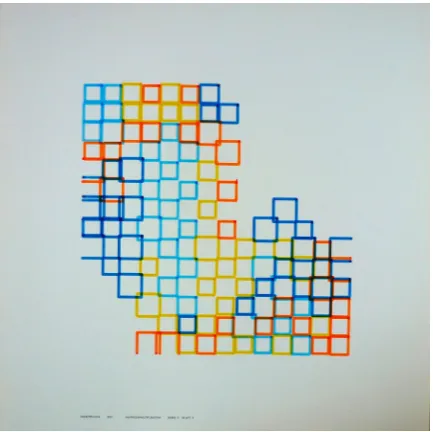
Please refer to usage guidelines at or alternatively
Full Terms & Conditions of access and use can be found at
https://www.tandfonline.com/action/journalInformation?journalCode=yisr20
Interdisciplinary Science Reviews
ISSN: 0308-0188 (Print) 1743-2790 (Online) Journal homepage: https://www.tandfonline.com/loi/yisr20
The movement of the poem in the 1960s: from
circle and line to zero and one, from concretion to
computation
Bronaċ Ferran
To cite this article: Bronaċ Ferran (2017) The movement of the poem in the 1960s: from circle and line to zero and one, from concretion to computation, Interdisciplinary Science Reviews, 42:1-2, 127-143, DOI: 10.1080/03080188.2017.1297168
To link to this article: https://doi.org/10.1080/03080188.2017.1297168
© 2017 The Author(s). Published by Informa UK Limited, trading as Taylor & Francis Group
Published online: 24 Jul 2017.
Submit your article to this journal
Article views: 1595
The movement of the poem in the 1960s: from circle and line
to zero and one, from concretion to computation
BronaċFerran
Department of Literature & the Humanities, Birkbeck, University of London, London, UK
ABSTRACT
Poetic form in the 1960s in Britain, and elsewhere, was affected by trans-disciplinary and trans-cultural influences that came fully into focus after the end of the Second World War. These were substantially iterated and theorized throughout the 1950s, paving the way for radical experiments in language during the following decade. Drawing on Paul Celan’s observation that poetry maintains itself ‘at its own extremity’ (expanded by Lyon [1983.
“Poetry and the Extremities of Language: From Concretism to Paul Celan.”Studies in 20th Century Literature8 (1): Article 5. Accessed September 20, 2016. doi:10.4148/2334-4415.1131] and Klink [2000.
“You. An Introduction to Paul Celan.”The Iowa Review30 (1): 1–18. http://ir.uiowa.edu/iowareview/vol30/iss1/2], this article considers movement in the form and language of poetry in the post-war period. It looks at some specific examples of how this became manifest in Britain and at traversal connections to developments within other disciplines, not least in scientific and technological domains.
ARTICLE HISTORY
Received 8 September 2016 Revised 20 December 2016 Accepted 12 January 2017
KEYWORDS
Hansjörg Mayer; Max Bense; Margaret Masterman; Pierre Garnier; dom Sylvester Houédard; BronaċFerran; typoetry; code
Zero and one is everything–the whole universe–and equally the circle and line, which is the futura typeface, can express everything.1(Hansjörg Mayer;Figure 1)
The concrete poet, by leaving the firm ground stepped over and over by abstractions, the tra-ditional solid ground of outward meaning, dives into the mysterious region of the becoming, to return from there, trembling, with new proper names, captive of nothingness. (Flusser [1967]2013)
We still have to come to terms with technology and poetry.2(Jerome Rothenberg)
Context
After the horrors of the Second World War, the function and role of language was subject to deep scrutiny by many writers and philosophers and particularly those
© 2017 The Author(s). Published by Informa UK Limited, trading as Taylor & Francis Group
This is an Open Access article distributed under the terms of the Creative Commons Attribution-NonCommercial-NoDerivatives License (http://creativecommons.org/licenses/by-nc-nd/4.0/), which permits non-commercial re-use, distribution, and reproduction in any medium, provided the original work is properly cited, and is not altered, transformed, or built upon in any way.
CONTACT BronaċFerran [email protected] Department of Literature & the Humanities, Birkbeck, University of London, 43 Gordon Square, London WC1H OPD, UK
1
Hansjörg Mayer in conversation with author. September 2016.
2Poet & Polemicist: an interview with Jerome Rothenburg, 2013; accessible at:
living in Germany or working with the German language. Founder of the Frankfurt School, Theodore Adorno speculated whether poetry should still be written in the face of the barbaric (1949). Paul Celan, a Rumanian born poet whose parents were killed in the Holocaust, decided to continue writing in the German language, until death by suicide in Paris in 1970. He outlined his post-war position in a speech accepting the Bremen Literary Prize, in 1959:3
Only one thing remained close and reachable amid all losses: language. Yes, language. In spite of everything, it remained unlost. But it had to go through its own lack of answers, through terrifying silence, through the thousand darknesses of murderous speech. It went through and gave no words for what had happened; but it went through this event. It went through and could resurface, ‘enriched’ by it all. In this language I tried, during those years and the years after, to write poems: in order to speak, to orientate myself, to find where I was, where things were going, to sketch for myself a reality.
It meant, as you see, something happening, movement, being under way, it was an attempt to find direction…. (Celan1986; Fynsk1994)
As the darkness of the 1940s proceeded into the drive for political and economic recon-struction of the early 1950s, leadingfigures internationally within the arts and humanities maintained a process of profound questioning. Many struggled to work out their direction, wrestling with important questions of human agency in the face of a growing scientific positivism.
[image:4.493.136.352.50.271.2]New fields such as cybernetics and information science, that played an important role in the conclusion of the war, required new understanding, calling for trans-disciplinary discourses, such as those activated within the 10 Macy conferences in the United States
Figure 1.oil. Hansjörg Mayer, letterpress. 1965.
3
between 1946 and 1953.4In a series of lectures, Martin Heidegger (whose name became for many irreparably tainted by his failure to speak out directly against the Nazi regime in Germany) speculated on language, poetry, technology and thinking (in a destitute time). Having fled to Brazil from war-torn Czechoslovakia, media philosopher Vilém Flusser consistently warned of the perils of mechanized thought and automated systems in relation to their neutralizing effect on human ethics and individual responsibility (1999). Throughout the 1940s, meetings of the Moral Sciences Club at King’s College, Uni-versity of Cambridge, brought leading philosophers Ludwig Wittgenstein, Karl Popper, G.E. Moore, Bertrand Russell and others together for intense arguments about the signifi-cance of language and the transcendence, or otherwise, of philosophy (Edmonds and Eidinow2001).
In turn, the work of poets at the leading edges of avant-garde practices in post-war Europe combined new techniques of composition with destabilization of poetic form. Pro-cesses of linguistic decomposition came fully to the fore. In Paris, Isodore Isou and Maurice Lamaître, defining themselves as lettrists, built on earlier Dadaist experiments (Kac1991) and sought to reinforce and reinvent the basic elements of language–focussing on the sound and the letter–shamanically casting off the word as if to invent new affor-dances, to renew language at its roots, to make a tabula rasa.5
Lines to constellations
Swiss poet and theorist Eugen Gomringer played an important role with respect to this experimentation. His manifesto From Line to Constellation, written first in German in
1954, was published by Max Bense in his journal Augenblick.6 It was first translated into English by Michael Weaver and published inIMAGE, a magazine edited by Philip Steadman in Cambridge (1964). The translation included the lines:
…The constellation is the simplest possible kind of configuration in poetry which has for its basic unit the word, it encloses a group of words as if it were drawing stars together to form a cluster. The constellation is an arrangement, and at the same time a play-area of fixed dimen-sions. The constellation is ordered by the poet. He determines the play-area, the field or force and suggests its possibilities. The reader, the new reader, grasps the idea of play, and joins in. In the constellation something is brought into the world. It is a reality in itself and not a poem about something or other. The constellation is an invitation.
Gomringer’s original text had stated its debt to Stéphane Mallarmé’sUn Coup de Dés Jamais N’Abolira le Hasard, written in 1896 (Lyon1983). The words UNE CONSTELLA-TION had been spelt out in capitals by Mallarmé within his poem. Quentin Mellassoux has argued that Mallarmé’s poem was based on a numerological play with the number seven (Mellassoux2012). Whilst this theory remains in question, the poem was certainly a turning point between nineteenth-century symbolism and twentieth-century serialism and foundational in relation to the spatialist turn in the poetics of the next century (Ferran 2016). Reviewing Marshall McLuhan’s The Gutenberg Galaxy: The Making of 4Macy conferences: further information about these is accessible at:http://www.asc-cybernetics.org/foundations/history2.
htm#MacyPeople.
5Orson Welles interviewed Maurice Lemaitre and Isodore Isou in 1955 for the St. Germain part of hisAround the World with
Orson Wellesdocumentary;https://www.youtube.com/watch?v=uZayMaC4RLo(accessed 12 December 2016): see also http://www.mauricelemaitre.org/~pfs/what-is-lettrism/(accessed 12 December 2016).
6
Typographical Man(1962) forEncountermagazine, Frank Kermode describedUn Coup de Desas‘the first poem to take full account of the invention of printing’(Kermode1963). Gomringer’s use of graphic space in his own poetry was also formative: one of his best known works,Silencio,made in 1952, had a single white space at the centre: like a muted nucleus around the poem was constructed. Steve McCaffery has recently argued that the historical and political context of its making within a decade of the concentration camps has often been underestimated (2013). In the mid-1960s John Furnival’sOpenings Pressin Gloucestershire, England published another version of the poem with the sign for the Hebrew sound forshrepeated 10 times around the void at its centre (Figure 2).
Space and time continuum
A major sensitivity among poets, writers, film-makers and visual artists from the mid-1950s to late 1960s was a preoccupation with the idea of a space-time continuum; this was imaginatively explored in various works of art in many media. This took place against a backdrop of the Space Race, when the idea of freeing the human from the earth and from gravity was growing nearer to realization, during the first years when sat-ellites were circling the earth, a monkey was set forth into outer space and many poets sim-ultaneously were seeking to set words free from the meshes of rhythm and meter.
The alphabet, the basis of written and spoken language in Western civilization, became a primary force and site for experimentation: its letters were disassembled, fragmented, grafted, reassembled and scattered in acts of phonetic and typographic experimentation. Performed and visual acts broke the alphabet down into bits and fragments and/or recon-structed it again to become super-signs and icons. As these decades progressed, print, tape and type machines became collaborators in the action. The poetic form itself became the object of attention, undergoing numerous acts of naming and renaming.
From information to the program
[image:6.493.136.353.52.215.2]One of the primary theorists of these questions working in Europe in the 1950s whose work had significant impact on poets elsewhere, including in Britain, was Max Bense, a
Figure 2.SilencioEugen Gomringer. Hebrew characters, trans. Harry Warschaurer. Openings Press 16.
Stuttgart-based mathematician and philosopher. Bense’s theories combined ideas relating to semiotics (after C. S. Peirce7) and informational theory (after Norbert Weiner8). His pre-Second World War research into mathematics and aesthetics continued afterwards whilst his expertise in mathematics and philosophy infused the experimentation which his publishing, teaching and exhibition activities facilitated. Having taught at Ulm School of Design from 1954–1958 he then set up the Studiengenerale course at the Tech-nischen Hochschule in Stuttgart. There he fostered an extraordinary range of experiments related to the stochastic and algorithmic properties of language and pioneered thinking around the idea of information aesthetics. He invited writers, mathematicians and others to events at the Studiengalerie around which a seminal network formed, with exper-iments with the form of the poem and poetic language closely embedded in this. On a large Zusse mainframe computer at the Technischen Hochschule in Stuttgart what is regarded as the first computer poem was created by Theo Lutz in1959. He was a student of Bense who had suggested to him that he might use a random number generator to see what might happen. Lutz wrote up this experiment as the article Stochastic Texts published inAugenblick(1959).This work brought into the foreground underlying questions rip-pling below the surface of much poetic experimentation of the 1950s relating to the dimin-ishing position of the singular auteur. What kind of poetry might be written by and with a machine?
Bense’s work was exceedingly important in combining a strong theoretical framework with intensive experimentation. Frieder Nake, then a mathematician in Stuttgart, who started to make artwork with early computers, has described how the word ‘program’ was being investigated, shaped and tested in the Stuttgart context.9Now generically and generally applied to the language of computing, it was then only beginning to have trac-tion. Along withAugenblick,Bense co-edited a series of small books calledrot10(Figure 3). Both provided space for circulation and cross-fertilization of theories and practice linking poetry, semiotics and theories of information aesthetics. Such dynamic interplay between theory and practice, research and dissemination was deeply radical. Bense’s textprojekte generativer asthetikpublished inrot19 (Bense and Walther1965) coincided with an exhibition of computer-based art work by Georg Nees at the Studiengalerie in Feb-ruary 1965. Within this Bense advanced the idea of generative aesthetics building on the notion of generative grammar, developed by Chomsky (1957,1965).
Bense’s influence first found its way to Britain through inclusion of his journals in the
First International Exhibition of Concrete Kinetic and Phonetic Poetryheld at Cambridge University in late 1964. This was organized by Michael Weaver, a postgraduate researcher in English Literature based at Magdalen College. He was aided by Reg Gadney (co-editor ofGrantawho included the exhibition catalogue as a supplement) and Philip Steadman, who had recently graduated in Architecture and beginning post-graduate studies. Stephen Bann, then based in Paris, helped to find works for inclusion in the exhibition and returned to Cambridge for the opening. It was to Bann that Pedro Xisto, one of the Brazil based
7
Charles Stuart Peirce (1839–1914) was a logician, pragmatist and founder of semiotics or the science of signs.
8Norbert Wiener (1894–1964) was Professor of Maths at MIT and founder of cybernetics. He wroteCybernetics: Or Control
and Communication in the Animal and the Machinein 1948.
9Said by Nake in conversation with author. May 2015. 10
concrete poets included in this first exhibition, and an advocate of Zen Buddhism, sent the manuscript poem below a few years later. (Figure 4).
[image:8.493.113.380.52.250.2]IMAGEoffered an extraordinary platform in 1964–1965 for circulation of ideas, the-ories, primary documents and translations relating to concrete, kinetic and visual poetry. A relatively glossy and colourful magazine for the period, it was changing owner-ship when Steadman became editor. It had started as a photojournalistic magazine mod-elling itself on Paris Matchand Steadman, a self-taught, talented, graphic designer, got
Figure 3.rot 26.alphabetenquadrate. Hansjörg Mayer, letterpress. 1966.
Figure 4.Manuscript poems by Pedro Xisto, enclosed in letter to Stephen Bann. 1967. Reprinted with permission of Stephen Bann and the Xisto family.
[image:8.493.104.391.400.618.2]involved initially as an assistant editor; this allowed him to migrate during a transition of ownership to the editorship and, along with Bann, Gadney and Weaver–to‘hijack’it for experimental purposes in true avant-garde fashion. The three issues dedicated to aspects of kinetic and concrete art and poetry produced between 1964 and 1965 are now collectors’ items. Combining theory and practical analysis, they offered extremely important insights into then emerging avant-garde practices. But the new owner hoped to make it a careers advertising journal. The November edition about Parisian kinetic artists had also an ad for a career in the Royal Air Force on the back and one for the Women’s Royal Army Corps on its inside front cover. One could conclude that reading supplementary features on new forms of radar used by the British Aircraft Corporation, etc. might help students decide to go for the arts or sciences. But the experiment ended after three issues as Steadman has recalled recalled: ‘I suspect we then crashed it with the absurd combination of avant-garde art contents and careers advertising’.11
The November 1964 issue also had a translation of an article by Pierre Garnier, a poet based in France, where he edited the review,Les Lettres, Poesie Nouvelle.This provided an important space for circulation and dissemination of perspectives internationally on where the new poetry was heading. In the text inIMAGE, Garnier stated his belief in the radical autonomy of language and his sense of the experimentation, taking place at its roots, as being equivalent to space exploration (1964):
Let it be understood once and for all that language is an autonomous part of the world, including the other universes, as it is included by them; hence its authenticity, and all the poets are aiming towards the ideal point where the verb creates itself.
...
These forms of poetry do not merely explore with the help of linguistic postulates fixed once and for all in the way the surrealists did, first they isolate the language, then they modify it, shuffle it in its very foundations, they even destroy it and thus create the conditions of appa-rition if not of a new language (therefore of a new thought and a new man) at least a new art which by disturbing the foundations of language modifies man.… returning, without the obstacle of a language settled and compulsory, to the roots, the energies and working for it with the help of the most modern techniques, like the cosmonaut in space.
Garnier captured here one of the primary poetic impulses of the period, that is, to explore the‘roots’, or the‘movement of language within’a phrase used by Ian Hamilton Finlay in a letter to Garnier from September 1963, also printed in the same issue ofIMAGE. In this Finlay said:
I wonder if we are not all a little in the dark, still as to the real significance of‘concrete’ …. For myself I cannot derive from the poems I have written any‘method’which can be applied to the writing of the next poem; it comes back, after each poem, to a level of‘being’ …. Just so,‘concrete’began for me with the extraordinary (since wholly unexpected) sense that the syntax I had been using, the movement of language in me, at a physical level was no longer there … so it had to be replaced with something else, with a syntax and movement that would be true of the new feeling (which existed in only the vaguest way, since I had, then, no form for it)….
11
This has echoes of Celan from his speech in Bremen about poetic language as‘movement, you see, something happening, being en route, an attempt tofind a direction….’(Klink
2000). Garnier had asked Finlay for his views on the benefits of theory within a context where experimentation in poetry was leading into spaces that were seemingly without boundaries or clear definition. Finlay’s response above conveys a phenomenological feeling of transition as well as resistance to overlaying any constructed theory. Neverthe-less he did, in the end, agree to Garnier including his name in the list of those supporting his proposal to use the termspatialist poetryas a common heading for the following:
concrete poetry: working the language-matter freed from all representative duties
visual poetry: the word object and centre of energy
objective poetry: poem made object through the active collaboration of painters sculptors and musicians
mecaniste poetry: or poetry of permutations
phonic poetry: direct composition on a tape therefore an objectivation through mechanical means.
phonetic poetry: based on the phonems, sonorous elements of the language uttered by the vocal organs of man and that are interpreted on the tape recorder.
Defining each of these in his own way, Garnier described these as‘trends’, all of which involved‘objectivations of the language-universe’.His text published inIMAGEalso refers to poems as vibrations; earlier he, with his wife and partner in poetry, Ilse, had written of how they were‘like waves, shooting about in the universe’.
Garnier’s‘manifesto’for spatialist poetry as a banner over all the other genres and sub-genres had been published earlier the same year inSilâns, a weekly magazine edited and produced by the artist Barry Flanagan at St Martins School of Art in London. Flanagan dedicated Silâns to‘concrete poetry and its relations’. The text of the spatialist poetry manifesto reached his magazine via Henri Chopin, another French poet, who interestingly had told Garnier he would not sign the manifesto. However, the article inSilâns, headed INTERNATIONAL REVOLUTION IN MODERN LANGUAGES, is under his name, translated by Arlette Jackson. Chopin moved to live in England from 1965 and became a well-known figure in the network of relations around poets Bob Cobbing, dom Sylvester Houédard and many others in the experimental generation. Professor Jo Melvin at Chelsea College of Art reproducedSilânsin facsimile in 2011. In this she describes how Flanagan joined‘a department with a strong interest in experimentation and enquiry’and that the magazine‘provided a vehicle to circulate concrete poetry within an art arena’. Flanagan managed to persuade the administrative staff to help with cyclostyling the copies. Sixteen issues were produced between October 1964 and June 1965. She cites John James, a poet and friend of Flanagan, on how‘his circle of friends and associates’reacted to receiv-ing it every second Monday:
copies of Silâns
circulate from hand to hand among the poets
touching and shaping the form of the work
a consequence a continuum
a writing outside literature. (Melvin2011)
This idea of writing beingoutside literatureis a very powerful one, reflecting the state of mind of many of those who were busily making experimental poems in visual, graphic and poetic form, for publication and exhibition in autonomous, self-organized, self-generated contexts, rather than following established routes or pursuing traditional outlets. This, if it was literature, was literature at a generative extreme.
Poem as material
Traversing these extremes, was poet, typographer and publisher Hansjörg Mayer, who moved from Stuttgart to London in 1966 and began to teach typographic design at Bath Academy of Art in Corsham. Mayer’s work was already combining typographic expertise at a very high level with alphabetical, mathematical and aleatory processes, so evolving concrete poetry into highly original territories.
He became a significant crossover figure, traversing developments in England and in Germany and between graphic design and concrete poetry. His work reflected aspects of the controlled information aesthetics of Bense (which he had imbibed when studying infor-mally with him at the Technische Hochschule in the late 1950s and early 1960s) and an exper-imental poetics that he pioneered on his own, combining exemplary fluency in typography with chance and random processes. Aged 22 in 1965, at Bense’s Studiengalerie, he was given his first solo exhibition. It was namedtypoetry,a term generated by Haroldo de Campos, a member of the Noigandres group in Sao Paulo who had met Mayer there in 1964 and who subsequently christened him a typoet and his work as typophagous. In his letter printed in the catalogue for the exhibition de Campos said of Mayer,‘he eats reality with type’. Adept in creating works that explored the material interfaces between ink, language, paper and the machinery of print, much of Mayer’s work can be seen in the lineage of con-struction and constructivism, with an inventive interplay between language of form and technical experimentation. Simultaneously he had shown an intense interest in decon-struction, decomposition and in the live space between the work and its making. This has contributed to positioning him uniquely in between what has been called ‘clean’or purist concrete poetry and hybrid or ‘dirty’ intermedia forms associated with fluxus artists often using text and improvisatory performance. Among these was leading fluxist poet Emmett Williams, with whom Mayer worked closely on several publications that sit in the interface between poem and artists book (Ferran2017).
Work by Décio Pignatari was also included in the Cambridge 1964 exhibition. He was a designer as well as a poet and had also met Mayer during his visit to Brazil at the end of 1964. In an article called The Concrete Poets of Brazil published in the Times Literary Sup-plement (TLC) (1964) Pignatati declared that the poet was also‘a language designer’. He also said‘the alphabet is a computer’.12In this he was conceptually close to Mayer who regards the language of computation and the language of poetry as closely related. Mayer’s typoetical works often deployed mathematics where he would work within a
12
numerical constraint, usually linked to the number 26, the number of letters in the alphabet, or with subsets of 26. An early work from 1962–1963, 26 prints calledalphabethave been much reproduced.
The radical conjunction of computation, typography and print was at the heart of a portfolio Mayer published under his edition hansjörg mayer imprint in 1967 with Frieder Nake. Mayer recognized that aleatory processes were at play in drawings made by the computer plotters used by Nake and so suggested they make a print portfolio together that would combine for the first time ever, letterpress typography, computer plotter drawings and a print out of a computer program. The end result was matrizen multiplakationen, the significance of which as an early meeting point between art, typo-graphy and computation has rarely been appreciated. At the time of writing it is on display at Tate Modern in London (Figure 5).
[image:12.493.137.354.52.268.2]Mayer’s imprint was an important publishing outlet for concrete and visual poetry and his use of the Futura typeface was influential on other poets who adopted it for the setting and design of their work. Stephen Bann, in his introduction to Concrete Poetry: An International Anthology (London Magazine Editions 1967), referred to Mayer as having developed a grammarof Concrete Poetry, bringing into clearest prominence the elements with which the poet must work. Mayer himself has spoken of Futura’s uniqueness as a typeface pared to a modernist minimum, constructed of only line and circle. A relatedseries of poem prints calledfuturawere published between 1965 and 1968 featuring 26 works by various artists. Nake’sfutura was calledcomputer grafik. Scottish poet, Edwin Morgan, made a work for the series calledemergent poems. Mayer also worked on a poem print with Xisto, entirely com-posed of lines and circles, published as part of the13 visuelle texteportfolio (1964)13(Figure 6).
Figure 5.Frommatrizen multiplakationenFrieder Nake. Letterpress, computer plotter, program. Edition Hansjörg Mayer. 1967.
13This work by Xisto will be on display in Spring 2017 at the Getty Institute in Los Angeles along with two other pieces from
Mayer made his condition of employment at Bath Academy of Art the purchase by its Directors, Clifford and Rosemary Ellis, of a new large proof press as well as the Futura typeface. Using this, he developed and published the third of his concrete poetry portfolios which innovatively scaled up the size of paper used for production of poems to wall poster size. He encouraged a group of graphic design students to work together with a collection of concrete and visual poets from Britain, Canada and the United States to typeset letterpress versions of poems into one ‘edition’ (now held by Tate as part of their Mayer collection). Poets contributing to this from the UK were Stephen Bann, Thomas A. Clark, Bob Cobbing, Ian Hamilton Finlay, John Furnival, dom Sylvester Houédard, Cavin McCarthy, Edwin Morgan and John Sharkey. An introductory text was written by Jasia Reichardt.
The work of both Bense and Mayer was included in Reichardt’s exhibition Between Poetry and Paintingheld at the ICA in the autumn of 1965 which included lettrist works as well as concrete, semiotic, sound, spatialist and visual poetry. Reichardt invited dom Sylvester Houédard, a Benedictine monk and poet who produced work mainly on an Olivetti typewriter, to contribute an overview text for the catalogue. In the end this was a separate insert. Houédard had attempted the difficult task of aBetween Poetry and Painting chron-ology. In this he stressed the primary influence of communication theory.
[image:13.493.113.381.52.317.2]The work of both Bense and Mayer was referenced in the second of the two special fea-tures of theTLSpublished in London in 1964 focussing on literary avant-gardes interna-tionally. Edited by John Willett and extremely wide-ranging in scope,Any Advance the Changing Guard 2 showed intersections and correspondences between concrete and
visual poetry with ideas from semiotics and emerging information theory. Willett made reference to the‘text topology’ ‘word-counts’ and‘text algebra’ of Bense and mentioned books by Diter Rot, with whom Mayer later worked very closely. He gave these as examples of those who were challenging the limitations of linear prose and aiming at a new synthesis between the literary and the visual.
In 1967 a work by Mayer calledtypoaktionen(Figure 7) was featured on the front page of the TLS with a caption acclaiming it as an example of‘radical superimposition’. In 2016
typoaktionenwas installed alongsiderandom superposition of zeroes and ones, a new work inspired by Mayer’s original, made by a Cambridge researcher, as part of art and nanoscience exhibition held at the Maxwell Building at the University of Cambridge.
In 1964 the first of the two TLS features on avant-garde literatures focussed on UK and US-based writers and poets, including Houédard, who was also singularly interested in connections between computational language and poetry. He was the first in England to give lectures about concrete poetry and links to machines. His own works often calledtypestractswere usually produced on his typewriter in the small cell in the Abbey where he lived in Gloucestershire. He recognized that the movement (—the ‘turns’—) that kinetic poetry offered was a further step into a post-authorial void that Mallarmé had first signalled and that computers in potential offered a chance to take further. A pro-lific letter writer, he was often invited to provide introductory texts for concrete poetry festival catalogues that he wrote in characteristically hyper-textual, inventive language presciently with respect to the reductionist language now of texting and twitter.
[image:14.493.126.368.51.286.2]Prompted by being published in the same issue of theTLS, Houédard wrote a letter to Margaret Masterman who had founded the Computer Language Research Unit in Cam-bridge several years earlier (Houédard1966). His letter was subsequently published in the first issue of a new journal called Theoria to Theory, closely connected both to the
Figure 7.typoaktionen. Hansjörg Mayer. Letterpress, Leporello Binding, 1967.
Language Research Unit and a group called the Epiphany Philosophers, that Masterman was part of, operating from the same address in Cambridge. Published under the heading
–Poetry Theory and Poetry Theoria,his letter stated:
… I find all this area still unsatisfactorily mapped in british philosophy … I mean … if language is THERE to use ok … but the need for new words is w/us all the time … they don’t come by analysis … we can take the words & nonwords quark and antiquark & use them and make means things abt elementary properties … but I’m thinking about a deeper problem (I think) abt the originating of language and communicating signs … or does one just have to depend on the given & enlarge it?
Masterman had studied philosophy with Wittgenstein and with colleagues in the CLRU made a pioneering contribution to experimentation within the then emerging field of natural and machine language processing. In his letter Houédard also referred to the chal-lenges of:‘… getting machines to write tolerable conceptual and semantic associations & language models &c’. linking this to his experiments at the time in making in kinetic poetry with poets Kenelm Cox, John Furnival and Richard Loncraine:
… our own contribution … here in the Cotswolds (furnival loncraine cox myself) has been (….) towards the possibility (via kinetic poetry) of machine semiotic poems in which NO lexical key is provided any more than when nice/nasty/white/&c clouds passes across ?yr sky (have the glostershire group (‘gloop’) poets here produced art? Poems? Or a language?
…or is it that the poet constructs the MACHINE … ie the machine IS the poem? … (cf pierre albertbirot on the POET as the poem machine in grabinoulor).
Houédard also wrote a letter to Hansjörg Mayer shortly after meeting him at theBetween Poetry and Painting exhibition opening. In this he told him about the Cambridge Language Research Project recommending that he make contact with them as they seemed to be the closest equivalent in England to what Bense was doing in Germany.
Cybernetic Serendipity, acknowledged by many to be the first major exhibition in the world of computer art, was organized at the ICA in London by Jasia Reichardt, in 1968. Reichardt recalled in the catalogue introduction that she had been inspired to do the exhi-bition by Max Bense when they met at the opening ofBetween Poetry and Paintingat the ICA three years earlier. The exhibited works includedComputerised Haiku which Mar-garet Masterman made in collaboration with Robin McKinnon-Wood, who was a founder of another pioneering organization called Systems Research Ltd. In a text pub-lished in Theoria to Theory, McKinnon-Wood and Masterman gave an extended account of their hypothesis and experiments (1967).
(ii) Algorithms (mechanical tricks) can also be used to produce a fully computerized poem. For instance, in the output given immediately below the machine has been (a) only to chose words beginning with the letter‘s’and, (b) when there is a choice among‘S’words, to take the one whose second letter is nearest the end of the alphabet (and so recursively, if there is still a choice of words).
...
VII. The role of the poet in computer poetry
It will be evident from the above that the poet programming a computer must: (i) set up the frame, (ii) create the thesaurus, (iii) devise any mechanical tricks (e.g. rhyming) with which he may desire to operate.… He can, of course, be vastly more sophisticated than we have in setting up and varying his frame (a sonnet, for instance, is a sophisticated frame).
But the ultimate creative act, for the computer poet, lies in writing the thesaurus.
They end with a statement of differences between the concrete and the computer poet:
From the above it would provisionally appear that, whereas part of the motivation of the genuine concrete poet is to stream-line his own mind, so as to make his poem into something as like an algorithmically produced machine output as possible, the computer-poet on the contrary, tends to use the machine to create a profusion of new, surprising and unforeseen combinations of words which, without its help, he would not have thought of.
The editorial direction ofTheoria to Theorywas closely entwined with the interests of the Computer Language Research Unit and The Epiphany Philosophers,who were primarily interested in connections between religion and science. Early covers of the journal resembled visual poems (seeFigure 8). In a text by Robin McKinnon-Wood called Com-puter Programming for the Literary Laymen(1967) he outlined some of the primary chal-lenges facing anyone wishing to work with computer technology effectively in the mid-1960s. From his list he selected language as the most interesting problem and described how:
the first real development of computer languages came about when it was realised that the logic formerly embedded in a plug board by a set of physical wires could be stored in the machine’s own store. From this there developed the concept of pure machine code. This is a code which on the very early machines was written directly in binary notion, that is using only noughts and ones, and this was stored in the store of the machine…
He then outlined the introduction of punch-cards that meant there was now a written language, efficient for the machine but drudgery for the person writing it onto to the (then) recent stage of development – of writing assembly languages. He described this brilliantly:
An assembly language is a language in which each statement written corresponds directly with some binary code inside the machine; that is, some instruction which the machine can carry out and which it will obey whenever it is reached. In this sort of language, at least some of the characteristics of a human being are taken into consideration. For example, human beings like to write in symbols, such as sets of alphabetic characters, which can represent larger concepts than those possible in binary notation.
He then continued, explaining the limitations of assembly languages and why he and his colleagues were working on higher level programming languages to try to resemble natural languages, a challenge that is still current in the twenty-first century.14
From 1968 onwards computers began to be viewed in art as potential ideation tools, capable of process generation and not just as calculating machines. The computer artist and scientist Ernest Edmonds has written of his move between 1967 and 1968 from
14See Economist magazine, Technology Quarterly. 7thJanuary 2017:‘Finding a Voice’on how computers“still don’t
creating simple rules based poetry on typewriters to using the computer language called FORTRAN. In an article for theVisualisepublication after his inclusion in the Poetry, Language, Codeexhibition in Cambridge in 2012, he described how in 1968 he left con-crete poetry behind asthe poetry moved to be in the code(Edmonds2013).
Mayer had a major retrospective in the autumn of 1968 at the age of 25 and afterwards stopped making new typoems and publishing concrete poetry by others, to focus entirely on publishing artists books. By then, for many others also, the concrete poetry movement was over. It had achieved its purpose: language had been distilled into endurable form. The constellation no longer held an invitation. A period of experimentation had been com-pleted. Concretion had entered the code.
Disclosure statement
[image:17.493.114.381.50.405.2]Notes on contributor
BronaċFerranis a curator, writer and doctoral researcher working on Hansjörg Mayer and the
‘typoetical revolution’ of the 1960s, exploring connections between code, design, language and poetry. Formerly Director of Interdisciplinary Arts, Arts Council England and Senior Tutor, Research, Innovation Design Engineering at the Royal College of Art, she has curated exhibitions about concrete and visual poetry, design and software-based art in Cambridge, Glasgow and London. She has written the first monograph about Hansjörg Mayer’s work, The Smell of Ink and Soil: The Story of (Edition) Hansjörg Mayer(König Books, March 2017). She guest co-edited this issue of ISR journal with Elizabeth Fisher.
ORCID
BronaċFerran http://orcid.org/0000-0001-5052-3908
References
Adorno, W. Theodore.1949.“Cultural Criticism and Society”, essay; reprinted in Prisms, 1955; also MIT Press, 1983.
Bense, Max, and Elisabeth Walther.1965.Edition rot19. Work of Georg Nees. With text Projekter generativer Aesthetik by Bense. Stuttgart: Dr. E. Walther.
Celan, Paul.1986. Gesammelte Werke, Band 3. Suhrkamp Verlag. Chomsky, Noam.1957.Syntactic Structures. The Hague: Mouton.
Chomsky, Noam.1965.Aspects of the Theory of Syntax. Cambridge: MIT Press.
Edmonds, Ernest.2013.“Moving Between Poetry and Code.”InVisualise: Making Art in Context, edited by Bronac Ferran, 65–71. Cambridge: Anglia Ruskin University.
Edmonds, David, and John Eidinow.2001.Wittgenstein’s Poker. London: Faber & Faber. Ferran, Bronac. 2016. “Re Verse Engineering: Poems on the Turn.”In Engineering the Future,
edited by I. Papadimitriou, A. Prescott, and J. Rogers, 22–29. https://lguariento.github.io/ Engineering-the-Future/04.html.
Ferran, Bronac.2017.The Smell of Ink and Soil: The Story of (Edition) Hansjörg Mayer. Cologne: Buchhandlung Walther König.
Flusser, Vilém. [1967] 2013. Concrete–Abstract (originally printed in the Suplemento Literårio of O Estado de Sao Paulo in Da Religiosidade (Conselho estadual de cultura, Comissao de literature. Sao Paulo; English translation inExtra-Disciplinary Spaces and De-Disciplining Moments (In and Out of the 30th Bienal de Sao Paulo); trans from Portuguese by Antonio Sergio Bessa OEI # 60–61 2013; 254.
Flusser, Vilém.1999.“‘Ethik im Industriedesign?’Copyright Bollman Verlag GmbH 1993; English translation‘The Ethics of Industrial Design?’.”InThe Shape of Things: A Philosophy of Design, 66–69. London: Reaktion Books.
Fynsk, Christopher. 1994. “The Realities at Stake in a Poem. Celan’s Bremen and Darmstadt Addresses.” In Word Traces: readings of Paul Celan, edited by Aris Fioretos, 159–184. Baltimore, MD: John Hopkins University Press.
Gomringer, Eugen. 1954. From Line to Constellation. A manifesto printed in Augenblick No. 2. Editor: Max Bense. Agis Verlag, Baden-Baden.
Houédard, dom Sylvester.1966.“Poetry Theory & Poetry Theoria.”InTheoria to Theory, Vol 1 First Quarter 1966, 6–9. Cambridge: The Epiphany Philosophers.
Kac, Eduardo.1991. Display Holography (Fourth International Symposium–Proc. SPIE 1600), edited by Tung H. Jeong, 229–236. Bellingham, WA: SPIE. http://www.ekac.org/recent. experiments.htmlas Recent Experiments in Holography and Computer Poetry.
Kermode, Frank.1963.“Between Two Galaxies.”Edited by Stephen Spender and Melvin Lasky. EncounterXX (2): 113.
Klink, Joanna.2000.“You. An Introduction to Paul Celan.”The Iowa Review30 (1): 1–18. Web. http://ir.uiowa.edu/iowareview/vol30/iss1/2, 6.
Lutz, Theodore.1959.“Stochastic Text.”Edited by Max Bense. Published inAugenblick4. Baden-Baden: Agis Verlag.
Lyon, James K.1983.“Poetry and the Extremities of Language: From Concretism to Paul Celan.” Studies in 20th Century Literature8 (1). Article 5. Accessed September 20, 2016.doi:10.4148/ 2334-4415.1131.
McCaffery, Steve.2013.“Politics, Context & the Constellation.”European Journal of English Studies 7 (1): 10–22.
McKinnon-Wood, Robin.1967.“Computer Programming for the Literary Laymen II.”Theoria to Theory. Oxford: The Pergamon Press for The Epiphany Philosophers.
McKinnon-Wood, Robin, and Margaret Masterman (Cambridge Language Research Unit).1967.
“Computerized Haiku.” Theoria to Theory Vol. 1 Fourth Quarter, 378–382. Oxford: The Pergamon Press for the Epiphany Philosophers.
McLuhan, Marshall.1962.The Gutenberg Galaxy: The Making of Typographical Man. Toronto: University of Toronto Press.
Mellassoux, Quentin.2012.The Number and the Siren: A Decipherment of Mallarmé’s Coup de Dés. Translated by Robin McKay. Falmouth: Urbanomic.
Melvin, Jo.2011.Silâns 1964–1965. London: Plubronze Limited/Lethaby Press.
Pignatari, Décio.1964. The Concrete Poets of Brazil inAny Advance The Changing Guard 2in Times Literary Supplement. Editor: John Willett.