BIROn - Birkbeck Institutional Research Online
Hart, Sarah and Sbeiti Clarke, Amal (2018) Commuting involution graphs
for $\tilde C_n$. Communications in Algebra 46 (9), pp. 3965-3985. ISSN
0092-7872.
Downloaded from:
Usage Guidelines:
Please refer to usage guidelines at or alternatively
Commuting Involution Graphs for
C
˜
nSarah Hart and Amal Sbeiti Clarke∗
Abstract
In this article we consider commuting graphs of involution conjugacy classes in the affine Weyl group of type ˜Cn. We show that where the graph is connected the diameter is at mostn+ 2.
MSC(2000): 20F55, 05C25, 20D60.
1
Introduction
ConsiderX a subset of a groupG. The elements ofX constitute the vertices of the commuting graph
C(G, X), in which x, y ∈ X are joined by an edge whenever xy = yx. If X is a set of involutions
then we call C(G, X) a commuting involution graph. Commuting graphs have been studied by many
authors in various contexts. For example Fischer [3] studied commuting involution graphs for the case when X is a conjugacy class of involutions, in his work on 3-transposition groups. Segev and Seitz looked in [10] at commuting graphs for finite simple groups G where X consists of the non-identity
elements of G. More recently Giudici and Pope [6] gave some results on bounding the diameters of
commuting graphs of finite groups. Commuting graphs for elements of order 3 have been considered in [2]; there have also been many papers dealing with the case where X consists of all non-identity elements of a given group such as for example [1].
In [4], Bates et al looked into the commuting involution graph C(G, X) where X is a conjugacy
class of involutions in G and G is Sym(n). The remaining finite Coxeter groups were analysed in
[5]. Much less is known for infinite Coxeter groups. Commuting involution graphs in affine groups of type ˜An have been considered in [8]. In this article, we investigate the commuting involution graphs C(G, X) for another collection of Coxeter groups, the affine Weyl groups of type ˜Cn.
For the rest of this article, letGn be an affine Weyl group of type ˜Cn, for some n≥2, writing G
when n is not specified, and let X be a conjugacy class of involutions of G. We write DiamC(G, X) for the diameter ofC(G, X) whenC(G, X) is a connected graph, in other words the maximum distance
d(x, y) between any x, y ∈X in the graph. Since conjugation by any group element induces a graph
automorphism, we can determine the diameter by fixing any a ∈ X, and then Diam C(G, X) =
max{d(x, a) :x∈X}. Our main result is the following.
Theorem 1.1. LetX be a conjugacy class of involutions in the groupGnof typeC˜n. If the commuting graph C(G, X) is connected, then its diameter is at most n+ 2.
The proof of Theorem 1.1 is broken into several cases depending on the type of the conjugacy class. To describe this further, and in order to state our results about connectedness, we need to describe a parameterisation of the involution conjugacy class. We will explain in Section 2 that involutions in G can be written as ‘labelled permutations’ (Notation 2.2). These are permutations expressed as products of disjoint cycles in which every cycle has a sign and an integer written above it. For example
in G10 one of the involutions is
0
+
(12) 0
+
(34) 3
−
(5) 4
−
(6) 3
−
(7) 1
−
(8) 0
−
(9) 0
+
(10). A cycle is positive if it has a plus sign, and negative if it has a minus sign. The labelled cycle type of an involution σ will be a quadruple (m, ke, ko, l) where m is the number of transpositions, ke is the number of negative 1-cycles with an
even number above them,ko is the number of negative 1-cycles with an odd number above them, and
∗
l is the number of positive 1-cycles. For the example inG10, its labelled cycle type is (2,2,3,1).
We will show (Theorem 2.6) that involution conjugacy classes in G are parametrised by labelled cycle type. We may now give the conditions under which the graph C(G, X) is connected.
Theorem 1.2. Let X be a conjugacy class of involutions inGn (wheren≥2) with labelled cycle type
(m, ke, ko, l). Then C(G, X) is disconnected in each of the following cases. (i) m= 0 and l= 0;
(ii) m >0, l= 0 and eitherke= 1 or ko= 1;
(iii) m >0 and max(ke, ko, l) = 1;
(iv) n= 4 and m= 1;
(v) n= 6, m= 1 and ke =ko = 2.
In all other cases, C(G, X) is connected.
We note that the bound on diameter given in Theorem 1.1 is best possible. For example we have verified that when n= 8, m= 1 and ke=ko= 3, the commuting involution graph has diameter 10.
To construct the proofs needed for this result, we rely on the structure of the Coxeter group G
as a semi-direct product of a finite Coxeter group W of type Cn (whose elements can be thought
of as signed permutations) with a Zn lattice. In Section 2 we give the necessary detail on this
construction, and determine the involutions of G. We introduce the labelled cycle form for elements
of G, and describe the group multiplication for elements written in this form. We then show that
the involution conjugacy classes are parameterised by labelled cycle type. The section also contains three results giving criteria under which labelled 1-cycles, transpositions and double-transpositions commute. Section 3 is dedicated to proving the main theorems. Throughout we make use of the labelled cycle form along with the criteria for commuting developed in Section 2. In Section 4 we give examples of selected commuting involution graphs.
2
Involution conjugacy classes in
G
For the remainder of this paper a is a fixed involution with X its conjugacy class in the affine irre-ducible Coxeter group G. Our first job is to establish what involutions inGlook like.
Let W be a finite Weyl group with root system Φ and Φ∨ the set of coroots. The affine Weyl
group ˜W is the semidirect product of W with translation groupZ of the coroot latticeL(Φ∨) of W. See, for example, [7, Chapter 4] for more detail. Forα, τ ∈W and u,v∈Z we have
(α,v)(τ,u) = (ατ,vτ+u).
For the rest of the paperWnwill denote a Coxeter group of type Cn, and setGn= ˜Wn. We write,
respectively, W and Gwhenever it is not necessary to specify n. We may take the roots ofW to be
±2ei and ±ei±ej, for 1 ≤i≤n, where {e1, . . . , en} is the standard orthonormal basis forRn. The
coroots are then ±ei and±ei±ej. Therefore in this case
Z ={(λ1, . . . , λn) :λi ∈Z} ∼=Zn.
We may view the elements of W as signed permutations; they act onRn by permuting the subscripts
of basis vectors and changing their signs. To obtain a signed permutation we write a permutation in Sym(n) (including 1-cycles), add a plus sign or a minus sign above eachi, and sayiis positive or
Expressing σ as a product of disjoint cycles, we say that a cycle (i1· · ·ir) of σ is positiveif there
is an even number of minus signs above its elements, and negative if the number of minus signs is
odd. For example, (+1 +3 −2) is a negative cycle, whereas (−5 −6) is positive. It is straightforward to check that an involution of W only has 1-cycles (positive or negative) and positive 2-cycles. By the definition of group multiplication in Gn, we see that the element (σ,v) ofGis an involution precisely
when (σ2,vσ+v) = (1,0). This allows us to characterise the involutions inGn.
Lemma 2.1. A non-identity element (σ,v) of Gn is an involution if and only if σ, when expressed as a product of disjoint signed cycles, has the form
σ= (
+ + a1b1)· · ·(
+ + atbt)(
− −
at+1bt+1)· · ·( − − ambm)
−
(c2m+1)· · · −
(cn−l) ( + dn−l+1)· · ·
+
(dn)
for some ai, bi, ci, di, t, m and l; and, writing v = (v1, . . . , vn), we have vbi = −vai when σ contains
(+ +aibi),vbi =vai when σ contains ( − −
aibi) andvdi = 0 for n−l < i≤n.
Proof. Ifa= (σ,v) is an involution, then a2 = (σ2,vσ+v) = (1,0). Thus σ is an involution of W, and so its cycles are all either 1-cycles or positive 2-cycles. Thusσ has the form given in the statement of the lemma. Write vσ +v= (u1, . . . , un). We must have ur = 0 for all r. For 1≤i≤t, we have uai =ubi =vbi+vai. Thus vbi =−vai. Fort < i≤m, we haveuai =−vbi+vai and ubi =−vai+vbi.
So vbi =vai. When m < i < n−lwe have uci =−vci+vci = 0, so there is no restriction on vci. For n−l < i < n we have udi = 2vdi, forcing vdi = 0. These are the necessary conditions on σ and v; it
is clear that they are also sufficient.
Notation 2.2. There is a more compact way to write elements of G – for an element (w,v) of G,
v = (v1, . . . , vn), then above each signed number i in the expression of w as a product of disjoint
signed cycles, we will writevi. For example, we would write ((
−
1+2−3),4e1+ 5e2+ 6e3) as (
4
−
1 5
+
2 6
−
3). This allows us to employ a shorthand for writing involutions ofG. Suppose (σ,v) is an involution with the
form given in Lemma 2.1. For transpositions (
± ±
ai bi) of σ, where the number aboveai determines the
number above bi as described in Lemma 2.1, we write (
λ +
aibi) for (
λ +−λ+ aibi) and (
λ −
aibi) for (
λ −−λ
aibi). We will
call this thelabelled cycle form of (σ,v). Where it is helpful, we adopt the convention that cycles ( 0
+ di)
are omitted, as these fix both di and vdi.
In what follows we will be making a lot of use of the labelled cycle form, and so we give a couple
of examples of how to multiply elements in this form. Let w= (
v1
−
1
v2
+
2
v3
−
3 ) and w0 = (
u1
+
1 )(
u2
−
2
u3
−
3 ). These
represent the elements ((
−
1 +2
−
3), v1e1+v2e2+v3e3) and ((+1)(
−
2
−
3), u1e1+u2e2+u3e3) respectively, and we would usually write the vector components in coordinate form with respect to the standard basis,
so we write ((−1+2−3),(v1, v2, v3)) and (( +
1)(−2−3),(u1, u2, u3)). Recall that multiplication in G is given
by (α,v)(τ,u) = (ατ,vτ+u). So
ww0 = ((
−
1 +2
−
3),(v1, v2, v3))((+1)(
−
2
−
3),(u1, u2, u3))
= ((−1 +2−3)(+1)(−2−3),(v1, v2, v3)(
+
1)(−2−3 )+ (u
1, u2, u3))
= ((+1
−
3)(
−
2),(u1+v1, u2−v3, u3−v2))
= (
u1+v1 +
1
u3−v2 −
3 )(
u2−v3 −
2 ).
In simple cases calculations can be carried out entirely within the labelled cycle form as follows. To
multiply, for example, ( 4
+
1 5
+
2) and ( 6
−
2 7
−
3) inG3, we first calculate that (+1+2)(
−
2
−
3) = (
−
1
−
iin {1,2,3} we calculate the image ofiunder (−2−3) and move the number appearing aboveiin ( 4
+
1 5
+
2)
accordingly; to this we add the number appearing above i(
− 2−3 ) in (
6
−
2 7
−
3). For example, the number
appearing above 2 in ( 4
+
1 5
+
2) is 5; now 2 is mapped to−3 by (−2−3), so the number above 3 in the labelled
cycle form of our product will be −5 + 7 = 2 (because 7 is the number appearing above 3 in ( 6
−
2 7
−
3)).
Hence ( 4
+
1 5
+
2)( 6
−
2 7
−
3) = ( 4
−
1 2
−
3 6
+
2). The same result is obtained if we convert to the standard form:
( 4
+
1 5
+
2)( 6
−
2 7
−
3) = ((+1+2),(4,5,0))((
−
2
−
3),(0,6,7))
= ((+1+2)(−2−3),(4,5,0)(
−
2−3 )+ (0,6,7))
= ((
−
1
−
3+2),(4,0,−5) + (0,6,7)) = ((
−
1
−
3+2),(4,6,2))
= ( 4
−
1 2
−
3 6
+
2).
In the case of involutions, we just have to remember the rule that (
λ +
aibi) means (
λ +
−λ + aibi) and (
λ −
aibi) means
(
λ −−λ
aibi). Thus, for instance, (
5
+
12)( 6
−
34)·( 7
+
13)( 0
−
24) = ( 13
−
1 5
−
4)(
−6
+
2
−2
+
3 ). This product is not an involution, which means that these two involutions do not commute. Some general rules about when involutions commute will be derived using calculations like this in Lemmas 2.7 – 2.9. Before that, we give a characterisation of the involution conjugacy classes in terms oflabelled cycle types.
Definition 2.3. Leta be an involution inGn. The labelled cycle type of ais the tuple (m, ke, ko, l),
where m is the number of transpositions,ke is the number of negative 1-cycles with an even number
above them, ko is the number of negative 1-cycles with an odd number above them, and l is the
number of positive 1-cycles (fixed points), in the labelled cycle form of a.
For example, the labelled cycle type of 0
+
(12) 1
−
(3) 1
−
(4) 3
−
(5) 4
−
(6) 3
−
(7) 1
−
(8) 0
+
(9) 0
+
(10) is (1,1,5,2).
It turns out that involution conjugacy classes are characterised by labelled cycle type. To see this, we use a well-known result, due to Richardson, that gives a description of involution conjugacy classes in Coxeter groups.
Definition 2.4. LetW be an arbitrary Coxeter group, withRthe set of fundamental reflections. We say that two subsets I and J of R areW-equivalent if there existsw∈W such thatIw =J.
In the next result, we use the notation wI for the longest element of a finite standard parabolic
subgroupWI.
Theorem 2.5 (Richardson [9]). Let W be an arbitrary Coxeter group, with R the set of fundamental reflections. Let g ∈W be an involution. Then there exists I ⊆R such that wI is central in WI, and g is conjugate to wI. In addition, for I, J ⊆ R, wI is conjugate to wJ if and only if I and J are W-equivalent.
The Coxeter graphs of G2 (which is a Coxeter group of type ˜C2) and Gn for n ≥ 3 (which is a
Coxeter group of type ˜Cn) are as follows.
u u u
r1 r2 r3
˜
C2 u u u u
r1 r2 rn rn+1
˜
We may setr1 = 0
−
(1),ri= (
0
+ i−1
0
+
i) for 2≤i≤n, andrn+1 =
1
−
(n).
It is well known that in the finite Coxeter groupW of typeCn, elements are conjugate if and only
if they have the same signed cycle type. In particular two involutions are conjugate when they have the same number of transpositions, the same number of negative 1-cycles and the same number of positive 1-cycles.
InG(which is of type ˜Cn), the element (σ,v) is conjugate to (τ,u) via some (g,w) if and only if:
(τ,u) = (σ,v)(g,w)
= (g−1σg,vg+w−wg−1σg). (1)
Theorem 2.6. Involutions in G are conjugate if and only if they have the same labelled cycle type. In particular, every involution is conjugate to exactly one element a=am,ke,ko,l of the form
a= 0
+
(1 2)· · ·
0
+
(2m−1 2m) 0
−
(2m+ 1)· · ·
0
−
(2m+ke)
1
−
(2m+ke+ 1)· · ·
1
−
(n−l) 0
+
(n−l+ 1)· · ·
0
+
(n).
Proof. Let x be an involution of G. Since G is a Coxeter group (of type ˜Cn for some n), we may
apply Theorem 2.5 to see that x is conjugate to wI for some finite standard parabolic subgroup WI
of G in which wI is central. Therefore the connected components of the Coxeter graph for WI are
of types A1 or Bi for some i(including, by a slight abuse of notation, B1, where we have connected
components with just the vertex r1 or rn+1). Thus I = {r1, r2, . . . , ri} ∪J ∪ {rj+1, rj+2, . . . , rn+1}
for some i, j with 0 ≤ i < j ≤ n+ 1, where J is a subset of {ri+2, . . . , rj−1} no two elements of
which are adjacent vertices in the Coxeter graph. By conjugation in hri+2, . . . , rj−1i (which after all
is isomorphic to the symmetric group Sym(j−i−1)), we can assume that for some i, j and m with 0≤i≤i+ 2m < j < n+ 1 we have
I ={r1, r2, . . . , ri} ∪ {ri+2, ri+4, . . . , ri+2m} ∪ {rj+1, rj+2, . . . , rn+1}.
This gives that x is conjugate to wI, where
wI=
0
−
(1)· · ·
0
−
(i) 0
+
(i+ 1 i+ 2)· · ·
0
+
(i+ 2m−1 i+ 2m) 0
+
(i+ 2m+ 1)· · ·
0
+
(j−1) 1
−
(j)· · ·
1
−
(n).
Let c= (h,0), where
h= ( + 1
+
i+ 1)( + 2
+
i+ 2)· · ·( + 2m
+
i+ 2m)( +
i+ 2m+ 1 +
j) ( +
i+ 2m+ 2 +
j+ 1)· · ·(
+
i+ 2m+ 1 +n−j +n).
From Equation (1) we see that
wIc= 0
+
(1 2)· · ·
0
+
(2m−1 2m) 0
−
(2m+ 1)· · ·
0
−
(2m+ke)
1
−
(2m+ke+ 1)· · ·
1
−
(n−l) 0
+
(n−l+ 1)· · ·
0
+
(n).
Therefore, by setting a=wcI we see that each involution in G is conjugate to at least one element of the required form.
Now consider an involutionx in Gwith labelled cycle type (m, ke, ko, l), and supposey =rixr−i 1
for some simple reflection ri. Write x = (σ,v) and y = (τ,u). By Equation (1), τ is conjugate
to σ in the underlying Weyl group W. Hence τ and σ have the same number of transpositions,
negative 1-cycles and positive 1-cycles as each other. In other words, the labelled cycle type of y
is (m, k0e, ko0, l) for some k0e, ko0 satisfying ke0 +k0o = ke+ko. Now, from Equation (1) again, (
λ −
a labelled 1-cycle of x if and only if (
µ −
ig) is a labelled 1-cycle of y, where λ = vi and µ = uig. In
particular this means (
−
ig) is a signed cycle of τ, so that (wτ)ig =−wig. Now u =vg +w−wτ. So µ = uig = (vg)ig +wig −(wτ)ig = vi + 2wig ≡ λ mod 2. Therefore ko = k0o. Hence ke = ke0 and
so x and y have the same labelled cycle type. In particular x is conjugate to at most one element a
of the form stated in the theorem. Conversely, any two involutions of the same labelled cycle type (m, ke, ko, l) are both conjugate toam,ke,ko,l, and hence to each other. Thus conjugacy is parameterised
by labelled cycle type, and the set of elements {am,ke,ko,l : 2m+ke+ko+l=n}contains exactly one
representative of each conjugacy class of involutions in Gn.
We next prove three preliminary lemmas which will be used repeatedly in the proofs in Section 3.
Lemma 2.7. Let α ∈ {1, . . . , n} and λ, µ ∈Z. Then λ −
(α) commutes with
0
+
(α) for all λ, whereas λ −
(α)
commutes with µ −
(α) if and only if λ=µ.
Proof. For convenience, we assume without loss of generality thatα = 1. Note that two involutions
commute if and only if their product is an involution. We have that
λ −
(1) 0
+
(1)=
λ −
(1), which is an involution,
so
λ −
(1) commutes with 0
+
(1). In the case of two negative 1-cycles we have
λ −
(1)
µ −
(1)=
µ−λ +
(1), which is only an
involution if µ−λ= 0. So
λ −
(1) commutes with
µ −
(1) if and only ifλ=µ.
Lemma 2.8. Let α, β be distinct elements of {1, . . . , n} and letλ, µand ν be integers.
(i) λ +
(α β) and µ +
(α β) commute if and only if λ=µ, and λ −
(α β) and µ −
(α β) commute if and only if λ=µ.
But λ +
(α β) and µ −
(α β) commute for all λand µ.
(ii) λ ±
(α β) and
0
+
(α) 0
+
(β) commute for allλ, but there is no value of µ orλ for which λ ±
(α β) and
0
+
(α)
µ −
(β) or µ
−
(α) 0
+
(β) commute.
(iii) λ +
(α β) and µ −
(α)
ν −
(β) commute if and only if µ−ν = 2λ, whereas λ −
(α β) and µ −
(α)
ν −
(β) commute if and only if µ+ν= 2λ.
Proof. We lose no generality by assuming, for ease of notation, thatα = 1, β = 2 and n= 2. Recall
that
λ +
(1 2) and
λ −
(1 2) are shorthand for (
+
(1 2),(λ,−λ)) and (
−
(1 2),(λ, λ)) respectively. Involutions commute precisely when their product is an involution (or the identity), which we can check using Lemma 2.1.
(i) We calculate
λ +
(1 2)
µ +
(1 2) = (
+
(1 2),(λ,−λ))(
+
(1 2),(µ,−µ)) = (1,(λ,−λ) +
(1 2)+ (µ,−µ)) = (1,(µ−λ, λ−µ)).
This means
λ +
(1 2) and
µ +
(1 2) commute if and only ifλ=µ. We also have
λ −
(1 2)
µ −
(1 2) = (
−
(1 2),(λ, λ))(
−
(1 2),(µ, µ)) = (1,(λ, λ)
−
so again
λ −
(1 2) and
µ −
(1 2) commute if and only if λ = µ. Finally a similar calculation shows that
λ +
(1 2)
µ −
(1 2) =
µ+λ −
(1)
µ−λ −
(2), which is an involution for all values of λ and µ, so
λ +
(1 2) and
µ −
(1 2) always commute.
(ii) Certainly
λ ±
(1 2) and 0
+
(1) 0
+
(2) commute for all λ; after all, 0
+
(1) 0
+
(2) is just the identity element when
n = 2. Moreover, already in the underlying group W of type B2 we observe that
±
(1 2) does not
commute with
+
(1)
−
(2) or
−
(1)
+
(2), so there is no value of µ or λ for which
λ ±
(1 2) and 0
+
(1)
µ −
(2) or
µ −
(1) 0
+
(2) commute.
(iii) We have
λ +
(1 2)
µ −
(1)
ν −
(2) = (
µ−λ −
1
ν+λ −
2 ); this is an involution if and only ifν+λ=µ−λ. Thus
λ +
(1 2) and
µ −
(1)
ν −
(2) commute if and only ifµ−ν = 2λ. Similarly
λ −
(1 2)
µ −
(1)
ν −
(2) = (
µ−λ +
1
ν−λ +
2 ); this is an involution if and
only if ν−λ=−(µ−λ). Therefore
λ −
(1 2) and
µ −
(1)
ν −
(2) commute if and only if µ+ν = 2λ.
Lemma 2.9. Let g1 =
λ1 +
(αβ)
λ2 +
(γδ), g2 =
λ1 +
(αβ)
λ2 −
(γδ), g3 =
λ1 −
(αβ)
λ2 −
(γδ), h1 =
µ1 +
(αγ)
µ2 +
(βδ), h2 =
µ1 +
(αγ)
µ2 −
(βδ) and
h3= µ1
−
(αγ)
µ2
−
(βδ), for distinct α, β, γ, δ in {1, . . . , n} and integersλi, µi. Then (i) g1 commutes with h1 if and only if µ1−λ1 =µ2−λ2;
(ii) g1 does not commute with h2;
(iii) g1 commutes with h3 if and only if µ1−λ1 =µ2+λ2; (iv) g2 commutes with h2 if and only if µ1−λ1=µ2−λ2; (v) g2 does not commute with h3;
(vi) g3 commutes with h3 if and only if µ1−λ1=λ2−µ2.
Proof. We lose no generality by assuming, for ease of notation, thatn= 4 and g1 =
λ1 +
(1 2)
λ2 +
(3 4)
(i) g1 = (
+
(1 2)
+
(3 4),(λ1,−λ1, λ2,−λ2)) andh1 = (
+
(1 3)
+
(2 4),(µ1, µ2,−µ1,−µ2)). Hence
g1h1 = ( +
(1 4)
+
(2 3),(λ1,−λ1, λ2,−λ2)(
+
(1 3)
+
(2 4)+ (µ
1, µ2,−µ1,−µ2))
= (
+
(1 4)
+
(2 3),(µ1+λ2, µ2−λ2,−µ1+λ1,−µ2−λ1)).
Now g1 and h1 commute if and only if g1h1 is an involution. This occurs if and only if µ1+λ2 =
−(µ2−λ1) andµ2−λ2 =−(−µ1+λ1). Rearranging givesµ1−λ1 =µ2−λ2, as required for part (i).
(ii) Since
+
(1 2)
+
(3 4) and
+
(1 3)
−
(2 4) do not commute, it is impossible forg1 to commute withh2.
(iii) We have g1 = (
+
(1 2)
+
(3 4),(λ1,−λ1, λ2,−λ2)) andh3 = (
−
(1 3)
−
(2 4),(µ1, µ2, µ1, µ2)), and
g1g3= ( −
(1 4)
−
(2 3),(λ1,−λ1, λ2,−λ2) − (1 3)
− (2 4)+ (µ
1, µ2, µ1, µ2))
= (
−
(1 4)
−
(2 3),(µ1−λ2, µ2+λ2, µ1−λ1, µ2+λ1)).
(iv) We calculateg2h2 = ( −
(1 4)
+
(2 3),(µ1+λ2, µ2−λ2,−µ1+λ1, µ2+λ1)). Thus g2 commutes with h2
if and only if µ1−λ1 =µ2−λ2. (v) Since
+
(1 2)
−
(3 4) and
−
(1 3)
−
(2 4) do not commute,g2 cannot commute withh3.
(vi) This part follows from the fact thatg3h3= ( +
(1 4)
+
(2 3),(µ1−λ2, µ2−λ2, µ1−λ1, µ2−λ1).
We end this section by stating the relevant results from [5] about commuting involution graphs in Weyl groups of type Bn.
Theorem 2.10 (Theorem 1.1 of [5]). Suppose thatW is of type Bn, and let
σ =
+
(12)· · ·
+
(2m−1 2m)
+
(2m+ 1)· · ·
+
(2m+l)
−
(2m+l+ 1)· · ·
−
(2m+l+t).
Set X =aG and k:= max{l, t}. Then the following hold. (i) If m= 0, then C(G, X) is a complete graph.
(ii) If k= 0, then DiamC(G, X)≤2.
(iii) If k= 1 and m >0, then C(G, X) is disconnected. (iv) If k≥2 and n >5, then DiamC(G, X)≤4.
(v) If n = 5, m = 1 and k = 2 then Diam C(G, X) = 5. If n = 5, m = 1 and k = 3 then
DiamC(G, X) = 2. Finally if n= 4, m= 1 andk= 2 then C(G, X) is disconnected.
3
Proof of Main Results
We begin by looking at connectedness. For an element g= (σ,v) in a conjugacy classX ofG, define ˆ
g=σ. Then let ˆX be the conjugacy class of ˆg inW. Clearly if g, h∈X, then ˆg,ˆh∈Xˆ.
Lemma 3.1. Suppose g, h ∈ X. If d(ˆg,ˆh) = k, then d(g, h) ≥ k. If C( ˆG,Xˆ) is disconnected, then
C(G, X) is disconnected.
Proof. The result follows immediately from the observation that isg commutes with h inG, then ˆg
commutes with ˆh inW.
We can now prove Theorem 1.2 (which gives necessary and sufficient conditions forC(G, X) to be disconnected) in one direction. The proof in the other direction will arise from bounding the diameters of graphs not shown in Theorem 3.2 to be disconnected.
Theorem 3.2. Let X be a conjugacy class of involutions inGn (wheren≥2) with labelled cycle type
(m, ke, ko, l). Then C(G, X) is disconnected in each of the following cases. (i) m= 0 and l= 0;
(ii) m >0, l= 0 and eitherke= 1 or ko= 1;
(iii) m >0 and max(ke, ko, l) = 1;
(iv) n= 4 and m= 1;
(v) n= 6, m= 1 and ke =ko = 2.
Proof. Let X be a conjugacy class of involutions in Gn, with labelled cycle type (m, ke, ko, l), and a=am,ke,ko,l ∈X as defined in Theorem 2.6. We deal with each case in turn.
(i) Suppose l= 0 and m = 0. Then anyx inX is of the form
λ1
−
(1)
λ2
−
(2)· · ·
λn −
(n) for some λi (where ke of
the λi are even and ko are odd). By Lemma 2.7, x does not commute with any other element of X.
(ii) Suppose l= 0 andko= 1 (the caseke= 1 is similar). Then
a=
0 +
(1 2)· · ·
0 +
(2m−1 2m)
0 −
(2m+ 1)· · ·
0 −
(n−1)
1 −
(n).
Suppose b∈X such that a commutes with b. Consider the cycle ofb that contains n. This must be a negative 1-cycle or a 2-cycle, because bhas the same labelled cycle type as a. If it is a 2-cycle, then
b cannot commute with a, by Lemma 2.8(iii). Therefore it is a negative 1-cycle
λ
−
(n) where λ is odd,
and then by Lemma 2.7, b contains
1 −
(n). The same argument shows that any element c of X which
commutes with b must also contain
1 −
(n), and inductively all elements in the connected component of
C(G, X) containing amust contain
1 −
(n). ThereforeC(G, X) is disconnected.
(iii) Suppose m >0 and max(ke, ko, l) = 1. If l = 0 then C(G, X) is disconnected by (ii). So we can
assume l= 1. If either of ke orko is zero, then Theorem 2.10(iii) and Lemma 3.1 imply that C(G, X)
is disconnected. It remains to consider the case l=ke =ko = 1. Here, 2m=n−3 and
a=
0 +
(1 2)· · ·
0 +
(2m−1 2m)
0 −
(n−2)
1 −
(n−1)
0 +
(n).
Supposeb∈X such thatacommutes withb, and suppose
µ
±
(t) is a 1-cycle ofb. Ift∈ {1, . . . ,2m}then
asacontains a transposition
0 ±
(tt0) for somet0, Lemma 2.8 (ii) and (iii) show that the only wayaandb
could commute is if bcontained
0 +
(t)
0 +
(t0) or
µ
−
(t)
ν
−
(t) where µ≡ν (mod 2), contradicting our assumptions about the labelled cycle type of b. Therefore the elements appearing in 1-cycles ofb aren−2,n−1 and n. Inductively this holds for all elements in the connected component of C(G, X) containing a. ThereforeC(G, X) is disconnected.
(iv) Suppose n = 4 and m = 1. If max(ke, ko, l) = 1 then C(G, X) is disconnected by (iii). If this
doesn’t happen, then one of ke, ko orl is 2. By Theorem 2.10(v) and Lemma 3.1, C(G, X) is again
disconnected.
(v) Suppose n = 6, m = 1 and ke = ko = 2. For any x in X, we have x =
λ +
(α α0)
µ
−
(β)
µ0 −
(β0)
ν
−
(γ)
ν0 −
(γ0), where {α, α0, β, β0, γ, γ0} = {1,2,3,4,5,6}, µ and µ0 are even, and ν, ν0 are odd. Associate a set
T(x) ={{α, α0},{β, β0},{γ, γ0}} tox. Given that, by Lemma 2.8, a transposition can only commute with a pair of negative 1-cycles if either both cycles are odd or both are even, and also with reference to Lemma 2.7, we see that if y in X commutes with x, then T(x) = T(y). Therefore, for example,
0
+
(1 2) 0
−
(3) 0
−
(4) 1
−
(5) 1
−
(6) and 0
+
(4 5) 0
−
(1) 1
−
(2) 0
−
(3) 1
−
(6) are not connected inC(G, X). Our first result bounding diameters is whenm= 0.
Theorem 3.3. If m= 0 and l≥1, then
DiamC(G, X) =
2 if 2l≥n
dn
le if 0 ∈ {ke,ko}
n+ 1 if l= 1 and 0∈ {/ ke, ko}. In all other cases dn
Proof. In this case we have
a= 0
−
(1)· · ·
0
−
(ke)
1
−
(ke+ 1)· · ·
1
−
(ke+ko)
0
+
(ke+ko+ 1)· · ·
0
+
(n).
Let g ∈ X. Then for appropriate ε1, . . . , εke+ko, ρ1, . . . , ρl and λ1, . . . , λke+ko we have that g =
Qke+ko
i=1 λi −
(εi)Qli=1
0
+
(ρi). Since g∈X, exactly ke of the λi must be even. If 2l≥n, that is, l > ke+ko,
theng commutes with an elementh inX which contains the cycles
0
+
(1)· · ·
0
+
(ke+ke). Nowh certainly
commutes witha, and so DiamC(G, X) = 2.
Now we suppose that 2l < n, and that one of ke and ko is zero. Without loss of generality, we
may choose ko = 0. Then, writingk=ke, we havea=
0
−
(1)· · ·
0
−
(k) 0
+
(k+ 1)· · ·
0
+
(n). Since conjugation by elements of centralizer of apreserves distance inC(G, X), without loss of generality we may takeg to be of the following form for some integerr with 0≤r≤land even integers λi:
g= 0
+
(1)· · ·
0
+
(r)
λr+1
−
(r+ 1)· · ·
λr+k −
(r+k) 0
+
(r+k+ 1)· · ·
0
+
(n).
Now consider the following sequence, wherep=bklc and λr+k+1,. . .,λn are arbitrary even integers.
g0 =
0
+
(1)· · ·
0
+
(l)
λl+1
−
(l+ 1)· · ·
λn −
(n)
g1 =
0
−
(1)· · ·
0
−
(l) 0
+
(l+ 1)· · ·
0
+
(2l)
λ2l+1 −
(2l+ 1)· · ·
λn −
(n)
g2 =
0
−
(1)· · ·
0
−
(2l) 0
+
(2l+ 1)· · ·
0
+
(3l)
λ3l+1 −
(3l+ 1)· · ·
λn −
(n) ..
.
gp−1 =
0
−
(1)· · ·
0
−
((p−1)l)
0
+
((p−1)l+ 1)· · ·
0
+
(pl)
λpl+1
−
(pl+ 1)· · ·
λn −
(n)
gp =
0
−
(1)· · ·
0
−
(pl) 0
+
(pl+ 1)· · ·
0
+
((p+ 1)l)
λ(p+1)l+1 −
((p+ 1)l+ 1)· · ·
λn −
(n)
It is clear thatgi commutes with gi+1 for 0≤i < p. Moreoverg commutes withg0, andgp commutes
with a. If l divides k, then gp = a, which implies that d(g, a) ≤ p+ 1 = kl + 1 = dnle. If l does
not divide k, then d(g, a) ≤ p+ 2 = bk
lc+ 2 = d n
le. The diameter of the graph in each case does
equal this bound because at each stage of a path from g toawe can add at most l to the number of correct negative 1-cycles, but this requires the element being considered to share no fixed points with
a. Hence, for example the element
g= 2
−
(1)· · ·
2
−
(k) 0
+
(ke+ko+ 1)· · ·
0
+
(n)
must be distance at least dn−l
l e+ 1 =d n
le from a.
The remaining case is when ke and ko are both nonzero, and 2l < n.
For anyx∈X definec(x) to be the number of ‘correct’ negative 1-cycles inx. That is, cycles 0
−
(α)
where 1 ≤ α ≤ ke or
1
−
(β) where ke < β ≤ ke+ko. Thus, for example, c(a) = ke+ko. We say that
Let g ∈ X. Then g commutes with an element x0 whose positive 1-cycles are 0
+
(1)· · ·
0
+
(l). We will describe a sequence x0, x1, . . . where at each stage xi is an element of X such that c(xi) ≥ li
and the positive 1-cycles of xi are
0
+
(α1)· · ·
0
+
(αr)
0
+
(β1)· · ·
0
+
(βs) for some αj, βj where 1 ≤ αj ≤ ke and ke< βj ≤ke+ko, with r+s=l. Moreover, for i >0,xi will commute with xi−1.
Observe that the positive 1-cycles of x0 have the required form, and c(x0) ≥ 0×l = 0.
As-sume that we have x0, . . . , xi and let the positive 1-cycles of xi be
0
+
(α1)· · ·
0
+
(αr)
0
+
(β1)· · ·
0
+
(βs). To
form xi+1 we look for incorrect cycles λ1
−
(γ1)· · · λr
−
(γr)
µ1
−
(δ1)· · · µs
−
(δs) of xi, where each λj is even, each µj
is odd, γj ≤ n−l and δj ≤ n−l. If such cycles can be found, then xi commutes with xi+1
where xi+1 is given by replacing the cycles
0
+
(α1)· · ·
0
+
(αr)
0
+
(β1)· · ·
0
+
(βs)
λ1 −
(γ1)· · · λr −
(γr)
µ1 −
(δ1)· · · µs −
(δs) of xi with
0
−
(α1)· · ·
0
−
(αr)
1
−
(β1)· · ·
1
−
(βs)
0
+
(γ1)· · ·
0
+
(γr)
0
+
(δ1)· · ·
0
+
(δs), and leaving all other cycles unchanged. It is clear that xi+1commutes withxi; moreoverxi+1∈X, has the appropriate positive 1-cycles andc(xi+1)≥(i+1)l.
This sequence can continue until we have somexi with cycles
0
+
(α1)· · ·
0
+
(αr)
0
+
(β1)· · ·
0
+
(βs) but (without
loss of generality) fewer than r incorrect cycles
λ −
(γ) where λ is even and γ ≤ n−l. Suppose there
are exactly t such cycles (with t < r). So xi has the cycles
λ1 −
(γ1)· · ·
λt −
(γt). Since αj < ke for each j
there must be εt+1, . . . , εn where n−l < εj ≤n for each εj, and even numbers λj such that xi has
the cycles
λ1 −
(γ1)· · ·
λt −
(γt)
λt+1
−
(εt+1)· · · λr
−
(εr). Similarly xi has cycles
µ1 −
(δ1)· · ·
µ0t −
(δt0)
µt0+1 −
(ε0t0+1)· · · µr
−
(ε0s) for odd µ, some
t0 ≤s,δj ≤n−l and ε0j > n−l.
We now definey to be xi with
0
+
(α1)· · ·
0
+
(αr)
0
+
(β1)· · ·
0
+
(βs)
λ1 −
(γ1)· · ·
λr −
(γt)
λt+1
−
(εt+1)· · · λr
−
(εr)
µ1 −
(δ1)· · ·
µ0t −
(δ0t)
µt0+1 −
(ε0t0+1)· · · µr
−
(ε0s)
replaced with
0
−
(α1)· · ·
0
−
(αr)
1
−
(β1)· · ·
1
−
(βs)
0
+
(γ1)· · ·
0
+
(γt)
0
+
(εt+1)· · ·
0
+
(εr)
0
+
(δ1)· · ·
0
+
(δ0t) 0
+
(ε0t0+1)· · ·
0
+
(ε0s).
Now xi commutes with y, and c(y)≥(i+ 1)l. We observe thatd(g, y) ≤i+ 2. Notice that every β
withke < β≤ke+ko is either a fixed point ofy or appears in a cycle
µ −
(β) withµodd. Every incorrect even negative 1-cycle ofyfeatures a fixed point ofa, so for someq≤l, and conjugatingyby a suitable element of the centralizer of aif necessary, we can assume that the even negative 1-cycles ofy are
λ1
−
(n−l+ 1)· · ·
λq −
(n−l+q) 0
−
(q+ 1)· · ·
0
−
(ke).
Now y has at least (i+ 1)l correct negative 1-cycles. If we ignore the even negative 1-cycles and the correct odd negative 1-cycles, thenn−(i+ 1)l−qcycles remain (includinglfixed points). We can use the result for ke = 0 on this remaining part ofy to see thaty is distance at most dn−(i+1)l l−qe from
the element z ofX given by
λ1 −
(n−l+ 1)· · ·
λq −
(n−l+q) 0
−
(q+ 1)· · ·
0
−
(ke)
0
+
(1)· · ·
0
+
(q)
0
+
(n−l+q+ 1)· · ·
0
+
(n) 1
−
(ke+ 1)· · ·
1
−
Nowz commutes witha, and so d(g, a)≤d(g, y) +d(y, z) + 1 =i+ 2 +dn−q−l(i+1)le+ 1 = 2 +dn−lqe. If l= 1 andq = 0, then in fact z=aso d(g, a) =n+ 1. Ifq = 1 then again d(g, a) =n+ 1. Ifl >1 then we haved(g, a)≤ dnle+ 2. To give a lower bound on the diameter consider
g= 2
−
(1)· · ·
2
−
(ke)
3
−
(ke+ 1)· · ·
3
−
(ke+ko)
0
+
(ke+ko+ 1)· · ·
0
+
(n).
To create l additional correct negative 1-cycles at each stage of a path fromg toa one requires each fixed point to be a point not fixed bya; moreover in this case completion of the process for, say, the even negative 1-cycles requires the recreation of at least one fixed point between n−l+ 1 andn and hence fewer thanlcorrect negative 1-cycles being created at the next stage. Thus whenl= 1 we have
d(g, a)≥n+ 1, and whenl >1 we have d(g, a)≥ dnle. This completes the proof. From now on, assume thatm >0. Then we can take
a= 0
+
(1 2)· · ·
0
+
(2m−1 2m) 0
−
(2m+ 1)· · ·
0
−
(2m+ke)
1
−
(2m+ke+ 1)· · ·
1
−
(n−l) 0
+
(n−l+ 1)· · ·
0
+
(n),
where 2m+ke+ko+l=n.
Proposition 3.4. Suppose ke=ko = 0. If 2m=n, then DiamC(G, X)≤3. Ifn≥5 and l≥2 then
DiamC(G, X)≤5.
Proof. Letx ∈X. We can write a= (g,0) and x= (h,v), where g, h are conjugate elements of the underlying Weyl groupW. Define an elementy= (h0,0), by h0 =hw0, where w0 is the unique central involution of W. The result is that every minus sign inh corresponds to a plus sign inh0, and every
plus sign corresponds to a minus sign. Since k = 0, h and h0 are conjugate in W. So, by Theorem
2.10(i), d(g, h0)≤2 when 2m=nand d(g, h0)≤4 otherwise. Nowd(a, y) =d(g, h0) andy commutes
with xby Lemmas 2.7 and 2.8. The result follows immediately.
Proposition 3.5. Supposem≥1,l= 0, one ofkeandkois zero, and eitherm >1ormax{ke, k0} ≥3 (or both). Then C(G, X) is connected with diameter at most n. Ifx∈X and d(x, a) =nthen m= 1
and the transposition of x is λ ∗
(1 2) for some λ.
Proof. Letx∈X. Without loss of generalityko= 0. We start with the casem= 1. We will show that
if the transposition of x is
λ ∗
(1 2) for some λ, then d(x, a)≤n. Otherwise d(x, a)≤n−1. The graph
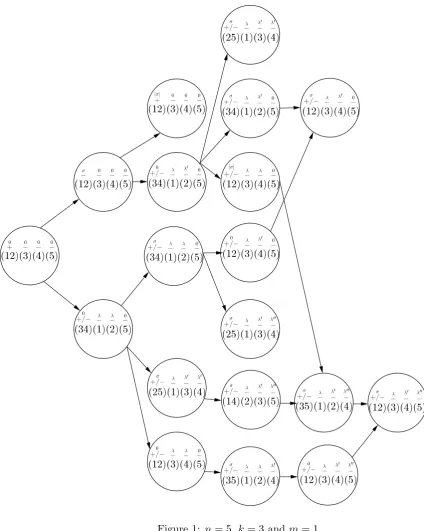
for n= 5 (and hence m = 1) is Figure 1. We can see from this graph that the inductive hypothesis
holds forn= 5, so assume n≥6. Suppose the transposition of x contains someα with α >2. Then
by Lemma 2.8(iii) x commutes with some y ∈ X such that y has the 1-cycle
0
−
(α) and such that the
transposition of y is not
λ ∗
(1 2). Ignoring the cycle 0
−
(α) we can work within G{1,...,α−1,α+1,...,n}, to see
that inductively d(y, a) ≤ n−2. Hence d(x, a) ≤ n−1. If the transposition of x is
λ ∗
(1 2) then x
certainly commutes with an element of X which does not have this transposition. So d(x, a) ≤nas required.
Now we assume m ≥ 2 and proceed by induction on ke to show that Diam C(G, X) ≤ n−1.
Suppose ke = 2. Then x is distance at most 2 from an element y of X which has the transposition
0
+/−
(n−1 n). To see this, note that if bothn−1 andnappear in transpositions ofx, or if both appear
in 1-cycles of x, then Lemma 2.8 or Lemma 2.9, as appropriate, implies that x commutes with some
x0 in X which contains a transposition of the form
λ −/+
If on the other hand, x contains (for example) the 1-cycle
µ −
(n) and n−1 appears in a transposition
σ +/−
(ε n−1) for some ε less than n−1, then x commutes with x00 in X containing the transpositions
λ −
(ε n−1) and
σ −
(ε0 n) for someλandε0. Lemma 2.9 now implies thatx commutes with an appropriate
y, in particular one containing the transpositions
σ+λ −
(ε ε0) and 0
−
(n−1 n). Nowy in turn commutes with
some z in X with the 1-cycles
0
−
(n−1) and 0
−
(n). If we ignore these cycles and work in Gn−2, then
Table 2 implies that when n= 6 d(z, a)≤2, and whenn >6 Proposition 3.4 tells us thatd(z, a)≤3. Therefore DiamC(G, X)≤n−1.
Finally, supposem≥2 andke>2. Suppose there is some transposition ofxcontaining an element α with α >2m. Then by Lemma 2.8(iii) x commutes with some y ∈ X such that y has the 1-cycle
0
−
(α). By induction d(y, a) ≤n−2. Hence d(x, a) ≤n−1. The final possibility is that the elements of the transpositions of x are {1,2, . . . ,2m}. Since m > 1 we can use Lemma 2.9 to show that x
commutes with some y inX containing the transposition
0
∗
(1 2). Working inG{3,4,...,n} (using the case m = 1 and induction onm) we see that d(y, a) ≤n−2. Hence d(x, a)≤n−1, which completes the proof of Proposition 3.5.
Lemma 3.6. Suppose m = 1, l = 0, ko = 2, ke ≥ 3 and x ∈ X. Then C(G, X) is connected with diameter at most n+ 1.
Proof. Letx∈X. The distance ofxfromawill largely hinge on the whereabouts ofnandn−1. But
first we deal with the case where the transposition ofxis
λ +/−
(12). Herexcommutes with an elementyof
X having cycles
µ −
(1)
µ0 −
(2) with µandµ0 odd. Using Proposition 3.5 on the remaining cycles ofy, we see that y is distance at most n−2 from the element bof X whose cycles are the same asa except that
we have
µ −
(1)
µ0 −
(2) 0
+
(n−1n) instead of 1
−
(n−1) 1
−
(n) 0
+
(1 2). Clearlyd(b, a) = 2. Hence d(x, a) ≤n+ 1. This
also shows that any element with odd negative 1-cycles
µ −
(1)
µ0 −
(2) is distance at mostn from a. Assume
from now on that the transposition of xis not
λ +/−
(12), and that its odd negative 1-cycles are not
µ −
(1)
µ0 −
(2).
If the transposition ofx is
λ +/−
(n−1n) thenx is distance 2 from some y∈X with cycles 1
−
(n−1) 1
−
(n). Ignoring these cycles we use Proposition 3.5 in Gn−2 to see thatd(y, a)≤n−2 if the transposition of
y is
λ +/−
(12) andd(y, a)≤n−3 otherwise. Thusd(x, a)≤n.
Ifxhas cycles
µ −
(n−1)
µ0 −
(n) whereµ≡µ0 mod 2, thenxis distance 3 from somey inX with cycles 1
−
(n−1) 1
−
(n). Thus d(x, a)≤n+ 1 if the transposition ofx is
λ +/−
(12) andd(x, a)≤n otherwise.
If one ofn−1 andn, say n, appears in the transposition ofx and the other appears in an even
negative 1-cycle
λ −
(n−1), then x commutes with some x0 ∈X with the cycles
λ −
(n−1)
λ −
(n). Then x0 is
distance 2 from some y ∈ X with the cycles
1
−
(n−1) 1
−
σ +/−
(12) for any σ. By Proposition 3.5 again,d(x, a)≤n.
If x contains
λ −
(n−1)
µ −
(n) 2σ−µ
−
(α) where λ is even, µ is odd, σ is an integer and α < n−1, then x
commutes with an element of X containing
λ −
(n−1)
σ −
(n α), which commutes with an element of X
containing
λ −
(n−1)
λ −
(n) 2σ−λ
−
(α) , which commutes with an element of X containing
0
−
(n−1n) 2σ−λ
−
(α) , which
finally commutes with an element y of X containing
1
−
(n−1) 1
−
(n) 2σ−λ
−
(α) , such that the transposition ofy
is the same as the transposition of x, namely not
λ +/−
(1 2). By Proposition 3.5, d(y, a) ≤n−3. Hence
d(x, a)≤n+ 1.
The final case to consider is where n is contained in the transposition of x and n− 1 is in
an odd negative 1-cycle. So x contains
λ −
(α n)
µ −
(β) 2σ−µ
−
(n−1) for some α, β and integers λ, µ, σ with µ
odd. If β /∈ {1,2} then subject to appropriate conjugation we can set β = 3. Using
Propo-sition 3.5 in G{1,...,n}\{3,n−1} we see that x is distance at most n−3 from the element y where
y = 0
+
(12) 2σ −
(n) 0
−
(4)· · ·
0
−
(n−2)
µ −
(3) 2σ−µ
−
(n−1). Then y commutes with
σ −
(3n−1) 2σ −
(n) 0
−
(4)· · ·
0
−
(n−2) 1
−
(1) 1
−
(2), which
commutes with 0
+
(45) 2σ −
(n) 2σ −
(n−1) 0
−
(3) 0
−
(6)· · ·
0
−
(n−2) 1
−
(1) 1
−
(2) which is distance 2 froma. Thusd(x, a)≤n+ 1. The last case is where without loss of generality β = 1 and we can assume α is 2 or 5. Let α0 be the
other element of {2,5}. Then x is distance 2 from some x0 in X containing
σ −
(1n−1)
τ −
(α)
τ0 −
(α0)
ν −
(3) 2κ−ν
−
(4) whereτ0is determined by xbut we may chooseτ arbitrarily, andν, κare integers withν odd. Now let
y= 0
+
(n−1n) 0
−
(1) 0
−
(2) 0
−
(5)· · ·
0
−
(n−2)
ν −
(3) 2κ−ν
−
(4) . Thend(x, x0) = 2 andd(y, a) = 3. What isd(x0, y)? Ifke >3
thenn≥8. Setτ = 0. Now working inG{1,...,n}\{α,3,4}we see from Proposition 3.5 thatd(x0, y)≤n−4.
If ke = 3 then n= 7. This time set τ =τ0. Thenx0 commutes with
0
+
(25) 0
−
(1) 2σ −
(6) 2σ0
−
(7)
ν −
(3) 2κ−ν
−
(4) for some σ0,
which commutes with
σ+σ0 −
(67) 0
−
(1) 0
−
(2) 0
−
(5)
ν −
(3) 2κ−ν
−
(4) which commutes withy, sod(x0, y) = 3. Hence in all cases
d(x, a)≤n+ 1, which completes the proof of Lemma 3.6.
Theorem 3.7. Suppose n ≥ 7, m ≥ 1, l = 0 and ke and ko are both at least 2. Then C(G, X) is connected with diameter at most n+ 2. Ifm≥2, then DiamC(G, X)≤n.
Proof. Assume thatke≥ko. Suppose first thatm= 1 and letx∈X. We use induction onko to show
that if the transposition of x is not
λ +/−
(1 2), then d(x, a) ≤n+ 1. Otherwised(x, a) ≤n+ 2. If ko = 2
the result holds by Lemma 3.6. Ifko>2 and the transposition ofxis not
λ +/−
(1 2), thenxcontains cycles
ν +/−
(αβ)
λ −
(γ)
λ0 −
(δ) where α >2, γ > 2,
σ −
(α) is a cycle of aand λ, λ0 and σ are all congruent modulo 2. Now
x commutes with some x0 ∈X containing the cycles
σ −
(α)
ν0 −
(γ δ) for appropriate ν0. If we ignore
σ −
(α) and work inG{1,...,n}\{α}, then inductivelyd(x0, a)≤n. Hence d(x, a)≤n+ 1. Suppose the transposition
of x is
λ +/−
(1 2). Then x commutes with some y inX that does not contain this transposition, and we
If m > 1 and ko = 2 then it is easy to see that x is distance at most 2 from an element of X
containing the transposition 0
+
(n−1 n). Thusxis distance at most 3 from an elementyof X
contain-ing 1
−
(n−1) 1
−
(n). Ignoring these 1-cycles we may work in Gn−2 and apply Proposition 3.5 to see that d(z, a)≤n−3. Hence d(x, a)≤n.
Now supposem > 1 and ko >2. If x has a transposition containing an element α withα >2m,
thenx commutes with an elementy containing
0
−
(α) or 1
−
(α) (choose whichever of these is a cycle of a). Then we can ignore this cycle and work inG{1,...,n}\{α}. Inductively, using the base caseko= 2, we see
thatd(y, a)≤n−1. Henced(x, a)≤n. Finally we deal with the case that every transposition of xis
of the form
λ +/−
(α β) whereα < β≤2m. Becauseke≥ko ≥3, it must be the case thatx contains cycles:
σ1 +/−
(α1 α2) σ2 +/−
(α3 α4) λ1
−
(β1) λ2
−
(β2) µ1 −
(γ1) µ2
−
(γ2) where λ1 ≡ λ2 mod 2, µ1 ≡µ2 mod 2, {α1, . . . , α4} ⊆ {1, . . . ,2m},
2m < β1 < β2 ≤2m+ke and 2m+ke < γ1 < γ2 ≤n. Then x is distance 2 from an element y with
the cycles 0
−
(β) and 1
−
(γ). Now, working inductively in G{1,...,n}\{β,γ} we see that d(y, a)≤n−2. Hence d(x, a)≤n.
Lemma 3.8. If n= 1, m= 1, l= 1 and ke= 2, then DiamC(G, X) = 5.
Proof. Letx∈X. If the transposition is
λ +/−
(12) then using Table 1 forG{3,4,5} we see that d(x, a)≤3.
Suppose the transposition of x is
λ +/−
(α β) where {α, β} ⊆ {3,4,5}, and let γ be the remaining element
of {3,4,5}. Then x commutes with x0 = 0
+/−
(α β)
λ −
(1)
λ0 −
(2) 0
+
(γ) for some even integers λ and λ0. Now x0
commutes with
(λ+λ0)/2
−
(12) 0
−
(α) 0
−
(β) 0
+
(γ), which commutes with a. So d(x, a) ≤ 3. The remaining cases are
(interchanging 1 and 2 if necessary) when x =
σ +/−
(1α)
λ −
(2)
λ0 −
(β) 0
+
(γ) or
σ +/−
(1α) +
+
(2)
λ0 −
(β)
λ −
(γ) for appropriate σ, λ
and λ0. The following is a path of length at most 5 from either of these to a: x , 0
−/+
(1α) 0
+
(2)
λ0 −
(β)
λ −
(γ), (λ0+λ)/2
−
(β γ) 0
−
(1) 0
+
(2) 0
−
(α), 0
+
(β γ) 0
−
(1) 0
−
(2) 0
+
(α), 0
+
(1 2) 0
−
(β) 0
−
(γ) 0
+
(α),a. Hence in all casesd(x, a)≤5, which completes the proof.
We observe, because we will need it for Lemma 3.10 later, that the proof of Lemma 3.8 shows that
d(x, a) ≤4 in all cases except where (modulo interchanging 1 and 2, or 3 and 4) the transposition of
x is 0
+
(1 3).
Theorem 3.9. Suppose m ≥ 1, l ≥ 1 and max{ke, ko, l} ≥ 2. Then C(G, X) is connected with diameter at most n.
Proof. Suppose n is minimal such that C(G, X) is a counterexample, and let x ∈ X such that
d(x, a) > n. By Lemma 3.8 we can assume n ≥ 6. If l ≥ 2 then x ∈ X commutes with some
y ∈X containing
0
+
(n). Ignoring this 1-cycle we can work in Gn−1 to find a path to a, which
If elementsα and β lying between 2m+ 1 and 2m+ke are contained in transpositions of x, then
x commutes with somex0 ∈ X having the transposition
λ +/−
(α β) for some λ(if m = 1 then we can set
x = x0). If we ignore this transposition of x0 we can work in G{1,...,n}\{α,β}, which is either the case l = 1 with a smaller m, so inductively the graph has diameter at most n−2, or (if m = 1) we can use Theorem 3.3, in which case the graph has diametern−1. In either case, we see thatx is distance
at most n−1 from the element b of X whose cycles are the same asa except thatb has 0
−
(1) 0
−
(2) 0
+
(α β)
instead of 0
−
(12) 0
−
(α) 0
−
(β). Since b commutes with a we have d(x, a) ≤ n. The same argument holds if 2m+ke < α < β < n. If 1≤α < β ≤2m then similar reasoning shows again x is distance at most
n−1 from an element b containing 0
+
(α β) that commutes with a. Sod(x, a)≤n. Thus none of these pairsα, β exist inx. This impliesm≤2. Moreover ifm= 2 thenk0 6= 0 and without loss of generality the transpositions ofx contain 1,5, n−1 andn.
If there is some β in a transposition of x with 2m+ke < β < n and if ko ≥2, thenx commutes
with some y∈X containing
1
−
(β). Inductively we can work inG{1,...,n}\{β} to see that d(y, a)≤n−1.
Hence d(x, a) ≤ n. Similarly, as long as either ke > 2 or ko ≥ 2 (or both), if there is some α in a
transposition of x with 2m < α≤ 2m+ke then inductivelyd(x, a) ≤n. This means that if m = 2
then ke= 2 and ko = 1.
Suppose thatm= 2, ke= 2 and ko = 1, so thatn= 8. We have observed that the transpositions
ofxmust contain 1,5,7 and 8. If 6 is not contained in an even negative 1-cycle ofx, thenxcommutes
with someycontaining a transposition
λ +/−
(α β) for someλ, where{αβ} ⊂ {2,3,4}. As at the start of this proof, d(y, a)≤ 7. More explicitly, inductivelyy is distance at most 6 from an element b containing
0
+
(α β) that commutes witha. Henced(x, a)≤8, a contradiction. Thusm= 1.
If x contains 0
+
(α) where 2 +ke < α < n then x commutes with some x0 ∈X containing
1
−
(α). So, using the result forG{1,...,n}\{α}, we getd(x0, a)≤n−1. Thusd(x, a)≤n. The same reasoning holds if
ke>2 andxcontains
0
+
(α) for someαwhere 2m < α≤2m+ke. Suppose first thatko6= 1. Sincen≥6
we must have ko ≥ 2 or ko = 0 and ke ≥ 3. Thus the transposition of x cannot contain any α with
2m < α < n. Hence without loss of generality x contains
λ ∗
(1n) 0
+
(2). Suppose that x contains
σ −
(β)
σ0 −
(β0) where σ≡σ0 mod 2 and either 3≤β < β0 ≤ke+ 2 orke+ 3≤β < β0 < n. Then,x commutes with
somey∈X wherey contains
λ −
(β β0)
σ −
(1) for someλ. Nowacommutes with some elementz containing
λ −
(β β0)
σ −
(1)
σ −
(2). Using Theorem 3.3 onG{1,...,n}\{1,β,β0} (that is, removing λ −
(β β0)
α −
(1), fromy andz) we see thatd(y, z)≤n−2. Therefore, d(x, a)≤n. Finally, we are reduced to the possibility thatxcontains
λ ∗
(1n) 0
+
(2) and any pair
σ −
(β)
σ0 −
(β0) whereβ < β0 andσ ≡σ0 mod 2 satisfies 3≤β ≤ke+ 2< β0 < n. Since n > 5 and ko 6= 1, the only way this can occur is when ke =ko = 2 and n= 7. Conjugating by an
element of the centraliser ofaif necessary, we can assume thatx=
λ ∗
(1 7)
σ −
(3)
σ0 −
(5)
µ −
(4)
µ0 −
(6) 0
+
(2) whereσandσ0
are even, and µ,µ0 are odd. The following is a path fromx toain the graph: x,
σ−σ0 +
(3 5) 0
−
(1)
λ0 −
(7)
µ −
(4)
µ0 −
(6) 0
+
0 − (3 5) 0 − (1) 0 − (2) µ − (4) µ0 − (6) 0 + (7), 0 + (1 2) 0 − (3) 0 − (5) µ0 − (6) 1 − (7) 0 + (4), 0 + (1 2) 0 − (3) 0 − (4) µ0 − (6) 1 − (7) 0 + (5), 0 + (1 2) 0 − (3) 0 − (4) µ0 − (5) 1 − (7) 0 +
(6), a. Sod(x, a)≤6, another contradiction.
The final case to consider is where m = 1 and ko = 1. Assume first that n ≥ 7. Suppose that
x contains λ − (1) λ0 −
(2) with λ, λ0 both even. Then x commutes with some y ∈ X containing
ν −
(1 2) for some ν. As observed at the start of this proof, d(y, a) ≤n−1. Hence d(x, a) ≤ n. Now suppose x
does not contain
λ −
(1)
λ0 −
(2). Then there is a set A = {α1, . . . , α6} containing 1, 2 and n−1 such that
x =
σ +/−
(α1α2)
λ −
(α3)
λ0 −
(α4)
µ −
(α5) 0
+
(α6)¯x where λ and λ0 are both even and µ is odd. By replacing x with a conjugate under the centraliser of a, we can further assume that A = {1,2,3,4, n−1, β} for some
β. Let z = 0 + (1 2) 0 − (3) 0 − (4) 1 −
(n−1) 0
+
(β)¯x . Now, using the case ko = 1, n= 6 on G{1,2,3,4,n−1,β} we see that
d(x, z)≤6. Next we apply Theorem 3.3 to 0
+
(β)x0 and 0
−
(5) 0
−
(6). . .
0
−
(n−2) 0
+
(n)∈G{5,...,n−2,n} (noting that
here there are no odd negative 1-cycles) to see thatd(z, a)≤n−5. Henced(x, a)≤6 +n−5 =n−1, another contradiction.
The remaining possibility is thatn= 6,m= 1,ke= 2, ko= 1. But Lemma 3.10 immediately after
this proof shows that this graph has diameter 6, which is the final contradiction completing the proof of Theorem 3.9.
Lemma 3.10. If n= 6, m= 1, ke= 2 and ko= 1 then DiamC(G, X)≤6.
Proof. We havea= 0 + (1 2) 0 − (3) 0 − (4) 1 − (5) 0 +
(6). Letx∈X. Supposex contains
σ +/−
(1 2) for some σ. By Theorem
3.3, the graph of 0 − (3) 0 − (4) 1 − (5) 0 +
(6) in G{3,4,5,6} has diameter 5. Hence d(x, a) ≤ 5. If x contains λ − (1) λ0 − (2)
where λ, λ0 are even, then x commutes with some x0 containing
σ +/−
(1 2) for some σ, and we have just seen thatd(x0, a)≤5. Henced(x, a)≤6.
We next consider the cases where 1 and 2 are in different types of 1-cycle ofx. Because interchanging 1 and 2 does not affect the distance ofx froma, there are just three cases to consider here: xcontains
λ − (1) 0 + (2), λ − (1) µ − (2) or µ − (1) 0 +
(2), where λis even and µis odd. In the first case we havex=
σ +/−
(α β)
λ −
(1)
λ0 −
(γ)
µ −
(δ) 0
+
(2)
where{α, β, γ, δ}={3,4,5,6},λ, λ0 are even andµ is odd. Herex commutes with 0
−/+
(α β)
λ − (1) λ − (2) µ −
(δ) 0
+
(γ),
which commutes with the element b given by b=
0
+
(1 2) 0
−
(α) 0
−
(β) 1
−
(γ) 0
+
(δ). Glancing at Table 2 we observe
that in G{3,4,5,6} elements at distance 4 or 5 from
0 − (3) 0 − (4) 1 − (5) 0 +
(6) require at least one even label to be
nonzero. So d(b, a)≤3. hence d(x, a)≤5. For the second case, where x contains
λ −
(1)
µ −
(2), note thatx
commutes with some x0 containing
λ −
(1) 0
+
(2). Hence, using the first case we get d(x, a) ≤6. The third
case is where x contains
µ −
(1) 0
+
(2). Here, x commutes with some x0 of the form
σ +/−
(α β)
λ −
(γ)
λ0 − (5) µ − (1) 0 + (2). The following is a path fromx0 toa:
x0=
σ +/−
(α β)
λ −
(γ)
λ0 − (5) µ − (1) 0 + (2), 0 −/+
(α β)
λ −
(γ) 0 − (2) µ − (1) 0 + (5), 0 +
(α β)
λ −
(γ) 0 − (2) 1 − (5) 0 + (1), 0 +
(α β) 0 − (1) 0 − (2) 1 − (5) 0 +
(γ),
0
+
(1 2) 0
−
(α) 0
−
(β) 1
−
(5) 0
+
So d(x, a)≤6.
It remains to take care of the possibility that exactly one of 1 and 2 lies in the transposition of
x. Here, without loss of generality, we can assumex contains
σ +/−
(1α) forα >2. If x contains
µ −
(2) forµ
odd, or 0
+
(2), thenx commutes with somex0 containing
λ −
(1) 0
+
(2), for evenλ, and as shown earlier in this
proof,d(x0, a)≤5. Henced(x, a)≤6. We may thus assume that x=
σ +/−
(1α)
λ −
(2)
λ0 −
(β)
µ −
(γ) 0
+
(δ). Ifδ = 5 then
x commutes with x0 given by
σ +/−
(1α)
λ −
(2)
λ0 −
(β) 1
−
(5) 0
+
(γ). By Theorem 3.8 applied to G{1,2,3,4,6} we see that d(x0, a)≤5 and sod(x, a)≤6. So we can assume thatδ 6= 5. Nowx is distance 4 from the elementb
given by b= 0
+
(1 2) 0
−
(β) 0
−
(δ) 1
−
(α) 0
+
(γ), as shown by the following path.
x=
σ +/−
(1α)
λ −
(2)
λ0 −
(β)
µ −
(γ) 0
+
(δ),
0
−/+
(1α)
λ0 −
(δ)
λ0 −
(β)
µ −
(γ) 0
+
(2),
0
+
(β δ) 0
−
(1) 0
−
(α)
µ −
(γ) 0
+
(2),
0
+
(β δ) 0
−
(1) 0
−
(2)
µ −
(γ) 0
+
(α),
0
+
(1 2) 0
−
(β) 0
−
(δ) 1
−
(α) 0
+
(γ) =b.
If α = 5, then d(b, a) = 1 so d(x, a) ≤ 5. If α = 6, then d(b, a) ≤ 2, so d(x, a) ≤ 6. If γ = 5, then
d(b, a) ≤ 2 so d(x, a) ≤ 6. Since interchanging 3 and 4 does not affect the distance from a, there is
only one case left to deal with: α= 3 andβ = 5. Sox=
σ +/−
(1 3)
λ −
(2)
λ0 −
(5)
µ −
(γ) 0
+
(δ). Butxis the same distance
fromaasy=
σ +/−
(2 3)
λ −
(1)
λ0 −
(5)
µ −
(γ) 0
+
(δ), andycommutes withzgiven byz=
σ0 +/−
(1 5)
λ −
(2)
λ00 −
(3)
µ −
(γ) 0
+
(δ) for appropriate
λ00 and σ0. By the ‘α= 5’ case above,d(z, a) ≤5. Therefored(x, a) =d(y, a)≤d(z, a) + 1≤6. This completes the proof.
Proof of Theorems 1.1 and 1.2 Suppose m = 0. If l = 0 then C(G, X) is disconnected by
Theorem 3.2(i). Otherwise DiamC(G, X)≤n+ 1 by Theorem 3.3. Suppose m= 1 and l= 0. If one
of ke and ko is 1 or the largest of ke and ko is 2, then C(G, X) is disconnected by Theorem 3.2 (ii),
(iv) and (v). Otherwise Diam C(G, X) ≤ n+ 2 by Propositions 3.4, 3.5, Lemma 3.6 and Theorem
3.7. Suppose m > 1 andl = 0. If either of ke orko is 1, then C(G, X) is disconnected by Theorem
3.2(ii). Otherwise Diam C(G, X) ≤ n by Propositions 3.4, 3.5 and Theorem 3.7. Finally suppose
m ≥1 and l >0. If max{ke, ko, l}= 1 then C(G, X) is disconnected by Theorem 3.2(iii). Otherwise
DiamC(G, X)≤nby Lemma 3.8, Theorem 3.9 and Lemma 3.10.
4
Examples
We first summarise the information on commuting involution graphs for G2, G3 and G4. For fixed
a ∈ X, the ith disc ∆i(a) is the set of elements of X which are distance i from a. Since a length
preserving graph automorphism interchanges classes withke≥ko and those withke ≤ko, we list here
only those classes with ke ≥ko. In describing the elements we omit positive 1-cycles. InG2 there are
two connected graphs, both of diameter 2. If a= 0
−
(1) then ∆1(a) ={ λ −
(2) :λeven} with the remaining
elements of X comprising the second disc. If a =
0
+
(12) then ∆1(a) = { σ −
(12) :σ ∈ Z}, with all other
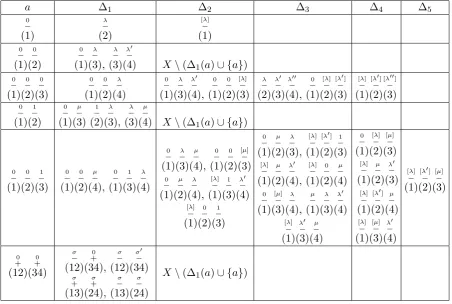
elements of X lying in the second disc. Tables 1 and 2 give, for each connected graph and each disc, a list of orbit representatives under the action of CG(a). We useλ, λ0 and so on to represent arbitrary
a ∆1 ∆2 ∆3 ∆4 0 − (1) λ − (2)
[λ]
− (1) 0 − (1) 0 − (2) 0 − (1) λ − (3) λ0 − (2) λ − (3), 0 − (1) [λ0]
−
(2)
[λ]
−
(1) [λ0]
− (2) 0 − (1) 1 − (2) 0 − (1) µ − (3), 1 − (2) λ − (3) 0 − (1) µ − (2), λ − (2) µ − (3), λ − (1) 1 − (2), µ − (1) λ − (3) µ − (1) λ − (2), [λ]
−
(1)
µ −
(3), [µ]
−
(2)
λ −
(3) [λ]
−
(1) [µ]
−
[image:20.595.102.511.52.155.2](2)
Table 1: Connected Graphs forG3 (with ke≥ko)
a ∆1 ∆2 ∆3 ∆4 ∆5
0 − (1) λ − (2)
[λ]
− (1) 0 − (1) 0 − (2) 0 − (1) λ − (3), λ − (3) λ0 −
(4) X\(∆1(a)∪ {a})
0 − (1) 0 − (2) 0 − (3) 0 − (1) 0 − (2) λ − (4) 0 − (1) λ − (3) λ0 − (4), 0 − (1) 0 − (2) [λ]
− (3) λ − (2) λ0 − (3) λ00 − (4), 0 − (1) [λ]
−
(2) [λ0]
−
(3) [λ]
−
(1) [λ0]
−
(2) [λ00]
− (3) 0 − (1) 1 − (2) 0 − (1) µ − (3) 1 − (2) λ − (3), λ − (3) µ −
(4) X\(∆1(a)∪ {a})
0 − (1) 0 − (2) 1 − (3) 0 − (1) 0 − (2) µ − (4), 0 − (1) 1 − (3) λ − (4) 0 − (1) λ − (3) µ − (4), 0 − (1) 0 − (2) [µ]
− (3) 0 − (1) µ − (2) λ − (4), [λ]
− (1) 1 − (3) λ0 − (4) [λ]
− (1) 0 − (2) 1 − (3) 0 − (1) µ − (2) λ − (3), [λ]
−
(1) [λ0]
−
(2) 1
−
(3) [λ]
− (1) µ − (2) λ0 − (4), [λ]
− (1) 0 − (2) µ − (4) 0 − (1) [µ]
− (3) λ − (4), µ − (1) λ − (3) λ0 − (4) [λ]
− (1) λ0 − (3) µ − (4) 0 − (1) [λ]
−
(2) [µ]
−
(3) [λ]
− (1) µ − (2) λ0 − (3) [λ]
−
(1) [λ0]
−
(2)
µ −
(4) [λ]
−
(1) [µ]
−
(3)
λ0 −
(4) [λ]
−
(1) [λ0]
−
(2) [µ]
− (3) 0 + (12) 0 + (34) σ − (12) 0 + (34), σ − (12) σ0 − (34) σ + (13) σ + (24), σ − (13) σ − (24)
[image:20.595.79.532.199.503.2]X\(∆1(a)∪ {a})
Table 2: Connected Graphs forG4 (with ke≥ko)
Figure 1 is the collapsed adjacency graph for a = 0 + (12) 0 − (3) 0 − (4) 0 −
(5) in G5, which has diameter 5. In