O R I G I N A L P A P E R
Open Access
First identification of primary nanoparticles in the
aggregation of HMF
Mu Zhang
1, Hong Yang
1*, Yinong Liu
1, Xudong Sun
2, Dongke Zhang
1and Dongfeng Xue
3Abstract
5-Hydroxymethylfurfural [HMF] is an important intermediate compound for fine chemicals. It is often obtained via hydrothermal treatment of biomass-derived carbohydrates, such as fructose, glucose and sucrose. This study investigates the formation of carbonaceous spheres from HMF created by dehydration of fructose under hydrothermal conditions. The carbonaceous spheres, ranging between 0.4 and 10μm in diameter, have granulated morphologies both on the surface and in the interior. The residual solution is found to contain a massive number of primary nanoparticles. The chemical structure of the carbonaceous spheres was characterised by means of FTIR and NMR spectroscopies. Based on these observations, a mechanism involving the formation and aggregation of the nanoparticles is proposed. This mechanism differs considerably from the conventional understanding in the open literature.
Keywords:saccharides, carbohydrate, HMF, nanoparticles, carbonaceous spheres
Introduction
Hydrothermal treatment of saccharides (e.g. fructose, glu-cose, sucrose and starch) at elevated temperatures has attracted much attention in recent years for its technologi-cal and scientific interests [1-6]. In general, hydrothermal treatment of saccharides produces water-soluble organic substances and insoluble carbonaceous solids. The soluble organic substances have been the focus of early research, and understanding of the chemical reaction process and the products has been well established by earlier research-ers [7,8]. In more recent years, the solid products, often referred to as humins in early studies, have attracted keen attention due to their potential for applications as func-tional nanomaterials or as nanotemplates for other materi-als [1,9-11]. Among these studies, several hypotheses have been suggested in the literature for the physical and che-mical mechanisms for the formation of these carbonac-eous solids, often in a spherical form. Earlier studies suggested that the carbonaceous spheres form via dehy-dration of saccharide molecules followed by aromatization under hydrothermal conditions. The carbonaceous spheres produced are thus expected to have a highly aromatic nucleus and a hydrophilic shell [1-5,9]. Another hypothesis
proposed by Wang et al. [12] suggests that sucrose mole-cules form a kind of amphiphilic micelle compound under hydrothermal conditions, and as the concentration of this compound reaches a critical micelle concentration, spheri-cal micelles develop. The carbonaceous spheres thus grow by the polymerization of sucrose molecules [12]. Yao et al. [2] proposed probably the most acceptable suggestion, in which fructose converts into 5-hydroxymethylfurfural [HMF] in the solution and then HMF monomers polycon-dense into nano-micro carbonaceous spheres via intermo-lecular dehydration. The microspheres further coalesce into larger spheres via a process analogous to emulsion coalescence. Despite the various concepts proposed, little direct experimental evidence have been reported in the lit-erature to support these hypotheses. More recently, Hu et al. [13] published a review paper on hydrothermal proces-sing of biomasses and pointed out:‘In the HTC process of carbohydrates, the formation process and the final mate-rial structures are rather complicated, and a clear scheme has not been reported’. This statement well summarises the current state of understanding of the products and their formation mechanisms.
To clarify this issue, we used fructose as a model precur-sor material to investigate the formation mechanism of the carbonaceous spheres under hydrothermal conditions. In this study, we identified for the first time the formation of primary nanoparticles, which serve as the building blocks * Correspondence: [email protected]
1School of Mechanical and Chemical Engineering and Centre for Energy, The
University of Western Australia, 35 Stirling Highway, Perth, Western Australia, 6009, Australia
Full list of author information is available at the end of the article
for the micron-sized carbonaceous spheres. Based on this observation, we are able to elucidate that the formation mechanism of carbonaceous spheres is via aggregation of the primary nanoparticles.
Experimental works
Fructose (99%, Sigma-Aldrich, Castle Hill, New South Wales, Australia) was used as the saccharide precursor for the hydrothermal treatment. The fructose was dissolved in distilled water to form a 7.5-wt.% solution. The solution was filled in a 100-ml, Teflon-lined, stainless steel auto-clave to 80% full. The autoauto-clave was placed into a pre-heated oven and maintained at a constant temperature ranging between 423 and 463 K for various durations up to 48 h. Carbon spheres formed were separated from the solution by centrifugation, followed by washing in distilled water and absolute ethanol for several times, and finally dried at 333 K for 24 h.
Morphology of the carbon spheres was characterised by means of scanning electron microscopy [SEM] (Zeiss 1555 instrument, Sydney, New South Wales, Australia) and transmission electron microscopy [TEM] (JEOL 3000 instrument, Sydney, New South Wales, Australia). Molecular structure of the carbon spheres was analysed by means of Fourier transform infrared [FTIR] spectro-scopy (PerkinElmer Spectrum GX FTIR spectrometer, Melbourne, Victoria, Australia) with a resolution of 4 cm-1. Samples for FTIR analysis were prepared by mixing the sample powders with KBr (Ajax Finechem Pty. Ltd., Sydney, New South Wales, Australia) and compacting into discs. Solid-state13C cross-polarisation magic angle spinning spectra were recorded with a Varian 400 MHz spectrometer (Melbourne, Victoria, Australia) with 4- or 6-mm zirconia rotors spinning at 5 kHz. A recycle delay of 2 s and a contact time of 2 ms were employed with SPINAC decoupling during acquisition. Typically, 1, 600 scans were acquired, and exponential multiplication with a line broadening of 100 Hz was applied prior to Fourier transformation.
Results
SEM and TEM identification of primary particles and their aggregation
Hydrothermal treatment of fructose solution in an auto-clave at temperatures in the range of 423 to 463 K for differ-ent times produced carbonaceous solids in a spherical shape. Figure 1 shows SEM images of carbon spheres pro-duced under hydrothermal conditions. Micrograph (a) shows carbon spheres synthesised at 423 K for 6 h. The spheres, typically 100 to 300 nm in diameter under these conditions, are granular on their surfaces. Micrograph (b) is a TEM image of the same sample, revealing the same features.
Hydrothermal treatment at higher temperatures pro-duced larger, smooth and nearly perfect spheres, with dia-meters in the range of 0.4 to 10μm. Micrograph (c) shows a sample treated at 453 K for 6 h. Micrograph (d) shows the surface morphology of a large, smooth sphere at high magnification. It is evident that the surface is rough and granulated. The granules are typically approximately 5 nm in size. To further examine the interior structure of the carbon spheres, the carbon sphere powders were cast into epoxy and then sliced for examination of their cross sec-tions. Micrographs (e) and (f) show the SEM images of a sliced sample. Micrograph (e) shows a low-magnification image of the cross section of the sample, capturing both populations of the large and small spheres. Micrograph (f) shows the details of the interior of the carbonaceous sphere, revealing that the interior consisted of entirely nano-sized particles, typically approximately 5 nm.
Figure 2 shows TEM images of a sample prepared from a residual fructose solution after hydrothermal treatment at 423 K for 6 h. It is seen that the residual solution con-tained a large population of nano-sized carbonaceous par-ticles. These nanoparticles, hereafter referred to as primary particles, are uniform and are typically approxi-mately 5 nm in size.
Chemical structure of carbonaceous spheres
Figure 3 shows an FTIR spectrum of carbon spheres synthesised at 453 K. The broad band at approximately 3, 300 cm-1corresponds to O-H stretching of carboxylic bonds [14]. The band at 2, 920 cm-1is due to asymmetric C-H stretching of aliphatic groups. The shoulder at 1, 704 cm-1 is an indication of undissociated carbonyl groups. The vibrations at 1, 604, 1, 510 and 1, 395 cm-1 are the characteristic band stretches of the five-member heteroaromatic ring with double bonds [15]. The bands at 800 to 700 cm-1may be assigned to strong hydrogen wag absorption of the five-membered ring with a CH = CH group unsubstituted [15]. This spectrum indicates that the carbon spheres are the derivatives of HMF, as evidenced by the signature five-member heteroaromatic rings. HMF is an intermediate compound formed via dehydration of fructose under hydrothermal conditions, as reported by Baccile et al. [16].
O-C = CH sites on the furan ring, respectively [16,17]. These peaks are attributed to a heterocyclic aromatic com-pound - furan, indicating the presence of HMF aromatic rings [17]. The broad peak at 170 to 180 ppm (marked by
*) is attributed to C = O groups in ketones and aldehydes from HMF, and embedded levulinic and formic acids [16]. The peak at 200.75 ppm (marked by #) is a spinning side band. This spectrum demonstrates that the carbonaceous spheres are composed of cross-linked furan rings derived from HMF, rather than graphene-type species or
(a)
100 nm
(b)
50 nm
10
μ
m
(c)
(e)
5
μ
m
(f)
100 nm
100 nm
(d)
(a)
100 nm
100 nm
(b)
50 nm
50 nm
10
μ
m
10
μ
m
(c)
(e)
5
μ
m
5
μ
m
(f)
[image:3.595.59.539.82.372.2]100 nm
100 nm
100 nm
100 nm
(d)
[image:3.595.57.291.482.703.2]Figure 1SEM and TEM images of carbonaceous spheres, revealing details of grainy surfaces and interiors. Carbon spheres produced at (a,b) 423 and (c,d) 453 K. (e,f) Cross-sectional views revealing the interior of the carbonaceous spheres.
Figure 2TEM image of primary nanoparticles in a residual fructose solution after hydrothermal treatment.
500 1000 1500 2000 2500 3000 3500 4000
T
ra
nsm
itt
a
n
ce
Wave Number (cm-1)
1704 1637 2925
1510 1022
3300 1604
797
1395
[image:3.595.302.541.504.702.2]saccharide molecular link, as claimed in the literatures [1-4,9]. This evidence, together with the FTIR analysis, further suggests that HMF, rather than fructose, is the feedstock of carbonaceous spheres. Elemental analysis of the solid carbon spheres showed that the spheres
contained 65.7 wt.% C, 4.3 wt.% H and 30.0 wt.% O, corre-sponding to a molecular formula of C6H0.59(H2O)2.06. This corresponds to a loss of 0.94 H2O per molecular unit of HMF.
Discussion
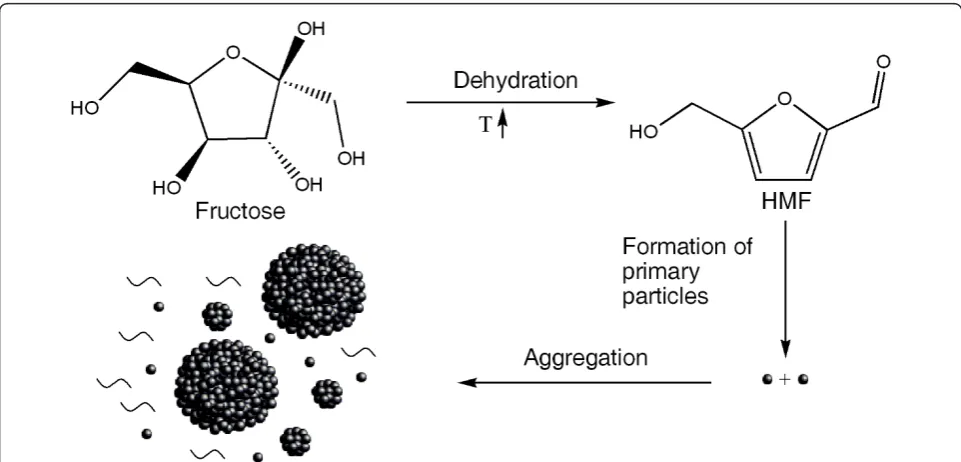
From all observations and analyses obtained in this study, we propose the following hypothesis as the for-mation mechanism of carbonaceous spheres from fruc-tose under hydrothermal conditions, as schematically illustrated in Figure 5. Under hydrothermal conditions, fructose undergoes dehydration to form HMF. This has been proven in the literature [8,18]. HMF monomer has active functional groups, such as the hydroxyl terminal. This renders the HMF monomer the ability to polycondense via intra-molecular dehydration through reactions between the hydroxyl and H-term-inals of different HMF monomers to form cross-linked furanic species. The continued growth in size of the cross-linked furanic species eventually results in the precipitation of the molecular clusters out of the solu-tion into the primary carbonaceous nanoparticles. These primary nanoparticles, having inherited the func-tional groups of HMF on their surfaces, may continue to aggregate via the same polycondensation reactions as those causing the formation of the primary particles, leading to the formation of the large, near carbonac-eous spheres. This concept, supported by the direct experimental evidence and the known chemistry of HMF, differs significantly from the conventional hypotheses in the open literature.
-50 0
50 100 150
200 250
Chemical Shift (ppm)
*
#
HMF
*
#
[image:4.595.57.292.87.333.2]HMF HMF
Figure 4 Solid state13C NMR spectrum of carbon spheres produced by fructose. Single arrows indicate aliphatic groups. Double arrows in dash box indicate furanic ring. Asterisk indicates C = O group.
[image:4.595.57.538.478.709.2]Conclusions
In this study, carbonaceous spheres were produced from fructose under hydrothermal conditions. The experimental evidence clearly demonstrates that the carbonaceous spheres are formed as aggregates of nanoparticles. TEM observation of residual solutions after hydrothermal treat-ment provides the direct and first evidence of the presence of these primary nanoparticles. Based on these observa-tions, a new mechanism for the formation of carbonaceous spheres from saccharides has been proposed. The mechan-ism involves three steps, including dehydration of fructose into HMF, polycondensation of HMF monomers into pri-mary particles via intra-molecular dehydration and aggre-gation of primary nanoparticles in carbonaceous spheres. This mechanism differs significantly from the conventional understanding in the open literature.
Acknowledgements
The authors wish to acknowledge the financial support from the Department of Innovation, Industry, Science and Research (DIISR) of the Australian government (Grant ISL-CH070104) and the Centre for Microscopy, Characterisation and Analysis of the University of Western Australia (UWA) for electron microscopy and microanalysis.
Author details
1School of Mechanical and Chemical Engineering and Centre for Energy, The
University of Western Australia, 35 Stirling Highway, Perth, Western Australia, 6009, Australia2School of Materials and Metallurgy, Northeastern University,
Wen Hua Road, Shenyang, 110004, People’s Republic of China3State Key
Laboratory of Rare Earth Resource Utilization, Changchun Institute of Applied Chemistry, Chinese Academy of Sciences, Ren Min Street, Changchun, 130022, People’s Republic of China
Authors’contributions
MZ carried out the experimental work and drafted the manuscript. HY is the guiding scientist who supervised the research and contributed to the scientific argument and in drafting of the manuscript. YNL is the co-supervisor who participated in the data analysis and drafting of the manuscript. XDS contributed in the planning of the experimental program and in discussing of carbon sphere formation mechanism. DKZ contributed in the analysis of FTIR experimentation and discussion of carbon sphere formation mechanism. DFX contributed in the theory of primary particles and the discussion of the chemical structure of carbon spheres. All authors read and approved the final manuscript.
Competing interests
The authors declare that they have no competing interests.
Received: 22 September 2011 Accepted: 5 January 2012 Published: 5 January 2012
References
1. Wang Q, Li H, Chen L, Huang X:Monodispersed hard carbon spherules with uniform nanopores.Carbon2001,39:2211-2214.
2. Yao CH, Shin YS, Wang LQ, Windisch CF, Samuels WD, Arey BW, Wang CM, Risen WM Jr, Exarhos GJ:Hydrothermal dehydration of aqueous fructose solutions in a closed system.J Phys Chem C2007,111:15141-15145. 3. Sevilla M, Fuertes AB:Chemical and structural properties of carbonaceous
products obtained by hydrothermal carbonization of saccharides.Chem Eur J2009,15:4195-4203.
4. Sevilla M, Fuertes AB:The production of carbon materials by hydrothermal carbonization of cellulose.Carbon2009,47:2281-2289.
5. Titirici MM, Antonietti M, Baccile N:Hydrothermal carbon from biomass: a comparison of the local structure from poly- to monosaccharides and pentose/hexoses.Green Chem2008,10:1204-1212.
6. Chen C, Sun X, Jiang X, Niu D, Yu A, Liu Z, Li J:A two-step hydrothermal synthesis approach to monodispersed colloidal carbon spheres.
Nanoscales Res Lett2009,4:971-976.
7. Romάn-Leshkov Y, Chheda JN, Dumesic JA:Phase modifiers promote efficient production of hydroxymethylfurfural from fructose.Science2006,
312:1933-1937.
8. Chheda JN, Romάn-Leshkov Y, Dumesic JA:Production of
5-hydroxymethylfurfural and furfural by dehydration of biomass-derived mono- and poly-saccharides.Green Chem2007,9:342-350.
9. Sun XM, Li YD:Colloidal carbon spheres and their core/shell structures with noble-metal nanoparticles.Angew Chem Int Ed Engl2004,43:597-601. 10. Titirici MM, Antonietti M, Thomas A:A generalized synthesis of metal
oxide hollow spheres using a hydrothermal approach.Chem Mater2006,
18:3808-3812.
11. Ji X, Huang X, Liu J, Jiang J, Li X, Ding R, Hu Y, Wu F, Li Q:Carbon-coated SnO2nanorod array for lithium-ion battery anode material.Nanoscales Res Lett2010,5:649-653.
12. Wang Q, Li H, Chen L, Huang X:Novel spherical microporous carbon as anode material for Li-ion batteries.Solid State Ionics2002,152-153:43-50. 13. Hu B, Wang K, Wu L, Yu S, Antonietti M, Titirici MM:Engineering carbon
materials from the hydrothermal carbonization process of biomass.Adv Mater2010,22:813-828.
14. Muscolo A, Sidari M, Attina E, Francioso O, Tugnoli V, Nardi S:Biological activity of humic substances is related to their chemical structure.Soil Sci Soc Am J2007,71:75-85.
15. Colthup NB, Daly LH, Wiberley SE:Introduction to Infrared and Raman
SpectroscopyNew York: Academic Press; 1975.
16. Baccile N, Laurent G, Babonneau F, Fayon F, Titirici MM, Antonietti M:
Structure characterization of hydrothermal carbon spheres by advanced solid-state MAS13C NMR investigations.J Phys Chem C2009,
113:9544-9554.
17. Memory JD:NMR of Aromatic CompoundsNorth Carolina: John Wiley & Sons; 1982.
18. Kuster BFM, van der Baan HS:The influence of the initial and catalyst concentrations on the dehydration of D-fructose.Carbohydrate Res1977,
54:165-176.
doi:10.1186/1556-276X-7-38
Cite this article as:Zhanget al.:First identification of primary nanoparticles in the aggregation of HMF.Nanoscale Research Letters2012
7:38.
Submit your manuscript to a
journal and benefi t from:
7Convenient online submission
7Rigorous peer review
7Immediate publication on acceptance
7Open access: articles freely available online
7High visibility within the fi eld
7Retaining the copyright to your article