N A N O E X P R E S S
Open Access
Band alignment and enhanced breakdown field
of simultaneously oxidized and nitrided Zr film
on Si
Yew Hoong Wong and Kuan Yew Cheong
*Abstract
The band alignment of ZrO2/interfacial layer/Si structure fabricated by simultaneous oxidation and nitridation of sputtered Zr on Si in N2O at 700°C for different durations has been established by using X-ray photoelectron spectroscopy. Valence band offset of ZrO2/Si was found to be 4.75 eV, while the highest corresponding conduction offset of ZrO2/interfacial layer was found to be 3.40 eV; owing to the combination of relatively larger bandgaps, it enhanced electrical breakdown field to 13.6 MV/cm at 10-6A/cm2.
Keywords:oxidation, sputtered-Zr, nitrous oxide, band alignment, electrical breakdown field
Background
Application of high dielectric constant () materials as future gate dielectrics on Si-based metal oxide semicon-ductor (MOS) devices has driven a tremendous research to realize an ultra-large-scale integrated circuitry with high performance and low power consumption [1-3]. Of various investigated high materials, ZrO2 is being con-sidered as a potential gate dielectric for the near future generation technology nodes. It has been reported that excellent electrical properties of MOS capacitors that incorporated ZrO2 thin film as gate dielectric [4,5]. Put-konenet al. [5] and Niinistoet al. [4] have obtained the breakdown fields of ZrO2at 6.0 and 9.5 MV/cm, respec-tively, at leakage current density of 10-2A/cm2. In order to attain excellent electrical properties of a device, inter-face properties of dielectric/Si play an indispensable role [6,7]. The leakage characteristic and electrical break-down field of gate dielectric are basically dependent on the bandgap of the dielectric and on the band alignment with Si [8,9]. Hence, to use ZrO2 as gate dielectric in MOS capacitors, it should have sufficiently high band offsets with Si (> 1.00 eV) for both holes (valence band offset) and electrons (conduction band offset), so that
an ultralow leakage current can be acquired [2,3]. Therefore, it is crucial to quantify these energy band off-sets. Additionally, it is necessary to consider an interfa-cial layer (IL) that is inevitably formed in between ZrO2 and Si in the evaluation of band alignment. Works along this direction were reported by a number of researchers (Table 1). It is summarized that band align-ment of the ZrO2/IL/Si system can be categorized into two types, depending on the oxide deposition techniques rather than the types (n or p) of semiconductor: type (i),
alignment of ZrO2 bandgap in between the IL bandgap
[10-13] and type (ii), alignment of ZrO2 conduction
band outside the IL bandgap [14]. In this work, using simultaneous oxidation and nitridation of sputtered Zr
on n-type Si in N2O, alignment of ZrO2 valence band
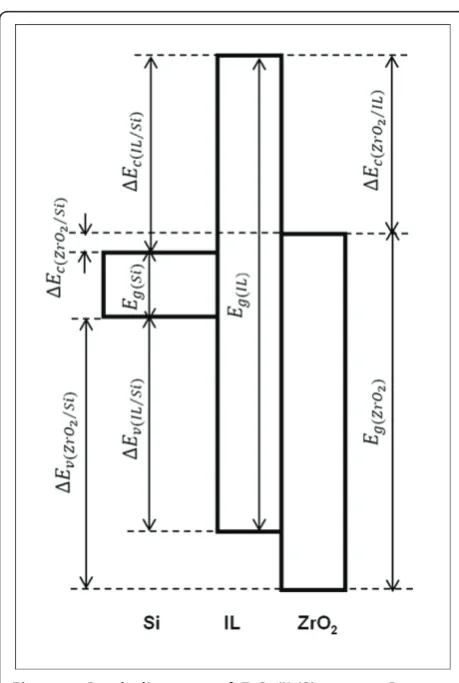
outside the IL bandgap has been revealed [type (iii) in Table 1] (Figure 1). Owing to this type of alignment, dielectric electric breakdown field at low leakage current density has been enhanced.
Results and discussion
Figure 2a shows typical X-ray photoelectron spectro-scopy (XPS) valence band spectra of ZrO2and IL for all investigated samples. The valence band edges (Ev) of ZrO2 and IL were estimated by an intercept of linear extrapolation of a maximum negative slope near the edge to the minimum horizontal baseline [10]. As a result, valence band offsets (ΔEv) of ZrO2 and IL with
* Correspondence: [email protected]
Energy Efficient and Sustainable Semiconductor Research Group, School of Materials and Mineral Resources Engineering, Universiti Sains Malaysia, Engineering Campus, 14300 Nibong Tebal, Seberang Perai Selatan, Penang, Malaysia
respect to Si substrate were 4.75 ± 0.05 eV and 3.75 ± 0.05 eV, respectively, for all investigated samples. To determine conduction band offset (ΔEc) of ZrO2/IL/Si system, the bandgaps (Eg) of ZrO2 and IL were first
deduced from O 1s plasmon loss spectra [15,16] of
ZrO2 and IL, respectively. Figure 2b representatively
demonstrates the XPS O 1s plasmon loss spectra of
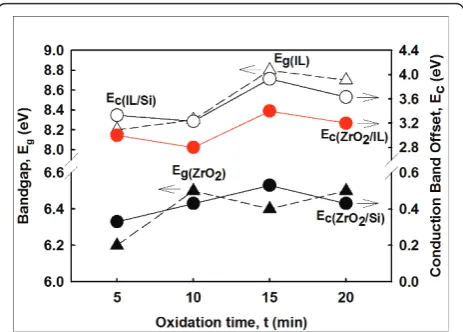
ZrO2 and IL for a 15-min sample. Whilst for other sam-ples, theEgvalues of ZrO2 and IL extracted from their
[image:2.595.58.538.101.187.2]respective O 1s plasmon loss spectra are shown in
Figure 3. As explained earlier, values of Eg were also approximated by an intercept of linear extrapolation. The extracted Eg values of ZrO2 and IL were 6.20 to Table 1 Comparison of the obtained values ofEg(ZrO2),Eg(IL),ΔEv, andΔEc
Type Deposition method Eg(ZrO2) Eg(IL) ΔEv ΔEc Reference
(i) Evaporation 5.50 8.60 1.00 1.90 [10]
Sputtering 5.40 7.60 1.00 1.20 [11]
Atomic layer chemical vapor deposition 5.80 7.60 1.15 1.05 [12] Electron beam deposition of Zr + oxidation in O2 5.80 9.00 1.80 1.40 [13]
(ii) PLD 5.70 4.70 3.30 to 3.50 1.50 [14]
(iii) Sputtering of Zr + oxidation and nitridation in N2O 6.20 to 6.50 8.20 to 8.80 4.75 3.40 This work
Type (i) defines alignment of ZrO2bandgap in between the IL bandgap and type (ii) defines alignment of ZrO2conduction band outside the IL bandgap. Type
[image:2.595.306.538.322.681.2](iii) defines ZrO2valence band outside the IL bandgap which is obtained from this work.
Figure 1 Band alignment of ZrO2/IL/Si system. Eg(ZrO2) =
bandgap of ZrO2,Eg(IL)= bandgap of IL,Eg(Si)= bandgap of Si,ΔEv
(ZrO2/Si)= valence band offsets of ZrO2to Si,ΔEv(IL/Si)= valence band
offsets of IL to Si,ΔEc(ZrO2/Si)= conduction band offset of ZrO2to Si,
ΔEc(IL/Si)= conduction band offset of IL to Si,ΔEc(ZrO2/IL)=
conduction band offset of ZrO2to IL.
Figure 2 XPS valence band spectra of ZrO2and IL for all
investigated samples. (a) XPS valence band spectra of ZrO2and IL
for all investigated samples. (b) XPS O 1splasmon loss spectra of ZrO2and IL for 15-min sample.
Wong and CheongNanoscale Research Letters2011,6:489 http://www.nanoscalereslett.com/content/6/1/489
[image:2.595.57.287.327.669.2]6.50 eV and 8.20 to 8.80 eV, respectively, with tolerance of 0.05 eV, dependent on the oxidation time (Figure 3). Ultimately, conduction band offset of ZrO2 to IL, ΔEc (ZrO2/IL) for the ZrO2/IL/Si system can be eventually derived [17]:
Ec(ZrO2/IL)=Eg(IL)−Ev(IL/Si)+Ev(ZrO2/Si)−Eg(ZrO2), (1)
where, Eg(ZrO2) and Eg(IL)are the bandgaps of ZrO2 and IL, respectively. ΔEv(ZrO2/Si) and ΔEv(IL/Si) are the valence band offsets of ZrO2 and IL, respectively, with respect to Si substrate. The calculated values ofEg(ZrO2),
Eg(IL), ΔEc(ZrO2/Si), ΔEc(IL/Si), and ΔEc(ZrO2/IL) are pre-sented in Figure 3. The highest value ofΔEc(ZrO2/IL), i.e., 3.40 eV, was attained by sample oxidized/nitrided for 15 min (Figure 3) when compared to other samples. A schematic of the band alignment of the ZrO2/IL/Si sys-tem is illustrated in Figure 1. The Eg value of Si sub-strate is obtained from literature [3,18]. It is found that values of Eg(ZrO2), Eg(IL), ΔEc, and ΔEv obtained in this study are higher than the values reported in literatures (Table 1).
Figure 4 shows typical leakage current density electric field (J-E) characteristics of the investigated samples. TheJ-Eplot was transformed from current-voltage (I-V) measurement. TheEvalue was estimated by first deter-mining the flatband voltage (VFB) shift from the applied gate voltage (Vg) and then dividing the total thicknesses of ZrO2 and IL (tox) measured by energy filtered trans-mission electron microscopy (EFTEM) (images are not shown here). The acquired Jvalue in this study is ~10 -8
A/cm2 at E = 2.0 MV/cm, which is lower than the
other studies [4,5,14].
A two-step oxide breakdown (BK-1 and BK-2) is being recorded in the J-E plot for all investigated samples
(inset of Figure 4). The existence of interfacial and ZrO2 layers in the sample is the main cause of this two-step breakdown [19]. The breakdowns can be explained as follows. One of the layers may experience an electrical breakdown at a lower field, which is labeled as BK-1. Subsequently, another layer would block the carriers. Due to the increment of the electric field, the concen-tration of the carrier increases until the layer is electri-cally broken down at a higher electric field at BK-2. The instantaneous increment of leakage current density at BK-1 is relatively small when compared with others, and it is defined as soft breakdown. The magnitude of BK-1 increases gradually as the oxidation time is increased (inset of Figure 4). In contrast, the instantaneous incre-ment of current density at BK-2 is large, and this is con-sidered as hard breakdown. The highest dielectric breakdown field, which is referred to as hard break-down, is attained by sample oxidized/nitride for 15 min
(13.6 MV/cm at 10-6 A/cm2). The lowest one is
recorded by sample oxidized/nitride for 10 min (4.8 MV/cm at 10-6 A/cm2). In comparison, dielectric break-down field recorded in this work is higher than the pre-vious reported works [4,5,14].
Conclusions
In summary, the band alignment of ZrO2/IL/Si structure produced by simultaneous oxidation and nitridation of sputtered Zr thin film on Si in N2O has been estab-lished. Via this method, higher ΔEcandΔEvvalues have been attained. Hence, a higher electrical breakdown field at low leakage current density has been achieved.
Methods
The n-type Si(100) substrate with a resistivity of 1 to
[image:3.595.306.539.86.259.2]10 Ω cm was used in this study. After undergoing a
Figure 3 Eg values of ZrO2 and IL extracted from their
respective O 1splasmon loss spectra. The calculated values ofEg (ZrO2),Eg(IL),ΔEc(ZrO2/Si),ΔEc(IL/Si), andΔEc(ZrO2/IL)in the band alignment
[image:3.595.58.290.88.254.2]of ZrO2/IL/Si system.
Figure 4J-Echaracteristics of the investigated Al/ZrO2/IL/Si
standard wafers cleaning process, a 5-nm thick Zr film was sputtered on the cleaned Si substrates by an RF sputtering system. Following that, samples were loaded into a horizontal tube furnace and were heated up from room temperature to 700°C in an Ar flow ambi-ent, and the heating rate was fixed at 10°C/min. Once the set temperature was achieved, N2O gas was intro-duced with a flow rate of 150 mL/min for a set of durations (5, 10, 15, and 20 min). After the furnace was cooled down to room temperature in an Ar ambi-ent, the samples were withdrawn from the furnace. To experimentally determine band alignment of the dielectric/semiconductor structure, XPS measurements were conducted using Kratos Axis Ultra DLD (Kratos Analytical, Chestnut Ridge, NY, USA). with a
mono-chromatic Al-Ka X-ray source (hν = 1,486.69 eV)
performed at the Research Center for Surface and Materials Science, The Auckland University, New Zealand. The spectra of survey or wide scan (binding energy of -5 to 25 eV) were collected at a take off angle of 0° with respect to surface normal, with low pass energy of 20 eV and small step size of 0.1 eV. Due to the onset of single particle excitation and band-to-band transition, the energy loss spectrum of O 1sphotoelectron provides further insight on the band-gaps of ZrO2 and IL [20]. Subsequently, a detail scan
of O 1s was carried out using the same pass energy
and step size of 1.0 eV. Ar ion gun (5 keV) was employed to etch the sample in order to perform che-mical depth profiling (results are not shown here), in order for the boundary of ZrO2 and IL to be identified. A Shirley background function, which is proportional to the integrated photoelectron peak area, was sub-tracted from all of the XPS spectra to correct for the inelastic photoelectron scattering effect [21]. Band alignment extraction was based on Kraut method [15,16]. As to characterize the leakage characteristic and electrical breakdown field of the film, MOS capaci-tor test structure was formed by thermally evaporated a 100-nm thick aluminum (Al) film, acting as a gate elec-trode, on top of the films. The area of a capacitor was photolithographically defined at 9 × 10⁻⁴cm2. In order to obtain an Ohmic back contact, a 100-nm thick Al film was thermally evaporated on the backside of the Si substrate after removal of native oxide.I-V measure-ments were performed by a computer-controlled Agi-lent HP4155-6C semiconductor parameter analyzer (Agilent Technologies, Santa Clara, CA, USA).
Acknowledgements
The authors would like to acknowledge the support provided by USM fellowship, USM-RU-PRGS (8032051), and The Academy of Sciences for the Developing World (TWAS) through the TWAS-COMSTECH research grant (09-105 RG/ENG/AS_C) during the study.
Authors’contributions
YHW has been involved in the experimental design, data acquisition, data interpretation and analysis, and drafting and revision of the manuscript. KYC has been involved in revising the manuscript critically for important intellectual content and has given final approval to the version to be submitted for publication.
Competing interests
The authors declare that they have no competing interests.
Received: 11 April 2011 Accepted: 10 August 2011 Published: 10 August 2011
References
1. Robertson J:High dielectric constant oxides.Eur Phys J Appl Phys2004, 28:265-291.
2. Wilk GD, Wallace RM, Anthony JM:High-k gate dielectrics: current status and materials properties considerations.J Appl Phys2001,89:5243-5275. 3. Wong YH, Cheong KY:ZrO2thin films on Si substrate.J Mater Sci: Mater
Electron2010,21:980-993.
4. Niinisto J, Putkonen M, Niinisto L, Kukli K, Ritala M, Leskela M:Structural and dielectric properties of thin ZrO2films on silicon grown by atomic
layer deposition from cyclopentadienyl precursor.J Appl Phys2004, 95:84-91.
5. Putkonen M, Niinistö J, Kukli K, Sajavaara T, Karppinen M, Yamauchi H, Niinistö L:ZrO2thin films grown on silicon substrates by atomic layer
deposition with Cp2Zr(CH3)2and water as precursors.Chem Vap Dep
2003,9:207-212.
6. Aygun G, Yildiz I:Interfacial and structural properties of sputtered HfO2
layers.J Appl Phys2009,106:014312-014317.
7. Weinreich W, Ignatova VA, Wilde L, Teichert S, Lemberger M, Bauer AJ, Reiche R, Erben E, Heitmann J, Oberbeck L, Schroder U:Influence of N2
and NH3annealing on the nitrogen incorporation and k-value of thin
ZrO2layers.J Appl Phys2009,106:034107-034107.
8. Chen Q, Feng YP, Chai JW, Zhang Z, Pan JS, Wang SJ:Band alignment and thermal stability of HfO2gate dielectric on SiC.Appl Phys Lett2008,
93:052104-052103.
9. Yim CJ, Ko DH, Jang MH, Chung KB, Cho MH, Jeon HT:Change in band alignment of HfO2films with annealing treatments.Appl Phys Lett2008,
92:012922-012923.
10. Miyazaki S:Characterization of high-k gate dielectric/silicon interfaces.
Appl Surf Sci2002,190:66-74.
11. Houssa M, Tuominen M, Naili M, Afanas’ev V, Stesmans A, Haukka S, Heyns MM:Trap-assisted tunneling in high permittivity gate dielectric stacks.J Appl Phys2000,87:8615-8620.
12. Afanas’ev VV, Houssa M, Stesmans A, Heyns MM:Band alignments in metal-oxide-silicon structures with atomic-layer deposited Al2O3and
ZrO2.J Appl Phys2002,91:3079-3084.
13. Fulton CC, Cook JTE, Lucovsky G, Nemanich RJ:Interface instabilities and electronic properties of ZrO2on silicon (100).J Appl Phys2004,
96:2665-2673.
14. Yamaguchi T, Satake H, Fukushima N:Band diagram and carrier conduction mechanisms in ZrO2MIS structures.IEEE Trans on Electron
Devices2004,51:774-779.
15. Kraut EA, Grant RW, Waldrop JR, Kowalczyk SP:Precise determination of the valence band edge in x-ray photoemission spectra: application to measurement of semiconductor interface potentials.Phys Rev Lett1980, 44:1620.
16. Kraut EA, Grant RW, Waldrop JR, Kowalczyk SP:Semiconductor core-level to valence band maximum binding-energy differences: precise determination by x-ray photoelectron spectroscopy.Phys Rev B1983, 28:1965.
17. Zhu LQ, Zhang LD, Li GH, He G, Liu M, Fang Q:Thermal stability and energy-band alignment of nitrogen-incorporated ZrO2films on Si(100).
Appl Phys Lett2006,88:232901-232903.
18. Muller RS, Kamins TI:Device Electronics for Integrated Circuits, 2 1986, 54. 19. Xiaolong Y, Qianghua X, Tao M:Electrical breakdown in a two-layer
dielectric in the MOS structure.Mat Res Soc Symp Proc2004,811:D2.8.1. 20. Miyazaki S, Nishimura H, Fukuda M, Ley L, Ristein J:Structure and
electronic states of ultrathin SiO2thermally grown on Si(100) and Si
(111) surfaces.Appl Surf Sci1997,113-114:585-589. Wong and CheongNanoscale Research Letters2011,6:489
http://www.nanoscalereslett.com/content/6/1/489
21. Shirley DA:High-resolution x-ray photoemission spectrum of the valence bands of gold.Phys Rev B1972,5:4709.
doi:10.1186/1556-276X-6-489
Cite this article as:Wong and Cheong:Band alignment and enhanced
breakdown field of simultaneously oxidized and nitrided Zr film on Si.
Nanoscale Research Letters20116:489.
Submit your manuscript to a
journal and benefi t from:
7 Convenient online submission
7 Rigorous peer review
7 Immediate publication on acceptance
7 Open access: articles freely available online
7 High visibility within the fi eld
7 Retaining the copyright to your article