International Journal of Emerging Technology and Advanced Engineering
Website: www.ijetae.com (ISSN 2250-2459, ISO 9001:2008 Certified Journal, Volume 7, Issue 10, October 2017)
253
Optimization of Process Parameters Affecting on Spring-Back
in V-Bending Process for Deep Draw Steel using FEA and
Taguchi Technique HSLA 420 and S12 Materials
Navajyoti Panda
1, Dr. R. S Pawar
21
Department of Mechanical Engineering, Shreyash College of Engineering & Technology, Aurangabad, M.S., India
2Principal, Shreyash College of Engineering & Technology, Aurangabad, M.S., India
Abstract— In this study, process parameters like punch
angle, die opening, grain direction and pre bend condition of the strip for deep draw steel are investigated. The finite element method (FEM) in association with the Taguchi and the analysis of variance (ANOVA) techniques are carried out to investigate the degree of importance of process parameters in V-bending process. From results it is observed that punch angle had major influence on the spring-back. Die opening also showed very significant role on springback. On other hand, it is revealed that grain direction had least impact on springback however if strip from flat sheet is taken then it is less prone to springback as compared to the strip from sheet metal coil. Hyper Form software is used for FEM simulation and experiments are designed using Taguchi method. Percentage contribution of the parameters is obtained through the ANOVA technique.
Keywords— Bending, V-bending, FEM, Spring-back, Taguchi, Hyperform, Profile projector, HSLA 420 & St12 Materials.
I. INTRODUCTION
Manufacturing industries are very much concerned about the manufacturing of high-precision sheet metal. Sheet metals are used in automotive industries, housing-utensil industries and electronics industries. Every industry is trying to reduce the trial time to deliver the good quality product on time. Sheet metal bending is the most widely used process in sheet metal industries. Spring-back is a very common and critical phenomenon in sheet metal forming operations, which is caused by the elastic redistribution of the internal stresses after the removal of deforming forces. Spring-back compensation is absolutely essential for the accurate geometry of sheet metal components.
However, the spring-back is studied in most of these researches. For examples, H K Yi, [1] studied a model based on differential strains after relief from the maximum bending stress , derived for six different deformation patterns in order to predict spring back analytically.
Thaweepat Buranathiti and Jian Cao [2] studied an effective analytical model for spring back prediction in straight flanging processes. The effect of punch height on V bending angle is examined by SutasnThipprakmas [3] using finite element model and results are validated through experiments. Effects of process variables on V-die bending process of steel sheet are discussed by You-Min Huang [4]. The investigation deals with a model which predicts the correct punch load for bending and the precise final shape of products after unloading, in relation to the tensile properties of the material and the geometry of tools. Ján SLOTA and Miroslav JURČIŠIN [5] analyzed TRIP, AHSS and mild steel considering normal anisotropic behavior of the materials for prediction of Springback in v- bending for automotive industry using experimental and numerical approaches. Himanshu V. Gajjar [6] focused on application of Hyperform, LS-DYNA for Finite Element Analysis of Sheet Metal Air – bending. Wang et al. [7] studied the spring-back control of sheet metal air bending process. W.M. Chan [8] also focused on Finite element analysis of spring-back of V-bending sheet metal forming processes where he investigated spring-back in the V- bending metal forming process with one clamped end and one free end. Different die punch parameters such as punch radius, punch angle and die-lip radius are varied to study their effect on spring-back. High-accuracy V-bending system by real time identifying material property is examined in by KazunariImaia [9] in which a bending system is proposed in order to realize high precision V- bending. Leu and Hsieh [10] investigated the influence of the coining force on spring-back reduction in V-die bending process the simulation model of the V bending process of sheet metals is elaborated by Florica Mioara Groze [11] where ABACUS is used for finite element
simulation for springback prediction of the v
International Journal of Emerging Technology and Advanced Engineering
Website: www.ijetae.com (ISSN 2250-2459, ISO 9001:2008 Certified Journal, Volume 7, Issue 10, October 2017)
254
Peng Chenb, Muammer Koc¸ in [13] studied the Simulation of springback variation in forming of advanced high strength steels for advanced high strength steel (AHSS) parts. Design of experiment (DOE) i.e. Response Surface Method and finite element analysis (FEA) approach is used for the variation simulation and analysis. Vijay Gautam [14] studied effects of punch profile radius and localized compression on springback in v-bending of high strength steel using Taguchi method. M.V. Inamdar, P.P. Date and U.B. Desai [15] presented prediction of springback in air V bending of metallic sheets using an artificial neural network. The phenomena of springback control in the bending process of aluminum sheets by hybrid forming process is investigated by A. Gisario [16] using Experimental analysis, empirical and neural network modeling. Kazan [17] predicted spring-back in wipe-bending process of sheet metal using neural network.Although many researches have been conducted the study for various factors affecting on spring-back but the study of factors affecting on springback such as punch angle, die opening, grain direction of sheet metal and pre bend condition of strip for sheet metal V bending for deep draw steel have not been researched yet. The aim of the presented work is to examine the degree of importance of process parameters such as punch angle, die opening, grain direction of sheet metal and pre bend condition of strip for sheet metal V bending for deep draw steel, using Finite Element Simulation, Design of Experiments (Taguchi Method) and the analysis of variance (ANOVA). The commercial software Hyper-Form is used to carry out the prediction of spring-back. The FEM simulation results are verified by the experiments. The percentage contribution of each affecting factor on springback is estimated with help of ANOVA technique. The results elucidated the degree of importance of each process parameter. The punch angle has a major influence on the spring-back along with die opening. Again it is also found that grain direction of sheet metal and pre bend condition of strip had less impact on springback for the given case.
II. METHODOLOGY
A. Taguchi method
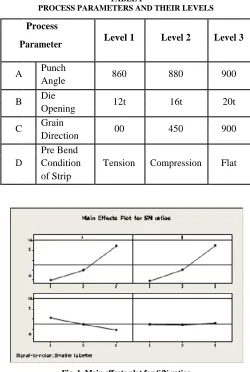
In the given study experiments are designed using Taguchi method with L18 orthogonal array. Four process parameters with three levels, including punch angle, die opening, grain directions of sheet metal and pre bend condition of strip are applied. Process parameters along with their levels selected for the study are shown in Table I.
The spring-back angle is taken as process response. The characteristics ‘‘Smaller is better’’ for signal-to-noise ratio is considered for process response.
Analysis of variance is a method of partitioning variability into identifiable sources of variation and the associated degrees of freedom in an experiment.
[image:2.612.318.568.249.621.2]The percentage contribution of each affecting parameter on springback is estimated with the help of ANOVA technique.
TABLE I
PROCESS PARAMETERS AND THEIR LEVELS
Process
Level 1 Level 2 Level 3 Parameter
A Punch 860 880 900
Angle
B Die 12t 16t 20t
Opening
C Grain 00 450 900
Direction
Pre Bend
D Condition Tension Compression Flat
of Strip
Fig. 1. Main effects plot for S/N ratios
International Journal of Emerging Technology and Advanced Engineering
Website: www.ijetae.com (ISSN 2250-2459, ISO 9001:2008 Certified Journal, Volume 7, Issue 10, October 2017)
255
It is also seen that S/N is lower for process parameter pre bend condition of the strip (C) and it is lowest for process parameter grain direction of sheet metal (D).B. Experimental procedure
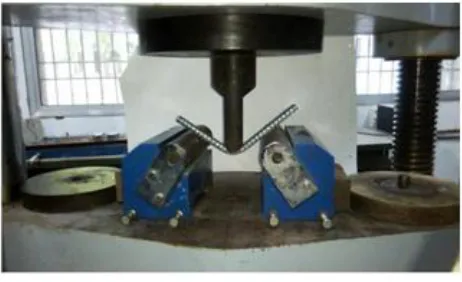
For experimental procedure three V-bending dies with die opening 12t, 16t and 20t are used keeping die angle and die radius constant where ‘t’ is the thickness of sheet metal. Three punches with 860,880 and 900 punch angles are used keeping punch radius constant as shown in fig.3. Experiments are performed on universal tensile testing machine in the laboratory with the same FEM simulation conditions. The laboratory experiments are carried out to validate the FEM simulation results. Fig. (2.A), (2. B) & (2.C) show the actual experimental set up used. The V bending angle of the component is examined using the profile projector.
Figures and tables must be cantered in the column. Large figures and tables may span across both columns. Any table or figure that takes up more than 1 column width must be positioned either at the top or at the bottom of the page.
Fig. 2. (A) Experimental Setup on Universal Testing Machine
Fig. 2. (B) Punches and Dies for Experimentation
Fig. 2. (C) Experimental Setup on Universal Testing Machine
Figures must be numbered using Arabic numerals. Figure captions must be in 8 pt Regular font. Captions of a single line must be centered whereas multi-line captions must be justified. Captions with figure numbers must be placed after their associated figures
C. FEM simulation procedure
In the presented work FEA simulation of V bending of sheet metal is performed using Hyper Form. Solid elements are used for meshing the sheet metal. Punch and die are meshed with rigid mesh which means there will not be any effect on punch and die during analysis. Type of mesh and number of elements are kept constant during all simulations. Fig. 3. (A) & Fig. 3. (B) Shows the FEA simulation model in Hyper Form. The sizes of strip used for FEA simulation and actual experimentation are 90 mm in length, 30 mm in width and 2.4 mm in thickness. Hyper-Form is used as the FEM simulation tool. A punch angle of 860,880 and 900, a material thickness (t) of 2.4mm, and die opening of 12t, 16t and 20t, grain direction of sheet metal 00,450 and 900 and pre bend condition of strip i.e. sample is taken from sheet metal coil and studied from both sides. Another sample is taken from flat sheet and investigated.
[image:3.612.324.562.137.287.2] [image:3.612.53.284.399.540.2] [image:3.612.49.289.561.667.2]International Journal of Emerging Technology and Advanced Engineering
Website: www.ijetae.com (ISSN 2250-2459, ISO 9001:2008 Certified Journal, Volume 7, Issue 10, October 2017)
256
Fig.3. (A) FEA model for hyper form simulation
Fig.3. (B) FEA model Pre-process form Hypermesh
III. RESULTS AND DISCUSSION
A.Application of ANOVA
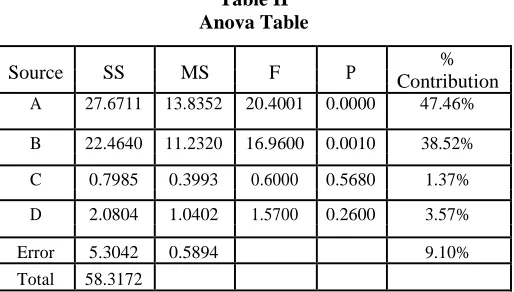
The process parameters and their levels investigated in springback and are listed in Table I. To investigate the degree of importance of the process parameters, therefore, the ANOVA technique is carried out in this case. The ‘‘Smaller is better (S/N)’’ characteristics are considered for the spring-back. The SS, MS, F, P and percentage contributions calculated for each process parameters in the case of spring-back are illustrated in Table II.
[image:4.612.50.287.137.527.2]In the case of spring-back, the percentage contributions of the punch angle, die opening, pre bend strip condition and grain direction are 47.45%, 38.52%, 3.57% and 1.37% respectively. Based on these statistical analysis results, it is found that the degree of importance of process parameters in V-bending process depended on punch angle (A), die opening (B), pre bend condition of the strip (C) and grain direction of sheet metal (D).
Table II Anova Table
Source SS MS F P Contribution %
A 27.6711 13.8352 20.4001 0.0000 47.46%
B 22.4640 11.2320 16.9600 0.0010 38.52% C 0.7985 0.3993 0.6000 0.5680 1.37% D 2.0804 1.0402 1.5700 0.2600 3.57%
Error 5.3042 0.5894 9.10%
Total 58.3172
As shown in the results, for the given case of spring-back the process parameters of the punch angle had the most influence, followed by similar influence of die opening and the small influence of the pre bend strip condition and the grain direction.
B.Effects of process parameters on the spring-back
In the presented work, the effects of punch angle, die opening, grain direction and pre bend condition of strip are clearly investigated and identified based on the tensile and compressive stress distribution analysis using Hyper Form.
The results showed that as punch angle is changing from 860 to 900 tensile and compressive stresses are also increasing. It is also observed that percent strain is higher for 860 and lower for 900 after removal of punch causing lower springback. It is also observed that as the die opening is increased, the amount of spring-back is reduced. In addition, the pre bend strip condition is also simulated and it is found that for given case it also had impact on springback on lower scale. With FEM simulation as well as experimental validation it is observed that grain direction did not influence the springback significantly.
[image:4.612.317.574.244.390.2]International Journal of Emerging Technology and Advanced Engineering
Website: www.ijetae.com (ISSN 2250-2459, ISO 9001:2008 Certified Journal, Volume 7, Issue 10, October 2017)
257
In the presented work the mechanism of spring-back related to process parameters punch angle (A), die opening (B), pre bend condition of the strip (C) and grain direction of sheet metal (D) is clearly identified based on the tensile and compressive stress distribution analysis. It found that as the die opening increased tensile and compressive stresses are also increased. It is investigated that the increase in punch angle also increased the tensile and compressive stresses.Hence, with these characteristics, as the die opening increased, the amounts of spring-back decreased. However it is also observed that with tensile and compressive stresses are higher for flat condition of the strip. In FEM simulation for the grain directions no significant change is observed in tensile and compressive stresses and thereby in springback.
The results illustrated that the punch angle had a great influence on the tensile and compressive stresses whereas die opening is found to be the second most influencing parameter on tensile and compressive stresses. The grain direction and pre bend condition of strip had a less influence on tensile and compressive stresses and hence on springback. Fig.4 explains the effect of each process parameter on tensile stresses and compressive stresses.
Fig.4 Tensile stress & compressive stresses
Fig.6 (a) & Fig.6 (b) shows a tensile and compressive stresses generated during one experiment with 900 punch angle, 20 ton die opening, flat strip condition and 00 grain direction. Similarly results are obtained for all 18 experiments as per Taguchi Technique for percentage of strain after removal of bending force for all cases.
Based on the tensile and compressive stress distribution the effects of process parameters and degree of importance of process parameters are clearly analyzed by the ANOVA technique. It observed that the punch angle and die opening had a major influence on spring-back.
Fig.5. % Strain after removal of applied force
Fig.6 (a) Tensile Stress during bending
Fig.6 (b) Compressive stresses during bending
Comparing the FEM simulation and Experimental results
International Journal of Emerging Technology and Advanced Engineering
Website: www.ijetae.com (ISSN 2250-2459, ISO 9001:2008 Certified Journal, Volume 7, Issue 10, October 2017)
258
In this study, experiments are carried out to confirm the accuracy of FEM simulation results especially for the case of punch angle, die opening, pre bend strip condition and grain direction for deep draw steel. Fig. 8 shows the comparison between the FEM simulation and the experimental results.Fig.8. Comparison between experimental and FEM results
IV. CONCLUSIONS
In the presented work four process parameters like punch angle, die opening, grain direction and pre bend condition of strip affecting on springback in V-bending process for deep draw steel HSLA 420 and St12 are analyzed and studied using FEM simulation, Taguchi and the ANOVA techniques. The results obtained through FEM simulation are validated by Laboratory experimentation. From the above study it is observed that two process parameters punch angle and die opening had major influence on springback with their approximately calculated percentage contribution of 47.45% and 38.52% respectively because as punch angle increased from 860 to 900 tensile and compressive stresses induced into the strip are also increasing from 335 MPa to 385 MPa and 392 MPa to 486 MPa respectively. The more stresses generated during the process yields the material to plastic state which results into the less straining after removal of the bending force. The percentage straining after removal of bending force for the punch angle from 860 to 900 found to 7.04% to 1.22%. Same is the case for die opening as die opening is increasing from 12t to 20t tensile and compressive stresses induced into the strip are also increasing from 320 MPa to 380 MPa and 385 MPa to 485 MPa respectively. The more stresses generated during the process yields the material to plastic state which results into the less straining after removal of the bending force. The percentage straining after removal of bending force for the die opening from 12t to 20t found to 7.55% to 1.35%.
On other hand the unique parameter studied here i.e. pre bend condition of strip also had influence on springback with its approximately calculated percentage contribution of 3.57%. Grain direction is identified as the parameter with least influence on springback with its approximately calculated percentage contribution of 1.37%. The effects of above process parameters could be clearly identified through tensile stress and compressive stress distribution analysis using Hyper Form. It is presented that, the punch angle and die opening had a major effect on the tensile and compressive stresses. Hence to find the optimum value of springback the designer has to concentrate on punch angle and die opening.
REFERENCES
[1] H K Yi1, D W Kim1, C J Van Tyne2, and Y H Moon1, Analytical
prediction of springback based on residual differential strain during sheet metal bending. Int. J. Mech. Sci., 2008, 117- 129
[2] Thaweepat Buranathiti and Jian Cao, An effective analytical model
for spring back predictionin straight flanging processes,Int. J. Materials and Product Technology,2004,137-153
[3] SutasnThipprakmas, Finite element analysis of punch height effect
on V-bending angle, Materials and Design 31 (2010) 1593– 1598
[4] You-Min Huang and Daw-KweiLeu, effects of process variables on
v-die bendingprocess of steel sheet, Int. J. Mech. Sci.Vol. 40, No. 7, 631 - 650, 1998
[5] Ján SLOTA and Miroslav JURČIŠIN, Experimental and
Numerical Prediction of Springback in V-Bending of Anisotropic sheet metals for automotive industry, Mechanika z. 84 (3/12) 2012, 55-68
[6] Himanshu V. Gajjar, Anish H. Gandhi, and Harit K. Raval, Finite
Element Analysis of Sheet Metal AirbendingUsing Hyperform LS-DYNA, World Academy of Science, Engineering and Technology 8 2007, 92-97
[7] Wang J, Verma S, Alexander R, Gauc J. Spring-back control of
sheet metal air bending process. J Manuf Process 2008;10:21– 7.
[8] W.M.Chan*,H.I.Chew, H.P. Lee, B.T.Cheok, Finite element analysis
of springback of V bending sheet metal forming processes, Journal of Materials Processing Technology 148 (2004) 15-24
[9] KazunariImaia,, Junichi Koyama, Yingjun Jin, High-accuracy
V-bending system by realtime identifying material property, journal of materials processing technology 2 0 1 ( 2 0 0 8 ) 193– 197
[10] Leu DK, Hsieh CM. The influence of coining force on spring-back
reduction in V-die bending process. J Mater Process Technol 2008; 196:230–5.
[11] Florica Mioara Groze; Gheorghe Achimaş, Springback Prediction
of the V Bending Process using Finite Element Simulation, 7th International Multidisciplinary Conference, Baia Mare, Romania, May 17-18, 2007, ISSN-1224-3264
[12] Sutasn Thipprakmas, Wiriyakorn Phanitwong, Process parameter
Design of springback and spring-go in V bending process using Taguchi technique, Materials and Design 32 (2011) 4430-4436
[13] Peng Chen, MuammerKoc¸Simulation of springback variation in
International Journal of Emerging Technology and Advanced Engineering
Website: www.ijetae.com (ISSN 2250-2459, ISO 9001:2008 Certified Journal, Volume 7, Issue 10, October 2017)
259
[14] Vijay Gautam, Parveen Kumar, Aadityeshwar Singh Deo, Effect of
Punch Profile Radius and Localised Compression on Springback in V-Bending of High Strength Steel and its FEA Simulation, International Journal Of Mechanical EngineeringAnd Technology (Ijmet) , Volume 3, Issue 3, (2012), 517-530
[15] M.V. Inamdar, P.P. Date, U.B. Desai, Studies on the prediction of
springback in air vee bendingof metallic sheets using an arti®cial neural network, Journal of Materials Processing Technology 108 (2000) 45 –54
[16] A. Gisario,M.Barletta, C.Conti , S.Guarino, Springback control in
sheet metal bending by laser-assisted bending: Experimental analysis, empirical and neural network modeling, Optics and Lasersin Engineering49(2011)1372– 1383
[17] Kazan R, Firat M, Tiryaki AE. Prediction of springback in