International Journal of Emerging Technology and Advanced Engineering
Website: www.ijetae.com (ISSN 2250-2459,ISO 9001:2008 Certified Journal, Volume 4, Issue 6, June 2014)
847
Secured communication through Secret Key Extraction using
RRM
Hemavathi M N¹, Annapurna V K²
1
Assistant Professor Department of Computer Science &Engineering, Vidya Vikas Institute of Engineering & Technology, Mysore, India
2Associate Professor Department of Computer Science &Engineering, The National Institute of Engineering, Mysore, India
Abstract— Secure wireless communications typically rely
on secret keys, which are difficult to establish in an ad hoc network without a key management infrastructure. The channel reciprocity and spatial decorrelation properties can be used to extract secret key, especially in a Rayleigh fading channel. But the intervention of intermediate objects between the communication nodes reduces the strength of the secret key generated through such methods. Furthermore, the impact of small fluctuations also reduces the bit matching rate of such key agreement methods. This paper is based on the survey conducted on secret key generation from Received Signal Strength (RSS). By considering uniqueness property of RSS as base, various authors have proposed different methods for secret key extraction. Due to use of RSS for key extraction the existing systems suffer from predictable filter response at random period. The existing system also faces signal fading and drop in RSS because of intermediate object. Basic idea of this paper is to provide a new secret key generation scheme to improve the data security. The core objective is to generate a unique key which can provide data confidentiality and improve the strength of extracted key. Secret key generation using Received Request Message (RRM) scheme can be used to achieve the objective. The secret key extracted from this method using request message consists of source and destination IP, port and user request along with random number will provide high entropy data bits to ensure strength of the key and can attain data confidentiality.
Keywords— wireless networks, received signal strength
(RSS), received request message (RRM), multipath fading, cryptography, key generation
I. INTRODUCTION
Secret key generation and establishment is a fundamental requirement for private communication between two entities. Currently, the most common method for generating a secret key in wireless networks is by using some random number or using received signal strength (RSS). But identical filter response of RSS will give chance for intruder to predict the pattern and some frequent problems like signal fading and drop in the RSS caused by intermediate object also degrade the strength of extracted secret key.
The main objective of this paper is to address problems like predictable filter response at random period, signal fading and drop in RSS because of intermediate object. As all the metrics are important for wireless nodes, the new key generation schemes need to balance the tradeoffs between data signal fading and drop in RSS under different system settings and requirements. Secret Key extraction based on received request message (RRM) scheme is used in this paper to balance the trade-offs between both signals fading and drop in RSS. This paper is organized as follows- In section two we present RSS and its components. Section three contains related work on key generation using RSS. Finally, section four gives the comparison of key extraction techniques using RSS and its drawbacks.
II. RECEIVED SIGNAL STRENGTH
Existing secret key extraction in some of the wireless network uses RSS scheme. RSS is a popular statistic of the radio channel and can be used as the source of secret information shared between a transmitter and receiver. The RSS can be used as a channel statistic, primarily because of the wireless cards, which can measure RSS on per frame basis without any modification. The variation of RSS over time caused by motion and multipath fading can be quantized and used for generating secret keys. The mean RSS value is somewhat predictable function of distance. This must be filtered out of the measured RSS signal to ensure that an attacker cannot use the knowledge of the distance between key establishing entities to guess some portions of the key.
A less expensive and more flexible solution to the problem of extracting and sharing secret keys between wireless nodes (say Alice and Bob) is to extract secret bits from the inherently random spatial and temporal variations
of the reciprocal wireless channel between them.
International Journal of Emerging Technology and Advanced Engineering
Website: www.ijetae.com (ISSN 2250-2459,ISO 9001:2008 Certified Journal, Volume 4, Issue 6, June 2014)
848 This specifies that identical filter response of RSS will give chance for intruder to predict the pattern. And some frequent problems like signal fading and drop in the RSS caused by intermediate object also degrade the strength of extracted secret key.
A. Components of RSS-Based Secret Key Extraction
To establish a shared secret key, Alice and Bob measure the variations of the wireless channel between them across time by sending probes to each other and measuring the RSS values of the probes. Ideally, both Alice and Bob should measure the RSS values at the same time. Typical commercial wireless transceivers are half duplex, i.e., they
cannot both transmit and receive the signals
simultaneously. Thus, Alice and Bob must measure the radio channel in one direction at a time. However, as long as the time between two directional channel measurements is much smaller than the inverse of the rate of change of the channel, they will have similar RSS estimates.
Most of the existing literature on key extraction from RSS measurements either use some or all of the following three steps:
1)Quantization
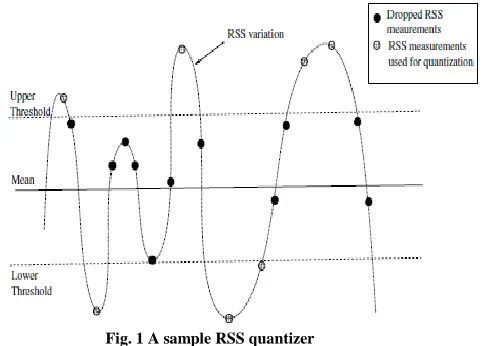
As multiple packets are exchanged between Alice and Bob, each of them builds a time series of measured RSS. Then, each node quantizes its time series to generate an initial secret bit sequence. The quantization is done based on specified thresholds. Figure 1 shows a sample RSS quantizer with two thresholds. The values between the lower and upper threshold are dropped, the value greater than the upper threshold is encoded as 1 and the value less than the lower threshold is encoded as 0. For the example in figure 1 the quantizer will output 1010011. Different quantizers have been proposed in the existing systems [6], [7], [21], [25]. The difference in these quantizers mainly results from their different choices of thresholds and the different number of thresholds that they use.
2) Information Reconciliation
[image:2.612.339.582.144.317.2]The existing system use Cascade an interactive information reconciliation protocol. In this protocol, Alice permutes the bitstream randomly, divides it into small blocks and sends permutation and parity information of each block to Bob. Bob permutes his bitstream in the same way, divides it into small blocks, and computes parities and checks for parity mismatches.
Fig. 1 A sample RSS quantizer
3) Privacy Amplification
It is observed that the information reconciliation stage reveals a certain fraction of information to correct the mismatching bits of Alice and Bob. The leaked portion needs to be removed so that an adversary cannot use this information to guess portions of the extracted key. Privacy amplification solves the above two problems by reducing the size of output bit stream. This is achieved by letting both Alice and Bob use universal hash functions. These functions are randomly chosen from a publicly known set, to obtain fixed size smaller length output from longer input streams. Essentially, privacy amplification generates a shorter secret bit stream with a higher entropy rate and a longer secret bit stream with a lower entropy rate. Most of the popular methods used for privacy amplification are
based on the leftover hash lemma, a well known technique
to extract randomness from imperfect random sources.
III. SURVEY ON WIRELESS NETWORK
A. Overview of Wireless Network Technology
International Journal of Emerging Technology and Advanced Engineering
Website: www.ijetae.com (ISSN 2250-2459,ISO 9001:2008 Certified Journal, Volume 4, Issue 6, June 2014)
849 They also include infrared (IR) devices such as remote controls, some cordless computer keyboards and mice, and wireless hi-fi stereo headsets, all of which require a direct line of sight between the transmitter and the receiver to close the link.
At present, a diverse range of client devices like laptops, PDAs and mobile phones that run applications such as multimedia imaging, video conferencing, online gaming, video streaming etc. which require very high bandwidth. Many technologies have provided their contribution to meet the ever increasing bandwidth and date rate
requirements and also provide efficient wireless
transmission between the communicating devices.
1) Wireless Network Configuration
The distinguishing feature of wireless networks is that packets (segments) are transmitted with the presence of wireless links. A device can send messages in a wireless network via the wireless medium, air, to another device provided that the receiver is within the transmission range of the sender. This adds flexibility to how a wireless network is formed and structured. Besides, it supports device mobility. The 802.11 standard offers two methods for configuring a wireless network ad hoc and infrastructure.
2) Infrastructure Mode
[image:3.612.330.566.152.295.2]With a wireless access point, the wireless LAN can operate in the infrastructure mode. This mode allows the user to connect wirelessly to wireless network devices within a fixed range or area of coverage. The access point has one or more antennas that allow you to interact with wireless nodes. In infrastructure mode, the wireless access point converts airwave data into wired Ethernet data, acting as a bridge between the wired LAN and wireless clients. Connecting multiple access points via a wired Ethernet backbone can further extend the wireless network coverage. As a mobile computing device moves out of the range of one access point, it moves into the range of another. As a result, wireless clients can freely roam from one access point domain to another and still maintain seamless network connection. Figure 2 shows the infrastructure mode wireless networks with access points.
Fig. 2 Infrastructure wireless networks
3) Ad Hoc Mode
In an ad hoc network, computers are brought together as needed; thus, the network has no structure or fixed points each node can be set up to communicate with any other node. No access point is involved in this configuration. This mode enables you to quickly set up a small wireless workgroup and allows workgroup members to exchange data or share printers as supported by Microsoft® networking in the various Windows® operating systems. The ad hoc networking can also be referred as peer-to-peer group networking.
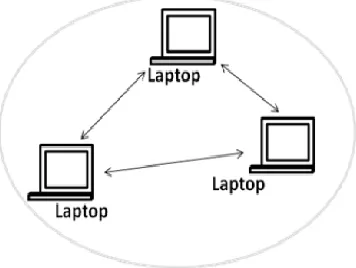
In this configuration, network packets are directly sent and received by the intended transmitting and receiving stations. As long as the stations are within range of one another, this is the easiest and least expensive way to set up a wireless network. Figure 3 shows wireless network configuration in Ad Hoc mode.
[image:3.612.349.527.536.670.2]International Journal of Emerging Technology and Advanced Engineering
Website: www.ijetae.com (ISSN 2250-2459,ISO 9001:2008 Certified Journal, Volume 4, Issue 6, June 2014)
850 4)Features of Ad Hoc wireless networks
Host movement is frequent
Topology changes frequently
No fixed infrastructure
Data must be routed via intermediate nodes
Do not need backbone infrastructure support
Easy to deploy
Useful when infrastructure is absent, destroyed or impractical
B. Related Work
Several researchers have proposed to use the unpredictability of the radio channels to extract secret keys. The level-crossing method [20] uses a protocol that allows two users to establish a common cryptographic key by exploiting special properties of the wireless channel. The underlying channel response between any two parties is unique and decorrelates rapidly in space. The established key can then be used to support security services (such as encryption) between two users. The algorithm here uses quantization along with level-crossing to extract bits from correlated stochastic processes. The resulting protocol resists cryptanalysis by an eavesdropping adversary and a spoofing attack by an active adversary without requiring an authenticated channel.Another author proposed a improved level-crossing [26] approach, which is well-suited for the Rayleigh and Rician fading models associated with a richly scattering environment for building practical secret key generation protocols between two entities. This level-crossing algorithm is simple, and incorporates a
self-authenticating mechanism to prevent adversarial
manipulation of message exchanged during the protocol. A different approach [20] is used for generation of the shared key in some existing system, where the transceivers use Low Density Parity Check (LDPC) decoders to resolve the differences in their channel impulse response measurements caused by noise. To ensure secret key agreement, a method of public discussion between the two users is performed using the syndrome from Hamming (7,3) binary codes. This algorithm checks the equality of generated keys for both legitimate users, and ensures error-free secure communication.
Later Adaptive Secret Bit Generation (ASBG) [18] evaluated the effectiveness of secret key extraction, for private communication between two wireless devices. Using real world measurements of RSS in a variety of environments and settings, secret key was extracted from RSS variations on the wireless channel. The ASBG approach generated bit streams of High entropy.
The quantizer used in this method divides the RSS
measurements into smaller blocks of block size and
calculates the thresholds for each block separately. The adaptive threshold allows the quantizer to adapt to slow shifts of RSS.
All the above schemes provided the best method of extracting the secret key from the RSS in the wireless network configurations. But RSS suffers from predictable filter response at random period, signal fading and drop because of intermediate object[1].
IV. KEY EXTRACTION USING RRM
A. Scope and Relevance of the secret key extraction using RRM
The main concern of this scheme is to provide efficient method to extract secret key for securing the private communication in public network. To do this, the Secret key extraction from RRM is used, which takes care about the uniqueness of the key by generating a random number along with source IP, port and destination IP, port in the request message. This uniqueness property will overcomes prediction of the session key by the intruder. This scheme even balances the tradeoff between signal fading and drop in the RSS.
The core component of this project is to generate secret key from Received Request Message (RRM). The uniqueness property of the RSS can be achieved by adding random number by the client program in the user node to the request before sending it to the Base station. Because of huge investment on the infrastructure, instead of actual mobile nodes and mobile stations computers are considered in this project for implementation. Figure 4 depicts secret key generation using RRM. User A send request to Base station(BS) to communicate with User B. The BS receives a request and extracts the secret key and safely distributes it to both sender and receiver. Further sender and receiver use the key for communication.
International Journal of Emerging Technology and Advanced Engineering
Website: www.ijetae.com (ISSN 2250-2459,ISO 9001:2008 Certified Journal, Volume 4, Issue 6, June 2014)
[image:5.612.322.576.137.560.2]851
Fig. 4 Secret key generation using RRM.
The uniqueness property of the secret key can be achieved by adding random number by the client program in the user node to the request message before sending it to the Base station.
B. Working of Secret Key Extraction using RRM
The main concern of this scheme is to provide an approach for efficient mechanism to extract secret key for securing the private communication in public network. To do this, the Secret key extraction used Received Request Message (RRM) as core component along with random number, source IP, port and destination IP, port in the request message which takes care about the uniqueness of the generated secret key. This uniqueness property will overcomes prediction of the secret key by the intruder. This scheme even balances the tradeoff between signal fading and drop in the RSS. The uniqueness property of the secret key can be achieved by adding random number by the client program in the user node to the request message before sending it to the Base station.
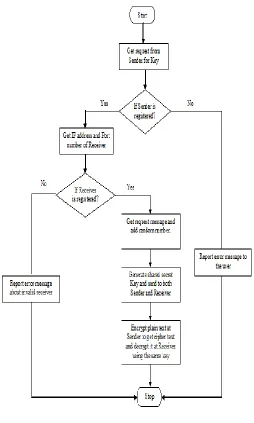
In the Figure 5 shows flow chart of secret key extraction using RRM. The process starts from request message, after receiving the request message from BS it validates sender. If the sender is valid it takes IP and port of destination for validation, receiver is also valid then it adds random number to the request message. The request message and random number will be sent to key generation process. The generated key is forwarded to key distribution process for sending it to both sender and receiver. Finally the received key will be used by the sender and receiver for encryption/decryption of communicating messages. If sender and receiver are not registered, then the error message will be sent from the BS and MSC respectively.
Fig. 5 Flow Chart of Secret Key Extraction using RRM.
V. CONCLUSION
[image:5.612.56.299.148.271.2]International Journal of Emerging Technology and Advanced Engineering
Website: www.ijetae.com (ISSN 2250-2459,ISO 9001:2008 Certified Journal, Volume 4, Issue 6, June 2014)
852 In both infrastructure and ad hoc mode of wireless configurations, the authentication between any two principle users is supposed to be ensured by the security system. Proper security mechanisms to provide secured communication has become challenging in the wireless networks. The security services should effectively handle both passive and active security attacks. In concern to the security mechanisms, data confidentiality and data integrity provides the higher contribution for all type of active attacks. The data confidentiality and data integrity can be achieved by encrypting the actual data with secret key. Generation of secret key is a center point of concern to provide higher degree of security. By sharing the secret key in an efficient manner security of key can be achieved. Then confidentiality of the user’s data can be assured by encrypting the data using secret key.
In this paper, a new secret key generation scheme is defined to improve the data security. Secret key generation using received request message (RRM) scheme is used for extraction of secret key. It takes the users request message as input for extraction of secret key. The basic idea is to generate a unique key which can provide data confidentiality and improve the strength of extracted key. This scheme provides high entropy data bit during extraction, thus ensures strength of generated secret key
acceptable. Extensive performance evaluation
demonstrates that the proposed schemes outperform the existing solutions in terms of highly efficient secret key generation.
VI. FUTURE ENHANCEMENT
Secret Key Extraction using Received Request Message consider only high entropy bit during extraction and data confidentiality service. Since Authentication is a primitive service that enables a node to ensure the identity of peer node with which it is communicating. Authentication is also very much essential to overcome vulnerability in wireless networks. Hence when source sends data (after getting secret key from Base Station) to the destination, data is being forwarded to the intermediate nodes one by one, based on Received Signal Strength (RSS) secret key will be generated which is passed to both the source and the destination. A random key will be parsed by both source and destination which is exchanged between both for verification. Both of them generates hash key value of the secret keys, which will also be verified by both of them only then the data can be viewed by the destination. Thus a strong verification scheme at source and destination end can be achieved to ensure authentication of each other.
Further, this scheme can be extended to provide authentication.
REFERENCES
[1] Hemavathi M N, Annapurna V K. ―A Survey on Secret Key Extraction Using Received Signal Strength in Wireless Networks‖, IJRITCC vol.2, issue. 4, April 2014.
[2] NIST, A statistical test suite for random and pseudorandom number generators for cryptographic applications. http://csrc.nist.gov/publications/nistpubs/800-22/sp-800-22-051501.pdf. 2001.
[3] ipwraw, http://homepages.tu-darmstadt.de/ p larbig/wlan/. [4] radiotap, http://www.radiotap.org.
[5] Converting signal strength percentage to dbm values, http://www.wildpackets.com/elements/whitepapers/Converting Signal Strength.pdf.
[6] T. Aono, K. Higuchi, T. Ohira, B. Komiyama, and H. Sasaoka. Wireless secret key generation exploiting reactance-domain scalar response of multipath fading channels. IEEE Transactions on Antennas and Propagation, 53(11):3776-3784, Nov. 2005.
[7] B. Azimi-Sadjadi, A. Kiayias, A. Mercado, and B. Yener. Robust key generation from signal envelopes in wireless networks. In ACM CCS, 2007.
[8] C. H. Bennett, F. Bessette, G. Brassard, L. Salvail, and J. Smolin. Experimental quantum cryptography. J. Cryptol., 5(1):3-28, 1992. [9] M. Bloch, J. Barros, M. R. D. Rodrigues, and S. W. McLaughlin.
Wireless information-theoretic security. IEEE Transactions on Information Theory, 54(6):2515-2534, 2008.
[10] G. Brassard and L. Salvail. Secret key reconciliation by public discussion. Lecture Notes in Computer Science, 765:410-423, 1994. [11] V. Brik, S. Banerjee, M. Gruteser, and S. Oh. Wireless device
identification with radiometric signatures. In MOBICOM, 2008. [12] G. D. Durgin. Space-Time Wireless Channels. Prentice Hall PTR,
2002.
[13] L. Greenemeier. Election fix? switzerland tests quantum cryptography. Scientific American, October 2007.
[14] A. A. Hassan, W. E. Stark, J. E. Hershey, and S. Chennakeshu. Cryptographic key agreement for mobile radio. Elsevier Digital Signal Processing, 6:207–212, 1996.
[15] J. E. Hershey, A. A. Hassan, and R. Yarlagadda. Unconventional cryptographic keying variable management. IEEE Trans. Commun., 43(1):3-6, Jan. 1995.
[16] R. Impagliazzo, L. A. Levin, and M. Luby. Pseudo-random generation from one-way functions. In STOC, pages 12-24, 1989. [17] S. Jana and S. K. Kasera. On fast and accurate detection of
unauthorized access points using clock skews. In MOBICOM, 2008. [18] S. Jana, S. N. Premnath, M. Clark, S. K. Kasera, N. Patwari, and S. V. Krishnamurthy. On the effectiveness of secret key extraction from wireless signal strength in real environments. In ACM MOBICOM, 2009.
[19] Z. Li, W. Xu, R. Miller, and W. Trappe. Securing wireless systems via lower layer enforcements. In ACM WiSe, 2006.
International Journal of Emerging Technology and Advanced Engineering
Website: www.ijetae.com (ISSN 2250-2459,ISO 9001:2008 Certified Journal, Volume 4, Issue 6, June 2014)
853 [21] S. Mathur, W. Trappe, N. B. Mandayam, C. Ye, and A. Reznik.
Radio-telepathy: extracting a secret key from an unauthenticated wireless channel. In ACM MOBICOM, 2008.
[22] U. M. Maurer. Secret key agreement by public discussion from common information. IEEE Trans. Info. Theory, 39(3):733-742, May 1993.
[23] U. M. Maurer and S. Wolf. Unconditionally secure key agreement and the intrinsic conditional information. IEEE Trans. Info. Theory, 45(2):499-514, 1999.
[24] A. Sayeed and A. Perrig. Secure wireless communications: Secret keys through multipath. In ICASSP, pages 3013-3016, April 2008. [25] M. A. Tope and J. C. McEachen. Unconditionally secure
communications over fading channels. In MILCOM, 2001. [26] Chunxuan Ye, Suhas Mathur, Alex Reznik, Yogendra Shah, Wade
Trappe, and Narayan B. Mandayam, IEEE transactions on information forensics and security, vol. 5, no. 2, june 2010