Preemption versus entrenchment : towards
a constructiongeneral solution to the
problem of the retreat from verb argument
structure overgeneralization
Ambridge, B, Bidgood, A, Twomey, KE, Pine, JM, Rowland, CF and Freudenthal, D
http://dx.doi.org/10.1371/journal.pone.0123723
Title
Preemption versus entrenchment : towards a constructiongeneral solution
to the problem of the retreat from verb argument structure
overgeneralization
Authors
Ambridge, B, Bidgood, A, Twomey, KE, Pine, JM, Rowland, CF and
Freudenthal, D
Type
Article
URL
This version is available at: http://usir.salford.ac.uk/id/eprint/48489/
Published Date
2015
USIR is a digital collection of the research output of the University of Salford. Where copyright
permits, full text material held in the repository is made freely available online and can be read,
downloaded and copied for noncommercial private study or research purposes. Please check the
manuscript for any further copyright restrictions.
For more information, including our policy and submission procedure, please
Preemption versus Entrenchment: Towards a
Construction-General Solution to the Problem
of the Retreat from Verb Argument Structure
Overgeneralization
Ben Ambridge1,3*, Amy Bidgood1,3, Katherine E. Twomey2,3, Julian M. Pine1,3, Caroline F. Rowland1,3, Daniel Freudenthal1
1University of Liverpool, Liverpool, United Kingdom,2University of Lancaster, Lancaster, United Kingdom, 3ESRC International Centre for Language and Communicative Development (LuCiD), Manchester, Liverpool and Lancaster, United Kingdom
Abstract
Participants aged 5;2-6;8, 9;2-10;6 and 18;1-22;2 (72 at each age) rated verb argument structure overgeneralization errors (e.g.,*Daddy giggled the baby) using a five-point scale. The study was designed to investigate the feasibility of two proposed construction-general solutions to the question of how children retreat from, or avoid, such errors. No support was found for the prediction of thepreemptionhypothesis that the greater the frequency of the verb in the single most nearly synonymous construction (for this example, the periphrastic causative; e.g.,Daddy made the baby giggle), the lower the acceptability of the error. Sup-port was found, however, for the prediction of theentrenchmenthypothesis that the greater theoverallfrequency of the verb, regardless of construction, the lower the acceptability of the error, at least for the two older groups. Thus while entrenchment appears to be a robust solution to the problem of the retreat from error, and one that generalizes across different error types, we did not find evidence that this is the case for preemption. The implication is that the solution to the retreat from error lies not with specialized mechanisms, but rather in a probabilistic process of construction competition.
Introduction
The story of language acquisition is, in large part, the story of how children move beyond sim-ply repeating words and phrases that they have learned from their caregivers (e.g.,Bye+bye; Drink!) and acquire the ability to produce utterances that they have never encountered in ex-actly that form; a point perhaps most famously made in Chomsky’s [1] review of Skinner’s Ver-bal Behavior. [2]
At the heart of this ability lies what many researchers have referred to as a paradox ([3], [4], [5], [6], [7], [8]) In order to achieve adult-like productivity with language, children must set up
a11111
OPEN ACCESS
Citation:Ambridge B, Bidgood A, Twomey KE, Pine
JM, Rowland CF, Freudenthal D (2015) Preemption versus Entrenchment: Towards a Construction-General Solution to the Problem of the Retreat from Verb Argument Structure Overgeneralization. PLoS ONE 10(4): e0123723. doi:10.1371/journal. pone.0123723
Academic Editor:Donald A. Robin, University of
Texas Health Science Center at San Antonio, Research Imaging Institute, UNITED STATES
Received:October 28, 2014
Accepted:March 5, 2015
Published:April 28, 2015
Copyright:© 2015 Ambridge et al. This is an open
access article distributed under the terms of the Creative Commons Attribution License, which permits unrestricted use, distribution, and reproduction in any medium, provided the original author and source are credited.
Data Availability Statement:All relevant data are
within the paper and its Supporting Information.
Funding:This research was funded by a Leverhulme
generalizations that allow them to use verbs in unattested constructions. For example, on the basis of hearing pairs of utterances likeThe ball rolledandThe man rolled the ball, the child might set up a rule that allows any verb attested in theintransitive inchoativeconstruction to be generalized into thetransitive causativeconstruction, and vice versa. Thus, upon encounter-ing an utterance likeThe vase broke, the child could use her generalization to produceDaddy broke the vase, even if she has never encounteredbreakin the transitive causative construction. The paradox arises because children must learn that, of the verbs that are as yet unattested in the target construction, many can be generalized into that construction if the communicative need arises (e.g.,The car moved!Mummy moved the car), while others cannot (e.g.,The baby giggled!Daddy giggled the baby).
The problem of how children learn to avoid these overgeneralizations of verb argument structure is sometimes referred to as the problem of theretreat from overgeneralization. Indeed, findings from several naturalistic and experimental studies suggest that at least some children pass through a stage in which they produce such errors before subsequently retreating from them (eg, [7], [8], [9], [10], [11], [12], [13]) Some examples of these errors are given inTable 1. However, it is important to note that the paradox of partial productivity applies whether or not a particular child happens to produce errors from which to“retreat”. Thus, while children cer-tainly appear to make some use of corrective feedback from adults (eg, [14]), this is unlikely to be a complete solution.
The present study investigates two solutions to this problem It is important to also acknowl-edge the existence of a third, and potentially complementary, proposal: Pinker’s [8] semantic verb class hypothesis, which holds that learners form classes of verbs that are semantically (in) consistent with particular constructions For example, verbs of semi-voluntary emotional ex-pression may appear in the intransitive and periphrastic causative constructions (eg,The baby laughed/giggled; Daddy made the baby laugh/giggle), but not the transitive causative (eg,
Daddy laughed/giggled the baby) The present study does not investigate this hypothesis, and
we will say no more about it here, other than to note that an effect of verb semantics—though not necessarily of discrete semantic classes per se—has been observed in a number of previous studies (eg, [10], [12], [15], [16], [17], [18], [19], [20], [21], [22])
The two proposals that are investigated in the present study are both forms of statistical learning The first is thepreemptionhypothesis:
If a potential innovative expression would be precisely synonymous with a well-established expression, the innovation is normally pre-empted by the well established term, and is therefore considered ungrammatical ([5]: 798)
Preemption was first proposed to account for the retreat from word-level errors involving derivational morphology. For example, children’s novel coinages such asspyer,drillerand
unappearare gradually preempted by the adult formsspy,drillanddisappear(perhaps even
semi-explicitly, as the child“notices”a mismatch between the adult form and her own). Be-cause preemption is a probabilistic process, the prediction that follows from this proposal is that the greater the frequency of the competitor form, the less likely children will be to produce the error, and the more unacceptable they will rate this error in a judgment task. Indeed, recent studies of overgeneralizations of derivational morphology have provided support for this claim (see [12], [20], for errors of verbalun-prefixation—e.g.,unclose—and [23] for errors of adjec-tivala-prefixation—e.g.,The asleep boy).
Whilepreemptionworks well for word-level morphological overgeneralizations, attempts to apply the proposal to utterance-level syntactic overgeneralizations (eg, [6], [24])—the focus of the present study—have met with mixed success. Again, the prediction is of a negative
Competing Interests:The authors have declared
correlation between the production probability/rated acceptability of a particular error (e.g.,
Daddy laughed the baby; a transitive causative overgeneralization) and the frequency of this
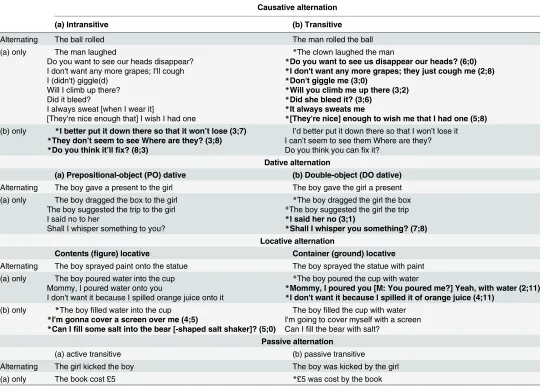
verb in the single most nearly synonymous construction (e.g.,Daddy made the baby laugh; the periphrastic causative construction). Similarly, overgeneralizations into the intransitive con-struction (e.g.,The book lost) are held to be probabilistically preempted by passive uses (e.g., The book was lost); SeeTable 1for more examples.
[image:4.612.36.579.90.480.2]Although novel verb laboratory studies of the intransitive and transitive constructions have provided support for this prediction ([10], [11]) there is reason to doubt that the relevant pre-empting constructions are sufficiently frequent in the input to which children are exposed. In-deed, on the basis of the counts obtained for the present study, periphrastic causative and passive uses are extremely rare in child directed speech (0.4% and 2.2%). Neither does preemp-tion seem likely to constitute a plausible mechanism by which children could avoid errors with
Table 1. Possible and attested verb argument structure overgeneralization errors.
Causative alternation
(a) Intransitive (b) Transitive
Alternating The ball rolled The man rolled the ball
(a) only The man laughed
Do you want to see our heads disappear? I don't want any more grapes; I'll cough I (didn't) giggle(d)
Will I climb up there? Did it bleed?
I always sweat [when I wear it]
[They're nice enough that] I wish I had one
*The clown laughed the man
*Do you want to see us disappear our heads? (6;0)
*I don't want any more grapes; they just cough me (2;8)
*Don't giggle me (3;0)
*Will you climb me up there (3;2)
*Did she bleed it? (3;6)
*It always sweats me
*[They're nice] enough to wish me that I had one (5;8)
(b) only *I better put it down there so that it won’t lose (3;7)
*They don’t seem to see Where are they? (3;8)
*Do you think it’llfix? (8;3)
I’d better put it down there so that I won’t lose it I can’t seem to see them Where are they? Do you think you canfix it?
Dative alternation
(a) Prepositional-object (PO) dative (b) Double-object (DO dative)
Alternating The boy gave a present to the girl The boy gave the girl a present
(a) only The boy dragged the box to the girl The boy suggested the trip to the girl I said no to her
Shall I whisper something to you?
*The boy dragged the girl the box
*The boy suggested the girl the trip
*I said her no (3;1)
*Shall I whisper you something? (7;8)
Locative alternation
Contents (figure) locative Container (ground) locative
Alternating The boy sprayed paint onto the statue The boy sprayed the statue with paint
(a) only The boy poured water into the cup Mommy, I poured water onto you
I don't want it because I spilled orange juice onto it
*The boy poured the cup with water
*Mommy, I poured you [M: You poured me?] Yeah, with water (2;11)
*I don't want it because I spilled it of orange juice (4;11)
(b) only *The boyfilled water into the cup
*I'm gonna cover a screen over me (4;5)
*Can Ifill some salt into the bear [-shaped salt shaker]? (5;0)
The boyfilled the cup with water I'm going to cover myself with a screen Can Ifill the bear with salt?
Passive alternation
(a) active transitive (b) passive transitive
Alternating The girl kicked the boy The boy was kicked by the girl
(a) only The book cost £5 *£5 was cost by the book
Attested errors (from [7]) are shown inbold, with the age of the child (years;months) and a possible grammatical formulation using the alternate construction
the passive construction (e.g.,An hour was lasted by the film; A kilogram was weighed by the box; Marge was looked like/resembled by Lisa). These verbs are not particularly frequent in the potentially-preempting active construction (e.g.,The film lasted an hour) and indeed, are pre-sumably less frequent in this construction than many verbs that passivize easily (e.g.,Homer was pushed by Marge). Potentially more straightforward are the three-argument constructions: datives and locatives, for which—in each case—the two alternate syntactic forms seem to ex-press almost identical meanings (seeTable 2), and hence are good candidates for preemption. Indeed, a grammaticality judgment study of errors involving the DO-dative construction (e.g.,
I said her no) [21] observed a clear effect of preemption (e.g.,I said no to her), even after
con-trolling for another statistical predictor; entrenchment (discussed below) On the other hand, a similar study with errors involving the locative constructions (e.g.,The boy poured the cup with water;The boy filled water into the cup) found an effect of preempting alternatives (e.g., The boy poured water into the cup; The boy filled the cup with water), but one that disappeared after controlling for entrenchment [18]
Thus the status of preemption as a construction-general solution to the paradox of partial productivity is unclear. While it seems to work well for morphological overgeneralizations and those involving the dative constructions, this is not necessarily the case for other argument structure constructions. In the present study we investigate whether preemption operates across a range of argument structure constructions, using statistical techniques that allow us to generalize beyond the particular constructions tested: mixed effects models ([25], [26])
A more recent statistical learning proposal—and one that perhaps does not share the intui-tive appeal of preemption—isentrenchment[27]. The general idea goes back to Langacker [28] who posits a continuous scale of entrenchment in cognitive organization. Every use of a struc-ture has a positive impact on its degree of entrenchment. Units are variably entrenched de-pending on the frequency of their occurrence.
When applied to the domain of the retreat from overgeneralization (eg, [9], [28]), the idea is that overgeneralization errors with a particular verb (e.g.,Daddy laughed the baby) are proba-bilistically blocked byanyuse of the relevant verb (e.g.,The baby laughed), and not solely—as for preemption—by uses in a nearly-synonymous construction (e.g.,Daddy made the baby laugh). In other words, the entrenchment of a verbin any number of constructions probabilisti-cally blocks its generalization into constructions in which it has not been attested. In intuitive terms, one can imagine the learning mechanism making a kind of inference from absence (e.g., “Given how frequently I’ve encountered laugh, then if this verbcouldappear in the transitive causative construction, I would surely have heard it by now”). However, entrenchment need not necessarily be framed in terms of deductive reasoning. For example, connectionist net-works can show entrenchment type behaviour (eg, [29]) simply because increasing the strength of the connection between an input node representinglaughand output nodes representing other constructions (e.g., the intransitive, the periphrastic causative, the single-word impera-tive) necessarily reduces the strength of the connection betweenlaughand the output node rep-resenting the transitive causative construction.
Entrenchment enjoys an important advantage over preemption: Because erroneous uses are probabilistically blocked byanyuse of the relevant verb, regardless of construction, it does not rely on learners encountering particular verbs in very low frequency constructions (e.g., the periphrastic causative and passive). Indeed, for all verb argument structure overgeneralizations, preempting evidence is always, by definition, a subset of entrenching evidence (and often a very small one).
revealed an effect of entrenchment even after controlling for preemption, though a production study ofun-prefixation [12] observed the opposite pattern, perhaps because—as noted above— preemption is particularly powerful in the case of word-level overgeneralizations of derivation-al morphology (e.g.,openpreemptingunclose).
In summary, previous findings and theoretical considerations suggest that entrenchment may hold more promise than preemption as a construction general solution to the problem of the retreat from overgeneralization error. At present, however, this conclusion remains tenta-tive for two reasons. The first is that, since measures of entrenchment and preemption (e.g., overall verb frequency and frequency in a particular construction) are invariably highly corre-lated, the two mechanisms are difficult to distinguish empirically. Indeed, many of the studies cited above did not even attempt to do so. Those that did used regression techniques to partial out the effect of each individual predictor on the dependent variable. However, this solution produces unreliable results when the correlation between the two predictors is very high (e.g., r= 0.7 in [18], 2011;r= 0.9 in [21]). In the present study, we address this problem by running separate statistical analyses for each predictor.
The second is that, with a single exception, each of these studies has focused on a single con-struction pair (or“alternation”). This is an important shortcoming, since we already know that —for example—preemption works well forat least sometypes of errors (e.g., morphological overgeneralizations); the issue at stake is the ability of these two statistical learning mechanisms to provide a general solution to the retreat from error across a range of different error types. More generally, as Herb Clark (co-originator of the preemption account) pointed out in a fa-mous paper, one cannot simply assume that one’s“findings generalize beyond the specific sam-ple of language materials. . .chosen”([25]: 335). Although Clark focuses mainly on single words, he explicitly notes that the need to demonstrate generalizability beyond the specific items used in the study holds for“words, sentences and other language materials”(p.335), pre-sumably including abstract syntactic constructions. This clearly cannot be done in a study that includes only a single construction pair In the present study we address this problem by using mixed effects models with crossed random effects for participants and items [26], where “items”includes both verbs and syntactic constructions. This strategy allows us to infer that any observed effect of preemption or entrenchment generalizes beyond the particular verbs and constructions included in the present study; clearly a prerequisite for any satisfactory solu-tion to the partial-productivity paradox.
In summary, the present study tested the preemption and entrenchment hypotheses across a range of verb argument structure constructions. The former predicts a negative correlation between the rated acceptability of a particular overgeneralization error and corpus frequency of the relevant verbin the single most nearly synonymous construction(seeTable 2for examples). The latter predicts a negative correlation between the rated acceptability of a particular overgeneralization error and the overall frequency of the relevant verb.
Method
Ethics statement
The study was approved by the University of Liverpool Ethics Committee. Informed written consent was obtained from adult participants and from parents of participating children (who also gave verbal consent).
Participants
Participants were recruited from schools and a university in the North West of England. The study was approved by the University of Liverpool ethics committee, and informed consent was obtained from all participants. Oral consent was obtained from children, written consent from parents, and from adult participants.
Verbs and Sentences
Since the design of the study is rather complex, it is probably best understood by consulting the relevant table (Table 2). The description below is intended to outline the logic of the design set out in the table, rather than to constitute a complete free-standing explanation of the design in its own right.
The study used nine different sentence-level verb argument structure constructions grouped into four alternations: Dative (PO-Dative, DO-dative), Causative (Intransitive inchoative, Transitive causative, Periphrastic causative), Locative (Figure locative, Ground locative) and Passive (Active, Passive) Morphological construction and overgeneralizations (eg,un-VERB;
unclose) were not included because the relationship between entrenchment and preemption is
different for these error types, in that the relevant preempting form generally has a different lexical root (eg,openforunclose) Thus while our conclusions generalize across different types of overgeneralizationof verb argument structure, they do not generalize acrossalldifferent types of overgeneralization error Indeed, there is some evidence that preemption may be more important for overgeneralization errors at the morphological level ([12], [23])
For each construction (e.g., PO-dative) we selected (a) four verbs that are grammatical in that construction but not the other construction in the alternation (e.g.,carry,haul,scream, shriek), (b) four verbs that show the opposite profile (e.g.,cost,fine,refuse,deny) and (c) four verbs that may appear in both constructions (e.g.,give,hand,show,teach). As these examples indicate, each set of four verbs comprised two higher-frequency verbs and two lower-frequency near synonyms (e.g.,carry+haul,scream+shriek). We then created a sentence for each con-struction+verb combination. The sentence for each alternation pair and each high/low fre-quency synonym pair used the same noun phrases (e.g.,Bart carried/hauled the box to Lisa; Bart carried/hauled Lisa the box). For each of these sentence quadruples, we created, using
Anime Studio Pro 5.5, a single cartoon animation for which all four sentences would constitute an appropriate description (e.g., Bart lifting a heavy-looking box, carrying it to Lisa and placing it at her feet). The main purpose of the animations was to maintain children’s interest, but they also served to illustrate the intended meaning of the accompanying sentence, and to demon-strate that its veracity was not in doubt (only its grammaticality).
In fact, the design was not quite as balanced as this description implies, due to (a) the inclu-sion of periphrastic causatives in the causative alternation (b) the non-existence of passive-only verbs (c) the unavailability of close synonyms for non-passivizable verbs and (d) the fact that the active construction in the passive alternation is the same construction as the transitive con-struction in the causative alternation (although as a non-causative transitive, it is arguably not exactlythe same, depending on whether or not one posits multiple transitive constructions; see Ambridge &, Lieven, in press, for discussion). Nevertheless, asTable 2shows, it was still possi-ble to devise sentence stimuli that are consistent with the overall design.
Rating scale and Procedure
The scale can be downloaded fromhttp://journalsplosorg/plosone/article/figure/image? size = large,id = info:doi/101371/journalpone0110009g002Children indicated their judgments by selecting a red counter (for ungrammatical) or a green counter (for grammatical) and plac-ing it on the relevant face to provide a graded judgment, with responses noted down by the ex-perimenter. Children were told that the red and green counters could be placed on only the red and green faces respectively, except that either counter could be placed on the middle face. Adults marked their ratings directly on the face scale.
The procedure was the same as that used in previous judgment studies of verb argument structure overgeneralization errors (for a more detailed description, see [8], [15]) In brief, chil-dren first complete a training session in which they are told that a talking dog (a toy with an in-ternal loudspeaker connected to a laptop computer) is learning to speak English but“because he’s only a dog, sometimes gets it wrong and says things a bit silly”. The child’s task is to help the dog by telling him whether he“said it right, or a bit silly”. The training procedure consists of seven warm-up sentences; the first two completed by the experimenter, the remainder by the child:The cat drank the milk(intended rating 5/5),The dog the ball played with(1/5),The frog caught the fly(5/5),His teeth man the brushed(1/5),The woman said the man a funny story (2/5),The girl telephoned her friend the news(3/5) andThe man whispered his friend the joke (4/5). Note that the final three warm-up sentences are examples of PO!DO dative overgener-alization errors. Although it would have been ideal to avoid using any of the same types of overgeneralization error as in the study proper, this was unavoidable, given the importance of providing children with practice at rating verb argument structure overgeneralization errors. Nevertheless, the warm-up sentences did not use any of the same verbs as test sentences.
After completing the warm-up, children moved on to the main part of the study, which they completed in two sessions on different (usually consecutive) days. Because the total number of trials (N= 100) was felt to be too many for young children, each child completed only half of the total number (i.e., 50): One high-low frequency sentence pair for each cell of the design, se-lected at random on a child-by-child basis (i.e., for any given row inTable 2, any given child completed either the two sentences in the column“Sentence Pair A”or the two sentences in the column“Sentence Pair B”, but never both). Children completed the trials in pseudo-ran-dom order with the constraint that neither (a) the same verb (or its high/low frequency equiva-lent) nor (b) the same construction could occur on consecutive trials.
Predictor variables
As outlined in the introduction, thepreemptionmeasure was operationalized as the log fre-quency of each verb in the single mostly nearly synonymous construction (seeTable 2). En-trenchment was operationalized as the log frequency of all uses of that verb (excluding uses as a noun). Frequency counts were taken from SUBTLEX-UK, a 200 million word corpus of sub-titles from programmes shown on British television, which has been shown empirically (e.g., via lexical decision tasks [31]) to be more representative of the language heard by speakers of British English than either (a) the British National Corpus (its only serious rival in terms of size) or (b) the equivalent US subtitle corpus.
of each (or, for verbs with fewer than 100 occurrences, the full set). Two raters then classified each sentence as (a) an instance of one of the constructions shown inTable 2(PO-dative, DO-dative, Intransitive, Transitive, Periphrastic Causative, Figure-Locative, Ground-Locative, Pas-sive), (b) an“Other”verb use or (c) a non-verb uses (in which case the sentence was replaced with another, and the counts pro-rated accordingly). Missing arguments were allowed, provid-ed that they could be inferrprovid-ed on the basis of the ongoing discourse, and construction classifica-tions were not mutually exclusive. Thus, for example, an utterance such as“John gave a card” would be classified as both a Transitive and a PO-dative. This decision was taken partly on the-oretical grounds (i.e., children presumably can and do recover missing arguments from dis-course) and partly on practical grounds: insisting that all arguments be explicitly realized would generally have resulted in counts of close to zero for all three-argument constructions (PO/DO-dative, Figure/Ground-locative).
Two coders (Amy Bidgood and Katherine Twomey) each classified 50% of the dataset, and reliability-checked 10% of the data coded by the other. Inter-rater reliability was 87% (Cohen’s Kappa = 0.79,z= 16.4,p<0.001). Disagreements were resolved by discussion. Raw verb-in-construction counts were pro-rated, on the basis of the overall number of verb uses, in order to yield a final estimate of the frequency of each verb in each construction in the corpus. All raw data are available inS1 Data.
Results
As the predictions of the entrenchment and preemption hypotheses relate only to ungrammati-cal sentences, grammatiungrammati-cal sentences were excluded from all analyses (though they play an im-portant role as fillers and encourage use of the full scale).
The data were analysed using linear mixed-effects models ([32]) inR, with random inter-cepts for (a) Participant and (b) Verb (N= 32; non-alternating verbs only) nested within Sen-tence Type (i.e., construction: PO-Dative, DO-Dative, Intransitive, Transitive, Periphrastic causative, Figure locative, Ground locative, Passive) In accordance with the recommendations of a recent methods paper [33], all models included by-participant random slopes, always cor-related with the intercept, and by-Sentence Type/Verb random slopes, corcor-related with the in-tercept, except for a few cases where this yielded convergence failure. Random slopes for Age Group and its interactions were also excluded for this reason. Depending on the analysis, the fixed effect was either the Preemption or the Entrenchment predictor, with some models also including Age Group (5–6, 9–10, Adult) and the relevant interactions. For example, for the first analysis, the model (in R syntax) was
Model1¼lmerðRating~AgeGroupPreemption þ ð1þPreemptionjParticipantÞ þ
ð1þPreemptionjSentenceType=VerbÞ; data¼UngrammaticalSentencesÞ
Note that because the nesting structure is rather unusual—transitive-only verbs were rated in both intransitive and periphrastic causative sentences, whereas all other verb types were rated in one sentence type only—it was necessary to specify this structure directly in the syntax.P values were obtained via thetdistribution (from thelmerfunction oflme4), but we also con-firmed thatpvalues obtained using a backwards-elimination model-comparison procedure (performed automatically using thestepfunction from thelmerTestpackage, eliminatingfixed effects only) yielded an identical pattern of results. Indeed, in most cases thepvalues were iden-tical to at least two decimal places (and hence we do not report them separately).
construction. Given that, for each particular construction, only four verbs—and hence four sentences—are ungrammatical, such an analysis would be seriously underpowered, and almost guaranteed to yield Type II errors (i.e., to fail to detect any effect present). Such an analysis strategy is not at all unusual. For example, consider a hypothetical drug trial in which 32 human participants are split across 8 treatment centers, with four participants per center. (analogous to the present situation of 32 verbs nested across 8 constructions). Mixed effects modeling (with treatment center as a random effect) could tell us that the drug is effective, and that this effect generalizes across the 8 treatment centers, but could not tell us whether or not the treatment given in any one center alone was effective. In the same way, the present study can tell us whether entrenchment and preemption effects are observed, and generalize across constructions, but not whether they hold for any particular construction individually.
Preemption
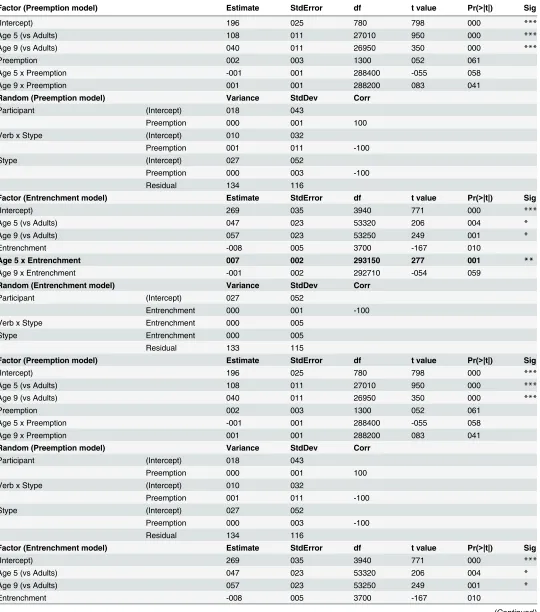
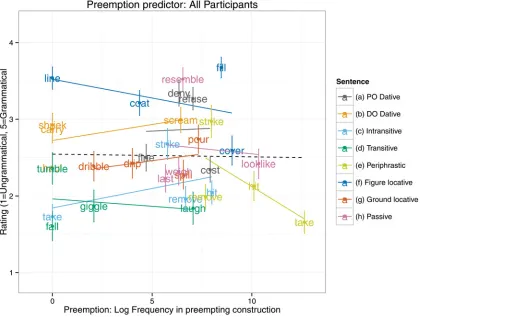
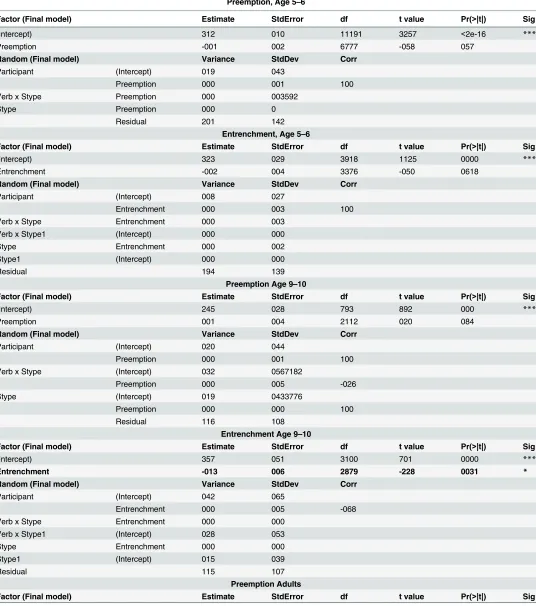
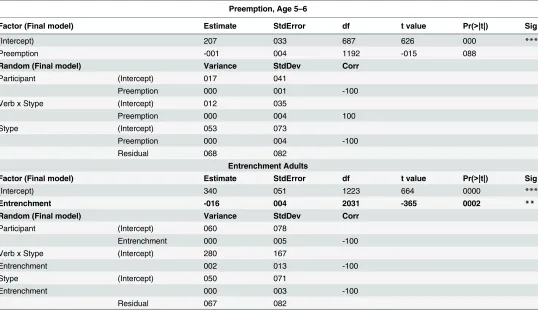
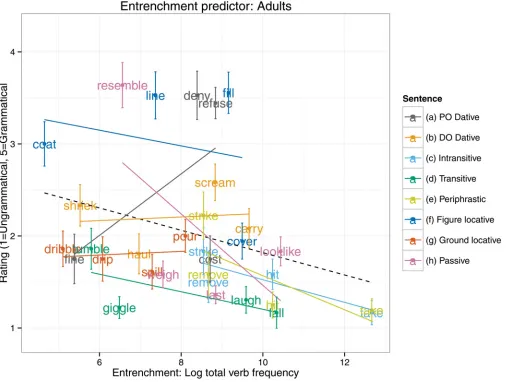
The first analysis (seeTable 3) was conducted on the combined data for all participants, and hence, in addition to the Preemption predictor, included as fixed effects Age Group and its in-teractions (with Adult as the reference category). This analysis revealed a main effect of age, such that both 5–6 and 9–10 year olds rated the overgeneralized ungrammatical sentences as more acceptable than did adults. However, the preemption predictor was not associated with any main effects or interactions (t<1 in all cases). The null effect for the preemption predictor (collapsing across all age groups) is plotted inFig 1; it is clear that the line is almost flat. Despite the lack of a significant interaction of Age Group by Preemption, it seemed important to verify that no individual age group showed any suggestion of a preemption effect, by running a sepa-rate model for each. These models (seeTable 4) revealed no effect of preemption for any group (t<1 in all cases). Thus, in summary, the present study failed to find any evidence for preemp-tion either for all participants combined, or for any age group individually.
Entrenchment
An equivalent set of analyses for the entrenchment predictor (seeTable 3) revealed an interac-tion, such that 5–6 year olds, but not 9–10 year olds, showed a significantly smaller entrench-ment effect than did adults. Indeed, the follow up models (seeTable 4) revealed that a
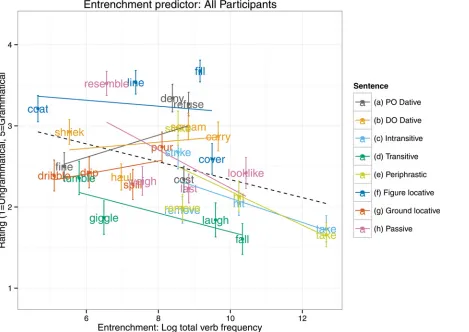
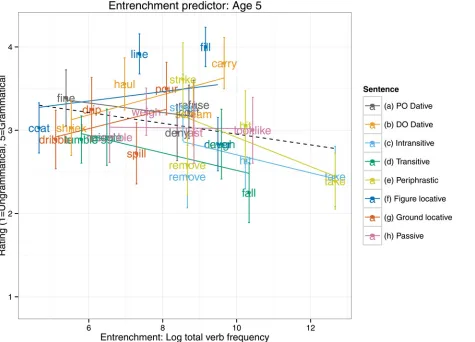
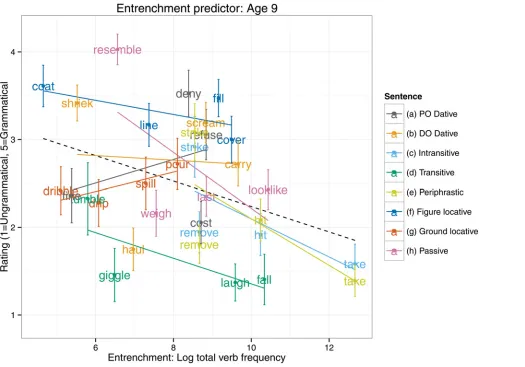
significant entrenchment effect in the predicted (negative) direction was displayed by the 9–10 year olds (B= -0.13,SE= 0.06,t[28.79] = -2.28,p= 0.03) and adults (B= -0.16,SE= 0.04,t [20.31] = -3.65,p= 0.002), but not the 5–6 year olds (t<1). Presumably the null finding for the 5–6 year olds is the cause of the narrow failure of the main effect of entrenchment to reach sig-nificance (p= 0.10) in the all-participants analysis (seeTable 3andFig 2). Plots of the en-trenchment predictor for each age group separately (Figs3–5) show that as overall verb frequency increases, so the rated acceptability of errors decreases (significantly so for the two older groups). Thus, in summary, the present study found an effect for entrenchment for 9–10 year olds and adults, but not 5–6 year olds.
Discussion
Table 3. Statistical models for all participants combined.
Factor (Preemption model) Estimate StdError df t value Pr(>|t|) Sig
(Intercept) 196 025 780 798 000 ***
Age 5 (vs Adults) 108 011 27010 950 000 ***
Age 9 (vs Adults) 040 011 26950 350 000 ***
Preemption 002 003 1300 052 061
Age 5 x Preemption -001 001 288400 -055 058
Age 9 x Preemption 001 001 288200 083 041
Random (Preemption model) Variance StdDev Corr
Participant (Intercept) 018 043
Preemption 000 001 100
Verb x Stype (Intercept) 010 032
Preemption 001 011 -100
Stype (Intercept) 027 052
Preemption 000 003 -100
Residual 134 116
Factor (Entrenchment model) Estimate StdError df t value Pr(>|t|) Sig
(Intercept) 269 035 3940 771 000 ***
Age 5 (vs Adults) 047 023 53320 206 004 *
Age 9 (vs Adults) 057 023 53250 249 001 *
Entrenchment -008 005 3700 -167 010
Age 5 x Entrenchment 007 002 293150 277 001 **
Age 9 x Entrenchment -001 002 292710 -054 059
Random (Entrenchment model) Variance StdDev Corr
Participant (Intercept) 027 052
Entrenchment 000 001 -100
Verb x Stype Entrenchment 000 005
Stype Entrenchment 000 005
Residual 133 115
Factor (Preemption model) Estimate StdError df t value Pr(>|t|) Sig
(Intercept) 196 025 780 798 000 ***
Age 5 (vs Adults) 108 011 27010 950 000 ***
Age 9 (vs Adults) 040 011 26950 350 000 ***
Preemption 002 003 1300 052 061
Age 5 x Preemption -001 001 288400 -055 058
Age 9 x Preemption 001 001 288200 083 041
Random (Preemption model) Variance StdDev Corr
Participant (Intercept) 018 043
Preemption 000 001 100
Verb x Stype (Intercept) 010 032
Preemption 001 011 -100
Stype (Intercept) 027 052
Preemption 000 003 -100
Residual 134 116
Factor (Entrenchment model) Estimate StdError df t value Pr(>|t|) Sig
(Intercept) 269 035 3940 771 000 ***
Age 5 (vs Adults) 047 023 53320 206 004 *
Age 9 (vs Adults) 057 023 53250 249 001 *
Entrenchment -008 005 3700 -167 010
To investigate this possibility, participants aged 5–6, 9–10 and 18–22 rated the acceptability of overgeneralization errors with a variety of different constructions. No support was found for the prediction of the preemption hypothesis that the greater the frequency of the verb in the single most nearly synonymous construction (for this example, the periphrastic causative; e.g., Daddy made the baby giggle), the lower the acceptability of the error. Support was found, how-ever, for the prediction of the entrenchment hypothesis that the greater the frequency of the verb in all constructions (e.g.,The baby laughed), the lower the acceptability of the error, at least for 9–10 year olds and adults. Although previous studies have investigated the preemption
Table 3. (Continued)
Factor (Preemption model) Estimate StdError df t value Pr(>|t|) Sig
Age 5 x Entrenchment 007 002 293150 277 001 **
Age 9 x Entrenchment -001 002 292710 -054 059
Random (Entrenchment model) Variance StdDev Corr
Participant (Intercept) 027 052
Entrenchment 000 001 -100
Verb x Stype Entrenchment 000 005
Stype Entrenchment 000 005
Residual 133 115
doi:10.1371/journal.pone.0123723.t003
Fig 1. Preemption predictor: All Participants.
[image:13.612.37.566.367.690.2]Table 4. Statistical models for each age group separately.
Preemption, Age 5–6
Factor (Final model) Estimate StdError df t value Pr(>|t|) Sig
(Intercept) 312 010 11191 3257 <2e-16 ***
Preemption -001 002 6777 -058 057
Random (Final model) Variance StdDev Corr
Participant (Intercept) 019 043
Preemption 000 001 100
Verb x Stype Preemption 000 003592
Stype Preemption 000 0
Residual 201 142
Entrenchment, Age 5–6
Factor (Final model) Estimate StdError df t value Pr(>|t|) Sig
(Intercept) 323 029 3918 1125 0000 ***
Entrenchment -002 004 3376 -050 0618
Random (Final model) Variance StdDev Corr
Participant (Intercept) 008 027
Entrenchment 000 003 100
Verb x Stype Entrenchment 000 003
Verb x Stype1 (Intercept) 000 000
Stype Entrenchment 000 002
Stype1 (Intercept) 000 000
Residual 194 139
Preemption Age 9–10
Factor (Final model) Estimate StdError df t value Pr(>|t|) Sig
(Intercept) 245 028 793 892 000 ***
Preemption 001 004 2112 020 084
Random (Final model) Variance StdDev Corr
Participant (Intercept) 020 044
Preemption 000 001 100
Verb x Stype (Intercept) 032 0567182
Preemption 000 005 -026
Stype (Intercept) 019 0433776
Preemption 000 000 100
Residual 116 108
Entrenchment Age 9–10
Factor (Final model) Estimate StdError df t value Pr(>|t|) Sig
(Intercept) 357 051 3100 701 0000 ***
Entrenchment -013 006 2879 -228 0031 *
Random (Final model) Variance StdDev Corr
Participant (Intercept) 042 065
Entrenchment 000 005 -068
Verb x Stype Entrenchment 000 000
Verb x Stype1 (Intercept) 028 053
Stype Entrenchment 000 000
Stype1 (Intercept) 015 039
Residual 115 107
Preemption Adults
Factor (Final model) Estimate StdError df t value Pr(>|t|) Sig
and entrenchment hypotheses, the present study was unique in using statistical models with crossed random effects for participants and items (both verb and construction) in order to in-vestigate the generalizability of these effects. The conclusion, then, is that entrenchment ap-pears to be a robust effect that generalizes across different types of verb argument structure overgeneralization error. (see also [34]) We did not, however, find any evidence that this is the case for preemption.
Before considering this null effect in more detail, it is important to reemphasize that the present study investigated only sentence-level overgeneralizations of verb argument structure. It remains possible, even likely, that preemption is the major retreat mechanism for other types of overgeneralization such as morphological overgeneralizations at the lexical level (e.g.,whisk andopenpreemptwhiskerandunclose). Indeed, as we saw in the introduction, the preemp-tion account was initially proposed with exactly these types of errors in mind [5] It is the subse-quent extension of this account to overgeneralizations of verb argument structure that the findings of the present study call into question.
[image:15.612.38.576.91.402.2]Returning to the present findings, although it is always difficult to draw conclusions on the basis of a null effect, the lack of a preemption effect does not seem to be straightforwardly at-tributable to flaws in our experimental design. For example, the study does not seem to be un-derpowered with regard to the number of participants (72 at each age). Indeed, given that the regression line is almost flat, it does not seem likely that adding even a large number of partici-pants would change the outcome.
Table 4. (Continued)
Preemption, Age 5–6
Factor (Final model) Estimate StdError df t value Pr(>|t|) Sig
(Intercept) 207 033 687 626 000 ***
Preemption -001 004 1192 -015 088
Random (Final model) Variance StdDev Corr
Participant (Intercept) 017 041
Preemption 000 001 -100
Verb x Stype (Intercept) 012 035
Preemption 000 004 100
Stype (Intercept) 053 073
Preemption 000 004 -100
Residual 068 082
Entrenchment Adults
Factor (Final model) Estimate StdError df t value Pr(>|t|) Sig
(Intercept) 340 051 1223 664 0000 ***
Entrenchment -016 004 2031 -365 0002 **
Random (Final model) Variance StdDev Corr
Participant (Intercept) 060 078
Entrenchment 000 005 -100
Verb x Stype (Intercept) 280 167
Entrenchment 002 013 -100
Stype (Intercept) 050 071
Entrenchment 000 003 -100
Residual 067 082
Another potential objection is that we failed to select a set of verbs with a sufficient spread along the dimension defined by the preemption predictor (i.e., that there is too little variance in this measure to enable it to predict variance in participants’judgments). Certainly it is true that, by definition, the spread is smaller for the preemption than the entrenchment predictor. Nevertheless, inspection ofFig 1reveals that the preemption predictor shows a relatively good spread; and, again, the finding that the predictor did not even approach significance suggests that a preemption effect could not easily be obtained simply by adding more items.
A related objection is that the absolute frequency of the verbs in the relevant preempting constructions was too low for a preemption effect to be observed. However, this is exactly the point: While preemption may work in experimental novel verb studies in which participants are trained on a very large number of exemplars, the present study suggests that, for many fa-miliar verbs, even adults may never encounter sufficient preempting evidence: occurrence in very low frequency constructions such as the passive and periphrastic causative. (Of course, learners hear enough exemplars of these constructions to eventually acquire them, but this does not necessarily mean that they hear each and every relevant verb used in one of these constructions).
[image:16.612.39.508.79.411.2]In summary, although it is wise to avoid drawing firm conclusions on the basis of a single experimental result, particularly when it is a null effect, the present study at least raises doubt regarding the feasibility of preemption as a general solution to the retreat from sentence-level
Fig 2. Entrenchment predictor: All Participants.
overgeneralizations of verb argument structure. This raises the question of how to explain the finding that preemptiondoesseem to work for certain verb argument structure constructions, particularly the locative constructions [12] (though it is important to remember that the design of the present study did not allow for the investigation of pre-emption or entrenchment effects for any particular construction individually). What, in fact, does it mean to have a learning mechanism that works for some constructions, but not others? Why would children use pre-emption in only a particular subset of cases to which it would seem to apply?
The answer, we suggest, is that it is a mistake to posit a sharp distinction between preemp-tion and entrenchment, and perhaps even to posit preemppreemp-tion and entrenchment as mecha-nismsrather thaneffectsat all. Consider an account under which several different
constructions (e.g., active transitive, passive transitive, intransitive, periphrastic causative) compete for the right to express the speaker’s message (eg, DADDY CAUSE [BABY LAUGH];
Daddy laughed the baby;The baby was laughed by Daddy; The baby laughed; Daddy made the
[image:17.612.39.514.78.420.2]baby laugh), perhaps even in real time as the sentence is produced word-by-word Assume that the activation of each competitor construction is determined, at least in part, by the frequency with which the verb that the speaker intends to use has occurred in each. An“entrenchment” effect would fall naturally out of this competition process, with no need for any kind of semi-explicit inference from absence. Now, onecoulddraw a circle around a particular set of verb
Fig 3. Entrenchment predictor: Age 5–6.
uses (for this example, periphrastic causative uses), and label them as“preemption”, but this would seem to add little to the explanation: Both“entrenchment”and“preemption”are just la-bels for particulareffectsthat are outcomes of the construction competition process, rather thanmechanisms.
Why then—according to previous studies—are preemption effects observed for some con-structions but not others? Under the account that we have outlined above, preemption is sim-ply a special subtype of entrenchment: A preemption effect (as opposed to solely
[image:18.612.37.562.76.443.2]entrenchment) will be observed when the“preempting”construction is (a) particularly fre-quent relative to the error construction and (b) particularly closely synonymous with the error (see [29] for evidence that a connectionist model that implements these factors can yield en-trenchment and preemption effects in this way). Presumably these conditions are met for over-generalizations of PO-dative-only verbs into the DO-dative construction (e.g.,I said no to her preemptsI said her no), and indeed for morphological overgeneralization errors (e.g.,ran,mice andopenpreemptrunned;mouses andunclose). Presumably, they are not met, however, for a sufficient number of the constructions used in the present study for a significant construc-tion-general preemption effect to be observed.
Fig 4. Entrenchment predictor: Age 9–10.
Essentially the same argument can be made coming from the opposite direction; by positing that entrenchment is a special extension of preemption Suppose that the notion of preemption is broadened such that errors with a particular verb (eg,Daddy laughed the baby) are proba-bilistically blocked not only by uses of that verb in thesinglemost nearly synonymous con-struction (eg,Daddy made the baby laugh) but byeveryconstruction that meets some minimum threshold for near synonymy (eg,The baby laughed) Under this proposal, preemp-tion and entrenchment are again collapsed into a single construcpreemp-tion-competipreemp-tion process
[image:19.612.38.552.78.460.2]If the account that we have outlined here is along the right lines, then the aim of future re-search should be not so much to disentangle“preemption”and“entrenchment”, but rather to investigate the factors that determine the outcome of this putative construction-competition process. These factors might include the (a) frequency of the relevant verb and the relevant construction (independently and in co-occurrence), (b) the extent to which the construction is relevant to the speaker’s intended message (and includes a slot for every argument that the speaker intends to express) and (c)—a factor that we have not discussed here—the fit between the verb and the verb slot of the relevant construction in terms of semantics, pragmatics,
Fig 5. Entrenchment predictor: Adults.
phonology and any other properties exemplified by this slot (see [12], [13], [17], [18], [19], [20], [21], [22], [29])
In conclusion, whether or not the account set out above is along the right lines, the present study has provided some preliminary evidence against the longstanding claim that preemption is the key mechanism in the retreat from verb argument structure overgeneralization error. In-stead, our findings suggest the need for a learning mechanism that is sensitive to overall verb frequency, regardless of construction (whether or not this is framed as“entrenchment”). Al-though a number of previous studies have investigated both preemption and entrenchment, the novel and particularly important contribution of the present study is its demonstration that only the latter (or whatever takes its place) appears to be robust across a range of different argu-ment structure overgeneralizations. We hope, therefore, that this study will inspire other re-searchers not only to conduct further experimental investigations into the factors that are important in the retreat from overgeneralization, but also to accept Clark’s [25] challenge of demonstrating that the effects observed—and hence the mechanisms proposed—generalize across different types of errors, and hence hold the promise of a general solution to the paradox of partial productivity.
Supporting Information
S1 Data. Anonymized participant-level data (ie, acceptability ratings on the 5-point scale) and predictor variables (overall and in-construction frequencies of each verb) in CSV for-mat
(CSV)
Author Contributions
Conceived and designed the experiments: BA AB JMP CFR. Performed the experiments: AB KT. Analyzed the data: BA AB KT. Contributed reagents/materials/analysis tools: DF. Wrote the paper: BA AB KT JMP CFR DF.
References
1. Chomsky N. A review of BF Skinner's Verbal Behavior Language. 1959; 35(1): 26–58. 2. Skinner BF. Verbal behavior Englewood Cliffs, NJ: Prentice-Hall; 1957.
3. Braine MDS. On two types of models of the internalization of grammars. In: Slobin DI, editor, The onto-genesis of grammar: a theoretical symposium New York: Academic Press; 1971. pp. 153–186. 4. Baker CL. Syntactic theory and the projection problem Linguistic Enquiry. 1979. 10: 533–581. 5. Clark EV, Clark HH. When nouns surface as verbs. Language. 1979; 55: 767–811.
6. Clark EV. (1988) On the logic of contrast. Journal of Child Language. 1998; 15(2): 317–335. PMID: 3062015
7. Bowerman M. The "no negative evidence" problem: how do children avoid constructing an overly gen-eral grammar? In: Hawkins JA, editor. Explaining language universals. Oxford: Blackwell; 1988. pp 73–101.
8. Pinker S. Learnability and cognition: the acquisition of argument structure Cambridge, MA: MIT Press; 1989. PMID:17316595
9. Brooks PJ, Tomasello M, Dodson K, Lewis, LB. Young children's overgeneralizations with fixed transi-tivity verbs. Child Development. 1979; 70(6): 1325–1337
10. Brooks PJ, Tomasello M. How children constrain their argument structure constructions. Language. 1999; 75(4): 720–738
11. Brooks PJ, Zizak O. Does preemption help children learn verb transitivity?. Journal of Child Language. 2002; 29: 759–781 PMID:12471972
13. Ambridge B, Lieven E.V.M. (in press). A Constructivist Account. In: MacWhinney B and O'Grady W, ed-itors. Handbook of Language Emergence. Hoboken, NJ: Wiley Blackwell; 2015. pp. 478–510. 14. Chouinard MM, Clark EV. Adult reformulations of child errors as negative evidence Journal of Child
Language. 2003; 30(3): 637–669 PMID:14513471
15. Ambridge B, Pine JM, Rowland CF, Young CR. The effect of verb semantic class and verb frequency (entrenchment) on children's and adults' graded judgements of argument-structure overgeneralization errors. Cognition. 2008; 106(1): 87–129. PMID:17316595
16. Ambridge B, Pine JM, Rowland CF, Jones RL, Clark V. A Semantics-Based Approach to the "No Nega-tive Evidence" Problem. CogniNega-tive Science. 2009; 33(7): 1301–1316. doi:10.1111/j.1551-6709.2009.
01055.xPMID:21585506
17. Ambridge B, Pine JM, Rowland CF. Children use verb semantics to retreat from overgeneralization er-rors: A novel verb grammaticality judgment study. Cognitive Linguistics. 2011; 22(2): 303–323. 18. Ambridge B, Pine JM, Rowland CF. Semantics versus statistics in the retreat from locative
overgeneral-ization errors Cognition. 2012; 123(2): 260–279. doi:10.1016/j.cognition.2012.01.002PMID: 22325040
19. Ambridge B, Pine JM, Rowland CF, Chang F. The roles of verb semantics, entrenchment and morpho-phonology in the retreat from dative argument structure overgeneralization errors. Language. 2012; 88: 45–81.
20. Ambridge B. How do children restrict their linguistic generalizations?: an (un-) grammaticality judgment study. Cognitive Science. 2013: 37 (3): 508–543. doi:10.1111/cogs.12018PMID:23252958
21. Ambridge B, Pine JM, Rowland CF, Freudenthal D, Chang F. Avoiding dative overgeneralization errors: semantics, statistics or both? Language, Cognition and Neuroscience. 2014; 29(2)218–243.
22. Bidgood A, Ambridge B, Pine JM, Rowland CF. The Retreat from Locative Overgeneralisation Errors: A Novel Verb Grammaticality Judgment Study. PLoS ONE. 2014: 9(5); e97634. doi:10.1371/journal. pone.0097634
23. Boyd JK, Goldberg AE. Learning What NOT to Say: The Role of Statistical Preemption and Categoriza-tion in A-Adjective ProducCategoriza-tion. Language. 2011; 85: 55–83.
24. Goldberg AE. Constructions: A Construction grammar approach to argument structure Chicago: Chi-cago University Press; 1995.
25. Clark HH. The language-as-fixed-effect fallacy: A critique of language statistics in psychological re-search. Journal of Verbal Learning and Verbal Behavior. 1973; 12(4): 335–359
26. Baayen RH, Davidson DJ, Bates DM. Mixed-effects modeling with crossed random effects for subjects and items. Journal of Memory and Language. 2008; 59(4): 390–412
27. Braine MDS, Brooks PJ. Verb argument strucure and the problem of avoiding an overgeneral grammar. In: Tomasello M, Merriman WE, editors. Beyond names for things: young children's acquisition of verbs. Hillsdale, NJ: Erlbaum; 1995; pp 352–376. PMID:17316595
28. Langacker RW. Foundations of cognitive grammar: Theoretical prerequisites ( Vol. 1). Stanford: Stan-ford University Press; 1987.
29. Ambridge B, Blything R. A connectionist model of the retreat from verb argument structure overgeneral-ization. Preprint. Available:http://ling.auf.net/lingbuzz/002427. Accessed 13th March 2015.
30. Stefanowitsch A. Negative entrenchment: A usage-based approach to negative evidence. Cognitive Linguistics. 2008; 19(3): 513–531.
31. van Heuven WJ, Mandera P, Keuleers E, Brysbaert M. SUBTLEX-UK: A new and improved word fre-quency database for British English. The Quarterly Journal of Experimental Psychology. 2014; 67(6): 1176–1190. doi:10.1080/17470218.2013.850521PMID:24417251
32. Bates M, Maechler M, Bolker B (2012) lme4: Linear mixed-effects models using S4 classes URLhttp:// CRANR-projectorg/package = lme4
33. Barr DJ, Levy R, Scheepers C, Tily HJ. Random effects structure for confirmatory hypothesis testing: Keep it maximal Journal of Memory and Language. 2013; 68(3): 255–278. doi:10.1016/j.jml.2012.11. 001PMID:24403724