International Journal of Emerging Technology and Advanced Engineering
Website: www.ijetae.com (ISSN 2250-2459,ISO 9001:2008 Certified Journal, Volume 3, Issue 9, September 2013)
192
Deploying Sensor Nodes and Generating Malicious Attacks by
Managing Key Management Technique of Network Test-Bed
Er. Rakesh Gandhi
1, Dr. Dinesh Arora
2 1MTech Student, 2Associate Professor, SDDIET Barwala
Abstract-- The WSN network was reliable and self contained unit that easily sense the networks and providing fastly data with little energy consumed. The reliability of this paper measured the performances of the all over networks with different parameters that discussed in the result section. The performance of WSN communication better that other Adhoc networks approaches if we calculate the parameters like power transmission and energy consumption. The network degrades the performances if the malicious node entered into the networks and resultant losses of packets. The packets cant transmitted in the entire network even if the AODV protocol is used. Our aim to show to prevent unwanted attacks and creates a secured environment. A MAC layer protocol with AODV Protocol that enables high security on the network and prevented unidentified attacks. The Experiment test-bed and results shown in Throughput and packet drop ratio and verifies that the WSN network was more secured and we got 100 percentage results, if the key management policy was properly adapted. The WSN network was difficult to implement but we try to implement and uses sensor nodes to deploy in the network simulator [8]. The route mapping and path diversion technique also used in this paper and both techniques implemented by AODV protocol with little bit modification on the protocol structure and changes on RREQ (Route request) and RREP(Route Reply) messages.
I. INTRODUCTION
To realize real-time monitoring of transport processes that enables an early detection and warning of such events, applying wireless sensor network (WSN) technology is very promising [11]. A wireless sensor network is a network of sensor nodes which is wirelessly connected to each other. These networked devices are capable of sensing, computing and communicating over short distances. A WSN may contain tens to thousands of such sensing nodes sharing information among each other. These sensing nodes grouped into clusters to increase the efficiency of the network operation. This sensor node are provided with the power sources which are mainly batteries and is equipped with integrated sensor units, data processing units and transceivers to share information. Providing security in Wireless Sensor Networks (WSN) is a prime concern due to the need of providing protected communication between Sensor nodes in a sensing environment.
The management tasks include visualization of all sensor nodes in the various sub-networks at the management station. Furthermore, status information about the sensor
nodes has to be monitored and displayed [7]. The sensor
nodes [14] are self-contained units equipped with a radio transceiver, a small microcontroller, and an energy source, usually a battery. Recently, acoustic sensors have also been built for underwater monitoring. In most WNSs, the sensors typically rely on each other to transport data to a monitoring computer. The nodes dynamically self-organize their network topology based on various network conditions, rather than having a preprogrammed network topology. There are many ways to classify the WSNs [14]. One way is whether the nodes are individually addressable, and another is whether the data in the network are aggregated.
Sensor Node
Sensor Node
International Journal of Emerging Technology and Advanced Engineering
Website: www.ijetae.com (ISSN 2250-2459,ISO 9001:2008 Certified Journal, Volume 3, Issue 9, September 2013)
193
Whether addressability is needed depends on the applications. Unlike traditional wired and cellular networks, the movement of wireless devices during communication could change the network topology to some extent [14]. But in this paper it works when topology changes. In such an environment, there is no guarantee that a path between two nodes would be free of malicious nodes. There is a possibility that a path consisting of malicious nodes may not comply with the rules of the protocol employed and can attempt to disrupt the network operation. The mechanisms currently incorporated in ad hoc routing protocols cannot cope with disruptions due to malicious behavior.The presence of even a small number of adversarial nodes could result in repeatedly compromised routes, and, as a result, the network nodes would have to rely on cycles of timeout and new route discoveries to communicate.
This would incur arbitrary delays before the establishment of a non-corrupted path, while successive broadcasts of route requests would impose excessive transmission overhead. The wireless links between nodes are highly susceptible to link attacks, which include passive eavesdropping, active interfering, leakage of secret information, data tampering, impersonation, message replay, message distortion, and denial of service. Eavesdropping might give an adversary access to secret information, violating confidentiality. Active attacks might allow the adversary to delete messages, to inject erroneous messages, to modify messages, and to impersonate a node, thus violating availability, integrity, authentication, and non-repudiation. The Malicious nodes can cause redirection of network traffic and DoS attacks by altering control message fields or by forwarding routing messages with falsified values [4].
AODV Protocol
Ad hoc networks have an implicit assumption that any node can be located adjacent to any other node [4]. In AODV routing entries are maintained by nodes along the route from source to destination.
When a node intends to communicate with a destination node, it broadcasts a route-request message (RREQ) to its neighbors, and its neighbors propagate the message to their neighbors: as a result the RREQ ultimately reaches the destination. While moving closer to the destination, if the RREQ message finds a node that has a path to the destination, then this node creates a route-reply message (RREP) and sends it to the source node by using the path that the RREQ message used. This forwarding process is called reverse path forwarding.
The RREQ message creates this path by inserting the identities of all the nodes that it encounters while traversing towards the destination. In the security-aware routing protocol, the security metric is embedded in the RREQ packet. Upon receiving an RREQ packet, the node verifies whether it has the ability to provide the required security. If it does, the packet is forwarded to the next hop, otherwise the RREQ packet is dropped. Upon finding a path that has a desired security, the destination node or any other intermediate node creates an RREP packet and sends it to the source. The routing updates are sent by a node to other remote nodes when the originating node sends such an update for a specific destination.
In an AODV routing protocol, there are two types of message that are exchanged among the nodes including the source and the destination.
(1) Messages that are forwarded to the neighboring
nodes; these are routing messages;
(2) Messages that are routing updates and need to be
forwarded to other remote nodes, including the neighbors.
International Journal of Emerging Technology and Advanced Engineering
Website: www.ijetae.com (ISSN 2250-2459,ISO 9001:2008 Certified Journal, Volume 3, Issue 9, September 2013)
194
Sensor Node
Sensor Node Destination Sensor Node
Fig.2: Route diversion in Sensor networks
II. METHODOLOGY USED
There exist a number of key pre-distribution schemes [1]. A naive solution is to let all the nodes carry a master secret key. Any pair of nodes can use this global master secret key to achieve key agreement and obtain a new pairwise key. This scheme does not exhibit desirable network resilience: if one node is compromised, the security of the entire sensor network will be compromised [1].
This algorithm can be used to detect malicious nodes in a set of nodes such that each pair of nodes in the set is within the radio range of each other. Two nodes within radio range of each other may be represented by an edge between the nodes and communicated with each other. The each sensing node formed a cluster networks. The Base Station appointed as a main key observer that distributes the key to one another nodes (authenticate only). To avoid frequent key pre-distribution, a cluster can be formed that allows communicating with each other via key observer.
The size of the cluster is 50 and no other node can be without the permission of base station (key observer). The proper key management technique is followed and we uses following assumptions in the scenario and further implemented in this paper:
1. The Key observer acting as a Base station that
issuance of the key to every node but the node should be authenticated.
2. The formation of group members in the sensing
environment is 50 let’s say n.
3. if the node authenticate from the other nodes in the
clustered networks; the key observer issue the key if in the clustered network having n<50.
4. No other node cant communicated with each other if
the node not having key.
5. Each sensing node communicated in the particular
session; if the session was expired then it would be treated in the next session but not required extra key for communication purpose. A set of secrets keys pre-installed in each sensor before deployment. After they are deployed, each sensor can set up secret keys by issuing the key from the key observer.
Sensor Node
Base Statation Node
International Journal of Emerging Technology and Advanced Engineering
Website: www.ijetae.com (ISSN 2250-2459,ISO 9001:2008 Certified Journal, Volume 3, Issue 9, September 2013)
195
III. SIMULATION RESULTSIn our simulations (in fig.3), the random-waypoint (RWP) model is by far the most commonly used mobility model for ad hoc networks.
The node moves toward this destination at a random speed chosen from [minspeed, maxspeed]. On arriving at the destination, the node pauses again and repeats the process.
Fig.4: Throughput of Secure Wireless sensor networks
Typically, the pause time is a predetermined value. We are mostly interested in analyzing the message spreading over time and if the attack on the counterpart then we analyzed those attacks and prevented by using key management technique. The Key observer appointed as Base station that manages and distributed keys to every node. The node that hold the key having privileges to send the data to another node and no other to communicating with sensors nodes that having no key.
Throughput of WSN
WSN communication system that improves throughput and reliability of a wireless system. The total throughput, i.e., the total data received at all the destinations in packets. We examine the throughput 80.15 standard specifications and impact of the Methodology used when malicious node attacks and obtained the result that satisfy the performance of the overall networks.
As closely examined the results seen that the packet delay percentage was almost zero that’s why the throughput goes high.
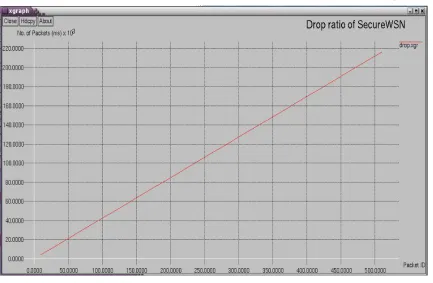
Drop Ratio of WSN
The drop ratio (in fig.5) specifies that the
International Journal of Emerging Technology and Advanced Engineering
Website: www.ijetae.com (ISSN 2250-2459,ISO 9001:2008 Certified Journal, Volume 3, Issue 9, September 2013)
[image:5.612.93.526.130.413.2]196
Fig. 5: Packet drop in WSN
IV. CONCLUSION
The specific properties of WSNs lead to special attacks as well as new challenges for countermeasure development [10].Our simulation results verify that our Proposed Methodology that was implemented is capable of monitoring attacks and even the networks conditions is low means the bandwidth rate was low. We can conclude from the simulation results that AODV protocol is good for reason send updated RT (Routing Tables) to each node in the sensing networks. The proper management policy adapted for distribution of the keys and uses above simulations using 802.15 standard.
REFERENCES
[1] Wenliang Du, Jing Deng, Yunghsiang S. Han, Shigang Chen, and Pramod K. Varshney,"A Key Management Scheme for Wireless Sensor Networks Using Deployment Knowledge",IEEE INFOCOM 2004.
[2] Vikram Srinivasan, Pavan Nuggehalli, Carla F. Chiasserini, Ramesh R. Rao,"Cooperation in Wireless Ad Hoc Networks",IEEE INFOCOM 2003.
[3] Seema Bandyopadhyay and Edward J. Coyle,"An Energy Efficient Hierarchical Clustering Algorithm for Wireless Sensor Networks",IEEE INFOCOM 2003.
[4] Kimaya Sanzgiri, Bridget Dahilly Brian Neil Leviney Clay Shieldsz Elizabeth M. Belding-Royer,"A Secure Routing Protocol for Ad Hoc Networks",IEEE 2002.
[5] Slobodanka Tomic,"Network-Growing Scenarios in IEEE 802.15.4 Wireless Sensor Networks",IEEE.
[6] Chao Lee,Li-Hua Yin, Yun-Chuan Guo, "Poster: A Multilevel Security Model for Wireless Sensor Networks",IEEE.
[7] Gerald Wagenknecht, Markus Anwander, Torsten Braun,"Demo: MARWIS - a Management Architecture for Heterogeneous Wireless Sensor Networks",IEEE.
[8] The network simulator ns-2 (www.isi.edu/nsnam/ns)
[9] Youngho Cho and Gang Qu,Yuanming Wu,"Insider Threats against Trust Mechanism with Watchdog and Defending Approaches in Wireless Sensor Networks",IEEE,2012.
[10] Nils Aschenbruck, Jan Bauer, Jakob Bieling, Alexander Bothe, Matthias Schwamborn,"WSNLab – a Security Testbed and Security Architecture for WSNs",IEEE.
[11] Sebastian Zoller, Markus Wachtel, Melanie Siebenhaar, Ralf Steinmetz,"Efficient Real-Time Monitoring of Multimodal Transports with Wireless Sensor Networks",IEEE.
[12] Ruben Hidalgo and José Ignacio Moreno,Routing Design in Wireless Sensor Networks and a Solution for Healthcare Environments",IEEE LATIN AMERICA TRANSACTIONS, 2011. [13] Markus Becker, Thomas Potsch, Koojana Kuladinithi and Carmelita
Goerg,"Deployment of CoAP in Transport Logistics",IEEE. [14] XiangYang Li,"Wireless Ad Hoc and Sensor Networks",Cambridge
University Press.
International Journal of Emerging Technology and Advanced Engineering
Website: www.ijetae.com (ISSN 2250-2459,ISO 9001:2008 Certified Journal, Volume 3, Issue 9, September 2013)
197
[16] Mohamed F. Younis,Kajaldeep Ghumman,Mohamed Eltoweissy,"Location-Aware Combinatorial Key Management Scheme for Clustered Sensor Networks",IEEE TRANSACTIONS ON PARALLEL AND DISTRIBUTED SYSTEMS,2006.
[17] S.Koteswararao, Dr. M. Sailaja, P. Ramesh, E. Nageswararao, V. Rajesh,"SENSOR NETWORKS SIMULATION IN NS2.26",IJECT Vol. 2, SP-1, Dec . 2011.