Involve users or fail: An IT project case
study from east Africa
Procter, CT and Businge, M
http://dx.doi.org/10.4018/ijitpm.2013100103
Title
Involve users or fail: An IT project case study from east Africa
Authors
Procter, CT and Businge, M
Type
Article
URL
This version is available at: http://usir.salford.ac.uk/31785/
Published Date
2013
USIR is a digital collection of the research output of the University of Salford. Where copyright
permits, full text material held in the repository is made freely available online and can be read,
downloaded and copied for noncommercial private study or research purposes. Please check the
manuscript for any further copyright restrictions.
October-December 2013, Vol. 4, No. 4
Special Issue on the Socio-Psychological and Cultural Aspects of Information Technology Project Management
Guest Editorial Preface
iv Terry T. Kidd, College of Business, University of Houston-Downtown, Houston, TX, USA Carolyn Ashe, College of Business, University of Houston-Downtown, Houston, TX, USA
Research Articles
1 A Journey through the Wilderness: An Autoethnographic Study of the ERP System Implementation Process As Created by IT Project Managers and Team Members
Terry T. Kidd, College of Business, University of Houston-Downtown, Houston, TX, USA Carolyn Ashe, College of Business, University of Houston-Downtown, Houston, TX, USA Natasha Carroll, University of Houston-Downtown, Houston, TX, USA
35 Positive Psychology in Information Technology Project Management: The Case of Bad News Reporting Joseph Natovich, School of Business Administration, College of Management-Academic Studies, Rishon Letzion, Israel Zeev Derzy, School of Business Administration, College of Management-Academic Studies, Rishon Letzion, Israel Rachel Natovich, Kreitman School for Advanced Graduate Studies, Ben Gurion University, Israel
51 Involve Users or Fail: An IT Project Case Study from East Africa Chris Procter, Salford Business School, University of Salford, Manchester, UK Molly Businge, Salford Business School, University of Salford, Manchester, UK
66 An IT Project Management Framework for Assessing the Dynamism of Culture under Globalization: Evidence from Zimbabwe
Sam Takavarasha Jr., Department of Computer Science, Faculty of Science, University of Zimbabwe, Harare, Zimbabwe Gilford Hapanyengwi, Department of Computer Science, University of Zimbabwe, Harare, Zimbabwe
Donald Chimanikire, Institute of Development Studies, Department of Social Studies, Faculty of Social Studies, University of Zimbabwe, Harare, Zimbabwe
Gabriel Kabanda, Zimbabwe Open University, Harare, Zimbabwe
82 Exploring the Impact of Team based Reward on Project Performance in Outsourced System Development Neeraj Parolia, Department of e-Business and Technology Management, Towson University, Towson, MD, USA Gary Klein, College of Business and Administration, University of Colorado, Colorado Springs, CO, USA James J. Jiang, College of Management, National Taiwan University, Taipei, Taiwan
93 The Effects of Project Management Certification on the Triple Constraint
Joseph T. Catanio, Department of Management Information Systems, John L. Grove College of Business, Shippensburg University, Shippensburg, PA, USA
Gary Armstrong, Department of Management Information Systems, John L. Grove College of Business, Shippensburg University, Shippensburg, PA, USA
Joanne Tucker, Department of Supply Chain Management, John L. Grove College of Business, Shippensburg University, Shippensburg, PA, USA
Book Review
112 Comparing High Technology Firms in Developed and Developing Countries: Cluster Growth Initiatives Adedeji Badiru, Air Force Institute of Technology, Dayton, OH, USA
I
nternatIonal
J
ournal
of
I
nformatIon
t
echnology
P
roJect
m
anagement
Table of Contents
Copyright
ABSTRACT
Repeated surveys, and most notably those by the Standish Group, suggest that a substantial proportion of Information Technology (IT) projects fail. The literature suggests that this is in part due to a lack of user in-volvement in the project. The authors’ research describes the case study of a major IT system implementation project in East Africa. The paper reports on the results of both an online questionnaire and interviews with key participants. The authors’ findings suggest that the subsequent failure of this project was in large part attributable to a lack of user involvement in the definition of requirements and implementation of the system. There did not appear to be an organisational culture that recognised the significance of such participation in the project. Although there are issues of definition raised, such as the definition of success and failure, this work supports previous findings that user involvement is a key factor in IT project success and failure.
Involve Users or Fail:
An IT Project Case Study from East Africa
Chris Procter, Salford Business School, University of Salford, Manchester, UK Molly Businge, Salford Business School, University of Salford, Manchester, UK
Keywords: Information Technology (IT), IT Project Management in East Africa, Project Failure, Project Success, User Participation
INTRODUCTION
This paper examines the implementation of a new IT system into a bank in East Africa. Over the years the bank had automated several opera-tions based on individual user or departmental information. The systems that were being used were on several platforms that needed to be merged. The bank required an IT system to streamline its operations and also to reduce fraud that was rising as a result of increasing market activity. The project was managed by a project team including the project manager, who was also the head of IT in the bank, members from the board of directors, and some of the heads of department. The project involved the
implementation of a Management Information System (MIS) that was to consolidate, stream-line and automate all processes in the investment bank. The budgeted cost of the project was about $4,000,000 and this was for both hardware and software, exclusive of recurrent licenses. Dur-ing the course of the project, costs increased to an estimated $5,350,000 partly due to the 20% yearly license fee later agreed with the supplier.
The project was estimated to take a period of six months to implement. However at the time it was stopped, it had been running for about one year. All budgetary allocations had been stopped by management. The hardware component of the project was about 85% implemented but the software component, the greater part of the whole project, was largely not implemented.
The author worked as an ICT systems administrator representing the branch of her bank during the project. The researcher was particularly interested, from her experience, in the human factors that contributed to the failure of the project and thus approached key stakeholders with a view to participating in research which sought to establish the level of user involvement in the project, and the rela-tionship between this and the project outcome. This personal involvement, and the significant role played by a few key stakeholders suggested qualitative research (discussed further in the section on methodology). Creswell’s widely cited work on qualitative research design (2007) suggests the case study as one of the five valid approaches for designing qualitative research. Thus the research examines the project as a case study in which we aim to answer three research questions:
1. What is the link between user involvement and IT project success?
2. How did the users describe their involve-ment in the project?
3. What issues were voiced or shared relat-ing to how user involvement influences a project?
The paper thus commences with a discus-sion on the definition of project success and failure, which is a key concept in this paper and a contested field. It then discusses the role of users and user involvement in IT projects. It goes on to examine literature concerning the significance of users in IT projects, the benefits and costs of user involvement and more detailed issues such as how and when to involve users. The paper describes the case study and the organisation of a questionnaire and interviews to elicit the views of those who took part in the project. The paper presents the findings from this research and discusses the findings with conclusions including suggestions for future work.
LITERATURE
IT Project Success/Failure
The failure rate of IT projects has been an area of great concern from the earliest days of software engineering and has resulted in a significant body of research investigating the reasons for failure (Agarwal & Rathod, 2006; Standish Chaos report, 2009). The 2009 Standish Group Chaos report, for example, showed a decline in the number of successful IT projects to 32% with those that were “challenged” at 44% whilst the remaining 24% were considered as failed projects. This report explained that in 2009 compared to the previous years there was a decline in success rates. In fact the report stated that the results in 2009 indicated the “highest failure rates” in a long time (Standish Chaos report, 2009).
User involvement has been ranked as one of the top factors that determine project success or failure: for example in the 1995 report, user involvement was ranked highest as the most significant contributor of project success or failure. The 2000, 2001 and 2009 reports indicated user involvement as one of the key explanations as to why projects fail or succeed. “Lack of user involvement has been the number one contributor to project failure. Even when delivered on time and on budget a project can fail if it does not meet user needs or expectations” (Standish Chaos report, 2001). Defining IT Project Success Such reports of course presuppose an agreed definition of project success. However, there is no common definition for success and failure (Thomas & Fernandez, 2008). Wang and Huang (2005) suggest there are different meanings attached to project success. For example, Thong et al
stakeholder expectations have been satisfied. It is clear that the way one person looks and defines what a successful project is varies from another person’s view (Shenhar et al., 2001). It is what the different stakeholders perceive as success that is of great significance (Baker
et al., 1983).
Whilst this position has great merit, for the purposes of this paper it is safe to rely upon the traditional and widely accepted definition given by Powers and Dickson (1973). They define IT project success as a project that is delivered on time, within budget and meets user requirements. This is referred to as the “Golden triangle” (Kerzner, 1994) or the “Iron triangle” (Bryde & Robinson, 2005)
User Involvement
The term user is deployed differently de-pending on the context it is used in. Damodaran (1996) states that users are people that will in the end own the system that is being implemented while the PMBOK (2004) categorises users as stakeholders who will utilise the “project’s products or services”. Several different users can be recognized:
• Senior management that use information from the system to make strategic decisions • Middle management who observe and
control any work that will and is performed by the system
• Employees who perform tasks on the system daily (Cavaye, 1995).
The term user involvement has been used interchangeably with terms such as “user participation” (Wu & Marakas, 2006), “user engagement” (Chan & Pan, 2008) and “repre-senting the user” (Iivari, 2006) among others. Folstad, et al (2004), define user involvement as “the activities in the information systems development process where information about users is collected, or users are actively involved in the requirements engineering, construction or development phase of the project” (p. 25). User involvement is also defined as the actual interaction with users during system design and
implementation (Kujala, 2003) and where users get to participate in the processes and activities during the development of a new system. This definition summarises the use of the term in this paper.
The idea of user involvement in the design of the systems they would use is not particular or newly created by IT. Alvin Toffler famously predicted in his book ‘The Third Wave’ (Toffler 1980) the advent of the ‘prosumer’ – i.e. pro-active consumers who would help design the goods and services they would later use. In Web development user participation in the design and use of systems has become widely accepted with adoption of the term Web 2.0 coined by O’Reilly (2007).
The Significance of User Involvement In IT Projects
The Information Systems literature agrees that user involvement is a really important issue. Research in IT project management and software development demonstrate the need for user involvement and suggests that the greater end users’ participation in the develop-ment process, the easier the impledevelop-mentation of the project (Harris & Weistroffer, 2009). According to Damodaran (1996), lack or user involvement or insufficient user involvement in IT projects, especially when it comes to the design process has been said to be one of the top most reasons as to why projects fail to meet the desired outcomes. Hasan (1999) discusses the significance of the impact of organisational culture in the adoption of IT, and this is more fully reviewed by Leidner and Kayworth (2006). Heeks (2002) discusses the significance of or-ganisational culture in relation to project success and failure in Information Systems projects in developing countries, but the literature in this field is very limited. The benefits of involving users can include:
• Improved system quality
• Increased system acceptance and satisfaction
How to Involve Users in IT Projects There is considerable discussion on how users can be involved in information system devel-opment and IT projects. They can be given responsibilities as part of the project team or just consulted in case specific information is needed (Kujala, 2008). In order to get users involved in IT projects or information system development processes, a range of techniques have been suggested by different authors. Hart-wick and Barki (1994), for example, recognized three ways users could participate in system development and these are:
• Overall Responsibility: Where users have certain tasks and obligations that show liability for the project
• User Information System Relationship:
Looks at the power users have during phases in the development process, show-ing how they can communicate their views such as being kept informed of the progress of the system and authorising work done by the development team
• Hands on Activity: Which looks at the work users actually do, such as identifying what the system should look like, writing procedures and reports
Damodaran’s research suggests an impor-tant difference between involving users and allowing them the power to make important decisions that may have an impact on the system (Damodaran, 1996). She represented the ways users can be involved in IT project on a scale showing three forms beginning with:
• The Informative Form: Allows users to get involved as information providers • Consultative Form: Users get involved
giving their views on what has been pre-sented to them with regards to the new system
• The Participative Form: Where users have a say on the decisions that can affect the system as a whole
This is developed further by Palanisamy and Sushil (2002) who discussed ways of involv-ing users from the planninvolv-ing point of view and suggested that having users act as consultants, or selecting specific people to represent the user group on a project team or steering committee can be ways of involving users. This idea is established in many methods. For example, traditional analysis and design methods such as the Structured System Analysis and Design Method (SSADM) specified the involvement of users in systems development. More impor-tantly, Project Management methods such as PRINCE2, which originated in the IT Project Management method PROMPT, require the involvement of users at the Project Board level. This thinking has been advanced significantly with the establishment of Agile Project Manage-ment methods and explicit integration of user defined quality into the success criteria of Six Sigma and other approaches.
When to Involve Users
Different authors have suggested the various stages at which users should get involved in IT projects (Noyes et al., 1996; Wu & Marakas, 2006). Many of them have found that user in-volvement is more fruitful in the early stages of the system development process. For example, Cavaye (1995) explains that users should be involved in initial stages of system develop-ment, where the reasons as to why a system should be implemented are being discussed and requirements discovered. This will foster better understanding of system requirements and it is also less expensive to make changes earlier on in the process than in later stages (Noyes et al., 1996).
Involving users earlier on in the analysis stage has greater impact allowing them to eas-ily accept and use the system (Wu & Marakas, 2006).
design and implementation phases could lead to enhanced agreement among all members in the organisation. The planning stage has also been thought to be the best stage to involve us-ers because it will lead to “strategic success”, and that when users take part in the planning stage, they are more likely to take part in the later stages of requirements definition and system design (Palanisamy & Sushil, 2002). Kim and Lee (1986) learnt that when it comes to the implementation stage, user involvement is useful with the help and support of management as well as a positive user attitude towards the whole concept of participation. Cavaye (1995) suggests that the later stages where the system is being tested and installed are also vital.
Unlike authors that are specific about the stages users should be involved in the system development process, Majid et al (2010) and Noyes et al (1996) argue that users should be involved in all the different stages from the initial to the final phases of the process. Majid
et al’s (2010) research, where a survey on user involvement was carried out in the whole software development life cycle, concluded that involving users in all the phases of development is of significant importance and can in turn lead to a successful system.
Costs of User Involvement
There are, however costs involved in user involvement. For example:
• User involvement in system development necessitates a lot of time to be set aside for both users and developers and can lead to project delays (Wu & Marakas, 2006). • User involvement can be a challenge when
it comes to both the users and developers of the system exchanging ideas and passing on information. Users need to be adequately informed about what system design entails and may need training to have full under-standing of the processes (Wilson et al.,
1997). SSADM, for example, included a whole handbook for users to understand the method and terminology.
• Involving users causes an escalation in the financial resources since additional people are taking part in the project (Ca-vaye, 1995).
Markus and Mao (2004) argue that, due to the expense and time involved of having users involved in IT project development their involvement should only be taken up in situa-tions where it is really required, such as in big projects and those with difficult tasks (Mckeen & Guimaraes, 1997).
Literature Summary
It is established that using the definition of the widely established Iron Triangle, there contin-ues to be a substantial proportion of IT projects that fail. The literature is agreed that there is a clear correlation between user involvement and project success. There are different approaches to user involvement ranging from specific stages of development, to a methodological approach requiring user involvement in the project from inception to review. Greater involvement can be closely related to greater success but also greater cost.
METHOD
The method of investigation involved a questionnaire and interviews with key re-spondents. The questionnaire allowed for the efficient collection of data from a significant number of project participants (Saunders et al., 2003). It was sent using Survey Monkey to 30 individual email accounts. Survey Monkey is a free online survey tool that allows a user to create his/her own questionnaires easily and which also helps to analyse the data. Judgemental sampling (Saunders et al., 2003) was used to select the 30 individuals because they were in the best position to provide the information that would enable the author answer the research questions.
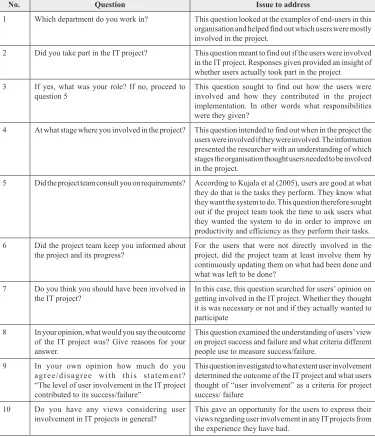
The structure of the questionnaire was designed in such a way as to be answered by two main types of users; those that existed in the organisation when the project took place but were not actively involved, and those users that were actively involved and had a responsibility in the project. It comprised 10 questions on user involvement and project success including both open and closed questions. The 10 questions were as follows in Table 1.
Prior to sending the questionnaires, an informed consent form was sent to all the re-spondents asking for their approval to take part in the research with an explanation of the aim of the research including a link to the questionnaire 24 respondents completed the questionnaire.
This was followed by interviews. Six respondents were interviewed: these included one system developer, one user from operations department, three staff from the IT departments and one from customer services. Interviewees were briefed by emails as to the duration and location of their interviews.
RESULTS
Data Analysis
Survey Monkey was used to generate the results from the questionnaire and this data was anal-ysed thematically and matched to themes arising from interviews. Given the qualitative nature of the research and the role of the researcher in the project, the author was especially interested
in establishing and appreciating the different views the users from the various departments had on user involvement in the project, and to understand this through the eyes of the users (Saunders et al., 2003).
Data relevant to this theme are given from the analysis of the questionnaires. For open-ended responses and interviews, direct quotes are used to illustrate what the participants said. Questionnaire Analysis
Respondents that took part in the question-naire were from the IT, Operations, Customer Services and Accounts departments. They were asked if they took part in the project develop-ment process. 22 out of 24 people that returned their questionnaires responded to this question with 11 people indicating that they took part in the development of the project, and 11 oth-ers indicating that they did not. Subsequent answers (see below) suggest that some had a partial involvement.
Those that had taken part in the project development were further asked to specify the roles they played. Seven respondents stated that they had been part of the project team, five had taken the role of users and one specified a role of infrastructure administrator. In addition to the roles they played, participants were asked at what stage they were involved in the project.
Six indicated they had been involved in the planning stage, three in the design stage, eight in implementation and six in testing. Three of the whole group had taken part in all 4 stages. All respondents were asked if they had been consulted on system requirements. A total of 19 people answered this question. 11 of the 19 indicated that they were not consulted on system requirements, while 8 said they had been consulted. Respondents were additionally asked if the project team kept them informed about the project and its progress.
happening at the various stages of the project. Participants were also asked if they thought they should have been involved in the development process. 16 people answered this question, with 15 agreeing that they should have been involved in the project, and 1 person stating that they should not have been involved.
[image:9.504.56.431.96.533.2]They were further asked to explain why they thought they should or should not have been involved in the project. Five gave reasons relating to their role as end users and their being affected by the new system:
Table 1. Ten questions on user involvement and project success
No. Question Issue to address
1 Which department do you work in? This question looked at the examples of end-users in this organisation and helped find out which users were mostly involved in the project.
2 Did you take part in the IT project? This question meant to find out if the users were involved in the IT project. Responses given provided an insight of whether users actually took part in the project 3 If yes, what was your role? If no, proceed to
question 5 This question sought to find out how the users were involved and how they contributed in the project implementation. In other words what responsibilities were they given?
4 At what stage where you involved in the project? This question intended to find out when in the project the users were involved if they were involved. The information presented the researcher with an understanding of which stages the organisation thought users needed to be involved in the project.
5 Did the project team consult you on requirements? According to Kujala et al (2005), users are good at what they do that is the tasks they perform. They know what they want the system to do. This question therefore sought out if the project team took the time to ask users what they wanted the system to do in order to improve on productivity and efficiency as they perform their tasks. 6 Did the project team keep you informed about
the project and its progress? For the users that were not directly involved in the project, did the project team at least involve them by continuously updating them on what had been done and what was left to be done?
7 Do you think you should have been involved in
the IT project? In this case, this question searched for users’ opinion on getting involved in the IT project. Whether they thought it is was necessary or not and if they actually wanted to participate
8 In your opinion, what would you say the outcome of the IT project was? Give reasons for your answer.
This question examined the understanding of users’ view on project success and failure and what criteria different people use to measure success/failure.
9 In your own opinion how much do you agree/disagree with this statement? “The level of user involvement in the IT project contributed to its success/failure”
This question investigated to what extent user involvement determined the outcome of the IT project and what users thought of “user involvement” as a criteria for project success/ failure
10 Do you have any views considering user
As an end user, I will be the one to use the sys-tem in the long run and so by getting involved I will be able to have a better understanding of the system ....
Four participants gave reasons stating that they should have been involved in the project mainly because their involvement would help them better understand the system which in turn would enable them to perform their tasks more efficiently. Some users expressed their opinions in the following way:
…I needed the skills to be able to serve clients better
If I am going to use the system, I should be able to know how the system will help me do my work
Six respondents suggested that they should have been involved in the development of the project because their requirements needed to be considered and they felt it was necessary for the system to meet and identify with their needs. One of the respondents wrote:
...For such a project the main goal is to meet the user needs and therefore user involvement is mandatory. User involvement is the key concept in the development of useful and usable systems and has positive effects on system success and user satisfaction.
Another stated that:
As a user I would be the most reliable person to identify system needs for the tasks to be performed.
Reasons for Success/ Failure Respondents were then asked to give their opinion on what they considered the outcome of the project was and why they thought it was a success/failure. Of the 24 that returned their questionnaires, 23 participants gave their
opinions and from the responses, 17 believed the project was a failure whilst 6 said the proj-ect was a success. The responses given were grouped into 2 to include reasons for success and reasons for failure of the project.
In discussing the reasons for success/failure one respondent explained that the roles that they had to perform were taken into consideration. Another said the project was a success because the technical side of it was a success. He wrote:
The project was both infrastructure upgrade and system upgrade. The infrastructure was successfully upgraded... So the technical implementation of the project was a success ....
For the majority who classed the project as a failure, the reasons given show that most of the respondents attributed the project failure to lack of user involvement (seven) and the fact that the system was never implemented (six). The seven citing user involvement included comments such as:
End users had no idea of what was going on
Lack of user involvement proved fatal for the project. Without user involvement nobody in the organisation felt committed to the sys-tem...senior management and users needed to get involved from the start and continuously throughout the development...
Whilst amongst the six who referred to the non-implementation of the system comments included:
The project never took off. It was a total failure
...the operational and other systems within the project were not completed due to the board’s decision to stop implementation...
Other respondents attributed the project failure to issues such as poor communication from management and the project team. For example one respondent wrote:
After all the time, effort and money invested, the system was never used and reasons for this were never communicated
Another respondent said the project did not meet organisational requirements. Others wrote that it was due to poor planning including the failure to take into account the increase in project costs.
From the project outcome, participants were then asked to state how much they agreed with the statement “The level of user involve-ment in the project contributed to its success/ failure”. From 23 responses 12 respondents strongly agreed with the statement, 4 agreed, 4 were neutral (neither agreed nor disagreed), 1 disagreed with the statement, and 2 strongly disagreed with the statement
Finally, respondents were asked to give their views on user involvement in IT projects in general, with no specific reference to the bank’s project. A total of 14 out of the 24 respondents gave their views. From the responses collected, 5 said that it was important for all users in an organisation to be involved at all stages of a system development cycle. One respondent wrote that:
Users should never be left out of project de-velopments and should generally be involved at all stages to better understand and share requirements”
Another that:
…all people that need to be involved in the IT project should be consulted throughout the development of the project
Aside from involving all users at all stages, 2 respondents discussed views related to involv-ing users as a means of helpinvolv-ing them understand
and accept the new system hence reducing the chances of resistance. 3 highlighted views on user involvement as being important when it comes to helping users and system developers determine system requirements, 2 wrote that user involvement leads to IT project success and another 2 suggested that involving users will improve work efficiency among other reasons. Interview Analysis
Interviews were carried out to get a more in-depth understanding of the project. Semi structured questions were asked under the topics; project funding, senior management involvement/interference, the stage in the project that problems were noticed, what could have been done differently in the project and whether there has since been an improvement in the development of other projects in the same organisation.
Project Funding
When asked about project funding, 5 interview-ees said the project failed to meet the allocated budget due to a continuous increase in costs. The management of the organisation did not put aside money to cover unexpected costs and there was poor planning in terms of the project cost. For example, the annual licence fee for the software was not considered in the budget:
The organisation had money put aside for the project but this money was not sustainable since other costs on requirements kept coming in.
…During the project implementation, there was a slump in the business (Financial invest-ment) and no money to continue financing it. The company decided to cut costs and thought the project would not be necessary after all…
Senior Management Involvement/Interference
senior management involvement/interference in the project on the outcome of the project. Two main arguments were raised; inadequate support from senior management and limited management involvement. 2 interviewees sug-gested that senior management backed out of the project leaving it to fail, and 3 said that senior management did not put in enough effort to support the project from the start:
The senior management interference was not up to the required level during all the phases of the project, which then led to the problems in the project at the later stages of the project.
...the project ended up failing because in the middle of it, management backed out and be-came negative especially after the cost implica-tion and hence we couldn’t progress
Yes it did have an impact because the manage-ment decided to withdraw funding for the project thereby ‘killing’ the project altogether
The Stage At Which Issues In The Project Were Noticed
Interviewees were asked at what stage of the project they thought management and the project team realised the project was taking a wrong turn. Three people mentioned that problems in the project were noticed at the implementation stage while two mentioned the testing stage. For the testing stage, one person specifically talked about a later User Acceptance Test (UAT) when the project team realised the system was not customised to suit the organisation’s require-ments. This is what he said:
During the later UAT phase of the project, the project team realised that the project without customisation will not suit the customer’s requirements but then it was too late to make any great effort to avoid failure of the project. However efforts were made both from the project team and management to work around areas of conflict.
One other interviewee did not specify any particular stage but said the project problems were noticed from the very start of the develop-ment process. He said:
Some of the things were noticed from the start for me, the project was doomed from the be-ginning…
Interviewees were then asked what could have been done differently in the project. Four of them pointed to user involvement in this context. They said that all users from all departments, including senior management, should have been involved from the beginning of the project to the end, while three said that the project needed better requirements analysis. One interviewee talked about project phasing and one other said that the project needed proper management and budgeting to succeed. Thus user involvement was ineffective. This is what one of the interviewees had to say:
…during the meetings a lot of time was wasted with consultants. Users were trying to agree on what needed to be included in the system but instead policy issues were discussed with consultants. I only attended one meeting and decided that it was not worth attending other meetings as these were not project implementa-tion meetings
Another interviewee suggested that user involvement was not taken seriously;
I was the one in charge of infrastructure at the time yet I was giving the project a cold shoulder. No one asked for my views.
During the discussions on requirements analysis, one of the interviewees explained that the system requirements were never properly analysed which should not have been the case. He said that;
an effective way…effective gap identification should have been in place much earlier in the project…
DISCUSSION
The main aim of this research was to explore the effect of user involvement on IT project imple-mentation and success. In order to achieve this, the study set out to answer two main questions:
• What is the link between user involvement and IT project success?
• How did the users describe their involve-ment in the project?
• What issues were voiced or shared relat-ing to how user involvement influences a project?
The discussion that follows seeks to provide the answers to the questions.
User Involvement
Half of the users who participated in the research were involved at some stage of the development and implementation of the new system. Some respondents were involved in all stages of the project while others were involved in specific stages only. Some expressed their wish to have been more involved.
One of the benefits of involving users in IT projects is that users are able to identify and provide information on system requirements that will enable the development of an efficient system and improved system quality (Kujala 2003, 2008). Consulting users on requirements has also been said to be one of the ways of involving users in the development process and best done at the beginning of the project development so as to get the bigger picture of the requirements (Damodaran, 1996). However looking at the results from the questionnaire, most of the users in this case were never consulted on their requirements. The develop-ment process began with little or no require-ments analysis from the users and most of the
respondents from the survey were not informed of the project’s progress either. Hartwick and Barki (1994) suggested that one of the ways us-ers can participate in IT projects is through the “user-information system relationship” where users can communicate their views as well as get feedback on the project progress at all stages.
Most respondents felt that their involve-ment in the developinvolve-ment of the new system could have improved their work efficiency and ensured that the system fitted with their requirements. They were clearly aware of the benefits they could have attained from being part of the project’s development process. These reasons are consistent with the findings by authors like Damodaran (1996); Wu and Marakas (2006) who explained the benefits of user involvement in IT projects in their research. Damodaran (1996) further explains that users in the end are the ones that will stay with and use the system.
Success and Failure
When participants were asked what the outcome of the project was, some stated it was a success while others a failure. This shows that the differ-ent participants all had their own conclusions. Evidence from this and from previous research shows that determining whether a project is a failure or a success depends on the person evaluating the project, as explained by Shen-har et al (2001); Wang and Huang (2005). The participants further explained the reasons as to why they said the project was either a success or failure. These reasons provided the differ-ent criteria responddiffer-ents used to determine the project outcome. From the literature reviewed, different criteria are used to measure project success/failure and these change depending on the project.
project failure supporting literature cited in the second section (Chaos report, 2001, 2009; Palanisamy & Sushil, 2002).
Most of the participants strongly agreed with this statement “the level of user involve-ment in the project contributed to its success/ failure”. Previous research findings also con-cluded that user involvement in IT projects can determine their success or failure (Damo-daran, 1996). These findings also conclude that the project in this organisation was to a greater extent a failure due to inadequate user involvement.
Project Funding, Senior Management Involvement/ Interference
Research has shown that it is very important for senior management to get involved in IT projects since they make strategic decisions on funding and other resources that could impact on the project. Senior management support also encourages users to get involved in the system development process (Cavaye, 1995).
It was noted that the implementation costs of the project continually increased and the estimated budget was not met. Furthermore there was no money set aside for contingencies during the planning process and this was the main reason for some respondents to define the project as a failure. Aside from the increase in the project costs, interviewees agreed that management did not play a sufficient part, and this also contributed to the failure of this project. Senior management withdrew from the project and cut off its funding exacerbating its failure. Management decided to cut costs in the company during the time the project was being implemented even though almost half the project work was completed.
CONCLUSION
Interviews and questionnaires were used to collect respondents’ opinions on user involve-ment and it was discovered that participants felt that their involvement would have made a difference in the project. The findings also show
that participants were of the view that if users are to be involved in IT projects, they should be involved at all the stages from planning to implementation. It was clear that the majority view was that the project failed, and lack of user involvement contributed substantially to this failure. Users were not effectively con-sulted on their requirements and were not given feedback on the project’s progress. This study concludes that user involvement in IT projects is very important and can indeed determine the project’s outcome; that is whether it turns out to be a success or failure. User involvement still remains one of the most significant factors that can lead to IT project success/failure.
Users may not be directly involved in the development process but at least they should be consulted on their requirements and given daily feedback on the project progress (Damodaran, 1996). It is better for users to be involved at all stages of the development process as noted by Majid et al (2010) and Noyes et al (1996) for better project results. The involvement of users in the development process should have an impact; users should be able to influence the decisions being made and not involved for the sake of it (Damodaran, 1996). User participa-tion is becoming the norm in relaparticipa-tion to internet development with widespread acceptance of Web 2.0 (O’Reilly 2007). However our research suggests that this culture is not prevalent in large scale ‘stand alone’ projects, where Toffler’s ‘prosumers’ (Toffler 1980) have yet to have their day. This is in accordance with research reviewed by Leidner and Kayworth (2006).
contributed to the failure of the project such as poor planning, senior management withdrawal from the project, and increasing costs.
Since this study is aimed at assessing the impact of user involvement on IT project implementation and success, the results obtained should be viewed in the perspective of the given research setting. The research is concerned with just one IT project in East Africa with a relatively small group of respondents. The findings cannot therefore be generalised but they are valuable in supporting key work in the field of user involvement and project suc-cess and failure in IT projects. Further work to establish why user involvement is not the defining culture in the design of large IT projects would be valuable and might help to increase the proportion of projects that succeed in future. The research did not investigate whether there was any correlation between the project failure, lack of user involvement and the geographical location of the project in East Africa and we note that there is a dearth of literature discussing IT Project Management and user participation in developing countries.
REFERENCES
Agarwal, N., & Rathod, U. (2006). Defining ‘suc-cess’ for software projects: An exploratory revela-tion. International Journal of Project Management,
24(4), 358–370. doi:10.1016/j.ijproman.2005.11.009 Baker, B. N., Murphy, D. C., & Fisher, D. (1983). Factors affecting project success. In D. I. Cleland, & W. R. King (Eds.), Project Management Handbook. New York, NY: Van Nostrand Reinhold.
Bryde, D. J., & Robinson, L. (2005). Client versus contract perspectives on project success criteria.
International Journal of Project Management, 23(8), 622–629. doi:10.1016/j.ijproman.2005.05.003 Cavaye, A. L. M. (1995). User participation in system development revisited. Information & Management,
28, 311–323. doi:10.1016/0378-7206(94)00053-L Chan, C. M. L., & Pan, S. L. (2008). User engagement in e-government systems implementation: A com-parative case study of two Singaporean initiatives.
The Journal of Strategic Information Systems, 17(2), 124–139. doi:10.1016/j.jsis.2007.12.003
Choe, J. (1998). The effects of user participation on the design of accounting information systems. Infor-mation & Management, 34, 185–198. doi:10.1016/ S0378-7206(98)00055-X
Cresswell, J. W., Hanson, W. E., Clark Plano, V. L., & Morales, A. (2007). Qualitative research designs: Selection and implementation. The Counseling Psy-chologist, 35, 236. doi:10.1177/0011000006287390 Damodaran, L. (1996). User involvement in the systems design process- a practical guide for us-ers. Behaviour & Information Technology, 15(6), 363–377. doi:10.1080/014492996120049
De Wit, A. (1988). Measurement of project success.
International Journal of Project Management, 6(3), 164–170. doi:10.1016/0263-7863(88)90043-9 Folstad, A., Jorgensen, H. D., & Krogstie, J. (2004). User involvement in e-government development proj-ects. In Proceedings of the third Nordic conference on Human computer interaction, Tampere, Finland. Harris, M. A., & Weistroffer, H. R. (2009). A new look at the relationship between user involvement in systems development and system success. Com-munications of the Association for Information Systems, 24(42), 738–756.
Hartwick, J., & Barki, H. (1994). Explaining the role of user participation in IS use. Management Science,
40(4), 440–465. doi:10.1287/mnsc.40.4.440 Hasan, H., & Ditsa, G. (1999). The Impact of culture on the adoption of it: An interpretive study. Journal of Global Information Management, 7(1), 5–15. He, J., & King, W. R. (2008). The role of user par-ticipation in I.S development: Implications from a meta-analysis. Journal of Management Information Systems, 25(1), 301–331. doi:10.2753/MIS0742-1222250111
Heeks, R. (2002). Information systems and devel-oping countries: Failure, success and local impro-visations. The Information Society, 18, 101–112. doi:10.1080/01972240290075039
Iivari, N. (2006). Representing the ‘user’ in software development – a cultural analysis of usability work in the product development context. Interacting with Computers, 18, 635–664. doi:10.1016/j.in-tcom.2005.10.002
Kim, E., & Lee, J. (1986). An exploratory contingency model of user participation and MIS use. Informa-tion & Management, 11, 87–97. doi:10.1016/0378-7206(86)90038-8
Kujala, S. (2003). User involvement: A re-view of the benefits and challenges. Behav-iour & Information Technology, 22(1), 1–16. doi:10.1080/01449290301782
Kujala, S. (2008). Effective user involvement in product development by improving analysis of end user needs. Behaviour & Information Technology,
27(6), 457–473. doi:10.1080/01449290601111051 Leidner, D. E., & Kayworth, T. (2006). A review of culture in information systems research: Toward a theory of information technology culture conflict.
Management Information Systems Quarterly, 30(2), 357–399.
Majid, R. A., Noor, N. L., Adnan, W. A. W., & Mansor, S. (2010). A survey on user involvement in software development life cycle from practitioner’s perspectives. In Proceedings of the 5th International Conference on Computer Sciences and Convergence Information Technology (ICCIT) (pp. 240-243). Markus, M. L., & Mao, J. (2004). Participation in development and implementation - updating an old, tired concept for today’s IS contexts. Journal of the Association for Information Systems, 5(11-12), 514–544.
McKeen, J. D., & Guimaraes, T. (1997). Successful strategies for user participation in systems develop-ment. Journal of Management Information Systems,
14(2), 133–150.
Noyes, J. M., Starr, A. F., & Frankish, G. R. (1996). User involvement in the early stages of the development of an aircraft warning system. Be-haviour & Information Technology, 15(2), 67–75. doi:10.1080/014492996120274 PMID:11541759 O’Reilly. (2007). What is web 2.0: Design pat-terns and business models for the next generation of software. Communications & Strategies, No. 1. First Quarter.
Palanisamy, R., & Sushil. (2002). User involvement in information systems planning leads to strategic success: An empirical study. Journal of Service Research, 1(2), 125–157.
Powers, R. F., & Dickson, G. W. (1973). MIS proj-ect management: Myths, opinions and realities.
California Management Review, 15(3), 147–156. doi:10.2307/41164448
Project Management Institute. (2004). A guide to the project management body of knowledge (3rd ed.). Newtown Square, PA: PMBOK Guide.
Report, C. (1995). The Standish group report. Re-trieved August, 1, 2011, from www.projectsmart. co.uk/docs/chaos-report.pdf
Report, C. (2001). The Standish group report. Re-trieved July, 20, 2011, from http://www.scribd.com/ doc/10167963/Chaos-Report-2001
Report, C. (2009). The Standish group report. Retrieved August, 5, 2011, from www.portal.state. pa.us/portal/server.pt/.../chaos_summary_2009_pdf Saunders, M., Lewis, P., & Thornhill, A. (2003).
Research methods for business students (3rd ed.). Pearson Education Ltd.
Shenhar, A. J., Dvir, D., Levy, O., & Maltz, A. C. (2001). Project success: A multidimensional strategic concept. Long Range Planning, 34(6), 699–725. doi:10.1016/S0024-6301(01)00097-8
Thomas, G., & Ferna’ndez, W. (2008). Success in IT projects: A matter of definition? International Journal of Project Management, 26, 733–742. doi:10.1016/j. ijproman.2008.06.003
Thong, J., Yap, C., & Raman, K. (1996). Top man-agement support, external expertise and information systems implementations in small businesses. Infor-mation Systems Research, 7, 248–267. doi:10.1287/ isre.7.2.248
Toffler, A. (1980). The third wave. Bantam Books. Wang, X., & Huang, J. (2005). The relationship between key stakeholders’ project performance and project success: Perceptions of Chinese construction supervising engineers. International Journal of Project Management, 24, 253–260. doi:10.1016/j. ijproman.2005.11.006
Wilson, S., Bekker, M., Johnson, P., & Johnson, H. (1997). Helping and hindering user involvement – A tale of everyday design. In Proceedings of CHI’97, Conference of Human Factors in Computing Systems
(pp. 178–185). ACM.
Wu, J. B., & Marakas, G. M. (2006). The impact of operational user participation on perceived system implementation success: An empirical investiga-tion. Journal of Computer Information Systems,
47, 127–140.
Yin, R. K. (2003). Application of case study Research
Chris Procter is a senior lecturer in project management at the University of Salford, United Kingdom. He has extensive experience in the practice of project management alongside teaching and research in the field. He has a longstanding involvement also in pedagogical research and supervises a number of students both in the area of IT Project Management and related areas. Further information at http://business.salford.ac.uk/staff/chrisprocter