Multifactor Model of Risk and Return Through Enterprise Risk
Management Framework
Fong-Woon Lai
1, M. Fazilah A. Samad
2, Noor Azlinna Azizan
3 1 Universiti Teknologi PETRONAS, MALAYSIA2University of Malaya, MALAYSIA
3Universiti Malaysia PAHANG, MALAYSIA
Abstract.
This paper presents a multifactor risk pricing model which conceptualizes a strategic risk premium framework in which the value enhancing dimension of managing firm-specific risks is factored into the reduction of the firm’s risk premium. The model’s concept of managing these firm-specific risks is embodied in an enterprise risk management (ERM) implementation framework. ERM is defined as the process of identifying and analyzing risk from a holistic and company-wide perspective. Findings of this study have provided a perspective on a productive management of firm-specific risk. They vindicate the efficacy of ERM in creating value for the firms. It lends reference to enterprises for adaptation of their own internal risk management modeling. The test results have implied that Malaysian listed companies are poised to benefit from a favorable credit profile rating if they put in place an effective ERM program as this will lead to lower risk premium, hence reducing their cost of capital.Keywords:
multifactor risk model, asset pricing model, enterprise risk management, strategic risk premium1.
Introduction
This paper presents a multifactor risk pricing model which conceptualizes a strategic risk premium framework in which the value enhancing dimension of managing firm-specific risks is factored into the reduction of the firm’s risk premium. The model’s notion of managing these firm-specific risks is espoused through an enterprise risk management (ERM) implementation framework.
ERM is defined as the process of identifying and analyzing risk from a holistic and company-wide perspective. It is a structured and disciplined approach in aligning strategy, processes, people, technology and knowledge with a purpose of evaluating and managing the uncertainties the enterprise faces as it creates value. It focuses risk management function from primarily defensive to increasingly offensive and strategic in nature [1]. However, the neo-classical finance theory (NCFT) postulates that firm-specific risk is irrelevant and that only the covariance of the firm’s asset returns to the market portfolio which is measured by the beta in the capital asset pricing model (CAPM) matters.
ERM implementation framework provides building blocks for a multifactor risk pricing model.This is in comparison to the well established and much debated market based, single-factor capital asset pricing model. The proposed ERM framework highlights pertinent elements for an effective implementation of it to cover the areas of governance, structure, and process of the framework. The analytic model develops hypotheses to test whether there are significant association between the implementation of ERM with the reduction of the firm’s tactical, strategic, and normative risks.
2.
Literature Review
2.1.
Capital Asset Pricing Model
Capital asset pricing model (CAPM) has been widely used in pricing the risk inherent in an asset. It is a rather narrow risk pricing model which is based on a single market risk factor in that it compensates investors for the systematic risk they assumed. Nonetheless, CAPM has been receiving its fair shares of challenge and criticism for not being able to accurately predict asset returns due to its shortcoming of failing to incorporate non-market risk factors relevant to the asset price movement. For instance,[2] suggested that the predictive power of non-market (firm-specific) factors are better than beta alone when it comes to predicting stock returns. [3] found that the firm’s unsystematic risk such as earnings-to-price ratio is a key predictor to stock returns. [4] found that leverage is just as important in predicting stock returns. [5] highlighted the material impact of firm-specific risk by noting an inverse relationship between a firm’s market value and its level of unsystematic risk.
2.2.
The Theoretical Foundation
According to modern financial theory, managing unsystematic risk will not be rewarded by the stock market. This is in contradiction to the notion of corporate strategy and the theory of strategic management where managing firm-specific risks is emphasized. [6] argued that managing these unsystematic risks become inherent in the concept of matching corporate resources and competencies to opportunities within the firms’ environment.
This paper links a dynamic framework of a firm’s risk premium conceptualized by Chatterjee, Lubatkin, and Schulze [7] – hereafter referred to as the CLS (risk premium) model, as the value enhancing transmission mechanism through ERM implementation framework for managing firm-specific risks that will enhance shareholders’ value. The linkage theorizes a model capturing the correlation between the risks that are strategically associated with the firm’s risk premium or cost of capital.
2.3
A Strategic Conceptualization of Risk Premium
The CLS risk premium model was conceptualized based on the assumption that investors do care about firm-specific risk. This is owing to the fact most investors are not as fully diversified and markets are not as perfect as CAPM assumes. The interactions among constructs in the model take reference from information economics, resource-based view of the firm, and the industry structural view of strategy [7].
The strategic conceptualization of CLS’ firm risk premium model postulates that investors are exposed to various classes of firm-specific risk in a world of partial diversification and imperfect markets. CLS risk premium model categorizes these three classes of unsystematic risk as tactical, strategic, and normative risk. The CLS model points out that, tactical risk exists mainly in information asymmetries, whilst strategic risk comes from imperfections in the resource and output markets, and finally normative risk presents itself in the forces that define institutional norms.
CLS risk premium model highlights the dynamic relationships between unsystematic risk (i.e. tactical, strategic, and normative risks) and a firm’s risk premium. Hence, firm-specific activities and skills derived from the active management of those risks will influence a firm’s risk premium. The factors that CLS model include are macroeconomic, tactical, strategic, and normative risks. In contrast, CAPM recognizes only macroeconomic risk which is represented by a single market factor. The arbitrage pricing theory (APT) on the other hand, attempts to improve on the CAPM model by incorporating multiple macroeconomic factors. Nevertheless, similar to CAPM, APT omits unsystematic risk factors.
Our proposed multifactor model of risk and return will include all factors highlighted by the CLS model which are firm-specific in nature such that the tactical, strategic, and normative risks. These unsystematic risks are to be managed and mitigated through our proposed ERM implementation framework as below.
2.4
The Conceptual Model
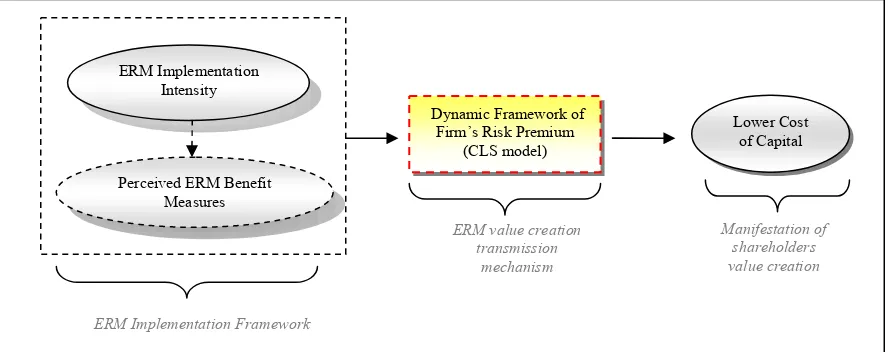
Figure 1 depicts the theorized conceptual framework for the shareholders value creating ERM model. Referring to Fig. 1, the proposed ERM implementation framework will yield some perceived benefit measures through the management and mitigation of tactical, strategic, and normative risks. This in turn will have favorable impact on the firm’s cost of capital as espoused by the strategic risk premium model.
Fig. 1: Conceptual framework of shareholders value creating ERM model
3.
Methodology
3.1
ERM Implementation Framework
Our proposed ERM framework consists of fourteen implementation elements deemed to be relevant and important to define the intensity, maturity, and penetration level of ERM practices. The fourteen elements cover seven aspects of the very essence of ERM implementation namely, (i) ERM definition, (ii) effective communication of risk and responsibilities, (iii) philosophy of ERM, (iv) risk identification and response, (v) compliance, (vi) risk quantification, and (vii) performance measurement. These seven aspects, in turns, embody the three principal dimensions of the ERM framework, i.e. the process, governance, and structure. Tab. 1 presents the fourteen implementation elements in the proposed framework.
Tab. 1: The fourteen elements ERM implementation Framework
No Statement No Statement
1 provides common understanding of the
objectives of each ERM initiative 8 Aligns ERM initiatives to business objectives 2 provides common terminology and set of
standards of risk management 9 Provides the rigor to identify and select risk responses 3 provides enterprise-wide information about risk 10 Reduces risk of non-compliance
4 Enables everyone to understand his/her accountability
11 Enables tracking costs of compliance
5 Integrates risk with corporate strategic planning 12 Quantifies risk to the greatest extent possible
6 Integrated across all functions and business
units 13 Identifies key risk indicators (KRIs)
7 ERM strategy is aligned with corporate strategy 14 Integrates risk with key performance indicators
3.2
Measurement for Tactical, Strategic, and Normative Risk
This study develops hypotheses H1, H2, and H3 to empirically examine the association between our
proposed ERM implementation framework with its impact in reducing / improving the firms’ three classes of unsystematic risk. The testing of hypotheses H1, H2, and H3 involved bivariate correlation test between ERM
Implementation, which is the independent variable, with the three classes of unsystematic risk, i.e. tactical, strategic, and normative, which separately become the dependent variables (see Tab. 2). The construct ERM Implementation is proxied by the 14 variables (statements) representing the implementation framework mentioned above (see Tab. 1).
Tab. 2: Hypotheses on reducing Tactical, Strategic and Normative risks with ERM implementation
Hi Hypothesis Statements
H1: ERM implementation will reduce firm’s tactical risk
H: ERM implementation will reduce firm’s strategic risk
ERM Implementation Intensity
Perceived ERM Benefit Measures
Dynamic Framework of Firm’s Risk Premium
(CLS model)
ERM Implementation Framework
ERM value creation transmission
mechanism
Manifestation of shareholders value creation
On the other hand, dependent variables tactical risk, strategic risk, and normative risk are measured by six, nine, and four items respectively. Each item describes the pertinent nature or situation in regard to the corresponding unsystematic risk. Each item was presented to respondents as a statement in the questionnaire for their rating in 5-point Likert’s scale. Tab. 3, 4 and 5 present the corresponding items (questionnaire statements) measuring each of the three classes of unsystematic risk (dependent variables).
Tab. 3: Tactical risk and its measurement items
No Items Statements
1 d2 There is minimum information friction (gap) between the management and the shareholders 2 d3 There is minimum gap of risk preference between the management and shareholders of firm’s
investment undertaking
3 d4 There is satisfactory liquidity/free float of firm’s shares traded in the stock exchange 4 d5 Company uses hedging strategy heavily
5 d6 Hedging strategy employed by firm is effectively meeting its intended objectives 6 d7 The use of real options to reduce firm’s earning surprises is effective and satisfactory
Tab. 4: Strategic risk and its measurement items
No Items Statements
1 d8 Management is effective in isolating firm’s earnings from market forces/uncertainty
2 d9 Management is effective in shaping the firm to attain and sustain its structural advantages
(advantages in areas such as supplier power, threat of substitutes, degree of rivalry, buyer power, and barriers to entry).
3 d10 Management is effective in isolating its earnings from rivals attacks through attaining structural advantages
4 d11 Our enterprise has attainedresource-based advantages(Firm’s strategy and competitive advantage in reducing demand- and supply- side risk).
5 d12 Our enterprise’s resource-based advantages has helped isolate it from market pressures
6 d13 Our enterprise has attained knowledge-basedadvantage(i.e. attain superior information from competitors regarding market situation and resources to protect earnings fluctuation)
7 d14 Our firm is able to absorb, interpret, and commercialize critical information on a timely basis which has helped to isolate its earnings from rival attack, market pressure, and technological obsolescence
8 d15 Our firm has attained strategic options advantages (i.e. ability to diversify business line, expand market reach and product offering, acquire key supplier)
9 d16 Our firm possesses a portfolio of strategic options which has enabled it to mitigate macroeconomic and industry disturbances risk.
Tab. 4: Normative risk and its measurement items
No Items Statements
1 d17 Our enterprise is successful in complying with industry and regulatory rules
2 d18 Our firm will face higher risk premium if we fail to comply with industry or institutional norms (i.e. those market rules expected by investors, regulators, interest groups)
3 d19 Our firm’s competitive advantages achieved through implementing strategic risk management
(i.e. structure, resource, knowledge advantages) will be quickly matched by our competitors. 4 d20 Our firm’s competitive advantages achieved through implementing tactical risk management
(i.e. hedging and options) will be quickly matched by our competitors.
Data was collected through questionnaire survey sent to senior officials (managerial level) of companies listed in the Malaysian stock exchange who have had involved in the companies’ risk management activities. A total of 31 questionnaires were received and accepted for analysis.
3.3
Test Statistic for Association Significance
Hypotheses H1, H2, and H3 were tested using the product moment correlation statistic to ascertain
whether a significant linear relationship exists between an independent and a dependent variables [8]. A rule of thumb would suggest that (r) values above 0.5 to indicate considerable association between an
independent and dependent variables. An r value of 1.0 indicates perfect correlationship between the independent and dependent variables [8].
4.
Findings and Conclusion
The bivariate correlation tests on the hypotheses relating to the CLS model’s postulation of the three classes of firm-specific risk indicate that managing the tactical and strategic risk have significant correlation to reduce firms’ risk premium. The test on managing normative risk, however, does not yield similar significant correlationship. Tab. 6 summarizes the hypotheses testing results.
Tab. 6: Results of hypotheses testing on H10 to H12
Hi Independent
Variable Dependent Variable Coefficient (r) Pearson (2-tailed) p-value
H1 ERM Implementation Reducing firm’s tactical risk 0.376 0.037**
H2 ERM Implementation Reducing firm’s strategic risk 0.348 0.055*
H3 ERM Implementation Reducing firm’s normative risk 0.241 0.191
*Significant at α = 0.10 level **Significant at α = 0.05 level
Based on the above results, hypotheses H1 and H2 are accepted whilst H3 is rejected. It is worth pointed
out that although the test results for H1 and H2 are statistically significant, the strength of associations
between the independent and dependent variables are not very strong. These are revealed by the Pearson coefficients (r) which are below the value of 0.5.
In conclusion, the test results have implied that Malaysian listed companies are poised to benefit from a favorable credit profile rating from rating agencies if they put in place an effective ERM program as highlighted in this paper. This is because such implementation will lead to lowering the firm’s risk premium which in turn, will reduce the firm’s cost of capital. This augurs well when firms attempt to raise fund with the issuance of various debt instruments in the capital markets. In addition, the conceptual model espoused by this paper has provided insights into formulating a multifactor risk and return model.
5.
References
[1] F.W.Lai, A.A.Azizan, and M.F.A.Samad. Shareholders Value Creation Through Enterprise Risk Management. International Journal of Business Research, 2010, 10 (1), pp.44-57.
[2] Basu, S. The relationship between earnings yield, market value, and return for NYSE common stocks: Further evidence. Journal of Financial Economics, 1983, 12, pp.129-156.
[3] C.Levy. Equilibrium in an imperfect market: A constraint on the number of securities in the portfolio. American Economic Review, 1978, 68, pp.643-658.
[4] L. Bhandari. Debt/equity ratio and expected common stock returns: Empirical evidence. Journal of Finance, 1988,43, pp.507-528.
[5] R.Amit, and B. Wernerfelt. Why do firms reduce business risk? Academy of Management Journal, 1990, 33, pp.520-533.
[6] K.R. Andrews. The concept of corporate strategy. 2nd ed., Richard D. Irwin, Homewood, Ill., 1980.
[7] S. Chatterjee, M.H. Lubatkin, and W.S. Schulze. Toward A Strategic Theory of Risk Premium: Moving Beyond CAPM. The Academy of Management Review, 1999, 24 (3), pp.556-567.