International Journal of Emerging Technology and Advanced Engineering
Website: www.ijetae.com (ISSN 2250-2459, ISO 9001:2008 Certified Journal, Volume 6, Issue 4, April 2016)
109
Improvement of Decision Making Process in Construction
Supply Chain Management using Analytical Hierarchy
Process.
S Vignesh
1, S Shanmugapriya
21Post Graduate Student, M.E (Construction Management), Coimbatore Institute of Technology, India 2
Assistant Professor, Department of Civil Engineering, Coimbatore Institute of Technology, India
Abstract-- Construction companies know that it is important to improve the decision making process in supply chain process. However, they do not know how to improve the decision making in supply chain process in relation to the needs of the organization. One reason is that a lot of companies do not have knowledge of factors and performance measure, which can support decisions in this area. To improve the decision making in supply chain process, first it is important to know the factors (Parameters) affecting the decision making in construction supply chain process. This paper explains the various decision nodes in construction supply chain process and factors affecting each decision nodes. Apart from the factors, the performance measures and alternatives available for each decision nodes also explained. Analytical Hierarchy process (AHP), a multi attribute decision analysis method is used with a view to providing solutions for two issues. First to find out the importance of factors which affect the decision making process in construction supply chain process. Second, based on the factors importance, which Performance measures need to be account for accurate decision making during material management process can be found out. The main academic contribution of the study is the application of AHP to construction supply chain process and its utilization as an effective means for the formalization of knowledge possessed by competent, experienced practitioners. On the practical side, it guides them in making logical, consistent decisions, and provides a facility for all necessary computations.
Keywords-- Analytical Hierarchy process, Supply Chain management, Decision making, Parameter, Performance measures, Alternatives.
I. INTRODUCTION
Construction companies experienced an increase in costs and a decrease in productivity. Owners of these companies thought that these increase in cost were due to inflation and economic problems. Further research concluded that was also attributable to poor management [1].Material management has been an issue of concern in the construction industry. Forty percent of the time lost on site can be attributed to bad management, lack of materials when needed, poor identification of materials and inadequate storage [2].
The proportion in terms of cost of materials has increased more than labour. Efficient material management is essential to managing a productive and cost efficient site [3]. Some studies have shown that an effective material management system can produce 6% improvement in labour productivity and a computerized system can produce additional 4 – 6% savings [1].Studies show that the poor material management is due to the inaccurate decision making during material management process. Hence for the effective material management system, it is vital to have accurate decision making during the process.
The main objective is to improve the decision making process for the supply chain management in the construction industry .The objective can be broken down into the following components (i) Identify the bottlenecks in the current decision making process for material management process.(ii)Develop responses to the bottlenecks in current practices. This will require identifying in greater detail about the decision nodes in the construction supply chain management process. (iii)Identify the Parameters, alternatives and Performance measures for each decision node.(iv)Ranking the Parameters which affect the decision nodes using Analytical Hierarchy process.(v)Based on the factors importance, which Performance measures need to be account for accurate decision making during material management process can be found out. Analysis and profiling of the selection problem and the identification of the solution method’s desirable capabilities, triggered the consideration of analytic hierarchy process AHP [5] as a possible basis for the selection of parameters and performance measures.
International Journal of Emerging Technology and Advanced Engineering
Website: www.ijetae.com (ISSN 2250-2459, ISO 9001:2008 Certified Journal, Volume 6, Issue 4, April 2016)
110
First to find out the importance of factors which affect the decision making process in construction supply chain process. Second, based on the factors importance which Performance measures need to be account for correct decision making process.II. LITERATURE REVIEW
2.1) Material Management Process
A review of literature on the material management process in the construction industry is discussed in this section. A research work by the [4] investigated material management practices in Electrical conducting works in construction industry. The investigation considered the entire range of activities necessary for procuring the needed material, starting with the estimating process and ending with site delivery, distribution and storage logistics. To improve the material management process on fast track construction projects there needs to be an integrated material handling process from the design stage to the usage of materials [5]. The materials management of manufacturing can assist in formalizing that of construction and some of the developed detailed techniques can be adapted or readily applied [6].
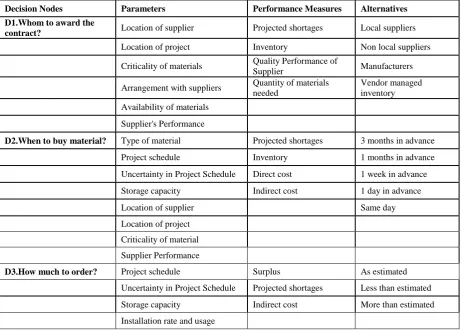
[image:2.595.68.531.435.765.2]And also just‐in‐time (JIT) approach to materials management appears to be superior to a just‐in‐case (JIC) approach in terms of reducing cost and improving productivity under most circumstances encountered in industrialized countries [7] .From the information acquired from the literature review, five distinct phases that comprise the material management process were identified: 1. Bidding Phase, 2.Sourcing Phase, 3.Material procurement phase, 4.Construction phase, 5.Post construction phase. Then decision nodes occurred in each phase were found out. After finding out the decision nodes, the next task was to define all of the knowledge elements that constitute the alternatives, factors (parameters) and performance measures for each decision node. This required identifying all the data that is needed to make decision and any other information that might impact the way in which a decision is taken for a particular decision node. The Factors, Performance measures and alternatives for each decision nodes in material management process were extracted from the literature review and explained in Table 1.
Table 1:
Decision Nodes, Factors, Performance measures and Alternatives for Material management process
Decision Nodes Parameters Performance Measures Alternatives
D1.Whom to award the
contract? Location of supplier Projected shortages Local suppliers
Location of project Inventory Non local suppliers
Criticality of materials Quality Performance of
Supplier Manufacturers
Arrangement with suppliers Quantity of materials
needed
Vendor managed inventory
Availability of materials
Supplier's Performance
D2.When to buy material? Type of material Projected shortages 3 months in advance
Project schedule Inventory 1 months in advance
Uncertainty in Project Schedule Direct cost 1 week in advance
Storage capacity Indirect cost 1 day in advance
Location of supplier Same day
Location of project
Criticality of material
Supplier Performance
D3.How much to order? Project schedule Surplus As estimated
Uncertainty in Project Schedule Projected shortages Less than estimated
Storage capacity Indirect cost More than estimated
International Journal of Emerging Technology and Advanced Engineering
Website: www.ijetae.com (ISSN 2250-2459, ISO 9001:2008 Certified Journal, Volume 6, Issue 4, April 2016)
111
Procurement cost rates
Indirect cost rates
D4.When to deliver? Project schedule Surplus Single /multiple
shipments
Uncertainty in Project Schedule Projected shortages Shipment quantities
Storage capacity Indirect cost
Installation rate and usage
Procurement cost rates
Indirect cost rates
D5.Where to deliver? Project schedule Projected shortages Jobsite
Uncertainty in Project Schedule Inventory Warehouse/Pre fab shop
Storage capacity Quality of material Subcontractor
Immediate installation vs critical
item not to be installed Quantity of material
cost
Location of supplier
Location of warehouse
D6.What to do with
surplus material? Space availability in warehouse Projected shortages
Return to the supplier with penalty
Expected need for the material in
future project Inventory cost
Return to supplier without penalty
Actual need for the material in
existing project Damage Send it to the warehouse
Penalty cost sell to the other contractor
Opportunity cost Scrap it
2.2) Analytical Hierarchy Process
The Analytic Hierarchy Process (AHP), introduced by [8], is an effective tool for dealing with complex decision making, and may aid the decision maker to set priorities and make the best decision. A typical MADA method, AHP was developed to assist in the as well as with tangible and objective factors. AHP allows for the incorporation into the decision-making process of subjective judgments and user intuition by producing a common formal and numeric basis for solution. Over the years, AHP has been implemented successfully in various areas. A literature survey found only a few AHP applications in the area of construction, as follows: advanced construction technologies/processes/materials evaluation [9], Supplier selection [10], contractor selection [11], procurement selection [12], alternative dispute resolution [13], project management [14], Inventory classification [15] and ERP system selection [16]. No AHP application,however, was found that deals with the supply chain management in a holistic View.
III. RESEARCH METHODOLOGY
International Journal of Emerging Technology and Advanced Engineering
Website: www.ijetae.com (ISSN 2250-2459, ISO 9001:2008 Certified Journal, Volume 6, Issue 4, April 2016)
112
From the literature review, it was found out that Saaty scale is more reasonable [17] and it is used for evaluation. Example for questionnaire format in google form (Pairwise comparison) is given below.How important were the following criteria in comparis on while choosing the
Supplier in material management process in constructi on?
a) Factor 1- Important or Factor 2 Location of supplier (Factor 1) Location of project (Factor 2) b) How much more important? 1 2 3 4 5 6 7 8 9
3.1) AHP Methodology
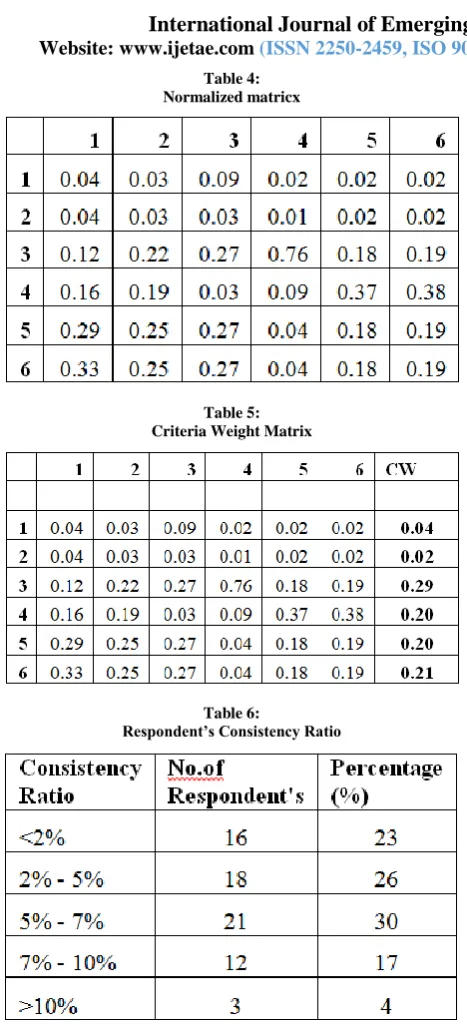
Collect the individual pairwise comparison data using questionnaire method. Then individual criteria matrix is arrived out ((n x n) matrix).Then using Weight aggregate method, aggregate criteria matrix is formed. After Aggregate criteria matrix is formed, then normalizing the matrix. Normalizing the matrix means to divide each element in every column b sum of that column. Average each row in the normalized matrix. This average is called criteria weight (W). After finding the criteria weight, Reliability test is conducted to check the stability and consistency of answer by respondents by using Consistency Index method that is widely adopted.
Determine a weight sum vector {Ws} using Eq (1)
{Ws} = [C]{W} (1)
Determine the average of the elements of {consis},
called λ. Determine the Consistency index (CI) using Eq (2)
CI = (λmax – n)/ (n-1) (2)
Calculate Consistency ratio (CI) using Eq (3)
CR=CI/RI (3)
Find the Consistency vector {Consis} using Eq (4)
{Consis} = {Ws}. {1/w} (4)
IV. ANALYSIS &RESULTS 4.1) Respondent’s Profile
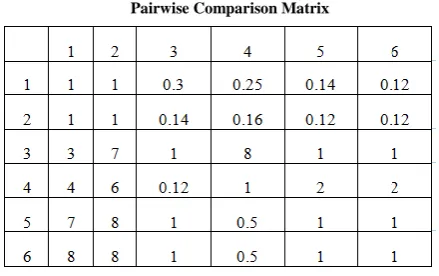
The questionnaires were distributed to consultants and contractors of the Indian construction industry. The respondents involved in the survey had several years of experience in material management process. The characteristics of the respondents participated in survey are summarized in Table 3. Table 3 indicates that majority of the respondents (64% respondents) are working with contractors organizations followed by consultants and owners.
[image:4.595.316.545.211.405.2]All the respondents had experienced in handling material management process in construction projects with 36% of respondents have 20 to 25 years of experience. A significant number of respondent’s i.e. 28% of respondents have experience more than 25 years in material management process.
Table 2: Respondent’s Profile
The appropriate Consistency index is called Random Consistency Index (RI).He randomly generated reciprocal matrix using scale.
4.2) Ranking of Factors affecting decision
Ranking of factors are arrived using Analytical Hierarchy Process. From the respondent’s results, aggregate matrix is formed in Table 4. Then normalized matrix are formed in Table 5.
4.3) Consistency Analysis using AHP
Reliability of the data is considered at low level when consistency ratio is greater than 10% which means the ranking is not reliable and cannot be adopted. Reliability is at high level when consistency index is less than 10%.
The consistency ratio for respondents are given in Table 6.
Table 3: Pairwise Comparison Matrix
[image:4.595.316.536.612.750.2]International Journal of Emerging Technology and Advanced Engineering
Website: www.ijetae.com (ISSN 2250-2459, ISO 9001:2008 Certified Journal, Volume 6, Issue 4, April 2016)
[image:5.595.48.282.99.614.2]113
Table 4:Normalized matricx
Table 5: Criteria Weight Matrix
Table 6:
Respondent’s Consistency Ratio
4.4) Parameter Ranking Results
For decision node D1. Whom to award contract, the criteria ranking are explained in Fig 1.The supplier performance cause a major effect (25%) in this decision node followed by the arrangement with supplier and availability of materials.
Figure 1: Parameter Ranking for D1: Whom to award contract
[image:5.595.325.534.135.284.2]For D2. When to buy material, the criteria ranking are explained in Fig 2.The supplier performance cause a major effect (25%) in this decision node followed by the arrangement with supplier and availability of materials.
Figure 2: Parameter Ranking for D2: When to buy material
[image:5.595.328.534.358.515.2]For D3. How much to Order, the criteria ranking are explained in Fig. 3.The procurement cost rate cause a major effect (22.6%) in this decision node followed by the installation rate and usage and storage capacity.
Figure 3: Parameter Ranking for D3: How much to order 25
17.2 16.8 11.6 10.7 10 8.8
0 20 40
Weight (%)
Cri
teria
Whom to award contract Location of supplier Discounts
Location of project Criticality of materials Availability of materials Arrangement with suppliers Supplier's Performance
23.6 18.2 17.3 13.6 11.7 9.4 4.3 1.9
0 20 40
Weight (%)
Cri
teria
When to buy material Location of supplier Location of project
Storage capacity
Type of material
Supplier Performance & ability to meet schedules
Uncertainity in Project Schedule
22.6 21 20.6 19.1 9.7 7
0 Weight (%) 20 40
Cri
te
ri
a
How much to order? Uncertainity in Project Schedule Project schedule
Indirect cost rates
Storage capacity
[image:5.595.327.531.591.757.2]International Journal of Emerging Technology and Advanced Engineering
Website: www.ijetae.com (ISSN 2250-2459, ISO 9001:2008 Certified Journal, Volume 6, Issue 4, April 2016)
[image:6.595.325.530.122.303.2]114
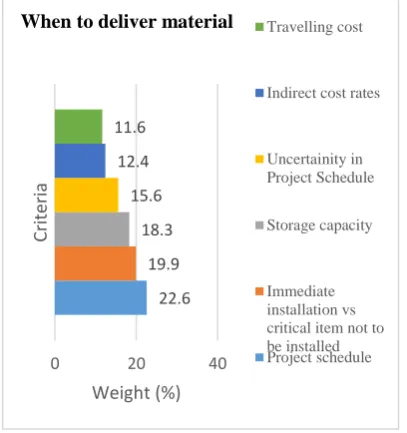
For D4. When to deliver material,the criteria ranking are explained in Fig. 4.The project schedule cause a major effect (22.8%) in this decision node followed by the immediate installation vs critical item not to be installed and storage capacity.Figure 4: Parameter Ranking for D4: When to deliver material
For D5. Where to deliver material,the criteria ranking are explained in Fig 5.The immediate installation vs critical item not to be installed cause a major effect (25.3%) in this decision node followed by the location of warehouse and location of supplier.
Figure 5: Parameter Ranking for D5: Where to deliver material
[image:6.595.63.267.198.415.2]For D6. What to do with surplus material,the criteria ranking are explained in Fig 6.The actual need for the project cause a major effect (55%) in this decision node followed by the Space availability in warehouse and Expected need for the material in future project.
Figure 6: Parameter Ranking for D6: What to do with surplus material
4.5) Performance measures Ranking
It is important to find out which performance measure need to be considered while decision to be take on material management performance. Based on the critical factors, the important performance measure which need to be measured is found out using second level analytical hierarchy process. For each decision nodes, the critical performance measures need to be found out. Considering each parameter, the weight of the performance measures need to be find out. For decision node: D4.When to deliver material .Let surplus material (A)Indirect cost (B),Projected shortages (C) are the performance measure for this decision node. Project schedule, Uncertainty in Project Schedule, Storage capacity, Installation rate and usage, Procurement cost rates and Indirect cost rates are the parameters influencing this decision node. Considering the project schedule, the importance of performance measures are gathered from questionnaire and aggregate matrix is formed.
Then normalized matrix should be formed. Normalizing the matrix means to divide each element in every column by sum of that column. Average each row in the normalized matrix. This average is called criteria weight (W) explained. The consistency ratio and consistency index should be check out. If the Consistency Ratio is greater than 10%, we need to revise the subjective judgment. After collecting the individual matrix, then form aggregate matrix using weighted geometric mean. Likewise considering all the factors, the weight of performance measures are found out and this is said to be final rating matrix (F).
The Eigen vector for the performance measure can be arrived using Eq (5)
{Performance measure value} = [F’] {W} (5) 22.6
19.9 18.3 15.6 12.4 11.6
0 20 40
Weight (%)
Cri
teria
When to deliver material Travelling cost
Indirect cost rates
Uncertainity in Project Schedule
Storage capacity
Immediate installation vs critical item not to be installed Project schedule
25 17.2 16.8 11.6 10.7 10 8.8
0 20 40
Weight(%)
Cri
teria
Where to deliver material Location of supplier Discounts
Location of project Criticality of materials Availability of materials Arrangement with suppliers Supplier's Performance
65 23 12
0 50 100
Weight (%)
Cri
teria
What to do with surplus material Expected need for the material in future project
Space availability in warehouse
[image:6.595.61.265.500.671.2]International Journal of Emerging Technology and Advanced Engineering
Website: www.ijetae.com (ISSN 2250-2459, ISO 9001:2008 Certified Journal, Volume 6, Issue 4, April 2016)
[image:7.595.326.532.131.282.2]115
For when to deliver material decision node (D4) in Fig 7, the projected shortages performance measure (45.3%) is important followed by the surplus material and indirect cost.Figure 7: Performance Measure Ranking for D4: When to deliver material
[image:7.595.62.265.185.336.2]For whom to award decision (D1) in Fig 8, the Quality Performance (43.43%) is important followed by the projected shortages (22.4%), inventory (14.3%) and Quantity of materials (12.3%).
Figure 8: Performance Measure Ranking for D1: Whom to award contract
[image:7.595.329.526.362.520.2]For when to buy material (D2) in Fig 9, the projected shortages (43.43%) is important followed by inventory (24.2%), direct cost (16.1%) and indirect cost (11.1%).
Figure 9: Performance Measure Ranking for D2: When to buy material
[image:7.595.61.266.421.572.2]For how much to order material (D3) in Fig 10, the projected shortages performance measure (39.4%) is important followed by the surplus material (37.2%) and indirect cost (23.4%).
Figure 10: Performance Measure Ranking for D3: How much to order
For where to deliver material (D5) in Fig 11, the inventory (45.2%) is important followed by the cost (25.4%), Quantity (22.2%), Quality (10.2%).
Figure 11: Performance Measure Ranking for D5: Where to deliver material
45.3 32.2
22.5
0 50
1
Weight (%)
Per
for
m
an
ce
m
e
asu
re
When to deliver?
Indirect cost
Surplus
Projected shortages
51 22.4 14.3 12.3
0 50 100
1
Weight (%)
Perf
o
rm
an
ce
m
easure
Whom to award the contract?
Quantity of materials
Inventory
Projected shortages
Quality
48.6 24.2
16.1 11.1
0 50 100
1
Weight (%)
Per
for
m
an
ce
m
e
asu
re
When to buy material?
Indirect cost
Direct cost
Inventory
Projected shortages
39.4 37.2
23.4
0 50
1
Weight (%)
Per
for
m
an
ce
m
e
asu
re
How much to order?
Indirect cost
Surplus
Projected shortages
42.2 25.4
22.2 10.2
0 20 40 60
1
Weight (%)
Per
for
m
an
ce
m
e
asu
re
Where to deliver?
Quality
Quantity
Cost
[image:7.595.327.531.591.730.2]International Journal of Emerging Technology and Advanced Engineering
Website: www.ijetae.com (ISSN 2250-2459, ISO 9001:2008 Certified Journal, Volume 6, Issue 4, April 2016)
[image:8.595.62.265.188.351.2]116
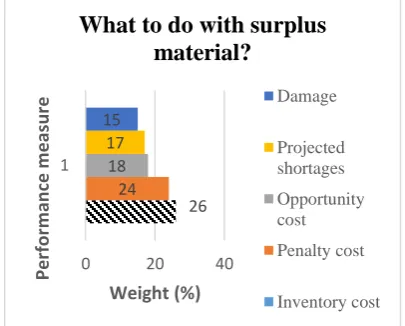
For what to do with surplus material (D6) in Fig 12, the inventory cost (26%) is important followed by the penalty cost (24%), opportunity cost (22%), projected shortages (17%) and damage (15%).Figure 12: Performance Measure Ranking for D6: What to do with surplus material
V. DISCUSSION &ITS IMPLICATION
For decision node D1. Whom to award contract, the supplier performance cause a major effect (25%) in this decision node. This factor is attributed because while selecting the vendor or supplier, the past performance (Lead time, any black marks etc.) of his activities should be taken in to account [18]. This is followed by the arrangement with supplier (17.2%), this factor is attributed because there is a need to assess a supplier’s quality and service capabilities as well as his strategies and managerial arrangement with the buyer [19].
For D2. When to buy material, the project schedule cause a major effect (23.6%) in this decision node. This factor can be attributed because in project schedule the activities and its duration are listed out, so based on the need of the resources, the material will be ordered [20]. This is followed by the criticality of materials (18.2%), because if any material is needed urgently for the activity, then material need to be bought immediately.
For D3. How much to order,the procurement cost rate cause a major effect (22.6%) in this decision node. This factor can be attributed because it’s important to have sufficient working capital for the company and there will be a limitation for the money spent on procurement [21]. This is followed by the installation rate and usage (21%), this factor is attributed because based on the material usage in the construction site the amount of material needed will be ordered and storage capacity (20.6%) also plays an important role because based on the space availability in the site, the amount of material needed will be ordered.
ForD4. When to deliver material,the project schedule cause a major effect (22.8%) in this decision node. This factor can be attributed because based on the master project schedule only material schedule will be derived and also in project schedule the activities and its duration are listed out so based on the need of the material, the material will be delivered.
For D5. Where to deliver material, the immediate installation vs critical item not to be installed cause a major effect (25.3%) in this decision node. This factor is considered because if there is a critical work in the site ,then the material need to be delivered to the site directly or else material will be deliver to the warehouse. This is followed by the location of warehouse (19%) and location of supplier (18.7%), these factors are attributed because the distance between the deliver and supplier place, indirectly contributed to the cost.
For D6. What to do with surplus material, the actual need for the project cause a major effect (55%) in this decision node. This factor can be attributed because if there is an actual need for the surplus material in the future, then surplus material can be stored and used.
For D1. Whom to award decision node, the Quality Performance (43.43%) is important, this performance measure is attributed because based on the quality performance measure only, we can evaluate the supplier and we can decide whether to give the contract or not. Quality assessment is a key factor of suppliers by which they can improve and maintain quality and delivery performance [21]. For when to buy material (D2) the projected shortages (43.43%) is important, this measure is attributed because based on the shortages we can determine the impact of material if not available, if there is sufficient amount of material then we can delay the material buying. This is followed by inventory (24.2%), direct cost (16.1%) and indirect cost (11.1%).For how much to order material (D3) decision node, the projected shortages performance measure (39.4%) is important, because based on the measure of shortages, we can able to found out the amount of material needed. This is followed by the surplus material (37.2%) and indirect cost (23.4%) performance measure. For when to deliver material decision node (D4), the projected shortages performance measure (43.43%) is important, because based on the shortages of material only we can decide when we will ask to deliver the material. This is followed by the surplus material (32.3%) performance measure, if there is a surplus amount of material, then we can delay the delivery time. For where to deliver material (D5) decision node, the inventory (45.2%) is important [20], because based on this measure if there is no storage place in site, the material need to be delivered in warehouse and it is followed by the cost (25.4%), Quantity (22.2%), Quality (10.2%).
26 24
18 17 15
0 20 40
1
Weight (%)
Per
for
m
an
ce
m
e
asu
re
What to do with surplus
material?
Damage
Projected shortages
Opportunity cost
Penalty cost
International Journal of Emerging Technology and Advanced Engineering
Website: www.ijetae.com (ISSN 2250-2459, ISO 9001:2008 Certified Journal, Volume 6, Issue 4, April 2016)
117
For what to do with surplus material (D6) decision node, the inventory cost (26%) is important, this factor is attributed because based on the cost needed to store the material, the decision will be taken whether to store the material or not [20]. This is followed by the penalty cost (24%), opportunity cost (22%), projected shortages (17%) and damage (15%).VI. CONCLUSION
The AHP process is nowadays used in various decision making situation. We have decided to present its use for to improve the decision making process in supply chain management by finding out the critical factors and performance measures. AHP biggest strength is systematic approach in several steps and its ability to lower subjectivity of managers who have to take decision. All the parameters, performance measures and alternatives for every decision node are established. The challenge is to consider all the elements while taking a decision. In this study critical factors which cause great impact in the specific decision was found , this provide not only the most cost effective solution, but the solution could better serve the contractor needs at that particular instant. Based on the critical factors, the important performance measure which need to be measured is found out using second level analytical hierarchy process. Instead of considering all the factors to find out the critical performance measure, the major factors (found out from the first level of AHP process) is considered. For when to deliver material decision, the project schedule cause a major effect in this decision node followed by the immediate installation vs critical item not to be installed and storage capacity. Based on this critical factors, the projected shortages is the critical performance measure which need to be measured while decision to be take on when to buy material. Likewise for each decision nodes, the critical factors and performance measures was found out with AHP process. This research will help the engineers in making logical, consistent decisions, and provides a facility for all necessary computations needed in supply chain management process. For further research we proposed to design a decision making model for supply chain management process using this critical factors and performance measures. Furthermore, it was verified during the study that, to take decision regarding supply chain process, most managers in the construction industry only consider criteria associated with price and quality, not using any formal method to provide a structured evaluation of the decision making process, which is essential to guarantee an efficient evaluation. In many situations, these evaluations are only based on the intuition and expertise of the decision-makers. Also, it was possible to apply the results to a real situation, showing its adequacy and coherence.
Moreover, may using this result, the company can reduced the risks associated with decision-making in the issue related to selecting suppliers and other procurement decision, making it possible to eliminate some subjective aspects related to the purchase of their materials.
REFERENCES
[1] Bell, L., and Stukhart, G. (1987).Costs and Benefits of Material Management system”. Journal of Construction Engineering and Management.1987; Vol.113, No. 2: pp. 222-235.
[2] Baldwin A.N., Thorpe A., and Alkaabai, J.A. (1994).Improved material management through Bar coding: Results and Implication from a feasibility study. Proceedings of the Institution of Civil Engineers - Civil Engineering, Loughborough University. Institution of Civil Engineers;1994. Vol. 102, pp. 156-162. [3] Thomas, H., Riley, D., and Messner, J. Fundamental Principles of
Site Material Management." Journal of Construction Engineering and Management.2005; Vol. 131(7), 808-815.
[4] Thabet, W., and Perdoma,J. A framework for an Integrated
Material Management System [PhD Thesis], Virginia University, Blacksburg, Virginia, US.2003.
[5] Kasim, N.B., Anumba, C.J., and Dainty A.R.J. Improving
Materials Management Practices on Fast-Track Construction
Projects.21st Annual ARCOM Conference, University of London,
Association of Researchers in Construction Management.2005; Vol.2, 793-802.
[6] Naief Turki Ibn-Homaid. A comparative evaluation of construction and manufacturing materials management. . International Journal of Project Management.2002; Vol. 20(2), pp 263-270.
[7] Polata and David Arditib. The JIT materials management system in developing countries. Journal of Construction Management and Economics.2005; Vol.23 (7), pp 697-712.
[8] Thomas Saaty, T. L. The analytic hierarchy process, London:
McGraw-Hill; 1980.
[9] Skibniewski, M., and Chao, L.-C. Evaluation of advanced
construction technology with AHP method. Journal of
Construction Engineering and Management .1992; 118(3), 577– 593.
[10] William Ho. Multi-criteria decision making approaches for supplier evaluation and selection: A literature review, European Journal of Operational Research.2010; vol 202, pp.16–24.
[11] Fong, S.-W., and Choi, K.-Y. Final contractor selection usingthe
analytical hierarchy process. Construction Management and
Economics.2000; 18(5), 547–557.
[12] Cheung, S.-O., Lam, T.-I., Leung, M.-Y., and Wan, Y.-W. An analytical hierarchy process based procurement selection method. Construction Management and Economics.2001; 19(4), 427–437. [13] Cheung, S.-O., Suen, H. C. H., Ng, S. T., and Leung, M.-Y.
Convergent views of neutrals and users about alternative dispute resolution. Journal of management in Engineering.2004; 20(3), 88–96.
[14] Al-Harbi, K. A.S. Application of the AHP in project management. International Journal of Project Management. 2001; No, 19(1), pp 19–27.
[15] Ozan Cakir. A web-based decision support system for multi-criteria inventory classification using fuzzy AHP methodology. Expert Systems with Applications. 2008; Vol. 35, pp.1367–1378. [16] Chun-Chin Wei. An AHP-based approach to ERP system
selection. International Journal of Production Economics. 2005; Vol. 96, pp 47–62.
International Journal of Emerging Technology and Advanced Engineering
Website: www.ijetae.com (ISSN 2250-2459, ISO 9001:2008 Certified Journal, Volume 6, Issue 4, April 2016)
118
[18] Ruth Mwikali., and Stanley Kavale. Factors Affecting theSelection of Optimal Suppliers in Procurement Management. International Journal of Humanities and Social Science.2012 Vol. 2 (14). 189-193p.
[19] Li S., Rao SS., Ragu-Nathan TS and Ragu-Nathan B. Development and validation of a measurement instrument for studying supply chain management practices. Journal of Operations Management.2005.Vol.23, 618p.
[20] A. Gunasekaran .,C. Patel and Ronald E. McGaughey. A framework for supply chain performance measurement. International Journal of Production Economics.2004.Vol.87, 333– 347p.
[21] Benita M. Beamon. Measuring supply chain performance. International Journal of Operations &Production Management.1999; Vol. 19 (3), 275 – 292 p.