Munich Personal RePEc Archive
Robust test for spatial error
model:considering changes of spatial
layouts and distribution misspecification
GUO, Penghui and LIU, Lihu and QIAN, Zhengming
2011
Online at
https://mpra.ub.uni-muenchen.de/38078/
Robust Test for Spatial Error Model
--
Considering Changes of Spatial Layouts and Distribution Misspecification
GUO Penghui, LIU Lihu
*,
QIAN Zhengming
Department of Statistics
School of Economics, Xiamen University Xiamen, China
E-mails: [email protected]
Abstract—This paper suggests a robust LM (Lagrange Multiplier) test for spatial error model which not only reduces the influence of spatial lag dependence immensely, but also presents robust to changes of spatial layouts and distribution misspecification. Monte Carlo simulation results imply that existing LM tests have serious size and power distortion with the presence of spatial lag dependence, group interaction or non-normal distribution, but the robust LM test of this paper shows well performance.
Keywords:LM test; Spatial Layouts; Distribution Misspecification; Robustness.
I. INTRODUCTION.
Recently, issues on model specification and estimation have become integral parts of spatial econometrics. Meanwhile, diagnostic tests of spatial correlation are increasingly receiving more researchers’ attention. Their tests built on different principle under different models have some advantages and disadvantages.
Moran’s I test could not give the accurate specification even if refusing the null hypothesis of no spatial correlation, though it could identify spatial effects effectively. Burridge (1980) proposed LM tests for spatial error model (SEM) and spatial autoregressive model (SAR) based on the Lagrange Multiplier principle. Anselin (2001) suggested an LM test for spatial autoregressive and moving average model (SARMA), which is a generalized form of SEM and SAR.
Anselin (1988) proposed an LM test for spatial error autocorrelation in the presence of a spatially lagged dependent variable. However, implementation of the suggested test required nonlinear optimization or the application of a numerical search technique due to maximum likelihood
estimation (MLE) and had not correct size and power. Noting that, Anselin et al (1996) applied the modified LM test developed by Bera&Yoon (1993) to spatial models and proposed simple diagnostic tests for spatial dependence by allowing the parameter of spatially lagged variable to fluctuate within zero’s neighborhood. Therefore, it performed well when the parameter remained small value (between ±
0.4).
Zhang Jinfeng (2011) derived a robust LM test for spatial error model on the basis of Bera&Yoon theories which shared the optimality properties of the C( ) test. The proposed test could reduce immensely computation burden in Anselin’s (1988) paper and solve the problem in Anselin (1996).
The LM tests above are developed under the assumptions that the model error are normally distributed and spatial weight matrix is Rook contiguity. This leads to a natural question on how robust these tests are against distribution misspecification and changes of spatial layouts. To overcome this shortcoming, Baltagi&Yang (2010) suggested a standardized LM test (SLM) for spatial error model which was asymptotically equivalent to LM test. Monte Carlo results show that the new tests possess good finite sample properties while LM test was sensitive to error distribution and spatial layout.However, Baltagi&Yoon’s test did not consider the presence of spatially lagged dependence variable. Based on above discussion, it could be implied that whether the spatial lagged effect existed or not will influence the size and power of the test significantly.
*Liu Lihu gratefully acknowledges the support from the Projects of the
In this paper, robust LM test is recommended based on Bera&Yoon’s and Baltagi&Yang’s theories under more relaxed assumptions on the error distributions, which is shown that our LM test is not only robust against distribution misspecification and model misspecification, but also quite robust against changes in the spatial layout. In Section 2 we develops new robust test. Section 3 provides some evidence on the performance of the robust test on the basis of results of a series of Monte Carlo simulation experiments. We close with some concluding remarks in Section 4.
II. SPECIFICATION TESTS FOR SPATIAL ERROR MODEL
As the treatment of Anselin (1988), we consider the mixed regressive spatial autoregressive model with a spatial autoregressive disturbance:
1 2
,
y W y Xβ ε
ε Wε ν
(1)
where yis an (N1) vector of observations on a dependent
variable, Xis (NK) matrix of exogenous variable, and βis
a ( K1 ) vector of parameters. and are scalar
parameters of spatial lagged effect and spatial error effect, respectively. W1 and W2 are ( NN ) observable spatial
weights matrix, ν is a (N1) vector of disturbance terms
and 2
( , )
ν N 0I .
Interested in testing 0
: 0
H with alternative hypothesis
1: 0
H . Zhang Jinfeng (2011) proposed an LM test on the
basis of Bera&Yoon’s (1993) theories. Noting that
1
1 0 1
A
S W IW , T2Atr W 2W2'SA, TAAtr
SASA'
SA, the testfollows as
2 1
2 2
2 2 1
2 1 22 2
' A ' A
Z
A
e W e T J e W y trS LM
T T J
(2)
where 2
[ ',β ]'
are ML estimators under 0 and
0
. e y 0W y1 Xβ , 2
2
1 ' 2
A A AA N A
J S Xβ M S Xβ T tr S .Our
Monte Carlo simulations show that it is important to standardize it with Batagi&Yang’s theroies if one is using asymptotic critical values, especially for certain spatial layouts. Some discussion on this is given after Theorem 1.
III. THE ROBUST LM TEST
The following basic regularity conditions are necessary for studying the asymptotic behavior of these test statistics.
Assumption A1: The innovations i are i.i.d. with
mean zero, variance 2
, and excess kurtosis . Also, the moment 4
i
E exists for some 0.
Assumption A2: For all i and j, the elements wij of
N N
W are at most order hN1
uniformly, with the rate sequence
hN , bounded or divergent, satisfying hN N0 as N goes
to infinity. The NN matrices W are uniformly bounded
in both row and column sums with wii0 and jwij1 for
all i.
Assumption A3: The elements of the NK matrix
Xare uniformly bound bounded for all N, and lim 1 '
NNX X
exists and is nonsingular. Therefore, 1
' '
X X X X and
1
' '
IX X X X are uniformly bounded in both row and column
sums.
Assumption A4: W and I 0W1
are bounded, where is a matrix norm. Then, 1
0
IW are uniformly bounded in
a neighborhood of 0.
The Assumption A1 corresponds to one assumption of Kelejian&Prucha (2001) for their central limit theorem of linear-quadratic forms. Assumption A2 corresponds to one assumption in Lee (2004a) which identifies the different types of spatial dependence. Typically, one type of spatial dependence corresponds to the case where each unit has fixed number of neighbors such as Rook contiguity and in this case
N
h is bounded, and the other type of spatial dependence
corresponds to the case where the number of neighbors of each spatial unit grows as N goes to infinity such as the case
of group interaction and in this case hN is divergent. To limit
the spatial dependence to a manageable degree, it is thus required that hN N0 as N . Assumption A3 and A4
correspond to two assumptions of Lee (2004a) for their central limit theorem of linear-quadratic forms.
For simplification, we use notation 1 2
N N K
S tr MW ,
1
2 1
PM Wn S I M , 2 12 i ii
S p , S13tr PP 'PP with pii are
the diagonal elements of P , A I 0W1,
12 1
N N K
1 1
2
QMWA M n S I M , 2 22 i ii
S q with qii are the diagonal
elements of Q , S23tr QQ 'QQ , S32ip qii ii , and
33 '
S tr PQPQ . Under the hypothesis H0: 0
vs H1:0, we derive a robust LM test following as
2 1
2 2
2 1 32 33 22 23 24 1 2 1 2
12 13 32 33 22 23 24
' '
R
e W e S S S S S S e W y S LM
S S S S S S S
(3)
where, [ ',β 2]'
is MLE of (1) under 0 and 0,
0 1
e y W yXβ, 2e e N'
and
2 24 1 ' 1S W Xβ M W Xβ , with is the excess sample kurtosis of e. Therefore, following
theorem is concluded.
Theorem 1: if W ii1,2, i and X of Model (1)
satisfy the Assumptions A1-A4, then under null hypothesis
0
H, (1) LMR converges to that of
2
1
, and (2) R
LM is asymptotically equivalent to LMZ
when 0.
The formal proof of Theorem 1 is given in the Appendix. To help understanding the theory, we outline the key steps leading to the modification in (9). Fist note that e W e' 2 and
1
'
e W y, part numerators of Z
LM , is not centered because
2
2 2
' 0
E e W e tr MW and 2
1
1 1
' 0
E e W y tr MW A , which lead
that Z
LM is not yielding standard normal distribution. This
motivate us to consider 2
2 2
'
e W etr MW
or 1
2 2
' N K ' '
e W e e etr MW εPε and
2 1
1 1
'
e W ytr MW A or
1
1
1 1
' N K ' '
e W y e etr MW A εQε. Upon finding the variance of the
numerators and replacing 2
in the variance expression by its MLE, our test R
LM is obtained and the quadratic form
'
εPε and ε'Qε with its mean and variance are readily
available as long as the first four moment of the elements of ε exist. Thus, our approach does not depend on the normality assumption.
Although Z
LM test statistic is derived under the assumption that the innovations are normally distributed, Theorem 1 shows that it is asymptotically equivalent to the
R
LM test. This means that all the two tests are robust against
distributional misspecification when the sample size is large. But they behave differently under finite sample. The major
difference between Z
LM and LMR lies in the mean correction of the statistic 2
2
'
e W e and the cross interaction
when eliminating the spatially lagged effect. This correction may quickly become negligible as the sample size increases under certain spatial layouts, but not necessarily under other spatial layout. The relation of two statistics is expressed as
1
1 2 1
0 1
2 2
1 2
0 0
1
1 2 2
03 02 1 2 2 1
1 2 0 ' ' R Z A A T S LM LM S S
S S e W y S T J e W y trS S
(4)
where S01 S12S13 , S02 S22S23S24 , S03 S32S33 , 2 1
0 01 03 02
S S S S and T0 T22
T2A2 J 1 . By Assumption A1 and
Lemma L1 in Appendix, the elements of P0 and 0
Q are
uniformly of order 1
N
h . Now Lemma L2 vi and Assumption
A2 ensure that 2
02
1 112 1 1
N N
ii ii N N
i i
S p p O h O h , by the same
reason
1 22 NS O h and
1 32 NS O h . By Lemma L2 i and
L2 ii , we could obtain S13T22O 1 , S23S24J O 1 and
33 2A 1
S T O . Furthermore, with Assumption A2 and A4 and
Lemma L4, the elements of W1, W2 and SA are uniformly of
order 1
n
h and the matrix are uniformly bounded in both row
and column sums. Thus, tr W W 2 2', tr W W 2 2, tr S S A A' and
A A
tr S S are uniformly of order 1
N
Nh . And then T22 and T2A
are uniformly of order 1
N
Nh . Assumption A2, A3 and Lemma
L2 i show that
1A N
S XβO h , leading to
2 1
1
22 2A N
T T J O Nh
. Since O 1 and S1O 1 obtained
easily with Lemma in Appendix, S0 T22
T2A2 J 1 O 1 and
10 N
S O Nh . Therefore, the multiplier of
LMZ
1 2 in (10) is
uniformly of order one and S1 S01 2O h
N N1 2
o 1 .Obviously, the third component of (10) is uniformly of order
1 2
N
h N or high order one. Consequently, LMR
is asymptotically equivalent to Z
correction of Z
LM is negligible or not depend on the ratio
1 2
N
h N *.
IV. MONTE CARLO RESULTS
The finite sample performance of LMR
proposed in this paper are evaluated based on a series of Monte Carlo experiments. These experiments involve a number of different error distributions and a number of changes of spatial layoutss. Detail in Baltagi&Yang’s(2010) paper.
A. Error distributions and spatial layouts
Three general spatial layouts are considered in the Monte Carlo experiments: (i) standard normal, (ii) mixture normal, (iii) log-normal, all standardized to have mean zero and variance one. Comparing with standard normal distribution, the mixture normal gives an error distribution that si symmetric but leptokurtic while log-normal is both skewed and leptokurtic. The standardized mixture normal variates are generated according to
1 22
1 1
i i Zi i Zi p p
(5)
where η is a Bernoulli random variable with probability of success p and Z is standard normal independent of η .
The parameter p in this case also represents the proportion
of mixing the two normal populations. In our experiments, we choose p0.05, implying that 95% of the random variates are
from standard normal and the remaining 5% are form another normal population with standard deviation . We choose
10
to simulate the situation where there are gross errors in
the data. The standardized lognormal random variates are genernated according to
1 2
exp exp 0.5 exp 2 exp 1
i Zi
(6)
The reported Monte Carlo results correspond to the following three spatial layouts. The first is based on the Rook
*
For example, 1 2 0.15
N
h N N when 0.7
N
h N , which means that if N=30,100,1000, then 0.15
N is 0.60, 0.50, 0.35. This suggests that difference between R
LM and Z
LM is 0.60 (N=30), 0.50 (N=100), 0.35 (N=1000). If spatial layout is Group contiguity, this case of 0.7
N
h N may appear when group size is large and group number is small. Monte Carlo results imply that LMZ
test without
modification have certain distortion of size and power.
contiguity, the second is based on Queen contiguity and the third is based on the notion of group or social interaction, Group contiguity, with the number of groups GN where
0 1. In the Rook or Queen contiguity, the number of
neighbors of each spatial unit stays the same (2-4 for Rook and 3-8 for Queen) and does not change when sample size N
increases, whereas in the Group case, the number of neighbors for each spatial unit increase with the increase of sample size but at a slower rate, and changes from group to group. The generating methods of the three spatial layouts referred Baltagi&Yang(2010).
B. Size and Power of the tests
The Monte Carlo experiments are carried out based on the following data generating process:
1 11 2 2 3 3 , 2
yW yX X X ε εWε ν (7)
where X1 is constant term, X2 and X3 are drawn from
10U 0,1 . The parameter 1, 2, 3 1,1,1 . Five different sample
sizes are considered for each combination of error different distribution and spatial layouts. The parameter is from 0 to 0.5, step by 0.1, the same as parameter . Each set of Monte Carlo results is based on 1000 samples.
Comparisons are made between the newly proposed test
R
LM and the existing LMZ
of Zhang Jinfeng (2011) to see the improvement of the new tests in the situations where there are distribution misspecification and changes of spatial layouts. Selected Monte Carlo results are summarized in Tables 1 and Figure 1-2 and the results of other sample size such as 30, 100, 400 are available from the author upon request.
1). Z
LM test is sensitive to error distribution while our test LMR
not. First, as Table 1 illustrated, when spatial weight matrix is Rook contiguity and model error is normal distribution, under sample size N=50 LMZ
has the size close to 5%, which means their probability of refusing the null hypothesis 0
: 0
H is among their confidential interval, while LMR
is a bit of higher than 5%. However, under sample size N=200, the two tests, Z
LM and LMR, have no significant difference, and their sizes are all close to 5%. When model error is log-normal distribution, Z
size N=50 while R
LM is close to 5%. However, when sample size goes to 200, the sizes of LMZ
(expect 0.2) and LMR are all close to 5%. But when error yields mixture-normal distribution, the two are all out of the confidential interval. Second, spatial weights matrix are Queen contiguity. While sample size N=50 for any distribution, Z
LM’s size is less than the lower limit of confidential interval while LMR
’s size is close to 5%. If sample size reaches to 200, Z
LM and LMR all have correct size. These results imply that if error is not normal distribution, the performance of Z
LM under small sample size is not good. But with sample size increasing, the performance is becoming better till to the correct size while our test R
LM remains good performance. This conclusion provides some proof for the Theorem 1, which means under usual spatial weights matrix, LMZ
and LMR are asymptotically equivalent with sample number increasing.
2). LMZ
is sensitive to changes of spatial layouts while
R
LM not. As section 3 discussed, whether the correct terms of
Z
LM are negligible or not depends on the ratio of
1 2
N
h N .
The size results in Table 1 suggest that under the condition that error is normal distribution and spatial layout is Group contiguity, if 0.3or 0.7
N
h N , the size of LMZ
is obviously smaller than 5% even if the sample size N goes to 200 while
R
LM is close to 5%. It is the same as the case 0.5 or
0.5
N
h N . If 0.7 or 0.3
N
h N and sample size N=50,
Z
LM(only equal to 0.2 and 0.3) is less than the lower limit of confidential interval. When sample size N=200, only the case of equal to 0.2 is out of the interval. However, R
LM proposed in this paper performs well and its size is close to 5%.
3). If error distribution and spatial layouts do not yield
regular assumption, LMR
has better size than LMZ . For example, when error is mixture-normal distribution and spatial weights matrix are Group contiguity ( 0.3 or
0.7
N
h N ), size of LMZ
is close to 2.5% under N=50 while
R
LM is 4%. When sample size goes to 200, the size of LMZ and LMR
is 3% and 4.3%, respectively. The case of error is log-normal distribution and Group contiguity (0.3 or
0.7
N
h N ) is similar to the above example. Furthermore, when
spatial matrix are Group contiguity (0.5 or 0.5
N
h N ), the
size of Z
LM is not located in the confidential interval for any
non-normal distribution, while R
LM is close to 5%. Finally, if spatial layout is Group contiguity (0.7 or 0.3
N
h N ), LMZ
and R
LM all have correct size since the correct part of LMZ could be negligible.
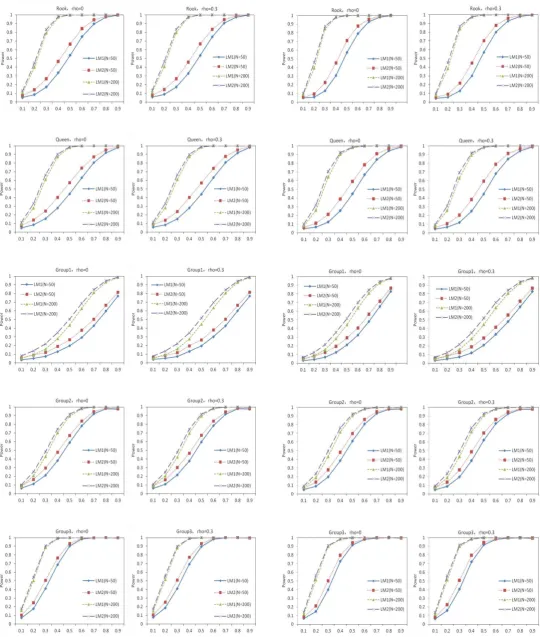
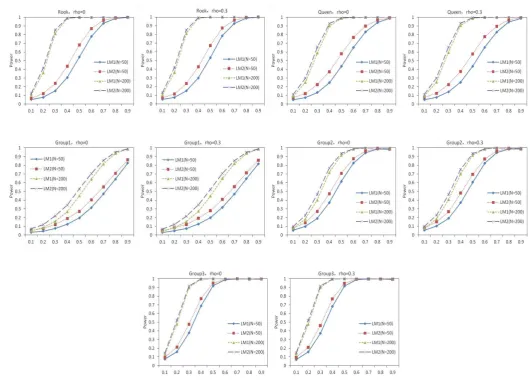
4). The power of R
LM is better than LMZ for any case. Figure 1-3 describe the power of the tests. When error is normal distribution as Figure 1 illustrated, the power of LMR
is significantly better than Z
LM under sample size N=50, while the two have almost the same power under N=200(but
R
LM is a little bit better). It is similar to the non-normal distribution cases. For instance, when model error is log-normal distribution (Figure 3) and spatial layout is Group contiguity, the power of Z
LM is inferior to LMR with small sample size while under large sample size except the case of
0.3
or 0.7
N
h N the two tests have similar power.
V. CONCLUSION
This paper proposes a robust LM test, LMR
, for spatial error model, and points out that our test is asymptotically equivalent to existing tests under certain condition. Also, our test is not sensitive to error distribution and spatial layouts. Monte Carlo results provide the proof of above remarks and suggest that our test LMR
is better under finite sample size. For example, when spatial weights matrix are Rook or Queen contiguity, the two tests is asymptotically equivalent with sample size increasing. However, when spatial layout is Group contiguity, especially the case of 0.3, comparing
with existing tests which have wrong size (smaller) for any distribution and sample size, while R
LM has the correct size. The proposed test is based on simple linear regression model, thus deriving robust tests of spatial panel data will be next step in the future.
REFERENCES
[1]. Anselin, L., (1988), Lagrange multiplier test diagnostics for spatial dependence and spatial heterogeneity [J], Geographical Analysis, 20, 1–17.
[2]. Anselin, L., (2001), Rao’s score test in spatial econometrics [J], Journal of Statistical Planning and Inference, 97, 113–139.
[3]. Anselin, L., A. K. Bera, R. Florax, and M. J. Yoon, 1996, Simple diagnostic tests for spatial dependence [J], Regional Science and Urban Economics, 26, 77–104.
[4]. Bera, A. K., and M. J. Yoon, (1993), Specification testing with locally misspecified alternatives [J], Econometric Theory, 9, 649–658. [5]. Baltagi, Badi and Yang, Zhenlin, (2010), Standardized LM Tests for
11-2010, Working Papers, Singapore Management University, School of Economics.
[6]. Burridge, P., (1980), On the Cliff-Ord test for spatial correlation [J], Journal of the Royal Statistical Society. Series B, 42, 107–108. [7]. Kelejian, H. H. and Robinson, D. P. (1995). Spatial correlation: a
suggested alternative to the autoregressive models. In: New Directions in Spatial Econometrics[C], Edited by L. Anselin and R. J. G. M. Florax. Berlin: Springer-Verlag.
[8]. Kelejian H. H. and Prucha, I. R. (2001). On the asymptotic distribution of the Moran I test statistic with applications[J], Journal of Econometrics 104, 219-257.
[9]. Lee, L. F. (2004a). Asymptotic Distributions of Quasi-maximum Likelihood Estimators for Spatial Autoregressive Models[J], Econometrica 72, 1899-1925.
[10]. Lee, L. F. (2004b). A supplement to’ Asymptotic distributions of quasi-maximum likelihood estimators for spatial autoregressive
models’ [W], Working paper , Department of Economics, Ohio State
University.
[11]. Lee, Lung-Fei, (2002), Consistency and Efficiency of Least Squares Estimation for Mixed Regressive, Spatial Autoregressive Models[J], Econometric Theory, 18, issue 02, p. 252-277.
[12]. Zhang Jinfeng, Fang Ying, (2011), Robust tests for Spatial Error Model[J], The Journal of Quantitative & Technical Economics, issue 01, p.152-160.
张进峰,方颖,. 空间误差模型的稳健检验[J]. 数量经济技术经济研 究,2011,(1), p. 152-160.
APPENDIX:PROOF OF THE THEOREM
To prove the theorems, we need the following lemmas.
Lemma L1 (Lee, 2004a, p.1918): Let V be an N1
random vector of i.i.d. elements with mean zero, variance 2
, and finite excess kurtosis 4
4 3
v
. Let A and B be N
dimensional square matrix with aii and bii are the
diagonal elements of A and B , respectively. Then:
2
'
E V AV tr A , 2
'
E V BV tr B and
4 2 4 2
4
4 2 2
4 4
4 4
' 3 '
'
' , ' 3 '
'
ii i v i ii
ii ii i v i ii ii
Var V AV a tr AA A a tr AA A
Cov V AV V BV a b tr AB AB a b tr AB AB
Lemma L2 (Lemma A.9, Lee, 2004b): Suppose that the
elements of the NK matrix Xare uniformly bounded; and
1
limN N X X'
exists and is nonsingular. Then the projectors
1
' '
X X X X and M I X X X ' 1X' are uniformly bounded in
both row and column sums. Suppose that A represents a
sequence of NN matrices that uniformly bounded in both
row and column sums. Then
2 2
2 2 2
1
' ' 1
1
' ' ' 1 .
i tr MA tr A O ii tr A MA tr A A O iii tr MA tr A O
iv tr A MA tr MA A tr A A O
Furthermore, if
1ij N
a O h for all i and j, then
2 2 1
2 2 1 1 1 n n n ii n
i ii i
v tr MA tr A O nh vi MA a O h
where MAii are the diagonal elements of MA, and aij the
diagonal elements of A.
Lemma L3 (Lee, 2004a, p1918): Suppose that A is a
square matrix with its column sums being uniformly bounded and elements of the NK matrix Z are uniformly bounded.
Then,
1 n Z AV' O 1 . Furthermore, if the limit of Z AA Z N' 'exists and is positive definite, then
2
1 ' D 0, lim ' '
n
N Z AVN Z AA Z N .
Lemma L4 (Kelejian&Prucha, 1995; Lee, 2002): Let A
and B be two sequence of NN matrices that are
uniformly bounded in both row and column sums. Let C be
a sequence of comfirmable matrices whose elements are
uniformly
1N
O h . Then
i the sequence AB are uniformly bounded in both row
and column sums.
ii the elements of A are uniformly bounded and
tr A O N , and
iii the elements of AC and CA are uniformly
1N
O h .
Proof of theorem 1: First, we note that
2 1
2 1 1 1
1 1 1 ' ' ' ' N N
e W e S e W S I e
εM W S I Mε
εPε
(A.1)
Under H0
and Assumption A1, Lemma L1 is applicable to ε'Pε , which gives 2
' 0
EεPεtr P and
4 2 4
2 4 12 13 1
' Ni ii '
Var εPε p tr AA tr A S S . Letting
0 1
2 1
P W n S I , we have PMP M0 . By Lemma L2 i and
Assumption A2, tr MW 2 O1 which gives
1 11
NS O N
.
Hence, the elements of P0 are of uniform order
1N
O h .
Under Assumption A3, M is uniformly bounded in both row
and column sums (Lemma L2). It follows that the matrix of
P are uniformly bounded. Thus, the generalized central limit
which shows that ε'Pε is asymptotically normal, or
equivalently,
4
12 13
' D 0,
εPεN S S (A.2)
Second, we note that
2 1 1 1
1 2 1 1 1
1 1
' ' ' '
' '
e W y S e W A Xβ e W A ε e n S I e
εM W A Xβ εQε
(A.3)
Under 0
H and Assumption A1, Lemma L1 is also applicable to the above equation, then
1
2 1
' ' 0
EεM W A X β εQεtr Q and
1
4 1 22 23 24
' '
VarεM W A X β εQε S S S . Letting 0 1 1
1 2
Q W An S I ,
we have 0
QMQ . By Lemma L2 i and Assumption A2,
1 1
tr MW O which gives 1
1 2NS O N
. Thus, the elements of
0
Q are of uniform order O h
N1
. Under Assumption A3, the
elements of Q are of uniform order
1N
O h and the row and
column sums of the matrix Q are uniformly bounded.
Therefore, the ε'Qε is asymptotically normal based on the
generalized central limit theorem of linear-quadratic form of
Lee (2004a),
4
22 23' D 0,
εQεN S S .
Third, by Assumption A2 and A3, it shows that 1 1
W A X β
is uniformly bounded and M is uniformly bounded in both
row and column sums. Hence, by Lemma L3, we have
1
2
1 24
1 N W A X β 'MεD N 0,S N
. Thus,
1
1' '
εM W A X β εQε is
asymptotically normal, or equivalently,
2 1 4 4
1 2 1 22 23 24
' ' ' 0,
e W yS εM W A X β εQεN S S S (A.4)
By A.1, A.3 and Lemma L1, we have
2 2 1
2 1 1 2 1
4 32 33
1
2 2
2 1 32 33 22 23 24 1 2
2 1
4
12 13 32 33 22 23 24
' , ' ' ' '
' '
' '
Cov e W e S e W y S E εPε εMW A Xβ εQε E εPε εQε
S S
Var e W e S S S S S S e W y S S S S S S S S
(A.5)
With A.2, A.4 and A.5, we have
2
1
2
2 1 32 33 22 23 24 1 2
' '
e W eS S S S S S e W yS is
asymptotically normal, or equivalently,
1
2 2
2 1 32 33 22 23 24 1 2 1 2
2 1
2
12 13 32 33 22 23 24
' '
0,1
e W e S S S S S S e W y S N S S S S S S S
(A.6)
Now, it is easy to show that 2 p 2
, p
and
24 24
p
S S by replacing 2
, and S24 with 2
, and
4
S , respectively. Slusky’s theorem suggests that the square of
A.6 yields chi-square distribution with one degree of freedom. This finished the poof of Part (i).
For Part (ii), it suffices to show that S1O 1 ,
1
2 1 1
S tr W A O and S24~S24 by Lemma L2 i , where ~
stands for ‘asymptotic equivalence’. Following from Lemma L2, we have
1 1
2 1 2 1
1 2 2
2 2 1 2 1
2 2
' '
' 2 1
' 1
tr PP tr M W n S I M M W n S I M tr W W n S tr MW n S tr I O tr W W O
1 1 1 1
1 2 1 2
1 1 1 1 2 2
1 1 2 1 2
1 2 1 1
' '
' ' 2 1
' 1
A A
tr QQ tr MW A M n S I MW A M n S I tr W A W A n S tr MW A n S tr I O tr S S n tr W A O
1 1 1
2 1 1 2
1 1 1 1 2
2 1 1 1 2 2 1 2
2
' '
' 1
' 1
A
tr PQ tr M W n S I M MW A M n S I
tr W W A n S tr MW A n S tr MW n S S tr I O tr W S O
Then tr PP tr W W 2 2O 1 ,
2 1 11
A A N
tr QQ tr S S tr WA O ,
2 A 1
tr PQ tr W S O .Hence, S13~tr W W 2 2'W W2 2T22 ,
2
2
2 1
23 24~ AA n A A ' A
S S T tr S S Xβ M S Xβ J and
33~ 2 A 2' A 2A
S tr W S W S T . Therefore, when 0 , LMR is asymptotically equivalent to LMZ
TABLE 1: SIZE OF THE TESTS
W
Standard Normal Distribution Mixture-Normal Distribution Log-Normal Distribution
N=50 N=200 N=50 N=200 N=50 N=200
Z
LM LMR
LMZ LMR LMZ LMR LMZ LMR LMZ LMR LMZ LMR
Rook
0.0 0.0506 0.0565 0.0468 0.0486 0.0459 0.0500 0.0590 0.0582 0.0383 0.0487 0.0467 0.0543
0.1 0.0466 0.0555 0.0512 0.0539 0.0478 0.0486 0.0646 0.0650 0.0414 0.0485 0.0463 0.0479
0.2 0.0440 0.0570 0.0459 0.0495 0.0431 0.0524 0.0614 0.0611 0.0393 0.0476 0.0427 0.0483
0.3 0.0505 0.0579 0.0476 0.0504 0.0505 0.0522 0.0644 0.0639 0.0393 0.0483 0.0484 0.0530
0.4 0.0450 0.0540 0.0476 0.0504 0.0491 0.0474 0.0642 0.0651 0.0398 0.0460 0.0495 0.0511
0.5 0.0502 0.0570 0.0500 0.0496 0.0491 0.0533 0.0615 0.0593 0.0393 0.0478 0.0464 0.0492
Queen
0.0 0.0405 0.0537 0.0445 0.0459 0.0393 0.0461 0.0499 0.0527 0.0376 0.0530 0.0473 0.0500
0.1 0.0405 0.0567 0.0492 0.0529 0.0401 0.0478 0.0481 0.0552 0.0383 0.0481 0.0433 0.0488
0.2 0.0398 0.0530 0.0505 0.0479 0.0390 0.0479 0.0500 0.0519 0.0346 0.0494 0.0423 0.0533
0.3 0.0420 0.0516 0.0471 0.0488 0.0410 0.0439 0.0545 0.0552 0.0330 0.0497 0.0454 0.0479
0.4 0.0395 0.0520 0.0479 0.0521 0.0433 0.0471 0.0522 0.0560 0.0371 0.0544 0.0442 0.0550
0.5 0.0414 0.0565 0.0460 0.0487 0.0370 0.0505 0.0516 0.0540 0.0345 0.0477 0.0443 0.0496
Group
0.3
0.0 0.0255 0.0425 0.0349 0.0497 0.0249 0.0409 0.0300 0.0404 0.0251 0.0414 0.0317 0.0431
0.1 0.0222 0.0405 0.0330 0.0486 0.0228 0.0408 0.0294 0.0433 0.0227 0.0394 0.0304 0.0436
0.2 0.0253 0.0420 0.0309 0.0500 0.0245 0.0393 0.0302 0.0414 0.0217 0.0366 0.0306 0.0439
0.3 0.0264 0.0432 0.0337 0.0534 0.0259 0.0390 0.0317 0.0449 0.0241 0.0372 0.0266 0.0435
0.4 0.0231 0.0411 0.0325 0.0513 0.0238 0.0383 0.0310 0.0436 0.0243 0.0385 0.0295 0.0423
0.5 0.0263 0.0404 0.0299 0.0511 0.0239 0.0374 0.0282 0.0406 0.0267 0.0424 0.0282 0.0458
Group
0.5
0.0 0.0336 0.0471 0.0363 0.0497 0.0350 0.0434 0.0427 0.0471 0.0347 0.0480 0.0409 0.0504
0.1 0.0359 0.0497 0.0397 0.0486 0.0343 0.0467 0.0415 0.0456 0.0346 0.0486 0.0396 0.0491
0.2 0.0338 0.0517 0.0342 0.0500 0.0339 0.0469 0.0406 0.0451 0.0330 0.0472 0.0389 0.0481
0.3 0.0333 0.0496 0.0404 0.0534 0.0347 0.0502 0.0413 0.0492 0.0325 0.0479 0.0393 0.0492
0.4 0.0347 0.0460 0.0408 0.0513 0.0376 0.0444 0.0385 0.0465 0.0326 0.0481 0.0339 0.0459
0.5 0.0331 0.0504 0.0373 0.0511 0.0357 0.0471 0.0402 0.0441 0.0332 0.0459 0.0382 0.0506
Group
0.7
0.0 0.0460 0.0532 0.0470 0.0494 0.0464 0.0520 0.0519 0.0564 0.0417 0.0542 0.0474 0.0507
0.1 0.0438 0.0486 0.0460 0.0534 0.0472 0.0507 0.0581 0.0597 0.0426 0.0485 0.0450 0.0493
0.2 0.0408 0.0502 0.0430 0.0463 0.0432 0.0516 0.0584 0.0558 0.0433 0.0524 0.0439 0.0520
0.3 0.0427 0.0562 0.0480 0.0524 0.0509 0.0544 0.0549 0.0611 0.0446 0.0533 0.0472 0.0530
0.4 0.0462 0.0550 0.0455 0.0518 0.0473 0.0516 0.0581 0.0579 0.0453 0.0518 0.0477 0.0533
Figure 1. Power of the tests (standard normal (left two columns) and mixture-normal(right two columns) distribution): LM1:LMZ
Figure 2. Power of the tests (log-normal distribution) : LM1:LMZ