Approximating correlated defaults
Rosenthal, Dale W.R.
University of Illinois at Chicago
15 February 2012
DALE W.R. ROSENTHAL
Abstract. Modeling defaults is critical to risk management as well as
pricing debt portfolios and portfolio derivatives. In the recent financial
crisis, multi-billion-dollar losses resulted from correlated defaults that
were improperly modeled. This paper proposes statistical
approxima-tions which are more general than those used previously, follow from an
intensity-based risk-factor model, and allow consistent parameter
esti-mation. The parameters imply an approximating portfolio of
indepen-dent, identical-credit loans and characterize both average credit quality
and default-relative diversification (aka the “diversity score”). Unlike
previous approaches, these metrics are derived jointly from theory. The
approach addresses weaknesses in the typical diversity score-based
meth-ods by allowing for fatter tails as well as loans differing in size and credit
quality. The approximations may also be used to model complete
port-folio default and help set capital adequacy requirements. An example
shows how to estimate the approximating portfolio.
(JEL: G13, G12, C16, G33)
In the financial crisis of 2008–2009, US households lost about $11
tril-lion in wealth and structured debt securities alone suffered impairments of
over $1.5 trillion.1 Many loan portfolios experienced high numbers of
corre-lated defaults: defaults at an accelerated rate and clustered in time. This
Helpful comments were provided by Per Mykland, Michael Wichura, and participants at the SoFiE Geneva, Peking Guanghua QMBA, and Oakland credit analysis conferences. Financial support from the National Science Foundation under grants DMS 06-04758 and SES 06-31605 is gratefully acknowledged.
Address correspondence to Dale W.R. Rosenthal, Department of Finance, University of Illinois at Chicago, 601 S. Morgan St (MC 168), Chicago, IL 60607; e-mail: [email protected]. 1Statistics on the scope of the crisis and the effect on structured products are well
docu-mented in Financial Crisis Inquiry Commission (2011) and Tunget al.(2011).
correlation was greater than predicted by typical methods such as Schorin
and Weinreich (1998). One of the causes and magnifiers of the crisis noted
by the Financial Crisis Inquiry Commission was the increased correlation
of risky assets. In particular, the US Federal Reserve’s Troubled Asset
Re-lief Program and Term Asset-Backed Securities Loan Facility programs were
targeted at assets which had been affected by a larger-than-expected number
of concurrent defaults.
Modeling correlated defaults well is of particular importance because of
the real effects of defaults. Many of these effects were seen in the recent
financial crisis. Financial firms withdrew funding liquidity from world
mar-kets; financial and non-financial firms failed due to the loss of funding; and,
unemployment increased while tax revenues decreased. Many investors not
directly affected by these troubles were affected by the increased market
volatility. Some investors rebalanced their portfolios at a time when doing
so was costly. Other investors chose not to fund risky ventures which further
suppressed job growth.
Since defaults are so destructive, lenders often manage default risk by
creating portfolios of loans. These portfolios may be tranched or split into
portfolio credit derivatives such as collateralized debt obligations (CDOs).
Default risks of portfolios, tranches, or other derivatives may also be hedged
with credit default swaps (CDSs). A primary concern for any portfolio,
however, is risk correlations. Two approaches dominate the modeling of
default: structural models of firm assets and liabilities and reduced-form
models of default intensities.
This paper shows how the assumptions behind some reduced-form
ap-proaches may be too restrictive. We propose apap-proaches that relax these
assumptions to find default-approximating portfolios. We then show how
quality of a loan portfolio. The source of these two measures is more robust
than many reduced-form methods because the assumptions are weaker. The
measures also better capture the tail risk of default times.
To get at the correlation of such defaults, we propose modeling the time
to loan default as an idiosyncratic component which interacts with shared
systematic components (risk factors). Since shared risk factors lead to
de-fault correlation, we explore approximating expansions for the distribution
of correlated default times. The expansions imply approximating portfolios
of independent, identical-credit loans.
The parameters of these approximations have direct economic meaning
for the approximating portfolios: they measure both default-relative
diver-sification of a correlated loan portfolio and aggregate credit quality. The
default-relative diversification is measured via an iid-equivalent loan count
and yields a theoretically-derived maximum likelihood version of Moody’s
KMV’s diversity score.2 One contribution of this paper is to derive the
diversity score jointly with the average credit quality so that the two are
consistent. Furthermore, one of the approximating expansions has a form
which is mathematically concise and theoretically novel.
1. Thinking About Default Times
Since we can think of the time to loan default as random, it makes sense
to ask when such a default is more likely to occur. The structural
model-ing approach assumes that default happens at a random time determined
by the stochastic evolution of a firm’s assets (and perhaps liabilities) with
2An explanation of a common approach to calculating the Moody’s KMV diversity score is
default occuring when some barrier is hit by the asset process. The
reduced-form intensity-based approach does not model the firm and instead assumes
defaults of individual loans happen stochastically at some rate.
If we observe a firm’s assets and the liability-dependent default barrier,
we may model default via structural models such as in Merton (1974), Black
and Cox (1976), and Leland and Toft (1996). Were we to observe these data
for multiple firms, we could use asset correlations with a default barrier to
study default correlation as in Zhou (2001). Giesecke (2006), however, noted
that we often cannot directly observe firm assets and that this leads us to
use an intensity-based, reduced-form modeling approach.
Reduced-form models can be traced back to theory in Erlang (1909) which
modeled the answering delay of busy operators as exponentially distributed.
Jarrow and Turnbull (1995) first suggested the modeling of bond default
times as exponentially distributed. Jarrow et al. (1997) modeled default
times of many credit ratings with Markov switching of bonds among credit
ratings; and, Banasiket al.(1999) briefly considered exponential or Weibull
default times. Collin-Dufresneet al. (2004) modeled default times as
expo-nential with random intensities and discuss modeling a two-loan CDO.
Modeling correlated defaults is more complex and thus came later.
Jar-row and Yu (2001) used the JarJar-row-Turnbull model to study default by two
firms with bond cross-holdings; and, they note that for more firms “working
out these distributions is more difficult.” This complexity explains the
popu-larity of reduced-form approaches. Duffie and Gˆarleanu (2001) decomposed
a firm’s (exponential) default rate into systematic and idiosyncratic
exponentially distributed defaults correlated by a joint distribution with
ex-ponential marginals and a singular “spine.”3 Duffie et al. (2009) analyzed
which random variables affect the default intensity process using a linear
model.
The approximations used here follow from theory in Edgeworth (1883).
Patnaik (1949), Cox and Reid (1987), and McCullagh (1987) discussed
sim-ilar approximations; and, Cox and Barndorff-Nielsen (1989) approximated
a weighted sum of Exp(1) variables with a gamma density and hinted at a
possible expansion. However, none of those approaches use approximations
of the form here.
2. Reduced-Form Model and Approximation Consistency
We start with a reduced-form model that assumes the time to default for
one loan is exponentially or nearly gamma-distributed.4 The gamma
dis-tribution has not generally been used in the reduced-form default-intensity
literature. However, if other random events alter the default rate, the actual
distribution of defaults may well be gamma-distributed (as is shown later).
Furthermore, the gamma is a less restrictive distributional assumption since
the exponential distribution is a special case of the gamma (with 1 degree
of freedom).
We assume multiple possible events affect the rate at which a borrower
defaults. One event is idiosyncratic to the borrower; others are related to risk
factors. These risk events interact with the idiosyncratic event. For example,
defaults may increase with rising interest rates, tightening credit standards,
or an economic downturn. The possibility that loans may share risk factors
3This construction is the same as the failure-time distribution first studied by Marshall
and Olkin (1967). Simultaneous defaults are theoretically problematic since they imply a singular component of the joint distribution which breaks the assumptions of most modeling approaches. For this reason, we do not follow this approach.
4Default may be censored, including by loan maturation. This does not challenge the
yields positively-correlated default times for multiple loans. Portfolios of
many loans would then behave like portfolios of fewer loans.
The assumption of risk factors affecting default intensities is not new;
others have used affine models to explore shared risk factors. While affine
models are simpler, they can be problematic if used to model bonds of
differ-ing credits. Affine models imply that bonds of differdiffer-ing credit experience the
same additive change in their default rate with respect to a risk factor. For
example, a AAA-rated bond in recession would default at a rateλAAA+γ
and a B-rated bond would default at a rateλB+γ where λB > λAAA.
In-stead, we assume that the default rate changes by a multiplicative factor
(e.g. δλAAA and δλB) with respect to a risk factor. Further support for
using a non-affine model comes from Daset al. (2007) who found clustering
beyond that suggested by an affine model.
Unfortunately, working with a non-affine model is more difficult than
working with an affine model. However, if we can find a default-approximating
portfolio of independent identical-credit loans, we can then model the
dis-tribution of portfolio defaults. To help find this portfolio, we focus on the
distribution of the average time to default.5 While we would prefer to work
with the default time distribution, working with the distribution of the
av-erage allows us to prove asymptotic consistency. This approach was also
used by Schorin and Weinreich (1998).
2.1. Reduced-Form Model. We begin by setting up notation. Let:
k = number of risk factors/possible risk events;
ℓ = number of loans/possible idiosyncratic default events;
Xi = delay before an event i, i∈ {1, . . . , ℓ+k};
5Finding the average default time for a portfolio involves adding multiple exponential
λi = rate parameter characterizing delay Xi;
δj = rate multiplier of λi∈{1,...,ℓ} after risk eventj ∈ {1, . . . , k};
Yi = time to default for loan i∈ {1, . . . , ℓ}; and,
Ft = filtration encapsulating information known up to time t.
The model assumes event times are exponentially distributed. For each
loani∈ {1, . . . , ℓ}, the rate parameterλiimplies an idiosyncratic probability
of default in a given year and thus a certain credit quality. For each risk
factorj ∈ {1, . . . , k}, the rate parameterλℓ+j implies a probability of a risk
event occurring in a given year andXℓ+j is the time of that occurrence.
To model default times, we assume a relationship of events for each loan.
First, loans default at their idiosyncratic default rates λi∈{1,...,ℓ}. Second,
some loans may be exposed to a risk factor j and undefaulted when a risk
factor event occurs. The idiosyncratic default rate of these loans accelerates
to δjλi after that risk event. For example, homeowners might default at a
certain rate but at twice that rate after the economy enters a recession.
2.2. Homogenous, Independent Loans. We start by considering loans
with no risk factors and only idiosyncratic propensities to default. This
approach helps develop the case where loans have shared risk factors.
For independent loans of equal credit quality (λi∈{1,...,ℓ} =λ), the average
default time ¯Y = 1ℓPℓi=1Xi is a Gamma(ℓ, ℓλ) random variable. For loans
of unequal size, let wi >0 be the portfolio weight of loani. If larger loans
are more likely to default, notional weighting may drive the average default
time to being gamma-distributed.
Theorem 1. (When Default Rates Scale with Loan Size) Ifℓ >1:
1) Xi
indep
∼ Exp(λi) ∀ i∈ {1, . . . , ℓ >1}; and,
2) there exist weights 0< wi <∞ such that λi/wi =ℓλ,
Proof. The mgf exists in a neighborhood aboutt = 0 and is integrable for
ℓ > 1, identifying the distribution. MY¯(t) = Qℓi=1λ λi
i−wit =
Qℓ
i=1 ℓλℓλ−t,
which is the mgf for a Gamma(ℓ, ℓλ) random variable.
If the λi/wi quotients are not equal, we essentially have heterogeneous
rates. Since the mgf for a sum of independent random variables is the
product of the individual mgf’s, we get the mgf and cumulant generating
function (cgf):
MY¯(t) =
ℓ
Y
i=1
λi
λi−wit
,
(1)
KY¯(t) =
ℓ
X
i=1
(logλi−log(λi−wit)),
(2)
and the first four cumulants of ¯Y: (κ1, κ2, κ3, κ4) =Pℓi=1(wλii,
w2
i
λ2
i
,2w3i
λ3
i
,6w4i
λ4
i
).
Since the mgf and cgf depend on the individual rates, we must find the
density explicitly for each problem instance. This can be cumbersome for
portfolios of many loans.
2.3. Reduced Form Consistency. We may progress further if we assume
nothing about independence, the λi’s, nor the number of risk factors k.
Instead, we approximate the density of the average default time ¯Y.
Edge-worth (1883, 1905, 1906) suggests expanding about a base density to get an
approximate density.
To more easily express event times, we letX(j) be the order statistics for
the risk event times Xℓ+1, . . . , Xℓ+k such that X(1) ≤ · · · ≤ X(k). We also
letδ(j) be the rate acceleration parameter forX(j)and set ki∗ to be the time
of the most recent risk event which affected loani:
k∗i = arg max
j
By the memoryless property of the exponential distribution, the timeYi
to default on loan i∈ {1, . . . , ℓ} may be written as a sum of a rate-changed
idiosyncraticXi and systematic Xj∈{ℓ+1,...,ℓ+k}’s. This allows us to express
the default timeYi of loan ias
Yi|Ft= k∗
i
X
j=1
(X(j)−X(j−1)) +
Xi−X(k∗
i)
Qk∗
i
j=1δ(j)
= Xi−X(k∗i)
Qk∗
i
j=1δ(j)
+X(k∗
i)
(4)
L = Qk∗Xi
i
j=1δ(j)
+X(k∗
i).
(5)
Simulation of these random variables is explained further in Section 4.1.
To approximate correlated loan portfolios, we must ensure Edgeworth
expansions may be used. The following proof shows consistency for the
mean of the previously-outlined construction of default times:
Theorem 2. (Consistency for Exponentials Correlated by Risk Factors)
Assume the following hold:
1) Xi’s are partitioned by index sets: one independent S¯ (idiosyncratic
risk factors) and many singular S1, . . . ,Sk (systematic risk factors).
2) If loan i ∈ {1, . . . , ℓ} is exposed to risk factor j ∈ {1, . . . , k}, then
i∈ Sj.
3) At least two of these index sets are non-empty.6
4) Xi’s in the independent index set (Xi∈S¯’s) are independent.
5) Xi’s belonging to different index sets are independent. (Thus all risk
factors and idiosyncratic risks are independent.)
6) ¯Y = 1ℓ Pℓi=1Yi.
7) Xi∼Exp(λi) ∀ i∈ {1, . . . , ℓ+k}.
6Were this not true, a risk event could cause all loans to immediately default. That would
yield a non-zero probability ofXi=Xi′ fori6=i′. Such a singularity would prevent us
Then Edgeworth expansions are consistent estimators of the Y¯ density.
Proof. By assumption 1, we may put XSj := Xi∈Sj with rate λSj for all
j∈ {1, . . . , k}. We then rewrite ¯Y as
¯
Y|FT = 1
ℓ
X
i∈S¯
Xi
Qk j=1δ
I(i∈Sj)
j
+|S1|XS1+. . .+|Sk|XSk
(6) = 1 ℓ X
i∈S¯
Xi∗+|S1|XS1 +. . .+|Sk|XSk
,
(7)
whereXi∗is a rate-changed exponential random variable with rateλiQkj=1δ
I(i∈Sj)
j .
Since XS1, . . . , XSp are exponentially distributed, we can rewrite|Si|XSi
as an exponential random variable XS∗i with rate λS∗i =λSi/|Si|. Thus we
get ¯Y =Pi∈S¯Xi∗+Pki=1XS∗i.
This is a sum of independent, non-identically distributed constituents.
This meets the regularity conditions in Feller (1971) since ¯Y has finite higher
moments and the characteristic functionφY¯(t) is integrable for m >1.
Corollary 1. (Individual Default Times Are Nearly Gamma-Distributed)
Under the assumptions above, if a loan is exposed to at least one systematic
risk factor, the default time for that single loan is nearly gamma-distributed
(and possibly not exponentially distributed).
Proof. Given the proceeding proof, we need only note that:
Yi=
Xi
Qk j=1δ
I(i∈Sj)
j
+
k
X
j=1
I(i∈ Sj)XSj
(8)
If there is at least one systematic risk factor to which loaniis exposed, then
the sum meets the regularity conditions outlined above and the
3. Approximation Forms
With consistency assured, we investigate three asymptotic
approxima-tions: (1) normal Edgeworth expansions; (2) gamma Edgeworth expansions;
and, (3) a combination of the above (“m´elange”).7
3.1. Normal Edgeworth Expansions. Most Edgeworth expansions use
a normal base density and expand about the normal density yielding
mul-tiplicative correction terms involving Hermite polynomials. This creates a
distribution approximation with support over all ofR. We begin with such
an expansion by matching the first two cumulants:
fY¯(y) = φ√(z)
κ2
1 +κ3(z 3−3z)
6pκ32 +
κ4(z4−6z2+ 3) 24κ22
+ κ
2
3(z6−15z4+ 45z2−15) 72κ3
2
+O(ℓ−3/2) (9)
where z = (y−κ1)/√κ2. While the correction terms allow us to match
skewness and kurtosis, the tail decay is of order e−z2 which may be
prob-lematic as discussed in Duffie and Gˆarleanu (2001).
3.2. Gamma Edgeworth Expansions. While most Edgeworth
expan-sions are based on the normal density, Section 2 suggests the default time
density might be close to a gamma density. If we use a gamma base density
and expand about that, the resulting correction terms are binomial sums
of other gamma densities differing only in the degrees of freedom. This
approach also has the structural advantage of assigning zero probability to
negative default times.
To clarify the results, we let:
7Approximation of the log-density, was also explored. Such forms are non-negative but
γℓ,λ(y) = the Gamma(ℓ, λ) pdf if ℓ >0,else 0; and,
γℓ,λ(k)(y) = the k-th bounded derivative of γℓ,λ(y),else 0
=λk
k
X
j=0
(−1)k−j
k j
γℓ−j,λ(y)Iℓ−k>0.
Thus γℓ,λ(k)(y) = 0 for all negative ℓ−k. This upholds the regularity
condition of a bounded k-th derivative as in Feller (1971), page 538.
We recall the Gamma(ℓ, λ) cumulants and match the first two, implying
ˆ
ℓ =κ21/κ2 and ˆλ =κ2/κ1 for estimates of the effective ℓ and λ. This and
the preceding derivatives yield:
fY¯(y) =γℓ,ˆˆλ(y) +
κ3ˆλ3−2ˆℓ 6
3
X
j=0
(−1)3−j
3
j
γℓˆ−j,λˆ(y)
+κ4ˆλ 4−6ˆℓ 24
4
X
j=0
(−1)4−j
4
j
γℓˆ−j,λˆ(y)
+(κ3λˆ
3−2ˆℓ)2 72
6
X
j=0
(−1)6−j
6
j
γˆℓ−j,λˆ(y) +O(ℓ−3/2), (10)
assuming that ˆℓ≥7 to meet the aforementioned regularity condition.8
Note that the expansion has a pleasingly simple form: binomial sums of
other gamma densities. That the expansion takes this form is an elegant
and novel result. We know of no other Edgeworth expansion (apart from
the typical normal-based form) that has such a concise and easily-expressed
form. Since we have shown that default times are likely to be well
approxi-mated by a gamma distribution, this expansion also gives us the machinery
to find that approximation.
8We can relax this to just ˆℓ≥4 with an error bound of onlyO(ℓ−1) if we drop the last
The correction terms allow us to match skewness and kurtosis (as in the
normal expansion). The tails are fatter with decay of order e−z. These
features help handle concentration risk and reduce the underestimation of
tail risk discussed in Duffie and Gˆarleanu (2001) and problematic in the
Schorin and Weinreich (1998) method, for example. For risk managers, this
model more effectively captures tail risk.
3.3. A Combination of Expansions (M´elange). We might instead
com-bine the preceding approaches: a base density thought to be close to the
true density, but coupled with correction terms from the normal density.
This approach allows for mathematially tractable correction terms and is
recommended by Cox and Barndorff-Nielsen (1989). Since the term
“com-bination” is too prevalent to refer to this approach alone and “mixture” is
used in other contexts, we dub this approach a “m´elange” for clarity and
convenience.
One possible m´elange uses a Gamma(ℓ, λ) base density and normal-derived
correction terms. This eliminates concerns about correction terms not
sat-isfying regularity conditions if ˆℓis too small; however, it assigns some small
probability to negative times.
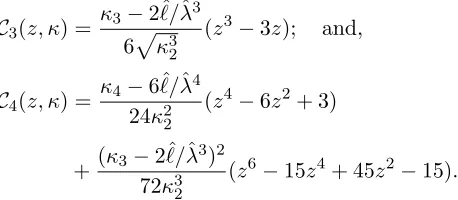
fY¯(y) =γℓ,ˆˆλ(y) +
φ(z)
√κ
2
withz= (y−κ1)/√κ2 as before and
C3(z, κ) =
κ3−2ˆℓ/λˆ3 6pκ32 (z
3
−3z); and,
C4(z, κ) =
κ4−6ˆℓ/λˆ4 24κ2
2
(z4−6z2+ 3)
+ (κ3−2ˆℓ/ˆλ 3)2
72κ3 2
(z6−15z4+ 45z2−15).
This expansion also has fatter tails (e−z decay, if the correction terms are
used) like the preceding gamma-based expansion.
4. Evaluating the Approximations
Having developed the theory, we can explore how well these expansions
approximate the average default time density for CDO tranches. Since
gamma Edgeworth regularity conditions may not hold or the expansion may
be negative, we also examine the base gamma density with no correction
terms.
The CDO setup is consistent with information in Lucas (2001) and Fender
and Kiff (2004): an underlying portfolio of 200 equal-sized loans. Each loan
has a different rate of default, chosen to equally cover a range of log-default
rates. The CDO trust is divided into three tranches, with defaults allocated
to the lowest still-extant tranche (Table 1).
Tranche # Loans Percent
A 150 75%
Mezzanine 40 20%
[image:15.612.175.404.148.248.2]Equity 10 5%.
Table 1. Tranche structure for a 200-loan CDO with three
While this CDO setup differs from later standardization on 125-loan
CDOs, the results here would be even stronger for a 125-loan CDO. For a
125-loan CDO, limiting asymptotic approximations would be less accurate
and thus would make these (large deviation) expansions perform relatively
better.
Default correlations are induced by the possibility of one (i.e.k= 1) rare
systematic risk event such as a sharp economic downturn at timeXℓ+1. Each
loaninot in default experiences accelerated default: the remaining time to
default is divided by a factor δ1. (By the memoryless property, Theorem 2
still applies.9)
We assume a range of equally spaced default rates. Since the
log-default rates are equally spaced, this setup is more difficult to handle than
if that range supported a modal distribution of log-default rates. These yield
average (idiosyncratic, unshocked) default times of 5–20 years with a skew
toward better credits: λi = 10i/200/20 for i ∈ 1, . . . ,200. The systematic
shock occurs at a rate λℓ+1 = 0.05, implying a mean time-to-shock of 20
years.10 Since the one-time shock is serious, the default time acceleration
used isδ1 = 5. These are equivalent to a portfolio of B–C-rated loans which
become C–D-rated during a recession.
4.1. Generating Risk Factor-Correlated Defaults. 200,000 simulated
loan portfolios were created using Algorithm 1. The simulations yielded
de-fault times for each loan. Cumulants of those dede-fault times were calculated,
which implied parameters for the expansions. The target density was then
9By memorylessness, shocked loans default atX
ℓ+1+Xi′ for a risk event at timeXℓ+1∼ Exp(λℓ+1),Xi′∼Exp(δλi).
plotted along with the approximations, and goodness-of-fit measures were
calculated.
The simulation method uses the memoryless property of the exponential
distribution. Specifically, we use the fact that the distribution of the time
remaining to default is conditionally independent of a stopping time. This
property implies that the time remaining has the same distribution as the
original default time (given the information at time 0), and allows us to
efficiently reuse idiosyncratic random variates.
Algorithm 1. (Risk Factor-Correlated Default Times)
1) Generate idiosyncratic default times: X˜i∈{1,...,ℓ}indep∼ Exp(λi).
2) Generate systematic shock time: X˜ℓ+1 ∼Exp(λℓ+j).
3) For i= 1 to ℓ, process each loan.
(a) If X˜i>X˜ℓ+1:
Accelerate remaining default time in affected loans.
1: Set X˜i := ( ˜Xi−X˜ℓ+1)/δ1.
2: Combine time periods:
Xi = ˜Xi+ ˜Xℓ+1.
(b) Otherwise: Xi = ˜Xi.
Appendix A explains how to do this sort of a simulation in a setting with
multiple risk factors, which is a bit more involved.
4.2. Example: CDO Equity Tranche with Major Shock. The average
default time of a CDO equity tranche can be modeled as a mean of correlated
exponential random variables. The equity tranche of a CDO is the riskiest
and most likely to be affected by correlated defaults. Thus we focus on
approximating the equity tranche under the possibility of a major shock,
The average default time is the sample mean ( ¯Y) of the ten smallest
generated default times. Simulated ¯Y’s yielded the sample cumulants of
(ˆκ1,κˆ2,κˆ3,ˆκ4) = (0.142,2.583×10−3,1.018×10−4,6.458×10−6) which
im-plied gamma parameters of ˆλ= 55.12 and ˆℓ= 7.849.
The average simulated default time is about two months; and, the
esti-mated diversity score (iid loan count) is 7.8. This implies that the shared
systematic risk factor causes a reduction in default-relative diversification of
nearly one-quarter. Further, we can think of the equity tranche as having
default behavior like a portfolio of 7.8 loans each with an annual probability
of default of 1−e−55.12 ≈ 1 (F credit). These are stark indicators of the
default risk taken by equity tranche holders in this setup.
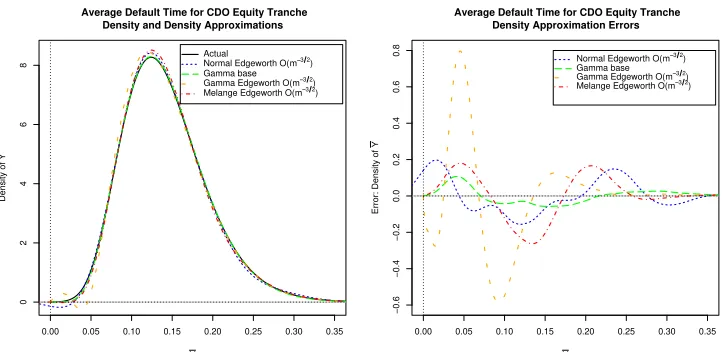
Plots of the approximations (Figure 1) to the average default time density
show overall good performance. The normal Edgeworth expansion is slightly
negative for ¯y < 0.04; the gamma Edgeworth expansion is negative for
0.025 < y <¯ 0.05; and, the gamma base is almost identical to the actual
density. The m´elange (gamma base, normal Edgeworth correction terms)
has almost no negativity and is close to the actual density more often than
the standard normal Edgeworth approximation.
While the gamma Edgeworth approximation has better tail behavior, it
is unfortunately not the best approximation. The mean squared errors
(Ta-ble 2) suggest that the simple gamma base, which still yields economically
meaningful metrics, or the m´elange approach are better approximations.
Normal Edgeworth Gamma Base Gamma Edgeworth M`elange
0.0034 0.0006 0.0306 0.0051
Table 2. Mean-squared errors for density approximations.
Note that the O(ℓ−1/2) gamma base is more accurate than
0.00 0.05 0.10 0.15 0.20 0.25 0.30 0.35 0 2 4 6 8
Average Default Time for CDO Equity Tranche Density and Density Approximations
Y
Density of
Y
Actual
Normal Edgeworth O(m−−3 2) Gamma base Gamma Edgeworth O(m−−3 2) Melange Edgeworth O(m−−3 2)
0.00 0.05 0.10 0.15 0.20 0.25 0.30 0.35
−0.6 −0.4 −0.2 0.0 0.2 0.4 0.6 0.8
Average Default Time for CDO Equity Tranche Density Approximation Errors
Y
Error: Density of
Y
[image:19.612.129.491.121.297.2]Normal Edgeworth O(m−−3 2) Gamma base Gamma Edgeworth O(m−−3 2) Melange Edgeworth O(m−−3 2)
Figure 1. CDO equity tranche average default time density
approximations (left) and errors (right). The true density is the solid line. Approximations: normal Edgeworth (- -);
gamma base (— —); gamma Edgeworth (–···); and,
gamma-normal m´elange (–·). All are O(ℓ−3/2) except the O(ℓ−1/2) gamma base.
4.3. Other CDO Tranches with Major Shock. These plots naturally
raise some questions:
1) What do average default time densities look like for other tranches?
2) What if loans ignored risk events with some probabilitypi>0?
3) What ifpi is inversely-proportional to λi? (i.e.What if issuers with
better credit are less likely to face default acceleration?)
For pi = 0 (as above), average default time densities for other tranches
exhibit left-skew which increases with tranche seniority. The A tranche
density, in particular, is sharply left-skewed with a minor mode on the left,
a non-zero plateau in the middle, and a major mode on the right.
If the probability of ignoring a risk event is higher (pi = 0.5,0.8), the A
tranche average default time looks normally distributed while the mezzanine
default time has slightly less right-skew than for pi = 0; but, even a casual
observer would probably doubt normality.
Finally, if the probability of ignoring the shock is proportional to credit
quality, the A and mezzanine tranche average default times appear
normally-distributed. The equity tranche average default time density is right-skewed
(as for pi= 0).
5. Estimating the Approximating Portfolio
We estimate the approximating portfolio in three steps. First, we estimate
the arrival rate for a systematic risk event (e.g. crisis). Next, we estimate
the idiosyncratic default rates and their acceleration during a systematic
risk event. Finally, we use these parameters to simulate loan portfolios from
which we measure cumulants. The cumulants specify the approximating
portfolio.
To estimate the occurence rate for the systematic risk event, the
maximum-likelihood estimator is simply the number of events per unit of time. For
example, if our systematic risk event were a US recession, we could use the
NBER business cycle data to estimateλs. Since the NBER notes an average
cycle length of 55 months, we would estimate λs= 0.218.
To estimate the default acceleration δ during a risk event, we use data
about loans similar to those in our portfolio and which existed when a
sys-tematic risk event occurred at some timets. If we characterize the loan credit
quality for one of those similar loans iasq(i) (e.g. q(i) ∈ {good, mediocre,
likelihood function given default timesti:
L(λ, δ|ts) =
Y
i∈{defaulted},ti<ts
λq(i)e−λq(i)ti·(1−e−λsts)
| {z }
pre-crisis defaults
×
Y
i∈{defaulted,ti≥ts}
δλq(i)e−δλq(i)(ti−ts)·e−λsts
| {z }
in-crisis defaults
×
Y
i∈{undefaulted,active}
e−δλq(i)(t−ts)·e−λsts.
| {z }
possible future defaults
Y
i∈{undefaulted,repaid}
e−δλq(i)(Ti−ts)
·e−λsts.
| {z }
undefaulted (censored default) (12)
Ideally, the idiosyncratic default ratesλq(i)would be the same as those in
the portfolio we are concerned with approximating. However, even if this is
not the case, we can still get a reasonable estimate of δ if we are willing to
assume a constant distress acceleration of default. We then use the estimated
δ to find the approximating portfolio through simulation. This yields the
metrics of interest: the diversity score and the average credit quality.
5.1. Example: 25-loan Subprime Portfolio. As an example of such
inference, we analyze a portfolio of 25 C-credit loans (q(i) = poor).
We are immediately faced with two possible approaches: We could use
risk-neutral default rates for pricing or physical default rates for risk
man-agement (and an appropriate stochastic discount factor for pricing).
To get risk-neutral default rates, we could look at credit default swaps
(CDSs) for the bonds in our portfolio and assume these did not price in
default correlation with risk factors. Similarly, we could find government,
on those bonds to imply a risk-neutral arrival rate for those risks.
Unfor-tunately, the assumption that bond CDSs do not price in the possibility of
correlated defaults is unlikely since CDSs are forward-looking instruments.
Instead, we look at physical default rates. This has the advantage of
cleanly separating the effect of idiosyncratic defaults from risk factors; and,
this is the measure we would want for risk management.
We start by examining (ex post) a portfolio of similar (C-credit) loans
from another recession to find the typical level of default accelerationδ and
idiosyncratic default rateλq(i). For a twenty-loan portfolio with the default
times given in Table 3, we would maximize the likelihood equation (12) to
estimate a crisis default-acceleration factor of ˆδ = 3.28 and an idiosyncratic
default rate of ˆλpoor = 0.22.
Pre-crash defaults 3.2 4.8 5.7
Post-crash defaults 5.8 5.8 5.8 5.9 5.9 6.0 6.1 6.2 6.3 6.5
6.8 7.2 7.7 8.3 9.2
[image:22.612.133.482.377.424.2]Repaid 10.0 10.0
Table 3. Table of loan lifetimes with 3 defaults before a
market crash at 5.8 years; 15 defaults after the crash; and, 2 undefaulted loans which were repaid in full at ten years. The repaid loans are “right censored” since we do not observe default and inference must account for this phenomenon.
Returning to the original portfolio of 25 C-credit loans, we can conduct
an ex ante analysis using the estimated ˆδ and ˆλpoor.11 At time t = 0, we
assume thatλpoor= 0.22 (as estimated).
The interaction between the systematic risk factor and the loans is not
affine, so we cannot easily find a closed-form solution to generate
cumu-lants. Instead, we proceed via simulation as outlined in Algorithm 1. This
simulation is straightforward since we have only one systematic risk factor.
11This entails the assumption that the estimated crisis default-acceleration rate ˆδis valid
Because the inference of ˆλ and ˆℓ assumes we have good estimates of
cumu-lants ˆκ1 and ˆκ2, we average the mean and variance of default times.12 For
10,000 simulations, this gives us the cumulants in Table 4. These
cumu-lants, mean ˆκ1 and variance ˆκ2, jointly determine the iid-loan credit quality
ˆ
λ = ˆκ2
ˆ
κ1 and the diversity score (number of iid loans) ˆℓ = 25df = 25b
ˆ
κ2 1
ˆ
κ2 for
the approximating portfolio.
ˆ
κ1 κˆ2 λˆ dfb ℓˆ 3.170 6.368 0.498 0.634 15.841
Table 4. Table of simulation-averaged cumulants for 10,000
simulations of 25 individual C-credit (subprime) loans with
default acceleration of δ = 3.28 in a recession arriving at
NBER-implied rates. The shared systematic risk factor in-duces default correlation which, in turn, affects the
cumu-lants. The cumulants imply the default intensity ˆλ and
di-versity score ˆℓfor a 25-loan subprime portfolio. Note that the
default-equivalent portfolio is one of just under 16 D-credit loans.
From this analysis, we see that our portfolio of 25 C-credit loans has
de-fault behavior best approximated by a portfolio of just under 16 D-credit
loans. This represents a 37% reduction in diversification strictly due to the
default acceleration from a shared macroeconomic risk factor. Clearly, the
capital adequacy required to hold such a portfolio would be significantly
greater than that required for holding 25 independent C-credit loans
unaf-fected by other risk factors.
6. Conclusion and Future Research
As the above analyses show, the expansions we propose can help analyze
the effects of defaults correlated by default-accelerating risk factors. The
12In this section, we switch from working with the average default time in a portfolio
greatest value from these approximations is the idea of an approximating
portfolio of independent, identical-credit loans and the two
theoretically-based, consistent metrics that approximation yields: ˆℓ, the diversity score
(number of iid loans in the approximating portfolio), and ˆλ, the credit
qual-ity of those loans. While Duffie and Gˆarleanu (2001) estimated the diversqual-ity
score alone, they note that they do not estimate the average loan credit
qual-ity. Thus this paper shows both a different way to estimate the diversity
score and jointly estimates the diverstiy score with the average loan credit
quality.
A further benefit is that many of these approximations perform well at
approximating the average default density. Ideally, we want the distribution
of total default; and, these approximations may be useful to achieving that.
One possibility would be to use the average default time distribution along
with the iid-equivalent loan count. The portfolio would then be modeled as
experiencing total default after all ˆℓiid loans had defaulted.
As for the approximations themselves, the gamma Edgeworth expansion
is mathematically concise and novel. Furthermore, the gamma Edgeworth
expansion, the m´elange, and even the base gamma density all have tail
be-havior that is thicker than standard Edgeworth expansions: tail decay on
the order of e−y instead of e−y2. Furthermore, the gamma and m´elange
expansions add correction terms to better capture the tail risk which Duffie
and Gˆarleanu (2001) raised as an issue with most reduced-form approaches.
While not detectable from the plots, these features are important for
analy-ses involving extreme events: the standard Edgeworth approximations (and
One shortcoming of gamma Edgeworth expansions not shown here is their
poor performance at approximating distributions which are left-skewed.13
An effective way to handle this might be to use the maturity timeT to model
the left-skewed distribution with a y-reversed gamma base or correction
terms originating fromy=T. The reversed gamma densities used would be
of the formγℓ,λ(T−y). A mixture of standard and reversed gamma densities
could be even be used, dictated by the signs of the cumulant differences.
Another area for further work is to study when the implied gamma base
parameter ˆℓis close to violating regularity conditions. In these cases, is may
be fruitful to bias ˆℓupward so the gamma-correction terms may be used.
While standard Edgeworth procedure is to match the first two moments,
this may not be optimal. One could investigate the performance of
Edge-worth expansions where the pseudocumulants are determined by maximum
likelihood or by minimizing some measure of the distance between the
ap-proximate and actual densities. The performance of such maximum-likelihood
“Edgeworth expansions” is surely better than using pseudocumulants;
how-ever, the approximation order is then a model selection question. Such an
approach would probably incorporate higher-order cumulant effects via the
optimization — and thus might be between the Edgeworth and saddlepoint
expansions in both accuracy and spirit.
Appendix A. Multi-Risk Factor-Correlated Default Times
To simulate default times affected by multiple shocks, we first must keep
track of which loans are affected by which shocks. Therefore, we set:
Ai :={j∈ {1, . . . , ℓ}: loan iaffected by risk factorj}.
(A.1)
13Simulations of CDO A tranches suggested that their average default times were
Algorithm 2. (Multi-Risk Factor-Correlated Default Times)
1) Generate idiosyncratic default times: X˜i∈{1,...,ℓ}indep∼ Exp(λi).
2) Generate systematic shock times: X˜j∈{ℓ+1,...,ℓ+k}∼Exp(λℓ+j).
3) Sort the systematic shock timesXℓ+1, . . . , Xℓ+kto generate risk-factor
order statistics: X(1)<· · ·< X(k).
4) Reorder the acceleration coefficients δj similarly to getδ(j).
5) For i= 1 to ℓ, process each loan.
(a) Hold last risk factor shock time: Li = 0.
(b) Forj = 1 to k, examine each risk factor (in time order).
1: If X˜i >X˜(j) and (j)∈ Ai:
Shock (j) affected loan i.
(A) Accelerate default due to risk factor (j) shock:
˜
Xi = ˜Xi/δ(j).
(B) Remember the latest risk shock time:
Li= ˜X(j).
(c) Set risk factor-affected default time: Xi := ˜Xi+Li.
References
Banasik, J.,J. N. Crook, and L. C. Thomas(1999): Not If But When
Will Borrowers Default. Journal of the Operational Research Society
50(12), 1185–1190.
Black, F. and J. C. Cox (1976): Valuing Corporate Securities: Some
Effects of Bond Indenture Provisions. Journal of Finance 31(2), 351–367.
Chambers, J. M. (1967): On Methods of Asymptotic Approximation for
Multivariate Distributions. Biometrika 54(3/4), 367–383.
Collin-Dufresne, P., R. Goldstein, and J. Hugonnier (2004): A
1377–1407.
Cox, D. R. and O. E. Barndorff-Nielsen (1989): Asymptotic
Tech-niques for Use in Statistics. London: Chapman and Hall.
Cox, D. R.and N. Reid (1987): Approximations to Noncentral
Distribu-tions. Canadian Journal of Statistics / Revue Canadienne de Statistique
15(2), 105–114.
Das, S. R., D. Duffie, N. Kapadia, and L. Saita (2007): Common
Failings: How Corporate Defaults Are Correlated. Journal of Finance
62(1), 93–117.
Duffie, D.,A. Eckner,G. Horel, and L. Saita (2009): Frailty
Corre-lated Default. Journal of Finance 64(5), 2089–2123.
Duffie, D.andN. Gˆarleanu(2001): Risk and Valuation of Collateralized
Debt Obligations. Financial Analyst’s Journal 57(1), 41–59.
Edgeworth, F. Y. (1883): On the Method of Ascertaining a Change in
the Value of Gold. Journal of the Statistical Society of London 46(4),
714–718.
Edgeworth, F. Y. (1905): The Law of Error. Transactions of the
Cam-bridge Philosophical Society 20, 35–65,113–141.
Edgeworth, F. Y.(1906): The Generalised Law of Error, or Law of Great
Numbers. Journal of the Royal Statistical Society 69(3), 497–539.
Erlang, A. K. (1909): The Theory of Probabilities and Telephone
Con-versations. Nyt Tidsskrift for Matematik B(20), 33–39.
Feller, W. (1971): An Introduction to Probability Theory and Its
Appli-cations, vol. II. 2nd edn. New York: John Wiley and Sons.
Fender, I.andJ. Kiff(2004): CDO Rating Methodology: Some Thoughts
on Model Risk and its Implications. Working Paper 163, Bank for
Financial Crisis Inquiry Commission (2011): Final Report of the
Na-tional Commission on the Causes of the Financial and Economic Crisis in
the United States. The Financial Crisis Inquiry Report, United States of
America.
Giesecke, K.(2003): A Simple Exponential Model for Dependent Defaults.
Journal of Fixed Income 13(3), 74–83.
Giesecke, K.(2006): Default and Information. Journal of Economic
Dy-namics and Control 30(11), 2281–2303.
Gram, J. P. (1883): ¨Uber die Entwickelung reeler Funktionen in Reihen
mittelstder Methode der kleinsten Quadrate. Journal f¨ur die reine und
angewandte Mathematik 94, 41–73.
Jarrow, R. A., D. Lando, and S. M. Turnbull (1997): A Markov
Model for the Term Structure of Credit Risk Spreads. Review of Financial
Studies 10(2), 481–523.
Jarrow, R. A.andS. M. Turnbull(1995): Pricing Derivatives on
Finan-cial Securities Subject to Credit Risk. Journal of Finance 50(1), 53–85.
Jarrow, R. A. and F. Yu (2001): Counterparty Risk and the Pricing of
Defaultable Securities. Journal of Finance 56(5), 1765–1799.
Leland, H. E. and K. B. Toft (1996): Optimal Capital Structure,
En-dogenous Bankruptcy, and the Term Structure of Credit Spreads. Journal
of Finance 51(3), 987–1019.
Lucas, D.(2001): CDO Handbook. New York: JP Morgan Securities.
Marshall, A. W.and I. Olkin (1967): A Multivariate Exponential
Dis-tribution. Journal of the American Statistical Association 62(317), 30–44.
McCullagh, P.(1987): Tensor Methods in Statistics. London: Chapman
and Hall.
Merton, R.(1974): On the Pricing of Corporate Debt: The Risk Structure
Patnaik, P. B.(1949): The Non-Centralχ2- andF-Distribution and their
Applications. Biometrika 36(1/2), 202–232.
Schorin, C. N.andS. Weinreich(1998): Collateralized Debt Obligation
Handbook. Working paper, Fixed Income Research, Morgan Stanley.
Thiele, T. N. (1871): En mathematisk Formel for Dødeligheden, prøvet
paa en af Livsforsikringanstalten af 1871 benyttet Erfaringrække.
Copen-hagen: C. A. Reitzel.
Thiele, T. N. (1872): On a Mathematical Formula to Express the Rate
of Mortality Throughout the Whole of Life. Journal of the Institute of
Actuaries 16, 313–329. Translated by T. B. Sprague.
Tung, J., A. Metz, and N. Weill (2011): Default and Loss Rates of
Structured Finance Securities: 1993–2010. Special comment, Moody’s
Investors Service.
Zhou, C. (2001): An Analysis of Default Correlations and Multiple