Munich Personal RePEc Archive
Does religion matter? Exploring
economic performance differences among
Romanian emigrants
Roman, Monica and Goschin, Zizi
Academy of Economic Studies Bucharest
February 2011
1
DOES RELIGION MATTER?
EXPLORING ECONOMIC PERFORMANCE DIFFERENCES AMONG ROMANIAN EMIGRANTS
Prof. Dr. Monica Roman Prof. Dr. Zizi Goschin
Bucharest Academy of Economic Studies
Abstract. Although migration and religion have traditionally developed as two separate research topics, in the current context of globalization and trans-nationalism attention begins to
focus on the way they interconnect. Religion received little attention in Romanian studies on
migration undertaken so far. Using the results of our survey among Romanian international
migrants of different religious faiths, this paper aims to raise interest in migration-religion
relationship and, at the same time, to improve the understanding of the economic performance
factors in a migration context by focusing on the distinctive characteristics of Romanian
religious minorities. We address both the theoretical and the empirical dimension of this topic,
making use of various statistical methods. Our main findings are consistent with the assumption
that religious belief is reflecting upon the behavior and economic performance of Romanian
migrants.
Key words: religious minorities, international migration, economic performance, remittances, Romania
JEL Classification: J61, Z12, C20
1. Introduction
The renewed interest in religion worldwide brought about increased attention to the role
2
receiving countries. The world had entered a post-secular era in which, far for determining the
abandonment of religious beliefs, modernization has produced a religious plurality which needs
to be acknowledged and studied1. The multi-sided relationship that exists between migration and
religion opens up a wide range of research lines, such as the interconnections between the
dominant and the migrant minorities religions, the degree of tolerance for the immigrants
traditions and religious practices, the establishment of places of worship for the migrant
minorities; the influence of immigrants on the religious diversity in the host country and the
possible challenges to mainstream denominations; the changes of the immigrants‟ religion during their integration in the host society; the contribution of the religion to spiritual comfort and
identity preservation for the immigrants.
In many of the classic studies on immigrants‟ integration in the host society, researchers
have emphasized that religion has a key role to play2, as an important part of the cultural
baggage. As migration flows are continuously growing in this increasingly globalised world, the
traditionally stable local religious systems are beginning to be challenged by the immigrants that
bring on their own traditions and religious beliefs and practices. The receiving communities may
respond to this intercultural pressure by reaffirming their own identity and traditions as opposed
to the migrants, which is sometimes leading to clashes3 and calls for state intervention and
adjustments on both sides4. Societies become increasingly aware of the existence of a religious
problem in the integration process and, especially after the events of 11th September the religious
question has become an issue of high interest in migration politics.
In order and to understand and prevent such problems, research has developed in this
field, aiming to identify and explain the large variety of ways in which religion is involved in the
migration movements and in the immigrants‟ successful resettlement in the context of a different dominant religion country. As economic performance of the immigrants is an essential part of
their successful integration, the relationship between religion and economics is another key topic
of research.
Given the fact that an increasing share of Romanian immigrants represents religious
minorities in destination country, understanding the migration-religion relationship and assessing
how religious affiliation may alter the economic situation of migrants represent issues of interest
for Romania as well. Emigrants left Romania in a number of emigration waves. The first major
3
religious mix, as ethnic minorities usually are religious minorities as well. Although the work
motivation now dominates the emigration flows, the Romanian immigrant communities,
frequently established on religious grounds, are acting as an attraction factor for the potential
emigrants of the same faith. While earlier studies on Romanian emigration mostly neglected the
religious issue, some recent ones acknowledge that religious affiliation has a role to play in
providing stability, reassurance, a more rapid integration and economic success for the
immigrants.
In this context we address two interrelated research questions: are there any differences in
behavior, including the propensity to remit, among Romanian immigrants of different religions?
and can religion be one of the explaining factors of Romanian migrants‟ economic performance?
This undertaking is based on the data provided by our online survey conducted during
August-December 2010 among Romanian emigrants of different religions. We employed
statistical methods to identify the similarities and to highlight the differences among dominant
and minority religions in Romania. Our work is providing insightful addition to the traditional
analysis of migration and remittances by including religion, in a regression framework, as one of
explaining factors that allow for understanding the economic success of Romanian international
migrants.
The rest of the paper is structured as follows. Section 2 offers an extended review of the
relevant theories on the interaction between migration and religion, and on religious affiliation,
in connection with economic outcomes. Section 3 explains the basic hypothesis and the
theoretical background of our paper, including a detailed description of religious demography in
Romania. Section 4 introduces the data set and variables involved in our approach and discuss
the appropriate econometric methodology as well. Section 5 concentrates on the empirical
results. Finally, concluding remarks and directions for future research complete the paper.
2. Religion’s impact on immigrant integration and economic performance
The growing literature on migration of the last decades emphasizes its complex social, cultural
and economic impact, both in the sending and recipient countries. The research on migration has
contributed to the definition of new theories and concepts such as globalization,
4
public debate on key issues connected with immigration such as national identity, minority
rights, security, social integration, cultural diversity and, more recently, religion5. The research
that developed in this field identified and explained a large variety of ways in which religion is
involved in the immigrants‟ successful integration. We further present the main avenues of research.
2.1. Religion’s role in the life of the immigrants
Religious practice in immigrant communities. Religious identity and practice becomes
more important for the immigrants, than they did before in the homeland and the religious
institutions forged in the new communities become focal points in their new life abroad6. Many
studies have emphasized the religiosity boost in a migration context, as immigrants need religion
to help them preserve spiritual identity and cohesion in a group7. The religious bond acts as one
of the strongest social ties.The same effect was noticed for Romanian migrants as well8.
While some immigrants continue to identify primarily with their homeland, the exposure
to a new culture and the sense of uprooting make others experience major transformations in
their religious and cultural identity9. On the other hand, immigrants gain a new perception of
own religious affiliation, against other faiths. Migration can thus, in a long time perspective,
implement and redesign the religious traditions, and even bring about independent traditions with
distinct characteristics, in contrast to former home tradition10.
Religion is helping alleviate the difficulties faced by the immigrants in a new
unpredictable environment by offering them the three Rs: Refuge, Respectability and
Resources11. Refuge, as religious practice in the immigrant communities creates strong bonds
and provides a sense of belonging and security for migrants. Respectability, as during the
struggle to build a new life in the host country, religion supplies spiritual identity, self-awareness
and ethical values. Resources can be supplied through social networks created around religious
communities that provide help in finding employment, offer information about social services or
create a place for social interactions.
The establishment of immigrants own religious institutions. Religious resettlement in a
new context frequently includes the establishment of religious institutions among immigrants, in
5
are the socio-religious associations, aiming to raise funds and organize activities13. Another
prominent role of such organizations involves fighting for legal rights regarding specific
religious or cultural practices, non discrimination, and equal access to public resources14.
Religious associations have a mixed influence on the successful integration of immigrants: they
are useful as providers of security and mutual support, but if these communities are marginalized
by the host society (e.g. ghetto like status) the integration process can be jeopardized15. The new
immigrant religious institutions should promote dialogue with similar religious communities of
the host society creating a bridging tool for integration, avoiding marginalization and frustration
that generate conflicts16.
Religious changes in subsequent generations. The so-called second and third
generations of immigrants are born and raised in different settings than their parents17. They are
educated in Western schools, influenced by secular and civil society practices and assimilate
local cultures, while still maintaining their original ones. All that may determine major
alterations or even abandonment of traditional religious practices in their community. Youth
natural dissatisfaction with conservative community leaders and religious teachers and the
conflict between generations may aggravate this process.
The role of religious institutions in the sending and receiving countries. Churches in
the sending and receiving countries both have various roles to play in the migration process,
acting as a bridge between different cultures and communities, offering support and solidarity
programmes to help individuals, promoting a migration policy which respects human rights and
non-discrimination18, warning and protecting against the human trafficking associated to the
migration flows19. Acting as responsible parts of the organized civil society, the churches in the
receiving countries should protect the human dignity, rights and religious freedom of the
migrants and refugees. Many churches in Western countries promote support for migrants, such
as programmes on housing, education, counseling for migrants and refugees, language schools
and courses for vocational training, legal assistance and enabling access to the labour
market20. Religious associations are often involved in the process of migration itself, alongside
cultural and work-related interest groups.
Government policy and the attitude of the receptor society towards immigrants’
religion.The estimated 95 million migrants that go all over the world in search of a better life,
6
the destination countries. As states handle the relationship with religion in different ways,
the migrants coming from authoritarian religious countries may experience difficulties in
the integration process in religious pluralistic countries, and governments are faced with the
challenge to manage increasingly heterogeneous societies. Except for Buddhism, all religions
exhibit a certain degree of intolerance, with Hinduism and Islam the less tolerant, and
Catholicism and Protestantism at about the same level21. Nevertheless, some Christian-secular
countries having large Islamic immigrant communities, such as Germany demonstrate that
religious differences and successful integration are not contradictory22. Germany is a success
story proving that problems may be prevented if migrants are provided adequate support in their
integration efforts, and that the religious identity of minorities can be preserved by a strategy of
cross-cultural education empowerment23. Sometimes a religious assimilation does take place,
such as the inclusion of the Protestant Huguenots, the 17th and 18th century as refugees to
England, or in the liberal Netherlands. The desire for social integration and social acceptance
may lead immigrants to religious conversion, mainly in subsequent generations.
The relationship with the homeland. As immigrants establish new relations into
receiving societies, they also remain linked to sending community. Consequently, migration
impacts not only the lives of the migrants themselves, but also the lives of the communities in
places of origin. The existence of strong links of the immigrants with the homeland was long
documented through the history of migration24. Although such connections are expected to fade
in time in space, modern instant communication and fast travel create new forms of transnational
links25, proved to be very resilient.
From an economic point of view, the strongest impact on sending countries is conveyed
through remittances. Migration and remittances do undoubtedly relieve pressure on the sending
countries, compensating for underemployment and generating new opportunities26, helping
alleviate poverty and improving life in poor countries27. Such effects of migrant remittances are
particularly important for Romania as, according to the World Bank data, itis on the 5th place in
the European top of emigration countries28 and on the 4th place as remittance recipient country29
($4.5 bn of remittances in 2010, representing 4.4 percent of GDP in 2009). According to some
experts, without remittances the current account deficits in Romania would have been over 50%
7
Besides the economic effect of remittances, emigrants may also affect the development of
religion in the homeland: the wealth, education and exposure to foreign influences transferred
from Diaspora may have significant effects on organization, practice and even belief in the origin
countries30.
Economic activity and religious rules. Economic inclusion is a key element in a
successful integration, with religious affiliation as a relevant factor of influence (as it will be
discussed in the next section). While the new environment opens up new carrier approaches and
business development opportunities for the migrants, religious laws on work may also have a
say. In some religions there are laws that influence the working conditions, the duration of the
workday and free time or impose clothing and food rules that prohibit believers to work in
certain places31. Commerce and industry may also be influenced by specific consumer behaviors
on religious grounds. Other sensitive questions regard the existence of different rules concerning
women‟ work and the problem of equal rights for men and women at the workplace.
2.2. Causal links between religious belief and economic performance.
Religion underpins the general set of beliefs of a society, shaping its values, customs and
traditions which in turn define the behavioral patterns of individuals, including their economic
behavior. Consequently, religion based differences among countries and individuals may act as a
major determinant of economic performance. In this respect, many scholars have argued that a
country‟s ability in growing and competing internationally relies not only on economic, social, historic and environmental factors, but on cultural ones as well, with religion as a key
component.
Religion reflects upon the economic life in a society through various channels such as the
shared values and beliefs which further determine the efficiency of the decision-making process
and thus economic outcomes; by impacting the attitude towards change and innovation, which is
crucial to progress and to economic growth; by setting the social and economic objectives in
accordance to the underlying values and religious beliefs of the society; by defining work ethics
and moral equity, such as the obligation to provide for future generation.
Religion may have both positive and negative impact on the economic outcomes. On the
8
work, honesty, and accumulation. At the same time, religion may encourage thrift, which would
stimulate savings, investments and therefore economic growth. It can discourage criminal
activities and diminish corruption, and may also improve trust, all bringing favorable effects on
economic life. A tolerant religion welcomes foreigners, which may in turn trigger economic
growth through foreign investments and immigrant work. By forbidding alcohol, drugs,
gambling, etc and encouraging family life, religion favors a better health that contributes to
higher labour productivity. On the negative side, there are religion based limitations on the
pursue of profit, credit markets and capital accumulation, and some countries are redirecting
substantial resources from the market economy towards religious goals (e.g. impressive
constructions).
Weber‟s seminal work, The Protestant Ethic and the ‘‘Spirit’’ of Capitalism32
, in1905,
was the first to acknowledge the importance of religion in understanding the economic success.
He argued that the Protestant Reformation has brought about a mental revolution that made
possible the rise of modern capitalism33. The Calvinist doctrine praising individual
responsibility, labor as a moral duty, efficient activity, thrift, approved risk-taking, was seen as
crucial for setting the right attitude towards economic activity, entrepreneurship and wealth
accumulation in a capitalist context. Weber‟s critics did not reject religion‟s influence on economics, but rather contested his exclusive Protestant line of thought34. Critics stressed that
Weber only captured the Protestants‟ view, omitting Catholics‟ essential contribution to the
development of science35 and their bigger wealth that stands as prove for economic success and
material accumulation36. In the same line, Greif37, and soon after Lal38pointed to various ways in
which Catholics prompted economic and social innovations in Europe. For instance, Pope
Gregory I favored changes in family law, while Pope Gregory VII supported modern legal
institutions.
In the 60th there was a second wave of studies on the economics of religion, including
scholars who build on the role of religious affiliation as base for practices and institutions39 that
reflect upon economic performance. In the same line with Weber, but more moderate,
Eisenstadt40 assessed an indirect, weaker role of Protestant religion in economic outcomes,
stating that religion accounts for changes in the values and behaviors that redefine the political
9
To sum up, researchers generally agree on the positive economic impact of all Christian
religion. In opposition, Islamic countries‟ slow economic development for most of millennium is considered to be largely determined by its system of religious beliefs. Among the world‟s major religions, Islam seems to be the most economic underperforming, many scholars explaining the
relative poverty of the Muslims (both at national and individual level41) through the existence of
uniquely Islamic economic practices or institutions unfavorable to growth, such as the
prohibition on the charging of interest, or the obligation to pay alms42. Moreover, Islam preaches
fatalism which is opposite to entrepreneurship and growth43. For instance, the Islamic practices
in force have long inhibited the commerce, until the introduction of new Western-inspired
institutions in the Muslim world in the 19th century44. Through its care for social security, wealth
taxation and immoral tax, Islam is more concerned with the redistribution of income, rather than
mere economic growth.
Many studies that illustrate religion‟s connections to economic performance build on the role of institutions in intermediating values and influencing economic outcomes45, on the
grounds that the existence of a dominant religion or the existence of a state-supported religion is
economically relevant46. A large part of these empirical studies are based on the World Values
Survey data, but their results are mixed. Making use of such data, Guiso et al47 highlighted
religion based differences in the attitude toward private ownership, with Protestants, Catholics,
and Hindus being more favorable, as compared to Muslims. They also found that Protestants and
Hindus would accept a greater income inequality in exchange for growth, while Jews and
Muslims will not. In opposition to Christian religion, that favors the development of market
economy and efficient institutions, Islamic religious beliefs were found not conducive to growth.
Noland‟s findings48 are questioning the robustness of such results on the basis that in the contemporary world the convergence in institutions and practices has mainly invalidated that
influence.
Although supporting the existence of a religion – economy link, many empirical studies offer contradictory results when it comes to pointing to the religions that are conducive to
growth. In a cross-country regression, Sala-i-Martin et al.49 found Islam to be
positively associated with income growth, while Barro et al.50, using similar methodology, but a
smaller panel of countries, showed that Catholicism is positively correlated to economic growth,
10
British, French, and Spanish colonies indicated Protestantism as positively impacting growth and
development51.
Barro and McCleary52 found religious beliefs to be positively correlated with economic
growth, while church attendance seems to be negatively correlated. Stulz and Williamson53 also
documented the influence of cultural values, including dominant religion as a key factor, on debt
market and banking development. In line with Weber, they found creditor rights and
enforcement to be more important in the Protestant countries.
From a methodological perspective, these empirical studies on religion economics fit into
two large categories: cross-country regressions and separate analysis of individual countries,
each line of research having both advantages and limitations. The cross-country regressions main
problem is the existence of institutional differences among countries. This makes unclear
whether the effect identified is solely caused by the dominant religion or by other factors linked
to religious beliefs. At the micro level, separate analysis of individual countries rise problems
with endogeneity (the correlations they identify may not be causal) and do not allow for
generalization of results.
Researchers found that religion is a significant factor in explaining the economic success
not only for countries, but for individuals as well. At an individual level, belonging to certain
religions potentially entails economic advantages based on the reputational signal it provides for
potential employers and customers, e.g. by inspiring trust (and consequently, diminished
economic risk). Empirical studies confirmed that the economic behavior of individuals and their
economic performance do correlate with religion: for instance, in the United States Jews have
bigger incomes then Christians54.
Although religions are widely varying in practice, researchers generally agree on the
existence of a causal link between religion and economic performance, both at individual and
society level. Our paper aims at testing this hypothesis for the Romanian migrants belonging to
different minority religions, as well as for the adherents of dominant Orthodox religion and for
the non-religion group. There are only a few empirical studies that combine migration, religion
and economic performance and, to the best of our knowledge, such a research has not been
11
3. Romanian religious context and research hypothesis
3.1. The Religious Demography in Romania.
Romania is one of the most religious countries in Europe, according to recent evidence55. The
World Values Survey 2005 also indicates high values of religiosity in Romania, situating it
among the first European countries, alongside predominantly Catholic countries: Malta, Poland
and Ireland.
According to 2002 census56 the Orthodox believers (including the Orthodox Serb
Bishopric of Timisoara) are dominant in Romania, including as much as 86.7% of the country's
population. The Christian faith existed on this territory since the formation of Romanian people,
as archaeology and linguistics prove57. Throughout their history, the Orthodox faith represented
for Romanians an essential part of their national identity, as they had to resist foreign powers as
the Ottoman Turks in Moldavia and Wallachia and the Hungarian rule in Transylvania. A
religious revival took place after 1989 and the Romanian Orthodox Church became a constant
advocate for religious solutions to various civil issues58.
Another Orthodox Church in Romania is the Lipovan Old Rite Christian Church (0.1 %
of the population), including Russians who came in Tulcea and Braila counties in the first half of
the 18th century due to persecution unleashed by the Russian Orthodox Church.
The Roman Catholicism accounts for 4.7% of the population, mainly of Hungarian ethnicity, even though there are also more than 300,000 ethnic Romanian Catholics in
Transylvania. Catholicism was first introduced in our country in the 11th century, due to
missionaries (Benedictine monks).
In 1698 a minority of Romanians in Transylvania became members of the Greek-rite
Roman Catholics, thus obtaining equality of rights with Roman Catholics. They now represent
less than 1 percent of the population, located mainly in the northern part of Transylvania, and in
Bucharest, Banat and Crisana as well. There are still unsolved problems concerning the
restitution of Greek Catholic properties transferred to the Romanian Orthodox Church in 1948,
during the communist regime.
12
located in Transylvania. Other Protestant Churches are: Unitarian Church of Romania (0.3%),
Evangelical Church of Augustan Confession (0.2%)- German ethnicity and Evangelical Lutheran
Church (0.1%) - Hungarian ethnicity. The smaller group of Neo Protestants include the
Apostolic Church of God - Pentecostal Church (1.5%), Baptist Church (0.6%), and Seventh-day
Adventist Church (0.4%).
The Romanian Evangelical Church is an evangelical Christian movement, born in
1920-1924 in Bucharest, that has no counterpart abroad. In 1939, they had to merge with
Christian Evangelical Church (which came in Romania in the early 20th century). After
December 1989, the two denominations functioned independently.
Jehovah's Witnesses include 0.2% of the population based on 2002 census.
Other smaller religious groups are also present in the country. Armenian Apostolic
Church accounts to 0.1% of the population. Armenians settled in Transylvania since the 11th century where they found an atmosphere conducive to practice their traditional occupations in
terms of religious tolerance. For about 700 years, Romania also has a small Muslim minority (0.3%), mostly of Tatar and Turkish ethnicity, concentrated in Constanta and Tulcea counties.
There are also approximately 6,000 Jews (mostly in Bucharest) and 23,105 people of no religion or atheist.
According to the US Department of State report on religious freedom 201059, in Romania
the government generally respected religious freedom in practice and minority religious groups
had less complains than previously.
3.2 Research hypothesis
Religious affiliation is more and more viewed as an inherent, socially described characteristic
similar to race or ethnicity. Because of this, religion has become an important variable of
concern in studying labor discrimination60. Researchers have begun to examine how religious
minority groups, in particular, experience an economic penalty or an economic advantage. It
should be noted from the beginning that in this paper we do not separate in our econometric
approach religious affiliation from religious participation, due to the lack of appropriate data.
Most of the studies consider emigrants as a minority observed from the perspective of the
13
immigrants belonging to religious minorities in destination country. For instance, using data
from Britain, Lindley61 finds an Islamic penalty for employment and earnings controlling for
migration status and race. This indicates the effect of religious affiliation is more similar than
diverse across differing societies, and through its comparative methodology, brings forward the
hypothesis that religious minority immigrants are generally economically disadvantaged in the
West.
In this paper we adopt a different perspective by analyzing Romanian emigrants‟ religious affiliation, separate from their religious minority or majority status in the receiving country
(depending on the dominant religion existing in the destination country). We consider the
Romanian emigrants from a large number of countries, observed through an on line survey
conducted in August-December 2010.
Our main hypothesis is that religious affiliation has a significant influence on economic
performance of Romanian emigrants. We expect to find that migrants affiliated with a minority
religious group (Neo-Protestants, Protestants or Catholic) have different economic outcomes
compared to Orthodox immigrants, which is the religious majority in Romania. Considering that
religion provides a motivation for helping others and immigrants remit for altruistic motives, we
therefore hypothesize that immigrants who are religiously affiliated are more likely to remit.
4. Data, methods and variables
4.1.Data and methods
To compensate for the lack of official statistical data on the religious beliefs of Romanian
migrants, an online survey was conducted during August-December 2010 and our present work
builds on the resulting database. Respondents were asked questions on a variety of topics
including income, employment, graduated studies both in Romania and in emigration country,
length of migration, remittances and intention to return to Romania. Therefore, our survey
represents a recent source of data on immigrant cohort and contains all necessary economic
outcomes (i.e. employment, occupation, earnings and education) as well as necessary
14
migrants‟ economic performance. The final database consisted of 1514 respondents from more than 20 countries and is referred henceforth as Romanian Emigrants‟ Study (RES).
Separate multivariate models are estimated for income, income change and for the
probability of remitting. Each multivariate regression equation includes religious affiliation and
control variables. Linear regression was applied in the case of the first two outcome variables,
income and income change. We employ a binary logistic regression model in order to identify
the impact of religious affiliation factors on the probability of sending money to Romania. In our
study, the binary dependent variable in regression model is whether a person is sending money to
the home country or not (specifically 1 denotes that the individual is remitting and 0 otherwise).
By employing these methods, we are following the main methodological trends in recent
literature. For instance, Sacerdote and Gleaser62 apply regression analysis on religious beliefs
and education, while Connor63 applies logistic regression on income and employability of
emigrants living in US.
4.2. Variables involved in econometric analysis
Effect variables. Three variables are used to assess labor market insertion: present income (INCOME), the dynamic of present income compared to income at the first job in
destination countries (INDEX) and the attitude towards remitting money to home country
(REM). They are the dependent variables in our regression models.
Present income is the net monthly income at the moment of filling the questionnaire and
is expressed in USD for comparability reasons. It is measured as a scale variable ranging from
less than 500 USD to more than 5000 USD, with interval length of 500. Romanian emigration
for labor is rather young and this fact is reflected by the great proportion of emigrants (90%) that
emigrated less than 15 years ago. In this sense most of the Romanian emigrants are employed
and they have an income. For this reason, we prefer to consider income level as the most
appropriate outcome in our study, compared to other variables presented in the literature, such is
employment64.
Religious affiliation has an impact not only on the present life of emigrants, but also on
the whole course of his/her emigration experience. Therefore, we evaluate economic outcome of
15
income received in the first job in host country. Values higher than 1 for this index show an
increase in income since the arrival in the host country (positive outcome), while values lower
than 1 reflect a decrease in income (negative outcome).
Another economic result of migration is the remitter quality of migrants. This is
measured as a binary variable: 1 if the migrant is sending money to Romania and 0 otherwise.
Money sent by emigrants to their families is increasing their quality of life and has positive
effects on the family relations. Remittances are also an important source of external funding for
developing countries. They rank only behind foreign direct investment and are much higher in
magnitude than total official development assistance and private non-FDI flows. Therefore, it
can be identified an increasing interest in the literature in studying such aspects and we consider
remittances as being one of the positive outcomes of the economic activity of emigrants.
Variables of interest. The variable of interest in our research is religious affiliation, measured through a nominal variable. Religious affiliation initially considered in our research
groupings were coded according to National Statistical Institute classification65 and included
Romanian Orthodox, Roman Catholic, Calvin, Lutheran, Pentecostal, Baptist, Adventist, Greek
Catholic-Uniate, Jewish, Islam, Atheist and No religion. These religions were further aggregated
into the next seven categories (see Table 1): Romanian Orthodox, Catholic (Roman Catholic,
Greek Catholic-Uniate), Protestant (Calvin, Lutheran), Neo-Protestant (Pentecostal, Baptist,
Adventist and others), Jewish, Islam, and No religion (individuals that are atheist or without
religion).
We treat the variable of interest as dummies, considering as the reference group the
emigrants with no religious affiliation. All the results from regression model have to be
considered relative to this reference group. In this sense, the analysis will reveal the economic
advantages or disadvantages of belonging to a religious community.
Individuals who generally report “no religion” constitute a relatively heterogeneous group: it includes atheists, agnostics, and persons who were raised without an affiliation due to
other circumstances (such is being a child from an inter-faith marriage). For this reason, many
studies on religions have omitted this group; therefore, its addition in our study is a valuable
contribution to better understanding the effects of religious affiliation on economic and
16
The “no religion” group is an important reference because there is a view in the literature66 that religious people have characteristics that are often difficult to measure directly,
but which make for better economic outcomes. On the other hand, in their study67, David
Blackaby et al. find that non religious persons are significantly advantaged against other
religions, while the overall message is that religion is equally as important as ethnicity in helping
to explain employment rates in Britain.
According to some authors68, it is useful to think of the “no religion” category as one extreme in the religiosity scale. Thus the benefits that are typically associated with religious
involvement are not available to the unaffiliated.
Following these reasons, we consider the “no religion” category as the reference group in our quantitative analysis, being supported in our decision by the important proportion of this
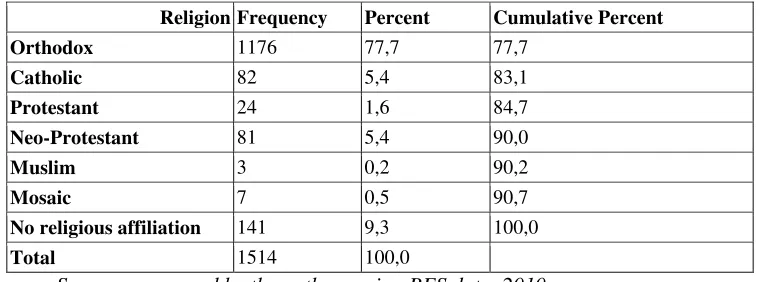
[image:17.612.116.498.361.502.2]category in the total number of emigrants from our sample (see Table 1).
Table 1. The distribution of Romanian migrants according to religious affiliation
Religion Frequency Percent Cumulative Percent
Orthodox 1176 77,7 77,7
Catholic 82 5,4 83,1
Protestant 24 1,6 84,7
Neo-Protestant 81 5,4 90,0
Muslim 3 0,2 90,2
Mosaic 7 0,5 90,7
No religious affiliation 141 9,3 100,0
Total 1514 100,0
Source: processed by the authors using RES data, 2010
The proportion of migrants with “no religion” or atheists in our survey is surprisingly high in the context of Romanian revival religiosity69. A similar situation was identified by
Jasoo70, when studying skilled migrants from US. The largest group of skilled migrants
according to religious affiliation is the no-religion category (27.6%).
Control variables. Socio-demographic predictors used as control variables include age (AGE), gender (GENDER), number of minor children living in receiving country (CHILD) and the last
level of education attended (EDU). Education is a scale variable ranging from 1 to 7 and coded
17
second level of secondary education, 5-first level of tertiary education, 5- higher education,
6-master degree, 7-doctoral studies.
The level of integration in the labour market from receiving country is evaluated through
the number of years spent in migration country (TIME). For the same purpose, we have also
considered the education received by the emigrant in host country (EDU1), described in our
models as dummy and coded with 1 if the emigrant have followed courses in the country of
emigration and 0 otherwise. Additionally, the intention of returning to Romania (RETURN) was
included in our econometric approach as a binary variable coded 1 if the emigrant has the
intention to return and 0 otherwise.
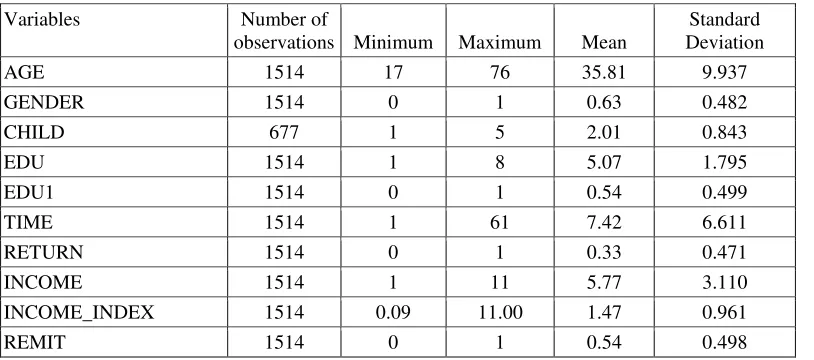
Before moving onto multivariate analysis, it is useful to investigate whether economic
outcomes are significantly different across religious groups. In this respect, descriptive statistics
are presented in Table 2. The average income is 5.77, corresponding to an average monthly level
of 2385 USD. Compared to this, the persons with “no religion” or atheist have the highest income, while the lowest income is obtained by Neo-Protestants and orthodox migrants. The
change in income was positive for all religious groups, with the highest level in the case of “no
religion” and the lowest in the case of Neo Protestants.
The highest percentage of remitting migrants is affiliated to Neo Protestants Churches,
followed by those belonging to Orthodox Church. It seems surprising that the migrants with the
[image:18.612.107.514.505.685.2]highest income, those with no religious affiliation, have the lowest probability to remit.
Table 2. Descriptive statistics for the effect and control variables
Variables Number of
observations Minimum Maximum Mean
Standard Deviation AGE 1514 17 76 35.81 9.937 GENDER 1514 0 1 0.63 0.482
CHILD 677 1 5 2.01 0.843
EDU 1514 1 8 5.07 1.795
EDU1 1514 0 1 0.54 0.499
TIME 1514 1 61 7.42 6.611
RETURN 1514 0 1 0.33 0.471 INCOME 1514 1 11 5.77 3.110 INCOME_INDEX 1514 0.09 11.00 1.47 0.961
REMIT 1514 0 1 0.54 0.498
18
Given the wide distribution among these outcome variables and variables of interest (see
standard deviations in Table 2), there is sufficient variation for further testing the association
between economic outcomes and religion.
5. Results and comments
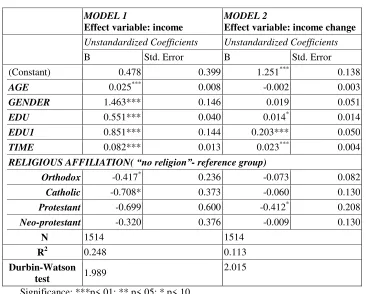
The first model considers migrants‟ monthly income as being the effect variable. The model
is statistically significant and explains in a good proportion the variability of income across
migrants (R2=0.24). The dummies explaining religious affiliation are statistically significant for
[image:19.612.124.490.292.586.2]Orthodox and Catholic migrants.
Table 3. OLS regression coefficients for models 1 and 2
MODEL 1
Effect variable: income
MODEL 2
Effect variable: income change Unstandardized Coefficients Unstandardized Coefficients
B Std. Error B Std. Error (Constant) 0.478 0.399 1.251*** 0.138
AGE 0.025*** 0.008 -0.002 0.003
GENDER 1.463*** 0.146 0.019 0.051
EDU 0.551*** 0.040 0.014* 0.014
EDU1 0.851*** 0.144 0.203*** 0.050
TIME 0.082*** 0.013 0.023*** 0.004
RELIGIOUS AFFILIATION( “no religion”- reference group)
Orthodox -0.417* 0.236 -0.073 0.082
Catholic -0.708* 0.373 -0.060 0.130
Protestant -0.699 0.600 -0.412* 0.208
Neo-protestant -0.320 0.376 -0.009 0.130
N 1514 1514
R2 0.248 0.113
Durbin-Watson test 1.989
2.015
Significance: ***p<.01; ** p<.05; * p<.10
Source: processed by the authors using RES data, 2010
The emigrants‟ belonging to all religious groups are exhibiting lower outcomes in terms of income, compared to migrants with “no religion”. All regression coefficients for religion affiliation variables are negative. Therefore, the persons which are not religiously affiliated are
better off compared to religious persons. The influence of religion on income is statistically
Neo-19
Protestants the level of significance is lower. The results of the regression model 1 presented in
table 3 show that Neo-protestants, followed by Orthodox, have the highest religious influence on
income, while the Catholics have the lowest influence of religion on income, compared to
migrants who are not religiously affiliated.
All control variables are statistically significant in the first regression model, gender
having the highest impact; income is 1.4 times higher in men‟s case, compared to female.
The outcome variable in the second model is the change in income. In this respect, we
have computed the income index by comparing the migrant‟s income in the moment of filling the questionnaire with the income received at the first job in the destination country. The income
index is explained by religion to a lower extend, compared to the variable income in the previous
regression, the model being statistically significant. At the same time, all regression coefficients
are negative and therefore the variation in income is lower for each religious group compared to
“no religion” group of migrants. We conclude that persons with no religious affiliation have better results in terms of income change compared all other religious groups. If we compare
these groups, we notice that Protestants have the lowest economic effect, while Neo-protestants
have the highest economic effect, meaning the lowest penalty in respect with the persons not
religiously affiliated.
The results from the quantitative analysis are reflecting the existence of a significant gap
in terms of economic outcomes of Romanian migrants between those affiliated to a religion and
those unaffiliated. More than that, there are important differences in economic effects between
religious groups. It is important to notice that religious minorities in the sending country-
Romania- such as the Neo-Protestants have the lowest penalty in receiving country. As it was
emphasized by Sandu71, religious minorities in Romania are better organized and benefit from a
better network compared to the Orthodox Church. Our findings support the idea that Romanian
emigrants “import” the religious networks in their receiving country, using it to increase and improve their economic status, in the context of a lower education compared to other religious
groups.
Following the objectives of our research, the next question we consider is if Romanian
emigrants with different religious affiliations differ in their remitting behavior, compared to the
20
While the literature on the determinants of remittances is well documented and there are
several studies on religiosity and social behaviors, there is little empirical evidence on the
relationship between religious affiliation and remittances sending propensity. Based on the
assumption that religion provides a motivation for helping others and immigrants remit for
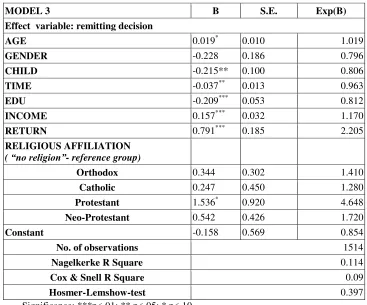
[image:21.612.122.489.214.519.2]altruistic motives, we expect religiously affiliated immigrants to be more likely to remit.
Table 4. Logistic regression coefficients for model 3
MODEL 3 B S.E. Exp(B)
Effect variable: remitting decision
AGE 0.019* 0.010 1.019
GENDER -0.228 0.186 0.796
CHILD -0.215** 0.100 0.806
TIME -0.037** 0.013 0.963
EDU -0.209*** 0.053 0.812
INCOME 0.157*** 0.032 1.170
RETURN 0.791*** 0.185 2.205
RELIGIOUS AFFILIATION ( “no religion”- reference group)
Orthodox 0.344 0.302 1.410
Catholic 0.247 0.450 1.280
Protestant 1.536* 0.920 4.648
Neo-Protestant 0.542 0.426 1.720
Constant -0.158 0.569 0.854
No. of observations 1514
Nagelkerke R Square 0.114
Cox & Snell R Square 0.09
Hosmer-Lemshow-test 0.397
Significance: ***p<.01; ** p<.05; * p<.10
Source: processed by the authors using RES data, 2010
We employ logistic regression in order to answer this research question. The variable of
interest - religious affiliation- is maintained the same as in the previous two cases, while the
control variables have been reconsidered. We introduce new control variables -described in
section 4.2.-consistent with the existing literature on remittances72 in order to better support our
objectives. With the exception of gender, all the control variables are significant with standard
significance level (see Table 4).
Our results from the logistic regression analysis indicate at the first glance that
21
groups have higher probabilities to remit compared to the “no religion” group. Protestants have the probability to remit four times higher compared to the “no religion” group, while Neo-protestants have a 1.7 times higher probability. For the Orthodox the value is 1.4, while for
Catholics is 1.2, as the odd ratios presented in Table 4 are indicating.
This is in line with our expectations and it is a strong argument in supporting the
hypothesis that emigrants belonging to a religious group are more likely to remit. The model is
statistically significant and has a good level of explanation of the probability to remit, though
“Protestant” is the only statistically significant interest variable.
6. Conclusions and directions for further research
A significant part of the rich literature on migration has addressed the impact of religion
on the international migration, such as the socio-economic and religious inclusion of the
immigrants in the host country. We consider the empirical dimension of this topic, making use of
various statistical methods to test the assumption that religious belief is reflecting upon the
behavior and economic performance of Romanian migrants.
This paper contributes to the literature by providing a quantitative analysis of the
economic outcomes of immigrants and religion. Therefore, we provide insightful addition to the
traditional analysis of migration and remittances by including religion, in a regression
framework, as one of explaining factors that allow for understanding the economic success of
Romanian international migrants. More specifically, the paper examines whether the
socio-demographic variables and immigrant‟s religious affiliation are important determinants of income, income change and remittance behavior. We analyze emigrants from the sending
country perspective- Romania- and in this sense we propose a new approach compared to the
present literature which is based on data coming from receiving countries. We exploit a new data
source on migration, the Romanian Emigrants Study (RES) database resulted after an online
survey, developed during the research project The Effects of Labor Force Migration and
Demographical Structural Changes on Dynamic Economies.
In order to obtain a more comprehensive picture of the impact of the religious faiths on
the economic performance in a migration context, we have developed three regression models.
22
income, which is decreasing with different intensities, compared to the “no religion” group. Furthermore, persons with no religious affiliation have the better results in terms of income
change, compared to all other religious groups. Comparisons across these groups indicate that
Protestants have the lower effect, while Neo-protestants have the highest effect, meaning the
lowest penalty in respect with the no religiously affiliated persons.
The results stemming from the logistic regression indicate that immigrants from different
religious affiliations do differ in their remitting behavior. All religious groups have higher
probabilities to remit compared to the “no religion” group. Protestants have the probability to remit four times higher compared to the “no religion” group, while Neo-protestants have a probability to remit 1.7 times higher. In the case of Orthodox migrants the value is 1.4 and for
Catholics is 1.2.
To conclude, through this paper we identified significant differences in economic
outcomes of Romanian emigrants, according to their religious affiliation. One important finding
is that in the case of persons with no religion or atheists, the economic outcome is higher,
compared to those that are members of religious communities, but their probability to remit is
lower. The higher level of education achieved by this “no religious” group compared to all other religious migrants might be one explanation of the results; this is one path to be followed in our
further research on this topic.
Our work opens the door for other future research opportunities in this field. One
promising line of research would be to extend the analysis by including more religion variables
in the regression equation in order to discriminate between different channels through which
religion impacts Romanian migrants‟ behavior and economic success. From a methodological point of view, we intend to refine the analysis from a regional perspective, using the territorial
data available in our database by means of spatial regression methods. This will allow us to
account for the regional distribution of Romanian immigrant communities, some of which were
established on religious grounds, as religion frequently acts as a pull factor for international
23
Acknowledgements:
This paper was supported by CNCSIS grant no. 1829/2008: The Effects of Labor Force
Migration and Demographical Structural Changes on Dynamic Economies, director prof.
Monica Roman, Bucharest Academy of Economic Studies.
The authors are grateful to the Romanian emigrants that have filled in the questionnaire and have
provided valuable information for Romanian migration analysis.
References
Adida, Claire, Laitin, David and Valfort, Marie-Anne, “Integration into Europe: identifying a Muslim effect”. In: Luce Speaker Series on Religion, Democracy and Conflict. New Jersey: Princeton, 2010.
Barro, Robert J. and Rachel M. McCleary. “Religion and Political Economy in an International Panel” NBER Working Paper 8931 (May 2002).
Barro, Robert J. and Rachel M. McCleary. “Religion and economic growth across countries”
American Sociological Review 68, 5 (October 2003): 760–781.
Baumann, Martin. “Religion und ihre Bedeutung für Migranten. Zur Parallelität von „fremd“
-religiöser Loyalität und gesellschaftlicher Integration”. In Religion – Migration – Integration in Wissenschaft, Politik und Gesellschaft, 19-30. Berlin, Bonn: Satz und Druck, 2004.
Bhalla, Surjit S. Imagine there’s no country: Poverty, inequality, and growth in the era of
globalization. Washington: Institute for International Economics, 2002.
Blackaby, David, Derek Leslie, Philip Murphy and Nigel O‟Leary. “The Religious Dimension to Ethnic Disadvantage in Great Britain.”, Working Paper in Economics, School of Business and
Economics, Swansea University, (June 2010): 1-41.
Bouma, Gary D. Many Religions, All Australians. Religious Settlement, Identity and Cultural Diversity. Kew, Victoria: The Christian Research Association, 1996.
Brenner, Reuven and Nicholas M. Kiefer. “The Economics of the Diaspora. Discrimination and Occupational Structure” Economic Development and Cultural Change 29, 3 (April 1981): 517-534.
24 Connor, Phillip. “Religion as resource: Religion and immigrant economic incorporation”. Social Science Research (October, 2010).
Dupré, Annemarie. “What role does religion play in the migration process?”. In Migration and Religion in a Globalized World. Rabat: IOM, 5-6 December 2005.
Eisenstadt, Shmuel N. The Protestant Ethic and Modernization: A Comparative View. New York: Basic Book, 1968.
Foner, Nancy. “What‟s new about transnationalism? New York immigrants today and at the turn of the century” Diaspora 6, 3 (March 1997): 355-75.
Gammage, Sarah. “Exporting People and Recruiting Remittances : A Development Strategy for
El Salvador?” Latin American Perspectives, 33, 6 (November 2006): 75-100.
Gordon, Michael. Assimilation in American life: the role of race, religion and national origins.
Oxford: Oxford University Press, 1964.
Goschin, Zizi, Daniela L. Constantin, Monica Roman. “The Partnership Between the State and
the Church Against Trafficking in Persons” Journal for the Study of Religions and Ideologies, 8, 24 (Winter 2009): 231-256, http://jsri.ro.
Greif, Avner. “Cultural beliefs and the organization of society: A historical and theoretical reflection on collectivist and individual societies” Journal of Political Economy, 102, 5, (October 1994):912–950.
Grier, Robin. “The Effect of Religion on Economic Development: A Cross-National Study of 63 Former Colonies” Kyklos 50, 1 (February1997): 47-62.
Guiso, Luigi, Paola Sapienza, and Luigi Zingales. “People‟s opium? Religion and economic
activities” Journal of Monetary Economics 50, 1 (January 2003): 225–282.
Hansen, Niles. “The Protestant Ethic as a General Precondition for Economic Development” The Canadian Journal of Economics and Political Science, 29, (May 1963): 462-474.
Herberg, William. Protestant-Catholic-Jew: An essay in American religious sociology. New York: Doubleday, 1955.
Hirschman, Charles. “The Role of Religion in the Origin and Adaptation of Immigrant Groups in
the United States” International Migration Review, 38, 3, (September 2004): 1126-1159.
Huang, Chi-Chen, Kleiner, Brian H.” New developments concerning religious discrimination in
25 Iannaccone, Laurence R. “Introduction to the Economics of Religion” Journal of Economic Literature, 36, 3 (June 1998): 1465-1496.
Jasso, Guillermina. “Ethnicity and the Immigration of Highly Skilled Workers to the United
States”. IZA Discussion Paper 3950 (January 2009): 1-38.
Karpat, Kemal. “The hijra from Russia and the Caucasus”. In Muslim Travellers, edited by Dale Eickelman and James Piscatory, 77-98. Berkeley: University of California Press, 1990.
Kivisto, Peter and Dag Blanck. American Immigrants and Their Generations. Urbana: University of Illinois Press, 1990.
Klinkhammer, Gritt. “Religion – Migration – Integration – eine Einführung”. In Religion – Migration – Integration in Wissenschaft, Politik und Gesellschaft, 12-18. Berlin, Bonn: Satz und Druck, 2004.
Knott, Kim. “The Religions of South Asian Communities in Britain”. In A New Handbook of Living Religions, edited by John Hinnells, 756-775. Oxford: Oxford University Press, 1997.
Kuran, Timur. “Islamic redistribution throughZakat: Historical record and modern realities”. In
Poverty and charity in Middle Eastern contexts, edited by Michael Bonner, Mine Ener and Amy Singer, 275-294. Albany, NY: State University of New York Press, 2003.
Kuran, Timur. “The economic ascent of the MiddleEast‟s religious minorities: The role of
Islamic legal pluralism” Journal of Legal Studies 33, (June 2004): 475–515.
Kuran, Timur. “The Islamic commercial crisis: Institutional roots of economic
underdevelopment in the Middle East” Journal of Economic History, 63, 2, (June 2003): 414– 446.
Lal, Deepak. Unintended consequences: The impact of factor endowments, culture, and politics on long-run economic performance. Cambridge: MIT Press,1998.
Landes, David. The Wealth and Poverty of Nations. London: Little, Brown, and Company, 1998.
Lehrer , Evelyn L. “Religion as a Determinant of Economic and Demographic Behavior in the United States” . IZA Discussion Paper No. 1390, (November 2004): 1-47.
Lianos, Theodore P. “Factors determining migrant remittances: the case of Greece”.
International Migration Review, 31 (Spring 1997): 72-87.
Lindley, Joanne. “Race or religion? The impact of religion on employment and earnings of
26 Marcus, Noland. “Religion and Economic Performance” World Development 33, 8 (August 2005): 1215–1232.
Ratha, Dilip. Understanding the importance of remittances. Washington: Migration Policy Institute, World Bank, 2004.
Rex, John, Danièle Joly and Czarina Wilpert. Immigrant Associations in Europe. Aldershot: Gower, 1987.
Roman, Monica and Voicu, Cristina. “Some Socio-economic effects of labour migration on sending country. Evidence from Romania”, Theoretical and Applied Economics, 7, (July 2010): 61-76.
Roman, Monica, Ileanu, Bogdan and Roman Mihai, „A comparative analysis of remittance
behaviour between East European and North African migrants” in International Conference on Eurasia Economies, Istanbul: T.C. Beykent University, 2010.
Sacerdote, Bruce and Glaeser, Edward. “Education and religion”. NBER Working Paper 8080, (January 2001): 1-53.
Sala-i-Martin, Xavier, Gernot Doppelhofer, Ronald I. Miller. “Determinants of long-run growth: A Bayesian averaging of classical estimates (BACE) approach” American Economic Review 94, 4 (April 2004): 813–835.
Samuelsson, Kurt. Religion and Economic Action: The Protestant Ethic, the Rise of Capitalism, and the Abuses of Scholarship. Toronto: Toronto University Press, 1993.
Sandu, Dmitru. Comunitati romanesti in Spania. Bucharest: Soros Foundation, 2009. http://www.soros.ro/ro/comunicate_detaliu.php?comunicat=85#
Sandu, Dumitru. Lumi sociale ale migratiei romanesti in strainatate. Iasi: Polirom Printing House, 2010.
Skeldon, Ronald. „On Migration and the Policy Process”. Sussex Centre for Migration Research, Working Paper T20, 2007.
Smith, Claudia Kelly and Blen Solomon. “The Influence Of Religion On Remittances Sent To
Relatives And Friends Back Home”, Journal of Business & Economics Research, 7,1 (January, 2009): 91-102.
Stan, Lavinia and Lucian Turcescu. "The Romanian Orthodox Church and Post-Communist
Democratization" East European Perspectives 3, 5 (March 2001),
27
Stulz, Rene M. and Rohan Williamson. “Culture, openness, and finance” Journal of Financial Economics 70, 3 (March 2003): 313–349.
Tawney, Richard H. Religion and the Rise of Capitalism. New York: Harper and Row, 1926.
Vadean, Florin. “Citizenship Status and Remittances: Evidence from German Micro Data”, ARI Working Paper No. 89, (2007): 1-39.
Vertovec, Steven. “Religion in Migration, Diasporas and Transnationalism”. Vancouver Center of Excellence: Working Paper Series 02-07, 2002.
Voicu, Malina and Voicu Bogdan (eds) - The values of Romanians, Iasi: Institutul European, 2008.
Warner, Stephen R. and Judith G. Wittner. Gatherings in Diaspora: Religious Communities and the New Immigration. Philadelphia: Temple University Press, 1998.
Weber, Max. The Protestant Ethic and the spirit of Capitalism. Translated by Talcott Parsons. London: Allen and Unwin, 1930.
Williams, Raymond B. Religions of Immigrants from India and Pakistan: New Threads in the American Tapestry. Cambridge: Cambridge University Press, 1988.
World Bank, Migration and Remittances Factbook 2011,
http://siteresources.worldbank.org/INTLAC/Resources/Factbook2011-Ebook.pdf.
Zhou, Min. “Revisiting ethnic entrepreneurship: convergencies, controversies, and conceptual advancements”. International Migration Review 38, (2004): 1040–1074.
Notes
1
IOM, Final Report of the Conference Migration and Religion in a Globalized World,(Genève: IOM, 2005),
http://iom.int/jahia/webdav/shared/shared/mainsite/policy_and_research/rcp/5+5/Report_Migrati on_&_Religion_Rabat_2005_FR+EN.pdf; see also the forthcoming joint international
multidisciplinary conference on Global Migration and Multiculturalism: “Religion, Society, Policy and Politics” at the University of Surrey, http://www3.surrey.ac.uk/Arts/CRONEM/. 2
See Peter Kivisto and Dag Blanck (eds.), American Immigrants and Their Generations, (Urbana: University of Illinois Press, 1990), William Herberg, Protestant-Catholic-Jew: An essay in American religious sociology, (New York: Doubleday, 1955), Maichel Gordon,
Assimilation in American life: the role of race, religion and national origins, (Oxford: Oxford University Press, 1964).
3