Munich Personal RePEc Archive
Comparative analysis of students training
needs regarding Internet and its effects
Turturean, Monica and TURTUREAN, Ciprian Ionel
Universitatea "Stefan cel Mare" Suceava, Romania, Universitatea
“Al.I.Cuza”, Facultatea de Economie şi Administrarea Afacerilor
26 April 2012
Online at
https://mpra.ub.uni-muenchen.de/40434/
The 8
thInternational Scientific Conference
eLearning and software for Education
Bucharest, April 26-27, 2012
Comparative analysis of students training needs regarding Internet and its effects
Monica Turturean
Teacher Training Department, “Stefan cel Mare” University of Suceava, Romaniam [email protected]
Ciprian Turturean
Faculty of Economics and Business Administration, “Alexandru Ioan Cuza” University of Iasi, Romania [email protected]
Abstract: In this article we will try to realize a comparative study in order to find out if the internet has a positive or a negative role for undergraduate’s university students.
The purpose of this study is to identify the perception of undergraduate university students regarding the effects of the internet for their scientific activities and their training needs.
The study is based on data obtained from the application of a sample survey which studies the opinion of undegraduate students regarding the role of internet in students education.
The sample size was 496 students (students from „Alexandru Ioan Cuza” University of Iasi and from „Stefan cel Mare” University of Suceava.
Keywords: higher education; internet role; attitude; academic performance, students’ training needs.
I. Review of the literature
The Internet was created by the US Defense Department for research purpose. In time, it becomes the most important tool for the worldwide organizations, including universities.
Many universities try to ensure full access on internet to its students, to help them to progress, to make their scientifically activities much more easily.
The specialty literature shows that Internet has the next roles in education: 1. to facilitate online communication, 2. to be a warehouse of information, 3. to allow online research, 4. to facilitate online learning, 5. to conduct to innovation in education, 6. to improve interest in learning, etc.
A lot of studies point out the importance of Internet in education. Li et al. (2003) highlight: “First, web-based instruction presents information in a non-linear style, allowing students to explore new information via browsing and cross-referencing activities. Second, web-based teaching supports active learning processes emphasized by constructivist theory. Third, web-based education is enhanced understanding through improved visualization and finally, the convenience, it could be used any time, at any place”. A review of studies conducted by the CEO Forum (2001) emphasizes: “technology can have the greatest impact when integrated into the curriculum to achieve clear, measurable educational objectives.”
2
In conclusion, we will do a study to find out if the opinion of undergraduate’s university students regarding internet and its effect will be positive or negative.
II. Study concerning undergraduate students attitudes about internet
2.1. The main purpose and objectives of the study
The purpose of this study is to identify the perception / opinion of undergraduate university students regarding the effects of the internet for their scientific activities and their training needs.
The objectives of the studies:
1. to identify the students opinion regarding internet; 2. to find out the purpose of using the internet;
3. to discover if the internet improves or not their scientific activity.
2.2. The hypothesis of the study
The hypotheses of the study are:
1. The undergraduate students use intensively the internet because is the easiest way to procure the information need it.
2. Many students will take into account the advantages of the internet, neglecting the disadvantages. 3. All the students have used, use and will use internet as the most important tool for their scientific activity and not only.
2.3. Research methodology
The study is based on data obtained from the application of a sample survey which studies the opinion of undegraduate students regarding the role of internet in students education. The sample survey was applied to a non-probabilistic sample. Students were randomly selected from two universities: "Alexandru Ioan Cuza" University of Iasi and "Stefan cel Mare" University of Suceava.
The investigative technique used was the auto-questionnaire survey consisting in 8 question administered in group.
2.4. The sample structure
The sample size was 496 students (students from „Alexandru Ioan Cuza” University of Iasi and from „Stefan cel Mare” University of Suceava. Each student completed one non-standardized questionnaire. We classify the whole sample after criterion: “university where the students study” providing the following sub samples:
• sub sample of students studying at "Alexandru Ioan Cuza" University of Iasi composed of 287 undergraduates students;
•sub sample of students studying at "Stefan cel Mare" University of Suceava composed of 209 undergraduate students.
2.5. Data analysis techniques
The Statistical Package for Social Science Program (SPSS) was used to summarize and run correlation on data obtained from the survey. Frequency distribution used to mention demographics of students. Correlation technique was utilized to discuss relationship between undergraduate university students training needs and internet usage.
2.6. Findings / The results obtained after applying the opinion questionnaire
Item 1.: the role using Internet is the scientific activity 35.7 30.4 17.7 16.2 38.4 32.1 15.9 13.6 0 5 10 15 20 25 30 35 40 45
an easy way hich help to have acces to the
information and understand it
a modality to comunicate with teachers and other students regarding
homeworks
a virtual library which allows them to save time and effort
a new envirnoment which allows to develop
the information UAIC (%) USV (%)
[image:4.612.187.426.68.186.2]As we can see, over 35% of undergraduate students consider internet an easy way to access information and over 30% of students considers internet a way of communication. There are not significance differences between students from “Alexandru Ioan Cuza” University of Iasi and students from “Stefan cel Mare” University of Suceava.
Figure 2: the structure of answers at question Q2
Item 2: tools / skills required to use Internet
41.7 32.4 15.3 10.6 48.2 35.6 10.3 5.9 0 10 20 30 40 50 60
ability to think critticaly ability to communicate with teachers and
students
ability to upload files ability to type UAIC (%) USV (%)
[image:4.612.187.427.272.389.2]It is interesting to discover that undergraduate students consider ability to think critically the most important skill required for using internet (over 41% of students) and the next one is the ability to communicate (over 32% of students).
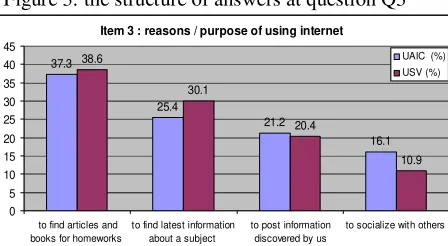
Figure 3: the structure of answers at question Q3
Item 3 : reasons / purpose of using internet
37.3 25.4 21.2 16.1 38.6 30.1 20.4 10.9 0 5 10 15 20 25 30 35 40 45
to find articles and books for homeworks
to find latest information about a subject
to post information discovered by us
to socialize with others UAIC (%) USV (%)
The most important reason why undergraduate students want to use internet is that they use it to find articles and books (over 37%) and another reason is that they wants to find the latest information about a subject (over 25% of respondents).
[image:4.612.203.427.446.569.2]4
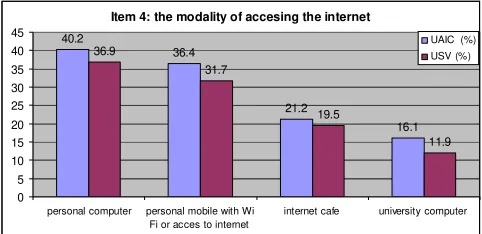
Item 4: the modality of accesing the internet 40.2
36.4
21.2
16.1 36.9
31.7
19.5
11.9
0 5 10 15 20 25 30 35 40 45
personal computer personal mobile with Wi Fi or acces to internet
internet cafe university computer UAIC (%) USV (%)
Over 36.9% of undergraduate students have a personal computer and over 36.4 of them have a mobile phone, the both instruments are used to access internet for their homework.
Item 5: internet improve the academic performance
Yes (83,7%) „Al. I. Cuza”
University of Iasi (%)
„Stefan cel Mare” University of Suceava (%) 1. we are up to date to the latest news and development
from a specific field
35.4 36.9
2. the quality of information is in a continuous increasing 32.6 30.7 3. they obtain information at any time of day or night 24.3 8.9 4. we can ask additional information from other users 7.7 23.5
More than 83% consider that internet has a huge role for their academic performance because they can find out the latest news regarding different topics (over 35.4%)and because the information expires very quickly (over 30.7%).
No (16.7%) „Al. I. Cuza”
University of Iasi (%)
„Stefan cel Mare” University of Suceava (%) 1. Internet is full of viruses which destroyed the computer 35.8 32.7
2. A lots of information are innacurate or outdates 33.7 37.3 3. Information are already structured and interpreted 23.4 19.4 4. Many students can’t have acces to internet 7.1 10.6
[image:5.612.185.426.68.185.2]But there are students (over 16.7%) which consider that internet not improve the academic performance, mostly because it is full of viruses (32.7%) and a lot of information is inaccurate or outdates (33.7%).
Figure 6: the structure of answers at question Q6
Item 6: Which engine do you use for your search
51.3
35.4
11.1
2 57.6
31.3
10.3
0.8 0
10 20 30 40 50 60 70
Google Yahoo Altavista Dogpile
UAIC (%) USV (%)
[image:5.612.187.425.476.596.2]As we are expected, over 51 % of university students use google as an engine to do search, and over 31% use yahoo.
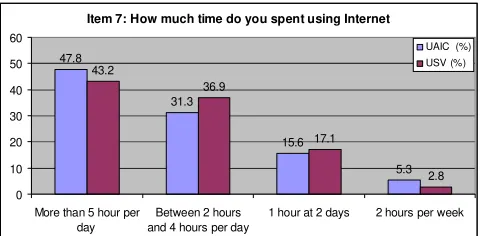
Item 7: How much time do you spent using Internet
47.8
31.3
15.6
5.3 43.2
36.9
17.1
2.8 0
10 20 30 40 50 60
More than 5 hour per day
Between 2 hours and 4 hours per day
1 hour at 2 days 2 hours per week UAIC (%) USV (%)
[image:6.612.186.427.67.185.2]It is interesting to see that university students spend a lot of time using computer and internet (over 43 % spend more than 5 hours par day and over 31 % spend between 2 and 4 hours per day)
Figure 8: the structure of answers at question Q8
Item 8: Will you use in the future the internet to resolve your homeworks and professional problems? 93.7
6.3 94.1
5.9
0 10 20 30 40 50 60 70 80 90 100
Yes No
UAIC (%) USV (%)
As a conclusion, more than 93% of university students will use internet to solve their professional problems. This thing indicates a high level regarding internet and its power.
2.7. Validition of the hypothesis
The first hypothesis „The undergraduate students use intensively the internet because is the easiest way to procure the information they need it” was validated by the answers offered by the undergraduates students from both university centers to the item 1 (more than 35 % consider this). The students consider that internet help them to have access to the information, to communicate with others, to find the latest information about a subject, to socialize.
The second hypothesis „Many students will take into account the advantages of the internet, neglecting the disadvantages” was validated by the answers offered by undergraduate’s students from both university centers to the item 5. (83.7% of students consider that internet improve the academic performance). The reasons offered by students are: they are up to date to the latest news and development from a specific field, the quality of information is in a continuous increasing, they obtain information at any time of day or night, etc.
The third hypothesis „All the students have used, use and will use internet as the most important tool for their scientific activity and not only” was validated by the big percent of undergraduates students from both university centers (93.7%) who will use in the future the internet and the big number of hours spent using the internet (over 43% spent more than 5 hours per day using internet and over 31% spent between 2 and 4 hours per day using internet).
6
III. Conclusions and suggestions
As we can see, there are no significant differences regarding the role of internet between undergraduates university students from “Alexandru Ioan Cuza” University of Iasi and undergraduates university students from “Stefan cel Mare” University of Suceava.
The entire sample emphasis the positive role of Internet for their academic and social training needs. They consider that the internet usage will conduct to development of information, to improvement of scientific performance, to a better communication and to saving time and money. But they neglet the negative aspects of internet usage, such as: internet is full of viruses which destroyed the computer; a lot of information are innacurate or outdates; iformation are already structured and interpreted, many students can’t have acces to internet.
In this context, we will try to make some sugesstions:
the universities should specify exactly why they encouraging the internet usage.
the universities shoud organize online courses, but, in the same time, to encourage critical thinking, creativity, originality, etc;
all universities should take into account the undergraduates students training needs and to not give tasks which involves spending a lots of time on internet;
course materials should be posted on Web to allow students to use its when they need;
the universities should facilitate comunication between teachers and students using internet;
the universities should use internet as the easiest and faster way to communicate and to cooperate with other universities.
Acknowledgements
This work was supported by the project "Post-Doctoral Studies in Economics: training program for elite researchers - SPODE", co-funded from the European Social Fund through the Development of
Human Resources Operaţional Programme 2007-2013, contract no. POSDRU/89/1.5/S/61755.
References
1. Angrist, J. D.; Lavy, V., 2002, New Evidence on Classroom Computers and Pupil Learning, Economic Journal. No. 112, pp. 735-765.
2. Bargeron, D., Grudin, J., Gupta, A. & Sanocki, E., 2002, Asynchronous collaboration around multimedia applied to on-demand education, Journal of Management Information Systems, 18, 4, 117–145.
3. CEO Forum, 2001, Year 4 STaR Report [Online]. Available:
www.electronicschool.com/2001/09/0901ewire.html#forum
4. DeBell, M. and Chapman, C., 2006, Computer and Internet Use by Students in 2003 (NCES 2006-065), National Center for Educational Statistics, U.S. Department of Education, Washington, DC, pp. 1-62.
5. Driscoll, M., 2002, How people learn (and what technology might have to do with it). ERIC Clearinghouse on Information and Technology Syracuse, NY. Retrieved 5 January 2006 from http://www.ericdigests.org/2003-3/learn.html
6. Fuchs, T.; Woessmann, L., 2004, Computers and Stuent Learning: Bivariate and Multivariate Evidence on the Availability and Use of Computers at Home and at School, CESifo Working Paper. No. 1321. November. Munich. 7. Goolsbee, A., Guryan, J.,2002,. The Impact of Internet Subsidies in Public Schools, NBER Working Paper. No. 9090. 8. Kirkpatrick, H.; Cuban, H.,1998, Computers Make Kids Smarter–right?, Technos Quarterly. No. 7.