JOURNAL OFCLINICALMICROBIOLOGY,
0095-1137/00/$04.00⫹0 Jan. 2000, p. 71–78 Vol. 38, No. 1
Copyright © 2000, American Society for Microbiology. All Rights Reserved.
Characterization of
Streptococcus agalactiae
Isolates of
Bovine and Human Origin by Randomly Amplified
Polymorphic DNA Analysis
GABRIELA MARTINEZ, JOSEE HAREL, ROBERT HIGGINS, SONIA LACOUTURE,
DANIELLE DAIGNAULT,ANDMARCELO GOTTSCHALK*
Groupe de Recherche sur les Maladies Infectieuses du Porc, Faculte´ de me´decine ve´te´rinaire, Universite´ de Montre´al, St-Hyacinthe, Que´bec J2S 7C6, Canada
Received 21 May 1999/Returned for modification 19 July 1999/Accepted 9 September 1999
Streptococcus agalactiaeis considered one of the major causes of bovine intramammary infections. It is also found in the vaginas of women without any apparent clinical symptoms, but reports of neonatal infections, causing significant morbidity, are relatively frequent. The aim of this study was to evaluate the genetic diversity of S. agalactiae strains isolated from bovine milk and from asymptomatic women in Que´bec, Canada, by randomly amplified polymorphic DNA (RAPD) analysis. A total of 185 bovine isolates and 38 human isolates were first serotyped for capsular polysaccharide by double diffusion in agarose gel (bovine isolates) and coagglutination (human isolates). Strains were then studied by RAPD using 3 primers, designated OPS11, OPB17, and OPB18, which were selected from 12 primers. Thirty-eight percent of bovine isolates and 82% of human isolates could be serotyped. Prevalent serotypes were type III (28%) for bovine isolates and types V (26%) and III (24%) for human isolates. RAPD results showed that, taken together, all isolates (of bovine and human origin) shared 58% similarity. Ninety-four percent of these isolates were clustered in four groups (I, II, III, and IV) with 70% similarity among them. Three clusters, A (48 isolates), B (14 isolates), and C (32 isolates), with 79 to 80% similarity were identified within group IV, whereas the three other groups did not present any clusters. Despite some clustering of human isolates, relatively high diversity was seen among them. Relatively high heterogeneity was observed with the RAPD profiles, not only for field strains belonging to different serotypes but also for those within a given serotype.
Mastitis remains one of the most economically important problems of the dairy cattle industry throughout the world. Milk quality and the prevalence of clinical and subclinical mastitis are major factors in determining farm profitability (16).
Streptococcus agalactiae (Lancefield group B) is a highly contagious obligate parasite of the mammary gland, where it can survive for long periods of time (19). Since this organism is susceptible to treatment with a variety of antimicrobial agents, eradication within a closed herd is possible. With increasing pressures for the reduction of antimicrobial agents in animals as well as in humans, the necessity for improved understanding of the epidemiology of this etiological agent has become ap-parent (1). Prevalence studies forS. agalactiaein cattle have been conducted in different areas of North America (19, 20, 31). Data about the epidemiology and molecular characteris-tics of this organism from bovine milk are not available in Canada. In the United States, only a few studies, with a limited number of strains, have been carried out on these subjects (7, 29).
S. agalactiaealso causes significant morbidity and mortality in humans, both infants and adults, worldwide (3). In neonates,
S. agalactiae is mostly acquired from the mother’s vagina in early-onset disease, although nosocomial, community, and breast milk transmissions have been reported (2). In adults,S.
agalactiaeoccurs preferentially in certain individuals, such as diabetics, pregnant and postpartum women, and immunocom-promised patients, emphasizing the opportunistic nature of the infection (23). Furthermore, humans act as a significant reser-voir ofS. agalactiae, since this bacterium may be carried in the vaginas of women without apparent clinical signs (14). Ques-tions have been raised as to whetherS. agalactiaeis a zoonotic agent or whether host-specific ecovars exist. Controversial re-ports indicate the absence or the presence of a relationship between human and bovineS. agalactiaeisolates (8, 18). Some epidemiological studies onS. agalactiaeinfections have been based on serotyping techniques, but these traditional proce-dures are limited in that their discriminatory potential is too low. DNA-based subtyping techniques, such as pulsed-field gel electrophoresis (PFGE) (10), ribotyping (5), restriction en-zyme analysis (REA) (9), multilocus enen-zyme electrophoresis (28), and random amplification of polymorphic DNA (RAPD) (6) have been used efficaciously to subtypeS. agalactiaeisolates of human origin. Methodologies such as ribotyping and PFGE usually involve time-consuming steps and/or sophisticated equipment. REA has the advantages of simplicity and high discriminatory power but is sometimes difficult to interpret because of the large number of restriction fragments gener-ated. RAPD is an accessible and sensitive method based on the use of arbitrary primers to amplify polymorphic segments of DNA. This technique has been widely used in recent years for detection of diversity among isolates (25, 34, 36).
The objective of this work was to study, by RAPD, the genetic diversity of a collection ofS. agalactiaeisolates origi-nating from dairy cattle in different parts of Que´bec, Canada. Data were used to standardize the technique and evaluate the discriminatory power of the primers used. In addition, some
* Corresponding author. Mailing address: Groupe de Recherche sur les Maladies Infectieuses du Porc, De´partement de Pathologie et Microbiologie, Faculte´ de me´decine ve´te´rinaire, Universite´ de Mon-tre´al, C.P. 5000, St-Hyacinthe, Que´bec J2S 7C6, Canada. Phone: (450) 773-8521, ext. 8374. Fax: (450) 778-8108. E-mail: gottschm@medvet .umontreal.ca.
71
on May 15, 2020 by guest
http://jcm.asm.org/
isolates from asymptomatic healthy women were also analyzed and compared to bovine isolates.
MATERIALS AND METHODS
Bacteria.Reference strains ofS. agalactiaeserotypes Ia(SS 615), Ib(SS 618),
II (SS 619), III (SS620), IV (3139), and V (SS 1169 [NT1]) were used as positive controls in serotyping and RAPD experiments. All reference strains originated from the Centers for Disease Control and Prevention, Atlanta, Ga., except forS. agalactiaeserotype IV (3139), which was kindly sent by J. Henrichsen, Statens Serum Institut, Copenhagen, Denmark.
A total of 297 bovine isolates were collected in cases of bovine mastitis or from a bulk tank of unrelated herds by the seven provincial laboratories of Que´bec, Canada, during 1996 and 1997. All agricultural regions of Que´bec were repre-sented. In addition, 38S. agalactiaeisolates were collected from vaginal or rectal swabs of asymptomatic pregnant women. These isolates originated from two different geographical regions (representing 29 and 9 isolates, respectively).S.
agalactiaewas isolated by using Trypticase soy agar supplemented with 5% sheep blood. All isolates were identified asS. agalactiaebased on a positive Christie, Atkins, and Munch-Peterson (CAMP) reaction, lack of esculin hydrolysis, and a positive latex agglutination test for Lancefield group B (22). The latter test was conducted with a commercial kit (Patho Dx; Diagnostic Products Corporation)
according to the manufacturer’s recommendations.
Serotyping.Human isolates were serotyped on the basis of capsular polysac-charides by the coagglutination method (21). Since most bovine isolates were autoagglutinable, they were serotyped by double diffusion in agarose gels (17). Anti-type Ia, Ib, II, III, IV, and V sera were purchased from Oxoid (Basingstoke,
England).
RAPD fingerprinting.All human isolates and 185 representative bovine iso-lates were analyzed by RAPD. This analysis was performed as described by Williams et al. (36) with some modifications. The PCR mixture consisted of buffer (10 mM Tris-HCl [pH 8.3], 50 mM KCl; 2.5 mM MgCl2), 100M each of
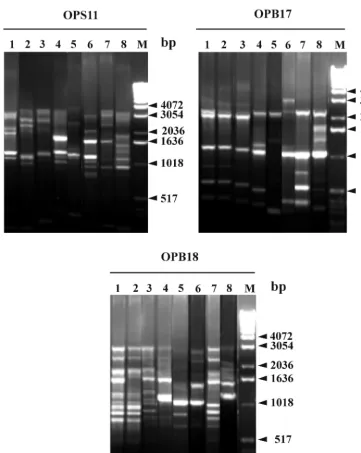
[image:2.612.121.483.69.523.2]the four deoxynucleoside triphosphates (Pharmacia Biotech Inc., Baie d’Urfe´, Que´bec, Canada), 0.4M primer, 50 ng of DNA extracted and purified as FIG. 1. Illustration of the RAPD patterns generated with primers OPS11, OPB17, and OPB18. Lanes 1, reference strain SS615 (serotype Ia); lanes 2 nontypeable
bovine isolate from region 3; lanes 3, serotype III bovine isolate from region 2; lanes 4, serotype III bovine isolate from region 7; lanes 5, serotype IV human isolate from region 4; lanes 6, serotype II bovine isolate from region 6; lanes 7, serotype V human isolate from region 4; lanes 8, serotype Ibbovine isolate from region 2; lanes
M, 1-kb DNA ladder (DNA molecular size marker).
on May 15, 2020 by guest
http://jcm.asm.org/
previously described (27), and 2.5 U ofTaqDNA polymerase (Pharmacia) in a total volume of 25l. The primers used are shown in Table 1 and were synthe-sized by Gibco BRL Custom Primers (Burlington, Ontario, Canada). Each sam-ple was subjected to the first cycle of denaturation (5 min at 94°C) in a DNA Thermal Cycler 480 (Perkin-Elmer Applied Biosystems, Foster City, Calif.). Each of the 35 subsequent cycles consisted of denaturing at 94°C for 30 s, annealing at 35°C for 30 s, and extension at 72°C for 1 min. The last cycle included an extension at 72°C for 5 min. Amplified products were separated by electrophoresis in a 1.4% agarose gel (Sigma) and visualized as white bands on a black background by UV transillumination following ethidium bromide stain-ing. A 1-kb DNA ladder (Gibco) was used in each gel as molecular size stan-dards. A negative control, consisting of the same reaction mixture but with water instead of template DNA, was included in each run. In addition, a positive control, containing the same reaction mixture with a template of DNA from a well-characterized reference strain (S. agalactiaeSS 615), was also included. Each isolate was tested under the same conditions at least three times with the selected primers.
Pattern analysis.Photographs of each gel were digitalized with a video camera connected to a microcomputer (Alpha ease; Alpha Innotech Corp., San Leandro, Calif.). After conversion, the data were normalized and analyzed. Degrees of homology were determined by Dice comparisons, and clustering correlation coefficients were calculated by the unweighted pair group method with arithmetic averages. When the calculations were completed, a dendrogram showing the hierarchic representation of linkage level between isolates was drawn. All these processes were carried out with Molecular Analyst Software, Fingerprinting, version 1.12 (Bio-Rad Laboratories, Mississauga, Ontario, Canada).
Discriminatory analysis.The probability that two unrelated isolates sampled from the test population will be placed into different typing groups or clusters was assessed according to the Hunter-Gaston formula (15). This probability is calculated as
D⫽1⫺N共N1⫺1兲
冘
j⫽1 s
nj共nj⫺1兲
whereNis the total number of isolates in the sample population,sis the total number of Rapid’s patterns described, andnjis the number of isolates belonging
to thejth type.
RESULTS
Identification of informative primers. To identify primers that generate informative arrays of PCR products, eight unre-latedS. agalactiaeisolates were selected from the entire panel of isolates. They had been isolated from different geographic sites and belonged to different serotypes or were nontypeable (Fig. 1).
Twelve oligonucleotides, each 10 nucleotides long, with a G⫹C content of 40 to 70%, and containing no palindromic sequences, were tested (Table 1). The choice of selected prim-ers was based on the number of bands generated (with as few low-intensity bands as possible) as well as the quantity of dif-ferent and reproducible patterns yielded. Three primers (OPS11, OPB17, and OPB18) were selected because they sat-isfied the characteristics described above (Fig. 1). A set of
reproducible bands produced for a particular primer was de-fined as a “pattern”.
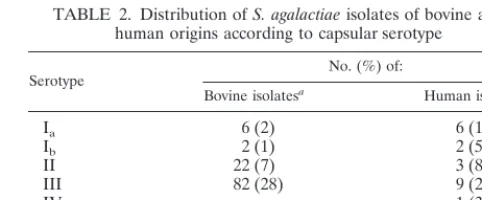
Serotyping.The double diffusion method was used to sero-type bovine isolates because most of them were autoaggluti-nable. However, nonagglutinable bovine isolates were analyzed by both methods with identical results (data not shown). Re-sults of serotyping for bovine and human isolates can be ob-served in Table 2. Sixty-two percent of bovine isolates were nontypeable. The remaining bovine isolates were found to belong to four different serotypes. Serotype III was the most prevalent, representing 28% of all bovine isolates. All six se-rotypes tested were identified among the 38 human isolates (Table 2). Only five human isolates were nontypeable and two autoagglutinated. Serotypes V and III were the most fre-quently identified serotypes, with prevalences of 26 and 24%, respectively.
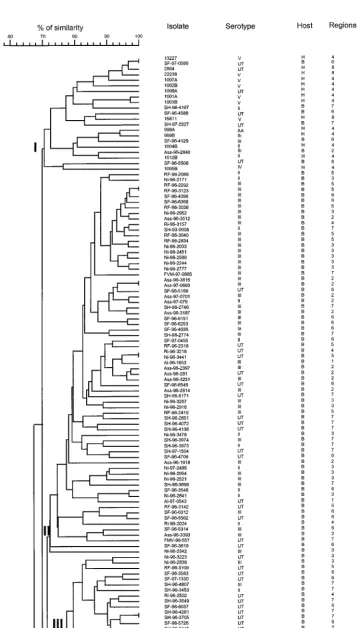
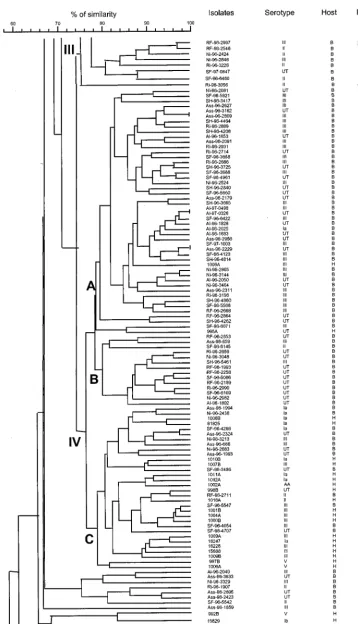
Genetic diversity as defined by RAPD fingerprinting. The genetic relationship among all RAPD patterns ofS. agalactiae
based on the combination of data obtained with the three primers is represented in the dendrogram shown in Fig. 2. Overall,S. agalactiaeisolates presented 58% similarity. A total of 94% of the isolates were clustered in four groups (I, II, III, and IV) with 70% similarity among them. Three clusters, A (48 isolates), B (14 isolates), and C (32 isolates), with 79 to 80% similarity, were identified within group IV. The other three groups did not present any clustering. The percent similarity of each group oscillated between 70 and 77%. The heterogeneity of the population was significantly increased by 14 nongrouped isolates.
Genetic variation in relation to serotype.The serotype dis-tribution for each RAPD pattern is indicated in Fig. 2. In addition, the relationship between serotype and RAPD group and/or cluster is also observed in Tables 3 and 4 for isolates of bovine and human origin, respectively. Half of serotype III and II isolates of bovine origin were in group II. Nontypeable bovine isolates were proportionally distributed in all groups (Table 3). All serotype Iaisolates and most serotype III isolates
recovered from humans were in cluster C. Most human isolates of serotype V were included in group I (Table 4). Clustering was not observed for other serotypes.
Genetic variation of isolates in relation to geographical dis-tribution.In general, clustering was not observed for bovine isolates originating from the same region, except for those from regions 1 and 2 (Fig. 2). In spite of the existing diversity, it was possible to find at least one pair of isolates sharing the same RAPD pattern in most of the regions.
[image:3.612.52.293.92.221.2]Genetic variation of isolates in relation to host origin. In general, clustering was observed in mostS. agalactiaeisolates
TABLE 1. List of primers tested by RAPD for study ofS. agalactiaefield isolates
Primera Sequence, 5⬘33⬘ % CG Bands (n) Patterns (n)
A4 GCATCAATCT 40 3–5 3
AP42 AACGCGCAAC 60 2–5 3
OPS11* AGTCGGGTGG 70 4–7 6
OPS16 AGGGGGTTCC 70 3 2
OPB04 GGACTGGAGT 60 1–4 4
OPB05 TGCGCCCTTC 70 ⱕ2 2
OPB06 TGCTCTGCCC 70 1–5 5
OPB07 GGTGACGCAG 70 2–5 7
OPB08 GTCCACACGG 70 1 1
OPB10 CTGCTGGGAC 70 2–4 4
OPB17* AGGGAACGAG 60 5–8 6
OPB18* CCACAGCAGT 60 5–8 8
aAsterisks indicate primers selected for the present study.
TABLE 2. Distribution ofS. agalactiaeisolates of bovine and human origins according to capsular serotype
Serotype No. (%) of:
Bovine isolatesa Human isolatesb
Ia 6 (2) 6 (16)
Ib 2 (1) 2 (5)
II 22 (7) 3 (8)
III 82 (28) 9 (24)
IV 1 (3)
V 10 (26)
NTc 183 (62) 7d(18)
aAs tested by double diffusion in an agarose gel test. bAs tested by the coagglutination test.
cNT, nontypeable.
dTwo strains were autoagglutinable.
VOL. 38, 2000 MOLECULAR EPIDEMIOLOGY OF S. AGALACTIAE ISOLATES 73
on May 15, 2020 by guest
http://jcm.asm.org/
[image:3.612.311.552.597.697.2]FIG. 2. Genetic relationship among 223S. agalactiaeisolates (of bovine and human origins) as estimated by clustering analysis of RAPD patterns obtained with three primers. The dendrogram was generated by the unweighted pair group method with arithmetic means. H, carrier woman; B, bovine milk; UT, untypeable; AA, autoagglutinable.
on May 15, 2020 by guest
http://jcm.asm.org/
FIG. 2—Continued.
VOL. 38, 2000 MOLECULAR EPIDEMIOLOGY OF S. AGALACTIAE ISOLATES 75
on May 15, 2020 by guest
http://jcm.asm.org/
of human origin (Fig. 2). Fifty percent of human isolates were placed in cluster C of group IV, and 37% belonged to group I. The human isolates were then analyzed separately to verify this apparently high homology. Figure 3 shows relatively high vari-ability among human isolates, since only 65% similarity was found. A principal group (group ii), in which approximately 79% of isolates clustered, and one minor group (group i) can be observed (Fig. 3). Two clusters, “a” (9 isolates) and “b” (21 isolates), with 80 to 82% similarity, were identified within group ii. The other group did not present any clear cluster. The percent similarity of each group oscillated between 76 and 77%. None of the human isolates shared identical RAPD pat-terns with the three primers. In addition, in the dendrogram illustrating the cluster analysis ofS. agalactiae isolated from asymptomatic women, most isolates of serotype V appeared in cluster “a” (Fig. 3). This confirmed results obtained with the general dendrogram that included the analysis of bovine and human isolates (Fig. 2).
Identical RAPD patterns (for the combination of the three primers) between human and bovine isolates were observed only in one case (Fig. 2). The isolate of human origin belonged to serotype V, whereas the isolate of bovine origin was non-typeable; both of them were placed in group I of the dendro-gram.
RAPD typing as an epidemiological tool.The discriminatory
capacity of the RAPD typing was determined in order to eval- uate the suitability of the primers chosen in this study for the epidemiological analysis ofS. agalactiaeisolated from milk. It was possible to define 215 RAPD types for the 223 isolates (index of discrimination [D]⫽0.9996) by combining data ob-tained with the three primers, whereas only seven serotypes for the 223 isolates (D⫽0.6908) were identified by serotyping.
DISCUSSION
Limited information was available on the epidemiology of CanadianS. agalactiaeisolates recovered from bovine milk. To our knowledge, few studies using DNA-based techniques have been carried out with a large collection of field isolates of bovine origin in North America. Previous studies onS. agalac-tiae isolates of human origin have suggested that RAPD is superior to serotyping for epidemiological evaluations of this pathogen (6, 24). In the present work, RAPD was used to study a large collection of bovine isolates from Canada. In general, high genetic diversity was found. A possible explanation for this diversity is that different isolates originated from different herds. Similar results were obtained by using other molecular techniques in Australia, Denmark, and the United States, even
[image:6.612.327.527.71.438.2]FIG. 3. Genetic relationship among 38S. agalactiaeisolates from asymptom-atic pregnant women as estimated by cluster analysis of RAPD patterns obtained with three primers. The dendrogram was generated by the unweighted pair group method with arithmetic means. UT, untypeable; AA, autoagglutinable. TABLE 3. Distribution ofS. agalactiaeisolates of bovine origin in
different RAPD groups and/or clusters according to capsular serotypea
Serotype no. ofTotal isolates
No. of isolates in the following
group and/or cluster: No. of nongrouped
isolates
I II III IV
A B C
Ia 6 2 1 3
Ib 2 1 1
II 22 1 11 6 1 1 2
III 82 1 40 4 28 2 4 3
NTb 73 4 16 15 17 11 5 5
aGroups and clusters are derived from a dendrogram generated withS.
aga-lactiaeisolates of human and bovine origins (Fig. 2).
[image:6.612.53.294.571.702.2]bNT, nontypeable.
TABLE 4. Distribution ofS. agalactiaeisolates of human origin in different RAPD groups and/or clusters according to
capsular serotypea
Serotypeb no. ofTotal
isolates
No. of isolates in the following
group and/or cluster: No. of nongrouped
isolates
I II III IV
A B C
Ia 6 6
Ib 2 1 1
II 3 2 1
III 9 1 8
IV 1 1
V 10 7 2 1
NT 5 2 1 1 1
AA 2 1 1
aGroups and clusters are derived from a dendrogram generated withS.
aga-lactiaeisolates of human and bovine origins (Fig. 2).
bNT, nontypeable; AA, autoagglutinable.
on May 15, 2020 by guest
http://jcm.asm.org/
though these studies were based on lower numbers of herds and field strains (1, 18, 29).
S. agalactiaecan be differentiated on the basis of distinct polysaccharide surface antigens. In this study, as in others (4, 11), most bovine isolates were nontypeable by polysaccharide antigens. Only 38% of isolates of bovine origin were typeable; serotype III was the most important. Previous studies showed a relative heterogeneity in the distribution of different sero-types of bovine isolates (4, 18, 26, 35). The importance of invasive serotype III strains is well known among human iso-lates (28), but the significance for bovine isoiso-lates is unknown yet.
In general, no evident correlation could be established be-tween serotyping and RAPD patterns. Before this study, data which combine genomic diversity and antigenic typing were not available for bovine isolates. Results showed genetic heteroge-neity not only among different serotypes but also among iso-lates belonging to same serotype. This suggests that the RAPD technique may be more accurate than capsular serotyping in differentiatingS. agalactiaeisolates from a bovine population. RAPD ofS. agalactiaeof bovine origin therefore appears to be of great value for epidemiological studies.
Clustering was not observed for bovine isolates originating from the same region, except for those from regions 1 and 2. This result is consistent with a previous report of Rivas et al. (29), who analyzedS. agalactiaeof bovine origin by automated ribotyping. They could not find one ribotype in all three re-gions delineated in New York State. In the present study, at least two isolates with an identical RAPD pattern were found in each region. This fact might suggest that, in some instances, there may be a common source ofS. agalactiae in different herds from the same region.
The serotype distribution ofS. agalactiae of human origin appears to have changed over time. Until recently, the pre-dominant serotypes that were detected among clinical isolates by the Centers for Disease Control and Prevention and other laboratories were Ia and III (3, 13, 14). A striking change,
however, occurred in the 1990s, when the percentage of sero-type V climbed from 2.6% in 1992 to 14% in 1993 and then to 20% in 1994 (12). The reasons for this increase are still un-clear. Interestingly, serotypes V and III were identified in the present study as the most frequent serotypes among isolates from carrier women, with prevalences of 26 and 24%, respec-tively.
Reports on the genetic diversity of S. agalactiae isolated from healthy women are controversial. Huet et al. concluded that the genetic polymorphism of isolates from carrier women, as evaluated by ribotyping, is relatively limited (14). However, this technique appears to have low discriminatory power when it is used alone for epidemiological studies ofS. agalactiae(14). On the other hand, Helmig et al. observed considerable het-erogeneity in a population ofS. agalactiaeisolates from asymp-tomatic women (13). In agreement with other studies (7, 33), data presented here indicate that isolates from asymptomatic women have a slightly closer relationship than isolates of bo-vine origin. In spite of some clustering of human isolates, relatively high diversity was seen among them.
In this study, only one pair of human (serotype V) and bovine (nontypeable) isolates showing the same RAPD pattern was found. This suggests the possibility of a common origin for both isolates. This is in agreement with the results of Jensen and Aarestrup, who detected identical ribotypes for isolates from milk and dairy workers (18). Despite the fact that a common source of human and bovine isolates is possible (18), results obtained in this work do not allow confirmation of this hypothesis. Isolates belonging to different serotypes but
indis-tinguishable by genetic analysis have already been described (2, 18). One possible explanation is the ability ofS. agalactiaeto regulate capsule expression in a phase shift-like manner (32). The ability to phase shift may be of particular interest inS. agalactiaemastitis, since bacterial adherence is an important factor in the pathogenesis of bovine mastitis, and the adhesion ofS. agalactiaeto epithelial cells seems to be inversely propor-tional to the degree of encapsulation (30).
The selection of primers is critical in maximizing the dis-criminatory power of RAPD typing. An index of discrimination (D) greater than 0.90 is necessary for interpreting typing re-sults with confidence (15). Two previous studies have reported genetic analysis ofS. agalactiae isolates of human origin by RAPD (6, 24). In one of those studies, a partially degenerated oligonucleotide with aDof 0.98 was used (24), whereas in the other, a combination of four primers with aD of 0.90 was obtained (6). Our data suggest that the RAPD typing gener-ated by the combination of OPS11, OPB17, and OPB18 prim-ers (D⫽0.9996) has increased the ability of the methodology to detect variability between isolates. Potential applications include identification of isolates that appear to have broad geographic distribution, suggesting interfarm transfer, and dis-crimination among recurrent versus new intramammary infec-tions. Such information may allow the establishment of control and eradication programs at the herd level. Furthermore, RAPD typing may be used to study the relationship between human and bovine infection.
ACKNOWLEDGMENTS
We thank the different provincial laboratories of Que´bec for pro-viding the isolates of bovine origin. We are also indebted to Philippe Jutras (Centre Hospitalier de Rimouski) and Monique Goyette (Hoˆ-pital Saint-Joseph, Trois-Rivie`res) for the group BStreptococcus iso-lates of human origin.
This work was supported by a grant from NSERC-RII (195831-96) and the Dairy Farmers of Canada.
REFERENCES
1.Baseggio, N., P. D. Mansell, J. W. Browning, and G. F. Browning.1997. Strain differentiation of isolates of streptococci from bovine mastitis by pulsed-field gel electrophoresis. Mol. Cell. Probes.11:349–354.
2.Bingen, E., E. Denamur, N. Lambert-Zechovsky, Y. Aujard, N. Brahimi, P. Geslin, and J. Elion.1992. Analysis of DNA restriction fragment length polymorphism extends the evidence for breast milk transmission in Strepto-coccus agalactiaelate-onset neonatal infection. J. Infect. Dis.165:569–573. 3.Blumberg, H. M., D. S. Stephens, C. Licitra, N. Pigott, R. Facklam, B.
Swaminathan, and I. K. Wachsmuth. 1992. Molecular epidemiology of group B streptococcal infections: use of restriction endonuclease analysis of chromosomal DNA and DNA restriction fragment length polymorphisms of ribosomal RNA genes (ribotyping). J. Infect. Dis.166:574–579.
4.Bopp, V., and C. Lammler.1995. Comparative studies on group-B strepto-cocci isolated from bovine milk samples in Thuringia and Hesse. Zentbl. Veterinarmed. B42:427–433.
5.Chatellier, S., H. Huet, S. Kenzi, A. Rosenau, P. Geslin, and R. Quentin.
1996. Genetic diversity of rRNA operons of unrelatedStreptococcus agalac-tiaestrains isolated from cerebrospinal fluid of neonates suffering from meningitis. J. Clin. Microbiol.34:2741–2747.
6.Chatellier, S., C. Ramanantsoa, P. Harriau, K. Rolland, A. Rosenau, and R. Quentin.1997. Characterization ofStreptococcus agalactiaestrains by ran-domly amplified polymorphic DNA analysis. J. Clin. Microbiol.35:2573– 2579.
7.Denning, D. W., C. J. Baker, N. J. Troup, and L. S. Tompkins.1989. Restriction endonuclease analysis of human and bovine group B streptococci for epidemiologic study. J. Clin. Microbiol.27:1352–1356.
8.Devriese, L. A.1991. Streptococcal ecovars associated with different animal species: epidemiological significance of serogroups and biotypes. J. Appl. Bacteriol.71:478–483.
9.Ellis, S., M. Kotiw, and S. M. Garland.1996. Restriction endonuclease analysis of group B streptococcal isolates from two distinct geographical regions. J. Hosp. Infect.33:279–287.
10. Fasola, E., C. Livdahl, and P. Ferrieri.1993. Molecular analysis of multiple isolates of the major serotypes of group B streptococci. J. Clin. Microbiol.
31:2616–2620.
VOL. 38, 2000 MOLECULAR EPIDEMIOLOGY OF S. AGALACTIAE ISOLATES 77
on May 15, 2020 by guest
http://jcm.asm.org/
11.Finch, L. A., and D. R. Martin.1984. Human and bovine group B strepto-cocci: two distinct populations. J. Appl. Bacteriol.57:273–278.
12. Harrison, L. H., D. M. Dwyer, and J. A. Johnson.1995. Emergence of serotype V group B streptococcal infection among infants and adults. J. In-fect. Dis.171:513.
13. Helmig, R., N. Uldbjerg, J. Boris, and M. Kilian.1993. Clonal analysis of Streptococcus agalactiaeisolated from infants with neonatal sepsis or men-ingitis and their mothers and from healthy pregnant women. J. Infect. Dis.
168:904–909.
14. Huet, H., C. Martin, P. Geslin, F. Grimont, and R. Quentin.1993. Ribotyp-ing ofStreptococcus agalactiaestrains isolated from vaginas of asymptomatic women. Res. Microbiol.144:457–465.
15. Hunter, P. R., and M. A. Gaston.1988. Numerical index of the discrimina-tory ability of typing systems: an application of Simpson’s index of diversity. J. Clin. Microbiol.26:2465–2466.
16. Janzen, J. J.1970. Economic losses resulting from mastitis. A review. J. Dairy Sci.53:1151–1161.
17. Jensen, N. E.1979. Production and evaluation of antisera for serological type determination of group B streptococci by double diffusion in agarose gel. Acta Pathol. Microbiol. Scand. Sect B.87:77–83.
18. Jensen, N. E., and F. M. Aarestrup.1996. Epidemiological aspects of group B streptococci of bovine and human origin. Epidemiol. Infect.117:417–422. 19. Keefe, G. P.1997.Streptococcus agalactiaemastitis: a review. Can. Vet. J.
38:429–437.
20. Keefe, G. P., I. R. Dohoo, and E. Spangler.1997. Herd prevalence and incidence ofStreptococcus agalactiaein the dairy industry of Prince Edward Island. J. Dairy Sci.80:464–470.
21. Kirkegaard, M. K., and C. R. Field.1977. Rapid slide coagglutination test for identifying and typing group B streptococci. J. Clin. Microbiol.6:266–270. 22. Lancefield, R. C.1934. Serologic differentiation of specific types of bovine
hemolytic streptococci (group B). J. Exp. Med.61:335–349.
23. Lerner, P., K. Gopalakrishna, E. Wolinsky, M. D. McHenry, J. S. Tan, and M. Rosenthal.1977. Group B streptococcus (S. agalactiae) bacteremia in adults: analysis of 32 cases and review of the literature. Medicine56:457–473. 24. Limansky, A. S., E. G. Sutich, M. C. Guardati, I. E. Toresani, and A. M. Viale.1998. Genomic diversity amongStreptococcus agalactiaeisolates
de-tected by a degenerate oligonucleotide-primed amplification assay. J. Infect. Dis.177:1308–1313.
25. Maslow, J. N., M. E. Mulligan, and R. D. Arbeit.1993. Molecular epidemi-ology: application of contemporary techniques to the typing of microorgan-isms. Clin. Infect. Dis.17:153–164.
26. Mosabi, J. M., S. M. Arimi, and E. K. Kang’ethe. 1997. Isolation and characterization of group B streptococci from human and bovine sources within and around Nairobi. Epidemiol. Infect.118:215–220.
27. Pitcher, D. G., N. A. Saunders, and R. J. Owen.1989. Rapid extraction of bacterial genomic DNA with guanidium thiocyanate. Lett. Appl. Microbiol.
8:151–156.
28. Quentin, R., H. Huet, F.-S. Wang, P. Geslin, A. Goudeau, and R. K. Se-lander.1995. Characterization ofStreptococcus agalactiaestrains by multilo-cus enzyme genotype and serotype: identification of multiple virulent clone families that cause invasive neonatal disease. J. Clin. Microbiol.33:2576– 2581.
29. Rivas, A. L., R. N. Gonzalez, M. Wiedmann, J. L. Bruce, E. M. Cole, G. J. Bennett, H. F. Schulte III, D. J. Wilson, H. O. Mohammed, and C. A. Batt.
1997. Diversity ofStreptococcus agalactiae andStaphylococcus aureus ri-botypes recovered from New York dairy herds. Am. J. Vet. Res.58:482–487. 30. Salasia, S. I. O., I. W. T. Wibawan, C. Lammler, and M. Sellin.1994. Phase
variation in streptococci of serological group B. APMIS102:925–930. 31. Sargeant, J. M., H. Morgan Scott, K. E. Leslie, M. J. Ireland, and A. Bashiri.
1998. Clinical mastitis in dairy cattle in Ontario: frequency of occurrence and bacteriological isolates. Can. Vet. J.39:33–38.
32. Sellin, M., M. Linderholm, M. Norgren, and S. Hakansson.1992. Endocar-ditis caused by a group B streptococcus strain, type III, in a nonencapsulated phase. J. Clin. Microbiol.30:2471–2473.
33. Wanger, A. R., and G. M. Dunny.1985. Development of a system for genetic and molecular analysis ofStreptococcus agalactiae. Res. Vet. Sci.38:202–208. 34. Welsh, J., and M. McClelland.1990. Fingerprinting genomes using PCR
with arbitrary primers. Nucleic Acids Res.18:7213–7218.
35. Wibawan, I. W. T., and C. Lammler.1990. Properties of group B streptococci with protein surface antigens X and R. J. Clin. Microbiol.28:2834–2836. 36. Williams, J. G. K., A. R. Kubelik, K. J. Livak, J. A. Rafalski, and S. V.
Tingey.1990. DNA polymorphisms amplified by arbitrary primers are useful as genetic markers. Nucleic Acids Res.18:6531–6535.