Anthropology Theses Department of Anthropology
8-11-2015
Eating at the Desk: Human Encounters with
Workplace Food
Chinelo Arinze
Follow this and additional works at:https://scholarworks.gsu.edu/anthro_theses
This Thesis is brought to you for free and open access by the Department of Anthropology at ScholarWorks @ Georgia State University. It has been accepted for inclusion in Anthropology Theses by an authorized administrator of ScholarWorks @ Georgia State University. For more information, please [email protected].
Recommended Citation
EATING AT THE DESK:
HUMAN ENCOUNTERS WITH WORKPLACE FOOD
by
CHINELO ARINZE
Under the Direction of Jennifer Patico, PhD
ABSTRACT
This manuscript is an analysis of human encounters with workplace food. The analysis
draws on an ethnographic field project in a Downtown Atlanta, Georgia business office to
illustrate that project participants operated food to facilitate specific social processes of agency,
affect, cultural movement, participation, and exclusion. Commensality at the project site was a
common thread for each social process. I demonstrate that project participants’ experiences with
food intersect rapid workplace changes. In presenting workplace food in the function of a
cultural lens as a focus of anthropological inquiry, the analysis argues the importance of
workplace as a cultural context for understanding human engagement with food. I argue that
workplace is an important cultural site because of the intense time and involvement that many
have with it. Implications for workplace food include commercial and organizational
management uses.
EATING AT THE DESK:
HUMAN ENCOUNTERS WITH WORKPLACE FOOD
by
CHINELO ARINZE
A Thesis Submitted in Partial Fulfillment of the Requirements for the Degree of
Master of Science
in the College of Arts and Sciences
Georgia State University
Copyright by Chinelo Elizabeth Arinze
EATING AT THE DESK:
HUMAN ENCOUNTERS WITH WORKPLACE FOOD
by
CHINELO ARINZE
Committee Chair: Jennifer Patico
Committee: Kathryn Kozaitis
Emanuela Guano
Electronic Version Approved:
Office of Graduate Studies
College of Arts and Sciences
Georgia State University
ACKNOWLEDGEMENTS
I’m grateful to be associated with an enterprise that increasingly offers opportunity for
critical reflection and thought about industrial cultures. I would like to acknowledge the advice,
support, and helpful comments from my thesis committee members: Dr. Patico, Dr. Kozaitis, and
Dr. Guano. This manuscript has benefited immensely from the critical and generous readings of
Dr. Patico, who served as my thesis advisor. She approached her review and feedback for the
manuscript with poise as I wrestled with a restricted schedule which made various stages of
writing this manuscript demanding, but gratifying. I am particularly thankful to Dr. Papavasiliou
for exhibiting passion for anthropology for it is her enthusiasm that served as a persuasive force
for me to apply to the Georgia State University graduate anthropology program. I would also
like to acknowledge community psychologist and former student of the Georgia State University
graduate psychology program, Dr. Dulamdary, who, when I was at a crossroad of deciding
whether to pursue social-community psychology or cultural anthropology, was instrumental in
my decision to pursue a path of cultural anthropology. Finally, I am most grateful to the
participation and cooperation from my informants who participated willingly in my study and
TABLE OF CONTENTS
ACKNOWLEDGEMENTS ... iv
LIST OF FIGURES ... vii
1 INTRODUCTION ... 1
1.1 Research Background ... 1
1.2 Summary of Thesis Chapters ... 4
1.3 Food Exchanges: Perspectives in Food Anthropology ... 5
1.3.1 Food, Identity, and Cultural Preservation ... 6
1.3.2 Gauging Cultural Movement ... 8
1.3.3 Political Economy and State Power ... 10
1.4 Methodology ... 13
1.4.1 Participant Observation ... 13
1.4.2 In-depth Interviews ... 14
1.4.3 Content Analysis ... 16
1.4.4 The Research Site ... 16
1.5 Reflexivity ... 17
1.6 Limitations ... 20
2 ENCOUNTERING FOOD IN THE WORKPLACE ETHNOGRAPHY ... 21
2.1 The Field Site Context: Workplace Change ... 21
2.1.2 Beyond Food ... 35
2.1.3 Gauging Change ... 42
2.1.4 Food as Participation ... 44
2.1.5 Food as Exclusion and Difference ... 47
3 CONCLUSION: TOWARD PRACTICAL USES FOR FOOD ANTHROPOLOGY RESEARCH ... 58
3.1 Organization Management ... 60
3.2 Business Strategy Management ... 63
LIST OF FIGURES
Figure 2.2 Collage of Office Food Celebrations ... 21
Figure 2.3 Interoffice Email Correspondence ... 32
1 INTRODUCTION
1.1 Research Background
Food is a cultural element that occupies many exchanges and activities of the everyday.
Cultural exchanges and insights about food derive not only from ordinary human transactions of
the everyday, but through a spectrum of discourse over many areas of critical focus. Food is
commonly granted serious philosophical discussion (Kaplan 2012). Cultural psychologists
employ food to explain human social evolution (Schaller et al. 2010). Furthermore, food
discourses echo in feminist scholarship; feminist studies have paid particular attention to the
role of food in capitalism and women’s oppression. Prominently, feminist scholars have
situated food as an instrument of patriarchy and capitalism (Avakian and Haber 2005). The
cultural importance of food is also pinpointed in food geography which examines the cultural
places of food and ways of food consumption (Feagan 2007).
In anthropology, food is frequently used for critical evaluation of cultural patterns and
cultural developments. For example, Carole Counihan (1992) analyzed the way that food is
used to mediate and read cultural norms. For Counihan, food is essential in facilitating
processes of genderization within Western societies. Moreover, anthropologists have employed
food to study historical cultural accounts (Levi-Strauss 1966; Mintz 1985). Levi-Strauss
evaluated that the meanings associated with methods of food preparation in some cultures
served as a form of communication within some societies (Levi-Strauss 1966). Mintz (1985)
used food to pinpoint the genealogy of British mercantile success. The existing work in food
anthropology opens a wide area of potential for greater anthropological attention to the role that
food plays in cultural processes. In this light, it is practical to conduct anthropological
of culture because of the extensive time that many people spend there, is a compelling context
for investigation about food. This analysis contributes to a growing area of anthropological
focus on food by developing a critical interpretation of how people encounter and make sense of
workplace food. I argue that workplace food can serve as a social instrument to facilitate
specific social processes within the workplace.
Notwithstanding the important cultural and political examinations that derive from food
dialogues, food remains a subject of conversation that is operated by the ordinary. People talk
about food in their homes; people discuss food in formal and informal social circumstances such
as celebrations, ceremonies, and work; and significantly, people conduct communication about
food in censored settings such as exchange in an institutional establishment. Food is frequently
the focus of television shows, books, blogs, journalism -- even this manuscript rests on the
subject of food. Our world economic and social systems revolve around food and, in the most
granular sense we not only interact daily with conversations about food, but we are produced
and sustained by food. Food is an important focus of cultural inquiry not only because of its
functional attributes, but food is important because of its social and political implications. In
some form, food is connected to the function of every natural life force known to humans.
Consequently, food offers strong propositions for power and ultimately human survival.
Pinpointing food’s cultural role in society might offer insight about the human experience.
Although cultural food studies are numerous, examining food from the cultural context of
workplace has received little attention. Yet, because the workplace occupies a significant
cultural role for many societies, it is imperative to understand how the workplace may shed light
about how human encounters with food connect with much broader social conditions. The
The social interactions and the essence of survival that the workplace provides for many is
another factor in the cultural importance of workplace.
In this study, I explore study participant’s encounters with workplace food and the
essence of such encounters in order to connect workplace food with broader social implications.
The aim of the study is to use ethnographic information to understand the experiences that study
participants have with workplace food at the project site. My fieldwork findings are informed
by concepts in food anthropology literature in order to link existing theoretical concepts with
information which developed from my research. To solidify some of the findings that resulted
in this project, the investigation is also informed by a pilot study that was conducted at the
research site prior to the commencement of the study. The research for this project was
conducted in an Atlanta, Georgia business office. The participants at the project site embraced
social encounters through food in order to adapt to a changing workplace under pressures of
urban conditions. In the framework of urban conditions, the project site experienced rapid
structural changes that were aligned with neoliberal practices. Neoliberal practices dictate
creative destruction and the production of technocratic space in the pursuit of maximizing the
rate and scope of market transactions and value (Harvey 2005; also see Brenner and Theodore
2005). The selected Atlanta business office field location for this project was a company that
experienced commercial takeover by a multinational organization. The takeover organization
reflected a model of neoliberal traditions through aggressive company rescaling following
business takeover, outsourcing, employment of unimaginative business and social policies, and
a profound focus on technology development in order to expand profits. Workplace
commensality was vital in the response and adaptation to changing workplace conditions by
which facilitated specific social processes and that which helped create a sense of place for
workers. This thesis looks at participants’ encounters with workplace food in order to
illuminate how participants experience workplace food in a setting of rapid change.
The conceptual development for how participants encountered workplace food is
organized through such themes of agency, affect mediated by organization management,
change, participation, and exclusion. Specifically, I located workplace food as something that
participants used to organize and sustain social tradition at work. Particularly, participants
planned commensality activities in order to resist the descent of company produced occasions of
shared eating. Organization management at the field location paid particular attention to the role
of affect that food played for employee morale. Consequently, in the wake of rapid workplace
change, organization management used food to induce a harmonious and productive work
atmosphere. Social changes at the project site were an outcome that could be read through
specific developments in office food occasions. Specifically, dwindling attendance of office
food occasions revealed the trajectory of social tradition for the office. Participants achieved
social participation through workplace commensality activities. Alternatively, commensality
became an experience of exclusion for some participants.
1.2 Summary of Thesis Chapters
The discussions for this manuscript are presented through two chapters following the
project overview and discussion of food anthropology perspectives provided in chapter 1. To
this end, the remainder of the manuscript will explore existing concepts in food anthropology,
engage ethnographic data to illustrate how empirical information is reflected in the themes
developed through this project, and consider the broad impact of qualitative workplace food
Chapter 2 ties together empirical evidence with critical concepts and theories explored in
Chapter 1 and provides an ethnographical account of information collected in the study. Here, I
draw on my fieldwork to explore ethnography about how people encounter workplace food.
Multiple theoretical concepts emanate through my investigation, which I expound upon in this
chapter. Finally, chapter 3 delivers an argument about applied uses of the research collected
through this project. This work shows how anthropological investigation about food might
offer practical solutions for multiple applications.
1.3 Food Exchanges: Perspectives in Food Anthropology
In this discussion, I outline how the cultural role of food is evaluated within existing
anthropological scholarship. Preceding anthropological food studies have focused on the
cultural symbolism and cultural readings that derive from food, yet I seek to highlight how
cultural readings from food can illuminate social conditions in the context of workplace.
Foodways reliably change over time and space as society changes. Necessarily, our
understanding of how humans engage with food in society must advance in order for
scholarship to extract knowledge about how food connects with broader political themes and
patterns of society. Recurrent dialogue and inquiry about human engagement with food is
necessary to stimulate development of knowledge about the social implications of food.
Anthropologists have focused on understanding human interaction with food over various social
contexts. Nonetheless, there has been little focus on the workplace as a setting for
anthropological investigation about human engagement with food. Because workplace is a
cultural pinnacle in many societies as many human social activities unfold at work, workplace
represents a significant cultural site for studying human engagement with food. However, more
aspects of food such as food as identity, food as cultural preservation, food as a gauge for
societal issues, and food as power. Among some of the prolific investigations in food
anthropology are the works of R.S. Khare, Anna Meigs, Joan Brumberg, Marvalene Hughes,
David Beriss, William Roseberry, Anne Allison, Stephen Mennell, Sidney Mintz, and Carole
Counihan. In order to build on the current literature in food anthropology, I engage such works
to support themes that emerge in my investigation of workplace food.
1.3.1 Food, Identity, and Cultural Preservation
Food is not merely a functional material. It is the fabric of human social condition. This
aspect makes food vital cultural material and an important component in the creation and
preservation of culture. In R.S. Khare’s (1992) investigation of the meanings of food in Hindu
society, food is identified as a pillar for which Hindu ideology and practice is established. As
Khare suggests, food is connected to the formation of a Hindu’s inner being. Khare posits that
the essence of Hindu culture is sorted out through Hindu food norms. Khare’s argument is a
practical means to recognize how food both constructs and preserves culture. Again, food’s role
in constructing culture emerges in the ethnographic account of the Hua people of the Eastern
Highlands of Papua New Guinea by Anna Meigs (1987). Meigs theorizes that food is a vital
component in the construction of culture. She argues that food constitutes important meaning
and drives the development of identity among the Hua people. Meigs’ goal is to demonstrate
that food is tied to the identity of a people and thus the construction of Hua culture.
Food framed as identity is important for understanding how food facilitates cultural
preservation. Food is a vehicle for social reproduction and subsequently a way to make
connections to the past. Hughes (1997) recognized how food facilitates cultural preservation.
distributed from Africa to the United States for colonial slave trade - a way to maintain ties to
their heritage. Hughes also revealed that, for these dislocated groups, food represented a coping
method and a strategy for sustaining identity. Again the importance of food in preserving
cultural identity is cultivated by David Beriss (2012). In his account of conditions in New
Orleans following Hurricane Katrina, Berriss ascribed red beans as an emblem of heritage for
New Orleans. He noted that the symbolic meaning of “red beans” helped New Orleans
recognize its cultural distinction from other cities within the United States and became a way
for the city to express an identity connected to the heritage of cuisine (Berriss 2012).
Prominently, Berriss pointed out that through the heritage of red beans cuisine, New Orleans
grounded its membership as a significant place in US society. These anthropological analyses
about food construct useful insights about how food facilitates and sustains culture. However,
my research develops this analytical construction further by considering how workplace food
might play a role in workplace identities and cultural preservation in the workplace.
Human capability to preserve culture through food is a method for human resistance
against cultural identity loss. Resistance against cultural identity loss through food models a
form of agency. Chiefly, resistance allows passive empowerment and an effective way for
people to preserve social traditions and sustain cultural identities. A prominent account of the
use of food as resistance against cultural identity loss is illustrated via Sidney Mintz’s (1996)
analysis of power in Caribbean slavery societies. Mintz reveals that those enslaved in the
Caribbean incorporated pieces of their cultural identity into ways of preparing food. Mintz
recounts that although the enslaved found new ways to bear conditions of transition from
freedom to enslavement, they maintained distinct styles of food preparation which became a
classes in the Caribbean achieved through their distinctive foodways presents food as agency.
The work of urban geographer Colin Mcfarlane provides support that inanimate objects such as
food may be employed by humans to exercise agency. Mcfarlane (2011) challenges scholars to
rethink forms of agency and resistance. Fundamentally, Mcfarlane’s insights about inanimate
forms of agency are grounded in his findings about the use of “quasi-objects”, such as public
phones, wires, and stones, by informal settlement dwellers in Mumbia, India to incite resistance
against government demolition projects. Given this focus, food can be interchanged with
agency. In my investigation of human encounters with workplace food, participants used food
to preserve cultural traditions and to sustain workplace’s identity that was grounded in the
meaning of office traditions and which frequently meant camaraderie to participants. Food was
key in permitting participants to realize a form of agency in order to resist loss of cultural
customs and identity.
1.3.2 Gauging Cultural Movement
More generally, food anthropology studies have taken a look at how the essence of
culture can be parsed through food. In particular, food offers explanations about social
phenomena and specific cultural conditions. For example, Joan Brumberg (1997) mapped food
practices to specific cultural contexts to emphasize how food can be used to understand social
issues. Brumberg reasoned that anorexia nervosa is socially rooted in food practices of the
Victorian era and subsequent societal imaginations of femininity such that young woman and
girls, particularly of Western middle class societies, find a way to express societal visions of
feminine identity through restriction of food. Brumberg fastens her argument to the concept
that food can offer a lens for cultural movements. Similarly, William Roseberry (1996)
ambition to restore demand for coffee, following gross coffee demand slumps in the 1980s,
corresponded with coffee marketers’ tactics to instigate a coffee consumption movement by
tying coffee to the imagined identity for targeted consumer bases of coffee. Roseberry argued
that coffee marketers’ ability to successfully situate coffee into the identities of targeted
consumer bases provides a foundation for cultural patterns that originated via the coffee
consumption movement. Roseberry likened his analysis to Sidney Mintz’s (1985) analysis of
sugar in to convey that changes in coffee consumption patterns in the United States signaled a
much larger shift in culture.
The magnitude of reading culture through food is visible through Carole Counihan’s
(1984) study of change in social relationships in Bosa, Italy following the introduction of bread
production technology and market economies. Counihan argued that in Bosa, Italy, where
social ties were once established around the communal production system of bread, the
introduction of market exchange systems in Bosa, diminished the social system established
around bread cultivation and in turn, initiated individualism in Bosa. Counihan described how
the trickle-down effects of market power were revealed in Bosan culture, namely supply and
demand. Specifically, where wheat cultivation and bread making practices once required shared
activities and dependence on others, collective activities were no longer necessary once bread
became available through a market exchange sphere such as a bakery. The introduction of
bakeries forced the reduction of demand for bread making at home for Bosans and ultimately a
reduction of collective activities for bread making (Counihan 1984). Counihan’s readings into
culture through food serve as a gauge for how the path of culture in Bosa might be interpreted.
Given this form of analysis that can be attained through food, I reason that food can provide a
direct food practices provide insight about relational shifts, but indirect food practices including
changes in celebration of food and communication about food provide a way to evaluate
structural and relational shifts in the workplace. The cultural shifts at the project site for this
study could be read through the fallen attendance numbers at office food occasions. Namely,
Birthday Wednesday food celebrations at the site provided a marker of rescaled staff size and a
signal that receding cultural traditions were to follow in light of the large absence of employees
who would not be present at the office site to practice and reproduce old office traditions.
1.3.3 Political Economy and State Power
Mintz’s (1985) analysis of sugar provides an even clearer picture of how food delegates
insight about societal issues. Key to Mintz’s argument about sugar is his concern with how
increased consumption of sugar relates to power in the English state. Mintz demarcates that the
increased use of sugar in English society meant the ascension of power for the English state.
Particularly, sugar brought a mechanism for social status in English society and grew in demand
among the working class who used sugar to attain social capital and physical energy. Sugar was
a guiding force for restructuring of labor systems and culture for working classes in English
society (Mintz 1985). The changes in English society that were instigated by increased sugar
consumption led to dependency on sugar by working classes and the subsequent growth of
power for the English state which included the expansion of its colonies and its presence in the
transatlantic slave trade (Mintz 1985).
Evaluating the use of food in political agendas and social order is an important focus of
food anthropology. State institutions prescribe social order through food in specific ways.
Anne Allison (1996) captures the ways that food reflects state institutional power in the
symbolized in the ritual of obento preparation and consumption. The practice of obento, a
systematic and detail approach to lunch preparation by Japanese mothers for nursery children in
Japan, involves intricately designed lunch meals and an enforced consumption of the entire
lunch meal for nursery children (Allison 1996). Allison makes the case that obento convention
is more than just lunch making. It represents Japanese state power cloaked in ideology that
guides the obento practice. Allison illustrates that the practice of obento is colored by an
elective notion (of an optional practice), yet she distinguishes the elective notion of obento
practice from hidden social obligations that obento infers. In this manner, Allison illuminates
that the practice of obento is an obligation that involves a detailed system of codes which
communicate aspects of Japanese culture. Allison cites that Japanese mothers’ commitment to
the elaborate ritual of obento preparation unveils the hidden cultural obligation of the practice
and a symbolic channel for which the Japanese state makes its way into the early indoctrination
of children. Through this notion, Allison perceives the obento practice as a cultural training
process. As Allison pinpoints, cultural training through the practice of obento commences with
cultural expectations, norms, and gendering that Japanese mothers reproduce through their
commitment to the obento practice. This serves as an example for children to model through
their commitment to eat the obento in its entirety (Allison 1996). In this analysis, Allison offers
a useful illustration of how food can be an effective political power to shape social order.
Equally demonstrative of how state power is exhibited through food is Stephen
Mennell’s (1987) analysis on civilizing processes of the appetite. Mennell’s ideas on civilizing
the appetite are influenced by Max Weber’s theories about rationalization. Mennell attributes
civilizing of the appetite to processes that rationalize specific food tastes. Such civilizing
serve state power agendas (Menell 1987). Appetite, Menell argued, is distinguished from
hunger; hunger is an influence of necessity and appetite is a result of tastes, which derives from
cultural influences (Mennell 1987). Mennell reasoned that tastes coincide with social pressures
stemming from social codes for ways of imagining the body, ways of realizing an ideal body,
and ways of functioning in a specific class (Mennell 1987). In this framework, Pierre
Bourdieu’s (1984) theory of habitus can help explain tastes in the civilizing process. Tastes are
cultural productions that become a means for social distinction and status (Bourdieu 1984). In
the course of cultural production, cultural producers inevitably interpret socially constructed
tastes as immanent and natural; hence, the impulse for reproduction (Bourdieu 1984). In this
manner, appetite, through taste conforms to the notion of habitus. Mennell’s goal is to
communicate that appetites are the result of habitus, a construction indirectly employed by
political powers to establish social order. My research reveals that organization management at
the field site exploits food in order to produce social order among employees. Organization
management produced food occasions for office workers in order to produce a positive social
and productive work environment and ultimately worker morale. I argue that organization
management attempted to achieve morale among workers through the affective utility that food
delivers. Richard and Rudnyckyi (2009) offer an analytical framework, economies of scale, to
illuminate how affect is an effective way to manage conduct and social conditions. Affect, they
argue, is the practice of power that permits conduct to be influenced and behavioral outcomes to
be conditioned. Organization management at the project site attempted to employ food
1.4 Methodology
The research question that guided my research is “how do people experience workplace
food and how do people make sense of such experiences”? I addressed this inquiry by
exploring people’s encounters with workplace.
The specific qualitative research methods that were employed for this study are
participant observation, in-depth interview, and content analysis. Each qualitative method
employed for this study offered specific advantages for the project. Participant observation
ensured that I was able to experience conditions at the workplace site firsthand in order to
circumvent superficial interpretations of events at the research site. Data that I collected from
in-depth interviews supplemented my observations by providing research participants an
opportunity to explain social rituals and behaviors that I observed during participation in events
at the research site. Finally, content analysis allowed ethnographic information to be interpreted
from documents, objects, and public mediums within the research setting.
1.4.1 Participant Observation
My role as employee at the research site provided me an insider status at the research
site. An insider status for me permitted ease of observation and an enhanced data collection
process for the study by the advantages of familiarity and acceptance that were established
between employees and me at the research site before the study began. Through the daily
activities as an employee at the site, I conducted intensive observations through daily
encounters with staff as well as company sponsored staff social events. Daily encounters with
staff included communication with office members about job tasks, project collaborations, and
regular camaraderie and exchanges with staff members. Company sponsored social events
participant observations were limited to the research location where the study was conducted.
To record data collected during observations, I employed an electronic journal to record notes.
Journal entries included notes and specific dates of notable events. Notable events ranged from
planned events to unplanned events such as collaborative activities or conversations that yielded
important information about people’s expressions, remarks, reactions, and interactions about
food or that may have provided contextual information about the research environment.
The organization leadership at the research site approved the research for my project. In
order to facilitate observations at the research site, I developed a protocol for conducting
observation. The protocol that I developed was an informational letter for workers at the site to
announce the research activities for the study. This letter outlined observation data collection
methods that were employed at the research site during the study as well as instructions for
opting-out. Employees were given the choice to opt-out of being included in analysis of
observations. There were no employees at the site who opted-out of the study.
1.4.2 In-depth Interviews
In-depth interviews for my project were conducted via open-ended, informal
conversation. In order to circumvent potential dilemmas associated with representation, I
interviewed eight informants at the research site– that represented a range of male/female,
administrators/non-administrators, and various racial groups. I decided that a total of eight
informants were suitable for providing a balanced scope of informant feedback for this project
in light of the relatively modest office staff size at the research site. I recruited a total of 12
informants for the study. Yet, I achieved interview with eight informants. Although initially
planned, group discussions for the study were cancelled in light of scheduling constraints for
In-depth interviewing for the study was open to all employees at the research site.
Informants were recruited by oral invitation only. I identified informants through contacts that
I established through repeat encounters with workers at the research site and by those who were
within access at the research site. “Within Access" refers to employees at the research site that I
made contact with without realizing a significant deviation from work activities or loss of
productivity (for either the employee or myself). A significant deviation from work activities
implies engaging in non- work activities for several minutes while in the workplace and not on
authorized break. The individuals that I invited to participate in the study were not limited to
those that I interacted with daily within the workplace; however, in the interest of viability,
recruitment was targeted to those that were “within access” and those for whom I established a
rapport with. To avoid coercion of informant participation in interviews, invited informants
were provided a consent form. Each informant was invited to participate in interview no more
than twice; yet informants were permitted to voluntarily participate in more than two interviews.
I held not more than two interviews with a single informant. Interviews took place at a public
location including café, restaurant, and workplace break room. A public space was selected to
conduct interviews because it presented a neutral place for both the informant and me, and
prevented either party from being placed in an environment that may have created discomfort,
which otherwise may have occurred from meeting in a personal space.
Interviews were conducted over a conversation period of 30 – 45 minutes. Voice
recorders were used to record conversations from in-depth interviews. Recordings from
interviews were transcribed. Transcriptions of interviews were used to build themes and
The real identities of each participant and informant in the study have been concealed.
A pseudonym is employed to replace the names of each informant in this study.
1.4.3 Content Analysis
Content analysis is the final qualitative method that was used for this study. Content
analysis offered the opportunity for interpretation of inanimate objects such as documents, texts,
and visual mediums (such as photos). In my examination, representational messages were
reflected through email and other electronic sources of communication and provided important
ethnographic information. I drew interpretation of content from examination of particular
communication at the field site such as company interoffice email and wiki postings by cultural
actors at the research site. Specifically, I examined these forms of content with a specific focus
on how language was framed. Photos were taken for this study however, in light of
confidentiality terms for this study, photos were modified to obscure and exclude human
identities.
1.4.4 The Research Site
The research site selection for this study was determined based on feasibility.
Particularly, the research site for this study was identified as viable due to my familiarity with
the setting and the multiple social ties that I established at the research site over an extended
period of time before commencement of the study – as a result of my role as employee. This
relationship to the research site presented me an insider status and facilitated acceptance and
participation with staff members at the research site. In addition, through my social
involvement at the research site, I recognized the vast opportunity to collect rich cultural data
specific to food as a result of the numerous activities and events that featured food at the
present and immersed in the research environment. This allowed me to avoid participation
constraints that otherwise may have emerged in a non-insider access environment.
1.5 Reflexivity
My dual role as researcher and participant observer is a rational reason for me to reflect
on the impact of my position in this study. As an employee at the research site, I was an insider
and subsequently able to bypass resistance that an outsider may have encountered. Because I
was an insider at the research site, I looked at circumstances in the research setting with an emic
view. Despite having an insider status, at the onset of my project proposal, I was apprehensive
about obtaining approval to conduct the study at the research site from organization
management who might have seen my research as a conflict of obligation. However, this
concern was overcome by the organization’s approval for me to conduct study at the research
site. Specifically, my boss granted approval for the project under the condition that the
investigation did not detract from the productivity of employees at the office site. A great
concern of mine at the start of the study was whether I would attain the study minimum of
interview informants. This concern stemmed from my awareness of calendars that remained
full and inundated with activities. I was majorly concerned about the potential imposition that
my research activities may have imposed on the schedule of individuals that already
experienced limited time. However, I defeated this concern by recruiting a larger number of
informants than the number of informants that I actually intended to interview. Over
recruitment was done as a result of my anticipation of participant dropout by some study
informants. I reason that this allowed me to attain the study number objective of eight interview
What attracted me to organize this study is my interest in the many ways that people
engage with food. Through my critical observations of society, I reason that human
engagement with food has many social implications. My attention for this project is a product of
my own lived experience, which involves encounters with food as difference. Particularly, my
childhood involved my practice of a vegan diet which resulted from my childhood family’s
lifestyle. This created a significant source of social dissimilarity for me as a child and an adult
in many cultural settings. Through my encounters with food, I recognize food as a critical
factor in social acceptance or rejection. Consequently, I conceive food as something that is
political. For example, my experience with workplace food as difference was a source of social
exclusion for me at work. This difference ultimately resulted in marginalization of my food
consumption practices in the workplace. Particularly, many of my food choices were relegated
by my colleagues as undesirable for workplace eating and largely unaccepted as ideal for
workplace commensality. This factor excluded me from participation in many food gatherings
at work. In the light of the political nature of food, I thought it would be consequential to delve
into a structured analysis of understanding the social processes of food in a contained cultural
setting such as workplace. I considered it meaningful to use workplace as a setting to conduct
such an analysis because I have spent most of my awaken hours as an adult in the workplace,
and naturally, I identify with the significance that workplace may represent in the lives of many
people. This position allowed me to approach my research with a sensitized idea of what I
intended to investigate and to remain open to new concepts. Approaching my research with a
socially sensitized concept permitted me to obtain direction of a general idea of what to study
while considering the opportunity for new information in the field (Puddephatt et al., 2009 ;Van
according to information that I collected over the course of the study. I found that some of the
ideas that I initially grasped about people’s encounters with food in the workplace did not
provide a rich source of data or were not attainable to investigate for the scope of this project.
Examples of such initial concepts include information sharing, affect, competition, and
criticism. While these ideas did emerge during the study, they did not evolve to become the
focus of my analysis.
Finally, my status as an employee at the research site provided a strength and a
weakness. Specifically, my role as employee made those who I interacted with comfortable
talking with me. In an extreme sense, I suspect many at the research site forgot that I was a
researcher. This ensured natural interactions between employees and me. Conversely, during
interviews I discovered some instances of response from informants which I perceived were
motivated by informants’ impressions of what was a fashionable response or socially desirable.
This is noted as social desirability bias in social science research. Social desirability bias is an
inclination for respondents to answer questions in a way that will appeal favorably to others.
Social desirability can pose a weakness for data quality. I do not take a committal position
about whether my relationship as a colleague to informants prompted socially desirable
responses as such responses could have been produced by a general desire of informants to
create a positive self-image. Nonetheless, to work around this weakness in my investigation, I
established open-ended questions that were designed to exhaust responses by informants. For
example, when informants submitted responses that described their feelings or thoughts, I
followed such responses with questions such as “why do you feel this way?”, “what does this
1.6 Limitations
Over the course of the project I encountered informant scheduling constraints.
Specific constraints involved informants’ unavailability to commit to interview scheduling due
to calendar conflicts. I mitigated these limitations by offering flexible scheduling that
encompassed both weekday and weekend scheduling. I also over recruited because I
anticipated that some informants might not be able to maintain interview commitments. This
provided a safeguard for my interview number objective. Other constraints relate to study
period timeframe. This study was executed over a period of six months in light of the amount
of time allotted between the approval date for the study - August 2014- and development of the
thesis analysis for the study. This was initially a concern in light of the quality of data that I
thought might be omitted from the study in the face of such a short study period. Despite this
limitation, I drew from experience that I attained at the research site before the commencement
2 ENCOUNTERING FOOD IN THE WORKPLACE ETHNOGRAPHY
Figure 2.1 Collage of Office Food Celebrations
In this chapter I illustrate how workplace food was operated to facilitate social processes
at the project site. The ethnographic material from my research is examined to demonstrate
how the overarching themes from the project connect with empirical information.
2.1 The Field Site Context: Workplace Change
In the Omni Dome district of Downtown Atlanta- Georgia, the Atlanta business office is
situated in an office building that comprises 36 floors. Business for the Atlanta business office
site is conducted from two office space floors within the building, the 35th and 36th floors. The
business intelligence data products to hospitality segments: hotel, car, and air. The
organization, although headquartered in New York, New York, USA, had either presence on the
ground or virtual presence in six continents in 2014. In 2014, the organization sustained a
competitive advantage in its market primarily because its product offerings were not matched
by any of its competitors. This business aspect provided the company a unique competitive
position. In addition to the company’s competitive advantage, the company generated value
organically and inorganically. The company attained organic growth by increased business
volume such as an uptick in product sales. Alternatively, the company accomplished inorganic
growth through acquisitions such as the purchase of small profitable companies. The Atlanta
business office site is a reflection of this acquisition process. In 2010, the business office site in
Atlanta was acquired and absorbed by the global company that it belonged to in 2014. The
acquisition marked a major intersection of polarized cultures. The pre-acquisition Atlanta
business site was the face of neo-enterprise, innovation, and liberal culture.
The pre-acquisition Atlanta office site was certainly the epitome of new enterprise
culture in a fashionable sense. One emblem of such culture was a Ping-Pong table planted in a
break area of the office where employees could freely play Pong with one another.
Ping-Pong in office break-out spaces symbolized a cultural practice among global start-ups in the 21st
century. Another feature of the Atlanta office prior to the acquisition was its relatively small
staff. The office maintained fewer than 200 employees and everyone within the organization
was acquainted with one another either through established personal ties or non-personal
in-office familiarity. Personal ties usually extended beyond the in-office where workers were
involved in the personal lives of co-workers. Frequently, workers with ties to one another spent
These sorts of activities made ties important and work an extension of home. Those with
non-personal ties were no less engaged (as a whole) with the company. The company offered ample
opportunities for all employees to participate in elaborate celebrations. While granted concrete
measures of autonomy and freedom to work uninhibited from things such as time clocks,
metrics, and activity reporting, the staff in the Atlanta office was productive. The productivity
of the staff was vivid through the company’s profit success. The company regularly hosted
gatherings with full course meal caterings to reward its workers. The Atlanta office site even
provided its employees perks such as annual bonuses and paid monthly parking, a savings that
amounted to roughly $100 monthly for employees. What made the Atlanta site unique prior to
the acquisition was that which provided incentive for its sale. It was the single most profitable
business of its size and product niche. Before its acquisition, it was the proprietor, developer,
and only marketer of the comprehensive line of business intelligence data products that it
marketed. This comprehensive line of business intelligence products included agency and
distribution systems reporting, applications for business demand projections, and a host of other
business strategy building tools. The staff talent of the office added to the success equation for
the Atlanta office. The staff was a fusion of software developers, programmers, data analysts,
database engineers, sales, and product support. Ultimately, the synergistic elements that were
present among staff in the Atlanta office were probably the glue that held the company in a
position of success.
Following the acquisition of the Atlanta business office in 2010, the founders of the
Atlanta organization departed from the company over the course of the successive four years.
Departure by additional key leadership personnel also occurred during this period. More
employed cuts largely an inevitable practice that the takeover company implemented to resolve
its acquisition expense and increase profits. Briefly after the acquisition, the post-acquisition
culture emerged in the Atlanta office. This culture brought with it the standards and aspirations
of the takeover company. The takeover company employed over 1000 employees globally and
was characterized by capitalistic industrial military governance. The takeover company’s
leadership style was less innovative, flexible, and liberal than the Atlanta office’s leadership had
been. In addition, Atlanta workers regularly criticized the takeover company’s distant New
York corporate center. During the two subsequent years following acquisition, the Atlanta
business office culture turned over in concrete ways. First, many of the traditional employee
benefits such as parking, bonuses, and generous vacation were discontinued for new employees
and phased out for existing employees. The acquisition introduced productivity metric systems,
activity reporting, close monitoring, and provisioned in-office time for many. Staff cuts
continued to emerge to the point of fear among workers in the Atlanta office. Meanwhile,
during this period, the takeover company developed a mega operations center in Orlando,
Florida that, in the eyes of the Atlanta office staff, represented labor that would eventually
replace the Atlanta site - in the name of cheap labor. Nonetheless, the Atlanta office remained
in operation due to its vital functions and knowledge which organization government perceived
as non-transferrable. One of the most destabilizing actions that the post-acquisition Atlanta
office site experienced was announcement from leadership of the takeover company that
another company sale was in the near future for the organization. This projection further incited
ambivalence and fear among employees at the Atlanta office site. Along with cultural changes
of the post-acquisition period were new office politics and a new worker attitude. While social
frequently and in less elaborate ways. Complaints among workers of excessive workloads
became a mantra. In addition, unrealistic production goals, and very little compensation growth
for employees - in immediate years following the acquisition- fueled an exodus for the Atlanta
office site.
In the Atlanta office, the post acquisition environment was symptomatic of urban
conditions. Urbanization as a process of capital explains the commercial value driven
momentum of the takeover company. David Harvey (1985) engaged Marx’s theories of capital
accumulation to situate urbanization as a process of capital where capitalist invariably seek new
ways to expand profit and accumulate capital through cheap labor, technology, and innovation.
In Harvey’s analysis of urbanization, urbanization is a cycle in the process of capital that allows
surplus capital to be circulated in and out of built environments in order for capital
accumulation to be safeguarded. The cycles of accumulation are revealed through commercial
activities that include acquisitions, organization reductions, layoffs, and outsourcing (Harvey
1985). For the Atlanta office, capital movements were vivid through post acquisition events of
division and budget cuts, layoffs, and outsourcing. Office workers in the Atlanta office met
such processes of capital with reasonable uncertainty, but importantly, office workers greeted
urban conditions with dedication and commitment to preserving office traditions. During the
transitional period following the acquisition, I was brought on board to the company – in 2011–
to work with data and product team operations. I spent my introductory activities engaged in a
migration process, which epitomized some of the major changes brought by the acquisition. I
was effectively brought into the company in time to greet the new climate and give my farewell
to the old culture as it exited the organization. I can remember that at the time that I joined the
commuting to work (i.e. public transportation, independent transportation, etc.). Less than six
months after I joined the company, this benefit ceased for me under the adopted policies of the
takeover company. Those who were employed with the Atlanta office before the acquisition
lost major benefits. New benefit policies under the takeover company significantly reduced
company contributions to retirement and health insurance for each employee. From the many
conversations shared in the office about the benefit changes, these changes were seemingly
important to many employees. Despite the changes that accompanied the inception of the new
company climate, many stayed on board and maintained a doubtful yet pleasant disposition.
The encounters that I had with staff while working in the Atlanta office were mainly friendly
and welcoming exchanges. Although employees were expressive about discontent with new
policies adopted through the takeover company, the general atmosphere in the company
remained considerably collaborative and synergistic.
2.1.1 Assembling through Food
Collaboration in the office frequently involved celebrations that featured food. Roughly
one year after I joined the company, a social committee was created within the Atlanta office to
inspire participation and engagement among staff. The committee was led by the Atlanta office
manager and took initiative for planning and hosting collective events in the office. All of the
events hosted by the social committee were centered on food. One of the things the committee
executed for planning was surveying among staff. Surveying facilitated a democratic process
that included obtaining and incorporating ideas from staff members about developing elements
for an ideal office event. This process allowed staff to fully participate in office events from
production to consumption. Input from staff comprised suggestions about food, namely food
On occasion, I participated in an office-wide email circulated request for menu and food vendor
suggestions for a planned event. Announcements for planned office gatherings were typically
disseminated by email. Such announcements communicated event details of regularly planned
gatherings such as monthly birthday celebrations as well as less frequent events such as
Oktoberfest.
Oktoberfest, a short-lived production by the social committee, embodied office workers’
commitment to tradition of celebration through food and social interaction. In 2013, I
participated in the first office held Oktoberfest event, an occasion that involved hors-d'oeuvres,
tributes to German folk culture (imagined and real), and tastings of various beers that were the
contributions of participants of Oktoberfest. The event was kicked off by German musical
tracks and staged dancing by members of the social committee who wore clothing for props
(such as green Don an Alpine hat, either red or green suspenders, red or green breeches, and
dark tone shoes) to recognize a perceived tradition of Oktoberfest. A notable element of the
Oktoberfest event was that it was a production of collective contribution from office workers
such that food and beverage provided at the event was a condition of participant contribution
rather than company budget contribution. This made the event a production of worker action
and less vulnerable to being ceased as a result of unavailable budget support. In one email
announcement for the Oktoberfest event, the manner in which the event would be approached
was communicated:
“Atlanta Office!”
“Next week on October 24th, we are going to have an Oktoberfest
celebration. It will be located on the 35th floor in the boardroom between 4:00pm and 5:30pm.”
The planned potluck style of the occasion signaled that workers would seize food as a
way to control the production of the event and thus the opportunity to come together for
celebration. In this mode, food intersected with the social capacity of office workers to produce
action. This scale of action performed by office workers coincides with Colin McFarlane’s
(2011) argument of critical assemblage. McFarlane cites assemblage as organization which
unfolds at the everyday scale that is allocated through social and material forms such that both
animate and inanimate objects become used to exercise agency. McFarlane provides
ethnographic evidence of how animate and inanimate forms of agency operated for city
dwellers of informal settlements in Mumbai, India. Through his fieldwork findings in Mumbai,
McFarlane reveals that informal settlement dwellers facing displacement due to state demolition
plans of informal housing, employed inanimate objects such as railway tickets, wires, and
stones to enable protests and demonstration in order to resist the state’s demolition tasks. In the
Atlanta office, the workers exercised agency by employing food and gathering in order to resist
dwindling opportunities for workplace social interaction. By creating a participant organized
and supported system for office events the office workers lessened the impact that budget
reduction had on the production of office food gatherings. Resistance through agency, a notion
exemplified through the office workers’ production of Oktoberfest, is an idea that is grounded
in the work of Sidney Mintz (1996). In his analysis of agency and resistance among Caribbean
enslaved peoples, Mintz conveys that those who were enslaved in the Caribbean adapted their
culture to the conditions of slavery in order to survive the transition from freedom to
enslavement. Enslaved peoples of the Caribbean resisted loss of cultural ties to their past by
transferring long cultural traditions to their circumstances of enslavement (Mintz 1996). Mintz
slavery created meaning through experience; and consequently, empowered theirselves to
maintain ties to their past through food.
The action by office workers at the project site to establish Oktoberfest allowed workers
to sustain a connection to old traditions and it also demonstrated that office workers were
adjusting to budget reductions by collectively sponsoring office food gatherings. The first 2013
Oktoberfest event was not followed by another Oktoberfest event in 2014. The event’s
discontinuation resulted largely from loss of key committee members in 2014 that were
responsible for planning the first event. Nonetheless, the spirit of determination that unfolded in
the production of Oktoberfest continued to be reflected in the attitudes of workers following
Oktoberfest.
During another occasion of planning for an event that would take place in the office, I
convened with a colleague of mine, Amme, who had designated herself responsible for
organizing the event. Amme’s reason for organizing the event was to celebrate the marriage
engagement of an office employee, Al, who worked as a member of the same department as
Amme and I. As Amme and I talked about how the event would unfold, Amme made a
statement about the planned event that revealed the impact that such an event had on her
perception of social interaction in the Atlanta office, when she stated:
“I think this is a good way for us to take a break from what we do…we don’t get together often anymore…”
Amme’s remarks were a direct indication that holding gatherings in the office was a way
for office workers to take initiative toward effecting social interaction. As I convened with
Amme to collaborate about the details of event planning she continued to express how the event
that she was organizing was a much needed relief for office workers. As Amme continued with
she emphasized to me that the Atlanta office played a significant role in her life in light of the
number of years that she spent working with the office. Amme was a mother of two in 2014
and had been with the Atlanta office for eight years in 2014. Amme communicated that despite
the tough workplace circumstances that she perceived in the Atlanta office, the idea of departing
from the organization to start over was difficult and an idea that she would rather replace with
the decision to ride out tough times with people with whom she had developed strong bonds.
Amme shared that when she joined the Atlanta office she didn’t have any children, yet she
became a mother of two while with the Atlanta office and expected her third child in 2015.
From Amme’s comments, her perception of the Atlanta office’s importance in her life was
critical in her decision to stay with the Atlanta office. As Amme and I continued to pull
together the strings of the planned event, she indicated to me that the event would be much
more elaborate than she had originally imagined. Particularly, what she imagined for the event
was a simple potluck within our department, yet the scale of committed participation within the
Atlanta office became so great that Amme realized that the event would be a celebration by the
entire office rather than a celebration limited to our unit when she stated:
“…Initially, I thought that this could be something small for Al just to celebrate her engagement, but Tap’s team is bringing something and I think Enterprise is too…Naj is buying a pretty large cake and she’s doing some more shopping…”
Amme expressed that she thought the occasion would be a good opportunity for our
department to share comradeship. She made further remarks that she thought it was a good idea
for Naj to be involved with contributing to the event at the scale in which she did, as she
mentioned:
Amme’s statements were a reflection of how the office workers took advantage of an
opportunity to create social interaction in the office. An event that was imagined as a small
potlock by Amme evolved into an office-wide celebration as multiple units within the office
signed on for participation. Amme’s comments also revealed how important social gathering
could be for solidifying interpersonal relations. Specifically, Amme suggested that there existed
hostilities between Al and Naj that she conceived could be lessened by Naj’s gesture to cater to
the planned celebration through generous contribution. Naj served as immediate command for
the department for which Amme, Al, and I were members. Through Amme’s perception, Al
and Naj established a turbulent relationship over the history of their membership with the
department. Naj’s gestures were a signal of atonement. Although my exchanges with Amme
did not transpire through formal interview – in light of scheduling difficulties – the exchanges
that Amme and I shared were largely in depth and frequent. Through Amme’s statements, the
occasions such as the event that she planned for Al were a product of worker initiative to
recreate some of the old traditions of the Atlanta office that featured camaraderie and
relationship building.
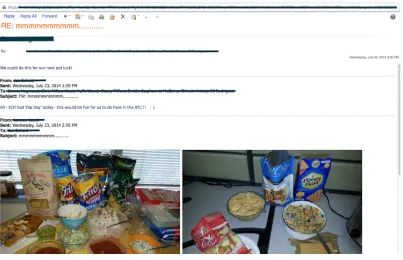
The spirit of holding on to food gathering tradition by office workers was pinpointed
frequently in various creative forms. Such an instance is illustrated through interoffice email
communication, which was prompted by a celebration that first took place in an affiliate office
located in Schaumburg- Illinois. The email communication illustrates how an idea that
commenced as a contained idea evolved into an open opportunity for celebration and
participation from the entire Atlanta office. With the subject line of the initial email
correspondence reading “mmmmmmmmmm...” what followed was a string of
Figure 2.2 Interoffice Email Correspondence
The email conversation threads for the planned event revealed intervention at the
bottom. This intervention by office workers inspired social interaction for the Atlanta office.
The name created for the event, DIP DAY, was coined by Naj and constituted an official event
in the office that provided a way to support the long Atlanta office tradition of social exchange
among employees. Through the assigned name for the event, the event received significance as
part of the Atlanta office social lineup. Naj, who served as a leader in the Atlanta office,
communicated on several occasions in the office that she perceived events such as DIP DAY
and other social gatherings in the office an important ingredient for positive morale.
Importantly, Naj made repeated statements on numerous occasions that suggested her
commitment to driving forward social gatherings in the office in order to sustain positive morale
among her team. Naj had over 20 years of experience in the hospitality industry when I met her
in 2011 and was a veteran of the Atlanta office – of over 10 years in 2014. Naj had witnessed
-through a bird’s eye view- the affects of the Atlanta office transition from the pre-acquisition
climate to the post acquisition climate.
Through the time that I spent working in the Atlanta office I developed an awareness of
the intimate friendships that Naj developed with many in the Atlanta office. Primarily, Naj,
who described herself as single and without children, recounted frequently of the out of office
time that she engaged in family activities with the family of the Atlanta office manager. Naj and
the Atlanta office manager maintained a close friendship. The office manager as well as two
other office staff members for which Naj car pooled to work with daily were those that Naj
frequently described through her activities conducted during out of office time. Naj also
recounted how she cherished her participation in office activities with office peers during
perceived her ties and connections with peers in the workplace as an important aspect of her
life. Like Amme, Naj invested a great deal of her life in the Atlanta office and it was apparent
that the Atlanta office and its traditions had significant meaning to Naj. To Amme and Naj the
office meant a place where they established important friendships, a place where they celebrated
and ate food together with friends, and a place where a significant portion of their life was
spent.
The many office food gatherings in the Atlanta office during the post acquisition period
occurred from the bottom, appropriately, gatherings received the blessings of organization
management with the proviso that such gatherings were not tied to the support of corporate
budget and that such gatherings did not rival productivity. The celebrations and social
gatherings that took place in the Atlanta office were not only an opportunity for people to
consume food, but celebration and gathering produced the Atlanta office as place for office
workers. Amidst circumstances of rapid change and uncertain workplace conditions, food
facilitated agency for participants in the Atlanta office. Specifically, food was a way for
participants to navigate change by holding on to office traditions that allowed workers to ground
a sense of cultural identity and place in their workplace. Participants’ agency mutually
produced and developed from community within the Atlanta office and became security against
prevailing structural changes that were present in the Atlanta office. Richard Sennett (1977)
argues that community develops through a sense of shared identity among groups of
individuals, and functions as a guard against deterioration of social networks. Community
among participants in the Atlanta office reflected the shared social identities which was
participants’ collective desire to practice office traditions. The community among workers