https://doi.org/10.5194/hess-22-4251-2018 © Author(s) 2018. This work is distributed under the Creative Commons Attribution 4.0 License.
Multi-source data assimilation for physically based hydrological
modeling of an experimental hillslope
Anna Botto, Enrica Belluco, and Matteo Camporese
Department of Civil, Environmental and Architectural Engineering, University of Padua, Padua, Italy Correspondence:Anna Botto ([email protected])
Received: 18 January 2018 – Discussion started: 31 January 2018
Revised: 25 May 2018 – Accepted: 24 July 2018 – Published: 13 August 2018
Abstract. Data assimilation has recently been the focus of much attention for integrated surface–subsurface hydrolog-ical models, whereby joint assimilation of water table, soil moisture, and river discharge measurements with the ensem-ble Kalman filter (EnKF) has been extensively applied. Al-though the EnKF has been specifically developed to deal with nonlinear models, integrated hydrological models based on the Richards equation still represent a challenge, due to strong nonlinearities that may significantly affect the filter performance. Thus, more studies are needed to investigate the capabilities of the EnKF to correct the system state and identify parameters in cases where the unsaturated zone dy-namics are dominant, as well as to quantify possible trade-offs associated with assimilation of multi-source data. Here, the CATHY (CATchment HYdrology) model is applied to reproduce the hydrological dynamics observed in an exper-imental two-layered hillslope, equipped with tensiometers, water content reflectometer probes, and tipping bucket flow gages to monitor the hillslope response to a series of artificial rainfall events. Pressure head, soil moisture, and subsurface outflow are assimilated with the EnKF in a number of sce-narios and the challenges and issues arising from the assimi-lation of multi-source data in this real-world test case are dis-cussed. Our results demonstrate that the EnKF is able to ef-fectively correct states and parameters even in a real applica-tion characterized by strong nonlinearities. However, multi-source data assimilation may lead to significant tradeoffs: the assimilation of additional variables can lead to degradation of model predictions for other variables that are otherwise well reproduced. Furthermore, we show that integrated observa-tions such as outflow discharge cannot compensate for the lack of well-distributed data in heterogeneous hillslopes.
1 Introduction
Data assimilation, i.e., the process in which observations of a system are merged in a consistent manner with nu-merical model predictions (e.g., Troch et al., 2003; Morad-khani, 2008), has become increasingly popular in hydrolog-ical modeling over the last few decades (Montzka et al., 2012). Among the various techniques available, the ensemble Kalman filter (EnKF) (Evensen, 2003, 2009b) is probably the most widespread, thanks to its ease of implementation, capa-bility to handle nonlinear models and potential to be used as a sequential inverse modeling tool when parameters are in-cluded in the update step. Applications in hydrology include studies in different disciplines, such as groundwater hydrol-ogy (e.g., Chen and Zhang, 2006; Hendricks Franssen and Kinzelbach, 2008; Bailey and Baù, 2010; Li et al., 2012; Zovi et al., 2017), rainfall–runoff modeling (e.g., Morad-khani et al., 2005; Vrugt et al., 2006; Weerts and El Serafy, 2006; Clark et al., 2008; Xie and Zhang, 2010; Han and Li, 2008), and land surface modeling at multiple scales (e.g., Re-ichle et al., 2002a, b; Crow and Wood, 2003; Francois et al., 2003; Pan and Wood, 2006; De Lannoy et al., 2007; Cam-malleri and Ciraolo, 2012; Flores et al., 2012; Hain et al., 2012).
head and soil moisture is beneficial to subsurface states and river discharge, but the assimilation of river discharge alone does not improve the prediction of subsurface states. Similar conclusions were drawn by Pasetto et al. (2012), who com-pared the EnKF with a modified particle filter to assimilate discharge and pressure head, using the CATHY model. More recently, Pasetto et al. (2015) used the EnKF and CATHY to investigate the impact of possible sensor failure on the observability of flow dynamics and estimation of the model parameters characterizing the soil properties of an artificial hillslope. Ridler et al. (2014) assimilated soil moisture re-mote sensing products in the MIKE SHE model and found that surface soil moisture has correction capabilities limited to the first 25 cm of soil. With the same model, Rasmussen et al. (2016), Rasmussen et al. (2015), Zhang et al. (2015), and Zhang et al. (2016) investigated in detail issues related to uncertainty quantification and biased observations, as well the impacts of update localization and ensemble size on the multivariate assimilation of groundwater head and river dis-charge at the catchment scale. Kurtz et al. (2015) first pre-sented a data assimilation framework for the land surface– subsurface part of the Terrestrial System Modelling Platform (TerrSysMP), followed by Baatz et al. (2017), who assimi-lated distributed river discharge data into the TerrSysMP to estimate the spatially distributed Manning roughness coeffi-cient, and Zhang et al. (2018), who tested and compared five data assimilation methodologies for assimilating groundwa-ter level data via the EnKF to improve root zone soil moisture estimation. Within yet another modeling framework, Tang et al. (2017) used the EnKF in conjunction with HydroGeo-Sphere to study the influence of heterogeneous riverbeds on river–aquifer exchange fluxes.
In spite of such a strong interest, several issues related to the use of EnKF for state and parameter estimation in inte-grated hydrological modeling remain unresolved. The sub-surface component of many IHSSMs is based on the solu-tion of the Richards equasolu-tion in one or three dimensions and, although recent studies with numerical experiments in syn-thetic test cases (Erdal et al., 2014; Brandhorst et al., 2017) have shown that the EnKF has great potential for the estima-tion of soil hydraulic parameters in the unsaturated zone, it is still unclear whether the method is able to cope with non-linearities and parameter estimation in real test cases, where multiple uncertainties on initial and boundary conditions make the problem much more challenging (e.g., Visser et al., 2006; De Lannoy et al., 2007; Monsivais-Huertero et al., 2010; Shi et al., 2015; Bauser et al., 2016). Also, as more sources of data become available at cheaper cost, it is increas-ingly difficult to assess which data types are the most suit-able or effective in assimilating and checking which possible tradeoffs might occur when assimilating different variables in a multivariate data assimilation framework. Zhang et al. (2018), for instance, found that joint assimilation of pressure head and soil moisture is beneficial only when pressure head is assimilated in the saturated zone and soil moisture in the
unsaturated zone, while Zhang et al. (2016) showed that joint assimilation of groundwater head and water content fails to provide reasonable results if proper countermeasures to spu-rious correlations are not adopted.
Within this context, the main goals of the present study are (i) to assess whether the EnKF in combination with a Richards equation-based hydrological model is able to effec-tively improve states and parameters in a real-world test case characterized by dominant unsaturated dynamics and (ii) to quantify the tradeoffs associated with multi-source data as-similation.
To pursue these goals, the EnKF is used in combination with the CATHY (CATchment HYdrology) model (Cam-porese et al., 2010) to assimilate real observations of pressure head, soil moisture and subsurface outflow collected during a controlled experiment carried out in an artificial hillslope. The experiment is characterized by strong nonlinearities, due to the dominant unsaturated dynamics, but the strictly con-trolled conditions, as opposed to field studies, allow us to minimize the effects of initial and boundary condition un-certainty. The behavior and performance of the EnKF-based assimilation framework in terms of its ability to retrieve the correct hillslope response are evaluated in a number of data assimilation scenarios, characterized by different combina-tions of assimilated and updated variables. In each scenario, a significant part of the simulation is devoted to the valida-tion of the model (i.e., with no data assimilavalida-tion), to assess the impacts of parameter updating on the model predictions, also during periods without observations.
2 The hillslope experiment
The artificial hillslope is placed inside a concrete structure of length 6 m, width 2 m and height varying linearly from 3.5 to 0.5 m, corresponding to a slope of 32◦(Fig. 1). A total of 50 apertures, which can be kept closed with screw cups when needed, allow the positioning of various monitoring sensors in properly chosen positions on each lateral wall of the struc-ture. The hillslope toe is made with a hollow-brick porous wall, in order to allow subsurface water to drain. The soil is placed inside the structure to mimic a two-layered hillslope. A uniform 60 cm thick silty fine sand is deployed on top of a low-permeable basement made of sandy clay soil. More de-tails on the soil properties can be found in Lora et al. (2016a) and Schenato et al. (2017). In the following, we will refer to the two soil types simply as sand and clay.
Figure 1.Plan view and longitudinal cross section of the artificial hillslope, along with the position of the monitoring instruments. Tensiometers are indicated by the letter “P”, while WCR probes are denoted by “W”. All dimensions are in centimeters.
hillslope to measure surface runoff and subsurface outflow, while the rain is generated by a rainfall simulator that can produce relatively uniform rainfall intensities varying from 50 to 150 mm h−1(Lora et al., 2016a).
A Campbell Scientific (CR 1000) data logger is used to collect and record all the data with a frequency of 0.5 Hz during a 12-day experiment, carried out by generating rain-fall events of different duration alternated with recession pe-riods (no rainfall, evaporation only). Before the experiment, two preliminary tests were performed to check the intensity and the uniformity of the rainfall rate. The coefficients of uniformity of the preliminary tests are equal to 72 %, for a mean rate of 58.8 mm h−1 (Lora et al., 2016a). The evap-oration rate has been measured throughout the experiment by an atmometer. The average measured rate is quite small (<1 mm day−1), consistent with weather and period of the year (November 2016).
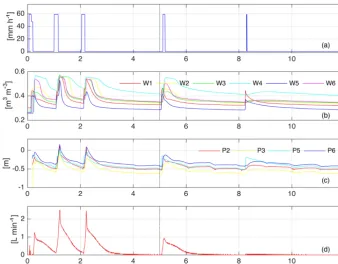
Figure 2 reports all the data collected during the exper-iment. Note that the tensiometers P1 and P4 were affected by malfunctioning; therefore, their data are not reported and were not used in the data assimilation simulations.
3 Numerical methods 3.1 The CATHY model
The CATHY model (Camporese et al., 2010) is a physics-based hydrological model capable of simulating inte-grated subsurface, overland and channel water flow. The model combines a Richards equation solver for the three-dimensional flow in variably saturated porous media with a surface water flow module for the solution of the one-dimensional diffusion wave approximation of the de Saint-Venant equation. In this study, however, there is no surface runoff. Therefore, only subsurface flow is considered, ac-cording to the following form of the Richards equation:
SwSs
∂ψ ∂t +φ
∂Sw
∂t = ∇[KsKr(∇ψ+ηz)] +qs. (1)
In Eq. (1),Sw=θ/φis water saturation,θ andφbeing the volumetric soil water content and porosity (/), respectively,
Ssis the specific storage coefficient (L−1),ψis the pressure head (L),t is time (T),∇ is the gradient operator,Ks is the saturated hydraulic conductivity tensor (L/T),Kris the rel-ative hydraulic conductivity function (/), ηz=(0,0,1)T is
the vertical direction vector,zis the vertical coordinate di-rected upward (L), and qs represents distributed source or sink terms (L3/L3T).
The unsaturated hydraulic properties are taken into ac-count by means of the van Genuchten functions (e.g., Wösten and van Genuchten, 1988)Sw(ψ )andKr(ψ ):
Sw=Swr+
1−Swr
[1+(α|ψ|)n]m, (2)
Kr= S
w−Swr 1−Swr
0.5 1−
1−
S w−Swr 1−Swr
m1m2
, (3)
whereSwr=θr/φis the residual water saturation, withθrthe residual water content,αis an empirical constant (L−1) re-lated to the inverse of the air entry suction, and the dimen-sionless shape parametersnandmare linked by the expres-sion m=1−1/n. The model solves Eq. (1) by means of Galerkin finite elements with tetrahedral elements and lin-ear basis functions in space and weighted finite differences for integration in time (Camporese et al., 2010).
It is worth noting that the Richards equation is strongly nonlinear, due to the retention curves (Eqs. 2 and 3). Such nonlinearities are enhanced in this study by the fact that the hillslope is characterized by dominant unsaturated conditions (Fig. 2), as opposed to many other previous applications of data assimilation with physics-based models. This makes our hillslope experiment particularly challenging and distinctive from both modeling and data assimilation perspectives. 3.2 The ensemble Kalman filter
pa-Figure 2.Experimental data collected during the experiment:(a)rainfall rate;(b)water content as measured by the WCR probes;(c) pres-sure head as meapres-sured by the tensiometers;(d)subsurface outflow. The black vertical dashed line marks the transition between the data assimilation and the validation phases.
rameters) are sequentially updated based on a Monte Carlo approximation of the covariance matrices needed in the stan-dard Kalman filter. The process is Markovian of the first or-der and the implementation of the EnKF does not require the linearization of the model, making it particularly suitable for handling nonlinear problems.
In this paper the EnKF is implemented according to the numerical formulation proposed by Sakov et al. (2010). Let Xbe an ensemble matrix ofMrows andN columns, where
N is the number of realizations andM is the state dimen-sion, i.e., the number of nodes in the finite element grid, aug-mented by the number of parameters that are subject to up-date. The main idea behind this type of implementation is that the matrix Xcan be defined as the sum,x+A, of the ensemble average,x,
x= 1
NX1, (4)
and the matrix of ensemble anomalies,A, A=X(I− 1
N11
T), (5)
where 1 andIare a vector with all elements equal to one and the identity matrix, respectively. As usual, superscriptT
denotes matrix transposition.
Whenever observed data are available, the EnKF can com-pute the updated matrixXuas the sum of the updated
ensem-ble mean,xu, and the updated anomalies,Au:
Xu=xu+Au. (6)
In the following, the lack of a superscript u denotes that the matrix or vector is computed at the forecast stage, i.e., at the previous model time step.
The updated mean can be calculated as
xu=x+βAGs, (7)
whereβ is a diagonal matrix of dampening factors (Hen-dricks Franssen and Kinzelbach, 2008), whose elements vary from 0 to 1, andsis the scaled innovation vector
s=R−1/2(D−Hx)/ √
N−1, (8)
which depends on the measurement error covariance matrix, R, the difference between the measurements,D, and the en-semble mean of the simulated observations,Hx. Dampening factors help to prevent the occurrence of unstable updates and filter divergence (e.g., Evensen, 2009b) and were chosen as an alternative to covariance inflation due to ease of imple-mentation.
The matrixGis defined as
G=MST, (9)
whereSis the matrix of scaled ensemble innovation anoma-lies
S=R−1/2HA/ √
[image:4.612.130.468.66.330.2]HAbeing the simulated measurement anomalies HA=HX(I− 1
N11
T), (11)
andMbeing defined as
M=(I+STS)−1. (12)
The updated anomalies,Au, are computed as
Au=A+βA(M1/2−I). (13)
When updating the states only, the elements ofXare the pressure heads at each node of the finite element grid, while the state augmentation technique is used when also updat-ing the parameters. In this latter case, the desired parame-ters (e.g., hydraulic conductivity, parameparame-ters of the retention curves), transformed as described in Sect. 4.2, are added toX and updated based on their correlation with the system states (e.g., Erdal et al., 2015).
4 Model and data assimilation setup 4.1 CATHY setup
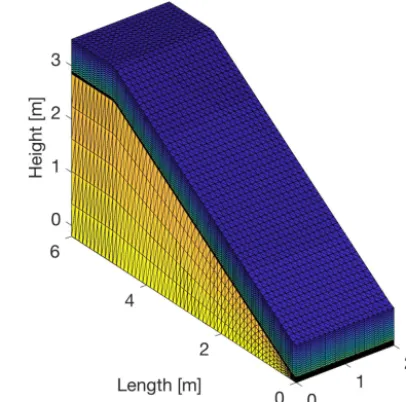
The artificial hillslope is discretized with a surface triangular grid resulting from the subdivision of square cells of 10 cm side. The triangular grid is then replicated vertically for a to-tal of 25 layers to generate the three-dimensional tetrahedral mesh (Fig. 3). Fifteen layers are used to represent the top sand, while 10 layers discretize the clay. No flow boundary conditions are assumed at each boundary, except for the sub-surface outflow section, where seepage face boundary condi-tions are used, and the surface, where time-variable rainfall or evaporation rates are imposed. Finally, the soil hydraulic parameters are assigned as reported in Table 1. The values of saturated hydraulic conductivity and van Genuchten reten-tion parameters are perturbed to generate the ensemble of re-alizations as described in the following section, whereas soil porosities and specific storages are considered deterministic, the former being well characterized with laboratory tests and the latter having little impact on the CATHY model response in this case.
4.2 EnKF setup
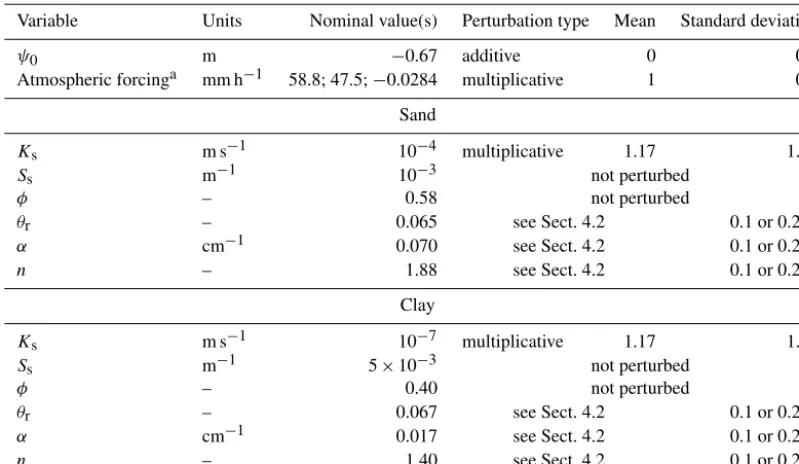
[image:5.612.324.527.68.269.2]In order to generate the ensemble of realizations needed for the application of the EnKF, we perturb the atmospheric forc-ing (i.e., rainfall and evaporation rates), soil properties and initial conditions. Table 1 reports a summary of the per-turbed variables, along with their nominal mean values as well as the nature and statistics of the perturbations. The uncertainties on model parameters and boundary conditions have been assigned on the basis of previous modeling expe-riences and preliminary characterization of the soils in the hillslope (Camporese et al., 2009a, b; Lora et al., 2016b).
Figure 3.Three-dimensional finite element grid of the hillslope.
The ensemble of time-variable atmospheric forcing rates was generated with a sequence of multiplicative perturba-tions,qk, correlated in time as in Evensen (2003):
qk=γqk−1+ q
1−γ2w
k−1, (14) where the subscriptkis the time index,wkis a sequence of white noise drawn from the standard normal distribution, and the coefficientγ is computed as
γ=1−1t
τ , (15)
1t being the assimilation interval andτ the specified time decorrelation length, here set equal to 108 000 s, i.e., 30 h.
Table 1.Perturbation parameters for the generation of the ensemble initial conditions, hydraulic conductivities and atmospheric forcing.
Variable Units Nominal value(s) Perturbation type Mean Standard deviation
ψ0 m −0.67 additive 0 0.2
Atmospheric forcinga mm h−1 58.8; 47.5;−0.0284 multiplicative 1 0.2
Sand
Ks m s−1 10−4 multiplicative 1.17 1.53
Ss m−1 10−3 not perturbed
φ – 0.58 not perturbed
θr – 0.065 see Sect. 4.2 0.1 or 0.25b
α cm−1 0.070 see Sect. 4.2 0.1 or 0.25b
n – 1.88 see Sect. 4.2 0.1 or 0.25b
Clay
Ks m s−1 10−7 multiplicative 1.17 1.53
Ss m−1 5×10⁻³ not perturbed
φ – 0.40 not perturbed
θr – 0.067 see Sect. 4.2 0.1 or 0.25b
α cm−1 0.017 see Sect. 4.2 0.1 or 0.25b
n – 1.40 see Sect. 4.2 0.1 or 0.25b
aRainfall (positive) and evaporation (negative) rates.bσ
VGas described in Sect. 4.2.
Perturbed soil parameters, for both sand and clay, include the saturated hydraulic conductivity as well as the parame-ters of the van Genuchten retention curves. Table 1 reports the nominal mean values of Ks, based on soil samples an-alyzed in the laboratory, as well as the parameters used for generating their ensembles. The saturated hydraulic conduc-tivities of sand and clay are perturbed independently of each other with multiplicative perturbations sampled from a log-normal distribution.
The parameters of the van Genuchten retention curvesα,
n, andθrare perturbed taking into account their mutual cor-relation according to Carsel and Parrish (1988), who de-scribed their statistics and transformed them into normally distributed variables via the Johnson system (Johnson, 1970). Three main transformation functions are available, i.e, the lognormal (LN), log-ratio (SB), and hyperbolic (SU):
LN:Y =ln(V ), (16)
SB:Y =ln[(V−A)/(B−V )] =ln(U ), (17)
SU:Y =sinh−1(U ), (18)
where V denotes the parameter before transformation, bounded within the range [A B], andY denotes the trans-formed parameter with normal distribution. In this work, the prior statistics of the van Genuchten parameters are taken from the soil types “sandy loam” and “silt loam” in Carsel and Parrish (1988), assumed as valid representations of our sand and clay, respectively. In particular, the SB transforma-tion has been used for all the parameters, except fornof the sandy loam andαof the silt loam, for which the LN
transfor-mation has been applied. The ensemble of transformed pa-rameters is generated by
y=u+TTz, (19)
whereyis the vector containing transformedα,n, andθr,u contains the transformed variable means,Tis an upper diag-onal matrix, obtained from the Choleski factorization of the covariance matrix of the three parameters (see Table 2), and zis a vector of normal deviates with mean equal to 0 and standard deviationσVG. The transformed variables can be in-cluded in the matrixXwhen updating the parameters, and can then be back-transformed in order to obtain the updated values of the soil retention parameters.
pres-Table 2.Factored covariance matrices used for the perturbation of van Genuchten parameters (from Carsel and Parrish, 1988).
θr α n
Sandy loam θr 0.538 0.017 −0.194
α 0.014 0.019
n 0.108
Silt loam θr 0.522 0.030 −0.17
α 0.082 0.234
n 0.158
sure head and water content data, with a standard deviation equal to 8 % of the measured discharge. All measurement error standard deviations have been estimated based on the accuracy of the sensors and plausible positioning errors.
When assimilating multiple variables, proper normaliza-tion of the measurement error covariance matrices, anoma-lies of the simulated data, and innovation vectors were per-formed, using values of 0.6 m, 0.58, and 4.17×10⁻⁵m3s−1 for pressure head, water content and subsurface outflow, respectively. The normalization ensures that in multivari-ate assimilation scenarios the covariance matrices in the Kalman gain are not ill-conditioned (Evensen, 2003; Cam-porese et al., 2009b).
4.3 Data assimilation scenarios
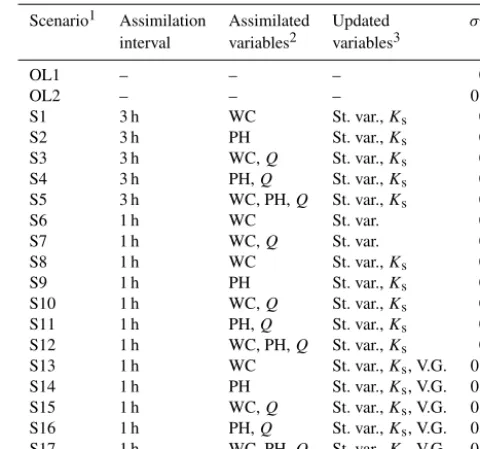
A total of 17 data assimilation scenarios have been simu-lated, whereby the assimilation interval, the assimilated vari-ables, the updated varivari-ables, and the uncertainty on the van Genuchten parameters were varied. Table 3 reports a sum-mary of the main characteristics for each scenario. Assimi-lated variables may include water content only or with sub-surface outflow, pressure head only or with subsub-surface out-flow, and all three variables together. With regard to the up-dated variables, three cases have been analyzed: update of the state variables only; update of the state variables and sat-urated hydraulic conductivities for both sand and clay; up-date of the state variables, hydraulic conductivities and van Genuchten parameters, for both sand and clay. In all the data assimilation scenarios, observations were assimilated only during the first 5 days of simulation, leaving the final 7 days as a validation period, during which the ensemble was left to evolve freely. For comparison, two open loop simulations, i.e., without data assimilation, have also been carried out (Ta-ble 3).
[image:7.612.307.547.86.310.2]The performance of the simulations has been evaluated by means of the root mean square error (RMSE), computed for the different variables, i.e., pressure head, water content, and subsurface outflow. The root mean square error is calculated
Table 3.Overview of the open loop and data assimilation scenarios.
Scenario1 Assimilation Assimilated Updated σVG interval variables2 variables3
OL1 – – – 0.1
OL2 – – – 0.25
S1 3 h WC St. var.,Ks 0.1 S2 3 h PH St. var.,Ks 0.1 S3 3 h WC,Q St. var.,Ks 0.1 S4 3 h PH,Q St. var.,Ks 0.1 S5 3 h WC, PH,Q St. var.,Ks 0.1 S6 1 h WC St. var. 0.1 S7 1 h WC,Q St. var. 0.1 S8 1 h WC St. var.,Ks 0.1 S9 1 h PH St. var.,Ks 0.1 S10 1 h WC,Q St. var.,Ks 0.1 S11 1 h PH,Q St. var.,Ks 0.1 S12 1 h WC, PH,Q St. var.,Ks 0.1 S13 1 h WC St. var.,Ks, V.G. 0.25 S14 1 h PH St. var.,Ks, V.G. 0.25 S15 1 h WC,Q St. var.,Ks, V.G. 0.25 S16 1 h PH,Q St. var.,Ks, V.G. 0.25 S17 1 h WC, PH,Q St. var.,Ks, V.G. 0.25
1OL1 and OL2 indicate open loop scenarios, i.e., simulations without data assimilation.2WC, PH, andQdenote water content, pressure head, and subsurface outflow, respectively.3St. var.,Ks, and V.G. indicate state variables (in terms of pressure head), saturated hydraulic conductivity, and van Genuchten parameters, respectively.
as
RMSE(t )= 1 No
No X
j=1 v u u t 1 N N X
i=1
Si,j(t )−Oj(t )
2
, (20)
whereNois the number of observations available (six, four, and one for water content, pressure head, and subsurface out-flow, respectively),Si,j refers to the simulated results of the
ith realization of the ensemble at the location of thejth ob-servation andOjis the corresponding experimental value. To
obtain a meaningful comparison between the errors of differ-ent variables, we also compute the time-averaged normalized root mean square error, NRMSE,
NRMSE= 1 NT
NT
X
k=1 RMSEk
NF , (21)
whereNT is the number of time steps,k is the time index,
and NF is a normalization factor equal to 0.58, 0.60 m, and 4.17×10⁻⁵m3s−1(i.e., 2.5 L min−1) for the water content, pressure head, and subsurface discharge, respectively. The NRMSE is computed separately for each variable and for the assimilation (NT =120) and validation (NT =167) periods,
[image:7.612.78.257.95.195.2]5 Results and discussion 5.1 Preliminary simulations
A preliminary sensitivity analysis over a number of EnKF parameters has been performed, in order to select a final and satisfactory setup for the subsequent data assimilation sce-narios. First, simulations withN equal to 32, 128 and 256 have been performed, and it has been found that an ensem-ble size of 128 ensures a good tradeoff between performance and computational effort. Some preliminary sensitivity anal-yses of the value ofσVGhave also been performed, resulting in values of 0.1 and 0.25 for the scenarios with and without update of van Genuchten parameters, respectively (Table 3). Then, several dampening factor values (βin Eqs. 7 and 13) were tested, including combinations of different values for the update of system state and parameters. Based on this analysis, a value of 1 has been chosen for the update of the system state, whereas a dampening factor equal to 0.5 has been selected for the update of the soil hydraulic pa-rameters (Ks, α, n, and θr, for both sand and clay). This choice of dampening factors is consistent with previous stud-ies (Brandhorst et al., 2017) and prevents abrupt changes in the retention curve parameters that could lead to difficulties in model convergence and hence loss of realizations.
According to these preliminary analyses, all scenarios re-ported in Table 3 have been simulated with an ensemble size of 128 and dampening factors of 1 and 0.5 for system state and parameters, respectively.
5.2 Overall EnKF performance
Table 4 and Fig. 4 summarize the performance of the EnKF in all the data assimilation scenarios, expressed in terms of NRMSE for the three measured variables (water content, WC, pressure head, PH, and subsurface outflow,Q), and av-eraged separately over the assimilation and validation win-dows. A comparison between scenarios 1–5 and 8–12 in Ta-ble 4, characterized by the same assimilated and updated variables but different assimilation intervals, shows that as-similating more frequently does not always result in signif-icant improvements of model predictions. The variable that benefits the most from more frequent updates is subsurface outflow, especially in the scenarios where Qis assimilated (e.g., compare scenarios 3–5 with 10–12).
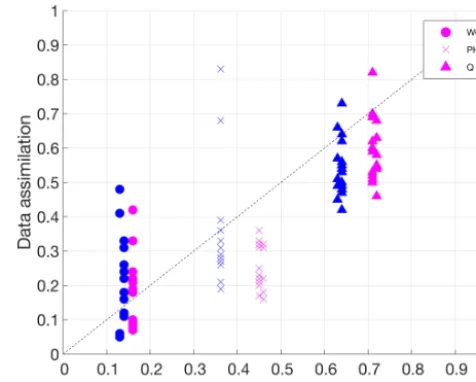
[image:8.612.310.548.66.257.2]Figure 4 highlights that most of the data assimilation sce-narios result in an improvement of model predictions for pressure head and subsurface outflow, compared to the open loop simulations (data pairs below the 45◦ reference line). However, in some scenarios, the filter performance in pre-dicting the water content is actually worse than in the open loop. A close inspection of the values in Table 4 indicates that such scenarios are those where pressure head is assim-ilated, alone or in conjunction with water content and sub-surface outflow. This is likely due to a combination of two
Figure 4.Normalized root mean square errors for water content, pressure head, and subsurface outflow of the data assimilation sce-narios versus corresponding values of the open loop. Symbols in magenta represent values calculated over the assimilation period, while symbols in blue represent values calculated over the valida-tion period.
factors: (i) only four out of six tensiometers are available for assimilation, compared to the six WCR probes available for water content, and (ii) the pressure head measurements are characterized by relatively poor quality. This can be appreci-ated from the pressure head data shown in Fig. 2, where diur-nal disturbances caused by temperature fluctuations (Warrick et al., 1998) are apparent.
5.3 Parameter estimation capabilities
Table 4.Normalized root mean square errors (NRMSEs) for the 17 data assimilation scenarios under analysis and two open loop (OL) simulations. The table reports the NRMSE for three variables, water content, pressure head and outflow discharge, for both the assimilation and the validation periods. The last three columns report the mean values calculated over the three variables (WC, PH andQ) and the global average between assimilation and validation. Bold values indicate exceedance of the corresponding open loop errors.
NRMSEWC NRMSEPH NRMSEQ Mean NRMSE
Scenario Assimilation Validation Assimilation Validation Assimilation Validation Assimilation Validation Global
OL1 0.16 0.14 0.45 0.36 0.72 0.64 0.44 0.38 0.41 OL2 0.16 0.13 0.46 0.36 0.71 0.63 0.44 0.38 0.41 S1 0.09 0.11 0.33 0.27 0.58 0.53 0.33 0.30 0.32 S2 0.21 0.24 0.21 0.31 0.51 0.47 0.31 0.34 0.33 S3 0.10 0.16 0.31 0.21 0.63 0.56 0.34 0.31 0.33 S4 0.24 0.26 0.25 0.39 0.82 0.73 0.44 0.46 0.45
S5 0.18 0.22 0.23 0.26 0.70 0.64 0.37 0.37 0.37 S6 0.07 0.12 0.36 0.36 0.68 0.62 0.37 0.37 0.37 S7 0.08 0.12 0.33 0.33 0.55 0.50 0.32 0.31 0.32 S8 0.08 0.11 0.32 0.27 0.55 0.49 0.32 0.29 0.30 S9 0.22 0.24 0.17 0.29 0.46 0.42 0.29 0.32 0.30 S10 0.09 0.18 0.31 0.21 0.54 0.48 0.31 0.29 0.30 S11 0.24 0.33 0.22 0.83 0.59 0.54 0.35 0.57 0.46
S12 0.19 0.31 0.20 0.68 0.62 0.55 0.34 0.51 0.43
[image:9.612.125.470.399.664.2]S13 0.07 0.06 0.32 0.28 0.52 0.49 0.30 0.28 0.29 S14 0.33 0.41 0.16 0.21 0.50 0.45 0.33 0.36 0.34 S15 0.07 0.05 0.31 0.29 0.53 0.51 0.31 0.28 0.29 S16 0.42 0.48 0.18 0.19 0.60 0.57 0.40 0.41 0.41 S17 0.10 0.05 0.22 0.29 0.69 0.66 0.34 0.34 0.34
Figure 6.Plots of the pressure head in P2(a, b, c), water content in W6(d, e, f), and outflow discharge(g, h, i)for scenarios S6(a, d, g), S8(b, e, h), and S13(c, f, i). Solid green lines represent experimental data, while solid black and magenta lines indicate the ensemble mean of the open loop and data assimilation scenarios, respectively. The simulated 90 % confidence bands are also reported (dashed black and magenta lines). The locations of the tensiometer P2 and water content probe W6 are shown in Fig. 1.
The effect of parameter updating on model predictions for scenarios S6, S8, and S13 can be visualized in Fig. 6, which shows ensemble means and 90 % confidence bands of simulated water content, pressure head, and subsurface outflow in comparison with the experimental data and the corresponding open loop values. In scenario S6, without pa-rameter update, model predictions during the validation tend to converge again to the open loop simulations in terms of both mean and uncertainty (Fig. 6a, d, g). Updating the pa-rameters (scenarios S8 and S13) results in decreased uncer-tainty during validation (Fig. 6b, c, e, f, h, i), due to the re-duced variability of saturated hydraulic conductivity and van Genuchten parameters. Note also that the update ofKsis par-ticularly beneficial to pressure head (panel a versus b and c, where it can be seen that, in the validation phase, the en-semble mean with data assimilation departs the open loop and gets closer to the measurements) and subsurface outflow (panel g versus h and i), whereas updating α,n, andθr im-proved significantly the water content (panel e versus f). 5.4 Tradeoffs in multi-source data assimilation
We now focus our attention on the scenarios where multi-source data are assimilated. The right panels in Fig. 5 show the ratios between RMSE in data assimilation scenarios S7, S10, and S15 and the corresponding open loop values for
wa-ter content, pressure head, and subsurface outflow. Whereas in scenarios S6, S8, and S13 (see panels(a),(c)and(e)in Fig. 5) water content alone was assimilated, in scenarios S7, S10, and S15 (see panels(b),(d)and(f)in Fig. 5) water con-tent and subsurface outflow were jointly assimilated. The up-dated variables are system state only in S7, system state and saturated hydraulic conductivity in S10, and system state plus
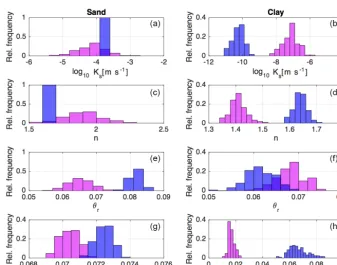
Figure 7.Relative frequency distributions of the saturated hydraulic conductivity,Ks, of sand and clay in scenario S10. Graphs in magenta denote the priorKsdistributions, while the blue ones indicate the posterior distributions, i.e., at the end of the assimilation period.
Figure 8. Relative frequency distributions of the saturated hydraulic conductivity,Ks, and van Genucthen parameters of sand and clay in scenario S15. Graphs in magenta denote prior distributions, while the blue ones indicate posterior distributions, i.e., at the end of the assimilation period.
tradeoffs associated with multi-source data assimilation and parameter updating in integrated hydrological models.
Further insights into the differences between scenar-ios S10 and S15 can be gained from Figs. 7 and 8, which report the prior and posterior (i.e., at the end of the assimi-lation period) distributions of soil parameters. Fig. 7 reports the results for scenario S10, whereKsonly was updated, and shows that the sand Ks is clearly identifiable, whereas the
[image:11.612.130.467.284.549.2]Figure 9.Time evolution of the saturated hydraulic conductivity and van Genuchten parameters (mean values, solid line, together with minimum and maximum values, in dashed lines, to indicate the ensemble spread) for the two types of soil, sand and clay, in scenario S17.
Figure 8 shows the prior and posterior distributions ofKs,
α,n, andθr in S15. Again, for the sand, the saturated hy-draulic conductivity can be clearly identified, as well as the exponentn of the van Genuchten retention function, while parametersθrandαare more difficult to estimate. As for the clay, posterior uncertainty is large for all the parameters and the mean value ofKs shows again a bias with respect to the prior value, although in this case the final value is more con-sistent with the actual soil type and this could explain why the water content model predictions improve significantly com-pared to scenario S10. This can also be explained by the fact that all the sensors are located in the sand layer, while no experimental data from the clay layer are assimilated.
An additional perspective on parameter estimation is given by Fig. 9, which shows the time evolution of ensemble mean and spread of the saturated hydraulic conductivity and van Genuchten parameters for both sand and clay in scenario S17 (one of the scenarios reported in Fig. 10). The convergence toward stable values in the data assimilation phase is only achieved for the parametersKsandnof the sand layer, while the dispersion remains generally higher forθr(to which the model is typically not very sensitive) andα, as well as for all the parameters of the clay layer.
In summary, the results of parameter updating for the clay show that data would be needed in all the soil layers. How-ever, when dealing with large heterogeneous structures, it is very expensive to have every soil zone properly probed, which is why it is important to assess whether multivariate
data assimilation approaches are capable of compensating for the lack of distributed observations with alternative sources of information. Here, an integrated measurement such as the subsurface outflow does not seem to be sufficient to compen-sate for this lack of representativeness.
Finally, we analyze the tradeoffs in system state predic-tions associated with multi-source data assimilation for sce-narios S15, S16, and S17. Figure 10 shows pressure head in P2, water content in W6, and subsurface outflow as simulated in the data assimilation and open loop scenarios, in terms of ensemble mean and 90 % confidence bands, compared to the measurements. In scenario S15 (Fig. 10a, d, g), where water content and subsurface discharge were assimilated, model re-sults are very good for these variables but not so for pressure head (see also NRMSE values in Table 4). On the other hand, in scenario S16, where pressure head and subsurface outflow were assimilated, pressure head and discharge are well sim-ulated, but not water content (Fig. 10b, e, h, and Table 4). Finally, in scenario S17, where all the available data were assimilated, the model predicts well both pressure head and water content, but at the cost of a slightly degraded predic-tion of subsurface outflow compared to scenarios S15 and S16 (Fig. 10c, f, i, and Table 4).
en-Figure 10.Plots of the pressure head in P2,(a, b, c), water content in W6,(d, e, f)and outflow discharge(g, h, i)for scenarios S15(a, d, g), S16(b, e, h), and S17(c, f, i). Solid green lines represent experimental data, while solid black and magenta lines indicate the ensemble mean of the open loop and data assimilation scenarios, respectively. The simulated 90 % confidence bands are also reported (dashed black and magenta lines). The locations of the tensiometer P2 and water content probe W6 are shown in Fig. 1.
semble sizes, whereas in our case it might be that the rela-tively poor quality of pressure head measurements, compared to water content observations, and the lack of observations in the clay layer do not allow us to obtain accurate estimates of the van Genuchten parameters.
6 Summary and conclusions
In this study, a Richards equation-based hydrological model, CATHY, has been used with the ensemble Kalman filter to assimilate pressure head, water content, and subsurface out-flow data in a real-world test case, represented by an exper-imental artificial hillslope. A total of 17 data assimilation simulations have been presented and described to provide a comprehensive overview of possible scenarios. Univariate scenarios with the assimilation of water content or pressure head alone were compared to multivariate cases where wa-ter content and pressure head were combined with outflow discharge or where water content, pressure head and outflow discharge were jointly assimilated. Regarding the updating strategies, single (state variable) and joint (state variables plus saturated hydraulic conductivity with and without van Genuchten parameters) updating scenarios were considered. Overall, the capabilities of the ensemble Kalman filter to jointly correct the system states and soil parameters in
phys-ically based hydrological models were confirmed, even in a real-world test case such as the one presented here, charac-terized by dominant unsaturated dynamics and hence strong nonlinearities. Updating of the saturated hydraulic conduc-tivity brought significant improvements in the prediction of pressure head and subsurface outflow, while updating the van Genuchten parameters proved to be highly beneficial to the prediction of the water content dynamics. On the other hand, multivariate data assimilation may lead to significant trade-offs. For instance, the assimilation of soil moisture in addi-tion to pressure head and subsurface outflow improved water content, but slightly degraded the prediction of the outflow discharge. Moreover, our results suggest that high-quality and representative data are essential for a proper and effec-tive use of data assimilation in physically based hydrological models, as shown by the relatively poor performance of the EnKF in scenarios when pressure head was assimilated, due to temperature disturbances of the data, and by biased esti-mates of clay parameters, due to the lack of data in this soil layer.
[image:13.612.129.463.65.330.2]Data availability. All the data are available from the corresponding author upon request.
Author contributions. AB and EB carried out the experiment. AB conducted the numerical simulations. AB and MC wrote the manuscript. MC supervised the research. All the authors reviewed the manuscript.
Competing interests. The authors declare that they have no conflict of interest.
Acknowledgements. We gratefully acknowledge the financial support of the University of Padua, through grant CPDA148790. We thank the editor and three anonymous reviewers for their detailed and very helpful comments.
Edited by: Harrie-Jan Hendricks Franssen Reviewed by: three anonymous referees
References
Baatz, D., Kurtz, W., Franssen, H. H., Vereecken, H., and Kollet, S.: Catchment tomography – An approach for spa-tial parameter estimation, Adv. Water Resour., 107, 147–159, https://doi.org/10.1016/j.advwatres.2017.06.006, 2017. Bailey, R. and Baù, D.: Ensemble smoother assimilation of
hydraulic head and return flow data to estimate hydraulic conductivity distribution, Water Resour. Res., 46, w12543, https://doi.org/10.1029/2010WR009147, 2010.
Bauser, H. H., Jaumann, S., Berg, D., and Roth, K.: EnKF with closed-eye period – towards a consistent aggregation of informa-tion in soil hydrology, Hydrol. Earth Syst. Sci., 20, 4999–5014, 10.5194/hess-20-4999-2016, 2016.
Bishop, C. H., Etherton, B. J., and Majumdar, S. J.: Adap-tive Sampling with the Ensemble Transform Kalman Filter. Part I: Theoretical Aspects, Mon. Weather Rev., 129, 420–436, https://doi.org/10.1175/1520-0493(2001)129<0420:ASWTET>2.0.CO;2, 2001.
Brandhorst, N., Erdal, D., and Neuweiler, I.: Soil moisture predic-tion with the ensemble Kalman filter: Handling uncertainty of soil hydraulic parameters, Adv. Water Resour., 110, 360–370, https://doi.org/10.1016/j.advwatres.2017.10.022, 2017. Cammalleri, C. and Ciraolo, G.: State and parameter
up-date in a coupled energy/hydrologic balance model using ensemble Kalman filtering, J. Hydrol., 416–417, 171–181, https://doi.org/10.1016/j.jhydrol.2011.11.049, 2012.
Camporese, M., Paniconi, C., Putti, M., and Salandin, P.: Ensem-ble Kalman filter data assimilation for a process-based catchment scale model of surface and subsurface flow, Water Resour. Res., 45, w10421, https://doi.org/10.1029/2008WR007031, 2009a. Camporese, M., Paniconi, C., Putti, M., and Salandin, P.:
Com-parison of Data Assimilation Techniques for a Coupled Model of Surface and Subsurface Flow, Vadose Zone J., 8, 837–845, https://doi.org/10.2136/vzj2009.0018, 2009b.
Camporese, M., Paniconi, C., Putti, M., and Orlandini, S.: Surface-subsurface flow modeling with path-based runoff routing, boundary condition-based coupling, and assimilation of mul-tisource observation data, Water Resour. Res., 46, w02512, https://doi.org/10.1029/2008WR007536, 2010.
Carsel, R. F. and Parrish, R. S.: Developing joint probability dis-tributions of soil water retention characteristics, Water Resour. Res., 24, 755–769, https://doi.org/10.1029/WR024i005p00755, 1988.
Chen, Y. and Zhang, D.: Data assimilation for tran-sient flow in geologic formations via ensemble Kalman filter, Adv. Water Resour., 29, 1107–1122, https://doi.org/10.1016/j.advwatres.2005.09.007, 2006. Clark, M. P., Rupp, D. E., Woods, R. A., Zheng, X., Ibbitt,
R. P., Slater, A. G., Schmidt, J., and Uddstrom, M. J.: Hy-drological data assimilation with the ensemble Kalman fil-ter: Use of streamflow observations to update states in a dis-tributed hydrological model, Adv. Water Resour., 31, 1309– 1324, https://doi.org/10.1016/j.advwatres.2008.06.005, 2008. Crow, W. T. and Wood, E. F.: The assimilation of remotely sensed
soil brightness temperature imagery into a land surface model using Ensemble Kalman filtering: a case study based on ESTAR measurements during SGP97, Adv. Water Resour., 26, 137–149, https://doi.org/10.1016/S0309-1708(02)00088-X, 2003. De Lannoy, G. J., Houser, P. R., Pauwels, V., and
Ver-hoest, N. E.: State and bias estimation for soil mois-ture profiles by an ensemble Kalman filter: Effect of as-similation depth and frequency, Water Resour. Res., 43, 6, https://doi.org/10.1029/2006WR005100, 2007.
Erdal, D., Neuweiler, I., and Wollschläger, U.: Using a bias aware EnKF to account for unresolved structure in an un-saturated zone model, Water Resour. Res., 50, 132–147, https://doi.org/10.1002/2012WR013443, 2014.
Erdal, D., Rahman, M., and Neuweiler, I.: The impor-tance of state transformations when using the ensemble Kalman filter for unsaturated flow modeling: Dealing with strong nonlinearities, Adv. Water Resour., 86, 354–365, https://doi.org/10.1016/j.advwatres.2015.09.008, 2015. Evensen, G.: The Ensemble Kalman Filter: theoretical
formula-tion and practical implementaformula-tion, Ocean Dynam., 53, 343–367, 2003.
Evensen, G.: Data Assimilation: The Ensemble Kalman Filter, Springer-Verlag, Berlin, Germany, 2009a.
Evensen, G.: The ensemble Kalman filter for combined state and parameter estimation, vol. 29, IEEE Control Systems, 83–104, 2009b.
Flores, A. N., Bras, R. L., and Entekhabi, D.: Hydrologic data assimilation with a hillslope-scale-resolving model and L band radar observations: Synthetic experiments with the ensemble Kalman filter, Water Resour. Res., 48, W08509, https://doi.org/10.1029/2011WR011500, 2012.
Francois, C., Quesney, A., and Ottlé, C.: Sequential Assimilation of ERS-1 SAR Data into a Coupled Land Surface–Hydrological Model Using an Extended Kalman Filter, J. Hydrometeorol., 4, 473–487, 2003.
into the Noah land surface model, Water Resour. Res., 48, 11, https://doi.org/10.1029/2011WR011268, 2012.
Han, X. and Li, X.: An evaluation of the nonlinear/non-Gaussian fil-ters for the sequential data assimilation, Remote Sens. Environ., 112, 1434–1449, 2008.
Hendricks Franssen, H. J. and Kinzelbach, W.: Real-time groundwater flow modeling with the Ensemble Kalman Fil-ter: Joint estimation of states and parameters and the fil-ter inbreeding problem, Wafil-ter Resour. Res., 44, w09408, https://doi.org/10.1029/2007WR006505, 2008.
Johnson, S. K.: Distributions in Statistics: Continuous Unvariate Distributions-1, Houghton Mifflin, 1970.
Kollet, S., Sulis, M., Maxwell, R. M., Paniconi, C., Putti, M., Bertoldi, G., Coon, E. T., Cordano, E., Endrizzi, S., Kikinzon, E., Mouche, E., Mügler, C., Park, Y.-J., Refsgaard, J. C., Stisen, S., and Sudicky, E.: The integrated hydrologic model intercompari-son project, IH-MIP2: A second set of benchmark results to di-agnose integrated hydrology and feedbacks, Water Resour. Res., 53, 867–890, https://doi.org/10.1002/2016WR019191, 2017. Kurtz, W., He, G., Kollet, S. J., Maxwell, R. M., Vereecken, H.,
and Hendricks Franssen, H.-J.: TerrSysMP–PDAF (version 1.0): a modular high-performance data assimilation framework for an integrated land surface–subsurface model, Geosci. Model Dev., 9, 1341–1360, 10.5194/gmd-9-1341-2016, 2016.
Li, L., Zhou, H., Gómez-Hernández, J. J., and Franssen, H.-J. H.: Jointly mapping hydraulic conductivity and porosity by assimi-lating concentration data via ensemble Kalman filter, J. Hydrol., 428–429, 152–169, 2012.
Lora, M., Camporese, M., and Salandin, P.: Design and per-formance of a nozzle-type rainfall simulator for land-slide triggering experiments, CATENA, 140, 77–89, https://doi.org/10.1016/j.catena.2016.01.018, 2016a.
Lora, M., Camporese, M., Troch, P. A., and Salandin, P.: Rainfall-triggered shallow landslides: infiltration dynamics in a physical hillslope model, Hydrol. Process., 30, 3239–3251, https://doi.org/10.1002/hyp.10829, 2016b.
Maxwell, R. M., Putti, M., Meyerhoff, S., Delfs, J.-O., Ferguson, I. M., Ivanov, V., Kim, J., Kolditz, O., Kollet, S. J., Kumar, M., Lopez, S., Niu, J., Paniconi, C., Park, Y.-J., Phanikumar, M. S., Shen, C., Sudicky, E. A., and Sulis, M.: Surface-subsurface model intercomparison: A first set of benchmark results to di-agnose integrated hydrology and feedbacks, Water Resour. Res., 50, 1531–1549, https://doi.org/10.1002/2013WR013725, 2014. Monsivais-Huertero, A., Graham, W. D., Judge, J., and Agrawal,
D.: Effect of simultaneous state-parameter estimation and forcing uncertainties on root-zone soil moisture for dynamic vegetation using EnKF, Adv. Water Resour., 33, 468–484, https://doi.org/10.1016/j.advwatres.2010.01.011, 2010. Montzka, C., Pauwels, V. R. N., Franssen, H.-J. H., Han, X., and
Vereecken, H.: Multivariate and Multiscale Data Assimilation in Terrestrial Systems: A Review, Sensors, 12, 16291–16333, https://doi.org/10.3390/s121216291, 2012.
Moradkhani, H.: Hydrologic remote sensing and land surface data assimilation, Sensors, 8, 2986–3004, 2008.,
Moradkhani, H., Hsu, K.-L., Gupta, H., and Sorooshian, S.: Uncer-tainty assessment of hydrologic model states and parameters: Se-quential data assimilation using the particle filter, Water Resour. Res., 41, 5, https://doi.org/10.1029/2004WR003604, 2005.
Pan, M. and Wood, E. F.: Data Assimilation for Esti-mating the Terrestrial Water Budget Using a Constrained Ensemble Kalman Filter, J. Hydrometeorol., 7, 534–547, https://doi.org/10.1175/JHM495.1, 2006.
Pasetto, D., Camporese, M., and Putti, M.: Ensemble Kalman fil-ter versus particle filfil-ter for a physically-based coupled surface– subsurface model, Adv. Water Resour., 47, 1–13, 2012. Pasetto, D., Niu, G.-Y., Pangle, L., Paniconi, C., Putti, M., and
Troch, P. A.: Impact of sensor failure on the observability of flow dynamics at the Biosphere 2 LEO hillslopes, Adv. Water Resour., 86, 327–339, https://doi.org/10.1016/j.advwatres.2015.04.014, 2015.
Rasmussen, J., Madsen, H., Jensen, K. H., and Refsgaard, J. C.: Data assimilation in integrated hydrological modeling using en-semble Kalman filtering: evaluating the effect of enen-semble size and localization on filter performance, Hydrol. Earth Syst. Sci., 19, 2999–3013, 10.5194/hess-19-2999-2015, 2015.
Rasmussen, J., Madsen, H., Jensen, K. H., and Refsgaard, J. C.: Data assimilation in integrated hydrological modelling in the presence of observation bias, Hydrol. Earth Syst. Sci., 20, 2103– 2118, 10.5194/hess-20-2103-2016, 2016.
Reichle, R. H., McLaughlin, D. B., and Entekhabi, D.: Hydrologic data assimilation with the ensemble Kalman filter, Mon. Weather Rev., 130, 103–114, 2002a.
Reichle, R. H., Walker, J. P., Koster, R. D., and Houser, P. R.: Ex-tended versus ensemble Kalman filtering for land data assimila-tion, J. Hydrometeorol., 3, 728–740, 2002b.
Ridler, M.-E., Madsen, H., Stisen, S., Bircher, S., and Fensholt, R.: Assimilation of SMOS-derived soil moisture in a fully in-tegrated hydrological and soil-vegetation-atmosphere transfer model in Western Denmark, Water Resour. Res., 50, 8962–8981, https://doi.org/10.1002/2014WR015392, 2014.
Sakov, P., Evensen, G., and Bertino, L.: Asynchronous data assimilation with the EnKF, Tellus A, 62, 24–29, https://doi.org/10.1111/j.1600-0870.2009.00417.x, 2010. Schenato, L., Palmieri, L., Camporese, M., Bersan, S., Cola,
S., Pasuto, A., Galtarossa, A., Salandin, P., and Simonini, P.: Distributed optical fibre sensing for early detection of shallow landslides triggering, Sci. Rep., 7, 14686, https://doi.org/10.1038/s41598-017-12610-1, 2017.
Shi, Y., Davis, K. J., Zhang, F., Duffy, C. J., and Yu, X.: Pa-rameter estimation of a physically-based land surface hydro-logic model using an ensemble Kalman filter: A multivari-ate real-data experiment, Adv. Wmultivari-ater Resour., 83, 421–427, https://doi.org/10.1016/j.advwatres.2015.06.009, 2015. Tang, Q., Kurtz, W., Schilling, O., Brunner, P., Vereecken,
H., and Franssen, H.-J. H.: The influence of riverbed het-erogeneity patterns on river-aquifer exchange fluxes un-der different connection regimes, J. Hydrol., 554, 383–396, https://doi.org/10.1016/j.jhydrol.2017.09.031, 2017.
Troch, P. A., Paniconi, C., and McLaughlin, D.: Catchment-scale hydrological modeling and data assimilation, Adv. Water Resour., 26, 131–135, https://doi.org/10.1016/S0309-1708(02)00087-8, 2003.
Visser, A., Stuurman, R., and Bierkens, M. F.: Real-time forecast-ing of water table depth and soil moisture profiles, Adv. Water Resour., 29, 692–706, 2006.
Streamflow Forecasting, J. Hydrometeorol., 7, 548–565, https://doi.org/10.1175/JHM504.1, 2006.
Warrick, A. W., Wierenga, P. J., Young, M. H., and Musil, S. A.: Diurnal fluctuations of tensiometric readings due to sur-face temperature changes, Water Resour. Res., 34, 2863–2869, https://doi.org/10.1029/98WR02095, 1998.
Weerts, A. H. and El Serafy, G. Y.: Particle filtering and ensem-ble Kalman filtering for state updating with hydrological con-ceptual rainfall-runoff models, Water Resour. Res., 42, W09403, https://doi.org/10.1029/2005WR004093, 2006.
Wösten, J. H. M. and van Genuchten, M. T.: Using Texture and Other Soil Properties to Predict the Unsaturated Soil Hydraulic Functions, Soil Sci. Soc. Am. J., 52, 1762–1770, 1988.
Xie, X. and Zhang, D.: Data assimilation for dis-tributed hydrological catchment modeling via ensem-ble Kalman filter, Adv. Water Resour., 33, 678–690, https://doi.org/10.1016/j.advwatres.2010.03.012, 2010. Zhang, D., Madsen, H., Ridler, M. E., Refsgaard, J. C., and
Jensen, K. H.: Impact of uncertainty description on as-similating hydraulic head in the MIKE SHE distributed hydrological model, Adv. Water Resour., 86, 400–413, https://doi.org/10.1016/j.advwatres.2015.07.018, 2015.
Zhang, D., Madsen, H., Ridler, M. E., Kidmose, J., Jensen, K. H., and Refsgaard, J. C.: Multivariate hydrological data assimilation of soil moisture and groundwater head, Hydrol. Earth Syst. Sci., 20, 4341–4357, 10.5194/hess-20-4341-2016, 2016.
Zhang, H., Kurtz, W., Kollet, S., Vereecken, H., and Franssen, H.-J. H.: Comparison of different assimilation method-ologies of groundwater levels to improve predictions of root zone soil moisture with an integrated terres-trial system model, Adv. Water Resour., 111, 224–238, https://doi.org/10.1016/j.advwatres.2017.11.003, 2018. Zovi, F., Camporese, M., Franssen, H.-J. H., Huisman, J. A.,