© Author(s) 2007. This work is licensed under a Creative Commons License.
Earth System
Sciences
Technical Note: Determination of the SCS initial abstraction ratio in
an experimental watershed in Greece
E. A. Baltas1, N. A. Dervos2, and M. A. Mimikou2
1Dept. of Hydraulics, Soil Science and Agricultural Engineering School of Agriculture, Aristotle Univ. of Thessaloniki, 54006 Thessaloniki, Greece
2Dept. of Water Resources and Environmental Engineering, National Technical Univ. of Athens, Athens, Greece Received: 11 June 2007 – Published in Hydrol. Earth Syst. Sci. Discuss.: 9 July 2007
Revised: 4 October 2007 – Accepted: 25 October 2007 – Published: 26 November 2007
Abstract. The present study was conducted in an exper-imental watershed in Attica, Greece, using observed rain-fall/runoff events. The objective of the study was the de-termination of the initial abstraction ratio of the watershed. The average ratio (Ia/S) of the entire watershed was equal to 0.014. The corresponding ratio at a subwatershed was 0.037. The difference was attributed to the different spatial distri-bution of landuses and geological formations at the extent of the watershed. Both of the determined ratios are close to the ratio value of 0.05 that has been suggested from many stud-ies for the improvement of the SCS-CN method.
1 Introduction
SCS-CN method constitutes a popular empirical approach for the estimation of direct runoff for a given rainfall event from small agricultural, forest, and urban watersheds and is capable of incorporating several watershed runoff produc-ing characteristics; soil type, land cover and practice, hydro-logic condition, and (AMC) antecedent moisture condition (Mishra and Singh, 2003; Mishra et al., 2004, 2005; Jain et al., 2006). It was developed by the U.S. Department of Agriculture (SCS, 1956) Soil Conservation Service (SCS), now called Natural Resources Conservation Service (NRCS). Due to its low input data requirements and its implementation within GIS, it has been incorporated in many widely used hy-drological models.
The initial abstraction ratio (Ia/S); (initial abstractionI a -potential maximum retentionS) plays an important role in the calculated runoff depth, the hydrograph peak and the time distribution of runoff. It largely depends on climatic conditions (Ponce and Hawkins, 1996) and is the most am-biguous assumption and requires considerable refinement. Correspondence to: E. A. Baltas
Therefore, it has been investigated in many studies (Jiang, 2001; Hawkins et al., 2002; Mishra and Singh, 2004; Mishra et al., 2004, 2005, 2006). This ratio was assumed in its orig-inal development to be equal to 0.2. Mishra et al. (2006), employing a large dataset of 84 small watersheds (0.17 to 71.99 ha) in USA, investigated a number of I a-S-relations incorporating antecedent moisture (M) as a function of an-tecedent precipitation. Hawkins et al. (2002) using data sets that covered a plethora of rainfall/runoff events in USA, sug-gested changing the coefficient from 0.2 to 0.05 for use in runoff calculations. Mishra and Singh (2004) examined the applicability of a versatile SCS-CN model to long-term hy-drological modeling and found that the model efficiency is maximum when the ratio is in the order of 0.01.
The objective of this study is the determination of the initial abstraction ratio (Ia/S), in a 15.18 km2 experimental watershed in Greece, by analyzing measured rainfall/runoff events. Eighteen storm events of various rainfall depths were used for that purpose. Moreover, the initial abstrac-tion ratio was determined in a subwatershed with different landuses and geological formations, based on common, but fewer storm events and conclusions were drawn regarding the change in ratio value.
2 Study area
Fig. 1. The study area.
The steep slopes constitute another characteristic. The mean slope is equal to 21%.
The watershed is divided into north and south part, from the geological point of view. It consists approximately of 60% schists, 23% conglomerates, 9% marls and 8% mar-bles. The geologic formations that prevail in the northern part, which constitutes about 51% of the extent of the entire watershed, are schists with marble intercalations. Schists are not impervious. They are tectonically intensely fractured and their upper layer is eroded. A karstic aquifer contributes sig-nificantly to the baseflow of the watershed, which is constant throughout the year. In the southern part of the watershed, there are cohesive conglomeratic formations with varying participation of clay and sand and thus varying infiltration ca-pacity. Additionally, there is a low percentage of impervious marly formations. The installed equipment consists of two hydrometric stations and a dense raingauge network that has been operating since October 2003. The raingauge network consists of three gauges that are properly installed at sites of different altitude; 203, 383 and 680 m, correspondingly. The gauges’ records have a ten-minute time step. The first hy-drometric station has been operating since January 2003 and is located at the watershed’s outlet, where stage-discharge
Table 1. The landuses of the experimental watershed.
Landuse Area (m2) Percentage %
Pasture 10 541 581 70.2
Wood 113 247 0.75
Inhabited area (Drafi)
1.Residencies 1 118 250 7.37
2.Roads (impervious) surface) 502 394 3.3 3.Pasture among residencies 2 791 013 18.38
SUM 15 182 800 100
measurements are regularly made. The second hydrometric station (a spillway construction) is installed at the outlet of the northern subwatershed and has been operating since Jan-uary 2005.
3 Methodology
3.1 Selection of storm events
Eighteen storm events were selected (Table 2). The analysis time step was thirty minutes. A storm event was considered to be over when there was at least a six-hour period without rainfall. The surface rainfall for each event was estimated by the use of the Thiessen Polygon method (Wride et al. 2004; NRCS, 1993). The selection criteria were the following:
– Uniform spatial distribution of rainfall at the extent of the watershed.
– Continuous rainfall. Storm events with discontinuous rainfall were excluded.
– The winter events at which snowmelt contributed to runoff were excluded.
The peak flow rate of the hydrograph should be higher than 0.2 m3/s. A lower peak value in a watershed area of approxi-mately 15 km2indicates an insignificant event for analysis.
The antecedent runoff condition (ARC) of the watershed should be average or high, ARC II or III, correspondingly.
[image:2.595.311.550.96.188.2]these eight events and only in the remaining three events it was insignificant.
Regarding the northern subwatershed, five storm events, common to those of the entire watershed, were selected based on the same criteria as above, plus the criterion that the rainfall depthP for each storm event should be higher than 20 mm, since lower rainfall produces insignificant hy-drograph at the outlet of the northern subwatershed.
3.2 Determination of the SCS initial abstraction ratio The basic rainfall-runoff relationship with the initial abstrac-tion taken into account is the following (SCS, 1972):
P e= (P−I a) 2
(P−I a)+S for P >I a
P e=0 for P <I a (1) Where:
– P is the depth of rainfall (mm)
– P eis the depth of runoff or excess rainfall (mm) – I ais the initial abstraction (mm)
– Sis the maximum potential retention after runoff begins (mm)
The initial abstraction (I a) represents losses due to inter-ception, infiltration and surface storage, all of which occur before runoff begins. Predominantly, retention S consists of the infiltration occurring after runoff begins (SCS, 1972). The empirical initial abstraction ratio that relates the initial abstraction Ia with the retentionS is used in many studies. That is:
I a=0.2S (2)
Substituting Ia from Eq. (2) in Eq. (1), results in the follow-ing widely used Equation:
P e=(P−0.2S) 2
P+0.8S for P >0.2S
[image:3.595.312.544.54.225.2]P e=0 for P <0.2S (3) The procedure for the determination of the initial abstraction ratio (Ia/S) for each event was the following; firstly, the total excess rainfall Pe in mm was calculated by dividing the to-tal direct runoff volume of the event by the toto-tal area of the watershed. The separation of each observed hydrograph into direct runoff and baseflow was based on the hygrograph’s points of inflection. These points indicated the starting and the ending point of direct runoff on the rising and recession limb of each hydrograph, correspondingly. Then, followed the initial abstractionI a, which is equal to the accumulated rainfall from the beginning of the storm to the time when di-rect runoff started. The total rainfall depthP for each storm event was known. The only unknown parameter, which was
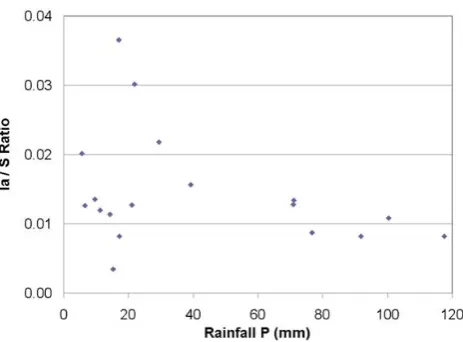
Fig. 2. Initial abstraction ratio Ia/S versus rainfall depthP, for each event.
the retentionS, was calculated by using Eq. (1). Finally, af-ter dividingI a by S, a unique initial abstraction ratio was determined for each event.
Additionally, for comparison reasons, the (Ia/S) ratio was determined in the northern subwatershed. In this part there are no impervious residential areas, as well as no impervious geological formations, in contrary to the southern part of the watershed.
4 Results and discussion
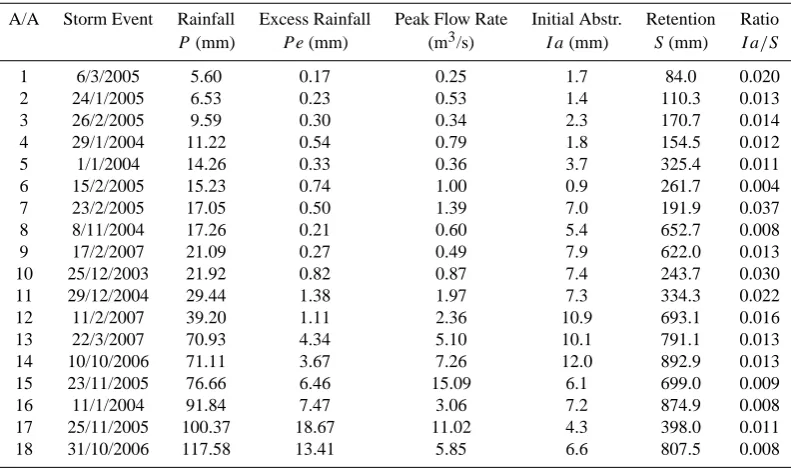
Eighteen storm events were examined and it was found that the average initial abstraction (Ia/S) ratio of the watershed is equal to 0.014. The maximum value was 0.037 and the minimum 0.004 (Table 2). Figure 2 shows that the (Ia/S) ratio is predominantly around 0.01 and is not related to rainfall depthP.
Similar results, concerning the low ratio value, have re-sulted from other studies. Mishra and Singh (2004), eval-uating the impact of the initial abstraction ratio on the effi-ciency of a versatile SCS-CN model, found that as the ra-tio increases the efficiency decreases. The maximum effi-ciency was obtained when the ratio was in the order of 0.01. Based on recent investigations, Jiang R. (2001)and Hawkins et al. (2002) suggest changing the coefficient from 0.2 to 0.05 for use in runoff calculations. Hawkins et al. (2002) deter-mined the coefficient by using rainfall/runoff data from 307 watersheds or plots and a total of 28 301 events in USA. The results showed that the ratio is not a constant from storm to storm, or watershed to watershed, and that the assumption of 0.2 is unusually high. According to the event analysis, the median Ia/S ratio was 0.0476. More than 90 percent of Ia/S ratios were less than 0.2.
Table 2. Storm events.
A/A Storm Event Rainfall Excess Rainfall Peak Flow Rate Initial Abstr. Retention Ratio
P (mm) P e(mm) (m3/s) I a(mm) S(mm) I a/S
1 6/3/2005 5.60 0.17 0.25 1.7 84.0 0.020
2 24/1/2005 6.53 0.23 0.53 1.4 110.3 0.013
3 26/2/2005 9.59 0.30 0.34 2.3 170.7 0.014
4 29/1/2004 11.22 0.54 0.79 1.8 154.5 0.012
5 1/1/2004 14.26 0.33 0.36 3.7 325.4 0.011
6 15/2/2005 15.23 0.74 1.00 0.9 261.7 0.004
7 23/2/2005 17.05 0.50 1.39 7.0 191.9 0.037
8 8/11/2004 17.26 0.21 0.60 5.4 652.7 0.008
9 17/2/2007 21.09 0.27 0.49 7.9 622.0 0.013
10 25/12/2003 21.92 0.82 0.87 7.4 243.7 0.030
11 29/12/2004 29.44 1.38 1.97 7.3 334.3 0.022
12 11/2/2007 39.20 1.11 2.36 10.9 693.1 0.016
13 22/3/2007 70.93 4.34 5.10 10.1 791.1 0.013
14 10/10/2006 71.11 3.67 7.26 12.0 892.9 0.013
15 23/11/2005 76.66 6.46 15.09 6.1 699.0 0.009
16 11/1/2004 91.84 7.47 3.06 7.2 874.9 0.008
17 25/11/2005 100.37 18.67 11.02 4.3 398.0 0.011
18 31/10/2006 117.58 13.41 5.85 6.6 807.5 0.008
Table 3. Initial abstraction ratio in the northern subwatershed.
Storm Event Rainfall Excess Rainfall Peak Flow Rate Initial Abstr. Retention Ratio
P (mm) P e(mm) (m3/s) I a(mm) S(mm) I a/S
22/3/2007 73.5 2.23 1.45 31.3 759.7 0.041
10/10/2006 78.4 1.12 2.05 46.7 867.6 0.054
23/11/2005 92.2 3.93 4.05 26.7 1025.3 0.026
25/11/2005 99.8 10.63 2.28 9.2 681.5 0.014
31/10/2006 111.1 5.42 1.00 42.4 801.2 0.053
more events are necessary for the analysis in this part, the calculated values clearly indicate a higher ratio value. Un-der approximately the same antecedent runoff condition in the entire watershed, the average ratio of the entire water-shed (0.014) is lower than that of the northern subwaterwater-shed (0.037). This is attributed to their differences in the landuses and the geology; the greater percentage of impervious areas (roads, residencies) and impervious geological formations (marls) in the southern part, in combination to the fact that these are located near the outlet of the watershed, leads to the conclusion that runoff from these areas reaches the out-let in a short period of time, at the early stages of the storm. Thus, the initial abstraction of the entire watershed is lower than that of the subwatershed and consequently, this leads to the lower initial abstraction ratio of the entire watershed.
The antecedent runoff condition (ARC) of the watershed in all events is classified as ARC II (average) or III (high) and contributed to the low amount of initial abstraction. Initial
abstraction is proportional to retention. When the retention increases, the initial abstraction also increases. This indicates that the initial abstraction of the entire watershed is not only affected by the impervious areas, either those of the residen-tial area or those of the impervious marls. It also depends on ARC, which among others (NRCS, 2004) depends on the antecedent soil moisture condition of the geological forma-tions.
[image:4.595.112.483.371.460.2]5 Conclusions
The determined values of the initial abstraction ratio are close to the suggested ratio of 0.05 (Hawkins et al., 2002). The average ratio was equal to 0.037 and 0.014 for the northern subwatershed and the entire watershed respectively. Simi-lar low ratio values have been reported from other studies (Hawkins et al., 2002; Mishra and Singh, 2004; Jiang, 2001). Under approximately the same hydrologic conditions in the entire area, the ratio values for the northern and the entire watershed are different. The human intervention, in the form of urban development and the impervious geological forma-tions found in the southern part, contribute to the decrease in the initial abstraction ratio of the watershed. Runoff from these impervious areas reaches the outlet at the early stages of the storm and thus leads to low initial abstraction. On the contrary, the initial abstraction is higher in the northern sub-watershed due to the lack of impervious areas.
Edited by: A. Montanari
References
Hawkins, R. H., Jiang, R., Woodward, D. E., Hjelmfelt, A. T., Van Mullem, J. A., and Quan, Q. D.: Runoff Curve Num-ber Method: Examination of the Initial Abstraction Ratio, in: Proceedings of the Second Federal Interagency Hydro-logic Modeling Conference, Las Vegas, Nevada, U.S. Geolog-ical Survey, Lakewood, Colorado,ASCE Publications, pg.NA, doi:10.1061/40685(2003)308, 2002.
Hjelmfelt, A. T.: Empirical investigation of Curve Number tech-nique, J. Hyd. Eng. Div., 106, 1471–1476, 1980.
Jain, M. K., Mishra, S. K., and Singh, V. P.: Evaluation of AMC-Dependent SCS-CN-Based Models Using Watershed Character-istics, Water Res. Manag., 20, 531–552, 2006.
Jiang, R.: Investigation of Runoff Curve Number Initial Abstrac-tion Ratio. MS Thesis, Watershed Management, University of Arizona, 120 pp., 2001.
Mishra, S. K. and Singh, V. P.: Soil Conservation Service Curve Number (SCS-CN) Methodology, Kluwer Academic Publishers, Dordrecht, The Netherlands, ISBN 1-4020-1132-6, 2003. Mishra, S. K. and Singh, V. P.: Long-term hydrological simulation
based on the Soil Conservation Service curve number, J. Hydrol. Process., 18, 1291–1313, 2004.
Mishra, S. K., Jain, M. K., and Singh, V. P.: Evaluation of the SCS-CN-based model incorporating antecedent moisture, J. Water Re-sour. Management, 18, 567–589, 2004.
Mishra, S. K., Jain, M. K., Pandey, R. P., and Singh, V. P.: Catchment area-based evaluation of the AMC-dependent SCS-CN-inspired rainfall-runoff models, J. Hydrol. Process., 19(14), 2701–2718, 2005.
Mishra, S. K., Sahu, R. K., Eldho, T. I., and Jain, M. K.: An Improved Ia-S Relation Incorporating Antecedent Moisture in SCS-CN Methodology, Water Resour. Management, 20, 643– 660, 2006.
Natural Resources Conservation Service (NRCS): National Engi-neering Handbook, Part 630 Hydrology, U.S. Department of Agriculture, Chapt. 4, Storm Rainfall Depth, 1993.
Ponce V. M. and Hawkins R. H.: Runoff curve number: has it reached maturity?, J. Hydrol. Eng., American Society of Civil Engineers, 1(1), 11–19, 1996.
Soil Conservation Service (SCS): Hydrology, National Engineering Handbook, Supplement A, Sect. 4, Chapt. 10, Soil Conservation Service, USDA, Washington, D.C., 1956.
Soil Conservation Service (SCS): National Engineering Handbook, Sect. 4, Hydrology, Chapt. 10, Estimation of direct runoff from storm rainfall by Victor Mockus, 1972.