Business Administration Dissertations Programs in Business Administration
5-4-2014
The Impact of Systematically Hiring Top Talent: A Study of
The Impact of Systematically Hiring Top Talent: A Study of
Topgrading as a Rigorous Employee Selection Bundle
Topgrading as a Rigorous Employee Selection Bundle
Michael S. Lorence
Georgia State University
Follow this and additional works at: https://scholarworks.gsu.edu/bus_admin_diss
Recommended Citation Recommended Citation
Lorence, Michael S., "The Impact of Systematically Hiring Top Talent: A Study of Topgrading as a Rigorous Employee Selection Bundle." Dissertation, Georgia State University, 2014.
https://scholarworks.gsu.edu/bus_admin_diss/38
PERMISSION TO BORROW
In presenting this dissertation as a partial fulfillment of the requirements for an advanced degree from Georgia State University, I agree that the Library of the University shall make it available for inspection and circulation in accordance with its regulations governing materials of this type. I agree that permission to quote from, to copy from, or publish this dissertation may be granted by the author or, in his/her absence, the professor under whose direction it was written or, in his absence, by the Dean of the Robinson College of Business. Such quoting, copying, or publishing must be solely for the scholarly purposes and does not involve potential financial gain. It is
understood that any copying from or publication of this dissertation which involves potential gain will not be allowed without written permission of the author.
NOTICE TO BORROWERS
All dissertations deposited in the Georgia State University Library must be used only in accordance with the stipulations prescribed by the author in the preceding statement.
The author of this dissertation is: MICHAEL SHEPHARD LORENCE 234 OAKDALE ROAD
BRANDON, MISSISSIPPI 39047 The director of this dissertation is: WESLEY J. JOHNSTON, PHD
J. MACK ROBINSON COLLEGE OF BUSINESS GEORGIA STATE UNIVERSITY
THE IMPACT OF SYSTEMATICALLY HIRING TOP TALENT:
A STUDY OF TOPGRADING AS A RIGOROUS EMPLOYEE SELECTION BUNDLE
BY
MICHAEL SHEPHARD LORENCE
A Dissertation Submitted in Partial Fulfillment of the Requirements for the Degree Of
Executive Doctorate of Business In the Robinson College of Business
Of
Georgia State University
GEORGIA STATE UNIVERSITY ROBINSON COLLEGE OF BUSINESS
Copyright by Michael Shephard Lorence
ACCEPTANCE
This dissertation was prepared under the direction of the MICHAEL SHEPHARD LORENCE Dissertation
Committee. It has been approved and accepted by all members of that committee, and it has been accepted in partial fulfillment of the requirements for the degree of Executive Doctorate of Business in the J. Mack Robinson College of Business of Georgia State University.
H. Fenwick Huss, Dean
DISSERTATION COMMITTEE Wesley J. Johnston, PhD (Chair) Steven D. Olson, PhD
DEDICATION
I lovingly dedicate this work to my wife, Erica. She is, by far, the most important person in my life. Erica worked substantially harder in her vocation as a mother and wife than I did in my vocation as a student writing this
Table of Contents
Chapter I: Introduction ... 1
Significance of the Study ... 2
Why do CEOs care about mis-hire rates? ... 2
The Frequency and Cost of Mis-Hires ... 3
Theme and Purpose of the Study ... 3
Exploratory Questions ... 4
Research Question ... 5
Definition of Terms ... 6
Chapter II: Review of Existing Literature ... 7
The Interview as an Employee Selection Instrument ... 7
How Can Hiring Success Be Improved? ... 23
Chapter III: Research Model ... 35
Design/Approach ... 35
Method ... 35
Procedures ... 40
Methods of Analysis ... 41
The Researcher ... 41
Chapter IV: Results and Analysis ... 42
Analysis of Topgrading Hiring Success Rate: Firm Level ... 42
Analysis of Topgrading Hiring Success Rate: Category Level ... 45
Analysis of Topgrading Hiring Success Rate: Ownership Type ... 48
Analysis of Topgrading Implementation Conditions ... 51
Analysis of Topgrading Implementation—Twelve Step Process Conformance: Firm Level ... 54
Analysis of Topgrading Implementation—Twelve Step Process Conformance: Category Level ... 62
Analysis of Topgrading as a Double Loop Learning Model ... 66
Analysis of Topgrading as a Goal Setting Tool ... 69
Analysis of Topgrading Modes of Value Creation for the Firm ... 71
Analysis of Topgrading: Volume of Data Collection ... 80
Analysis of Topgrading Using Action Research Perspectives ... 83
Discussion of Findings ... 95
Chapter VI: Conclusions ... 107
Significance of the Study ... 107
Limitations ... 107
Recommendations for Action ... 108
Areas for Future Research ... 109
Appendices ... 111
Appendix A: Value Creation Attributed to Each Topgrading Step: Good Eats Company ... 110
Appendix B: Value Creation Attributed to Each Topgrading Step: Brand Consultants Inc. ... 111
Appendix C: Value Creation Attributed to Each Topgrading Step: Auto Supplier Firm ... 112
Appendix D: Value Creation Attributed to Each Topgrading Step: Fun Time Leisure ... 113
Appendix E: Value Creation Attributed to Each Topgrading Step: Rewards For You ... 114
Appendix F: Value Creation Attributed to Each Topgrading Step: Soft Drink Distributor ... 115
Appendix G: Chandler and Torbert’s Research Voices Raw Data Coded for Pre-Topgrading Environment by Step ... 116
Appendix H: Chandler and Torbert’s Research Voices Raw Data Coded for Post-Topgrading Environment by Step ... 117
Appendix I:Example of a Topgrading Job Scorecard with Self-Evaluation by Employee for an Administrative Assistant ... 119
Appendix J: Example of a Topgrading Job Scorecard for Technology Professional ... 124
Appendix K: Sample Topgrading Job Scorecard for Store Director ... 127
Appendix L: Sample Topgrading Job Scorecard for Home Health Care Giver ... 128
Appendix M: Sample Topgrading Career History Form ... 131
Appendix N: Sample Reference Check Call Script and Form ... 136
References ... 140
List of Tables
Table 1. Model I Governing Variables of Single Loop Learning Adapted To Employee Selection ... 18
Table 2. Model II Governing Variables of Double Loop Learning Adapted To Employee Selection ... 19
Table 3. The Employee Selection Bundle of Topgrading Meets the Three Conditions Necessary for Causal Attribution of Economic Performance ... 29
Table 4. Pre- and Post-Topgrading Mis-Hire Rate and Years of Topgrading Experience by Firm ... 42
Table 5. Mis-Hire Rates and Topgrading Experience by Case Category ... 45
Table 6. Average Performance and Implementation Tenure by Case Category ... 46
Table 7 Post-Topgrading Mis-Hire Rates by Firm Type and Size ... 49
Table 8. Topgrading Implementation Conditions ... 52
Table 9 Post-Topgrading Process Compliance by Firm ... 55
Table 10. Ranking of Topgrading Step Implementation Across All Firms ... 57
Table 11. Implementation of Each Topgrading Step in Pre- and Post-Topgrading Environments—Average of All Firms ... 59
Table 12. Topgrading Process Compliance by Firm Category ... 63
Table 13. Topgrading Steps Ranked by Implementation by Firm Category ... 65
Table 14. Topgrading as a Double Loop Organizational Learning Tool ... 67
Table 15. Linkages Between Topgrading and Argyris’s Model II Double Loop Learning (2002) ... 68
Table 18. Forced Ranking for Value Creation: Financial or Operational Improvement ... 76
Table 19. Forced Ranking for Value Creation: Individual Employee Performance Improvement ... 77
Table 20. Forced Ranking For Value Creation: Mis-Hire Reduction ... 78
Table 21. Topgrading Steps With Number of Data Points Collected Pre- and Post-Topgrading ... 81
Table 22. Chandler and Torbert’s Research Voices (2003) Summary for Pre- and Post-Topgrading Environments ... 84
Table 23. Number of Research Perspectives Captured ... 85
Table 24 Topgrading Unique Adaptations by Firm ... 86
Table 25. Unique Adaptations of Topgrading by Step ... 87
List of Figures
Figure 1. The enduring feedback loop of Topgrading. ... 33
Figure 2. Post-Topgrading percentage decrease of mis-hire rates. ... 43
Figure 3. Pre- and post-Topgrading mis-hire rates by firm. ... 44
Figure 4. Pre and post-Topgrading mis-hire rates by category. ... 47
Figure 5. Post-Topgrading percentage decrease of mis-hire rate by category. ... 48
Figure 6. Pre- and post-Topgrading implementation statistics by firm type. ... 50
Figure 7. Post-Topgrading mis-hire rates by firm type. ... 51
Figure 8. Post-Topgrading process compliance by firm. ... 56
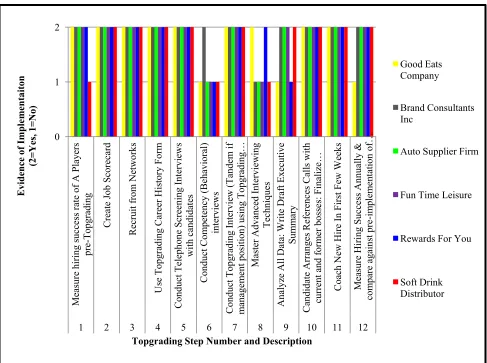
Figure 9. Evidence of implementation of Topgrading steps in pre- and post-Topgrading environment. ... 60
Figure 10. Evidence of implementation for each step of Topgrading after Topgrading implementation by category. ... 64
Figure 11. Impact of each Topgrading step on firm value post-Topgrading. ... 72
Figure 12. Average number of Topgrading steps that create value by mode: All firms. ... 75
Figure 13. Value creation by mode by each Topgrading step: All firms. ... 79
Figure 14. Number of data points collected during each selection process. ... 82
Figure 15. Comparison of total data points collected pre- and post-Topgrading. ... 83
Figure 16. Number of unique adaptations of Topgrading by step. ... 88
Figure 17. Number of unique adaptations and post-Topgrading mis-hire rate by firm. ... 94
Abstract
This research contributes to the employee selection literature by examining the various aspects of
value creation derived from systematic approaches to selective hiring and onboarding best
practices. These best practices covering the end-to-end spectrum of talent acquisition activities
from pre-recruitment to post-hiring performance management are examined through the
construct of employee selection bundles. A rigorous type of employee selection bundle called
Topgrading is examined across six case studies. This research builds on the employee selection
literature by exploring the cross section of organizational learning theory, goal setting theory,
and process management theory on the employee selection bundle as a mechanism that
positively impacts firm performance.
Keywords: employee selection bundle, selective hiring, organizational learning theory,
double loop learning, goal setting theory, process management theory, attribution theory, firm
Chapter I: Introduction
As the global economy becomes more competitive, CEOs are rigorously pursuing
strategies to achieve better firm performance. Selective hiring is one of the most important
strategies CEOs have to improve their firm’s performance (MacDuffie 1995; Vlachos 2008;
Vlachos 2009).
Despite one hundred years of organizational psychology research in the area of employee
selection however, managers are still inept at hiring high performance employees. Previous
research illustrated that the classic interview performs quite poorly as a selection instrument
(Arvey and Campion 1982; Zedeck, Tziner et al. 1983; Arvey, Miller et al. 1987; Dreher, Ash et
al. 1988; Harris 1989; Maxwell and Arvey 1993; Lombardo and Eichinger 1997; Dipboye,
Gaugler et al. 2001). A study of the top human resource executives in Global 100 companies
revealed that hiring managers across various industries averaged an eighty percent mis-hire rate
of senior managers (Smart 2012 c). A mis-hire is defined as an employee who subsequently
turned out to be an underperformer for his/her position (Smart 2005).
There are several reasons why hiring managers pick the wrong people to hire. First, the
interview can cloud the judgment of the hiring manager. The attribution theory provides an
explanation that hiring managers ascribe beneficial judgments to candidates who do not
objectively merit such positive judgments (Herriot 1981; Ramsay, Gallois et al. 1997).
Candidate deception is also a factor because candidates falsify information about themselves.
Fifty-three percent of all people lie on their resumes (Rosenberg 2012).
Furthermore, interviewees have become sophisticated in their attempts to deceive
interviewees tell hiring managers to fool the hiring manager into believe the candidate is the best
choice (Hartsmith 2013).
Significance of the Study
Why do CEOs care about mis-hire rates?
Prior research revealed an important link between effective talent acquisition and firm
performance (MacDuffie 1995; Vlachos 2008). Therefore, understanding the effectiveness of
the firm’s talent acquisition system is important. One approach to quantify the effectiveness of
such a system is to monetize the cost of mis-hires on the firm.
When a hiring manager makes a bad hiring decision, termed a mis-hire, the company
wastes valuable time, money, and effort. The direct costs of mis-hires include training and
recruiting sunk costs; costs associated with testing, interviewing, and human resources (HR)
department time; and travel, training, relocation, compensation, and severance for the mis-hired
person (Smart 2005).
The average cost of each mis-hire is approximately three to five times a person's base
compensation across all industries (Smart 2005; Gravelle 2012). The largest costs of mis-hires
are indirect in nature relating to sub-par employee performance. For example, the average cost
of mis-hiring a sales representative who earns $100,000 per year in compensation is over
$500,000 (Smart and Alexander 2008). This includes the opportunity cost of missed sales by the
low performing sales representative that a high performing sales representative would have
closed.
Not only is the cost of mis-hiring high, but companies may be understating the cost of
this mis-hire by setting the expectation bar too low on new hire performance. One way to
to which hiring managers are satisfied with their new hires (Sullivan, Brophy et al. 2009). Some
firms are defining hiring success as the newly employee simply meets expectations or can do the
job. This seems to set the bar too low for hiring high performers, thus producing low QOH
measurements.
The Frequency and Cost of Mis-Hires
To put this into perspective, consider the cost of mis-hires on the U.S. economy. Using
Gravelle (2012) and Smart (2005) as anchoring points, assume the cost of mis-hiring a manager
is five times the person’s annual compensation. To understand the rate of mis-hires, one can
look to Smart’s longitudinal, multi-decade study that showed only approximately twenty-five
percent of all managers are top performers (Smart 2012 d). This translates to a mis-hire rate of
seventy-five percent of all managers.
Extrapolating this data across the U.S. economy, approximately fifty-one million people
were hired across all industries in the U.S. in 2011 with an average salary of $45,230 (Huber,
Neale et al. 1987; Statistics 2011). If ten percent of all hires in 2011 were managers, then 5.1
million of those hires were managers. Taking the twenty-five percent mis-hire rate previously
cited as a benchmark, approximately 3.83 million mis-hires occurred at the manager level in
2011. Using the previously cited mis-hire cost factored at five times average salary, the cost of
mis-hiring managers for the total U.S. economy is approximately $864.5 billion1 annually, a
colossal proportion.
Theme and Purpose of the Study
The purpose of this study is to study a holistic talent acquisition and talent management
process, and to understand its impact on the firm. Given this purpose and the staggering cost of
Exploratory Questions
If hiring top talent using selective hiring best practices is a key determinant of better firm
performance, why are hiring managers still selecting the wrong people at an alarmingly high
rate? Are there best practices that improve their ability to hire high performers? If so, how do
those best practices of selective hiring affect value creation for the firm?
Examples of employee selection bundles
These questions inspired a search for best practices of talent acquisition that span the
spectrum of recruiting, selective hiring, onboarding, and post-hire performance management.
These practices, defined as employee selection bundles, are the best HR practices linked through
an end-to-end system of talent acquisition that enable the firm to achieve better performance.
There are several models of employee selection bundles that have been fully
implemented in the business landscape over the past fifteen years. One example is the Sales
Talent Acquisition Routine, or STAR process, invented by David Kurlan. This comprehensive
multi-step process covers recruiting, assessing, selecting, and onboarding of high-performing
sales representatives. Another example is Development Dimensions International assessment
center offerings combined with its onboarding and interview offerings of Targeted Selection®
and Strong Start®.
Another type of employee selection bundle that is both rigorous and accepted in the
global business community is Topgrading. Topgrading is a talent acquisition and talent
management process invented by Dr. Brad Smart in the mid-1970s. Topgrading includes best
practices across a broad spectrum of talent acquisition activities including recruiting, job
adopted by several thousand firms ranging in size from Global 100 to small businesses (Smart
2013).
The tactical purpose of Topgrading is to identify and hire only top performers. Top
performers are termed “A Players” in Topgrading vernacular (Smart 2005). Smart defines A
Players as the top ten percent of talent in a given geographic location, at a given salary range, for
a predefined job scorecard. Over the years since its conception, Topgrading methods have been
refined into a twelve-step methodology that is reported to increase hiring success rates to 90% A
Players in some cases (Smart 2012 c; Smart 2012 d).
Building on previously cited research that linked selective hiring and firm performance,
the more A Players a firm has, the better its operational and financial performance (Smart 2011;
Smart 2012 b). Supporting this contention, Smart cited forty case studies that revealed
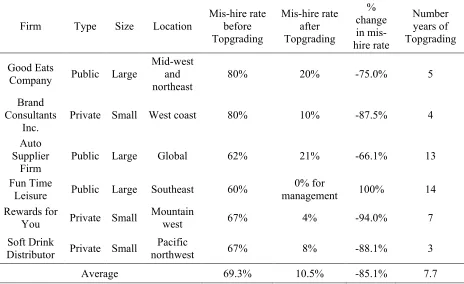
companies who implemented Topgrading increased their hiring success rate from 26% to 85%
(Smart 2012 d). This corresponds to a mis-hire rate change from 74% pre-Topgrading to 15%
post-Topgrading. Given that 39 of the 40 CEOs of these firms stated that their firms’
performance improved because of using the Topgrading methodology, mis-hire rate suggests a
link to the value creation for the firm.
Unfortunately, the amount of research on employee selection bundles such as Topgrading
is small. This brings us to the research question of this investigation.
Research Question
How do employee selection bundles such as Topgrading affect the different aspects of
Definition of Terms
Given that this research is grounded in employee selection literature but explores a novel
approach to hiring, several acronyms and key terms are defined below.
Pre-Topgrading. The employee selection process a firm used before implementing
Topgrading as their employee selection process.
Post-Topgrading. The employee selection process a firm used after implementing
Topgrading.
Process compliance. The level of compliance that a firm implemented in Topgrading
according to the prescribed twelve-step Topgrading process published by Dr. Smart.
Mis-hire. A hiring decision in which the candidate hired did not meet the performance
Chapter II: Review of Existing Literature
The Interview as an Employee Selection Instrument
Employee selection is the process by which organizations select people to hire (Huber,
Neale et al. 1987). It generally requires some analysis of the job itself, followed by a series of
recruiting efforts and interview sessions. Ultimately, the process culminates in deciding whether
to hire or not hire. The previously cited literature showed strong evidence that the standard
interview is a rather poor selection instrument for hiring people. So why do so many companies
still rely on the interview as the major selection tool for hiring? This seems a bit like banging
our heads against a collective theoretical wall.
Decades of organizational psychology research in employee selection has produced a rich
set of findings about the interview as a selection instrument. For instance, the interview is the
most widely adopted selection instrument, and companies still favor unstructured interviews to
structured interviews overwhelmingly (Guion 1976; Harris 1989; Hough and Oswald 2000). This
seems counterintuitive given the fact that these studies proved that the selection validity of hiring
managers is nearly double with a structured interview approach versus an unstructured interview.
Taxonomies for employee selection
A variety of taxonomies have been proposed to understand and analyze the literature
stream of employee selection. A comprehensive review of this literature stream revealed two
overarching schools of thought. One camp of researchers viewed the interview as a social
interaction that can be explained through various decision-making frameworks (Huber, Neale et
al. 1987; Ferguson and Fletcher 1989; Harris 1989; Hough and Oswald 2000) The other camp
questions, and analyses that culminate in a “hire” or “no hire” decision (Herriot 1981; Graves
1993; Ramsay, Gallois et al. 1997).
Examination of the process-oriented approach revealed robust literature describing the
types of interviews and the environmental factors that impact the process of employee selection.
The two basic major forms of interviews are structured and unstructured (Harris 1989).
Understanding the interview as a process is helpful in understanding how to lower mis-hire rates
and increase selection validity. Dipboye provided a basic three-phased approach to understand
the interview process. In this pre-interview, interview, and post-interview rubric, Dipboye
elucidated how, when, and to what extent an interview collects and interprets data about the
interviewee (Dipboye 1982). This intuitive model helped parse out the different stages of the
interview and showed which stages have the greatest propensity of interviewer attribution.
The seminal work by Ferguson and Fletcher examined the process of an interview before
the hiring decision. Ferguson and Fletcher conceptualized the interview into three steps:
acquiring information about the candidate, retaining information about the candidate, and
retrieving information about the candidate (Ferguson and Fletcher 1989).
Unfortunately, a process-oriented approach left several theoretical gaps in the way
investigators explained interview validity. Arvey and Campion’s landmark work on the
selection interview gave insight into the variables that affect interviewers’ decisions of
applicants. They proposed three distinct constructs to explain how the
applicant-interviewer-company interaction impacts interview validity. Applicant data (age, race, sex, appearance, and
educational background), interviewer data (age, race, sex, psychological characteristics,
experience as interviewer, and prior knowledge of applicant), and corporate interview
work in the hiring organization) should affect the ability of the hiring manager to make the
correct hiring decision (Arvey and Campion 1982).
Furthering this holistic approach to a multi-construct view of the interview process,
Hough and Oswald coined the term “personnel selection system” (Hough and Oswald 2000).
They recommended a modular portfolio of constructs approach that can be mixed and matched to
provide optimal interview validity.
However, taking a purely process-oriented approach silenced a competing viewpoint on
the study of employee selection: the social interaction approach. Dipboye explored the social
interaction between two actors (interviewer and interviewee) and discussed the merits of a social
interaction approach to understand how the hiring managers’ decision is impacted by
self-fulfilling prophecy (1982). His three-phase framework debunked the myth that interviews are
“one time” events. Phillips and Dipboye showed that each phase has certain activities that shape
the impressions and ensure social interactions of the interview events (Phillips and Dipboye
1989).
Herriot and Rothwell’s similar approach examined an interview as a social interaction by
revealing how the behavior of the interviewee impacts the interviewer’s decision to offer a
candidate the job (Herriot and Rothwell 1983). Ramsay et al. straddled both the process and
social interaction perspectives when exploring how the conformance or lack thereof, to basic
social norms affected the selection decision of a hiring manager. They concluded that the
interview is classified into two separate process related segments introducing the idea of social
processes, which are the social norms that govern the separated out processes of the interview,
and information processes, which cover the collection and synthesis of interview data (Ramsay,
How are employee selection decisions measured?
The employee selection literature commonly makes use of validity as a quantitative
research tool to measure hiring success rate and prove causality of a certain hiring technique(s)
(Zedeck, Tziner et al. 1983; Arvey, Miller et al. 1987; Dipboye, Gaugler et al. 2001). Selection
validity, defined as hiring success rate within the context of this paper, ranges from 0.1 to a high
of 0.5 with an average validity of unstructured interviews hovering at approximately 0.2 (Arvey
and Campion 1982; Zedeck, Tziner et al. 1983; Arvey, Miller et al. 1987; Dreher, Ash et al.
1988; Harris 1989).
The rate of allowable mis-hires has even garnered the attention of the U.S. government.
The government claims that a validity range between .21 and .35 is an appropriate goal (Saad,
Carter et al. 2000). In other words, hiring a productive employee three out of ten times is
sufficient for the U.S. federal government standard.
However, a review of this literature revealed that investigators have not done a
comprehensive job in defining the different types of validity used in industrial and organizational
psychological research. Three different types of validity must be considered when building a
thorough body of research. The three types are internal validity, construct validity, and external
validity (Gibbert, Ruigrik et al. 2008). Investigation of the previous research for these three
constructs reveals unclearly defined terms such as “overall validity”, “predictive validity”,
“general validity”, “content validity”, “simple validity”, “incremental validity”, and “validity”.
Multiple, unclearly defined terms create an obstacle for researchers. To understand the
impact of employee selection bundles on the firm, reviewing the definitions of validity and
related terms can clarify the implication of validity. Internal validity, also called logical validity,
al. 2008). Ideally, the researcher is to provide a logical, compelling reason that underlies the
relationship between the input and output variables.
Construct validity refers to the purity of the construction or operationalization of the
construct being observed; that is, the extent to which a study investigates what is claimed to be
investigated (Gibbert, Ruigrik et al. 2008). Stated otherwise, what is being measured actually
leads to an accurate instance of reality (Denzin and Lincoln 1994). In the previously cited
employee selection research, the constructs studied which were used to measure validity may or
may not have appropriate construct validity. Since construct validity was not addressed,
conjecture cannot be made that construct validity was present.
Finally, external validity is derived from internal and construct validity. External validity
deals with the very important topic of generalizability from the study to some other sample or to
the rest of the world (Gibbert, Ruigrik et al. 2008). For this research, selection validity is a
measure of the selection instrument’s ability to predict a candidate’s performance after being
hired.
How should employee selection decisions be measured?
Given the previous findings, the use of validity as the chosen metric of measuring hiring
performance creates questionable theoretical grounding since selective hiring is a key driver of
firm performance. Therefore, understanding the hiring success rate within the context of firm
performance is necessary. In other words, if we are not going to use validity, what should we
use?
Herriot (1993) proposed a contrarian view to the widely held practice of using validity as
the most important metric of employee selection by contending that validity is the wrong metric
achieving their business goals (Herriot 1993). Furthermore, Herriot claimed that validity is a
largely academic metric that has little relevance to the hiring manager in the field.
Herriot’s assertions encouraged a new stream of employee selection research that focused
on measurements that are indirectly or directly related to firm performance instead of selection
validity. Taking Herriot’s point as an important call to action for practitioner-oriented, engaged
scholar researchers, this research seeks to explore employee selection bundles and how they
create or destroy value.
Why do hiring managers make bad hiring decisions?
Hiring managers want to hire top talent, although previous research showed they struggle
with hiring top talent. Why? The literature suggested three common root causes. First, there is
attribution bias which occurs when hiring managers draw incorrect conclusions about a
candidate’s future performance. Secondly, hiring managers do not have a mechanism to expose
this mis-hiring problem, and thus they do not learn how to fix it. In essence, this is an
organizational learning problem that lacks a structured feedback loop to cast a bright, shiny light
on the problem of mis-hiring.
The third major root cause of mis-hiring relates to process management. Graves (1993)
and Herriot (1981) conceptualized employee selection as a process-oriented phenomenon.
Without a structured, systematized procedure that governs the employee selection process,
organizational learning, along with process improvement required to improve the underlying
process, is exponentially more difficult. The following literature review addresses these three
separate root causes within the context of their respective literature streams and relates the
Attribution theory
Attribution bias is a widely documented and well researched area of organizational
psychology. The foundational attribution theory research between the early 1950s through the
mid-1980s is summarized in two main bodies of work published by (Kelley and Michela 1980;
Harvey and Weary 1984).
Kelley and Michela’s investigation of this literature stream defined attribution theory as
the examination of perceived causes of other persons’ behavior (1980). Similar literature bore
out several different applications of attribution bias and how it reduces interview validity. One
example is the incorrect placement of causality regarding the results a candidate produced or
failed to produce in a previous job. The interviewer may believe that a candidate was not the
reason that the candidate’s department created exceptional results in his previous company.
Theoretically this occurs when an interview is given consensus information that an
interviewee’s behavior mimics that of a consensus population. In this case the attribution that
the interviewer gives the interviewee is credited to the environment the employee works in,
rather than to the actions of the employee himself. For example, the interviewer makes the
assessment that the sales person met sales quota for eight consecutive quarters because he had an
easy territory in which to farm and close leads (Kelley and Michela 1980). Actually, the territory
was not an “easy” territory.
Wiener (1979) showed that perceived stability of a person’s skills is a factor in attributing
his success to him or his environment. For instance, if the skills of a candidate are thought to be
high, the hiring manager will be more apt to attribute success in the candidates’ previous job to
Another form of attribution bias is trust based on similar experience. This is known as
consistency of information. The more consistent or distinctive an observers’ experience is with
an event, the more confident he is in his assessment of the event, resulting in the thought that the
observer trusts his reactions to these experiences when the experience is similar to historical
experiences over time or distinctive from historical experiences over time (Kelley and Michela
1980).
The negative effect of information consistency bias does not stop there. Kelley and
Michela (1980) cited several studies that revealed the effect of intensity of conformance or
difference to an observer’s own beliefs as it relates to confidence in the observer’s assessment of
another person. For example, if an interviewer interviewed two different people, and one of the
persons displayed a behavior that had wide variance to an accepted norm, the interviewer would
think he requires less observations than that of the high variance person to make an effective
judgment of the wide variance person’s abilities (Kelley and Michela 1980).
Primacy effect is a third type of attribution bias that suppresses hiring success. Salience
and primacy were also shown to affect information as an antecedent. Kelley and Michela
described how observers will attribute cause to the most salient of all observations (1980).
Primacy was shown to effect attribution such that an observer will investigate a sequence of
information until he is able to make an attribution from a piece of data. After the attribution is
made, the observer will neglect later information or incorporate it into his already predefined
attribution (1980).
Interviewer motivation creates yet another form of attribution bias. Human beings have
motivations in the form of interests, desires, social standing, and a sense of abilities perceived by
process. Motivations will drive a person to either make or not make attributions to the extent his
desires are affected by such attribution (Kelley & Michela, 1980). For example, if a hiring
manager is pressured to fill an open position quickly, he may attribute positive characteristics to
a candidate that, under normal circumstances, would not elicit the same assessment.
Timing works similarly to interviewer motivation when committing attribution errors.
Interviewers have a tendency of placing excessive importance on data gathered early in the
interview (Herriot 1981). This is known as the “first impression effect,” and Herriot showed that
interviewers underestimate this effect.
Building upon Herriot’s work, Ramsay et al. studied the impact of social norms that bind
interview behavior. If an interviewee displays socially undesirable behavior such as not having
good communication skills, displaying a lack of self-confidence, providing unclear answers, or
not having a good vocabulary, then the interviewer tends to make negative attribution (Ramsay,
Gallois et al. 1997).
First impression bias is closely related to timing bias as postulated by Herriot (1981).
First impressions appear to be important in the employee selection process. Tucker and Rowe
(1979) examined the effect of pre-interview review of a candidate’s application data in relation
to that candidate’s selection. Their findings showed that an interviewer will likely attribute
success to a candidate if the interviewer had a positive expectancy of the candidate based upon
pre-interview data (Tucker and Rowe 1979). The same interviewer will tend to make stronger
external attribution about any failure the candidate may have had.
A final example of attribution bias at work in the selection process is unfavorable
information bias. When unfavorable information is brought forth during an interview, that
incorrectly assesses the candidate against the expected performance construct(s). This, in turn,
increases the probability of a mis-hire.
Organizational learning theory
If attribution theory explains how hiring managers hire the wrong person, organizational
learning theory explains why the problem has failed to be fixed. Rooted in action research, the
organizational learning literature stream illustrates that the people who are thought to be the
smartest and most capable people, such as executives and hiring managers, are in fact not very
good at organizational learning (Argyris 1991).
As Argyris discovered, this organizational learning deficiency is particularly vexing for
several reasons. For example, well-educated, motivated, “type A” people who occupy key
leadership positions are adept at solving problems in the external environment. When they need
to critically examine their own behavior and the contribution their own behavior has on
organizational problems, however, learning breaks down.
Relating this to the mis-hiring problem, hiring managers are not capable of critically
examining their own behavior to understand how, why, and to what extent they continue the
perpetuation of mis-hiring. To make matters worse, executives, such as those who occupy hiring
manager positions, rarely experience failure in their lives. This lack of experience in failure
stunts their ability to learn from their mis-hiring failures. Argyris called this single loop learning
(Argyris 1991).
Argyris coined the term single loop and double loop learning to conceptualize the theory
behind organizational learning. Single loop learning occurs when errors are corrected without
learning occurs when errors are corrected by changing the overall governing values of the system
in addition to the actions that create the errors (Argyris 2002).
Argyris also illustrated the point of difference between single loop and double loop
learning by using a common household example. Single loop learning is like a thermostat that
turns on the heat if the room becomes too cold. Double loop learning would be a thermostat that
questions why it is programmed to turn on at sixty-eight degrees, and then adjusts itself upward
to seventy degrees given the desires of those that live in the house (1991, 2002).
Single loop learning neutralizes the organization’s ability to fix the mis-hiring problem.
This concept, called antilearning, occurs with relative predictability (Argyris and Schon 1974).
Antilearning is rooted in the theory of action perspective. Moreover, theory-in-use is the most
prevalent set of rules for behavior that an individual uses to conceive and implement such
behavior. These actions and rules become so engrained in a human being’s thought process that
people do not even recognize they are engaging in such behavior (Argyris 1991).
The theory-in-use that is most prevalent in a manager’s behavior is known as Model I.
Model I is composed of four governing variables. They are (a) be in unilateral control; (b) strive
to win and not lose; (c) suppress negative feelings; and (d) act rationally. These four variables
relate well to employee selection. See Table 1 which applies Argyris, Putnam, and McLain
Smith’s Model I description to the typical unstructured employee selection process (Argyris,
Table 1
Model I Governing Variables of Single Loop Learning Adapted To Employee Selection
Governing
variables Employee selection context Consequences for learning
Be in unilateral
control Hiring manager seeks authority and control in order to make himself look good with this hiring decision
Self-sealing
Strive to win and
not lose Hiring manager gets defensive when confronted with his role in mis-hires Single loop learning
Suppress negative feelings
Hiring manager emphasizes diplomacy and tact in interviews, does not delve into risky questions that create negative feelings with candidate or HR department
No testing of hiring theories publicly, only test theories privately
Act rationally Hiring manager conforms to previous hiring
norms, avoids risk taking
Model I, much like a piece of software running in the brain of the hiring manager without
him knowing it, tells him to “form (his) positions, evaluations, and attributions in ways that
inhibit inquiries into and testing of them with the use of independent logic” (Argyris 2002).
Argyris points out that the consequences of this Model I software are likely to result in
defensiveness and self-sealing processes (Argyris 1982). Hence, mis-hiring is perpetuated.
Extensive use of Model I strategies results in what Argyris referred to as organizational
defensive routines. Organizational defensive routines, similar to Model I theories-in-use,
suppress valuable, necessary organizational and individual learning. That is, these defensive
routines have considerable inertia and are not easily overcome (Argyris, Putnam et al. 1985;
Argyris 1990).
The following is an example of how the organizational defensive routine of mis-hiring
might sound scripted into an organization. “John, we want you to hire great people. But don’t
time-to-with the governing values of the system. John must then act as if there is no inconsistency time-to-with
this message. He is not permitted to discuss this inconsistency, nor is he permitted to talk about
the inability to discuss his situation. In effect, he is trapped inside what Argyris calls the “doom
loop” (Argyris 1990). The doom loop is a perpetual state of dysfunction with little chance of
eliminating the dysfunction.
Model I strategies lie in sharp contrast to Model II strategies. The three governing values
for Model II are (a) valid information, (b) informed choice, and (c) vigilant monitoring of the
implementation systems that generated the choice in order to detect and defeat errors. See Table
2 which translates Argyris et al.’s Model II into employee selection (Argyris, Putnam et al.
1985).
Table 2
Model II Governing Variables of Double Loop Learning Adapted To Employee Selection
Governing variables Employee selection context Consequences for learning
Valid information Hiring manager digs deeply into candidate’s background including uncomfortable
weaknesses; hiring manager’s hiring success is measured, reported, and reviewed in a non-defensive manner
Unconfirmable processes
Informed choice Hiring manager makes selection using an
informed set of criteria without fear of his choice
Double loop learning
Internal commitment to the choice and constant monitoring to detect and defeat errors
Review mis-hire rate; understand and debate drivers that affect mis-hire rate
Public testing of theories
lack of valid information on both the candidate and the hiring manager’s performance.
Furthermore, if there was a way to create a better, richer set of valid information on the hiring
manager’s performance as a hiring manager, and on the candidate’s themselves, then Argyris’s
Model II system tells us that organizational learning will increase and selection performance will
improve.
Argyris’s action research concept of Model II system relates to Chandler and Torbert’s
model for action research perspectives. In their seminal 2003 article, Chandler and Torbert
proposed a model that identifies “twenty-seven flavors” of action research built on three different
variables of research voices, research practices, and the time continuum. The twenty-seven
perspectives are derived from 3 Time Perspectives (past, present, future) x 3 Research Voices
(first person, second person, third person) x 3 Practices (first person, second person, third person)
= 27. This schema sought to organize inquiries and experiences into meaningful categories
(Chandler and Torbert 2003).
Using a theoretical action research lens to view and understand the employee selection
process is helpful. Consider the parallels between action research and employee selection.
Action research is the methodology that seeks to understand past events, present phenomena, the
ongoing interaction of human dynamics, and future intentions (Chandler and Torbert 2003).
This is very similar to the methodology a hiring manager uses to vet, screen, and select a
candidate for employment.
By conceptualizing every discrete employee selection decision as a mini action research
project, better understanding of why hiring managers’ mis-hire is acquired. Employee selection
literature documents that a hiring manager uses information processing strategies to gather data
the present circumstances of the candidate (Ferguson and Fletcher 1989). Chandler and
Torbert’s research perspectives model inferred that employee selection is largely a second person
research activity (i.e., the hiring manager and his HR team) being conducted on first person
performance in the past tense (i.e., the candidate’s employment history) in order to make
predictions about the candidate’s future performance (i.e., the employee’s likelihood of meeting
expectations post-hire).
Furthermore, Chandler and Torbert contended that the more research perspectives the
investigator includes in the research, the greater the variance explained by the observable
outcome (Chandler and Torbert 2003). If Chandler and Torbert were correct, then the hiring
manager who collects a greater proportion of the twenty-seven perspectives during the interview
process will be able to make a better hiring decision. The selection apparatus that will help the
hiring manager make an accurate hiring decision does so because he is better able to predict the
post-hire performance of the candidate.
Up to this point the literature has provided several root causes that help explain why
hiring managers make bad decisions. These causes include attribution errors and organizational
learning problems; however, there is one more literature stream that provides insight into why
mis-hires occur—business process management. Because Dipboye and Harris conceptualized
employee selection as a process-oriented phenomenon, an examination of process-related
literature may give understanding as to how and why employee selection processes work or fail
(Dipboye 1982; Harris 1989).
Process management theory
Process management based view of the firm defines a business as a system of interlinked
Additionally these interlinked processes roll up to create organizational routines (Benner and
Tushman 2003). If these organizational routines are not stabilized, efficiency and financial
performance are sacrificed (Hammer and Stanton 1999).
Process management theory provides an important link between a process management
based view of the firm and the organizational learning ability of the firm mentioned previously.
Recalling Argyris’s single loop learning model, Argyris used the same construct of
organizational routines. He described how those organizational routines that damage the
company’s ability to learn are considered defensive organizational routines. Thus if a firm’s
processes for organizational learning are not stable, defensive organizational routines cannot be
overcome, single loop learning persists, and mis-hires continue.
This science and practice of improving organizational processes has proven difficult for
practitioners. Much to the chagrin of management, process improvement efforts frequently yield
only short-term efficiency improvements that fade over time. In some instances organizational
performance is worse after the improvement effort has concluded than before the effort began.
Scholars see these efforts as implementation failure (Morrison 2011).
Understanding and recognizing these process improvement modes of failure provide
further insight into why hiring managers continue to mis-hire. Moreover, understanding how
and why process improvement initiatives fail may preempt the roadblocks that will inevitably
stand in the way of process improvement initiatives focused in the employee selection process.
Previous research in process management has shown that there are several attributes of
successful process management. One of those attributes relates to an organization’s commitment
and Larcker 1997). Digging deeper into these two attributes provides insight into some of the
boundary conditions necessary for executing successful, enduring process change.
There are several components to an organization’s human resource practices that must
change in order for process changes to remain in place and efficacious. Examples of those
changes include increased training in problem solving and learning, greater use of teams for
cross-functional cooperation, and increased decentralized autonomy for employees to respond to
errors in the process without requirement of management approval.
Information utilization and organizational commitment are two additional attributes of
successful process management. Information utilization refers to the idea that a process will
likely not be improved unless some benchmarking of the processes to be improved is done and
communicated to the workforce (Ittner and Larcker 1997). Ittner and Larcker also showed that
researchers regard organizational commitment as one of the most important conditions necessary
for successful, lasting process improvement (1997). Without the commitment of top
management, the organizational inertia that must be overcome to create enduring change is too
great.
How Can Hiring Success Be Improved?
The three literature streams of attribution theory, organizational learning theory, and
process management theory reviewed in the previous sections shed insight into the numerous
problems that rob the hiring manager of making a good decision. What can be done to reduce
mis-hires?
The literature suggests several antidotes. First, using a hiring process that attenuates the
negative impact of attribution bias can help improve a hiring manager’s ability to select the right
successful attributes of process management covered in the previous section are necessary.
Third, increasing organizational learning by snuffing out single loop learning and replacing it
with double loop learning will help. These three strategies may be efficacious, but they will
likely not occur unless there is a paradigm shift in the way employee selection is viewed.
Therefore, a redefinition of employee selection is needed. Redefining employee selection
as an end-to-end collection of processes rooted in best practices that encompass a broad spectrum
of employee selection, onboarding, and talent management is necessary to generate better hiring
success, resulting in better firm performance. To illustrate this point, a discussion about hiring
methods that lead to better hiring success rates will be reviewed, followed by a section about
redefining the employee selection paradigm as employee selection bundles.
Choosing a structured over an unstructured interview
When a hiring manager seeks to attenuate attribution error, the type of interview format
chosen is important. Structured interviews produce better selection validity than unstructured
interviews (Arvey and Campion 1982; Harris 1989; Hough and Oswald 2000). A review of
different interview formats and their corresponding hiring success rates provides additional
insight regarding improving hiring success.
Harris proposed three major interview formats that explain how corporate America hires
people. Behavioral Description Interviews (BDI) focus on past behaviors as it is based on the
closely held belief that “the best predictor of future behavior/performance is the past
behavior/performance” (Harris 1989). Comparatively, Situational Interviews focus on what the
applicant would do in a particular situation. Comprehensive Structured Interviews (CSI) use a
scorecard to rate a host of variables such as situation, job simulation, and job requirements of
Harris (1989) showed that the validity of structured interviews is double that of
unstructured interviews. Of the three main types of interviews, CSI yielded the highest validity
at 0.56. The next most effective interview format was BDI. BDI is less structured than CSI but
more structured than Situational Interviews and yielded a validity of 0.54. The poorest
performing interview type was Situational Interviews. These types of interviews yielded a
validity of 0.3. The validity is lower likely because this format is a less structured approach.
Given this link between lower mis-hire rates of highly structured interviews, Harris
(1989) provided an explanation of the linkage. He stated that the negative effects of attribution
are better attenuated in a structured interview. One reason is that structured interviews reduce
the variability questions asked during the interview. When the interviewer asks a standard set of
questions to all candidates, the interview reduces overemphasizing negative information
discovered early in the interview. This supports the earlier reference to primacy. Previously
stated, once an observer determines an attribution, he stops looking for additional attribution
opportunities. In a sense, structured questions neutralize the effect of attribution.
Reduction of attribution bias due to primacy is also seen in the number of questions asked
during an interview. Harris (1989) proved that when negative views of the candidate form in the
mind of the interviewer, which is termed confirmatory bias, the interviewer will tend to ask
fewer questions. Structured interviews help the interviewer from slipping into this mistake.
Another reason why structured interviews produce better selection validity is that the
interviewee cannot manipulate the interviewer as easily. Drawing on Gilmore and Ferris’s
research on impression management, interviewees are not as able to provide “right” or “wrong”
answers to questions, which is often the case in unstructured interview questions (Gilmore and
Harris (1989) showed the effects of mis-attribution are less pronounced during structured
interviews because the interviewer is forced to ask a relatively scripted set of questions to each
interviewee. In an unstructured interview, the interviewer tends to ask fewer questions if a
negative view of the candidate is perceived by the interviewer.
Arvey and Champion confirmed some of the same findings of Gilmore, Ferris, and Harris
by postulating several root causes of lower validity in unstructured interviews. One reason is
that there are inconsistent questions asked across the interviewee population leading to different
data collected and different answers provided by the candidates (Arvey and Campion 1982).
Also, interviewers tend to do most of the talking in an unstructured interview, and finally,
interviewers tend to make their hiring decision too quickly in unstructured interviews.
Synthesizing this literature, structured interviews clearly reduce mis-hire rates. However,
addressing the causes of attribution theory in employee selection does not go far enough in
addressing the mis-hiring problem. A complete paradigm shift on how hiring managers view the
hiring process is proposed. The approach will be reviewed in the follow section.
Redefining the scope of the employee selection process
Redefining the paradigm of employee selection is the second of two actions to improve
hiring performance. Although this seems to be nothing more than a nuance at first pass, this is
perhaps one of the most important insights of this research. The justification for such a
redefinition of employee selection is that much of the previous literature cited on employee
selection narrowly defines hiring success through the lens of a standalone interview. A more
contemporary view of employee selection uses the paradigm of an HR bundle to define an
In review, Zedeck et al. defined employee selection as job analysis tasks, followed by a
series of recruiting efforts and interview sessions (Zedeck, Tziner et al. 1983). The culminating
event ends in a hire or no-hire decision. Given that some firms engage in other human resource
related activities that fall outside of Zedeck et al.’s definition of employee selection, a broader
view of employee selection should be taken. Firms also engage in recruiting, performance
management, and aligning company strategy to individual performance, sometimes called
performance management.
The entire spectrum of HR best practices in recruiting, job evaluation, interviewing,
onboarding, and post-hire performance management can be better defined as an HR bundle
(MacDuffie 1995). The bundle concept was introduce in MacDuffie’s work on HR best
practices in which he showed that HR bundles are interrelated to HR best practices that work
together to create value for the firm by improving firm performance (MacDuffie 1995).
MacDuffie provided justification for this bundle paradigm by citing previous works
which showed that focusing on and measuring an individual HR tactic (i.e., hiring success rate)
may produce misleading results when linking those observations to firm performance
(Ichniowski, Shaw et al. 1993). In other words, there can be a generalizability problem when
trying to isolate the impact of a singular HR best practice, like interviewing method, to a macro
measurement relating firm performance.
Human resource bundles: What do we know about them?
MacDuffie defined a human resource bundle as an isolated set of HR practices that
cluster into work system or HR policies (1995). He argued that that human resource bundles can
be a primary source of competitive advantage in a firm, and he reviewed the three conditions
(a) employees possess skills that managers lack; (b) employees are motivated to apply this skill
through discretionary effort; and (c) the firm’s strategy can only be achieved when employees
contribute this discretionary effort (Levine and Tyson 1990; Bailey 1992). The converse is true.
If any of these three conditions are not met, then the HR bundle may not be causally linked to
firm performance.
Building on MacDuffie’s work, Vlachos’s review of Pfeffer’s work on the seven HR
management best practices provides the justification necessary to merge together the concepts of
HR bundles and employee selection into the construct of employee selection bundles.(Pfeffer
1998; Vlachos 2008). Specifically, Pfeffer identified seven major HR best practices: (1)
employee security; (2) selective hiring; (3) self-managed teams and decentralization of decision
making; (4) compensation linked to organizational performance; (5) extensive training; (6)
reduced status distinction between managers and front line workers; and (7) extensive sharing of
financial and performance information across the entire organization.
Vlachos proved that selective hiring, Pfeffer’s second of seven best practices, was found
to be a significant predictor of all firm performance measures (2008). Therefore, employee
selection is one of the most, if not the most, important component of the HR bundle. Given the
importance of selective hiring, employee selection is defined in this research as its own unique
HR bundle termed the employee selection bundle.
Topgrading as an employee selection bundle
This leads to an important question. Does Topgrading stand up to MacDuffie’s (1995)
test of being an employee selection bundle that can be linked to improved economic performance
of the firm? The short answer is yes. Drawing in MacDuffie’s use of this same rubric, Table 3
conditions required to causally link increased economic performance to this employee selection
bundle.
Table 3
The Employee Selection Bundle of Topgrading Meets the Three Conditions Necessary for Causal
Attribution of Economic Performance (MacDuffie 1995; Smart, Mursau et al. 2012)
Step Description of Topgrading steps Skill/
knowledge
Motivation/ commitment
Integration of HR with execution and
strategy
1 Measure hiring success rate of A players pre-Topgrading X X
2 Create job scorecard X X
3 Recruit from networks X X
4 Use Topgrading career history form X X X
5 Conduct telephone screening interviews with candidates X X
6 Conduct competency (behavioral) interviews X X
7
Conduct Topgrading interview (tandem if management position) using Topgrading
interview guide X X X
8 Master advanced interviewing techniques X X X
9 Analyze all data: Write draft executive summary X X
10
Candidate arranges references calls with current and former bosses: finalize executive summary
X X
11 Coach new hire in first few weeks X X X
12 Measure hiring success annually & compare against pre-implementation of Topgrading X X
Topgrading steps three through eleven serve as the engine of selectivity in the hiring
process, illustrating how Topgrading creates an environment where the employees who are hired
Recruiting from networks, Topgrading step three, injects more high quality candidates
into the top of the funnel. Just like a funnel, Topgrading steps four through eleven create a
filtering mechanism that systematically reduce the pool of candidates until the hiring manager is
left with only the highest quality candidates. Resultantly, persons hired through Topgrading are
inclined to have differentiated, unique skills and knowledge as compared to their managers.
Addressing MacDuffie’s (1995) second necessary condition for economic performance of
the firm, motivation and commitment are thought to be created by all twelve Topgrading steps.
Using MacDuffie’s logic, employee selection bundles are additives such that different individual
practices of the bundle reinforce other elements. The Topgrading steps that create unique skill
and knowledge (steps three through eleven) help reinforce those steps that create employee
motivation.
Topgrading steps one and twelve create motivation for the hiring manager to improve his
hiring success rate. Smart (2012c) showed that the average hiring success rate, as defined by
percent of A Players hired, was approximately 25%. When hiring managers understand how few
A Player they have hired in the past, they have motivation to improve their hiring success rate.
Furthermore, when the hiring managers understand that the cost of mis-hires is three to
twenty-four times (Smart 2005; Gravelle 2012), and they monetize those costs against their previous
mis-hires, they have even greater motivation to improve hiring success rate.
Topgrading step one encourages goal setting of hiring success rate. Specifically, Smart
instructed hiring managers to set the hiring success rate at between eighty and ninety percent
(2012c). Topgrading steps two through eleven are postulated to create well-defined expectations
Topgrading steps reduce the common confusion of ill-defined position descriptions, vague goals,
and improper fit of the candidate to the position.
Topgrading also incorporates MacDuffie’s third necessary condition for causal linkage to
economic performance. When the employee selection bundle is integrated with core business
practices, it is thereby linked to the firms execution and strategy (MacDuffie 1991). In reference
to Table 3, there are several Topgrading steps that link directly to the firm’s strategy and
execution. Those steps are those that reinforce measurement of hiring performance and link day
to day employee activities to overall firm strategy.
Job scorecarding, which is Topgrading step two, links the employee’s activities to the
firm’s strategy by creating a set of specific, measurable accountabilities. The measurable
accountabilities of those scorecards are cascaded from the firm’s strategy into the individual job
for which the candidates are being considered (Smart 2012 d). Furthermore, those job scorecards
are discussed during the various steps of the interviewing, screening, and reference checking
processes (Topgrading steps three through ten). The job scorecards are implemented and used as
a feedback and coaching tool during the onboarding phase (Topgrading steps eleven and twelve).
Measurement of hiring success rate is thought to link the firm’s talent acquisition
practices with the firms overall strategy. Kaplan and Norton called this alignment (Kaplan and
Norton 1996). Alignment provides direct linkage between the newly hired person’s day to day
activities and the firm’s overall strategy. This seems to be supported by the forty case studies in
which thirty-nine of the forty CEOs of those case study firms cited the employee selection
bundle Topgrading as being directly responsible for improving the performance of their firms
Summarizing the literature review up to this point, the argument for this proposal is built
on several theoretical insights. First, previous research shows that firm performance is
connected to human resource best practices called HR bundles (MacDuffie 1995). Selective
hiring, featured here as an employee selection bundle, drives better firm performance (Vlachos
2008). Third, the employee selection bundle Topgrading meets the three criteria required to
ascribe causal attribution of this employee selection bundle to firm performance (MacDuffie
1995; Smart 2012 d). Fourth, the employee selection bundle Topgrading has been shown to
improve firm performance through a case study body of research (n=40) (Smart 2012 c).
The question remains of which theoretical lens should be used to understand how
employee selection bundles create or destroy value for the firm. Goal setting theory provides a
practical theoretical lens through which to understand value creation derived from employee
selection bundles.
Goal setting theory as a rival explanation
Quite simply, what gets measured gets improved. But according to Smart (2012c), hiring
managers rarely track, measure, and report their hiring success rate. If hiring success rate is not
measured, tracked, and reported over time, there is little incentive for the hiring manager to
improve his selective hiring skills.
Goal setting theory states that setting specific, challenging goals leads to higher
performance (Locke and Latham 2002). Moreover, goal setting has the ability to focus a
person’s efforts towards a stated goal, sustain that person’s efforts over time, and motivate the
goal chaser until the goal is ultimately met (Colineau and Paris 2009). Lock and Latham reported
that goals affect action by arousing a goal chaser to use task relevant knowledge and strategies at
The employee selection literature is silent on using goal setting theory to explain how or
why employee selection impacts the firm. This new application of goal setting can be applied to
employee selection bundles by measuring hiring manager hiring success rate. When a firm
implements an employee selection bundle such as Topgrading, hiring managers are measured
against their firms’ hiring success rate goal. Moreover, these hiring managers are expected to
eventually achieve eighty-five percent or better hiring success rate which corresponds to 15% or
lower mis-hire rate.
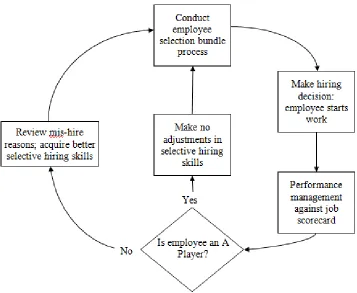
This measurement, tracking, and reporting system of mis-hire rate serves as an enduring
feedback loop to the hiring manager. Therefore, the author hypothesizes that goal setting theory
is a theoretical root cause that will help explain how employee selection bundles create value for
[image:46.612.112.469.422.715.2]the firm. See Figure 1 for a depiction of this process.