
HONEYWELL
I
MULTICS
----"'--_._-_._-. ---_._-_.. .
THE MULTICS
- •.. -_._--_ .. _-_ .. _---- "-.-.. -....VIRTUAL
. ---. __Honeywell
THE MUL TICS VIRTUAL MEMORYMULTICS
SUBJECT:
Technical Papers on the Multics Virtual Memory as Designed for Model 645 Implemen-tation.
SPECIAL INSTRUCTIONS:
These technical papers are reprinted here for theoretical and historical purposes only.
DATE:
June 1972
ORDER NUMBER:
PREFACE
This document consists of three technical papers which describe the theory and
practice of Multic s virtual memory implementation. Multic s (Multiplexed .!nformation and
Computing Service) is a general purpose computer system which has been designed to be a
"computer utility." As such, it is essential that Multics provide its users with sufficient
resources to do a wide variety of tasks and that the system be protected from destructive
interac.tions between users. The papers address the theory, the practice, the hardware,
and the software used to provide an effectively infinite memory to each user and to protect
both the users and the system.
The first paper discusses the concept of a virtual memory and explores several ways
in which such a melnory could be implemented. The method used to implement the Multics
virtual memory on the Series 600 Model 645 proces.sor is developed in detail~ This paper
is of historical importance and presents valid Multics design theory although the Model 645
is no longer used as the Multics processor.
The second pap er extends the discussion further into the subject of protection. The
theory of the Multic s ring structure is introduced and its implementation on the Model 645
is described. This theory is still valid although the Model 645 is no longer used as the
Multics processor.
The third paper shows how the features described in the tW() earlier papers are
handled by hardware under the optional Multics modifications to Series 6000 processors.
Several new processor features are introduced and described.. Use of these features allows
Multics to run on the Series 6000 processors, specifically the Model 6180, with greatly
increased efficiency as compared with the .earlier implementation of Multics on the Series
600 processors.
© General Electric Company, U.S.A., 1970
An alphabetized list of abbreviations and acronyms used in all three papers has been
included aa an aid to the reader.
Papers in this document were written to further the understanding of the Multics
design philosophy and practices. They are not intended to be specifications of the Multics
system or its components. Authors have made simplifying assumptions at times to make the
main point clearer and easier to understand. ·Persons requiring design specification details
are requested to contact the Multics development staff for guidance and assistance.
"The Multics Virtual Memory" was first published as Technical Information Series
Report R69LSD3, Copyright 1970 by General Electric Company, U. S. A.
"Access Control to the Multics Virtual Memory" was first published as Technical
A.
B.
c.
D.
CONTENTS
The Multics Virtual Memory
Access Control to the Multics V1rtual Memory
Series 6000 Features for the MUltics Virtual Memory
Abbreviations and Acronyms
iv
Page
v
119
165
Chapter Title
1 General Properties of the Hultics Virtual Memory
2 Overview of the Implementation
3 Directory Structure
4 Making a Segment Known to a Process
5 Segment Fault Handling
6 Page Fault HandlIng
7 Secondary Storage Management
PREFACE
In the past few years several well-known systems have
implemented large virtual memories which permit the execution of programs exceeding the size of available core memory •. These
implementations have been achieved by demand paging in the
Atlas computer, allowing a program to be divided physically into pages only some of which need reside in core storage at anyone
time, by segmentation in the B5000 computer allOWing a program
to be divided logically into segments, only some of which need be in core, and by a combination of both segmentation and pag-ing in the' 645 and the IBM 360/67 for which only a few pages . of a few segments need be available in core while a program is
running.
As experience has been gained with remote-access, rnultiprogrammed systems, however, it has become apparent that, in addition to being able to take advantage of the direct addressibility of large amounts of information made possible by large virtual
memories, many applications also require the rapid but controlled sharing of information stored on-line at the central facility.
In Hultics (Multiplexed lnformation and fomputing ~ervice), segmentation provides a generalized basis for the direct access-ing and sharaccess-ing of on-line information by satisfyaccess-ing two design goals: 1) it must be possible for all on-line information
stored in the system to be addressed directly by a processor and hence referenced directly by any computation. 2) it must be possible to control access, at each reference, to all on-line
information in the system.
The fundamental advantage of direct addressability is that information copying is no longer mandatory. Since all instruc-tions and data items in the system are processor-addressible, duplication of procedures and data is unnecessary. This means, for example, that core images of programs need not be prepared by loading and binding together copies of procedures before
execution; instead, the original procedures may be used directly in a computation. Also,.partial copies of data files need not be read, via requests to an I/O system, into core buffers for subsequent USE and then returned, by means of another 110 request, to their original locationsj instead the central processor executing a computation can directly address just those required data items in the original version of the file. This kind of access to information promises a very attractive reduction in. program complexity for the programmer.
If all on-line infonnation in the system may bt; ad.~t!"~ !:.~ed
directly by any computation, it becomes imperative L~ De able
to limit or control access to this information both for the self-protection of a computation from its own mishaps, and for the mutual protection of computations using the same system hardware facilities. Thus it becomes desirable to
compartmentalize or package all information in a
directly-addressible memory and to attach to these information packages access attributes describing the fashion in which each user
may reference the contained data and procedures. Since all
such information is processor-addressible, the access attri-butes of the referencing user must be enforced upon each processor reference to any infonnation package.
Given the ability to directly address all on-line information in the system, thereby eliminating the need for copying data and procedures, and given the ability to control access to this
information, then controlled info~ation sharing among several
computations follows as a natural consequence.
In Multlcs, segments are packages of information which are directly addressed and which are accessed in a controlled fashion. Associated with each segment is a set of access
attributes for each user who may access the segment. These
attributes are checked by hardware upon each segment reference
by any user. Furthermore all on-line information in a Multics
Chapter 1
GENERAL PROPERTIES OF THE MULTICS VIRTUAL MEMORY
1. INTRODUCTION
In recent literature the term "virtual memory" has become quite familiar. The adjective "virtual" suggests that this memory is the image of an ideal memory that one would like to have, since it complies with the actual needs of a multi-progrannning, multiple-access computer utility. Th'is "ideal memory" is not available as a hardware device and has been simulated by the Multics system using a conventional memory with the assistance of additional hardware and software
features.
This chapter describes the properties of the ideal memory, justifies the desire for these properties, and explains the principles of the simulation of this memory.
2 • THE IDEAL MEMORY
In order to describe this ideal memory the terms "segment" and "segmented memory" need to be defined first.
2.1. Segments
A segment is an entity def'ined by:
1) A ~ which uniquely identifies the segment. 2) A descriptor which describes the properties or
"attributes'" associated with the segment.
3) A body which is an array of consecutive elements.
The name is a character string of arbitrary length.
The descriptor contains all attributes the system designer needs to attach to the segment: the size and the physical
location of the body, access rights for different users with respect to this segment, the date it was created, etc.
The body of the segment is an ordered set of elements, called words, each of which is identified within the segment body by an integer,i, its index. The number of elements in the body
2.2. Segmented Memory
A segmented memory will be defined as a memory with the following properties:
1) It is capable of containing segments and only segments. 2) If it contains a segment named n, then n is the
address of the descriptor of this segment and the pair [n,il is the address of the ith element in the body of this segment.
3) It is capable of performing operations on the
descriptor and the body of any segment, in accordance with the attributes recorded in the descriptor.
2.3. Ideal Memory
The ideal memory can now be defined as a large, segmented memory directly accessible by the processor, where by "large"
it is meant that the maximum number of segments that one can store in it is adequate for the needs of the system.
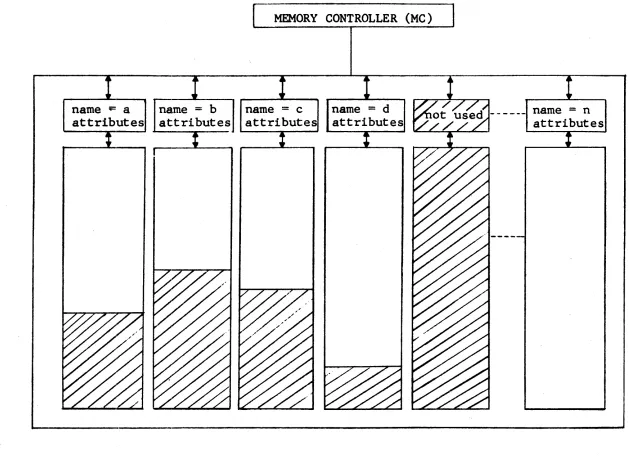
A simple representation of such a memory is shown in Figure 1; it comprises a memory controller (MC), a large number of
descriptors each of which contains the name and the attributes of a segment, and a large number of linear memories each of which is connected to a descriptor and can contain the body of a segment.
The processor can send two types of requests to the MC: requests for operations on descriptors and requests for operations on bodies. In both cases the processor must communicate to the MC the identification of the user on behalf of whom the
operation is requested.
2.4. Operations on Descriptors
The general form of a request sent by the processor to the Me
for operations on descriptors is
where:
OPCODE n arguments userid
- n is the name of the segment. TheMe uses it to locate the appropriate segment descriptor;
- arguments are parameters associated with the function defined by OPCODE;
- userid is the identification of the user on behalf of whom the operation is requested. The Me uses this userid in order to determine from the attributes of the segments whether this particular user has the right to perform this particular operation.
2.5. Operations on Segment Bodies
The general form of a request sent by the processor to the Me for operations on segment bodies is
where:
OPCODE [n,i] userid
- OPCODE designates operations, such as "read", "write", "instruction fetch";
- n is the name of the segment; the Me use~ it to locate the appropriate segment descriptor. It then uses the segment descriptor to locate the segment body;
- i is the index of the word within the segment to which the operation is to be applied;
name
;:::~
attributesname
=
b attributes"---MEMORY CONTROLLER (MC)
name
=
c attributesFigure 1. Organization of the Ideal Memory
[image:13.792.96.724.40.504.2]3. JUSTIFICATION OF THE IDEAL MEMORY PROPERTIES
The ideal memory has been defined as a "large segmented memory directly accessible by the processor". The advantages of such an ideal memory will be explained by successively introducing the advantages of a memory, that is: 1) large (but not
segmented); 2) segmented (but not large); and finally, 3) large and segmented.
3.1. Large, Unsegmented Memory
Because the memory is large and directly accessible by the processor, the user is provided with a core memory large enough for any of his computations. Therefore, he can rtm a program without being concerned with its size. However, no matter how large the core memory is, if it is a linear memory accessible by a single number, no sharing of infonnation in core can be tolerated between programs of different users since no protection mechanism is irt effect at the time a word is
accessed.
3.2. Small, Segmented Memory
Because the memory is segmented and directly accessible by the processor, the user is provided with several independent
linear core memories in each of which he can store one of his . segments, deciding who can access it and how. Therefore, the
same segment ~an be shared in core by several user programs without the danger of unauthorized accessed to this segment. However, even though the memory is segmented, if the number of segments that one can store in it is small, the user is
faced with the problem of overlays.
3.3. Large, Segmented Memory
By having the two properties "large" and "segmented" a directly accessible memory provides the user with:
a protection mechanism. This mechanism is in effect during execution at any memory access and protects segments from unauthorized access.
3.4. Note on Information Sharing
It is worth making some remarks about information sharing. Information to be shared consists of data and procedures.
Sharing data or procedures in core requires:
a) A mechanism by which a reference to a segment by its name X will cause segment X, and not a copy segment X, to be referenced during program execu-tion.
b) A mechanism by which the shared information can be protected from unauthorized access while it is in core.
Sharing procedures in core also requires:
c) A mechanism by which one can produce pure
procedures that can be executed simultaneously by several programs.
The memory described here provides a) and b), but not c). In fact the memory itself cannot provide c); writing a pure procedure implies the ability of communicating as parameters
to this procedure the names of any information private to the program on behalf of which the procedure is executing. These names cannot be stored in the memory itself; they have to be stored in processor registers whose names are invariant.
4. PRINCIPLE OF THE SIMUlATION
The memory presented here is simulated in the Multics system, this simulation being achieved by a- combination of hardware and software features. Hardware segmentation has been
imple-mented in the .645 and constitutes the most important of
the hardware features mentioned above. Paging has also been implemented in the 645; although of innnense help to the implementation, we do not regard paging as a concept funda-mental to a description of the prinCiples of the ideal memory
simulation and shall postpone the discussion of paging until the end of this section.
Let us first examine how much of the ideal memory capability has been integrated into the hardware. Then a discussion of
the software functions needed to compensate for those capabilities which are not provided by the hardware will follow.
4.1. Hardware Segmentation in the 645
Concepts of segment name, segment descriptor, and segment body have been integrated into the hardware as follows.
4.1.1. Segment Names. A segment name for the hardware is an integer s, called segment number, such that 0 < s < 218.
4~1.2. Segment Descristors. The segment descriptor of
segment "s" is the stentry of a table called a Descriptor Segment. The descriptor segment is in core memory and its absolute address is kept in a processor register. A
descrip-tor segment entry is called a Segment Descripdescrip-tor Word (SDW). SDW number s will be designated by the notation SDW(s).
Attributes that can be recorded in an SDW area are:
The absolute core address of the head of the segment body_
The length of the segment body.
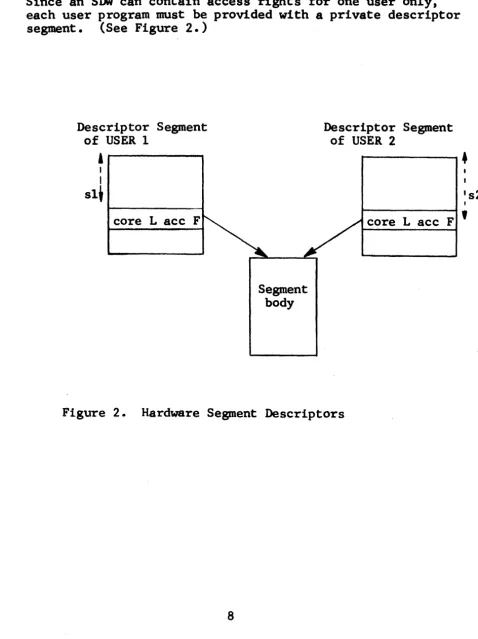
Access rights for only ~ user with respect to the segment body.
Since an SDW can contain access rights for one user only, each user program must be provided with a private descriptor segment. (See Figure 2.)
Descriptor Segment of USER 1
Descriptor Segment of USER 2
&
...---4
I
I
sl~
core L acc F
[image:17.620.54.532.114.753.2]Segment body
Figure 2~ Hardware Segment Descriptors
182
,
4.1.3. Segment Bodies. The segment body is an array of contiguous words in core memory and its maximum length is 218 words.
4.1.4. Address Transformations. Word number i of the body of segment s is addressed by the pair [s,iJ and is accessed through SDW(s) by the processor.
Provided that the absolute core address
rna
of word 0 of the segment is stored in SDW(s), the processor transforms-- the processor segment name s into the core memory
address mo using the descriptor segment which provides the mapping rno
=
Z(s).- the processor address [s,i] into the core memory address mi by the translation mi
=
mo+i , that is mi=
Z(s)+i.4.1.5. Access Rights Checking. Before accessing word mi the processor performs a check on
-the length ~f the segment by comparing i to the length recorded in SDW(s).
- The access rights for the user with respect to segment s by using the access rights recorded in SDW(s).
This hardware organization presents the following advantages over more conventional hardware.
The set of processor addresses [s,iJ is sufficiently large that all words referenced by a program can be assigned unique processor addresses. The user does not have to organize a large program into overlays provided that he uses no more than 218 segments.
- Processor addresses are independent of physical memory addresses. Addresses which appear in the instructions of a program are invariant when segments are moved from one location to another in core memory.
- Each access to core memory is subject to access rights checking.
However, the hardware has only a restricted understanding of the concept of segments and needs to be complemented by
4.2. Software Segmentation
Given the foregoing hardware segmentation capabilities, the corresponding software segmentation capabilities required to implement the Mu1tics virtual memory can be described.
4.2.1. Segment Names. A segment name is a character string called a symbolic segment name. The set of symb~lic seg-ment names is larger than 218. Therefore, the supervisor must map a large set of symbolic segment names into a smaller
set of segment numbers.
4.2.2. Segment Descriptors. The hardware does not permit one to
-- retrieve attributes of a segment given the
symbolic name of the segment. The software pro-vides this capability.
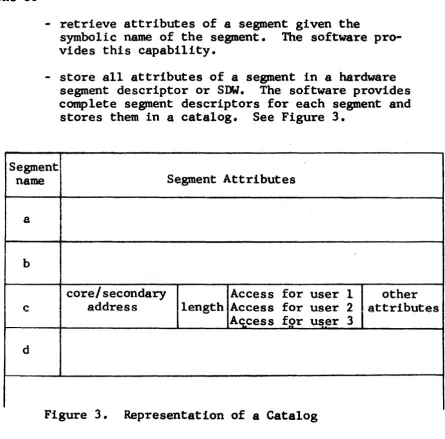
- store all attributes of a segment in a hardware segment descriptor or SDW. The software provides complete segment descriptors for each segment and stores them in a catalog. See Figure 3.
Segment
name Segment Attributes
a
b
core/secondary Access for user 1 other c address length Access for user 2 attributes
A~cess fgr user 3
d
[image:19.615.71.517.272.711.2]4.2.3. Segment Bodies. The body of a segment is an array of
contiguous words in ~ or in secondary memory. Since the
processor can fetch data and instructions only from core-resident segments, the software must intercede when a
segment is found to be missing from core.
4.2.4. Address Transfonnations. Assuming for the moment that all segments are in core memory, the supervisor performs the following three transformations to make segments accessible by the processor.
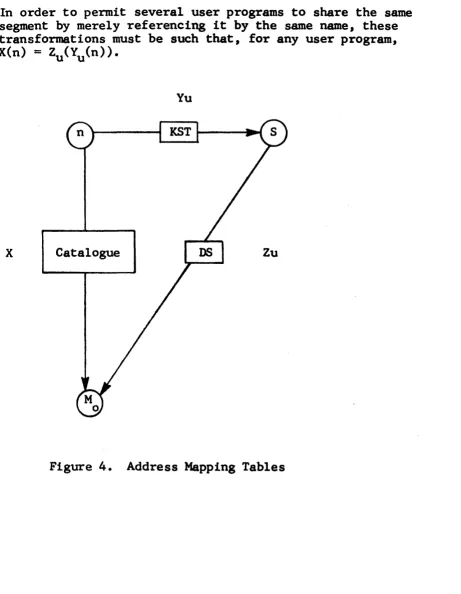
First, for any segment in the system, the supervisor must provide a one to-one mapping from its symbolic name n into its memory address mo ' where m is the address of the
be-ginning of the segment. This ~pping mo =X(n)O is recorded
in the catalog. See Figure 4.
Next, for each segment referenced by a user program, the supervisor must provide a one-to-one mapping from its
symbolic name n into the segment ntnnber 5 assigned to it in
this user program. This mapping s
=
Y (n) is recorded ina table associated with the user program and called the Known Segment Table (KST).
Finally, for each segment that has been assigned a segment number s in a user program, the supervisor must provide a one-to-one mapping between the segment number s and its·
memory address mo. This mapping mo=Z(s) is recorded in the
descriptor segment associated with the user program.
In order to permit several user programs to share the same segment by merely referencing it by the same name, these transformations must be such that, for any user program, X(n)
=
Zu(Yu(n».Yu
x
Catalogue Zu [image:21.613.67.528.122.716.2]To this pOint we have assumed that all segments are in core. In fact, core memory being limited, the supervisor has to move segments between core and secondary memory.
The transportation of segment n from core memory address m to
secondary memory address Mo must be associated with the fo~low
ing address mapping modifications:
- "rno must be replaced by Mo in the catalog entry for n.
- rna must be replaced by an undefined value in any SDW in which it appears. This is done by setting the invalid attribute flag ON in the SDW.
Note that the mapping between nand s remains unchanged in any user program.
A subsequent reference to segment n by segment number s in a user program will cause the processor to fault since the
invalid attribute flag is ON in SDW(s). This fault will be
referred to as a missing segment fault. Using the KST
associated with this user program, it is possible to determine the name n of the segment s. Knowing n, the catalog entry for
n can be found. The segment must be moved from secondary
memory address Mo to some (generally different) core memory
address m~. This move must be associated with the following
address mapping modifications:
- Mo must be replaced by m~ in the catalog entry for n.
- The undefined value (Flag) in SDW(s) must be replaced
by m~.
Note again that the mapping between nand s remains unchanged by the, move.
4.2.5. Access Rights Checking. We have seen how the supervisor
responds to a missing segment fault occurring in a user pro-gram but the description was not complete. A missing segment fault is a signal to evaluate the segment attributes in a
specific SDW. Only the evaluation of the core address
attri-bute has been described. Moreover, when the supervisor ex-tracts core address information from the catalog, it also
ex~racts the length and access rights attributes and stores
them in the SDW. Each subsequent hardware reference to the
However, when performing operations on segment attributes the supervisor itself must do the necessary validation for any operation requested by a particular user since the hardware does not provide for access checking on attributes.
4.3. Paging
In a system in which the maximum size ~of any segment were very small compared to the size of the entire core memory, the "swapping" of complete segments into,and out of core would be feasible. Even in such a system, if all segments did not have the same maximum size, or had the same maximum size but were allowed to grow from initially smaller sizes, there remains the difficult core management problem of
providing space for segments of different sizes.
Multics, however, provides for segments of sufficient
maximum size that only a few can be entirely core-resident at anyone time. Also, these segments can grow from any initial size smaller than the maximum permissible size.
By breaking segments into equal-sized parts called pages and providing for the transportation of individual pages to and from core as demand dictates, several practical problems encountered in the implementation of a segmented virtual memory are solved.
First, since only the referenced page of a segment need be in core at one instant, segments need not be small compared to core memory.
Second, "demand paging" permits advantage to be taken of any locality of references peculiar to a program by transporting to core only those pages of segments which are currently needed. Any additional overhead associated with demand paging should of course be weighed against the alternative
inefficiencies associated with dedicating core to entire segments which have been swapped into core but which may be only partly referenced.
The basic principles of paging in the Multics virtual memory may be briefly summarized as follows.
When a segment is not paged, the memory location of its
element i is defined by relation (1), where mo is the memory location of element
o.
When a segment is paged into pages of K elements, the memory location of its element i is defined by relation (2), where ~K is the memory location of element pK; that is, the memory
location of the page number p of the segment.
(2 )
mi =
npK
+ jj
=
i mod Kp
=
(i-j)/KIf N is the number of pages in a segment, paging this segment requires
-- a segment map with N entries, one for each page.
- a relocation capability in the hardware.
In the 645 the N entries of the segment map are provided by a "page table" and the relocation is perfonned by the processor itself. Furthermore, a page table entry contains
a missing-~ flag such that, if found ON by the processor while attempting to perfonn relocation, causes the processor to trap to the supervisor.
The missing-page flag is ON
wh~n
the corresponding page is not in core. When, upon attempting to access a missing page, the processor traps to the supervisor, the supervisor must move the requested page into core. In order to do so the- Update the mapping in entry p of the segment map located in the directory entry.
- Update the mapping in entry p of the page table.
Although paging need not be considered essential to a
description of the simulation principles of an ideal memory, it is a basic feature for the implementation of such a memory.
The next chapter describes in some detail how the ideal
Chapter 2
IMPLEMENTATION OF THE MULTICS VIRTUAL MEMORY: OVERVIEW
1. INTRODUCTION
As we have seen in Chapter 1, the Multics virtual memory is a large, segmented memory. Each segment can be referenced by its name ,in a user program; a reference by name will cause the segment to be accessed by the processor according to the access rights of the user with respect to that segment. The memory is called "virtual" because it is not available as a hardware device. Instead, it is simulated using a conven-tional non-segmented memory, a set of processor registers which provide the second dimension of a segmented memory and a supervisor which compensates for the difference in
capabilities between the 645 hardware and the ideal memory described in Chapter 1.
Although the hardware checks each user's access rights to a segment whenever it accesses that segment, a certain number of additional functions must be provided by the supervisor in order to give the illusion that all segments are directly accessible by name by the processor.
- The hardware cannot retrieve the attributes of a segment using its symbolic name; the supervisor organizes segment attributes into "directories" where it can retrieve them.
- The hardware cannot interpret access rights for segment attributes; all operations on segment attributes are done by the supervisor.
- The hardware cannot reference a segment by a symbolic name; it does it by a' segment ntunber. The supervisor translates all symbolic segment names into segment ntunbers.
- The hardware cannot access a segment if it is not in core memory; each reference to a segment which is not in core will cause the supervisor to move the segment from secondary memory to core memory. In
This chapter builds upon the ideas developed in Chapter 1 to show in some detail how the ideal memory is simulated. The major topics covered are:
2.
- Segmentation and paging on the 645 processor.
- The organization of segment attributes into hierarchically ordered directories and the manipulation of these attributes by the super-visor.
- Segment accessing and all the supervisory functions needed to make a segment directly accessible by the processor.
- The structure of the supervisor itself, showing how parts of the supervisor are able to utilize the virtual memory provided for user programs.
THE 645 PROCESSOR
This paper discusses only those features of the 645 processor which are of interest for the implementation of a virtual memory. They can be grouped into two different classes
--segmentation and paging -- and are treated separately below.
2.1. Segmentation
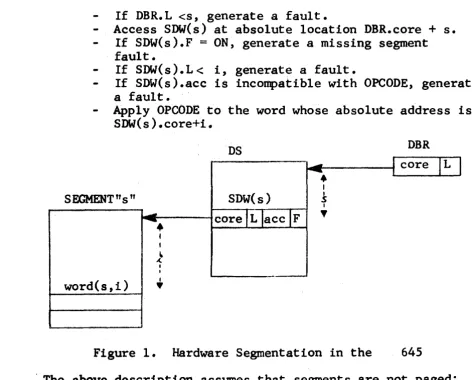
Any address in the 645 consists .of a pair of integers [s,iJ. The range of sand i is 0 to 218_1. s is called the segment number, i the index within the segment. WOrd rs,!J is accessed through a hardware register which is the 5th
word in a table called a descriptor segment (DS) • . This
descriptor segment is in core memory and its absolute address is recorded in a hardware register called a descriptor base register (DBR). Each word of the DS is called a segment
~os~?4~~n- wn_~ ~ _ _ ~~~~~4 ~4~' (SDW'·
J'
~he ~~ sth cDW ~ w~" L L L be -e~e--~~ ~~ L L LL~U ~v a~--SDW(s). See Figure 1.
The DBR contains the following values:
- DBR.core which is the absolute core address of the DS.
Segment descriptor word number s contains the following values:
SDW(s).core which is the absolute address of the segment s.
SDW(s).L which is the length of the segment s. SDW(s).acc which describes the access rights for the segment.
SDW(s).F which is a flag that can be ON or OFF. This is the invalid attribute flag mentioned in Chapter 1.
The algorithm used by the hardware for executing an instruction of the type OPCODE Ls,i] is as follows:
If DBR.L <s, generate a fault.
Access SDW(s) at absolute location DBR.core + s. If SDW(s).F
=
ON, generate a missing segment fault.If SDW(s).L< i, generate a fault.
If SDW(s).acc is incompatible with OPCODE, generate a fault.
Apply OPCODE to the word whose absolute address is SDW(s).core+i.
DS DBR
I core
IL I
-..
II
SEGMENT"s" SDW(s) S I
.-.
corelLlacclF
•
-.
II
..
-<.
I
I
--I
word(s,i)
•
Figure 1. Hardware Segmentation in the 645
[image:28.615.54.527.279.659.2]2.2 Paging
A bit in an SDW indicates whether the corresponding segment is paged or not. Another bit in the SDW indicates whether the page size is 64 or 1024 words. Analogous bits in the DBR serve the same purpose for the descriptor segment.
However, in the Mu1tics implementation, all segments are paged and the page size is always 1024 words. Therefore, this description makes the following two assumptions:
All segments are paged.
The page size is a constant, K, equal to 1024 words.
No further reference will be made to these two bits in the SDWand DBR.
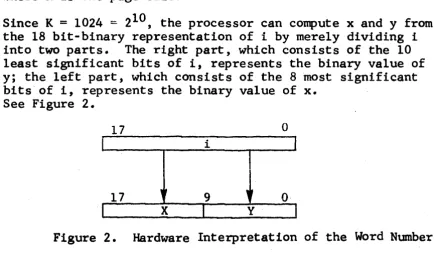
Element i of a segment is the yth word of the xth page of the segment, x and y being defined by:
(
y=imodK
x = (i-y)/K
where K is the page size.
Since K = 1024 = 210 , the processor can compute x and y from
the 18 bit-binary representation of i by merely dividing i into two parts. The right part, which consists of the 10 least significant bits of i, represents the binary value of y; the left part, which consists of the 8 most significant bits of i, represents the binary value of x.
See Figure 2.
17
o
i
17
I
i
9~
I
o·
[image:29.615.97.532.414.686.2]x
yThe ~ table (PT) of a segment is an array of physically contiguous words in core memory. Each element of this array is called a ~ table word (PTW).
Page table word number x contains the following items.
PTW(x).core which is the absolute core address of page
Ix.
PTW(x).F which is a flag that can be ON or OFF. This is the missing page flag mentioned in Chapter 1.
The meaning of DBR.core and SDW(s).core is now as follows:
DBR.core
=
Absolute address of the PI of the DS. SDW(s).core=
Absolute address of the PT of segmentIs.
The full algorithm used by the hardware to access word [s,iJ is (see Figure 3):
If DBR.L <s, generate a fault.
Split s into sx and 8y such that sy
=
s mod K and sx=
(s-sy)/K. .Access PTW(sx) at absolute location DBR.core + sx.
If
PTW(sx).F =
ON, generate a missing page fault.Access SDW(s) at absolute location PTW(sx).core
+ sy.
If SDW(s).F
=
ON, generate a missing segment fault. If SDW(s).L < i, generate a fault.If SDW(s).acc is incompatible with OPCODE, generate a fault.
Split i into ix and iy such that iy
=
i mod K and ix=
(i-iy)/K.- Access PTW(ix) at absolute location SDW(s).core
+ Ix.
If PTW(ix).F
=
ON, generate a missing page fault. Apply the OPCODE to the word whose absoluteN N
PAGE"sx" of DS _
-+
II
sr
I
PT of t
SEGMENT" s " SDW(s)
,
-~
p. 1iX
corelLlacclF
~GE"ix"of SEGMENT"s" PTW(ix) I
-
•
- T
core FI
I
iy
I I
I \tX>RD(s.i)
•
Figul:"e 3. Hardware Segmentation and Paging in the 645
DBR
PT of DS
~ corelL
I
-""
PTW(sx)
•
Isx3. SEGMENT ATTRIBUTES
3.1. Directory Hierarchy
The association between the name of a segment and its attributes is recorded in a catalogue. This catalogue consists of a table with one entry for each segment in the
system. An entry contains the name of the segment and all its attributes (length, memory address, list of users allowed to use that segment with their respective access rights, date the segment was created, etc.).
In Multics this catalogue is divided into several segments called directories, which are organized into a tree struc-ture. A naming convention permits one to search the tree structure for a given name without having to search all directories.
A segment name is a list of subnames reflecting the position of the entry in the tree structure, with respect to the
beginning of the tree or root directory. By convention, sUbnames are separated by the character
">".
Each subname is called an entryname and the list of entrynames is called a pathname.There are two types of directory entries called branches and links. A branch is a directory entry which contains all attributes of a segment while a link is a directory entry which contains the pathname of another directory entry.
This chapter will deal only with entries of the branch type.
The pathname is the only ~ J2:y which .!! segment .£!ill be searched for in the directory hierarchy.
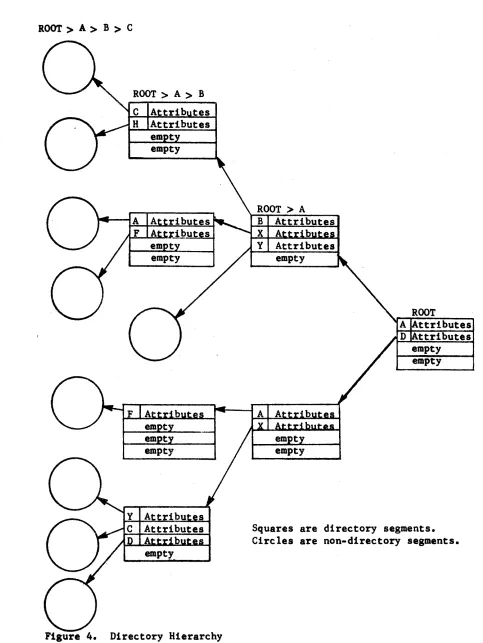
The attributes associated with a segment whose pathname is
ROOT> A > B > C are found as follows (see Figure 4):
Search the root directory for an entry whose entry name is A. This entry contains attributes for the directory segment whose pathname is Roar> A. These attributes permit one to locate the directory
Search directory ROOT > A for an entry whose entry name is B. This entry contains attributes for the directory segment whose pathname is ROOT > A> B. These attributes permit one to locate the directory ROOT > A > B in memory.
ROOT>A>B>C
Figure 4. Directory Hierarchy
ttributes ttributes empty empty
[image:34.612.93.576.69.712.2]3.2. Operations on Segment Attributes
All operations on segment attributes are done by supervisor primitives. There is a set of primitives available to the user which allow him, for example, to:
Create a segment. Delete a segment.
Change the entryname of a directory entry. Change the access rights of a segment.
List a directory.
Any of these operations is performed on behalf of a user by the supervisor only if the user has the right to perform them.
Some further details about one of these operations, segment creation, are important to an understanding of the topic of segment accessing developed in the next section.
Creating a segment whose pathname is ROOT > A > B > C consists basically of taking the following actions:
Check, by searching the directory hierarchy, that this segment does not exist already in the system.
Allocate space for a branch in directory
ROOT> A> B.
Store in the branch the following items:
•
•
•
•
The entry name C.
The access list, given by the creator.
The segment map which consists of a ·secondary storage address for each page of the segment. This segment map is manufactured by the
supervisor.
The segment status "inactive", meaning that there is no page table for this segment.
4. SEGMENT ACCESSING
We are now in a position to understand a description of the functions that are provided by the supervisor in order to make accessible by the processor segments which are referenced by name in a user program. Figure 5 is key to an appreciation of the Multics virtual memory implemen-tation. Although frequent references to Figure 5 follow, the full implications of its contents will not be apparent until the entire section has been read.
4.1. Concept of Process and Address Space
A process is generally understood as being a program in execution. A process is characterized by its state-word defining, at any given instant, the history resulting from the execution of the program.
A process is also characterized by its address space. The address space is the set of processor addresses that this process can use to reference the memory. In Multics the address space of a process is defined as the set of segment numbers that the process can use to reference segments in
the virtual memory. As explained in Chapter 1, a segment number can be used to reference the virtual memory only if it has been associated with a segment name, i.e., a pathname. This association [pathname, segment numberJ
is recorded in a table called the Known Segment Table (KST) which defines the address space of the process. There is a one-to-one correspondence between Multics processes and address spaces. The action of adding a new pair [pathname, segment number] in a KST is referred to as making the seg-ment with that pathname known to the process.
4.2. Making a Segment Known to a Process
Each time a segment is referenced in a process by its pathname, the pathname must be translated into a segment number in order to permit the processor to address the seg-ment. This translation is done by the supervisor using the KST associated with the process. The KST is an array
If the association rpathname, segment numberJ is found in the KST for this process, then the segment is known to the process and the segment number can be used to reference the segment.
If the association [pathname, segment number] is not found it means that this is the first time the segment is refer-enced in the process and the segment has to be made known. This is done by assigning an unused segment number "s" in the process and by establishing the pair [pathname, segment number] in the KST by recording the pathname in KSTE(s). Furthermore, the directory hierarchy is searched for this pathname and a pOinter to the corresponding branch is entered in KSTE(s) for later use (see Section 4.3.).
This stage is fundamental because, in the Multics system, it is impossible to assign a unique segment number to each segment. The reason is that the number of segments in the system may be larger than the number of segment numbers available in the processor.
~en a segment is made known to a process by segment number "s" its attributes are not placed in SDW(s) of the descrip-tor segment of that process.
SDW(s)
has been initialized with an invalid attribute flag. Therefore, the firstreference in this process to that segment by segment number "s" will cause the processor to generate a fault. In Multics this fault is called a "missing segment fault" and transfers control to a supervisor module called the .segment fault
handler.
4.3. The Segment Fault Handler
Upon the occurrence of a missing segment fault, control is passed to the segment fault handler whose function is to store the proper segment attributes in the appropriate SDW and to set the invalid attribute flag OFF in the SDW.
This information, we recall, consists of:
The page table address. The length of the segment.
The information initially available to the supervisor upon occurrence of a missing segment fault is:
The segment number"s.
The process identification.
The only place where the needed information can be found 1s in the branch of the segment. Using the process
identification, the supervisor can find the KST for this" process. It can then search this KST for the segment number
s. Having found the KST entry for s, it can find the required branch since a pOinter to the branch has been stor"ed in the KST entry when the segment was made known to that process. See Sectiorl 4.2.
1
•
1ST
ISTB(S)
r -__ .~~----~~---1'J---~====~:::J~~=,r,p;-1~======~pathname ptr
~---~~--~
.
It "
... _ _ _ _ _ _ --1 ••
.. , ... ..
.'
.
,M- - - " , ' .. , - - - teaporary mapping
.
"
, ,
.
___ . . •• _ • _ • __ • __ .pplDg needed to ill'lval idate a temporary -.ppins
CC===:===::f)'HJllpl1c1t mapping
ASTE Length Segment map Connect. List Branch ptr
,
.
.
.
.
.
.
:..
-...
ltO'l'E •. The page table of the descrIptor segment is not shown for: the sake of simplicity
Piau" 5. Basic Tables Used to Implement the ItJltic. Virtual Memory
."
.
,-,.
..
.
...
.-
.,.-SelJDllDt map • Laagth
Active Iwitch ASTE-pt Ptr
USER I • Accesl rights
The supervisor divides these page tables into ~o lists: the "used list" and the "free list". Manufacturing a page table (PT) for a segment could consist only of selecting a PT from the free list, putting its absolute address in the branch and moving it from the free to the used list. If this were actually done, however, then the servicing of each missing page fault would require access to a branch since the segment map is kept there.
Since all directories cannot be core-resident, page fault handling could thereby require a secondary storage access in addition to the read required to transport the page itself into core. Although this mechanism works, effi-ciency considerations have led to the "activation"
convention between the segment fault handler and the page fault handler.
4.3.1. Activation. A portion of core memory i.s pennanently reserved for recording attributes needed by the page fault handler, i.e., the segment map and the segment length. This portion of core is refe~red to as the active segment table (AST). The AST contains one entry (ASTE) for any segment that has a PI' .·A PT 1s always associated with an ASTE, the address of one implying the address of the other. They may be regarded as a single entity and will be
referred to as the [PT,ASTE] of a segment.
A segment which has a [PT,ASTE] is said to be active.
The property of being active or not active fs an attribute of the segment and, therefore, has to be recorded in the branch. When this active switch is set ON it means that both the segment map and the segment length are no longer in the branch but are to be found in the segment's
pPT,ASTE] whose address has been recorded in the branch during "activation" of the segment.
To activate a segment the supervisor must:
Find a free [PT,ASTEJ. Assume temporarily that at least one is available.
Set the active switch in the branch.
Record the pOinter to [PT,ASTEJ in the branch.
Having defined activation, the actions taken up to now by the segment fault handler can be summarized as:
Use the segment number s to access the KST entry.
Use the KST entry to find the branch.
If the active switch is OFF, activate the segment. If it is ON, then activation is unnecessary at this time as the segment was already activated for
another process.
By pairing an ASTE with a PI in core, the segment fault handler has guaranteed that the segment attributes needed by the page fault handler are core-resident, thus per-mitting efficient page fault servicing.
4.3.2. Connection. Now that the segment is active, the corresponding SDW must be "connected" to the segment.
To connect the SDW to the segment the supervisor must:
Get the absolute address of the PT, using the [PT,ASTEJ pointer kept in the branch, and store it in the SDW.
Get the segment length from the ASTE and store it in the SDW.
Get the access rights for the user from the branch and store them in the SDW.
Having defined activation and connection, segment fault handling can finally be summarized as:
Use the segment number s to access the KST entry.
Use the KST entry to find the branch.
If the active switch in the branch is OFF, activate the segment.
Connect the SDW.
Note that segment sharing in core is "automatically" guaranteed by the use of the active switch and [PT,ASTEJ pOinter kept in the segment branch since all SDW's describ-ing this segment will point to the same
PT.
Now that the segment has an SDW pointing to the
PT,
the hardware can access the appropriate page table word. If the page is not in core, a missing page fault occurs, transferring control to the supervisor module called the page fault handler.4.4. The Page Fault Handler
When a page fault occurs the page fault handler is given control with the following information:
The
PT
address. The page number.The information needed to bring the page into memory is:
The address of a free block of c.ore memory into which the page can be moved.
The address of the page in secondary memory.
The job of the page fault handler is to:
Find a free block of core. (Assume temporarily that there is at least one free block in the free list.)
Access the ASTE associated with the PT and find the address in secondary memory of the missing page.
Issue an"
Ilo
request to move the page from secondary memory into the free block of core.upon completion of the
Ilo
request, store the core address in the PTW and remove the fault from the PI'W.4.5. Page Multiplexing
It was assumed that a free block of core was available in the core map free list; however, this is not always the case since there are many more pages in the virtual memory than there are blocks of core. Therefore, in order to get a free block of core, the page fault handler may have to move a page from core to secondary memory. This requires:
An algorithm to select a page to be removed.
Knowing the address of the PTW which holds the address of the selected page in order to set a fault in it.
Knowing where to put the page in secondary memory.
The selection algorithm will not be described here; however, it should be noted that candidates for removal are those pages described in the core map used list. Therefore, each core map entry which appears in the used list must contain a pointer to the associated PTW in order to permit one to examine the used bit. The action of storing the PTW pOinter in the core map entry must be added to the list of actions taken by the page fault handler when a page is moved into core (see Section 4.4.).
A fault is stored in the PTW.
The secondary storage address for the page is found in the ASTE whose address can be computed from the PTWaddress.
An I/O request is issued to remove the page to secondary storage.
upon completion of the I/O request, the core map entry is removed from the used list and put in the free list.
By this mechanism, blocks of core are multiplexed among all pages of all active segments in the system.
It is important to realize that a page is either in core or in secondary storage. There is no such thing as a "copy" of a page. When a page is moved from secondary storage to core, its secondary storage address, located in the ASTE, could be freed; it is no longer needed since the address of the page is now in the PTW. When the page is to be removed, a free block of secondary storage could be assigned to it. It is only for practical reasons that the block of secondary storage is not freed each time a page is moved into core.
Page multiplexing maintains a "perpetual motion" between core and secondary storage of pages of active segments. If the
4.6. [PTaASTEJ Multiplexing
In the descript:ion of segment fault handling, when a segment had to be activated, a pair [PT,ASTE] was assumed available for assigmnent to that segment. In fact, the number of [PT,ASTE] pairs is limited in the system and is, by far, smaller than the number of segments in the vir·tual memory. Therefore, these [PT,ASTEJ pairs must be multiplexed among all segments in the virtual memory.
This means that making a segment active may imply making another segment inactive thereby disassociating this other segment from its [PT,ASTE]. Since each process sharing the same segment will have the address of the PT in an SDW it is essential to invalidate this address. in all SDW's before removing the page table. It is also essential to move to secondary memory all pages of that segment which are in core before removing the [PT,ASTE], since the ASTE is needed to remove a page. Then, and only then, can [PT,ASTE] be
disassociated from the segment.
This operation requires:
An algorithm to select a segment to be deactivated.
Knowing all SDW's that contain the address of the page table of the selected segment in order to
invalidate this address.
The removal of all pages of the selected segment that are still in core.
Moving the attributes contained in the ASTE back to the branch and changing the status of the segment from active to inactive in the branch.
The selection algorithm is here again based· on segment usage. The only thing of interest at this point is that selection is done by scanning the ASTE used list. Therefore, the ASTE must provide all the information needed for removing the
During activation, a pOinter to the branch must be placed in the ASTE; during connection, a pOinter to the SDW must be placed in the ASTE. Since more than one SDW is connected to the same PT when the segment is shared by several pro-cesses the supervisor must maintain a list of pointers to connected SDW's. This list is called a connection list.
See Figure 5.
-Now we are in a position to understand how a [PT,ASTE] can be disassociated from a segment. After the selection algorithm decides on an ASTE to be freed, actions to be taken consist of two steps called "disconnection" and "deactivation".
Disconnection consists of storing a segment fault in each SOW whose address appears in the connection list in the ASTE.
Deactivation consists of removing all pages of this segment that may be in core, moving the segment map from the ASTE back to the branch, resetting the active switch in the branch and putting the [PT,ASTE] in the free list.
4.7. Segment Number Multiplexing in a Process
The number of segments that a process can describe in its descriptor segment is limited to 218. It is unlikely that a process needs to access more than 218 segments from the time it is created to the time it is destroyed. However, if this should happen, a facility is provided to a process to remove an association [pathname, segment-number] by an explicit call to the supervisor. This action is referred to as making a segment tmknown. When segment A which is known
to a process by the segment number "s" is made unknown to that process, no attempt is made by the supervisor to remove
residual [s,iJ pairs that may have been generated and stored during the time that s was assigned to A. Making segment A unknown to the process implies freeing KSTE(s). If
sub-sequently another segment, say B, is made knOwn to the process, the supervisor may assign this unused segment number s to
segment B, entering the pathname B in KSTE(s). From this pOint on, any reference by segment number s in this process will cause segment B to be accessed. Therefore, it is
4.8. Directory Entry Multiplexing
When a segment is deleted, the branch of that segment is deleted. No attempt is made by the supervisor to remove residual KST entries that contain a pOinter to this branch. However, the supervisor can detect references by residual segment numbers, to segments which have been destroyed as follows:
When segment A is created, the supervisor assigns a unique number NA to segment A and stores it in the branch.
When segment A is made known to a process P by the segment number s, NA is copied from the branch to KSTE(s) for process P along with the pOinter to branch A.
If segment A is deleted by any process, the supervisor disconnects the corresponding SDW in process P, if it was connected, and deletes the branch together with
NA•
If the same directory entry is reused to record the branch information of another segment B, a new unique identifier NB will be stored in the branch.
Now, if process P uses the segment number s in order to access segment A, a segment fault will occur; the KST entry contains a pointer to the directory entry which is supposed to be the branch A. But by
compar-ing the NA of the KST entry and NB of the directory
entry, the supervisor can discover that segment A has been deleted.
Therefore, it is possible to detect the deletion of a branch
e··e- .... v &.1. ~Iol."'''''& ~"·· .... h " .... ". I. ..L.~O ..L."'~" ~ .r:"rme- d': ..L.~ -e-.... "-· ___ '-~VL7 'C1o" ..
t-_.
L 7 1... ... Uel S1...___
"''CCII --··se~ L'CU U f--VLanother segment.
5. STRUCl'URE OF THE SUPERVISOR
up
to now supervisor functions have been described, butsupervisor structure has not been discussed. In this section, the different components of the supervisor are covered and the ability of portions of the supervisor to partially utilize
5.1. Functional Modules
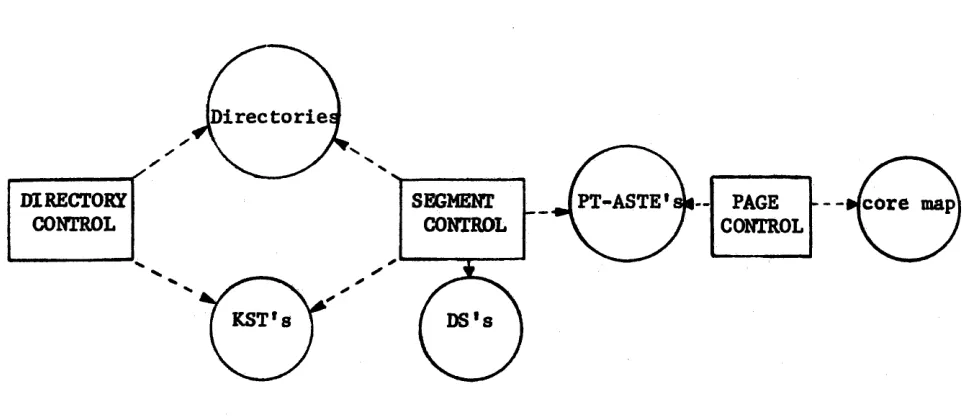
Three functional modules can be identified in the supervisor described;.they are called directory control (DC), segment control (SC), and page control (PC).
5.1.1. Directory Control. Directory control is that part of the supervisor which can manipulate all segments in the
system. DC identifies a segment by its pathname which uniquely defines a segment in the system. Data bases that are manipulated by DC are the directories and KST's of all processes (see Figure 6). DC provides all primitives to simulate operations on segment attributes; it also provides the assignment of a segment number to a segment within a process.
5.1.2. Segment Control. Segment control is that part of the supervisor which can manipulate only those segments which are
mown
to at least one process. SC identifies a segment by either its segment number within a particular process, which uniquely defines a segment in the system, or by its[PT,ASTEJ address which uniquely defines an active segment in the system. Data bases that are manipulated by SC are directories, KST's of all processes, descriptor segments of all processes and [PT,ASTEJ pairs of all active segments.
SC provides the functions of activation, connection, dis-connection and deactivation.
5.1.3. Page Control. Page control is that part of the
supervisor which can manipulate only those segments which are active. PC identifies a segment by its [PT,ASTEJ address which uniquely defines an active segment in the
system. Data bases that are manipulated by PC are [PI',ASTEJ
pairs of all active segments and the core map. PC provides the mechanism to move pages of active segments between
CONTROL
'"
'"
'"
" , "SEGMENT
CONTROL
ImRECTOur
,
,---"'6//
Figure 6. Supervisor Fune tional Modules and Data Bases
5.2. Use of Segmentation in the Supervisor
Previous to this no assumptions were made about the type of addressing used by the supervisor. It could be written so as not to use segment addressing of course; but organizing
the supervisor into procedures and data segments permits one to use in the supervisor the same standard conventions that are used in a user program. For in'$tance, the CALL-SAVE-RETURN conventions made for user programs can be used by the . supervisor, the standard way to manufacture pure procedures
in a user program can be used in the supervisor, etc. Thus, it seems desirable to use segmentation in the supervisor, and the follO\\Fing (temporary) assumption will be made:
Assumption 1:
a. The address space of the supervisor is entirely defined by a desc~iptor segment.
b. All segments used by the supervisor are always in core.
Assumption l.b is not realistic, however, since it generally Is not possible to dedicate enough core to contain the entire supervisor. It is, therefore, interesting to determine
[image:49.612.62.543.82.292.2]5.3. Use of PC in the Supervisor
For the purpose of this paper, let us assume the validity of the following statement. "Page fault handling for a page x must be performed without referencing page x".
It is certainly possible to design a PC module which allows recursive page faults provided that the above condition is always satisfied. Each recursive invocation of the page
fault handler should use a set of pages which does not include any of the pages that caused the previous invocations;
furthermore, the number of recursive invocations must be guaranteed to be finite. The technique that has been chosen in Multics for page fault handling is to fix this finite number to 1 and thus no recursive page faults will ever occur. This decision has been made for reasons of
effi-ciency and design simplicity. Therefore, it is assumed that all segments used in PC are always in core.
We can observe that the page fault handler need not know if
a missing page belongs to a user or to the supervisor; it only expects to find the information it requires in the [PT,ASTEJ of the segment to which the missing page belongs. Therefore, if all segments used in SC and DC are always active, then their pages need not be in core since PC can load them when they are referenced.
Thus, assumption 1 can be replaced by the following one (again temporary):
Assunption 2:
a. The address space of the supervisor is entirely defined by a descriptor segment.
b. All segments used in PC are always in core.
c. All segments used in SC and DC must be active and connected.
![External trade monthly statistics [Monthly external trade bulletin] 4/1987/Commerce exterieur statistiques mensuelles [bulletin mensuel du commerce exterieur] 1987 4](data:image/gif;base64,R0lGODlhAQABAIAAAP///wAAACH5BAEAAAAALAAAAAABAAEAAAICRAEAOw==)