ORIGINAL RESEARCH ARTICLE
THE CONSTRUCT VALIDITY OF THE POLISH SELF-REGULATION QUESTIONNAIRE – LEARNING
(SRQ-L)
*Agnieszka Iłendo-Milewska
Departament of Psychology,
University College of Pedagogy in Bialystok, Poland
ARTICLE INFO ABSTRACT
The content of this article focuses on the construct validity of the Polish Self-Regulation Questionnaire-Learning (SRQ-L). The assessment of students' level of self-regulation can be a powerful tool in enhancing and understanding students' functioning in the school environment. Theoretical consideration is based on the Theory of Self-Regulation by Deci & Ryan. The aim of the present study is to adapt, validate and determine the psychometric properties of the SRQ-L on a Polish student sample, consisting of 200 teenagers, ages 14–17 from middle schools. First, the translation-back-translation method was used to ensure the linguistic equivalence of the Polish questionnaire. Second, Alpha Cronbach's coefficient was used to determine the level of reliability of individual variables. Third, Pearson's correlation coefficient was used to recognise whether there is statistically significant correlation between variables. Then, analysis of variance (ANOVA) was used to check if there is a statistically significant difference between more than two groups of variables. The Polish SRQ-L showed good internal consistency for two subscales, internal regulation: α = 0.73 and external regulation: α = 0.55. In summary, the Polish SRQ-L is a reliable and valid self-report instrument for the assessment of the level of self-regulation within the school environment.
Copyright © 2019,Agnieszka Iłendo-Milewska. This is an open access article distributed under the Creative Commons Attribution License, which permits unrestricted use, distribution, and reproduction in any medium, provided the original work is properly cited.
INTRODUCTION
In recent years, social psychologists have been interested in focusing on self-regulation. Researchers compare the factors which support the process of students' self-regulation and identify the key processes in the field of risky behavior. They learn about the possible cognitive and motivational factors working together in learning. Self-regulation is one of the most important areas in this field. It has been known as the pillar of education. Why? Because educators started to see the importance of SRL and began to search for ways to define practical methods of intervention in order to enhance and implement SRL in existing educational systems. More and more research is inclined to find a correlation between the success of young people in controlling their behavior and emotions and their social competences and conventional behavior. On the other hand, abilities of self-regulation are frequently considered by parents and teachers to be one of the most crucial factors explaining the child's scholastic success.
*Corresponding author: Agnieszka Iłendo-Milewska
Departament of Psychology, University College of Pedagogy in Bialystok, Poland
Social psychology shows many definitions of the concept of self-regulation. Some of the most influential theories that are derived are Clinical Psychology (Self-efficacy theory, Bandura, 1993), Cognitive Psychology (Carver, 2004) and Educational Psychology (Pintrich, 2000; Zimmerman, 2002). Although these theories have different backgrounds, they have a lot in common and offer a comprehensive understanding of self-regulated learning (Sitzman & Ely, 2011). Different perspectives have offered different definitions of self-regulation. Zimmerman (2000) defines self-regulation as the level or degree in which the students are motivationally cognitively and behavioral are active in their learning processes and achieving their goals. From this point of view, students will have an important role in learning process. It includes a review of self-regulation, management and control of cognition, motivation, behavior and environment so that they will be able to achieve their goals (Pour, 2015). Cognitive regulation is the degree to which children can be self-reflective, can plan and think ahead. Children with these strengths are in control of their thoughts. They are able to monitor and adjust their behavior, and evaluate their abilities, if necessary (Kanfer, 1970). Carver defines self-regulation as
ISSN: 2230-9926
International Journal of Development Research
Vol. 09, Issue, 01, pp.25087-25093, January, 2019
Article History:
Received 09th October, 2018 Received in revised form 06th November, 2018 Accepted 14th December, 2018 Published online 30th January, 2019
Key Words:
Questionnaire, Validation, Self-regulation, Learning.
Citation: Agnieszka Iłendo-Milewska. 2019. “The construct validity of the polish self-regulation questionnaire – learning (srq-l)”, International Journal of
Development Research, 9, (01), 25087-25093.
the process that affects the ability to control responses (Carver, 2004). Blair adds that the ability to self-regulate is the foundation for complying with the accepted standards that are expected at home, school, and later, in the workplace. Students who are having academic self-regulation, self-planning, independent, listen to the teacher, focus on home works, get higher marks in exams, they can remember what teacher has told earlier and eventually has a better performance. Several studies have confirmed the positive impact of self-regulation on academic achievements. Cheng (2011) found that students' learning motivation, goal setting, monitoring activities and learning strategies play an important role in learning performance. This means that students with higher learning motivation and greater ability to set their goals and a better monitoring on their activities and learning strategies can learn better. Cazan (2013) showed that a combination of cognitive and metacognitive strategies lead to improve the ability of self-regulation.
Research has also found that there is a relation between self-efficacy and self-regulation strategies. The literature highlights the positive impact on one another. Higher self-efficacy beliefs increase the use of self-regulation strategies (Pajares, 2008) and the use of self-regulation strategies can lead to increases in self-efficacy beliefs and academic achievement. In a study of high school students, Labuhn et al. (2010) found that learners who were taught SRL skills through monitoring and imitation were more likely to elicit higher levels of academic self-efficacy (i.e., confidence) and perform higher on measures of academic achievement compared to students who did not receive SRL instruction (Zumbrunn et all, 2011). Self-regulation is often thought of as a dual cognitive and social-emotional process (Blair, Razza, 2007). Social-social-emotional self-regulation is the ability to inhibit negative responses and delay gratification. An individual with this ability can control his or her emotional reactions to positive and negative situations. Furthermore, Self-Regulated Learning (SRL) refers to the effective regulation of one’s own learning in the pursuit of personal goals. SRL is contextual in nature and changes dynamically in response to “episodes” experienced by the learner (Netfield, Shores, Hoffmann 2014). Emotional and cognitive self-regulation are not separate or distinct skills. It is what helps children focus on learning when they might be distracted by others, upset by a problem, or excited about an upcoming event. The ability to self-regulate helps children get along better with teachers and their peers (McKown, Gumbiner, Russo, Lipton, 2009). Good self-regulation skills play an important role in building socio-emotional competence (Denham, 2006; McKown, 2009).
Self-regulation in school settings increases success in problem solving, academic achievement and intrinsic motivation (Cleary, Zimmerman, 2004). The impact of self-regulation also extends beyond educational life, since self-regulatory skills equip students with more positive views towards their future, empower them to manage their social behavior, and support the development of lifelong learning skills. Fortunately, various studies have repeatedly indicated learning and teaching self-regulation is achievable. Extensive research has shown that appropriate adjustments made to the learning environment and teaching practices have a positive effect on pupils’ ability to learn and develop of self-regulation (Perels, Dignath, Schmitz, 2009). Teachers play a crucial role in promoting self-regulatory processes (Zimmerman, 2002). Despite the fact that primary school teachers positively believe that the introduction
of self-regulation learning in their own classroom may be efficient, different elements still prevent them from fully promoting it (Dignath-van Ewijk, Van der Werf, 2012; Lombaerts, Engels, Van Braak, 2009). Self-determination Theory differentiates between types of behavioral regulation in terms of the degree to which they represent autonomous versus controlled functioning. This theory allows to give an answer for the question why is self-regulation important? There are some important elements in the process of self-regulation in the context of the proper functioning in the school environment (Ryan, Deci, 2000). Level of motivation, as a first, is understood as an impulse to take an action in the field of school motivation, because intrinsic human needs facilitate internalization of extant values and regulatory processes, and they facilitate adjustment (Ryan, Deci, Grolnick, 1995). The significance of motivation level can be analysed according to:
autonomous regulation, which focuses on the behavior to
which a person applies as specific value, and controlled
regulation, which focuses on the behavior that a person
chooses to avoid punishment or to get a reward. Numerous
studies show that autonomous regulation promotes
perseverance, higher levels of achievement and greater work
responsibility (Sheldon, Ryan, Deci, Kasse, 1995).
Experiencing strong levels of autonomy means that a person is able to self-regulate their behavior, be active, determined and apply self-discipline (Deci, Ryan, 2008). In this model, people's propensities to regulate behavior through different strategies are assessed. Past research has shown autonomy to be positively associated with enhanced self-regulation, higher
self-esteem, self-actualization and greater personality
integration (Deci, Ryan, 1985; Koestner, Bernieri, Zuckerman,
1992; Williams, Deci, 1996). Its opposite, controlled
regulation, refers to regulation from outside the phenomenal
self, by forces experienced as alien or pressuring, be they inner impulses or demands, or external contingencies of reward and punishment (Ryan, Deci, 2006, p. 1562). Those who are
autonomy-oriented organize their behavioral regulation by
taking a reflective interest in possibilities and choices, whilst those who are control-oriented tend to regulate behavior by focusing on perceived or ambient social contingencies, such as salient rewards and punishment (Ryan, Deci, 2006).
Summing up the considerations, it seems to be important to answer the main question why are self-regulation important?
A theory and previous research in the field of relation between SRQ-L and academic performance amongst adolescents state that it has a positive relation that includes motivational as well as learning strategy aspects of SRL (Azlina, 2007). Children who are self-regulated are more likely to perform well in school (Kuhnle, Hofer, Kilian, 2010). Cheng (2011) also showed that students obtained higher scores when they used appropriate SRL strategies (Ahmad Sayuti, Mohd Rafee, Murni Illani, Suhaily, 2015). Adolescents who delay gratification and adjust their behavior are more likely to be engaged in school.
Moreover, such students tend to work harder than their peers who lack self-regulatory abilities (Shapiro, 2000).
MATERIALS AND METHODS
The main aim of this article is to adapt, validate and determine the psychometric properties of the SRQ-L on a Polish student sample. The practical aim is to develop a school prevention tool that would help psychologists and school counsellors to make an effective diagnosis of the quality of students' functioning in the school environment. It is important to recognize actions that could be taken to increase the level of students' self-regulation at school. Besides, a diagnosis ofthe school environment might contribute to a decrease in dysfunctional behaviour at school.
The population
The final validation research of SRQ-L took place in a public middle school in Bialystok, in the period from March to May 2014. There were 200 middle school students from Bialystok in the research: three groups of first grades, three second grades, three third grades, in all 94 girls (47%) and 106 boys (53%), aged 14 to 17.
Statistical Power
All analyses were done in the IBM SPSS Statistics Program. In the statistical analysis of the data:
1. Alpha Cronbach's coefficient was used to determine the level of reliability of questionnaires (variables). It can take values from 0 to 1. The higher the value, the higher the reliability level.
2. Pearson's correlation coefficient was used to check whether there are statistically significant correlations between the quotient variables.
Statistically significant results at the level of p <0.001 were marked with***, statistically significant results at the level of p <0.01 were marked with**, and statistically significant results at the level of p <0.050 were marked with*. If the correlation is statistically significant then the coefficient (r) in the table should be interpreted. It can take values from -1 to 1. The further away r is from 0, the stronger the relationship. Positive values mean that as the value of one variable increases, the value of the second variable also increases. It should be remembered that the coefficient only shows a linear correlation between variables, but does not inform in any way which variable is the cause and which is the result.
3. The analysis of variance (ANOVA) was used to check whether there is a statistically significant difference between more than two groups in terms of quotient ratios. The tables include: M-arithmetic mean, SD-standard deviation, F-test value and key value of 'p' - significance of the test. Statistically significant differences at the level of p <0.001 were marked with ***, statistically significant differences at the level of p <0.01 were marked with**, and statistically significant differences at the level of p <0.05 were marked with*. ANOVA indicates if at least two groups differ significantly. To see exactly which groups differ significantly from each other, the Tukey's multiple comparison test was performed. In the columns of Tukey's Test were presented the numbers of the pairs of groups that differ significantly from one another.
Research Tools - The Self-Regulation Questionnaire-Learning (SRQ-L)
The Self-Regulation Questionnaire was developed by Deci, Ryan, Williams (1996) to recognise the indicators associated with the level of self-regulation among middle school students.
The structure of the questionnaire
It asks three questions about why people engage in learning-related behaviors. This questionnaire was includes just two subscales: controlled regulation and autonomous regulation. Researchers have selected the task on the sevenfold scale (from 7-very true to the 1-not at all true) in these questions: A) I will participate actively in the school life, B) I am likely to follow my instructor's suggestions for interviewing C) The reason that I will continue is to broaden my interviewing skills.
The psychometric properties of the questionnaire
Each participant gets a score on each subscale by averaging responses to each of the items that make up that subscale–for example, the average of all items representing introjected regulation would represent the score for that subscale. This questionnaire has two subscales: controlled regulation and autonomous regulation. This is done because the research questions can be adequately addressed with just the two “super” categories of regulation. In these scales, items representing external and introjected regulation make up the controlled subscale, and items representing identified, integrated, and/or intrinsic make up the autonomous subscale (http://selfdeterminationtheory.org/self-regulation
questionnaires). The Cronbach’s alpha for the two subscales is .75 for controlled regulation and .80 for autonomous regulation (Black & Deci, 2000; Williams & Deci, 1996).
RESULTS
Back-translation: The study comprised of two stages: the first stage in adaptation is the forward translation into Polish, the second – back-translation is a process of validity checking to make sure that the translated version is reflecting the same item content as the original versions. The original English version of the scale was translated into Polish independently by two bilingual speakers. A team of psychologists with expertise in the subject of SDT reviewed the translations. Based on the translations and the questions raised by the research team, we optimized the Polish version of the questionnaire. The Polish version of the SRQ-L was then back-translated independently by two different bilingual speakers to ensure the conceptual equivalency to the original version. Subsequently, the research team and all translators compared the back-translation with the original version to identify any questions that were not equivalent or problematic.
Data Collection
should be modified to obtain good psychometric properties. Cronbach's α ranging between 0,489 and 0,554 for an external regulation, which proves the average reliability of this dimension. The content of each item was analysed once again. Each item has been checked in the field of compliance with the criteria of external self-regulation. It turned out that item C 12 does not correlate with the overall result, so it was decided to remove it. After removing the item C12, the Cronbach's Alpha Reliability Coefficient for internal regulation is 0.735, which proves the high reliability of this dimension. All items correlate positively with the overall result. No changes were made to the internal regulation dimension.
Relevance and reliability of the questionnaire
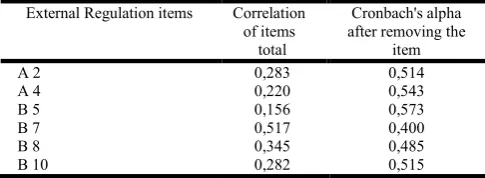
[image:4.595.306.561.326.396.2]Reliability coefficients for two dimensions of the SRQ-L questionnaire: internal regulation and external regulation have been calculated. The discriminatory powers of the item: internal regulation is 0.735, while the discriminatory power of the item: external regulation is 0.554. Ultimately, the reliability of the dimension of the external regulation is high, and the dimension of the external regulation is average. The dimensions of internal and external regulation correlate with each other in a statistically significant way. This correlation is not very strong and positive (R = 0.212, p = 0.003 **). Table 1 presents the analysis of the reliability of the SRQ-L questionnaire in the field of internal regulation for all items
Table 1. The analysis of the reliability of the SRQ-L questionnaire in the field of internal regulation for all items
Internal Regulation items Correlation of items
total
Cronbach's alpha after removing the
item
A 1 0,500 0,691
A 3 0,495 0,692
B 6 0,283 0,738
B 9 0,442 0,705
C 11 0,491 0,693
C 13 0,410 0,712
C 14 0,509 0,690
Source: own research
The analysis of the table above shows that all items correlate positively with the overall result. Table 2 presents the analysis of the reliability of the SRQ-L in the field of external regulation for all items.
Table 2. The analysis of the reliability of the SRQ-L in the field of external regulation after removing one item
External Regulation items Correlation of items
total
Cronbach's alpha after removing the
item
A 2 0,283 0,514
A 4 0,220 0,543
B 5 0,156 0,573
B 7 0,517 0,400
B 8 0,345 0,485
B 10 0,282 0,515
Source: own research
All of the items correlate positively with the overall result, and the Cronbach's Alpha Reliability Coefficient for external regulation is 0.519, which proves the average reliability of this dimension.
In order to obtain convergent and divergent validity of the Polish SRQ-L, I chose various questionnaires which are
conceptually related to the level of motivation (Deci, Ryan, 2000) and the ability to control (Baumeister, Vohs, 2004) as claimed by SDT. It was checked whether dimensions of SRQ-L are correlated with the dimensions of the Students' Motivation for Learning Questionnaire (KMSG) and The Questionnaire for Locus of Control Study (QLCS).
Correlations between the dimensions of the The Self-Regulation Questionnaire – Learning (SRQ-L) and the dimensions of Students' Motivation for Learning Questionnaire (KMSG)
I will begin my considerations with a presentation of the data that have been collected on the basis of Students' Motivation for Learning Questionnaire (KMSG) by R. Sterczyński (2010). This questionnaire is assumed the existence of 4 scales about general students' motivation to learn: self-control, autonomy
motivation, external motivation, self-awareness. The
[image:4.595.42.283.408.507.2]theoretical basis of the questionnaire is the concept of motivation by Deci and Ryan.
Table 3. Correlations between internal / external regulation and dimensions of the Motivation for Learning Questionnaire
Motivation for Learning Questionnaire items
Internal Regulation External Regulation
R p R p
Internal Motivation 0,370 0,000*** 0,324 0,000*** Diligence 0,212 0,003** 0,162 0,022* External Motivation 0,373 0,000*** 0,141 0,046* Self-consciousness 0,437 0,000*** 0,277 0,000***
Source: own research
It turned out, there are positive correlations between internal and external regulation and four dimensions of the motivation questionnaire. It shows a clear tendency suggesting that the correlations between the dimensions of both questionnaires are only positive. But it is increasingly clear that there are positive correlations between internal regulation and external motivation and also between external regulation and internal motivation. Correlations between these tools do not represent the proof, they are only an adequate validity of the tool.
Correlations between the dimensions of The Self-Regulation Questionnaire – Learning (SRQ-L) and the dimensions of The Questionnaire for Locus of Control Study (QLCS)
[image:4.595.40.283.620.709.2]The respondents with an external sense of control on the scale of successes achieved significantly lower results in the scope of internal regulation than respondents with an undetermined and internal sense of control. This is compatible with the assumptions according to which the external sense of control should correlate with the lower level of internal regulation, while the internal sense of control should correlate with the higher results of internal regulation. It may provide proof of the validity of internal regulation. There were no statistically significant differences in the field of internal regulation among respondents with undefined and internal sense of control. There were no statistically significant differences in the field of external regulation across all respondents with an external, undefined and internal sense of control on the scale of success. This result can not be proof of the validity of the external regulation dimension. The situation is similar in the case of the scale of failures. The respondents with an external sense of control on the scale of failure achieved significantly lower results in the field of internal regulation than respondents with an undetermined and internal sense of control. This is compatible with the assumptions according to which the external sense of control should correlate with the lower level of internal regulation, while the internal sense of control should correlate with the higher results of internal regulation. It may provide proof of the validity of internal regulation. There were no statistically significant differences in the field of internal regulation among respondents with undefined and internal sense of control. There were no statistically significant differences in the field of external regulation across all respondents with an external, undefined and internal sense of control on the scale of failure. This result can not be proof of the validity of the external regulation dimension. It turned out that the analysis of both scales: the scale of success and failures shows the similar situation. The respondents with an external sense of control on the scale of success and failure achieved significantly lower results in the field of internal regulation than respondents with an undetermined and internal sense of control.
This is compatible with the assumptions according to which the external sense of control should correlate with the lower level of internal regulation, while the internal sense of control should correlate with the higher results of internal regulation. It may provide proof of the validity of internal regulation. There were no statistically significant differences in the field of internal regulation among respondents with undefined and internal sense of control.
DISCUSSION
The aim of the present study is to evaluate the utility of the Polish version of the SRQ-L as a report measure for self-determination motivation styles and locus of control, by reporting psychometric properties, examining the factorial structure of the SRQ-L, assessing construct validity in a large sample of middle school students. The results of the present study indicate good levels of internal consistency for all subscales of the Polish version of the SRQ-L. Those levels are comparable to the original version of the SRQ-L (Ryan and Connell, 1989). The correlations between the two SRQ-L subscales reveal a pattern consistent with the continuum of self-determination (Ryan and Connell, 1989). The final Polish SRQ-L therefore resulted in 13 items (two dimensions: internal regulation – 7 items, external regulation – 6 items), whereas the original English version excluded two more items, because of insufficient variability. Internal regulation is characterized by a high level of reliability and research proved its
appropriate validity. Whereas external regulation is
characterized by average reliability and the research didn't prove its validity. Because of the unequal number of items in individual dimensions, the results of each dimension should be given as an average for the sum of items included in its dimensions. Thanks to this, it will be possible to compare
them. The present version of the Polish SRQ-L has been
[image:5.595.52.548.90.145.2]validated in an academic context with students attending to the first and third grades of middle school. The analysis will be
Table 4. Comparison of groups distinguished on the basis of the scale of success (QLCS) and the dimensions of internal and external regulation (SRQ-L)
Regulation items LOC – the scale of success ANOVA Tukey's Test (R.I.)
external unidentified internal
M SD M SD M SD F p
internal 3,92 1,01 4,60 1,07 4,94 1,21 17,369 0,000** Z/N, Z/W
external 3,64 1,02 3,89 0,96 3,80 1,03 1,281 0,280
[image:5.595.59.536.194.246.2]Source: own research
Table 5. Comparison of groups distinguished on the basis of the scale of failure (QLCS) and the dimensions of internal and external regulation
Regulation LOC – the scale of failure ANOVA Test Tukeya (R.I.)
external unidentified internal
M SD M SD M SD F p
internal 4,12 1,14 4,66 0,97 4,81 1,14 6,572 0,002** Z/N, Z/W
external 3,68 0,97 3,77 1,15 4,06 0,92 1,523 0,221
Source: own research
Table 6. Comparison of groups distinguished on the basis of the scale of failure and scale of success (QLCS) and the dimensions of internal and external regulation
Regulation LOC – the scale of success and failure ANOVA Test Tukeya (R.I.) external unidentified internal
M SD M SD M SD F p
internal 4,04 1,08 4,82 1,07 4,67 1,15 11,042 0,000*** Z/N, Z/W external 3,69 1,02 3,91 1,04 3,72 ,83 0,923 0,339
[image:5.595.90.504.295.350.2]enriched by research conducted among students of the seventh and the eighth grade of primary school because of the educational reform conducted by National Ministry of Education in 2017/2018 changed the school structure. Thus, its application among high school students is restricted. The present study conducted with a large representative school children sample demonstrates that the Polish version of the SRQ-L is a reliable and valid self-report instrument for the assessment of self-regulated styles within the school environment among primary school students. Furthermore, its psychometric properties are comparable to the original scale. In summary, my findings suggest that the Polish SRQ-L will be a useful tool within the educational context, as well as for research evaluating self-regulation in educational settings. However, the analysis of results obtained with SRQ-L should be viewed in connection with standards of adolescents' development, which emphasize high self-criticism that during this time of growth students have a tendency towards a high level of internalizing failure and low level of internalizing success. This passive attitude in school can cause unwillingness to participate in social activities. It is linked with low motivation to succeed, because according to students' perception of situations, what happens to them does not depend on themselves or their activities. They take no responsibility for their own activity due to the situation of social influence or pressure. Generally, the psychological theory states that students with external sense of control have a tendency to develop high level of anxiety, they feel worse at selecting appropriate goals and managing time and effort properly. Furthermore, the methods which are implemented in my research, might serve as methods to be used in diagnosis and prevention activities. In addition, reliable recognition of the processes that take place in the school environment can help teachers, school management, parents and students in their efforts to prevent risky behavior in the school environment.I am in agreement with Loevinger (1957) that psychological tests and surveys should serve as an aid in theoretical development. Scales may be in need of adaptation as the research question changes.
REFERENCES
Ahmad Sayuti, Z.A., Mohd Rafee, B.B., Murni Illani, J., &
Suhaily, A. 2015. Self-Regulated Learning SRL
Assessment in Occupational Safety and Health OSH
Competency Based Training, International Journal of
Education and Research, 3(11), pp.25-35
Azlina, M. 2007. Self-regulated learning and academic achievement in Malaysian undergraduates. International
Education Journal, 8 (1), pp.221-228
Bandura, A. 1993. Perceived self-efficacy in cognitive
development and functioning. Educational Psychologist,
28, pp.117-148
Baumeister, R.F., & Vohs, K.D. 2004 Handbook of self-regulation. New York: Guilford Press.
Black, A. E., & Deci, E. L. 2000. The effects of instructors’ autonomy support and students’ autonomous motivation on learning organic chemistry: A self-determination theory perspective. Science Education, 84, pp.740-756
Blair, C., & Razza, R.P. 2007 Relating effortful control, executive function, and false belief understanding to emerging math and literacy ability in kindergarten, Child
Development 78(2), pp.647-63
Bouffard-Bouchard, T., Parent, S., & Larivee, S. 1991.
Influence of self-efficacy on self-regulation and
performance among junior and senior high-school age
students. International Journal of Behavior Development,
14, pp.153-164
Carver, C.S. 2004. Self-regulation of action and affect In R.F. Baumeister & K.D. Vohs (Eds.), Handbook of self-regulation. New York: Guilford Press.
Cazan, A.M. 2013 Teaching self-regulated learning strategies for psychology students, Social and behavioral science 78, pp.743-797
Cheng, E. 2011. The Role of Self-regulated Learning in
Enhancing Learning. The International Journal of
Research and Review, 6 (1), pp.1-16
Cleary T.J., & Zimmerman B. J. 2004 Self-regulation empowerment program: A school-based program to enhance self-regulated and self-motivated cycles of student learning, Psychology in the Schools, 41(5), pp.537–550. http://doi.10.1002/pits.10177
Deci, E. L., & Ryan, R. M. 2000. What is the self in self-directed learning? In G. A. Straka (Eds.), What is the self in self-directed learning? Muenster: Waxmann.
Deci, E.L., & Ryan, R.M. 1985. Intrinsic motivation and self-determination in human behavior. New York: Plenum Publishing Co.
Deci, E.L., & Ryan, R.M. 2008. Self-Determination Theory: A Macrotheory of Human Motivation, Development and
Health. Canadian Psychology, 49, pp.182-185.
http://dx.doi.org/10.1037/a0012801
Denham, S. A. 2006. Social-emotional competence as support for school readiness: What is it and how do we assess it? Early Education and Development, 17(1), pp.57–89. https://doi.org/10.1207/s15566935eed1701_4
Dignath-van Ewijk, C. & van der Werf, G. 2012. What
Teachers Think about Self-Regulated Learning:
Investigating Teacher Beliefs and Teacher Behavior of Enhancing Students' Self-Regulation. Education Research International. 10, 741713. http:// dx.doi.org/10/1155/ 2012/741713
Kanfer, F. H. 1970. Self-regulation: Research, issues, and speculations. In C. Neuringer, J. L. Michael (Eds.), Behavior modification in clinical psychology. New York: Appleton-Century-Crofts.
Koestner, R., Bernieri, F., & Zuckerman, M. 1992. Self-regulation and consistency between attitudes, traits, and behaviors. Personality and Social Psychology Bulletin, 18, pp.52-59. http://dx.doi.org/10.1177/0146167292181008 Labuhn, A.S., Zimmerman, B.J., & Hasselhorn, M. 2010.
Enhancing students’ self-regulation and mathematics performance: The influence of feedback and self-evaluative standards Metacognition and Learning, 5 (2), pp.173-194 Loevinger J. 1957. Objective Tests as Instruments of
Psychological Theory. Psychological Reports, 3, pp.635-694. https://doi.org/10.2466/pr0.1957.3.3.635
Lombaerts K., De Backer F., Engels N., van Braak J., & Athanasou J. 2009. Development of the Self-Regulated Learning Teacher Belief Scale, European Journal of Psychology of Education, 24(1), pp.79-96. http://hdl. handle.net/10453/10431
McKown, C., Gumbiner, L.M., Russo, N.M., & Lipton, M. 2009. Social-emotional learning skill, self-regulation, and social competence in typically developing and
clinic-referred children. Journal of Clinical Child & Adolescent
Psychology, 38(6), pp.858–871. http://doi:
10.1080/15374410903258934
environment. Journal of Educational Psychology, 106(4), pp.961-973. http://dx.doi.org/10.1037/a0037116
Pajares, F. 2008. Motivational role of self-efficacy beliefs in self-regulated learning. In D. H. Schunk & B. J. Zimmerman (Eds.), Motivation and self-regulated learning: Theory, research and applications. New York: Erlbaum, pp.111-139
Perels, F., Dignath, C., & Schmitz, B. 2009. Is it possible to improve mathematical achievement by means of self-regulation strategies? Evaluation of an intervention in regular math classes. European Journal of Psychology of
Education, 24(1), pp.17-31. https://doi.org/10.1007/
BF03173472
Pintrich, P. 2000. Multiple goals, multiple pathways: The role
of goal orientation in learning and achievement. Journal of
Educational Psychology, 92, pp.544-555
Pour M.M. 2015. Psychometric indices of academic self-regulation Learning Scale. Saussurea 3(2), pp.69-79 Richards, J., Gross, J. 2000. Emotional regulation and
memory: The cognitive costs of keeping one’s cool.
Journal of Personality and Social Psychology, 79(4),
pp.410-424. http://doi 1O.1037/70O22-3514.79.3.410 Ryan R., M., & Deci E. L. 2006. Self-regulation and the
problem of human autonomy: does psychology need choice, self-determination, and will? Journal of Personality 74(6), pp.1562, 1557-1586. http://doi 10.1111/j.1467-6494.2006.00420.x
Ryan, R. M., & Deci, E. L. 2000. Self-determination theory and the facilitation of intrinsic motivation, social
development, and well-being. American Psychologist, 55,
pp.68-78
Ryan, R. M., Deci, E. L., & Grolnick, W. S. 1995. Autonomy, relatedness, and the self: Their relation to development and psychopathology. In D. Cicchetti, D. J. Cohen (Eds.), Developmental psychopathology: Theory and methods. New York: Wiley.
Schunk, D. H. 1984. Self-efficacy perspective on achievement behavior. Educational Psychologist, 19, pp.48-56
Shapiro, E. S. 2000 School psychology from an instructional perspective: Solving big, not little problems. School Psychology Review, 29(4), pp.560-572
Sheldon, K. M., Ryan, R. M., Deci, E. L., & Kasse T. 1995. The independent effects of goal contents and motives on well-being: it's both what you pursue and why you pursue it. Personality and Social Psychology Bulletin 30(4), pp.475-486. http://doi 10.1177/0146167203261883
Sitzmann, T. & Ely, K. 2011. Ameta-analysis of self- regulated learning in work-related training and educational attainment: What we know and where we need to go psychological bultein 421, pp.137-3
Sterczyński, R., Burczyk, P., Tucholska, K., Konwińska, M., Gmińska, B., Bławat, K., Kutajczyk, T., Przychodzeń, B. 2010. Kwestionariusz Motywacji Szkolnej Gimnazjalisty, In: XVI Konferencja Diagnostyki Edukacyjnej, Toruń Trentacosta, C. J., & Shaw, D. S. 2009. Emotional
self-regulation, peer rejection, and antisocial behavior: Developmental associations from early childhood to early
adolescence. Journal of Applied Developmental
Psychology, 30(3), pp.356-65. https://DOI:10.1016/
j.appdey.2018.12.016
Williams, & G. C., Deci, E. L. 1996. Internalization of Biopsychosocial Values by Medical Students: A test of
Self-Determination Theory, Journal of Personality and
Social Psychology, 70(4), pp.767-779
Zimmerman B. J. 2002. Becoming a Self-Regulated Learner: An Overview, Journal Theory Into Practice, 41, pp.64-70. https://doi.org/10.1207/s15430421tip4102_2
Zimmerman, B. 2000. Attaning self-regultion: A social cognative perspective. In M.Boekaerts, P. R., Pintrich & zeidner (Eds.), Handbook of self-regulation. San Diego: Academic press. pp.13-39
Zumbrunn S., Tadlock J., Roberts E.D. 2011. Encouraging Self-Regulated Learning in the Classroom: A Review of
the Literature, Metropolitan Educational Research
Consortium (MERC), Virginia Commonwealth University