8300
THE EFFECTS OF TECHNOSTRESS ON INFORMATION
TECHNOLOGY ACCEPTANCE
1Kyoungjune Kim, 2Hyunjun Park
1Senior Research Fellow, Global Business Academy, Incheon National University,
(Songdo-dong) 119 Academy-ro, Yeonsu-gu, Incheon, 22012, Korea
2
(
Corresponding author)Assistant Professor, Department of Business Administration, Incheon NationalUniversity (Songdo-dong) 119 Academy-ro, Yeonsu-gu, Incheon, 22012, Korea
E-mail: 1[email protected], 2[email protected]
ABSTRACT
Recent information technology is developing rapidly enough to provide new insights beyond human intuition. However, due to incidents such as job loss and privacy invasion, individuals are exposed to stress such as fear and pressure. The stress caused by such information technology may have a negative impact on the acceptance of new technology or productivity, and understanding this in practice is a critical task in modern society. The purpose of this research is to investigate the direct and indirect effects of technostress on the level of the individual in accepting new information technology. We developed a research model with innovation resistance as a mediating variable and conducted empirical analysis through 190 questionnaire responses. As a result, there were influences of the pace of change, reliability, connectivity, and complexity on the characteristics of information technology that induces individual technostress. Also, technostress has been proven to influence the acceptance of information technology only indirectly through innovation resistance. This study will provide meaningful insights and implications for the technostresses and consequences raised in the information system field through innovation resistance.
Keywords: Technostress, Innovation Resistance, Technology Acceptance, Techno-Strain, P-E Fit theory
1. INTRODUCTION
Information technology (IT) closely approaches our everyday life, such as artificial intelligence secretary (e.g. Siri), autonomous driving (self-driving) car, and big data to find consumers' hidden consumption patterns, to improve corporate productivity and convenience of consumers, it is an essential element.
Rapid and innovative changes in ICT technology: reduce response time, obscure the distinction between family and workplace, and make the area between leisure and work unclear [1] which leads to technological stresses such as physical fatigue accumulation, psychological pressure, and fear. Contrary to the attainment of various conveniences delivered by IT, it is emerging as an uneasy factor in the future society by causing an adverse reaction, which is known as technostress.
Primarily, technostress refers to the unique characteristics of IT such as changeability and
connectivity, and the negative psychological state that arises from the interaction of individuals [2], and acts as a serious obstacle in the modern society that requires rapid acceptance of new IT.
Therefore, the management of technostress is inevitable in the modern world. Also, in the future society which is a detailed and accurate personal-level countermeasure strategy focusing on the absorption and acceptance of technology beyond the present IT, which is centered on technology development.
In research related to IT acceptance, emphasis on 'proactive innovation bias' is neglecting the impact on techno-stress. Most research on IT acceptance focuses only on the positive aspects of IT and lacks understanding of the factors that hinder acceptance [3, 4, 5, 6].
8301 significance in embodying the process in which technostress is generated by the interaction of the individual and the environment, and Ragu-Nathan et
al.(2008) emphasize the importance of
psychological aspects by modeling the effects of technostress on organizational outcomes.
In the field of research, where the negative aspects of IT acceptance are represented by a similar theme, the concept of innovation resistance [7] is different from technostress research focusing on the concept of rejection and opposition, which are behavioral responses rather than psychological characteristics. In other words, it expresses that innovation resistance acts as a behavioral response to the acceptance of IT as a result of technostress [8]. The purpose of this study is to examine how technostress negatively affects IT acceptance, more specifically, it is intended to reveal "how the psychological state of technostress at the individual level leads to the acceptance or non-acceptance of IT by individuals through a process and behavioral response."
Furthermore, we would like to study whether "technostress, an individual's psychological state, directly influences the acceptance of IT, or does it indirectly influence acceptance through another behavioral process such as resistance or rejection?" The first research questions of this study are what factors cause technostress? Second, how does technostress affect technology acceptance?
If indirect effects occur, we will find variables that can control stress levels between technostress and information acceptance. Also, the development of solid education and training programs can control the acceptance of IT irrespective of stress level.
The expected effect will be a detailed understanding of the psychological and behavioral process mechanisms of technostress, which are often caused by the emergence and diffusion of innovative IT. Also, it will contribute to improving the acceptability of IT through the development of education and training programs to manage and control technostress generation process.
2. LITERATURE REVIEW 2.1 Technostress
Technostress is conceptually defined as 'negative psychological state caused by misfit of individual and IT environment [2] ' and has a conceptual basis in 'Stress as a dynamic process [9] '.
According to this concept, stress is caused by the interaction of the individual and the environment, and consists of a stressor, which means 'an individual's stimulus or event,' and strain, which is the psychological response of the individual due to the stressor [10].
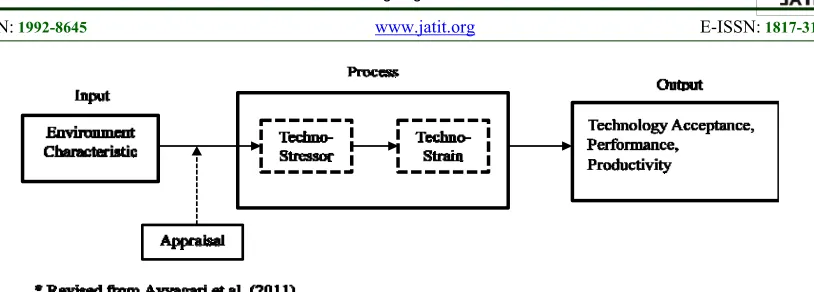
Technostress is described by P-E (Person– Environment) Fit theory [11], which is based on the concept of 'stress as a dynamic process [9] '. If the demand or supply of the IT environment does not fit the individual's ability or need, stress occurs. Therefore, the process of technostress occurrence of the individual appraises the fit of the IT environment at the input stage, and the process of generating the techno-stressor and techno-strain at the process stage when it is inadequate [2].
The technostress that occurs in this process affects personal outcomes such as technology acceptance or end-user performances in figure 1.
Therefore, the study on technostress needs to be preceded by a systematization of the generation process, a discussion on stressor and techno-strain, and then the outcomes should be verified. Although the P-E Fit theory [11] represents psychological stress, its application in technostress research is very rare [2].
The prior study was focused on the result of technostress was based on job satisfaction [12], productivity [13], personal performance [1], and organizational commitment [14]. However, some conceptual problems arise.
8302
Figure 1:P-E Fit Theory of Technostress
However, the components of the techno-stressor are conceptually incomplete using the IT environment characteristics together (complexity: techno-complexity, pace of change: change rapidly, uncertainty). Specifically, although techno-stressor is defined as 'IT-related event [10]', it conceptualized techno-stressor to the characteristics of IT. Therefore, problems of internal validity can arise in table 1.
Table 1: Technostress model and its construct
Research
Ayyagari et al. (2011): P-E fit model
Ragu-Nathan et al. (2008): Transaction–Based
model
Environm ental Character istics
Usefulness
Complexity1)
Reliability
Pace of Change2)
Presenteeism Anonymity
Not used in model (Only mentioned):
connectivity, information
overload, complex1),
change rapidly2)
technical problems and errors, multitasking
Techno-Stressor
Work-Home conflict Invasion of privacy Work overload Role ambiguity Job insecurity
Techno-overload Techno-insecurity Techno-invasion
Techno-complexity1)
Techno-uncertainity2)
Techno-Strain
Strain (drained, tired,
strain, burned out) Job satisfaction
1) ‘complexity, complex, techno-complex’ means the complexity of IT
2) ‘Pace of change, change rapidly, techno-uncertainty’ means the change of IT
Second, problems of measurement for techno-strain may occur. Techno-strain is a negative psychological state due to IT [10], which indicates pressure, fatigue, burden, and exhaustion. However, previous studies limit the strain to job dissatisfaction [12, 14, 16]. Therefore, it is not realistic to represent technostress. Then, by analyzing the causal relationship between the output and these variables, misinterpretation of the result may occur. Because of
these problems, this study attempts to examine the concept of technostress and its effect on the outcome, using P-E fit theory [11] as the theoretical framework.
2.2 Innovation resistance
Resistance is used as a user's reactive concept of change [7], and innovation resistance is defined as ‘behavior that contributes to maintaining the status quo in response to pressure to change the current state’ [8, 17]. Therefore, in the process of acceptance of new technologies, conflicts with existing beliefs lead to reactions to delay or reject introduction [18, 19].
Innovation resistance is part of the process of adopting new technology, pointing to the 'proactive innovation bias' of technology acceptance theory [20, 21]. It is also at the heart of the claim that new technologies go through a process of resistance before they are adopted to users [7, 22, 23].
Innovation resistance occurs when the characteristics (relative advantage, complexity, etc.) of a new technology are reflected in the individual's characteristics when exposed to innovation and affect acceptance [7, 22]. The characteristics of the new technology create functional barriers towards usage, value, and risk for the individual, and generate psychological barriers such as negative images and traditions [24]. Recent research has recognized the importance of innovation resistance in the adoption of new ITs and media. It also introduces the concept of innovation resistance that hinders the acceptance of technology [22, 25].
8303 Technostress, which can act as a psychological factor, induces behavioral responses of innovation resistance [26] and influences acceptance of IT [27]. As a result, innovation resistance supports the claim that "innovative and new IT is not always acceptable to the user [28], and that its introduction is not always successful [19] or positive for performance [29]". Therefore, the establishment of countermeasures to control the resistance of innovation can lead to strong acceptance of IT when overcoming user resistance [30].
Research on innovation resistance has been conducted in recent years with the advent of
innovative products. In particular, it is
demonstrating the role of innovation resistance in the adoption of mobile banking [31], IPTV [32], smart cars (In-Vehicle Infotainment: [22]), and HTML5 [8]. These studies commonly argue that functional barriers or technical characteristics that cause innovation resistance directly lead to the response of innovation resistance. However, few studies have examined the psychological state that induces the
behavioral response, innovation resistance.
Therefore, in this study, we will test the research model for technology acceptance by using technostress as a concept of psychological state and applying innovative resistance as a behavioral response.
3. RESEARCH MODEL AND HYPOTHESIS 3.1 Research model
We have developed a research model to demonstrate how technostress, which is the purpose
of this research, affects IT acceptance. More specifically, "Does technostress, an individual's psychological state, have an indirect effect on the acceptance of IT through behavioral responses? If not, does it directly affect? ".
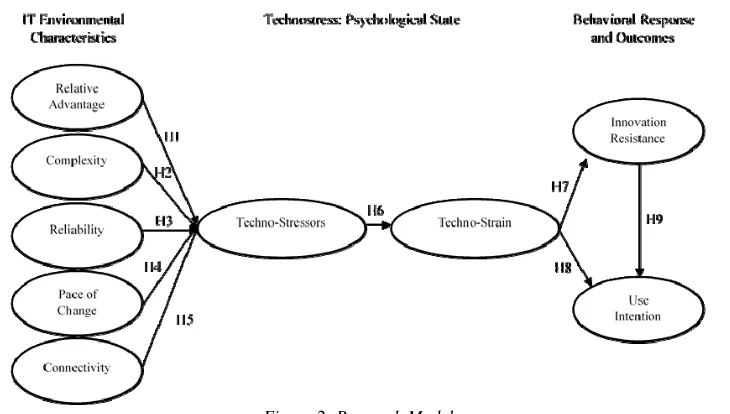
Therefore, in this research model, the relative advantage, complexity, reliability, pace of change, and connectivity, which are characteristics of innovative IT, are set as environment variables [2, 12] that cause technostress. Techno-Stressor, a component of technostress, used techno-overload, techno-invasion, and techno-insecurity [1, 12, 13]. As a result of previous researchers, techno-complexity and techno-uncertainty have the same conceptual composition as complexity and pace of change of environmental variables [2]. Therefore, in this study, techno-stressor is expressed by using factors excluding these two factors.
Techno-strain was measured by pressure, fatigue, burden, exhaustion [33], which is a construct of psychological state and was designed as a leading factor in innovation resistance [7] and intention to use [22] in research model.
[image:4.612.127.492.511.718.2]To demonstrate the direct and indirect effects of technostress on individual outcomes, we set the innovative resistance as a behavioral response mediating variable and propose an empirical analysis model for the acceptance of IT. In this study, a research model was developed by integrating the technostress model based on P-E fit theory [11] and the model of innovation resistance [7].
8304
3.2 Hypothesis
3.2.1 Relationship between IT environmental characteristics and Techno-stressor
The characteristics of IT provide the primary cause of the occurrence of technostress. In other words, the relative advantages, complexity, reliability, the pace of change, and connectivity inherent in innovative IT create events (i.e. techno-stressor) such as techno-overload, techno-invasion, and techno-insecurity that cause technostress [2, 12]. Therefore, the characteristics of IT will directly cause techno-stressors.
Relative advantages can be defined to the degree that the new IT is better than the existing IT and complexity is recognized by new IT as difficult to use or understand [34].
Research on innovation resistance [7] has argued that the higher the relative advantage and the lower the complexity, the lower the incidence of
innovation resistance through individual
psychological characteristics. Also, technology acceptance theory [20] argues that the relative advantage is expressed by perceived usefulness, complexity by the ease of use, and influencing acceptance of IT through individual attitudes [3]. Prior research argues that these factors are considered to be characteristics of innovative technologies and are the cause of techno-stressors that lead to work overload due to technology [2, 16]. Reliability is defined as the degree of dependable in the functions or results provided by IT, and it is included in the information system quality [35, 36]. DeLone and McLean (2003) argue that information system quality influences user satisfaction and the degree of IT use. Ayyagari et al. (2011) pointed out that if the reliability of IT is low, it reaffirms the results and causes problems such as delays in the system and causes the techno-overload. The pace of change in IT is defined as the degree to which new ITs have perceived the change rapidly [37]. Also, connectivity means the degree to which IT is always connected with an individual and that information can be provided in real time or communicated [2, 12, 38]. The two factors are fundamental characteristics of new IT, and prior research suggested that the characteristics of these new technologies cause job insecurity due to technology, invasion of privacy, and techno-overload [2, 12].
H1: The low relative advantage of the new IT will
have a positive influence on the techno-stressor.
H2: Complexity of the new IT will have a positive
influence on the techno-stressor.
H3: The low reliability of the new IT will have a
positive influence on the techno-stressor.
H4: Pace of change positively influence on the
techno-stressor.
H5: Connectivity positively influences on the
techno-stressor.
3.2.2 Relationship between techno-stressor and techno-strain
In stress theory, a stressor is defined as a specific event that occurs in an individual, and a strain refers to an individual's psychological response due to a stressor [2, 10]. Also, the stressor is the most important factor that causes strain [11].
In this study, stressor consists of three factors, which are techno-overload, techno- invasion, and techno-insecurity [1, 12, 13]. Because techno-complexity and techno-uncertainty are separated by environmental factors in hypotheses 2 and 4, the problem of constituent internal validity arises when used as a techno-stressor. Therefore, we excluded from the stressor of this study.
Work-home conflict, work overload, role ambiguity, job insecurity, and invasion of privacy are not directly used in this study because they are a factor of job stress [2]. Job stress is affected by technostress and may cause problems of internal validity [15]. Therefore, to resolve the problem of internal validity in this study, techno-stressor is limited to three components: techno-overload, techno- invasion, and techno-insecurity.
In previous studies, techno-strain was mainly expressed as job satisfaction. Although job satisfaction is a useful variable for expressing strain from an organizational point of view [12], the concept of stress, pressure, and exhaustion, which are negative psychological states, is more appropriate for an individual [2]. Therefore, in this study, the hypothesis is set by applying the concept of techno-strain to negative psychological state due to IT.
H6: Techno-stressor has a positive effect on
techno-strain.
3.2.3 Relationship between techno-strain, innovation resistance, and use intention
8305 overcome negative images such as technostress [8, 24].
In prior studies, it is argued that the user's stress or fear causes the resistance of the user [39], or that the negative emotions cause innovation resistance to delay or oppose the acceptance of the new IT [40, 41]. Therefore, technostress can be a factor that induces innovation resistance.
Technostress can also affect the acceptance of new ITs. The use of new IT is shrinking if IT causes work overload, privacy is violated, job security is threatened, and negative reactions occur [16]. These studies lead to the hypothesis that technostress will have a negative impact on the acceptance of new ITs.
At the stage where new technology is accepted by the user, the innovative resistance which is a behavioral reaction is generated reflecting the psychological state of the user and the IT is accepted through this process [7, 27]. Most users, not early adopters, accept new technologies through the process of resistance [7]. In the diffusion theory of innovation [42], new technologies have indicated that acceptance will occur when resistance is overcome and has been demonstrated through several studies since then [22, 27, 31].
H7: Techno-strain is positively related to innovation
resistance.
H8: Techno-strain is negatively related to intention
to use.
H9: Innovation resistance will have a negative effect
on intention to use.
3.3 Operational Definition
In this study, we try to analyze the direct and indirect effects of technostress on individual
technology acceptance through innovation
resistance. The environmental characteristic factors of technostress are composed of relative advantage and complexity (innovation resistance and diffusion theory), reliability (information system success theory), pace of change and connectivity (technostress theory) which are important concepts in technostress theory [2]. Techno-Stressor and Techno-Strain attempted the operational definition of composition concept based on technostress theory [2, 12]. Innovation resistance and acceptance of technology have been used by Song et al. (2016) and Venkatesh et al. (2012) (see Table 2) and constitute the questionnaire (see Appendix).
1 All answers have the same number
4. METHODOLOGY, ANALYSIS 4.1 Data collection
The target sample of this study was conducted using general individuals residing in Korea. The Korean society presently has a penetration rate of more than 90% of smartphones. Therefore, acceptance and diffusion of new ITs are rapidly emerging. Also, AI, robot, and big data are very interested in human versus AI (AlphaGo) game. The appropriateness of the questionnaire items was verified through the pilot test of 30 specialist groups, and the scale of the survey was defined as the Likert 7 point scale during the month of the August. The actual survey was conducted through an e-mail survey of 1,500 people in Korea for one month in September 2016. The total number of survey responses we received back was 203, which had a response rate of 13.5%. There were 13 fraudulent responses1 which were excluded from the recovered responses for this research. Therefore, in our research, we used 190 survey responses for our study.
Table 2. Operational Definition
Construct Operational
Definition
Ite ms
Referenc e Relative
Advantage
The degree to which using a new IT is perceived as being better than using its precursor.
3 Adapted
from [34]
Complexity The degree to which a
new IT is perceived as relatively difficult to understand and use.
3 Adapted
from [34]
Reliability Degree to which
features and capabilities provided by the technology are dependable
3 Adapted
from [35, 36, 43]
Pace of Change
Degree to which an individual perceives technological changes to be rapid
4 Adapted
from [37, 44]
Connectivity Degree to which
technologies enable individuals to be reachable
3 Adapted
from [2]
Techno-Stressor
Tech no - Over load
ITs force users to work faster and longer.
3 Adapted
8306
Tech no - Insec urity
Users feel threatened about losing their jobs, either because of automation from ICTs or to other people who have a better understanding of ITs.
3 Adapted
from [10, 45, 46]
Tech no - Invas ion
Perception that individual’s privacy has been
compromised
3 Adapted
from [47, 48]
Techno-Strain The individual’s
psychological response to the stressors
4 Adapted
from [10]
Innovation Resistance
The degree of rejection or opposite intention arising in the course of innovation adoption
3 Adapt
from [7, 8]
Use Intention Intent to use the
Information Technology in the future.
4 Adapted
from [21]
4.2 Sample Characteristics
[image:7.612.316.523.507.617.2]The characteristics of the sample collected in this study are shown in Table 3. The respondents' gender was 111 were female, accounting for 58.4% of the respondents and 79 were male, 41.6%. In the age group, the highest portion of percentage was 55.3% which were in their 30s, and in job category 58.4% of them worked for the government. In Korea, public service workers and their 30s are highly affected in techno-stress because they are experiencing frequent information system upgrades and has to apply the latest technology during their work.
Table 3. Respondent sample profile
Measure Categories Frequency Percent (%)
Gender Female Male 111 79 41.6 58.4
Age
1-29 24 12.6
30-39 105 55.3
40-49 46 24.2
50-59 15 7.9
Job
Student 7 3.7
Office workers 33 17.4
Works for
Government 111 58.4
Experts 13 6.8
Service 9 4.7
Research 16 8.4
Housewives 1 0.5
Total 190 100
4.3 Measurement Model
Prior to the verification of the measurement model, this study investigated 'techno-stressor' in three different concepts (overload, techno-invasion, techno- insecurity). Also, the results were combined and analyzed by 2nd order construct. Specifically, the techno-stressor is expressed as a concept of a latent variable rather than a measurement variable and it is conceptualized to be expressed precisely [49]. Furthermore, in the previous research, techno-stressor was measured as a latent variable to improve the explanatory power of research [1, 12, 15, 16].
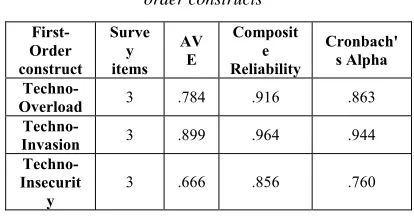
The two-step approach proposed by Wilson (2007) is used to conceptualize the second-order construct through the partial least squares (PLS) structural equation. The reliability and validity of the first-step measurement variables are shown in Table 4.
As a result of the analysis, the reliability and validity index of AVE C.R value of the first step measurement variable exceeded the reference value of 0.5 and 0.7, therefore, the latent variable could be used. Thus, in this study, we used Latent Variable Scores (unstandardized) of three factors as a 'techno-stressor' for 2nd-order constructs [50].
The validity and reliability of the research model are shown in Table 5. The Composite Reliability (C.R.), Cronbach Alpha (C. Alpha), and Average Variance Extracted (AVE) values of each construct were above the reference values, and reliability and convergent validity and discriminant validity were secured.
Table 4. Measurement result of techno-stressor
first-order constructs
First-Order construct
Surve y items
AV E
Composit e Reliability
Cronbach' s Alpha
Techno-Overload 3 .784 .916 .863
Techno-Invasion 3 .899 .964 .944
Techno-Insecurit
y
3 .666 .856 .760
4.4 Structural Model
8307 48.4% [50]. Thus, the research model has good explanatory power.
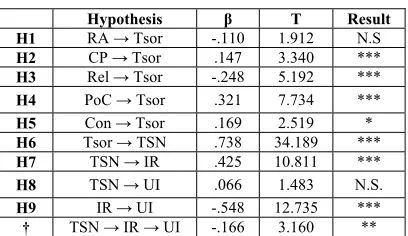
The results of this hypothesis test are shown in Table 6. All research hypotheses were supported except hypotheses 1 and hypothesis 8 were not supported. All factors except the relative advantage (β=-.11, t=1.912) of environmental characteristics of IT were significant to stressor, and techno-stressor had a significant influence on techno-strain (β=.738, p<.001).
Techno-strain had a significant effect on innovation resistance (β = .425, p< .001), but did not have a direct effect on intention to use (β = -.066, N.S). Therefore, it was not supported. However, it
was confirmed that innovation intention had a negative effect on intention to use through innovation resistance (β = -.548, p<.001), and it was analyzed that innovation resistance full mediated technostress and utilization intention.
This result expresses that the psychological factor, technostress, does not directly affect the acceptance of IT of behavioral consequences. However, it can be seen that, through the behavioral response factor of innovation resistance, it has indirectly influenced the individual's acceptance of IT.
Table 5. The result of validity and reliability analysis
Constr
uct C. R.
C.
Alpha AVE Com. RA CP Rel PoC Con TSor TSN IR UI
RA .969 .954 .913 .913 .955
CP .955 .929 .876 .876 .387 .936
Rel .890 .813 .733 .733 .484 .298 .856
PoC .931 .903 .772 .772 .288 .078 .238 .879
Con .919 .872 .790 .790 .445 .272 .400 .254 .889
TSor .797 .626 .569 .569 -.120 .193 -.202 .262 .062 .755
TSN .957 .939 .846 .846 -.212 .175 -.263 .232 .060 .739 .920
IR .888 .809 .729 .729 -.429 .208 -.327 -.025 -.263 .425 .425 .854
UI .954 .927 .873 .873 .592 -.465 .436 .246 .486 -.110 -.166 -.520 .934
[image:8.612.96.300.522.640.2]* Com.: Communality, RA: Relative Advantage, CP: Complexity, Rel: Reliability, PoC: Pace of Change, Con: Connectivity, Tsor: Techno-Stressor, TSN: Techno-Strain, IR: Innovation Resistance, UI: Use Intention ** bold: √AVE
Table 6. Partial Least Squares Result
Hypothesis β T Result
H1 RA → Tsor -.110 1.912 N.S
H2 CP → Tsor .147 3.340 ***
H3 Rel → Tsor -.248 5.192 ***
H4 PoC → Tsor .321 7.734 ***
H5 Con → Tsor .169 2.519 *
H6 Tsor → TSN .738 34.189 ***
H7 TSN → IR .425 10.811 ***
H8 TSN → UI .066 1.483 N.S.
H9 IR → UI -.548 12.735 ***
† TSN → IR → UI -.166 3.160 **
† mediating effect, * p<.05, **p<.01, ***p<.001, N.S: notsupported
5. RESULT
The purpose of this study is to investigate the effect of technostress, which is a psychological state, on the acceptance of individual IT, as innovative IT approaches our life. Specifically, it
was tested for innovation resistance whether technostress is directly or indirectly related to individual outcomes.
For this purpose, this study developed a research model that integrates technostress and innovation resistance theory and conducted PLS analysis using 190 questionnaires. As a result of the research hypothesis, 7 out of 9 research hypotheses were supported, and the relative advantage influence of environmental factors on techno-stressor (H1) and the direct effect of technostress on a personal outcome (H8) were not supported. Specifically, it can be concluded that the psychological state technostress affects the individual outcome through the behavioral response of innovation resistance.
8308 induced as a Techno-stressor. We found that the complexity [2, 12, 13, 16], reliability [35, 36], the pace of change [2] and connectivity [2] are important variables in the environmental factors that cause Technostress. Studies have examined the existing literature and found that constructing a stressor with overload, insecurity, and techno-invasion is more valid.
Second, it can be seen that technostress indirectly IT acceptance. This study shows that negative emotion induces innovation resistance and hinders the acceptance of new information technology [41].
In particular, the acceptance of innovative technologies overcomes resistance [42], and it was found through this study that the technostress management of the user was important before that. Through the control of innovation resistance, we emphasize the need to overcome the negative aspects of technostress that is prevalent in modern society and prepare for the effective acceptance of new information technologies. So, it is vital to find various coping strategies.
The results of hypothesis investigation in this study can be interpreted as follows. First, we support the previous study that the environmental characteristics of IT have a significant influence on the occurrence of technostress, except for relative advantages [2]. Especially, the pace of change of IT was the most important environmental factor and reliability, connectivity, and complexity was proved to be important determinants of technostress occurrence (H2~H5: PoC > Rel > Con > Cp). Relative advantage (H1) was not supported despite the characteristics of IT. This study can be interpreted as a result of comprehensive information about new IT without specifying IT.
Second, techno-stressors have been found to induce techno-strain of the individual's psychological state (H6). As a result, IT induced events (stressors) are the direct cause of technostress [2] and support the P-E Fit theory of stress [11].
Third, it is demonstrated that the psychological state (Technostress) that is the core of this study indirectly influences personal outcomes (Acceptance of IT, H7~H9). In particular, it influences individual outcomes by mediating the behavioral response of innovation resistance, and the occurrence of technostress does not significantly directly affect individual outcomes (H8: [51]). This study argues that the psychological state of technostress affects the acceptance of IT before the behavioral reaction of innovation resistance occurs.
Previous studies have demonstrated the importance of technostress, which directly affects
productivity or performance [1, 15, 16]. However, in this study, the psychological state of the individual (technostress) did not directly affect the individual outcome (Acceptance of IT), but the behavioral response (innovation resistance) was influential. Therefore, it provides a different perspective of technostress and individual outcome than previous research.
Additionally, in this study, it is different from the previous research [1, 12, 13, 15, 16] that the factors of techno-stressor are classified into three factors of techno-overload, techno-invasion, and techno-insecurity. It is more appropriate to classify the techno-complexity and techno-uncertainty factors used in the previous research into the environmental characteristics of IT [2] that precedes the stressor, based on the review of the literature on technostress. As a result of this study, causal relation of these factors is revealed, and this study contributes to solving the internal validity problem in technostress study.
6. CONCLUSION
This study has the following academic and practical implications. Academically, it provides the validity of the research model regarding the occurrence of technostress and systematization of its components. In particular, the environmental characteristic variables of IT have solved the internal validity problem of the techno-stressor used in the previous research [1, 12, 16].
Also, it provides academic implications by improving the reality of measurement by using techno-strain which expresses the complex psychological state of the individual. It also provides a conceptual framework for understanding technostress and their consequences through the use of the mediating variable of innovation resistance.
In practice, individuals or organizations primarily needs to establish control over technology before introducing new ITs. In particular, it is necessary to establish institutional procedures to control the rapid change of IT and to secure the reliability of technology from users with sufficient pilot application.
Second, it is necessary to actively manage the stress caused by IT. Negative psychological states lead to innovative resistance, a behavioral response. Therefore, individuals and organizations should be encouraged to review the acceptance of innovative technologies through appropriate management of technostress.
8309 barriers of innovation resistance, because technology acceptance can occur if the barrier to innovation resistance is eliminated [24]. Particularly, it is necessary to overcome functional and psychological barriers through education on technology, expansion of user participation, pilot service, and occurrence of joy. Furthermore, it can be said that it is vital to overcoming technostress and innovation resistance through individual capacity development education.
Despite these implications, this research study has some limitations and suggests future research. First, this study used convenience sampling. So, it is difficult to generalize the result.
Second, the environmental factors of IT set in this study need to be considered more. In particular, it is necessary to further investigate the causes of technostress by considering the social environment [21, 52] that induces the use of IT.
Third, consideration should be given to variables that can control the occurrence of technostress. The subsequent studies should discuss how individual characteristics or competency factors moderating the occurrence of technostress. Furthermore, the impact of technostress on performance or productivity through innovation resistance needs to be demonstrated.
ACKNOWLEDGMENT
Funding : This work was supported by Incheon National University Research Grant in 2017
REFERENCES
[1] Tarafdar, M., E.B. Pullins, and T. Ragu‐Nathan, "Technostress: Negative Effect on Performance and Possible Mitigations". Information Systems Journal, Vol.25, No.2, 2015, pp. 103-132. [2] Ayyagari, R., V. Grover, and R. Purvis,
"Technostress: Technological Antecedents and
Implications". MIS quarterly, Vol.35, No.4,
2011, pp. 831-858.
[3] Venkatesh, V., J.Y. Thong, and X. Xu, "Consumer Acceptance and Use of Information Technology: Extending the Unified Theory of
Acceptance and Use of Technology". MIS
quarterly, 2012, pp. 157-178.
[4] Davis, F.D. and V. Venkatesh, "Toward Preprototype User Acceptance Testing of New Information Systems: Implications for Software
Project Management". IEEE Transactions on
Engineering management, Vol.51, No.1, 2004, pp. 31-46.
[5] Van der Heijden, H., "User Acceptance of
Hedonic Information Systems". MIS quarterly,
2004, pp. 695-704.
[6] Wang, Y.-S., et al., "Determinants of User Acceptance of Internet Banking: An Empirical Study". International journal of service industry management, Vol.14, No.5, 2003, pp. 501-519. [7] Ram, S., "A Model of Innovation Resistance".
ACR North American Advances, 1987.
[8] Haeyeop, S., J. Jaewook, and J. Jaemin, "Factors Affecting Web Developers’ Resistance to Html5 Adoption". korean management review, Vol.45, No.3, 2016, pp. 925-945.
[9] Butler, G., "Definitions of Stress". Occasional paper (Royal College of General Practitioners), No.61, 1993, pp. 1.
[10] Cooper, C.L., et al., Organizational Stress: A Review and Critique of Theory, Research, and Applications. 2001: Sage.
[11] Edwards, J., R. Caplan, and R. Harrison, "Person-Environment Fit Theory: Conceptual
Foundations, Empirical Evidence, and
Directions for Future Research. Teoksessa Cl
Cooper (Toim.)". Theories of organizational
stress, 2002, pp. 28-67.
[12] Ragu-Nathan, T., et al., "The Consequences of Technostress for End Users in Organizations: Conceptual Development and Empirical
Validation". Information systems research,
Vol.19, No.4, 2008, pp. 417-433.
[13] Tu, Q., K. Wang, and Q. Shu,
"Computer-Related Technostress in China".
Communications of the ACM, Vol.48, No.4, 2005, pp. 77-81.
[14] Ahmad, U.N.U., S.M. Amin, and W.K.W. Ismail, "Moderating Effect of Technostress Inhibitors on the Relationship between Technostress Creators and Organisational
Commitment". Sains Humanika, Vol.67, No.1,
2014.
[15] Tarafdar, M., et al., "The Impact of Technostress on Role Stress and Productivity". Journal of management information systems, Vol.24, No.1, 2007, pp. 301-328.
[16] Tarafdar, M., et al., "Crossing to the Dark Side: Examining Creators, Outcomes, and Inhibitors of Technostress". Communications of the ACM, Vol.54, No.9, 2011, pp. 113-120.
[17] Zaltman, G. and R. Duncan, Strategies for
Planned Change. 1977: Wiley.
[18] Bovey, W.H. and A. Hede, "Resistance to Organizational Change: The Role of Cognitive
and Affective Processes". Leadership &
8310 [19] Kim, H.-W. and A. Kankanhalli, "Investigating
User Resistance to Information Systems
Implementation: A Status Quo Bias
Perspective". MIS quarterly, 2009, pp. 567-582. [20] Davis, F.D., R.P. Bagozzi, and P.R. Warshaw, "User Acceptance of Computer Technology: A Comparison of Two Theoretical Models". Management science, Vol.35, No.8, 1989, pp. 982-1003.
[21] Venkatesh, V., et al., "User Acceptance of Information Technology: Toward a Unified View". MIS quarterly, 2003, pp. 425-478. [22] Kim, J., S. Kim, and C. Nam, "User Resistance
to Acceptance of in-Vehicle Infotainment (Ivi)
Systems". Telecommunications Policy, Vol.40,
No.9, 2016, pp. 919-930.
[23] Lapointe, L. and S. Rivard, "A Multilevel Model of Resistance to Information Technology Implementation". MIS quarterly, 2005, pp. 461-491.
[24] Ram, S. and J.N. Sheth, "Consumer Resistance to Innovations: The Marketing Problem and Its
Solutions". Journal of consumer marketing,
Vol.6, No.2, 1989, pp. 5-14.
[25] Lee, H., S.H. Lee, and B. Jang, "Factors Affecting the Resistance of 3dtv Adoption; Combining the Theory of Diffusion of Innovation and Innovation Resistance Model". Korean Journal of Broadcasting and Telecommunications Research, Vol.80, 2012, pp. 78-111.
[26] Ellen, P.S., W.O. Bearden, and S. Sharma, "Resistance to Technological Innovations: An Examination of the Role of Self-Efficacy and
Performance Satisfaction". Journal of the
Academy of Marketing Science, Vol.19, No.4, 1991, pp. 297-307.
[27] Kim, et al., "The Effect of Acceptance and Resistance on User of Social Security Information System : An Integrated Research". The e-Business Studies, Vol.14, No.2, 2013, pp. 155-176.
[28] Ansoff, H.I. and E.J. McDonnell, Implanting
Strategic Management. Vol. 2. 1990: Springer. [29] Piderit, S.K., "Rethinking Resistance and
Recognizing Ambivalence: A Multidimensional View of Attitudes toward an Organizational
Change". Academy of management review,
Vol.25, No.4, 2000, pp. 783-794.
[30] Hosseini, M.H., et al., "Factors Affecting Consumer Resistance to Innovation in Mobile Phone Industry". International Journal of Asian Social Science, Vol.6, No.9, 2016, pp. 497-509. [31] Jae, E.Y., et al., "A Study on Innovation
Resistance Model of Internet Primary Banks".
International Journal of Software Engineering and Its Applications, Vol.10, No.6, 2016, pp. 1-12.
[32] Yunhwan, K. and C. Young, "Determinants of Psychological Resistance against Iptv - Modification of Innovation Resistance Model". Journal of Broadcasting and Telecommunications Research, 2009, pp. 163-191.
[33] Moore, J.E., "One Road to Turnover: An Examination of Work Exhaustion in Technology
Professionals". MIS quarterly, 2000, pp.
141-168.
[34] Moore, G.C. and I. Benbasat, "Development of an Instrument to Measure the Perceptions of
Adopting an Information Technology
Innovation". Information systems research,
Vol.2, No.3, 1991, pp. 192-222.
[35] DeLone, W.H. and E.R. McLean, "Information Systems Success: The Quest for the Dependent Variable". Information systems research, Vol.3, No.1, 1992, pp. 60-95.
[36] Delone, W.H. and E.R. McLean, "The Delone and Mclean Model of Information Systems
Success: A Ten-Year Update". Journal of
management information systems, Vol.19, No.4, 2003, pp. 9-30.
[37] Weiss, A.M. and J.B. Heide, "The Nature of Organizational Search in High Technology Markets". Journal of marketing research, 1993, pp. 220-233.
[38] Calabrese, F., et al., "Urban Computing and
Mobile Devices". IEEE Pervasive Computing,
Vol.6, No.3, 2007, pp. 52-57.
[39] Marakas, G.M. and S. Hornik, "Passive Resistance Misuse: Overt Support and Covert
Recalcitrance in Is Implementation". European
Journal of Information Systems, Vol.5, No.3, 1996, pp. 208-219.
[40] Bhattacherjee, A., "Understanding Information
Systems Continuance: An
Expectation-Confirmation Model". MIS quarterly, 2001, pp. 351-370.
[41] Fuglseth, A.M. and Ø. Sørebø, "The Effects of Technostress within the Context of Employee
Use of Ict". Computers in Human Behavior,
Vol.40, 2014, pp. 161-170.
[42]Rogers, E.M., Diffusion of Innovations. 2010:
Simon and Schuster.
[43] Jiang, J.J., G. Klein, and C.L. Carr, "Measuring Information System Service Quality: Servqual from the Other Side". MIS quarterly, 2002, pp. 145-166.
8311
Buyers in High-Technology Markets". The
Journal of Marketing, 1995, pp. 30-43.
[45] Ashford, S.J., C. Lee, and P. Bobko, "Content, Cause, and Consequences of Job Insecurity: A Theory-Based Measure and Substantive Test". Academy of Management journal, Vol.32, No.4, 1989, pp. 803-829.
[46] Burke, R.J. and C.L. Cooper, The Organization in Crisis: Downsizing, Restructuring, and Privatization. 2000: Blackwell Publishing. [47] Alge, B.J., "Effects of Computer Surveillance
on Perceptions of Privacy and Procedural Justice". Journal of Applied Psychology, Vol.86, No.4, 2001, pp. 797.
[48] Eddy, E.R., D.L. Stone, and E.E. STONE‐ ROMERO, "The Effects of Information Management Policies on Reactions to Human Resource Information Systems: An Integration of Privacy and Procedural Justice Perspectives". Personnel Psychology, Vol.52, No.2, 1999, pp. 335-358.
[49] Son, K.-H., Y.-H. Chun, and C.-S. Ok, "A Comparison of Estimation Approaches of Structural Equation Model with Higher-Order Factors Using Partial Least Squares". Journal of the Society of Korea Industrial and Systems Engineering, Vol.36, 2013.
[50] Fornell, C. and D.F. Larcker, "Evaluating Structural Equation Models with Unobservable
Variables and Measurement Error". Journal of
marketing research, 1981, pp. 39-50.
[51] Koo, C., Y. Wati, and S. Jung, "Does Technostress Effect Really Affect on Individual
and Organizational Effectiveness?: A
Multidimensional Empirical Test". The Korea
Society of Management Information Systems (Proceeding), 2009, pp. 283-289.
[52] Sami, L.K. and N. Pangannaiah,
8312
APPENDIX. Measurement instruments and Factor loading
Construct Measurements Loading Factor
Relative Advantage
1. Using the new ITs enables me to accomplish tasks more quickly.
2. Using the new ITs enhances my effectiveness on the job.
3. Using the new ITs increases my productivity.
.962
.955
.950
Complexity
1. My interaction with the new ITs would be clear and understandable.(reverse)
2. It would be difficult for me to become skillful at using the new ITs.
3. Learning to operate the new ITs are difficult for me.
.924
.952
.932
Reliability
1. The features provided by new ITs are dependable.
2. The capabilities provided by new ITs are reliable.
3. New ITs behave in a highly consistent way.
.937
.922
.685
Pace of Change
1. I feel that there are frequent changes in the features of new ITs.
2. I feel that characteristics of new ITs change frequently.
3. I feel that the capabilities of new ITs change often.
4. I feel that the way new ITs work changes often.
.881
.897
.892
.841
Connectivity
1. The use of new ITs enables others to have access to me.
2. The use of new ITs enables me to be in touch with others.
3. ICTs enable me to access others.
.928
.850
.887
Techno-Stressor
Techno -
Overload
1. I am forced by new technology to do more work than I can handle.
2. I am forced by new technology to work with very tight time schedules.
3. I am forced to change my work habits to adapt to new technologies.
.862
.884
.911
Techno -
Insecurity
1. I am worried that new ITs may pose a threat to my job.
2. I have to constantly update my skills to avoid being replaced.
3. I am threatened by coworkers with newer technology skills.
.773
.879
.793
Techno -
Invasion
1. I have to be in touch with my work even during my vacation due to the new
technology.
2. I feel my privacy can be compromised because my activities using the new ITs
can be traced.
3. I feel my personal life is being invaded by the new technology.
.936
.962
.947
Techno-Strain
1. I feel drained from activities that require me to use the new ITs.
2. I feel tired from my new IT activities.
3. Working all day with the new ITs is a strain for me.
4. I feel burned out from my new IT activities.
.895
.937
.906
.941
Innovation
Resistance
1. I am dissatisfied with the new Its
2. I have a dislike for the new ITs
3. I don’t need and the new ITs in my life.
.904
.937
.700
Use Intention
1. I intend to use the new ITs actively in the future.
2. I expect to use the new ITs in the future.
3. I plan to use the new ITs in the next few months.
.919
.942