8160
DETERMINING THE LEVEL OF TRUSTWORTHINESS OF
INFORMATION IN SOCIAL MEDIA
1MOHAMAD NAZRI BIN KHAIRUDDIN YAP, 2MASSILA BINTI KAMALRUDIN AND
3SAFIAH BINTI SIDEK
1Faculty of Computer Science & Information Technology, Universiti Malaysia Sarawak, 94300 Kota
Samarahan, Sarawak, Malaysia.
2 ,3 Institute of Technology Management and Entrepreneurship, Innovative Software System and Services
Group, Universiti Teknikal Malaysia Melaka, Hang Tuah Jaya, 76100 Durian Tunggal, Melaka, Malaysia.
E-mail: 1[email protected], 2[email protected], 3[email protected]
ABSTRACT
The social media are increasingly becoming the main reference and having important implications on virtual community. Parts of the information published in the social media could be useful and some could be misleading. Therefore, there is a need to develop an approach that can verify the trustworthiness of online information to minimise the dissemination of misleading information. This paper presents a study that develops an objective approach to determine the level of trustworthiness of information. Based on four parameters derived from literature and empirical data, an algorithm to determine the level of trustworthiness has been developed. This algorithm measurement of trustworthiness was then realised through an automated tool called TrustCrawler. The functionality of the tool was demonstrated using online information on Government Service Tax (GST) of Malaysian drawn from Twitter. It was found that the tool is able to provide consistent results on the level of trustworthiness of online information based on the four parameters. It is anticipated that this tool is able to help social media users to determine level of trustworthiness of the information, hence becoming informed, safe and ethical users of media content.
Keywords:Degree, Information Trustworthiness, Social Media
1. INTRODUCTION
The increasing usage and reliability on information from social media has been a major concern as it is very difficult to determine the trustworthiness of information shared by various and anonymous parties. Serena et al. mentioned that trust is a mechanism for managing uncertain information in decision-making, taking into considering the information source [7]. Although information sharing that helps to make better decision is an important process in human society, the truthfulness of information should not be taken for granted. Therefore, information should not be arbitrarily disseminated considering information are sensitive and private.
Media social users may have difficulties to decide the trustworthiness of information due to the huge information available on social media. Further, it has become a taken for granted practice for mobile or social media users to rely and believe information on social media without
considering the truth of the information. Jarutas et al. stated that it is necessary to aid users in assessing the trustworthiness of Web information they consume [13]. As such, there is a need to develop a method or approach that validates and verifies information from social media.
Serena et al. argued that trust minimizes the uncertainty in the interactions among the information sources. They provide a focused representation of trust about the sources, in which trust concerns not only the sources but also the information items. Ricardo et al. posit that the level of specific quality is determined by the quality of context in relation to a specific entity. As such, trust is determined based on a certain range of preciseness and accurateness. In this case it is important to understand the degree of information trustworthiness to obtain more accurate result on verifying information trust.
8161 purpose, two research questions will be addressed in this paper: i) what are the factors that determine the trustworthiness of information? and ii) how to determine the different levels of trustworthiness of online information? For presentation, this paper is organised into four sections. After the introduction, the paper presents the literature review which is followed by the methodology section. The next section is the results and discussion and the final section is the conclusion and future work.
2. LITERATURE REVIEW
Studies related to trustworthiness of online information are varied and they primarily focus on developing framework, model or approach to produce the degree of information trustworthiness. Aniket et al. developed an approach to identify the level of trust by exploring the question of how users’ perceptions of trustworthiness of wiki system by specifying the low and high with quality [1]. Focusing on the static data rather than real data from the social network, Salvatore et al. outlined the breadth-first-search sampling and uniform sampling. Shafiza et al. emphasized on the credibility on the news on Twitter by applying several methods of analysing the data. The results however, produced the rating on its credibility based on topic, message and user-based category only. Carnegie et al. visualized the different degree of trustworthiness into a matric by utilising two types of data in their work: controversial and non-controversial with high and low quality. However, they did not specifically address the issue of trustworthiness of information. So far, studies that focus on the approach to systematically and objectively determine the level of trustworthiness of online information is still lacking.
We also found that studies of verifying trustworthiness of information are not related to social media. For example, Aniket et al. used a matrix design to verify the trustworthiness of wiki. They reported that the classification of the trust was based on the quality and the controversial of the wiki articles. However, this visualisation technique did not specify the evaluation criteria of the articles selected. Another similar study was conducted by Ricardo et al., in which he focused on the context information. According to him, context-aware
service platforms use context information to adapt the current situation of the service users [6]. JaeHong Park et al. focus on investors’ active and passive participation in message boards. Meanwhile, Kristin et al. highlighted that users with high social media self-efficacy tend to be more likely to trust information shared to other social information source. However, their work did not address the degree of trustworthiness of the information.
There are some studies that emphasise the credibility of the information. These studies, however, did not discuss the information trustworthiness evaluation criteria. It is important to understand the evaluation technique in order to gain the trust of users on how the trustworthiness of information will be generated.
3. METHODOLOGY
This study advocates the importance of identifying the components of trust when determining the level of trustworthiness of online information. Specifically, it is crucial to identify the most reliable component that contributes to verify the degree of trust. Further, to ensure objective determination of the trust, a weightage to calculate the degree of trust degree should be developed. Therefore, this study formulates a combination of attributes of trust to calculate the degree of information trustworthiness. By computing the percentage of trust, it is easier for us to determine the level of trust of information.
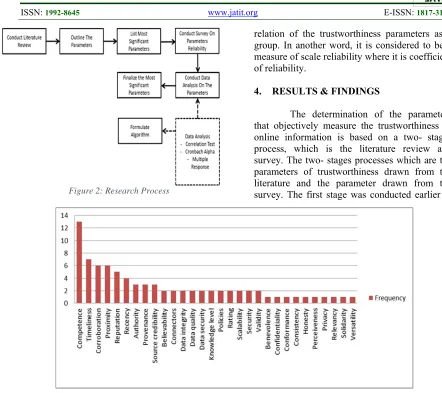
8162 Figure 2: Research Process
It begins with the conduct of the literature review to determine the significant parameters for determining the trustworthiness of online information. The identification of the parameters drawn from the literature review are presented in the next section. The next stage involved the conduct of the survey. The purpose of the survey is to verify the parameters based on empirical data. Out of 300 surveys distributed, 200 were selected. 100 responses were rejected due to non-response errors (Some respondents did not provide any answer or the answer were irrelevant for the study).
We then analysed the data using SPSS. For this purpose, the analysis conducted was the Correlation, Cronbach Alpha and Multiple Response. We tested the internal consistency of the items based on the Cronbach Alpha. Correlation test to determine the statistical relationship between the parameters was also conducted. The purpose is to determine the
relation of the trustworthiness parameters as a group. In another word, it is considered to be a measure of scale reliability where it is coefficient of reliability.
4. RESULTS & FINDINGS
The determination of the parameters that objectively measure the trustworthiness of online information is based on a two- stages process, which is the literature review and survey. The two- stages processes which are the parameters of trustworthiness drawn from the literature and the parameter drawn from the survey. The first stage was conducted earlier to
identify the reliability of the parameters and the second stage was conducted after the tool; TrustCrawler was developed in order to prove the significant of the first stage.
4.1 Parameters of Trustworthiness drawn from the Literature
8163 have identified the factors that contribute to the verification of information trustworthiness. It is also found that most of the works do not represent the same factors as shown in Figure 1. From the literature review, the results showed that trustworthiness relates to the trust of network security, software and the data itself. Less works were found on the information trust from the social media. However, the terms and factors mentioned from the studies were almost similar to one another.
It was found that the four most influential factors in verifying information trustworthiness are proximity, reputation, competence and timeliness. Reputation is considered as one of the parameters of trustworthiness of information since most social media user will get attracted to information with high reputation or popularity. This can also be referred as trending information. In social media, the popularity of the information is when it becomes viral, retweets or shared. Competence or the level of knowledge in the Internet or social media refers to the individual, organisation or agencies that post or share the information. The reliability of the source of information is very important. At the same time, it could be biased on the source because the source of information could be personal and individual preference. However, source of information plays a major role in providing the trusted source of the information. Meanwhile for proximity, it shows the closeness, provenance, nearest in place, time, order, occurrence or relation of the information. Such information with the level of proximity will show the degree of relatedness of the information. The fourth parameter is the timeliness. The information in social media moves or changes fast every second. It is crucial to have the most recent and updated information. News feed of information is considered outdated after 48 hours. So far, there were none existence work to justify the period of expire of a post of an information. Most studies focus on the length to user stay on the Internet or website. Therefore, only most recent information is considered to be trustworthy.
4.2 Parameters of Trustworthiness drawn from the Survey
In order to get a precise and more accurate parameter, a survey with 300 respondents was conducted. As shown in Figure
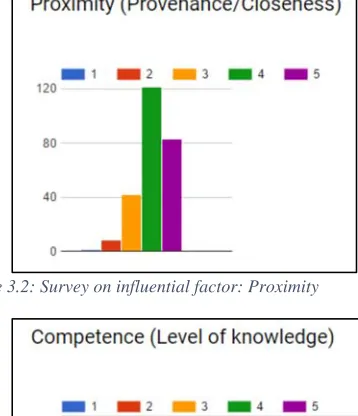
[image:4.612.357.532.139.286.2]3.1 to 3.4, reputation, proximity, and timeliness shows the highest responds, while competency has an average value.
Figure 3.1: Survey on influential factor: Reputation
[image:4.612.354.535.221.635.2]Figure 3.2: Survey on influential factor: Proximity
[image:4.612.355.534.332.540.2]8164 Figure 3.4: Survey on influential factors: Timeliness
The Likert Scale from 1-5, where 1 is most disagreed towards 5 is the most agreed of the four parameters which displayed a positive results of the parameters. Most of the respondent had provided the range of respond between most agreed and agreed. It showed a very strong requirement for the parameters in verifying trustworthiness of information as shown in Figure 3.1 to 3.4.
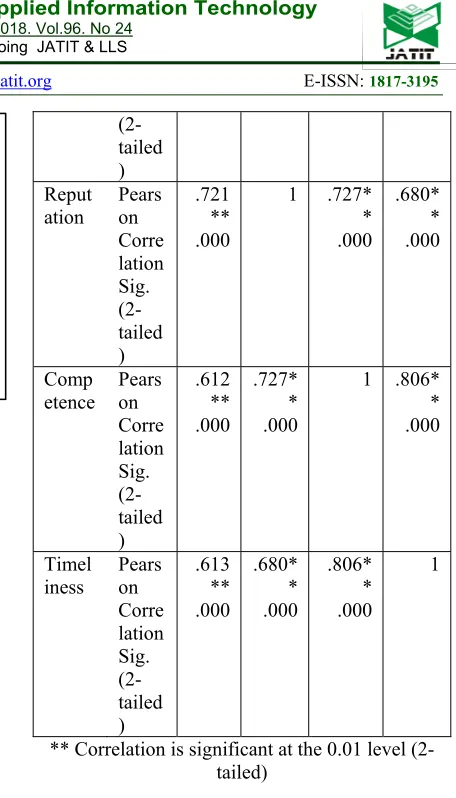
[image:5.612.94.309.72.237.2]After the four parameters had been selected and empirically verified, a set of rules was assigned to each of the parameter. From the survey result from the respondents, we then find the relationship between the parameters using SPSS. SPSS is a mathematical tool to analyse the quantitative result from the survey. We computed the correlation matrix and the significance of the parameter and the results were very high. From the correlation matrix, the value were .000 for all the parameter which indicated that the parameter were all significant. Moreover, based the significant level, α=0.01, the correlation between all the parameter are significant as shown in Table 1. Furthermore, the Cronbach Alpha of the parameter is .901, which indicates high reliability as in Table 2. Therefore, it can be concluded that the four parameters are significant determiners of trustworthiness of social media information.
Table 1: Correlation Matrix
Prox imit y Repu tation Comp etence Time liness Proxi
mity Pearson Corre lation Sig.
1 .721* * .000 .621* * .000 .613* * .000 (2-tailed ) Reput
ation Pearson Corre lation Sig. (2-tailed ) .721 ** .000
1 .727* * .000 .680* * .000 Comp
etence Pearson Corre lation Sig. (2-tailed ) .612 ** .000 .727* * .000
1 .806* * .000
Timel
iness Pearson Corre lation Sig. (2-tailed ) .613 ** .000 .680* * .000 .806* * .000 1
[image:5.612.316.529.456.518.2]** Correlation is significant at the 0.01 level (2-tailed)
Table 2: Reliability Statistics
Cronbach’s Alpha
Cronbach’s Alpha Based on Standardized
Items N of Items
.901 .901 4
4.3 Formulating Algorithm to Determine the Level of Trustworthiness
[image:5.612.84.295.619.727.2]8165 variables have to be joined to form a set. Here, the variables are the Proximity, Reputation, Competence and Timeliness. The set is the trustworthiness parameter. Then, we specify which of the two options in the dichotomy has to be counted. Table 3 shows the result of the multiple response computation.
Table 3: Parameter Frequency
Responses Percent of
Cases
N Percent
Proximity 104 23.9% 77.0%
Reputation 100 23.0% 74.1%
Competence 114 26.2% 84.4%
Timeliness 117 26.9% 86.7%
Total 435 100% 322.2%
4.5 TrustCrawler: An Automated Tool to Determine the Trustworthiness of Online Information
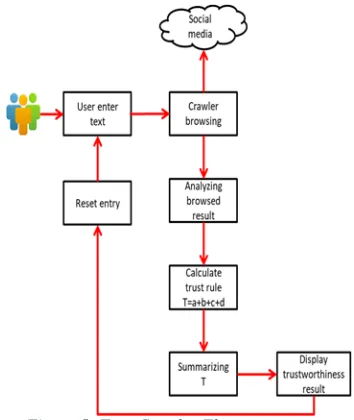
[image:6.612.357.534.194.404.2]Based on the formulated algorithm, we have developed a tool called TrustCrawler to test the algorithm. In realising this, Figure 4 explains how the tool could provide the trustworthiness level. The tool is capable to generate the degree of trustworthiness of information. Specifically, users who want to identify the trustworthiness of social media information can feed in the information in the system. Once the information is inserted in the tool system, the tool will objectively determine the level of trustworthiness based on the algorithm. The level of trustworthiness identified as either high, average or low will then be displayed.
Figure 4: TrustCrawler Approach
Furthermore, Figure 4 demonstrates the overall approach conducted to achieve in obtaining the trustworthiness level. Identifying and confirming the essential parameters are the most crucial. Therefore, the two main stages play an important role for the development of the tool.
Figure 5: TrustCrawler Flow
[image:6.612.84.305.506.688.2]8166 Figure 5 shows that the process of TrustCrawler in delivering the trustworthiness of information results. First, the user of TrustCrawler will enter the keyword or information he/she desired. The crawler will get the information from the social media which is the Twitter. Matching of the keywords were analysed and calculated. The results then are compute to the trust rule. The display of the trustworthiness result would be in the form of percentage. Figure 6 is the example of the TrustCrawler wireframe to show the trustworthiness level of the information obtained.
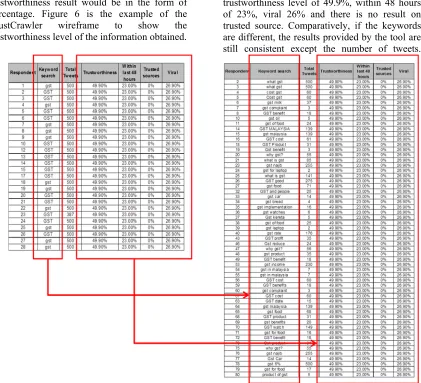
To demonstrate the functionality of TrustCrawler, we use information on Government Service Tax (GST) of Malaysia. Figure 7 shows the result of the trustworthiness of information on GST. There were two sets of accuracy testing conducted by the tool. The first set was by using only one keyword, which is the GST. The second set was anything on GST or a sentence on GST. The results show that there is a consistence result generated from the tool. In this work, the data were obtained from Twitter.
[image:7.612.101.276.102.206.2]In this result, we focus on the keywords, total tweets, trustworthiness time and the source. The respondents have several ways to provide the keywords but the keyword that they provide have to be in line on the search for the information on GST. When the keyword is specifically on GST, as shown in Figure 7, the tool will show a consistence result of 500 tweets, trustworthiness level of 49.9%, within 48 hours of 23%, viral 26% and there is no result on trusted source. Comparatively, if the keywords are different, the results provided by the tool are still consistent except the number of tweets.
[image:7.612.101.522.327.710.2]8167 Here, TrustCrawler tool is capable in providing the degree of information trustworthiness with consistent level of the parameters.
5. CONCLUSION
The degree in trustworthiness of information is very important when dealing with information from the social media. The degree of trust will assist and educate users on the level of trust for specific information. For this purpose, an approach that objectively determines the level of trustworthiness of online information has been developed. Further, an automated tool embedded with a crawler capability has been developed to realise the approach. It is anticipated that the adoption of this approach will help to educate and make the public users aware of the level of trustworthiness of the information, hence developing an informed, safe and ethical users of media content.
ACKNOWLEDGEMENTS
This research is jointly supported by Innovative Software System and Services Group, Universiti
Teknikal Malaysia Melaka (UTeM:
PJP/2017/ftmk-cact/S015699) and Universiti Malaysia Sarawak (UNIMAS), Malaysia.
REFERENCES
[1] Kittur, A., Suh, B., & Chi, E. H. (2008, November). Can you ever trust a wiki?: impacting perceived trustworthiness in wikipedia. In Proceedings of the 2008 ACM conference on Computer supported cooperative work (pp. 477-480). ACM. [2] Miller, L. M. S., & Bell, R. A. (2012).
Online health information seeking: the
influence of age, information
trustworthiness, and search
challenges. Journal of aging and
health, 24(3), 525-541.
[3] Kelton, K., Fleischmann, K. R., & Wallace, W. A. (2008). Trust in digital information. Journal of the American Society for Information Science and Technology, 59(3), 363-374.
[4] Pan, L. Y., & Chiou, J. S. (2011). How much can you trust online information? Cues for perceived trustworthiness of
consumer-generated online
information. Journal of Interactive
Marketing, 25(2), 67-74.
[5] Flanagin, A. J., & Metzger, M. J. (2000). Perceptions of Internet information credibility. Journalism & Mass Communication Quarterly, 77(3), 515-540.
[6] Neisse, R., Wegdam, M., & Van Sinderen, M. (2008, November). Trustworthiness and quality of context information. In Young Computer Scientists, 2008. ICYCS 2008. The 9th International Conference for (pp. 1925-1931). IEEE.
[7] Xu, S., Sandhu, R., & Bertino, E. (2009, June). Tiupam: A framework for trustworthiness-centric information sharing. In IFIP International Conference on Trust Management (pp. 164-175). Springer Berlin Heidelberg.
[8] Guba, E. G. (1981). Criteria for assessing the trustworthiness of naturalistic inquiries. Educational technology research and development, 29(2), 75-91.
[9] Shenton, A. K. (2004). Strategies for ensuring trustworthiness in qualitative research projects. Education for information, 22(2), 63-75.
[10] Lo, S. K., & Lie, T. (2008). Selection of communication technologies—A perspective based on information richness theory and trust. Technovation, 28(3), 146-153.
[11] Cheung, C. M., & Thadani, D. R. (2012). The impact of electronic word-of-mouth communication: A literature analysis and integrative model. Decision support systems, 54(1), 461-470.
8168 [13] Pattanaphanchai, J., O'Hara, K., & Hall,
W. (2013, May). Trustworthiness criteria for supporting users to assess the credibility of web information. In Proceedings of the 22nd International Conference on World Wide Web (pp. 1123-1130). ACM.
[14] Park, J., Konana, P., Gu, B., Leung, A. C. M., & Chung, A. (2010). An Investigation of Information Sharing and seeking Behaviors in Virtual Communities. In ICIS (p. 242).
[15] Hocevar, K. P., Flanagin, A. J., & Metzger, M. J. (2014). Social media self-efficacy and information evaluation
online. Computers in Human
Behavior, 39, 254-262.
[16] Saini, H., Dash, S. B., Panda, T. C., & Mishra, A. (2013). Prediction of Trustworthiness in the Cloud Computing Environment using Predator-Prey Model. International Journal of Cloud Computing and Services Science, 2(5). [17] Jessen, J., & Jørgensen, A. H. (2011).
Aggregated trustworthiness: Redefining online credibility through social validation. First Monday, 17(1).
[18] Venanzi, M., Rogers, A., & Jennings, N. R. (2013, May). Trust-based fusion of untrustworthy information in
crowdsourcing applications.
In Proceedings of the 2013 international conference on autonomous agents and multi-agent systems (pp. 829-836). International Foundation for Autonomous Agents and Multiagent Systems.
[19] Atzori, L., Iera, A., & Morabito, G. (2014). From" smart objects" to" social objects": The next evolutionary step of the internet of things. IEEE Communications Magazine, 52(1), 97-105.
[20] Yu, P. L., Balaji, M. S., & Khong, K. W. (2015). Building trust in internet banking: a trustworthiness perspective. Industrial Management & Data Systems, 115(2), 235-252.
[21] Nitti, M., Girau, R., Atzori, L., Iera, A., & Morabito, G. (2012, September). A subjective model for trustworthiness evaluation in the social internet of things. In Personal Indoor and Mobile Radio Communications (PIMRC), 2012 IEEE 23rd International Symposium on (pp. 18-23). IEEE.
[22] Wang, G., Liu, X., & Fan, W. (2011). A knowledge adoption model based framework for finding helpful user-generated contents in online communities. [23] Xiang, Z., & Gretzel, U. (2010). Role of
social media in online travel information search. Tourism management, 31(2), 179-188.
[24] Westerman, D., Spence, P. R., & Van Der Heide, B. (2014). Social media as information source: Recency of updates and credibility of information. Journal of Computer-Mediated
Communication, 19(2), 171-183.
[25] Moturu, S. T., & Liu, H. (2011). Quantifying the trustworthiness of social media content. Distributed and Parallel Databases, 29(3), 239-260.
[26] Lotan, G., Graeff, E., Ananny, M., Gaffney, D., & Pearce, I. (2011). The Arab Spring| the revolutions were tweeted: Information flows during the 2011 Tunisian and Egyptian revolutions. International journal of communication, 5, 31.
[27] Westerman, D., Spence, P. R., & Van Der Heide, B. (2012). A social network as information: The effect of system generated reports of connectedness on credibility on Twitter. Computers in Human Behavior, 28(1), 199-206.
[28] Kang, M. (2010). Measuring social media credibility: A study on a Measure of Blog Credibility. Institute for Public Relations, 59-68.
[29] Kietzmann, J. H., Silvestre, B. S., McCarthy, I. P., & Pitt, L. F. (2012). Unpacking the social media phenomenon: towards a research agenda. Journal of Public Affairs, 12(2), 109-119.
[30] Pentina, I., & Tarafdar, M. (2014). From “information” to “knowing”: Exploring the role of social media in contemporary news consumption. Computers in Human Behavior, 35, 211-223.
8169 [32] Heinrichs, J. H., Lim, J. S., & Lim, K. S.
(2011). Influence of social networking site and user access method on social media evaluation. Journal of Consumer Behaviour, 10(6), 347-355.
[33] Yap, M. N. K., Kamalrudin, M., Bakar, A. Z. A., & Sidek, S. (2016).
VERIFICATION ON THE
TRUSTWORTHINESS OF
INFORMATION: A STUDY. Journal of Theoretical and Applied Information Technology, 92(1), 72.
[34] Creese, S., Goldsmith, M., Nurse, J. R., & Phillips, E. (2012, June). A data-reachability model for elucidating privacy and security risks related to the use of online social networks. In Trust, Security and Privacy in Computing and Communications (TrustCom), 2012 IEEE 11th International Conference onTrust, Security and Privacy in Computing and Communications (pp. 1124-1131). IEEE. [35] Nurse, J. R., Agrafiotis, I., Creese, S.,
Goldsmith, M., & Lamberts, K. (2013, July). Building confidence in information-trustworthiness metrics for decision support. In Trust, Security and Privacy in Computing and Communications (TrustCom), 2013 12th IEEE International Conference on (pp. 535-543). IEEE. [36] Nurse, J. R., Agrafiotis, I., Creese, S.,
Goldsmith, M., & Lamberts, K. (2013, July). Communicating trustworthiness using radar graphs: A detailed look. InPrivacy, Security and Trust (PST), 2013 Eleventh Annual International Conference on (pp. 333-339). IEEE.
[37] Nurse, J. R., Agrafiotis, I., Goldsmith, M., Creese, S., & Lamberts, K. (2014). Two sides of the coin: measuring and communicating the trustworthiness of online information. Journal of Trust Management, 1(1), 1-20.
[38] Nurse, J. R., Creese, S., Goldsmith, M., & Lamberts, K. (2011, September). Trustworthy and effective communication of cybersecurity risks: A review. InSocio-Technical Aspects in Security and Trust (STAST), 2011 1st Workshop on (pp. 60-68). IEEE.
[39] Nurse, J. R., Creese, S., Goldsmith, M., & Lamberts, K. (2012, June). Using Information Trustworthiness Advice in Decision Making. In Socio-Technical Aspects in Security and Trust (STAST), 2012 Workshop on (pp. 35-42). IEEE. [40] Nurse, J. R., Creese, S., Goldsmith, M., &
Rahman, S. S. (2013). Supporting human decision-making online using information-trustworthiness metrics. InHuman Aspects of Information Security, Privacy, and Trust (pp. 316-325). Springer Berlin Heidelberg.
[41] Nurse, J. R., Rahman, S. S., Creese, S., Goldsmith, M., & Lamberts, K. (2011). Information quality and trustworthiness: A topical state-of-the-art review. In The International Conference on Computer Applications and Network Security (ICCANS).
[42] Yang, S., Joy, M., & Nurse, J. R. (2011). Experiences on sharing e-learning resources using service technologies. [43] Chuanyi, L. I. U., Jie, L. I. N., & Binxing,
F. A. N. G. (2013). T-YUN: Trustworthiness Verification and Audit on
the Cloud Providers. IEICE
TRANSACTIONS on Information and Systems, 96(11), 2344-2353.
[44] Elo, S., Kääriäinen, M., Kanste, O., Pölkki, T., Utriainen, K., & Kyngäs, H. (2014). Qualitative content analysis: A focus on trustworthiness (pp. 1–10). [45] Fisher, B. A., & Hawes, L. C. (1971). An
interact system model: Generating a
grounded theory of small
groups. Quarterly Journal of Speech, 57(4), 444-453.
[46] Ge, L., Gao, J., Li, X., & Zhang, A. (2013, August). Multi-source deep learning for information trustworthiness estimation. In Proceedings of the 19th ACM SIGKDD international conference on Knowledge discovery and data mining (pp. 766-774). ACM.
8170 [48] Ge, L., Gao, J., Yu, X., Fan, W., &
Zhang, A. (2012, December). Estimating local information trustworthiness via multi-source joint matrix factorization. InData Mining (ICDM), 2012 IEEE 12th International Conference on (pp. 876-881). IEEE.
[49] Grimmelikhuijsen, S. G., & Meijer, A. J. (2012). The effects of transparency on the perceived trustworthiness of a government organization: Evidence from an online experiment. Journal of Public Administration Research and Theory, mus048.
[50] Gui, X., Wang, D., Fu, L., & Zh, W. (2012). A Verification Model for Trustworthiness of Interaction between Objects. International Journal of Digital Content Technology and its Applications, 6(20), 140.
[51] Han, Q., Yang, G., Han, J., & Bao, W. (2014). Trustworthy Construction Approach of BPR Software System Based
on Semantic Model
Verification.International Journal of Hybrid Information Technology, 7(4), 83-90.
[52] Hartig, O. (2008, September). Trustworthiness of data on the web. InProceedings of the STI Berlin & CSW PhD Workshop.
[53] Houmb, S. H., Ray, I., & Ray, I. (2006). Estimating the relative trustworthiness of information sources in security solution evaluation. InTrust Management (pp. 135-149). Springer Berlin Heidelberg.
[54] Houmb, S. H., Ray, I., & Ray, I. (2006). Estimating the relative trustworthiness of information sources in security solution evaluation. InTrust Management (pp. 135-149). Springer Berlin Heidelberg.
[55] Kuz, I., Zhu, L., Bass, L., Staples, M., & Xu, X. (2012, August). An architectural approach for cost effective trustworthy systems. In Software Architecture (WICSA) and European Conference on Software Architecture (ECSA), 2012 Joint Working IEEE/IFIP Conference on (pp. 325-328). IEEE.
[56] Ling, C. T. N. (2011). Culture and trust in fostering knowledge-sharing.Electronic Journal of Knowledge Management, 9(4), 328-339.
[57] O’Neill, D. (2014). Software Assurance, Trustworthiness, and Rigor.CrossTalk, 25. [58] Ramachandran, S., Paulraj, S., Joseph, S., & Ramaraj, V. (2009). Enhanced trustworthy and high-quality information retrieval system for web search engines. arXiv preprint arXiv:0911.0914. [59] Toma, C. L. (2010, February).
Perceptions of trustworthiness online: the role of visual and textual information. In Proceedings of the 2010 ACM conference on Computer supported cooperative work (pp. 13-22). ACM. [60] Stavri, P. Z., Freeman, D. J., &