7535
A TECHNOLOGY-INTEGRATED STORYTELLING METHOD
IN DEVELOPING SYLLABUS DESIGN FOR UNIVERSITY
WRITING EDUCATION
1HWA-SEON KIM, 2*KYEONG-OUK JEONG
1Department of Basic Education, Pai Chai University, Korea
2Hannam University, Department of English Education, Graduate School of Education, Korea
E-mail: 1[email protected], 2*[email protected]
ABSTRACT
The purpose of this study is to develop syllabus design for university writing education. To invent the architype of university writing instruction for the curricular sequence, a technology-integrated storytelling method was implemented. With the current development of digital technology, more and more people are interconnected through storytelling to each other through various social media or social networks. In the field of education, storytelling has been considered as an effective instructional method that can provide students with entertainment, promote learner motivation, and help students focus on their own learning process. In the recent educational milieu based on constructivism, learner responsibility and learner autonomy become much more crucial than those of the teacher. This phenomenon has reflected the essential concept that the main character of learning is the learner, not the teacher. Owing to the development in technologies, technology-enhanced instructional methods such as flipped learning or blended learning have also become the new educational trends. Consequently, the notion of technology-integrated storytelling method based on learner-centered perspectives becomes more significant than ever, and various online platforms can be served as a powerful network to share stories among people. In this regard, the storytelling instructional method with technology integration can wonderfully match the learner-centered pedagogical approach. In this study, the architype of syllabus will be designed using the technology-integrated storytelling method in university writing education. Learning and teaching strategies will be suggested with the use of technology-integrated storytelling teaching method.
Keywords: Storytelling Method, Technology-enhanced Learning, Syllabus Design, Writing Education,
Learner-centered Learning
1. INTRODUCTION
With the recent advances in digital technology, people are interacting each other through various social networking services such as Facebook, Instagram, or Twitter. People have been accustomed to internet dependence for their daily communication. Some people assert that the use of computers and mobile devices have resulted in isolating people without interpersonal interaction. However, people have been communicating each other more than ever through writing their thoughts and stories on the web [1]. The changing technology has created the possibilities to adopting new and innovative platforms of writing which possess unique features of sharing and distributing ideas and storytelling. Digital devices play a role as a vital vehicle of expressing our thoughts and sharing individual’s storytelling. Therefore, the impact of
technology-integrated storytelling becomes much more significant than ever because these online services can work as a prevailing network to share storytelling among people [2].
7536 storytelling [4]. The history of storytelling has been evolving from the prehistoric myth, into medieval romance, and into contemporary books, films, and dramas. We human beings as storytellers have manipulated reality and created the imperatives and interrogatives to which our companions should reply [5]. The human life itself, from the cradle to the grave, adopts the layout of storytelling. Our life events have been represented as each story in which the cause and effect of life events were interwoven in the relationship with other people. We have related some parts of life events into another and then have imposed some distinct meaning on them. The format of human history has the same structure as storytelling. Connecting events and adding some specific significance on the events so as to develop them as a story is exactly the same notion of manipulating reality. As we already know, we can find the evidence of storytelling history from the ancient tomb mural in The Cave of Altamira, the fables of the grandmother to the grandchildren, and various contemporary digital storytelling in the modern world [4]. In the process of creating storytelling by manipulating our reality, we can find the growing-up story of the character who came to experience life events and understand the wisdom of life.
Likewise, the learning process that a student meets a teacher and is well educated as a wise person can be regarded as a kind of a growing-up storytelling process. Especially, in the recent educational paradigm in which the motivation and autonomy of students become much more important compared to traditional educational setting, the current educational situation looks like the design of storytelling in which the premature hero of a story undertakes life troubles, encounters a helper, and overcomes the hardship of life. Therefore, through the implementation of technology-integrated storytelling method, learners can understand the world, organize meaning and communicate with others while participating in storytelling via various multimedia and social networks.
The purpose of this study is to propose the prototype of the technology-integrated storytelling method to develop learner-centered syllabus design in which the whole curricular sequence of students’ learning process is invented as a growing-up storytelling process of the students. The pilot study of this research was conducted and presented in the 2017 International Conference on Platform Technology and Service [6]. The learner-centered and technology-integrated storytelling method was implemented to create concrete learning and
teaching strategies for university students’ writing education for this study.
2. RELATED RESEARCH
Recently, digital storytelling, which relates digital technology to storytelling, has attracted much popularity and attention not only in the area of game industry but also in the area of writing and literary education. Storytelling has been used in the field such as citizenship education or social value education and it also has been actively integrated into classes such as mathematics in solving various problems. For learners from digital native generation, learning through technology-integrated storytelling has become a familiar instructional strategy. When the storytelling technique, which is in fact the innate nature of human beings, encounters the advanced digital technology, it can create an innovative teaching and learning strategy. This encounter can increase the interest of the learners and help them engage in their study. Technology-integrated storytelling method has gained much attention in recent times as an influential teaching and learning strategy that supports to engage both teachers and their students. However, until recently, little attention has been paid to a pedagogical and theoretical framework that can be adopted to boost the effectiveness of new technology as a powerful device in the classroom environment [7]. This study attempts to suggest the overall format of a university writing course as a storytelling structure. This endeavor is related to the current educational situation which emphasizes self-directed learning. For learner-directed learning to occur, leaners’ commitment is the most essential factor.
7537 literature such as Harry Potter, which has a large fandom, have exactly the similar storytelling structure. For learners, genuine learning means self-growth and self-realization. True learning should help learners see the world with deep and wide angles from balanced perspectives. So far, storytelling has been adopted into various educational fields. Among them, educators have especially focused on how teachers can employ the storytelling technique as the effective educational method in order to motivate their students and improve their learning [9].
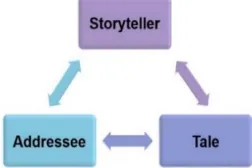
Storytelling has been used to persuade people, sell products, or educate learners [10]. Generally, storytelling has been used as a teaching technique for teachers and as a trauma curing method for psychologists. Storytelling can be served both as an effective publicizing method and as a solution in the growth of applied storytelling. Since storytelling can serve as a mechanism of propaganda that can make people immersed, people have utilized storytelling strategies in order to find solutions when the structure of a society has been jeopardized. Storytelling can be also used as a means of profiling personal history, visualizing information, and manipulating fabricated notional intelligence. Above all, storytelling has power in persuading people. Storytelling makes people put emotions over rational minds, uplifts charming fiction over solid reality, and substitutes political power into fictional competence [11]. One of the effective ways to persuade people is by connecting an idea into emotion. The most powerful way to accomplish this purpose is by an enchanting storytelling. The reason why storytelling can touch our mind is that storytelling has the charm to appeal to the inner voice of the hearer [11]. In telling this kind of story, people not only intertwine much information into the storytelling but also boost listener’s emotions and inner energy [12]. The concept of storytelling as an instructional method consists of the interlocking relationships of three important aspects: the teller, the tale, and the addressee. Figure 1 shows the interconnecting aspects of the teller, the tale, and the addressee in the notion of storytelling [13].
Figure 1: The relationship of three aspects in storytelling
In the university lectures, the instructor as a teller meets the students as the addressee. Through engaging in the learning process from cause and effect relationship among the storyteller, the addressee, and the tale of storytelling, learners can attain knowledge and wisdom and develop as more mature people. The genuine purpose of using storytelling as the effective instructional strategy is to motivate the learners to become an autonomous protagonist of their own storytelling as learning process. For achieving that purpose, educators in universities and schools should discard the outdated teacher-centered teaching methods and should try to find various innovative teaching methods that can motivate their students and help them concentrate on their own learning process.
[image:3.612.313.517.485.627.2] [image:3.612.118.244.632.716.2]Because the technology-integrated instructional methods such as flipped learning or blended learning have recently become the new agendas in education field, educators should contemplate about how they can actually invent technology-enhanced syllabus design in order to boost learner autonomy [14]. For example, what kind of structure should a class implement in order to communicate with each other through smart devices while the students are immersed in their storytelling as learning in the class? The teacher role is not a unidirectional transmission of knowledge. Rather, from a recent pedagogical view, it is desirable for the teachers to guide the learners in the search of their own storytelling. Figure 2 shows the interactional framework for the technology-integrated storytelling writing process.
Figure 2: Interactional framework for the technology-integrated storytelling writing process storytelling
7538 storytelling. This should be the first starting point of the storytelling pedagogy that takes place at the learner level.
In the university lectures, storytelling is an effective instructional method that can provide learners with entertainment, promote learner motivation, and help learners focus on the lesson. Technology-integrated instructional methods such as flipped learning or blended learning have become the new educational trends and this phenomenon has reflected the essential concept that the main character of learning is the learner, not the instructor [14]. A learner who acts as the main character of the storytelling through various empathic experiences becomes immersed in learning from the stable affective condition and finds pleasure in learning. Therefore, immersion as a hero in the storytelling through empathic experience infers a psychological attitude that a learner should have. At this point, digital technologies can play a vital role to mediate the storytelling of learners to their autonomous learning. Furthermore, technologies can also play an essential role to connect the storytelling of the instructor to the storytelling of the learners. In this regard, the storytelling instructional method with technology integration can wonderfully match the learner-centered teaching approach.
3. THE NATURE OF THE
TECHNOLOGY-INTEGRATED STORYTELLING METHOD
Storytelling is sometimes misunderstood as narrative. While narrative is to depict a factual or fictitious event according to the cause and effect relationship in the chronological order, storytelling is to tell a story in the interactional discourse format. Storytelling has been integrated in diverse pedagogical areas. According to Aristotle in Poetica, a well-formed plot of a story should be composed of beginning, middle, and end. The design of storytelling should be merged as a whole and every piece of the plot should link with the rest of the storyline [15]. Therefore, the instructor who utilizes the technology-integrated storytelling method should make an outline of the lecture with beginning of a story, middle of a story and end of a story to become as a whole.
The real purpose of utilizing technology-integrated storytelling as the effective instructional strategy is encouraging the learners to become self-directed agents of their learning process. Learners are expected to actively reconstruct the acquired knowledge during the class time and to realize the true meaning of authentic learning. The technology-integrated storytelling instructional strategies for this
study can be explained into two dimensional aspects between the instructor and the learners.
The technology-integrated storytelling instructional strategy for the instructor level
The technology-integrated storytelling instructional strategy for the learner level
3.1 The technology-integrated storytelling
instructional strategy for the instructor level
For the technology-integrated storytelling teaching strategy for the level of the instructor, the instructor becomes a storyteller or an author who produces a story and makes an instructional structure of a course base on the technology-integrated storytelling format. The most important point here is that the technology-integrated storytelling teaching method should be processed in two sequential aspects. The instructor constructs not only the whole semester but also every class according to the timeline of storytelling.
Technology-integrated storytelling on a whole semester basis
Technology-integrated storytelling on each class basis
3.1.1 Technology-integrated storytelling on
the whole semester basis
The instructor should design the whole course itself as a complete technology-integrated storytelling. The whole course itself should be regarded as a complete storytelling. The beginning, middle, and end of the course should be interpreted as a beginning of a story, middle of a story, and an end of a story.
In technology-integrated storytelling structure, authors usually introduce the background of the story at the beginning and have the characters come into the story frame for the first time. Thus, the instructors should recognize themselves as authors or storytellers and then provide students with the background knowledge around the topics of the designated week of the course. The instructors also try to incorporate motivational teaching methods relevant to the topic of the week. If instructors want to have their students review the study, it would be great for the instructors to arrange the contents of the lesson around the previous lesson.
7539 middle of one semester, except for the beginning and the end of the semester, as a structure with probability and coherence. The topic of the lecture to be held every week should be structured appropriately to the course objectives.
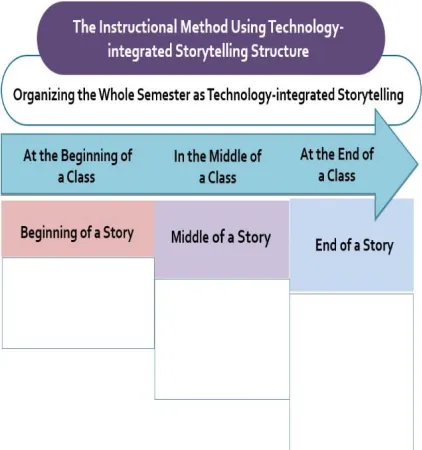
[image:5.612.316.525.212.505.2]Accordingly, the end of the semester corresponds to the end of the storytelling. It is important what ending will be made for the whole storytelling. For a meaningful ending, the instructor should finish the contents of the lesson within the scheduled time of the semester in order to interweave the whole corresponding storytelling case. The instructor should re-hint at how the contents are linked to the other lessons of the courses to which they relate. The instructor should also provide opportunities for students to retrospect whether they have accomplished academic achievement in the course. Figure 3 shows the technology-integrated storytelling instructional structure that the instructor should consider in designing the effective course syllabus with the technology-integrated storytelling structure of a whole semester.
Figure 3 Technology-integrated storytelling teaching structure of a whole semester
3.1.2 Technology-integrated storytelling on
the each class basis
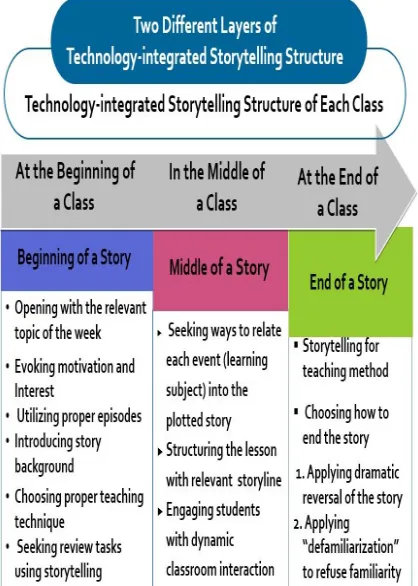
The instructor should organize each lesson of the weekly lectures using technology-integrated storytelling instructional method. The storytelling structure of the weekly lecture is similar to the whole structure of the lecture in one semester. The weekly lesson should also consist of the interrelated whole storytelling structure. Figure 4 shows the technology-integrated storytelling teaching structure of each week.
Figure 4: Technology-integrated storytelling teaching structure of each class
[image:5.612.93.301.373.657.2]7540 When organizing each class with the technology-integrated storytelling structure, defamiliarization technique should be applied for constructing each class. Defamiliarization is the artistic technique, in which authors show audiences common things in an unfamiliar or strange manner in order to enhance perception of the familiar and let the audience concentrate on the story [12]. Like using the defamiliarization technique in the technology-integrated storytelling, instructors should not make each weekly class in the same sequential order. Generally, each class goes through the regular sequence as follows:
Reviewing the previous class
Introducing learning goals of the week
Having a lecture
Summarizing the class
Rather, instructors should find the different tactics of having a lecture and summarizing the class as much as possible. This teaching method is important in helping students be focused on each class and get expected for the upcoming classes.
3.2 The technology-integrated storytelling instructional strategy for the learner level
For the technology-integrated storytelling learning strategy for the level of the learner, learners themselves can produce their own storytelling as two steps. For the first step, learners become the main characters of the technology-integrated storytelling and proactively solve the learning events of every class. Through engaging in the learning process from cause and effect relationship of a story, they can attain knowledge and wisdom and develop as more mature people. For the second step, leaners become critics or readers of a story and then restructure the course of the semester to discover the significance of their learning. At this point, technology plays a vital role to relate the storytelling of the instructor into the storytelling of the learners.
4. CLASSROOM IMPLEMENTATION
For classroom implementation of the technology-integrated storytelling teaching method in the real teaching situation, some practical instructional strategies can be used in designing syllabus with the storytelling teaching method are as follows:
Developing syllabus design using technology-integrated storytelling
Making a roadmap (or mind map) related to the subject matter
Making and fulfilling a study bucket list during the semester
4.1 Developing syllabus design using
technology-integrated storytelling
[image:6.612.314.525.353.578.2]Based on specific learning objectives and weekly learning contents, the instructor should develop the storytelling syllabus design by assimilating innovative instructional techniques. The syllabus design with technology-integrated storytelling teaching method can help instructors recognize the whole semester as a storytelling. Learners should also recognize the instructional structure of the whole semester as a storyline presented by the instructor and fill the missing parts in each step. Figure 5 shows the technology-integrated storytelling instructional format of the whole semester that the instructor should consider in designing the effective course syllabus.
Figure 5: Technology-integrated storytelling instructional structure in syllabus design
7541 interconnected relationship between each lesson and the whole semester. The students try to use metacognitive strategies throughout the semester by taking a note on the course syllabus or monitoring their learning process. At the end of the semester, students should engage in self-evaluation about what they have studied during this course and should revise their learning strategies for the semester. After finishing the course and identifying the storytelling design of the course syllabus, they can realize the course structure of the whole semester.
4.2 Making a roadmap (or mind map)
related to the subject matter
Drawing a road map or a mind map can help students to organize their study plan and engage in self-evaluation about the lessons they have studied so far. This activity should be completed as the first version at the beginning of the semester. Then in the middle of the semester and at the end of the semester, students can revise and improve the previous version. The significance of this activity is that individual subjects can be thought of in connection with other subjects. Students can visualize the effectiveness of learning after taking the courses. However, this activity should not end with a one-time event. It should be repeated at least two more times within the semester so that the students have enough time to revise and retrospect their own learning through the use of mind maps or roadmaps. The use of web-based mind map would be more effective for the students to engage in the continuous self-reflection for their study as the technology-integrated storytelling process. These methods are practical ways to practice technology-integrated storytelling pedagogy which can be clearly recognized by the students. The instructor can appropriately select and utilize these techniques in accordance with the course objectives or characteristics of their students. They can share these contents with online blogs, Facebook, Twitter, Instagram, Google Doc, Band, SNS, or KakaoTalk.
4.3 Making and fulfilling a study bucket list
during a semester
The instructor recognizes the whole semester as a technology-integrated storytelling structure and then guides the students to create a study bucket list and post it on the course blog. Students are encouraged to make the study bucket lists on what they have to study or want to study. It should be noted that the study bucket lists must be very specific. The instructor and other classmate can share and monitor their learning process of the semester through checking the progress of fulfilling the study
bucket lists. The study bucket lists should be evaluated both during the semester and right before the final exam. Through creating the study bucket list, students can become the main character of their technology-integrated storytelling and concentrates on the class. It would be efficient to share the study bucket lists created by students using online blogs or Facebook, and to give each other the useful feedback.
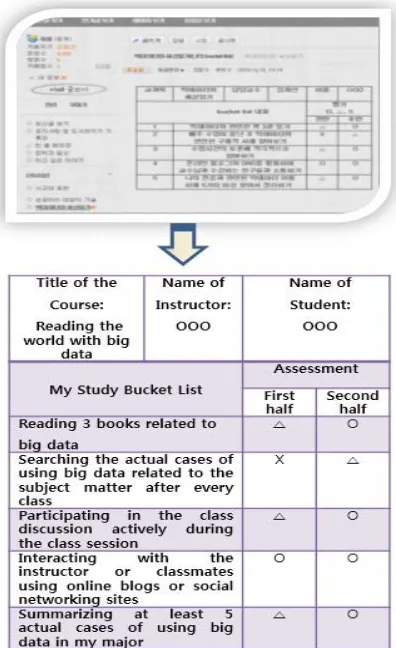
[image:7.612.316.514.358.682.2]The study bucket lists can help the students to engage in the lessons and to comprehend the course procedure from the beginning to the end of the lesson consistently. What is important here is the on-going evaluation of the study bucket lists. Before taking the midterm exam, students examine their own study bucket lists and check their attitude toward the class and the accomplishment they have achieved. Then they have the opportunity to think about the lessons and the goals of the whole course. This activity can provide the opportunity for the students to consider the whole structure of the course as a continuous storytelling structure. Figure 6 shows an example of the student’s study bucket list.
Figure 6: An example of the students’ study bucket list
7542 lecture by the instructor. The evaluation conducted in the first half of the course was made right after the midterm exam, and the second half was evaluated at the end of the semester. The student created a bucket list and uploaded it to an online blog organized by the instructor. Some of the students who took part in the technology-integrated storytelling activities shared their opinions about their experience in the storytelling course activities through Facebook or online blog. Some of the students responded:
Courses in my major field are systematically linked, so if you take one course, you know what course you will take next. However, when I take courses in the liberal arts, I don’t know how one lecture would be linked to other liberal arts classes or major courses. This semester, I applied for this writing course with the technology-integrated storytelling teaching method and it helped me to think about how this class was related to my major classes and other liberal arts classes.
I usually enjoy SNS. I am very happy when I chat with my friends online and meet various people. I thought studying something was not related to sharing my favorite story on SNS. It was interesting to understand my study within a storytelling framework as I shared my story with people. Just as I shared my experiences with my friends over the internet yesterday, it became an interesting story because the theme of each week was linked to the whole study. It was an interesting experience.
Storytelling method allowed me to understand what I was doing specifically while attending to lectures. In the past, I studied only in the classroom while attending liberal arts classes, but now I have been able to communicate online with my mobile phone and have made my study more interesting by understanding the process of studying as a storytelling process.
5. CONCLUSION
This study suggests the archetype of the learner-centered syllabus design in which the whole curricular sequence is devised as a growing-up technology-integrated storytelling process of the students. This study explores technology-integrated storytelling teaching methods and suggests the classroom procedures that can be implemented in the university writing education. For this study, the technology-integrated storytelling method is integrated in order to organize the syllabus of the whole semester into the technology-integrated storytelling format. Each class is also structured into the storytelling setting. Through these procedures,
students can recognize the stream of the course as the flow of a storytelling and can be motivated in achieving the learning goals of each class as well as the whole course. The most important feature in technology-integrated storytelling teaching method is to help students focus on the course and to encourage active participation. The technology-integrated storytelling teaching method is an effective instructional model which can help learners take initiatives in their own learning process while they are engaging in each class and acquiring new knowledge. When both instructors and students participate in the active classroom interaction and maintain consistency and relevance using technology-integrated storytelling teaching methods, the effect of the technology-integrated storytelling teaching method can be enriched.
ACKNOWLEDGEMENT
This work was supported by the research grant of Pai Chai University in 2018.
REFERENCES:
[1] TCBOK, “About Informal Electronic Rhetoric,”
Informal Electronic Rhetoric, May, 2018,
available at https://www.tcbok.org/wiki/informal-electronic-rhetoric/
[2] T. S. Minga, L. Y. Simb, N. Mahmudc, L. L. Keed, N. A.Zabidie, and K. Ismail, “Enhancing 21st century learning skills via digital storytelling: Voices of Malaysian teachers and undergraduates,” Social and Behavioral Sciences, Vol. 118, 2014, pp. 489-494.
[3] S. H. Choi, What to do for storytelling?, Seoul:
Literature and Intelligence, 2015.
[4] P. Psomos, and M. Kordaki, “Pedagogical analysis of educational digital storytelling environments of the last five years,” Social and Behavioral Sciences, Vol. 46, 2012, pp.
1213-1218.
[5] T. R. Phillips, and D. L. Okholm, Christian Apologetics in the Postmodern World, Downers
Grove, IL: Inter Varsity Press, 1995.
[6] H. S. Kim, and K. O. Jeong, “Instructional Strategies for ICT-based Storytelling Teaching Method,” Proceedings of the 2017 International Conference on Platform Technology and Service (PlatCon), Busan, Korea, February 2017.
7543 3, 2008, pp. 220-228.
[8] B. Blake, and T. Pope, “Developmental Psychology: Incorporating Piaget’s and Vygotsky’s Theories in Classrooms,” Journal of Cross-Disciplinary Perspectives in Education,
Vol. 1, No. 1, 2008, pp. 59-67.
[9] M. Hamilton, and M. Weiss, Children Tell Stories: Teaching and Using Storytelling in the Classroom (2nd ed.), Katonah, NY: Richard C.
Owen Publishers, 2005.
[10] C. Salmon, Storytelling: Bewitching the Modern Mind, New York: Verso, 2010.
[11] M. K. Yang, “Exploring the Significance of Storytelling as an Educational Method: The Case Study of ‘Curriculum’ Course in University,”
The Journal of Yeolin Education, Vol. 21, No. 3,
2013, pp. 1-30.
[12] R. McKee, “Storytelling That Moves People,”
Harvard Business Review, The June issue, 2003,
pp. 5-8.
[13] M. J. Toolan, Narrative: A Critical Linguistic Introduction, London: Routledge, 1988.
[14] K. O. Jeong, “Integrating a web-based platform to promote creativity and authenticity in language classrooms,” International Journal of Knowledge and Learning, Vol. 11, No. 2/3,
2016, pp. 127-136.
[15] S. H. Bucher, The Poetics of Aristotle, London: