IJPSR (2011), Vol. 2, Issue 12 (Review Article)
Received on 14 July, 2011; received in revised form 26 September, 2011; accepted 19 November, 2011
FREEZE DRYING PROCESS: A REVIEW
Soham Shukla*
Department of Pharmaceutical Technology, B. S. Patel Pharmacy College, Saffrony Institute of Technology, Near Saffrony Holiday Resort, Ahmedabad-Mehsana Highway, At & Post Linch-384435, Mahesana, Gujarat, India
ABSTRACT
Among the various methods of drying, this article has mentioned only one most important method, “Freeze drying”. This method is mainly used for the drying of thermo labile materials. This method works on the principle of sublimation. This method is divided into 3 steps for its better understanding; these are Freezing, Primary drying, and secondary drying. There are many advantages and disadvantages of this method, but still this is the most useful drying method nowadays.
INTRODUCTION: There are many processes available
to dry the various type of product. There are mainly two type of products used in pharmaceutical industry:
Thermo labile
Thermo stable
Most of the methods can be used for the thermo stable materials, but in case of thermo labile materials very few methods can be used due to decomposition problems. Among all the methods Freeze Drying is the most reliable method nowadays for thermo labile materials.
Historical Perspective 1-2: Drying from the frozen state is not uncommon in nature. In the winter, snow vanishes along the roads in dry cold air without melting. In Central Siberia, scientists have found the large bodies of mammoths that have been progressively freeze-dried during the past 15,000 years. In the Peruvian high plateau, the Incas reportedly stored, in their tambos, meat that had been dried in the sun at the reduced pressure of the Andes.
Scientific interest in freeze-drying began at the turn of the twentieth century with a publication by Bordas and d'Arsonval at the French Academy of Sciences. Following that publication, Altman and later Gersh used this technique to prepare undistorted dry samples for microscopy. Ronald Greaves, in Cambridge, UK, began his work along those lines in the 1930s by preparing dry suspensions of living bacteria. However, this technique still was only familiar to a handful of scientists in isolated laboratories.
Then came World War II. With tens of thousands of casualties on the battlefields, human plasma was in great need, and freeze-drying again entered the limelight. Thanks to Greaves in England, François Henaff in France, and Earl Flosdorf in the United States, thousands of liters of blood were processed to isolate plasma, which was then preserved by freezing and drying. As the use of lyophilization expanded, the process began to be industrialized. Loire, Stokes, Edwards, and others designed and built the first equipment for the purpose. Called “lyophilization” by Flosdorf, the process faced its first major challenge Keywords:
Sublimation, Annealing, Condenser temperature
Correspondence to Author:
Soham Shukla
under Sir Ernst Boris Chain, who used the technique to preserve antibiotics. Given Chain’s results turned to lyophilization to prepare vaccines and, later on, to refine blood fractions. By the mid-1950s, many industries were already using freeze drying to preserve pharmaceutical and biological products, as were the physicians and surgeons who developed tissue-banking for plastic and reconstructive surgery. Drs. Hyatt, Bassett, and Meryman of the United States Navy were among the early pioneers in the field.
Advantages 1, 3-5:
Stored in dry state, so stability problem is few.
Product is dried without elevated temp.
Good for o2 & air sensitive drugs.
Rapid reconstitution time.
Constituents of dried material remain homogenously dispersed.
Product is process in the liquid form.
Storage of dry material is less expensive than solution form.
In some specialized laboratories, scientists are developing more sophisticated processes that combine freeze-drying technology with electron microscopy, biochemistry, and refined surgery.
At the same time, the cosmetics industry is increasing its use of lyophilization to help prepare beauty masks, hair dyes, and sophisticated supports for face creams.
Chemical industries also are beginning to use freeze-drying to prepare refined chemicals, catalysts, and selective filters.
Freeze-drying can preserve food and make it very lightweight.
If a freeze-dried substance is sealed to prevent the reabsorption of moisture, the substance may be stored at room temperature without refrigeration, and be protected against spoilage for many years.
Preservation is possible because the greatly reduced water content inhibits the action of microorganisms and enzymes that would normally spoil or degrade the substance.
Freeze-drying also causes less damage to the substance than other dehydration methods using higher temperatures.
Freeze-drying does not usually cause shrinkage or toughening of the material being dried.
Flavors and smells generally remain unchanged, making the process popular for preserving food.
Water is not the only chemical capable of sublimation, and the loss of other volatile compounds such as acetic acid (vinegar) and alcohols can yield undesirable results.
Freeze-dried products can be rehydrated (reconstituted) much more quickly and easily because the process leaves microscopic pores.
The pores are created by the ice crystals that sublimate, leaving gaps or pores in their place. This is especially important when it comes to pharmaceutical uses.
Lyophilization can also be used to increase the shelf life of some pharmaceuticals for many years.
Disadvantages 1, 3-5:
Volatile compounds may be removed by high vacuum.
Expensive unit operation because pumps are more expensive.
Stability problems associated with individual drugs.
Some issues associated with sterilization & sterility assurance of dry chamber & aseptic loading of vials into chamber.
Freeze-drying is facing difficult challenges as the sensitivity, complexity, and price of treated products steadily rise.
New antibiotics and drugs, immunological products, substances derived from genetic engineering, high molecular weight proteins, and sophisticated peptides are very fragile, difficult to freeze, and all highly sensitive to residual moisture content.
Amorphous (glassy) materials do not have a eutectic point, but do have a critical point, below which the product must be maintained to prevent melt-back or collapse during primary and secondary drying.
Large objects take a few months to freeze-dry.
If too much heat is added, the material’s structure could be altered.
Freezing damage can occur with labile products such as liposomes, proteins, and viruses.
a large ice–water interface. Exposure of proteins to this ice–water interface can lead to denaturation.
Freezing stresses also can disrupt the liposome bilayer and emulsion structure.
Small ice crystals produce pores with lower volume–surface area, thus resulting in lower diffusive flux and slower sublimation rates.
Removal of the hydration shell from proteins and products such as liposomes during drying in the absence of the appropriate stabilizers can cause destabilization of the protein structure and fusion of liposomes.
Extremely low water content in the final product can result in destabilization, and optimal water content should be determined.
The desired residual moisture must be correlated to stability during long-term storage as part of development studies.
Characteristics of freeze dried products 3-5:
Intact cake
Sufficient strength to prevent cracking, powdering or collapse
Uniform color & consistency
Sufficient dryness to maintain stability
Sufficient porosity & surface area to permit rapid reconstitution
Sterile
Free of pyrogens & particulates
Chemically stable
Long-term stability
Short reconstitution time
Elegant cake appearance
Maintenance of the characteristics of the original dosage form upon reconstitution, including solution properties; structure or conformation of proteins; and particle-size distribution of suspensions
Isotonicity upon reconstitution (in some cases, also for bulk solution)
Today, considering all these issues, we can say that lyophilization;
Is an increasingly essential tool for the pharmaceutical industry
Although a highly sophisticated technology, still is far from mature and deserves substantial fundamental and applied research presents constant challenges for equipment manufacturers that must provide instruments that can process, in a reproducible and reliable way, large batches of high therapeutic and material value
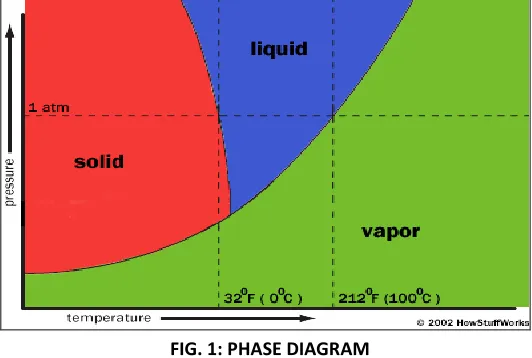
Principle 6: The fundamental principle in freeze-drying is sublimation, the shift from a solid directly into a gas. Just like evaporation, sublimation occurs when a molecule gains enough energy to break free from the molecules around it. Water will sublime from a solid (ice) to a gas (vapor) when the molecules have enough energy to break free but the conditions aren't right for a liquid to form. There are two major factors that determine what phase (solid, liquid or gas) a substance will take: heat and atmospheric pressure. For a substance to take any particular phase, the temperature and pressure must be within a certain range. Without these conditions, that phase of the substance can't exist. The chart below in fig. 1 shows the necessary pressure and temperature values of different phases of water.
[image:3.612.315.581.418.597.2]F FIG. 1: PHASE DIAGRAM
Freeze drying process: There are three stages in the complete freeze-drying process:
1. Freezing 2. Primary drying 3. Secondary drying
Freezing 7: The freezing process consists of freezing the material. In a lab, this is often done by placing the material in a freeze-drying flask and rotating the flask in a bath, called a shell freezer, which is cooled by mechanical refrigeration, dry ice and methanol, or liquid nitrogen. On a larger-scale, freezing is usually done using a freeze-drying machine. In this step, it is important to cool the material below its eutectic point, the lowest temperature at which the solid and liquid phases of the material can coexist. This ensures that sublimation rather than melting will occur in the following steps.
Larger crystals are easier to freeze-dry. To produce larger crystals, the product should be frozen slowly or can be cycled up and down in temperature. This cycling process is called annealing. However, in the case of food, or objects with formerly-living cells, large ice crystals will break the cell walls (discovered by Clarence Birdseye). Usually, the freezing temperatures are between −50°C and −80°C. The freezing phase is the most critical in the whole freeze-drying process, because the product can be spoiled if badly done. Amorphous (glassy) materials do not have a eutectic point, but do have a critical point, below which the product must be maintained to prevent melt-back or collapse during primary and secondary drying. Large objects take a few months to freeze-dry.
Primary drying 7: During the primary drying phase, the pressure is lowered (to the range of a few millibars), and enough heat is supplied to the material for the water to sublimate. The amount of heat necessary can be calculated using the sublimating molecules’ latent heat of sublimation. In this initial drying phase, about 95% of the water in the material is sublimated. This phase may be slow (can be several days in the industry), because, if too much heat is added, the material’s structure could be altered. In this phase, pressure is controlled through the application of partial vacuum.
The vacuum speeds sublimation, making it useful as a deliberate drying process. Furthermore, a cold condenser chamber and/or condenser plates provide a surface(s) for the water vapor to re-solidify on. This condenser plays no role in keeping the material frozen; rather, it prevents water vapor from reaching the vacuum pump, which could degrade the pump's performance. Condenser temperatures are typically below −50°C (−60°F). It is important to note that, in this range of pressure, the heat is brought mainly by conduction or radiation; the convection effect can be considered as insignificant.
Secondary drying 7: The secondary drying phase aims to remove unfrozen water molecules, since the ice was removed in the primary drying phase. This part of the freeze-drying process is governed by the material’s adsorption isotherms. In this phase, the temperature is raised higher than in the primary drying phase, and can even be above 0 °C, to break any physico-chemical interactions that have formed between the water molecules and the frozen material.
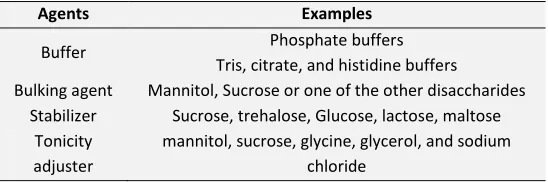
[image:4.612.314.588.580.671.2]Usually, the pressure is also lowered in this stage to encourage desorption (typically in the range of microbars, or fractions of a pascal). However, there are products that benefit from increased pressure as well. After the freeze-drying process is complete, the vacuum is usually broken with an inert gas, such as nitrogen, before the material is sealed. At the end of the operation, the final residual water content in the product is around 1% to 4%, which is extremely low. Formulation of Freeze Drying: In the freeze drying process, we can use various types of agents, which are mentioned in the below table 1.
TABLE 1: MATERIALS USED IN FREEZE DRYING
Agents Examples
Buffer Phosphate buffers
Tris, citrate, and histidine buffers
Bulking agent Mannitol, Sucrose or one of the other disaccharides Stabilizer Sucrose, trehalose, Glucose, lactose, maltose
Tonicity adjuster
mannitol, sucrose, glycine, glycerol, and sodium chloride
Buffers 8: Buffers are required in pharmaceutical
Bulking Agents 8: The purpose of the bulking agent is to provide bulk to the formulation. This is important in cases in which very low concentrations of the active ingredient are used. Crystalline bulking agents produce an elegant cake structure with good mechanical properties. However, these materials often are ineffective in stabilizing products such as emulsions, proteins, and liposomes but may be suitable for small-chemical drugs and some peptides e.g. Mannitol, Sucrose or one of the other disaccharides.
Stabilizers 8: In addition to being bulking agents, disaccharides form an amorphous sugar glass and have proven to be most effective in stabilizing products such as liposomes and proteins during lyophilization. Sucrose and trehalose are inert and have been used in stabilizing liposome, protein, and virus formulations. Glucose, lactose, and maltose are reducing sugars and can reduce proteins by means of the Mailard reaction. Two hypotheses have been postulated to explain the stabilizing effects of the disaccharides.
1. The water replacement hypothesis: Disaccharides have been found to interact with these products by hydrogen bonding similarly to the replaced water.
2. The vitrification hypothesis: Disaccharides form sugar glasses of extremely high viscosity. The drug and water molecules are immobilized in the viscous glass, leading to extremely high activation energies required for any reactions to occur.
Tonicity Adjusters 8: The need for such a formulation may be dictated by either the stability requirements of the bulk solution or those for the route of administration. Excipients such as mannitol, sucrose, glycine, glycerol, and sodium chloride are good tonicity adjusters.
Effects of the ingredients on the lyophilization process 8: One must understand that the process will be determined by the formulation For example, the use of disaccharides will result in a low collapse temperature, which causes primary drying to be performed at low temperatures and implying a long process. A large volume fill or high solids content in the formulation will provide increased resistance to mass transfer, hence a longer process.
The process also can determine the properties of the formulation. The freezing process can influence crystallization of excipients such as mannitol and glycine. Incomplete crystallization will depress the collapse temperature Significant crystallization of the bulking agent will reduce drying time. However, large amounts of crystalline bulking agent can reduce stabilizing effects of the amorphous stabilizer especially with proteins.
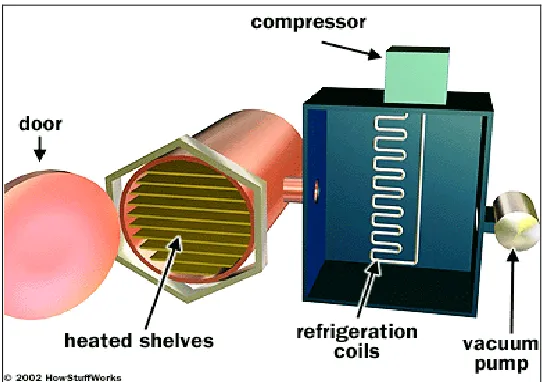
[image:5.612.314.585.209.400.2]Basic Construction of the Freeze Dryer 6:
FIG. 2: GENERAL CONSTRUCTION OF FREEZE DRYER In the above fig. 2, we can see the typical machine consists of a freeze-drying chamber with several shelves attached to heating units, a freezing coil connected to a refrigerator compressor, and a vacuum pump. With most machines, you place the material to be preserved onto the shelves when it is still unfrozen. When you seal the chamber and begin the process, the machine runs the compressors to lower the temperature in the chamber. The material is frozen solid, which separates the water from everything around it, on a molecular level, even though the water is still present.
This continues for many hours (even days) while the material gradually dries out. The process takes so long because overheating the material can significantly change the composition and structure. Additionally, accelerating the sublimation process could produce more water vapor in a period of time then the pumping system can remove from the chamber. This could rehydrate the material somewhat, degrading its quality.
Once, the material is dried sufficiently, it's sealed in a moisture-free package, often with an oxygen-absorbing material. As long as the package is secure, the material can sit on a shelf for years and years without degrading, until it's restored to its original form with a bit of water (a very small amount of moisture remains, so the material will eventually spoil). If everything works correctly, the material will go through the entire process almost completely unscathed!
Various Equipments:
Bench top manifold Freeze-Dryer 7: There are
[image:6.612.368.532.225.389.2]essentially three categories of freeze-dryers: rotary evaporators, manifold dryers, and tray freeze-dryers. Rotary freeze-dryers are usually used with liquid products, such as pharmaceutical solutions and tissue extracts.
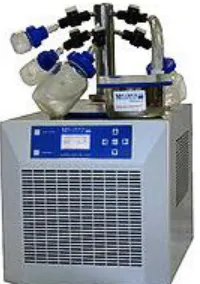
FIG. 3: BENCH TOP MANIFOLD FREEZE DRYER
Manifold freeze-dryers are usually used when drying a large amount of small containers and the product will be used in a short period of time. In the above fig. 3, we can see the Bench top manifold freeze dryer. A manifold dryer will dry the product to less than 5% moisture content. Without heat, only primary drying (removal of the unbound water) can be achieved. A
heater must be added for secondary drying, which will remove the bound water and will produce lower moisture content.
[image:6.612.115.215.470.612.2]Production freeze-dryer 7: Tray freeze-dryers are more sophisticated and are used to dry a variety of materials. A tray freeze-dryer is used to produce the driest product for long-term storage. A tray freeze-dryer allows the product to be frozen in place and performs both primary (unbound water removal) and secondary (bound water removal) freeze-drying, thus producing the driest possible end-product (fig. 4).
FIG. 4: PRODUCTION FREEZE DRYER
Tray freeze-dryers can dry product in bulk or in vials. When drying in vials, the freeze-dryer is supplied with a stoppering mechanism that allows a stopper to be pressed into place, sealing the vial before it is exposed to the atmosphere. This is used for long-term storage, such as vaccines.
Applications:
1. Removing water keeps food and pharmaceuticals
injectables. Similarly, research scientists may use freeze-drying to preserve biological samples for long periods of time. Freeze drying remove up to 95% of water, so we can save the food from spoiling for a long period of time.
2. Freeze-drying significantly reduces the total
weight of the food 6:Most food is largely made up
of water (many fruits are more than 80 to 90 percent water, in fact). Removing this water makes the food a lot lighter, which means it's easier to transport. The military and camping supply companies freeze-dry foods to make them easier for one person to carry. NASA has also freeze-dried foods for the cramped quarter’s onboard spacecraft.
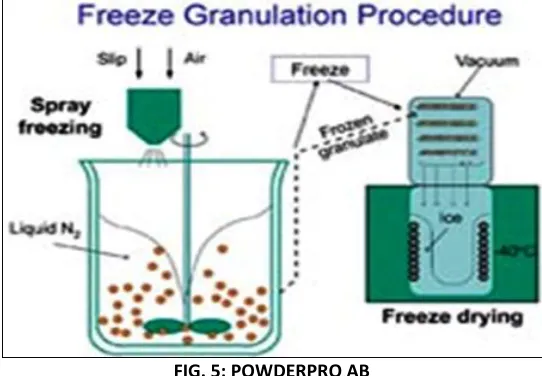
3. In Technological industry 9: Freeze granulation was developed at SCI in the late 1980s as the most suitable method to provide optimal granule properties for lab and research purposes. During the 1990s, freeze granulation was successfully used in material and processing developments within many research projects and contract work.
PowderPro AB (fig. 5) was founded in January
[image:7.612.26.297.427.615.2]2000.
FIG. 5: POWDERPRO AB
PowderPro AB (fig. 5) supplies granulation
equipments and carries out test granulations (standard concept), whereas SCI conducts slip and granulation development. Several companies and research labs around the world have applied the freeze granulation process with the support of
PowderPro. Typical ceramic powders are oxides
(Al2O3, ZrO2, SiO2), nitrides (Si3N4) and carbides
(SiC), but also nanopowders, diamonds and pharmaceuticals like proteins and enzymes.
Freeze-Drying with Closed Vials 10: This process has several advantages over traditional glass-vial processing:
1) The closed vial content is not exposed during its movement from the sterilization tunnel to the freeze dryer (no half-seated stopper).
2) There is no risk of product spillage on the vial track to the freeze dryer or on the shelves themselves. Moreover, the plastic vials are shock resistant and nearly unbreakable.
3) The stoppers do not stick to the upper shelf. 4) There is no risk of incomplete reseating of the
stopper or stopper pop-up after the stoppering step; closure integrity is maintained throughout the process.
5) When required, this process has the capability of inspecting for particles of the liquid before freeze-drying, provided that the inspection machine is compliant with a Class 100 environment. The vial's bottom ring enables it to be held from the bottom only for the rotation, without an upper spindle above the vial. Its slightly elevated bottom allows for a perfect view on the critical bottom part of the content.
Some other important information 3-5:
Freeze Dryers (Suppliers):
1. VIRTIS 2. USIFROID 3. SERIAL 4. HULL 5. FTS
Freeze Dried Products:
Vaccines:
Proteins and Peptides:
1. Protein G
2. White fish protein 3. LDH
4. G-6 PDH
5. Beta galactosidase catalase
Drugs:
1. Loperamide
2. Domperidone malate 3. Fluorescein
4. Calcitonin
SUMMARY: The freeze drying is now-a-days most
widely growing technology in pharmaceutical point of view. Freeze drying or lyophilization is an increasingly essential tool for the pharmaceutical industry. Many investigations have been done from last 15,000 years and still today, it is the main subject of research. Freeze drying process has many advantages and many disadvantages. The fundamental principle in freeze-drying is sublimation, the shift from a solid directly into a gas. The freeze drying process mainly involves 3 stages like freezing, primary drying and secondary drying.
There are many factors which affect the process, but our scientists had done many researches to overcome them. The formulation of freeze dried product may involve many excipients to be added like buffers, bulking agents, tonicity adjusters, stabilizers, etc. Now-a-days the freeze drying is most widely used in pharmaceutical industries even if it is too costly just because of its most prominent applications like freeze granulation process, keep safe the food and pharmaceuticals from spoilage for long period of time,
reduce weight by removing water, etc. There are many types of equipment which are used for freeze drying process like bench top manifold freeze dryer, production freeze dryer, etc.
There are many international companies which produce many type of advanced freeze dryers. They are VIRTIS, USIFROID, SERIAL, HULL, FTS, etc. There are many products which can be freeze dried by these equipments. They are many vaccine e.g. Small pox vaccine, Varicella vaccine, BCG vaccine, MMR vaccine, Zoster vaccine etc., proteins and peptides e.g. Protein G, White fish protein, LDH, G-6 PDH, Beta galactosidase catalase, etc. and many drugs e.g. Loperamide, Domperidone malate, Fluorescein, calcitonin, etc.
So, allover freeze drying is very effective and necessary technology in pharmaceutical point of view.
REFERENCE:
1. Louis Rey PhD et al.,” Sage of freeze drying” CH-1010. 5-8. 2. www.pharmatech.com
3. The Theory and Practice of Industrial Pharmacy By LEON LACHMAN, HERBERT A. LIEBERMAN, JOSEPH L. KANIG, Third Edition, Varghese Publishing House, 672
4. Pharmaceutical Dosage forms Parenteral Medications Second edition, Eddited by Kenneth E. Avis, Herbert A. LIBBERMAN,& Leon lechman Volume-1, 217-228, Volume Page no. 163-228 5. The science and Practice of Pharmacy 21st edition volume 1 by
REMINGTON,. 828-831 RAMIGTON
6. Tom Harris et al., “ How stuff Works How freeze drying works” 7. www.wikipedia.com
8. Frank Kofi Bedu-Addo, PhD et al., “Understanding Lyophilization Formulation Development” Biopharmaceuticals. 10-18.
9. PowderPro Goteborg AB- Technology freeze granulation powders pharmaceuticals proteins.
10. Jacques Thilly, Yves Mayeresse et al., “Freeze drying with closed Vials” Pharmaceutical technology. Nov 1, 2008.