IJPSR (2016), Vol. 7, Issue 4 (Research Article)
Received on 05 November, 2015; received in revised form, 20 January, 2016; accepted, 05 February, 2016; published 01 April, 2 016
FORMULATION AND EVALUATION OF ELASTIC NIOSOMES OF ELETRIPTAN HYDROBROMIDE
M.Shalini, M. M. Husnien Ali and P. K. Lakshmi*
G. Pulla Reddy College of Pharmacy, Mehdipatnam, Hyderabad, India.
ABSTRACT: Migraine is an episodic headache disorder characterized by a combination of neurological, gastrointestinal, and autonomic symptoms. Eletriptan hydrobromide (EHBr) is a second generation triptan drug intended for treatment of migraine headaches. The main aim of the study was to prepare and evaluate elastic niosomes of EHBr (ENEH) and optimise the concentration of non-ionic surfactants and ethanol by ethanol injection method. The ENEH formulations were characterised for vesicular shape, size, zeta potential, entrapment efficiency and percutaneous permeation. The formulations exhibited entrapment efficiencies of 19.21±0.124% to 58.20±0.147%. The optimised formulation was FE2 consisting of Span 80 and Tween 20 prepared by ethanol injection method exhibited vesicle size of 207.2±53.7 nm, zeta potential of 19.5 mV entrapment efficiency of 69.70%, flux of 53.903±0.13 μg/cm2/hr, Q8 of 448.262±0.18 µg/cm2, permeability coefficient of 0.013 cm/hr and lag time of 0.2±0.14 hrs and skin content of 1423±12.4 μg/gm. In vitro and ex vivo drug permeation across rat skin revealed improved drug permeation and higher transdermal flux with ENEH formulations compared to niosomes and drug solution. Results suggested that elastic niosomes are efficient carriers for the transdermal delivery of EHBr when compared to the conventional nanovesicles like niosomes.
INTRODUCTION: Vesicular Drug delivery
systems such as elastic niosomes have distinct advantages over conventional dosage forms because the vesicles which are the drug containing reservoirs, upon suitable modification of the vesicular compositions or surface properties can adjust the drug release rate and/or the affinity for the target site 1. Niosomes are the non-ionic surfactants vesicles which offer higher chemical stability, lower costs, and great availability of
surfactant classes when compared to the
liposomes2.
QUICK RESPONSE CODE
DOI:
10.13040/IJPSR.0975-8232.7(4).1679-85
Article can be accessed online on:
www.ijpsr.com
DOI link: http://dx.doi.org/10.13040/IJPSR.0975-8232.7 (4).1679-85
Elastic niosomes are the deformable niosomes composed of non-ionic surfactants, ethanol and water, could better penetrate the intact skin compared to the conventional vesicles since they can squeeze through small pores in stratum corneum which are smaller in size and can deliver the drugs or compounds at low and high molecular
weight 1 by prolonging the release and
demonstrating a better biological activity being one of the major advancements in vesicle research 3.
All the triptans approved for the treatment of
migraine are currently available as oral
formulations; however, this may not be the ideal route of administration for many migraineurs because the tablet form of drug (RELPAX 40 mg) should be administered twice a day & causes side effects viz., dizziness, drowsiness, weakness, severe GI problems etc.4. In order to improve the Key words:
Elastic niosomes, Span, Tween, non-ionic surfactants
Correspondence to Author:
Dr. P. K. Lakshmi
Professor & Head, Department of Pharmaceutics, G. Pulla Reddy College of Pharmacy, Affliated to Osmania University, Hyderabad - 500 028, India
patient compliance, the transdermal formulation would help to avoid frequent administration of tablet and may provide sustained transdermal delivery for prolonged periods in the management of migraine, which can be a good way to bypass the extensive hepatic first-pass metabolism. The present aim is to prepare the elastic niosomes to overcome the limitation of low penetration ability of the conventional liposomes and niosomes across the skin.
MATERIALS AND METHODS:
Materials: Eletriptan hydrobromide was obtained as a gift sample from Fenoza pharma, Hyderabad. Tweens (Tween 20 & 80), Spans (Span 20& 80),
cholesterol and absolute ethanol were purchased from S.D. Fine chemicals, Mumbai. All materials used inthe study were of analytical grade. Double distilled water was used for all experiments.
Methods:
Preparation of elastic niosomes 5:
[image:2.612.47.566.285.356.2]ENEH containing combinations of Span 20, Span 80 and Tween 20, Tween 80 were prepared by ethanol injection method (Table 1). Precisely, Span and Tween were dissolved in ethanol and injected into preheated aqueous phase (q.s. to 10 ml) containing drug which was stirred continuously on a magnetic stirrer maintained at 60°C.
TABLE 1: FORMULATION OF ENEH
FC Span20
(mg)
Span80(mg) Tween20
(mg)
Tween80 (mg)
Ethanol (v/v)
FE1 - 300 - 20 30%
FE2 - 300 20 - 30%
FE3 300 - 20 - 30%
FE4 300 - - 20 30%
Note: in all the formulations, 40mg of drug was used.
Preparation of niosomes of EHBr (NEH):
The NEH was developed by thin film hydration method 6, 7. Accurately weighed amounts of Span 80(300mg), Tween 20 (20mg) and cholesterol (320mg) were transferred into a clean round bottom flask. The chloroform and ethanol (8:2) solution was added and the flask was fixed to rotary evaporator at 500C temp, for 20 mins under vacuum at 150 rpm. The so formed thin film was hydrated with phosphate buffer pH 7.4 (q.s to 10ml) containing drug and vortexed at room temperature for 20 mins which forms milky white suspension.
Characterization of ENEH:
The prepared ENEH were evaluated for surface morphology and vesicle size, % entrapment efficiency, in vitro drug release, ex vivo permeation studies, skin deposition study, skin irritation study and stability study.
Vesicle shape and surface morphology:
ENEH were characterized for surface morphology and vesicle shape using optical microscope (Triangular Research Microscope with Fujifilm digital camera; magnification 10x and 40×) and Scanning electron microscope(SEM, S-4100,
Hitachi, Shiga, Japan). The analysis is performed by placing the samples on a brass stub using a double- sided adhesive tape and is made electrically conductive by coating in vacuum (6pas) with platinum using ion sputter (E-1030) at 15 Ma and visualized under scanning electron microscope (S-4100, Hitachi, Shiga, Japan).
Vesicle size and zeta potential:
Particle size was determined by using a zetasizer (HORIBA-SZ-100) based on dynamic light scattering. The diluted niosomal suspension was prepared with double distilled water and sonicated for 30 seconds on ice bath. The sample was analysed at a scattering angle of 1730 at a temperature of 250C. Poly-dispersibility index (PDI) was also measured to determine particle size distribution. Before measurements, the vesicular suspension was diluted with water.
Entrapment efficiency (E.E) 8, 9:
and sediment were recovered, and sediment was lysed using methanol and filtered through a 0.45 μm nylon disk filter. The concentration of drug in the supernatant and sediment was analysed by UV-VIS double beam spectrophotometer (Chemito Spectrascan UV2600, India) at 222.6 nm. The percentage drug entrapment was calculated using the following equation:
In vitro release study of prepared ENEH 8, 9, 10:
In vitro release studies on ENEH were performed using locally fabricated Franz-diffusion cell. The effective diffusion area of the cell was 2.5 cm2 and had a receptor volume of 20ml. The dialysis membrane was mounted between the donor and receptor compartment. A weighed amount of ENEH was placed on one side of the dialysis membrane. The receptor medium was phosphate saline pH 7.4. The receptor compartment was surrounded by a water jacket to maintain the temperature at by 37±1˚C. Heat was provided using a thermostatic hot plate with a magnetic stirrer. The receptor fluid was stirred by Teflon-coated magnetic bead fitted to a magnetic stirrer (Remi). At each sampling interval, 2 ml of samples were withdrawn and were replaced by equal volumes of fresh receptor fluid on each occasion. Samples withdrawn were analyzed spectrophotometrically (Chemito Spectrascan UV2600, India) at 222.6 nm.
Skin permeation studies:
Institutional animal ethical committee (IAEC) approved skin permeation studies. The permeation of ENEH formulations was determined by using Franz (vertical) diffusion cell. The effective diffusion area of the cell was 2.5 cm2 and had a receptor volume of 20ml. The male wistar rat (7-9 weeks old) skin was mounted on the receptor compartment with the stratum corneum side facing upwards into the donor compartment. 1 ml ENEH formulation. The top of the diffusion cell was covered with parafilm to avoid any evaporation process. The donor compartment was applied with ENEH formulation. A 20 ml aliquot of pH saline phosphate buffer was used as receptor medium to maintain the sink condition. The receptor compartment was maintained at 37°±1°C and
stirred by a magnetic bead. At appropriate intervals, 2 ml aliquots of the receptor medium were withdrawn through the sampling port at predetermined interval and immediately replaced by an equal volume of fresh receptor solution. The samples were analyzed by UV spectrophotometer (Chemito Spectrascan UV2600, India) at 222.6nm. Similar studies were performed with niosomes and drug solution.
Skin content 5:
After 8 hr study, drug retained in the skin was determined as skin content. For skin content studies, after study the skin was removed, washed with methanol, cut into small pieces, 4ml of methanol and 6ml of 7.4 phosphate buffer saline
was added and homogenized. After
homogenization the mixture was centrifuged at 7000rpm for 30min, filtered through Whattmann filter paper and analyzed for drug content with appropriate dilutions by UV-VIS double beam spectrophotometer at 222.6 nm.
Skin irritation study:
Skin irritation study was performed by using control, standard skin irritant, placebo and test. ENEH were applied on the left and right dorsal surface of rabbit skin and rabbits were examined for 24 hrs and erythema and edema was evaluated and the score was given according to the Primary Dermal Irritation Index classification (PDDI) 11.
Stability studies 12:
The optimized formulations were evaluated for physical stability testing to investigate the leaching of drug from the vesicles. The ENEH samples were sealed in 20 ml glass vials and stored at refrigeration temperature (4˚C - 8˚C) and at 30˚C for one month. The EE of all the samples was determined in the same manner as prescribed previously after one month.
RESULTS AND DISCUSSION:
further studies. Four formulations of different combinations of Span: Tween were prepared and the formulation with highest entrapment efficiency, clarity and practical yield i.e., FE2 was studied.
Entrapment efficiency:
Drug entrapment within a vesicular carrier is an important parameter to be defined to really evaluate the delivery potentiality of the system. FE1, FE2, FE3 and FE4 Formulations showed entrapment efficiencies of 19.21±0.124%, 69.17±0.254%,
45.10±0.541 and 58.20±0.147%. The highest
entrapment efficiency of FE2 formulation might bedue to the presence of 30%(v/v) ethanol in
vesicle membrane because increasing the
concentration of ethanol until 40% with or without cholesterol increases the entrapment efficiency owing to increase in fluidity and the intralamellar distance of vesicular membranes, which is probably responsible for better entrapment efficiency 13, 14, 15.
The niosomes formulation NEH i.e.,
Span80:Tween20:cholesterol showed maximum entrapment efficiency of 60.84±0.98%. The higher entrapment may be explained by high cholesterol content. Cholesterol, having a property to abolish the gel to liquid transition of niosome prevents the
leakage of drug from the niosome
formulation10thus entrapping the drug efficiently.
In-vitro Release Studies:
The In-vitro drug release study of ENEH- FE2 was done using franz diffusion cell in phosphate buffer saline of pH 7.4. The % drug release of FE2 was found to be 88.27±0.45% at the end of 8 hours. These formulations upon ex-vivo permeation studies on rat abdominal skin, showed varied results because the elastic niosomal formulation containing Spans, Tweens and ethanol act as edge activators show effect on the surface of lipophilic skin by interacting with skin or by rupturing skin integrity which does not show on dialysis membrane.
Comparison of the optimized ENEH (FE2) formulation with pure drug and niosomes:
The comparison of cumulative amount of drug, physical and permeability parameters of optimized ENEH (FE2) formulation with pure drug and NEH was done. The results are tabulated in Table 2.
Ex vivo release data for optimized formulations:
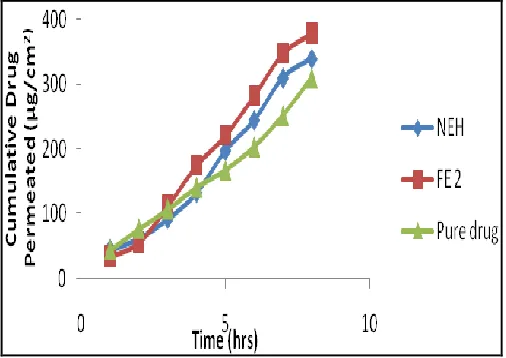
The ex vivo release rate studies performed on rat abdominal skin revealed that the cumulative percent release was maximum for FE2 formulation when compared to NEH and pure drug solution (Fig. 1). The reason might be due to smaller particle size (207.2 ± 53.7 nm) which increases the surface area available for release 16. The intrinsic unsaturation in oleate in Span 80, responsible for low transition temperature, might have better penetration enhancing ability 17 and also the ethanol in elastic vesicles furnishes the vesicles with a flexibility that allows them to penetrate deeper into skin layers more easily.
In addition any residual ethanol would be synergistic with the non-ionic surfactanst 13 and also the effect of chain length and unsaturation and phase transition temperature of Span 80(12 0C) might have made them in the disordered liquid crystalline state and completely fluid.
Hence, they were more permeable for the drug at 37°C 18 and thus released maximum amount of drug within 8 hrs of the study suitable for the treatment of the mild to moderate migraine condition whereas the slow permeation of drug from NEH at Q8 of 339±1.58 (µg/cm2) might be due to the fact that the presence of cholesterol at a certain high level reduces the leakage or release of encapsulating material by decreasing the niosome membrane fluidity.
[image:4.612.314.567.510.689.2]TABLE 2: COMPARISON OF PHYSICAL AND PERMEABILITY PARAMETERS OF ENEH (FE2) FORMULATION WITH PURE DRUG AND NIOSOMES
Permeability parameters Pure drug Niosomes FE2
EE(%) - 60.84±0.98 69.17±0.254
Zeta potential(mV) - ND 19.5
Particle size - 21.6 µm 207.2 ± 53.7nm
Q8(µg/cm2) 161.31±0.84 339±1.58 448.262±0.18
Flux(µg/cm2/hr) 20.60±0.04 45.54±0.13 53.903±0.13
Permeability coefficient (cm/hr) 0.012 0.005 0.013
Lag time(hr) 1.2±0.31 0.8±0.25 0.2±0.14
Skin content(µg/g) 2543±11.1 1752±8.5 1423±12.4
Note: N.D- Not determined; Values are expressed as Mean ±SD, n=3
Kinetics of Drug Release 19:
The release kinetics for all the formulations were plotted against time to fit zero order, first order, Higuchi kinetic model and Korsemeyer Peppas equation. The regression values and n values
obtained from the plots and n value of each formulation was used to study the mechanism by which the drug releases. The results are tabulated in
[image:5.612.54.561.75.183.2]Table 3.
TABLE 3: EX VIVO RELEASE KINETICS FOR THE PURE DRUG, NIOSOMES, OPTIMIZED ENEH (FE2) FORMULATIONS Formulation code Zero order First order Higuchi Korsemeyer peppa’s Release mechanism
r r r r n
Pure drug 0.969 0.955 0.940 0.95 0.76 Anomalous transport
Niosomes 0.979 0.970 0.928 0.960 1.05 Super case-II transport
FE2 0.985 0.959 0.935 0.972 0.882 Anomalous transport
Surface morphology:
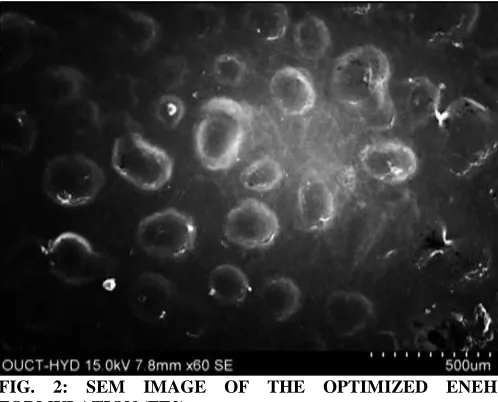
Scanning electron microscopy was used to characterize the surface morphology and vesicle shape and the vesicles were found to be spherical shape confirming the vesicular characteristics (Fig. 2).
FIG. 2: SEM IMAGE OF THE OPTIMIZED ENEH FORMULATION (FE2)
Particle size analysis:
[image:5.612.50.561.293.354.2]The vesicle size of the optimized FE2 was analyzed by HORIBA-SZ-100) zeta-sizer which showed mean particle size of 207.2±53.7 nm (Fig. 3).
FIG.3: VESICLE SIZE ANALYSIS OF THE OPTIMIZED FE2 FORMULATION
This result might be attributed due to the
relationship between niosome size, Span
[image:5.612.312.566.331.546.2] [image:5.612.49.298.455.656.2]may finally lead to a decrease in the mean particle size 5.
The prepared NEH were analyzed for surface morphology and vesicle size under Triangular Research Microscope with Fujifilm digital camera. The sizes of 100 vesicles were measured and the particle size was found to be 21.6 µm. The particle size of niosomes was significantly increased upon addition of cholesterol in the formulation when compared to the ENEH formulations with no cholesterol. The size of the vesicles depended on the cholesterol content and hydrophobicity of surfactants20.Cholesterol is the main additive which affects the physical stability of the vesicles as it provides the rigidity and strength to the bilayer membrane and diminishes the bilayer fluidity by eliminating the phase transition temperature peak of the vesicles 21, 22.
Zeta potential:
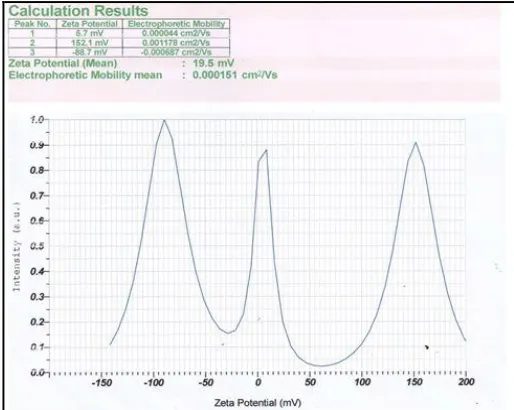
The zeta potential of the optimized ENEH (FE2) was found to be 19.5 mV indicating the formation of cationic vesicles with higher zeta potential (Fig. 4). High zeta potential values, either positive or negative, are expected to render a more stable system due to a strong electrostatic repulsion23
indicating that the optimised FE2 is a fairly stable formulation.
FIG. 4: ZETA POTENTIAL OF THE OPTIMIZED ENEH FORMULATION (FE2)
Skin irritation study:
The FE2 formulation, placebo, niosomes and drug solution showed irritation potential of ‘0’, thus
providing to be non-irritant. The ‘0’ value in an irritancy test indicates that the applied formulations are generally non-irritant to human skin. No obvious erythema and edema was observed on rabbit skin after 8hr of application of the optimized formulations.
Drug- excipient compatibility study by FTIR:
The liquid FTIR spectra of formulation with excipients revealed no interaction between drug and excipient (Fig. 5). Both the drug and excipient peaks were identified and interpreted in the spectra.
FIG.5: FTIR GRAPH OF DRUG LOADED ELASTIC NIOSOMES
Stability studies of optimized ENEH
formulations:
Stability studies indicated that optimized FE2 was stable when stored under refrigeration temperature with least leakage where the percentage of drug retained in the vesicles after a period of one month at 4˚C and room temperature was found to be 68.42% and 60.78% respectively.
[image:6.612.315.567.235.398.2] [image:6.612.47.304.468.673.2]CONCLUSION: ENEH elastic niosomes were prepared using non-ionic surfactants as edge activators to provide elasticity when compared to conventional niosomes. Elastic niosomes can be better carriers for the transdermal delivery of EHBr when compared to the conventional nanovesicles like niosomes. The future perspective of this project is that the optimised formulation can be combined with the free drug along with the penetration enhancers to enhance the release of the drug to provide quick action and prolonged release to treat mild to moderate migraine.
REFERENCES:
1. Aranya Manosroi, Pensak Jantrawut, Narinthorn Khositsuntiwong, Worapaka Manosroi and Jiradej Manosroi: Novel Elastic Nanovesicles for Cosmeceutical and Pharmaceutical Applications. Chiang Mai J. Sci 2009; 36(2):168-178.
2. Surender Verma, S.K. Singh, Navneet Syan, Pooja Mathur and Vinay Valecha: Nanoparticle vesicular systems: A versatile tool for drug delivery. J. Chem. Pharm. Res 2010, 2(2):496-509.
3. Maximiliano Glujoy, Claudia Salerno, Carlos Bregni, Adriana M Carlucci: Percutaneous drug delivery systems for improving antifungal therapy effectiveness. Int J Pharm Pharm Sci 2014; 6(6):8-16.
4. Safety data sheet by Pfizer–Eletriptan hydrobromide tablets: Available from http://www.pfizer.com/ system/files/products/material_safety_data/Eletriptan_Byd robromide_tablets_2-Apr-2015.pdf
5. Shilpa Kakkar and Indu pal kaur: A novel nanovesicular carrier system to deliver drug (ketoconazole) topically. Pharmaceutical development and technology 2013; 18(3);673-685.
6. Shaik Samifar, Rajesh Akki, Munagala Gayatri Ramya and Vasu Naik V: Development and characterization of carbamazepine loaded non-ionic surfactant vesicles. Acta Chim. Pharm. Indica 2015; 5(1):29-40.
7. Sakthivel M, Kannan K, Manavalan R, Senthamarai R: Formulation and in vitro evaluation of niosomes containing oxcarbazepine. Int J Pharm Pharm Sci2012;4(3):563-567.
8. Shishu Goindi, Gautam Kumar, Neeraj Kumar and Amanpreet Kaur: Development of novel elastic vesicle based topical formulation of cetirizine dihydrochloride for treatment of atopic dermatitis. AAPS Pharm Sci Tech 2013; 14(4):1284-1293.
9. Navneet Bhulli and Arvind Sharma: Preparation of Novel vesicular carrier ethosomes with glimepiride and their investigation of permeability. International Journal of Therapeutic Applications 2012; 2:1-10.
10. Rita B, Lakshmi PK: Preparation and evaluation of modified proniosomal gel for localised urticaria and optimisation by statistical method. Journal of Applied Pharmaceutical Science 2012; 02(03):85-91.
11. Shayne C Gad:Drug Safety Evaluation 2002;1(1):367-371. 12. Passent ME Gaafar, Ossama Y Abdallah, Ragwa M Farid
and Hamdy Abdelkader: Preparation, characterization and evaluation of novel elastic nano-sized niosomes (ethoniosomes) for ocular delivery of prednisolone. J Liposome Res 2014; 24(3):204-15.
13. Sheba Rani Nakka David, Mah Si Hui, Chong Fui Pin, Foo Yun Ci, Rajan Rajabalaya: Formulation and in vitro evaluation of ethosomes as vesicular carrier for enhanced topical delivery of isotretinoin. International Journal of Drug Delivery2013; 5(1):28-34.
14. Udaya sakthi M, Ramya devi V and Vedha hari BN. Vesicular mode of drug delivery: a promising approach for anti-infective therapy. Int. J. Chem. Sci 2014;12(3):797-814.
15. Mokhtar M, Sammour OA, Hammad MA, Megrab NA: Effect of some formulation parameters on flurbiprofen encapsulation and release rates of niosomes prepared from proniosomes. Int J Pharm 2008;361(1-2):104-11.
16. Randa M Zaki, Adel A Ali, Shahira F el Menshawe and Ahmed Abdel Bary: Formulation and in vitro evaluation of diacerein loaded niosomes. Int J Pharm Pharm Sci 2014; 6(2):515-521.
17. Meenakshi Bharkatiya, Rajesh Kumar Nema and Maheep Bhatnagar: Formulation and evaluation of metoprolol tartrate entrapped niosomes. Int. J. Chem. Sci 2010; 8(4): 2055-2062.
18. Sanket Dharashivkar, Sangeeta Sahasrabuddhe and Ashok Saoji: Silver sulfadiazine niosomes: A novel sustained release once a day formulation for burn treatment. Int J Pharm Pharm Sci2014; 6(1):611-616.
19. Yuksel N, Kanik AE, Baykara T: Comparison of in vitro dissolution profiles by ANOVA-based, model-dependent and independent methods. International Journal of Pharmaceutics 2000; 209:57-67.
20. Nasseri B: Effect of cholesterol and temperature on the elastic properties of niosomal membranes.Int J Pharm 2005; 300(1-2):95-101.
21. Malay K Das and Narahari N Palei: “Sorbitan ester niosomes for topical delivery of rofecoxib. Indian J Exp Biol 2011; 49(6):438–445.
22. Sunil Kamboj, Vipin Saini and Suman Bala: Formulation and Characterization of Drug Loaded Nonionic Surfactant Vesicles (Niosomes) for Oral Bioavailability Enhancement. The Scientific World Journal 2014:1-8. 23. Zeta Potential-An Introduction in 30 Minutes. Technical
note by Malvern. Available from
http://www3.nd.edu/~rroeder/ame60647/slides/zeta.pdf 24. Passent ME Gaafar, Ossama Y Abdallah, Ragwa M Farid
and Hamdy Abdelkader: Preparation, characterization and evaluation of novel elastic nano-sized niosomes (ethoniosomes) for ocular delivery of prednisolone. J Liposome Res 2014; 24(3):204-15.
All © 2013 are reserved by International Journal of Pharmaceutical Sciences and Research. This Journal licensed under a Creative Commons Attribution-NonCommercial-ShareAlike 3.0 Unported License.
This article can be downloaded to ANDROID OS based mobile. Scan QR Code using Code/Bar Scanner from your mobile. (Scanners are available on Google Playstore)
How to cite this article: