BIROn - Birkbeck Institutional Research Online
Sotiriadis, Stelios and Bessis, N. and Sant, P. and Maple, C. (2010) A
mobile agent strategy for grid interoperable virtual organisations. In: 1st
International Conference on Collaborative Technologies (ICCT-2010), 26-28
Jul 2010, Freiburg, Germany.
Downloaded from:
Usage Guidelines:
Please refer to usage guidelines at
or alternatively
A MOBILE AGENT STRATEGY FOR GRID
INTEROPERABLE VIRTUAL ORGANISATIONS
Stelios Sotiriadis, Nik Bessis, Paul Sant, Carsten Maple
Department of Computer Science and TechnologyUniversity of Bedfordshire, UK
(stelios.sotiriadis, nik.bessis, paul.sant, carsten.maple) @beds.ac.uk
ABSTRACT
During the last few years much effort has been put into developing grid computing and proposing an open and interoperable framework for grid resources capable of defining a decentralized control setting. Such environments may define new rules and actions relating to internal Virtual Organisation (VO) members and therefore posing new challenges towards to an extended cooperation model of grids. More specifically, VO policies from the viewpoint of internal knowledge and capabilities may be expressed in the form of intelligent agents thus providing a more autonomous solution of inter-communicating members. In this paper we propose an interoperable mobility agent model that performs migration to any interacting VO member and by traveling within each domain allows the discovery of resources dynamically. The originality of our approach is the mobility mechanism based on traveling and migration which stores useful information during the route to each visited individual. The method is considered under the Foundation for Intelligent Physical Agents (FIPA) standard which provides an on demand resource provisioning model for autonomous mobile agents. Finally the decentralization of the proposed model is achieved by providing each member with a public profile of personal information which is available upon request from any interconnected member during the resource discovery process.
KEYWORDS
Mobility Agents, Migration Agents, Self Led Critical Friends, Decentralized Grid
1.
INTRODUCTION
The Grid aims to provide a distributed infrastructure consisting of a variety of heterogeneous VOs from the viewpoint of resource discovery, allocation and scheduling. In such multi-participated environments it is vital to move the burden of interoperability from members to the middleware design. Such design should be based on autonomous environments with proactive and adaptive intelligence. Intelligent agents provide a powerful paradigm in order to achieve an inter-cooperative model with the ability to act in response to a member’s requirements whilst also learning from their operational environment. In this way, resource discovery happens directly within a VO, based on each VO member’s demands and requests. An open and interoperable grid environment of agents requires the analysis of the minimum requirements that need to be addressed in order to achieve the extended grid vision. Prerequisites should be respected from members so as to ensure interoperability between the autonomous agents’. Additionally, a common approved level of policy agreements in which agents can rely communication and information exchange have to be specified by the VOs. In this direction mobile agents may be the means of achieving inter-agent collaboration and storing useful information using agreed protocols, as well as time constraints [9] with respect to VO individuals.
At the very minimum, it is fundamental to analyze the internal knowledge of a participant’s internal capabilities for performing specific jobs. Agents have to deal with information concerning physical resources, including members’ physical potentials as well as communication and execution times. The result will be a network intelligence collaborative environment of autonomous members that cooperate in the
delivery of useful information and new services. We call these agents community agents and extend this to
which provides an agreement based protocol on different grid VOs. More specifically, SCFs are community members of specific VOs that communicate between each other in order to get across conventional VO boundaries. This involves a move towards an interoperable environment of agents which attain communication based on SCF functionality. Internal information relating to policies, knowledge, and physical and time constraints is stored within the public profile of each member. We call the internal storage
profile the metadata snapshot profile [3]. Agents generated by each individual member may be able to collect
and update metadata snapshot profile information from other members and assist the resource discovery process of it self and vice versa. Through a complete journey within a VO to each of the well known and trusted members, mobile agents gather and store new data relating to each participant profile for the latest agreements and capabilities, as well as newly added members. On the other hand agents that are capable of
performing migration to inter-connected VOs are called migration agents, and behave as a connection link
among unidentified VOs. In this way an extended environment of migrated agents will be the means of achieving resource discovery in complex and unknown VOs. Given this background it is essential to discuss the motivation of the study (section 2) and the related works (section 3), and by analyzing the resource discovery of migrated intelligent agents we suggest a solution based on the FIPA standards and SCF functionality (section 4) as also a case study of the proposed method (section 5). Finally we conclude our study by discussing the future work opportunities (section 6).
2.
MOTIVATION
Grid technology serves a very important role in the development of homogeneous or heterogeneous distributed environments. Within its context a huge number of resources may interoperate with each other to achieve an open standard without making difference between specific VO structures or middleware designs. Such an open grid environment predisposes the collaboration of several heterogeneous members. Mobile agents may traverse each grid participant by searching and discovering information on different sites. By utilizing the resource discovery method of SCFs [4] we suggest an inter-cooperating environment in which SCFs act as intermediate stations in the communication between discrete VOs by providing an extended environment. In any case, it is vital to acknowledge policies among different VO parties as also respecting internal VO rules and actions. In this direction we have introduced in [9] a study of the minimum requirements that need to be addressed in order to achieve the inter-collaborated environment. Moreover, we aim to achieve the discovery by respecting internal policies of VOs, coupling job descriptions and finally by extracting information from members internal knowledge in terms of physical resources and times. All this information should be stored in the form of a metadata snapshot profile upon each individual VO member, whilst its physical location is advertised to assist further resource discovery action.
Agent behaviour must function within such interoperable settings and must have a proactive nature when adapting to uncertain or unknown environments. Mobile agents are introduced in [12] as certain kind of software capable of searching for information on many different sites. The effectiveness of mobile agents in a heterogeneous and distributed environment is a crucial factor for providing a high quality inter-cooperated grid. As grid systems become bigger and more widely distributed, automating the resource discovery method becomes very important. Given that internal information is exchanged by making use of the metadata snapshot profile, the agents can perform migration to any party of a, possibly different, VO. The agent migration entails moving agents from one VO member to another [6]. The whole procedure is completely transparent to any VO member, as the metadata snapshot profile information is moved in a format that the destination party can handle. Finally migrated agents may communicate with all inter-collaborating members and by collecting and updating information they start a new migration route.
3.
RELATED WORKS
agents within the concept of grid as challenges that may be posed in such settings. In the same direction [8] propose a semantic grid agent model by providing an accurate level of autonomy by utilising multi-agent systems. In [2] a theoretical research study for migration agents is introduced. The authors identify several reasons for mobile agents’ poor performance and suggest solutions to all of these problems which are related to the implementation phase of agents and workload strategies. In the same direction the authors of [1] suggest that current agent based systems are immature and a few truly agent-based systems have been developed, e.g., the Foundation for Intelligent Agents Framework (FIPA). The aforementioned enterprise standard represents a consortium for developing and sharing knowledge among several members. FIPA [12] provides a standardization agent model for an interoperable agent solution that can be used for the development of inter-operable agent systems. The agent service referred standard offers an environment for organising the procedure of an agent traversing within unknown large scale domains with dynamical behaviour. In this study we base our design on this standard and by defining an agent model wherein we propose a new migration strategy based on the SCFs and the metadata snapshot profile functionality.
In previous work we have discussed the resource discovery methods of interoperable grid agents based on the FIPA specification [12]. In [10] we have analyzed the existing resource discovery methods of agents and a new solution of inter-collaborated agents is proposed. Moreover, we suggest that resource discovery is a systematic and continually updating process that occurs directly within a VO. Finally we conclude that the solution of resource discovery includes an iterated route of travelling in which internal capabilities and knowledge are spread across the VO. Best routes selection can be achieved by utiliazing any heuristic algorithm, such s in [11]
4.
THE AGENT MIGRATION RESOURCE DISCOVERY STRATEGY
Internal information of each VO member is stored as part of the metadata snapshot profile. Essential information extracted from internal member concerns capabilities for performing jobs, agreed policies and physical resources. More specifically, historical data from related work may be stored and be used to assist during the resource discovery and scheduling process. We have organised the profile information [9] as follows:
• Policy Management Control for identifying the level of agreed protocols for communication between
different parties and addresses of trusted members
• Knowledge Base Pairing as the procedure of job description coupling
• Physical Resources Announcement as the mechanism for advertising internal hardware and software
capabilities
• Time Constraints for storing historical data about execution and communication times from previous
delegations
Each VO member contains an agent capable of travelling across boundaries of different VOs and communicating with other agents to exchange internal information of affiliated VO members. In such environments a decentralized view of autonomous acting parties may offer significant advantages to the whole infrastructure. Decentralization of VOs offers an asynchronous and independent processing environment with a sophisticated fault tolerance conformation, as a large amount of data may be handled because of the independent behaviour of members. When the system extends to a large scale environment of various VOs, autonomous members can act on their own behalf. By utilizing their SCF ability, member can interact with well-known members of different VOs. It is essential that security measures articulated by VOs should be respected and a careful authentication scheme should be invoked before any actions are performed. In [9] we discussed the interaction policies that may be applied to such environments by specifying that different agreement protocols may be signed within or outside of the boundaries of a VO.
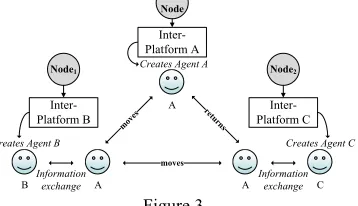
the middleware in which agent containers can be created, so that inter-platform behaviour offers a decentralized model of interacting members. It is fundamental that each mobile agent consists of three parts, the code, state and data. The code is the part of the agent that migrates to a different platform, the state is the execution environment and the data is that aspect that consists of members’ variables such as the internal knowledge.
The mobile agents dedicate to establish a specific route by moving from one member to another. Each time an agent moves to a specific VO member it carries internal data about physical resources and times. During their route traversal, agents are capable of collecting and updating internal information of visited VO members during their journey. We can classify mobile agents according to their acting environments:
1. Interacting mobile agents which are capable of traversing routes within a secure VO environment.
Their functionality is to collect information from internal profiles during their route traversal, as well as discover resources dynamically. It is essential that the newly discovered resources are internal members of the VO with assigned policies.
2. Interacting mobile agents which are capable of performing migration to different VOs by utilizing
common policy agreements signed among SCFs parties. More specifically, agent functionality is based upon the SCFs behaviour of internal VO members. After the first initialization, the mobile agent can collect new members’ addresses from any interconnected node through policy protocol agreements of SCFs.
The difference between these two methods is the platform that creates the agents. In the first case of the interacting agents the intra-platform functionality offers a centralized system of agents. More specifically, a member is selected as the host and creates a platform of agents. Other members of the same VO are aware of that platform and they generate sub-platforms which refer to the previously created host platform. Figure 2 illustrates this procedure.
A1 A
A
A A2 Host Node Node1 Node2 mov es moves retu rns Sub-Platform A1 Host Platform A Sub-Platform A2 Creates Agent A
Creates Agent A1 Creates Agent A2
Information exchange
[image:5.595.221.403.361.469.2]Information exchange
Figure 2
Our example consists of three members that are able to communicate with each other. A node is selected to be the host, which in our case will be able to create the agent service. The remaining nodes are capable of creating a platform specification which refers to the Host member platform. In other words,
sub-platforms accept communication from an agent A, while an internal agent waits for the connection. The agent
starting from the host platform traverses a route to each node to collect and update the internal information of visited members, and then returns back to the host. The service can be repeated by any of other members, however each time other members should be alerted of the service creator address.
B A
A
A C
Host Node
Node1 Node2
mov es moves retu rns Inter-Platform B Inter-Platform A Inter-Platform C Creates Agent A
Creates Agent B Creates Agent C
Information exchange
Information exchange
Figure 3
[image:5.595.218.397.561.664.2]knowledge. In other words, any of the agents are capable of performing communication directly so a new service can be created dynamically. Figure 3 illustrates this procedure.
The aforementioned scheme discussed above illustrates the inter-platform communication model; in which agents are created dynamically by the inter-platform utility. The mobile agent migrates to a different platform and exchanges information with local agents. This solution predisposes the need for compatibility between different platforms and security issues are resolved by the agents.
5.
CONCLUSION
Regarding grid VOs are composed from a huge number of resources, mobile agents is designed to be the mean of achieving interaction among members and provides an asynchronous and independent resource discovery task. They can address a unique model of exploring resources by migrating internal data to each inter-connected member. In this study we suggest that inter-platform utility of the FIPA standards can be utilized in the terms of interacting agents which act on behalf of their members and update the internal knowledge. Moreover, we suggest that VOs are cooperating by utilizing their SCFs ability for extending their standard boundaries. The idea is that each VO member sends an agent of itself containing internal metadata snapshot profile information to a remote host for collecting information. The Future work includes the development of an open standard architecture based on the members’ decisions by incorporating mobile migration agents, SCFs resource discovery method and an optimization technique of best paths selection. Moreover, migration evaluation results will be discussed regarding the effectiveness of this strategy.
6.
REFERENCES
[1] Bellifemine, F., Caire, G., Poggi, A., Rimassa, G., “JADE: A software framework for developing multi-agent applications”, Lecture Notes in Computer Science, Intelligent Agents VII Agent Theories Architectures and
Languages, pp. 42-47. Springer Berlin / Heidelberg (2001)
[2] Braun , P., Kern, S. , Müller, I. , Kowalczyk, R., “Attacking the migration bottleneck of mobile agents”,
Proceedings of the fourth international joint conference on Autonomous agents and multiagent systems, July 25-29,
2005, The Netherlands
[3] Huang Y., Bessis N., Brocco A., Sotiriadis S., Courant M., Kuonen P., Hisbrunner B., "Towards an integrated vision across inter-cooperative grid virtual organizations". Future Generation Information Technology (FGIT 2009), pp.120-128, Springer LNCS, Jeju island, Korea, 2009.
[4] Huang Y., Bessis N., Kuonen P., Brocco A., Courant M., Hirsbrunner B., “Using Metadata Snapshots for Extending Ant-based Resource Discovery Functionality in Inter-cooperative grid Communities”, International Conference on
Evolving Internet (INTERNET 2009), IEEE, Cannes/La Bocca, France, August 2009.
[5] Moreau, L., Avila-Rosas, A., Dialani, V., Miles, S., Liu, X.,“ Agents for the Grid: A Comparison with Web Services (part II: Service Discovery)”, Proceedings of Workshop on Challenges in Open Agent Systems, Italy, (2002), pp. 52-56.
[6]
Overeinder, B. J., Brazier, F. M. T. and de Groot, D. R. A., “Cross-Platform Generative Agent Migration”,
Proceedings of the Fourth European Symposium on Intelligent Technologies, Hybrid Systems and their
implementation on Smart Adaptive Systems, pages 356-363, 2004. [7] Rich, E., 1983, “Artificial Intelligence”, McGraw-Hill, Inc.
[8] Shafiq, M.O., Ahmad, H.F., Suguri, H., Ali, A. “Autonomous Semantic Grid: Principles of Autonomous
Decentralized Systems for Grid Computing”, IEICE Transactions on Information and Systems 2005, E88-D(12), pp. 2640-2650.
[9] Sotiriadis S., Bessis N., Huang Y., Sant P., Maple C., “Defining minimum requirements of inter-collaborated nodes by measuring the heaviness of node interactions”. International Conference on Complex, Intelligent and Software
Intensive Systems (CISIS 2010), IEEE, Krakow, Poland, February 2010.
[10] Sotiriadis S., Bessis N., Huang Y., Sant P., Maple C., “Towards to decentralized grid agent models for continuous resource discovery of interoperable grid Virtual Organizations”, The third international conference of Applications
and Digital information and Web technologies (ICADIWT), Instabul, Turkey, July 2010 {To appear}
[11] Sotiriadis S., Bessis N., Sant P., Maple C., “Encoding minimum requirements of ad hoc inter-connected grid virtual organisations using a genetic algorithm infrastructure”, IADIS multi conference on computer science and
information Systems (MCCSIS 2010), Freiburg, Germany, July 2010. {To appear}