1387
THE DEVELOPMENT AND APPLICATION OF A
RESPONSIVE WEB-BASED SMART LEARNING SYSTEM
FOR THE CYBER PROJECT LEARNING OF ELEMENTARY
INFORMATICS GIFTED STUDENTS
1YONGJU JEON, 2TAEYOUNG KIM
1, 2Korea National University of Education, Department of Computer Education, 28173, South Korea
E-mail: 1[email protected], 2[email protected]
ABSTRACT
The purpose of this study is to develop a responsive web-based smart learning system for elementary informatics gifted students by using a cyber teaching and learning environment and to verify the effects of this smart learning system on the information science creative personality. To achieve our goal, we explored theoretical background and surveyed the requirements of the cyber learning system by teachers and students, and then compared them with those of existing cyber learning systems. Next, we developed a responsive web-based smart learning system based on our theoretical background and users’ requirements. Then we analyzed our experimental results after applying the cyber learning environment to the 5th and the 6th grade elementary informatics gifted students. We performed our experiment to both a traditional class of the control group by using an existing cyber learning system and a new class of the experimental group by using our smart learning system, and then the paired samples t-tests were carried out. As a result, the mean score of the experimental group is significantly higher on the area of interest in information science and affirmation. According to the result, it has been proved that our smart learning system is effective in improving interest in information science and affirmation for the elementary informatics gifted students..
Keywords: Smart Learning System, Elementary Informatics Education, Cyber Teaching and Learning
1. INTRODUCTION
In recent years, nations around the world have recognized the importance of human resources in software, which will become competitiveness in the long-term basis with the dazzling development of information and science technologies and the beginning of the fourth industrial revolution. In accordance with this situation, many nations have invested human resources into IT-related projects as early as elementary school ages [1][2][3].
Korea has paid much attention to human resource promotion traditionally to overcome the limitation of scarce resources and small national land area and much attention has also been paid to gifted and talented education. With the establishment of the Act on Gifted and Talented Education in 1999 and enforcement of the act since 2002, gifted and talented education has been started at a national level. In 2007, the Comprehensive Planning on the Promotion of Specific Education for Brilliant Children has been announced. Since then, a target and area of gifted and talented education have been expanded so that gifted
education in information and science areas have started at gifted education institutions operated by the nation [4].
The gifted education of information for elementary school students in Korea has been managed and provided by education institute for the gifted and gifted classes under the National and Metropolitan and Provincial Offices of Education as well as Local Offices of Education. There have been three types of gifted education: weekend (after school) education, distance (cyber) education, and
concentration (camp) education [4]. In these
classes, several types of classes such as teacher-led whole class teaching, student-led individual learning, cooperative learning, and project-based learning are utilized.
1388 which were previously utilized, has become scarce compared to recently introduced smart learning systems, and the utilization on personal computers (PC) only as a means of interaction between teachers and students in a cyber space has caused a number of problems in responses to the need of learning parties appropriately in the timely manner. Teachers have also similar problems in handling and assessment on students since they cannot obtain various pieces of data about activities and progress of students.
Thus, this study aims to analyze related works and requirements on systems required for currently-provided cyber project learning of gifted elementary students in information and science in order to supply a system for cyber project learning in which the above problems are resolved, and to discuss related previous studies. To do this, the following contributions have been made in the present study.
First, functions required in cyber project learning for gifted elementary students in informatics were derived.
Second, a responsive web-based smart learning system on cross-platform that can be applicable to various devices and environments was designed and implemented.
2. RELATED STUDIES
2.1 Definition of Informatics Gifted
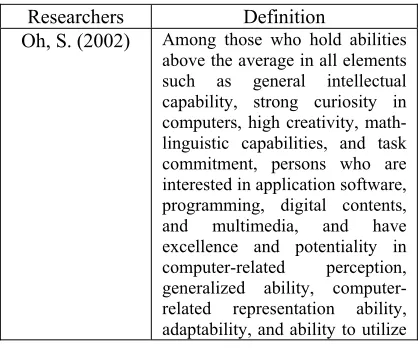
[image:2.612.90.299.561.735.2]The term “informatics gifted” is used variably according to scholars such as gifted person in computer, gifted person in informatics, gifted person in information technology (IT), and so on. In this study, it is unified to “informatics gifted”. The definitions of gifted person in information and science in previous studies are presented in Table 1 [5] [6] [7] [8].
Table 1: Definition of Informatics Gifted
Researchers Definition
Oh, S. (2002) Among those who hold abilities above the average in all elements such as general intellectual capability, strong curiosity in computers, high creativity, math-linguistic capabilities, and task commitment, persons who are interested in application software, programming, digital contents, and multimedia, and have excellence and potentiality in computer-related perception, generalized ability, computer-related representation ability, adaptability, and ability to utilize
computers. Lee, H. & Kang,
H. (2004) Children who can identify, understand, and analyze given problems through convergent or divergent thinking processes, and solve the problems logically and creatively using computer utilization skills.
Kim, H. (2008) In addition to features of general gifted persons such as strong intellectual curiosity, advanced linguistic capability, high creativity, excellent thinking capability, high attentive and concentration ability, and task commitment, students who are equipped with flexible knowledge absorption ability, capabilities of collection, analysis, summary, and utilization in information technology, and creative problem solving ability.
Hong, C.(2009) Among those who have intellectual capabilities, ability to think, intellectual curiosity, creativity, and task commitment above the general students, persons who can collect, analyze, and process information required to problem solving through accurate understanding on given problems based on computer-related ability and utilization, and are able to or potentially create new information.
Based on the previous studies, the present study defined the gifted person in information and science as follows: among those who have general characteristics of gifted persons such as high intellectual curiosity and capabilities, creativity, task commitment, and ability to think, persons who can solve given problems related to information and science areas logically and creatively through utilization on IT capabilities, and are able to or have potentials to create new information.
1389 rather than accepting the phenomenon without searching for the reason, and try to find the fundamental cause of the problem. Fourth, gifted students pursued minimalism. They enjoyed succinct, sophisticated, and implicative expression as well as problem division or scale-down of problem from bigger problem into smaller sub-problems [9].
In addition, Kang et al. (2000) asserted that gifted education program shall be provided to gifted students in information because gifted students were characterized by fast learning speed, excellent memory ability, tendency to identify problems by themselves, strong task commitment, and active, voluntary, and eager learning desire as well as preference to have a separated learning group [10].
Thus, the present study concluded that gifted students in information and science had the following features based on literature reviews: strong will to structurize a phenomenon and solve a problem, self-directedness, pursuit of minimalism, and preference of separated learning group.
2.2 The Cyber Project Learning of Informatics
Gifted Students
Cyber teaching and learning refers to a comprehensive teaching and learning method including guidance of learning process, assignment submission, discussion room for communication between teachers and learners and between learners, and e-mentoring by means of electronic communication using web chatting room based on online learning environment (OLE) [11].
[image:3.612.312.523.74.243.2]Furthermore, cyber project learning is directed by students throughout all processes in learning including exploration activities about topics and issues and activities of expression about the outcomes. It has advantages that learners have an opportunity to meet the up-to-date learning materials and assess their levels about learning outcomes and error correction through understanding and communication between learners. The web-based project learning has the following procedures as presented in Table 2 according to researchers [12][13][14].
Table 2: Procedures of Web-based Project Learning
Kim et al.(1999)
Harris(1995) Levin(1997)
Preparation Goal setup Proposal Determination
of topic Determination of learning activities
Planning Case analysis Detailing
Activities on project Project detailing - Recruitment of
participatory class and school
Structuring
- Selection of participatory parties Exploration and
representation
Exchange of information and opinions
Execution
Finish
Completion Summary Assessment Presentation
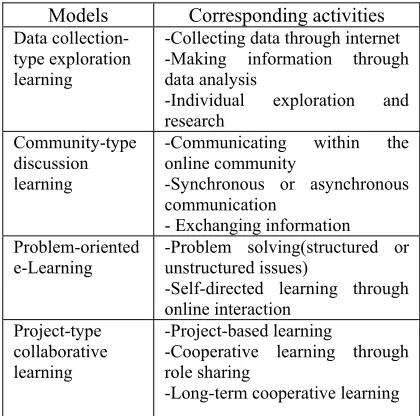
[image:3.612.312.522.347.555.2]Furthermore, Hong (2009) analyzed previous studies on cyber learning, and devised four types of cyber class models for gifted students in relation to the characteristics of gifted students (refer to Table 3) [8].
Table 3: Cyber Project Learning Models for Informatics Gifted Students
Models Corresponding activities
Data collection-type exploration learning
-Collecting data through internet -Making information through data analysis
-Individual exploration and research
Community-type discussion learning
-Communicating within the online community
-Synchronous or asynchronous communication
- Exchanging information Problem-oriented
e-Learning -Problem solving(structured or unstructured issues) -Self-directed learning through online interaction
Project-type collaborative learning
-Project-based learning
-Cooperative learning through role sharing
-Long-term cooperative learning
2.3 Responsive Web-based Smart Learning
System
2.3.1 Responsive Web
1390 HTML5 is a recently introduced new web standard. It is a web technology that can support various devices and browser environments as well as embedded multimedia data, new design style, communication function such as web sockets, and user customized web data services. The above features can be extended dynamically through JavaScript, and a responsive web can be easily applied by utilizing additional features such as jQuery and Bootstrap. A responsive web can be used regardless of operating systems (OS) and device types including browser type, which enables teachers and learners to have real-time and asynchronous learning in diverse environments [15].
2.3.2 Smart Learning System
The online learning environment (OLE) refers to a type of distance education by which learning resources can be exchanged synchronously or asynchronously utilizing communication networks [11]. The OLE in Korea started in the late 1990s as a form of ICT education utilizing computer programs, and introduced electronic learning (e-learning) by means of electronic methods such as wired Internet and television, and information and communication and radio broadcasting technologies. Since then, e-learning was evolved into mobile-learning (m-learning) utilizing mobile learning devices such as notebooks, mobile devices, and wireless Internet. Then, ubiquitous-learning (u-learning) was introduced, by which learners can connect to the Internet anywhere anytime without PC by combining ubiquitous computing technology, followed by smart learning, which was an intelligent learner-customized learning with the advent of various smartphones, smart pads, and tablet PC.
The term smart learning system was coined in recent years, and its definition is not established yet but the Ministry of Education (2011) combined two words: the “smart education” and “system” and scholars approached this view as the first definition of smart learning. The definitions of smart learning system in previous studies are presented in Table 4 [16][17][18].
Table 4: Definition of the Smart Learning System in Previous Studies
Researchers Definition Lee et al.
(2011)
System that can increase learning effects by inducing concentration and interest of users by expressing what is difficult by books or user's observation through
three-dimensional (3D) virtual objects as well as employing image-based augmented reality (AR) in addition to utilizing the advantages of existing e-learning systems.
Min, S & Yang, S.
(2011)
System that is equipped with learning tracking capability utilizing mobile apps and synchronization capability to utilize meaningful learning data regardless of which devices are used to support self-directed learning by users.
Choi, Y. (2011)
Learning system that employs multi-purpose devices whose use multi-purpose is diverse such as smartphones, smart TV, and tablet PC from tool viewpoints; enables 3D and AR in daily living and easy access to information with very fast speed and large amount of communication from environment viewpoints,; and enables learners to become a subject of learning activities, and interactive real-time communication between learners and teachers utilizing social media to overcome limitations due to time and space.
This study defined the smart learning system based on the previous studies as an interactive real-time learning system that can support cross-platform environment and cooperative learning that is self-directed by user-oriented education.
3. DESIGN AND DEVELOPMENT OF A
SMART LEARNING SYSTEM
3.1 Prior Analysis to Design the New Learning
System
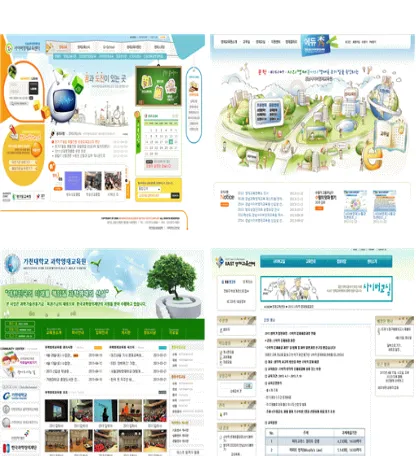
3.1.1 Existing gifted education systems
1391
Figure 1: Existing Gifted Education Systems based on E-learning
3.1.2 Requirements analysis on subjects of
cyber teaching and learning
The practical requirements of subjects in cyber teaching and learning were analyzed to design specific functions required to the smart learning system for cyber project learning by informatics gifted students developed in this study. To do this, interviews were conducted with three teachers who were responsible for informatics gifted education for elementary students in the Gyeonggi province, and 10 teachers who were responsible for gifted education at elementary schools in the Chungbuk province to determine the problems in existing systems. In addition, 16 students who attended gifted education class in information were surveyed to extract required functions in the system. Through the analysis of users’ requirements, we could extract seven key functions for the system: supporting mobile environments, statistical presentation, space for groups, chatting function, video streaming,
assessment, and material site. To implement these
seven functions, technologies that can be adoptable in the smart learning system are web community-based notice board type, and module type that can be operated separately inside the system.
3.2 Design of the Smart Learning System
Figure 2 shows a model of the learning technology systems architecture (LTSA) proposed by the IEEE learning technology standards committee (LTSC) that represented a correlation
[image:5.612.315.524.129.267.2]among teachers, learners, and systems under the learning circumstance of digital environment [19].
Figure 2: LTSA Model [1]
According to the model, teachers, learners, and systems are subjects under the digital learning circumstance, and there is an information flow between teacher and learner, learners, learner and system, and teacher and system. Thus, practical design can be achieved in terms of functional viewpoints by taking the information flow into account inside the smart learning system. In this regard, the present study can divide the smart learning system in terms of:
∙ Learner's viewpoints
∙ Teacher's (manager's) viewpoints, and ∙ System's viewpoints
Based on the above classification items, sub-items were designed to create a single complete system considering the information flows between subjects.
3.2.1 Design of user interface (UI)
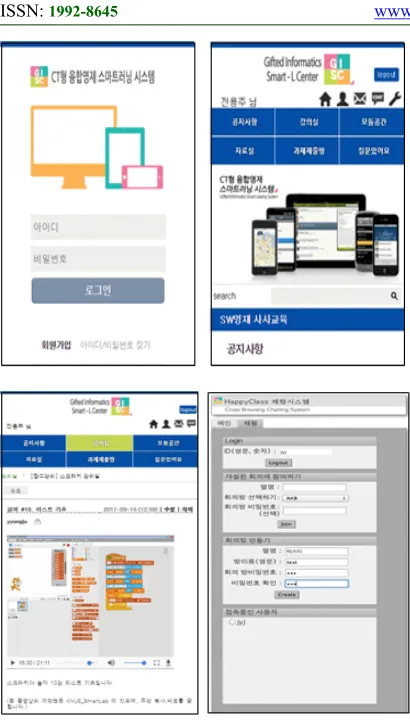
The user interface designed through the development direction, theoretical background review, and functional analysis is shown in Figure 3.
1392
Figure 3: Design of User Interface
3.2.2 Design of the database
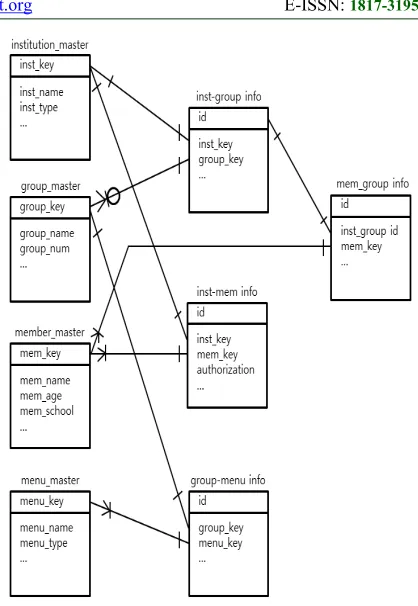
The database used to implement the system is as follows: class data, user data, board and reply data, memo data, mapping information relation - user information by class, notice board information by class, statistical information - a database is not assigned specifically but preferred results are found at the database through query.
Once a learner or teacher is registered in the system as a user, and inputs information about institution and small group, the information is recorded in a corresponding database table. A teacher that belongs to institution can manipulate menu and notice board information displayed in the screen at education center operated by him/her, and has an administration right on each notice board.
Figure 4 shows the entity-relation diagram (ERD) of the database design draft in the present system. More specifically, table and relations for each entity are shown in Figure 5.
[image:6.612.311.520.76.379.2]Figure 4: Entity-Relation Diagram (ERD) of the Database Design
Figure 5: Entities and Relations for the System
3.3 Implementation of the Smart Learning
System
The development tool (IDE) used to develop the smart learning system was Coda2 for MAC, and the PHP, HTML5, JavaScript, CSS3, and MySQL were used to implement the design of system. The web server environment was developed with Linux and the developed system can be accessible through all web browsers in PCs and mobile devices (except for IE 8.0 or lower version).
[image:6.612.91.300.509.661.2]1393
[image:7.612.308.529.463.562.2]Figure 7: The Implemented Smart Learning System on the Mobile Device
Figure 8: The Implemented Smart Learning System on the PC
4 APPLICATION OF THE SMART
LEARNING SYSTEM
4.1 Experiments
In order to quantitatively evaluate the purpose of this study, we designed and conducted an experiment for measuring the effect on the information science creative personality of the participants. We performed our experiment to both a traditional class with a control group by using an existing cyber learning system (only PC-based) and a new class with an experimental group by using our smart learning system, and then the paired samples t-tests were carried out. The participants in our experimental study were 34 informatics students, who participated in informatics gifted education of the institute of gifted education of a university located in the Chungbuk province of South Korea. The subjects were divided into two groups taking one of two courses provided by our experiments: 18 participants of the experimental group in which the smart learning system-based cyber project learning was applied, and 16 participants of the controlled group in which the existing cyber learning system-based cyber project learning was applied (See Table 5). A period of the experiment was 6-week and 18-hour (three hours per week) classes. A pre-test on the information science creative personality was conducted prior to the experiment and a post-test was done immediately after the course completion.
Table 5: The Number of the Participants of the Study
Subjects Number of participants Female Male Total
Experimental
Group 4 14 18
Controlled
Group 3 13 16
Total 7 27 34
4.2 Testing Instruments
[image:7.612.91.296.477.628.2]1394
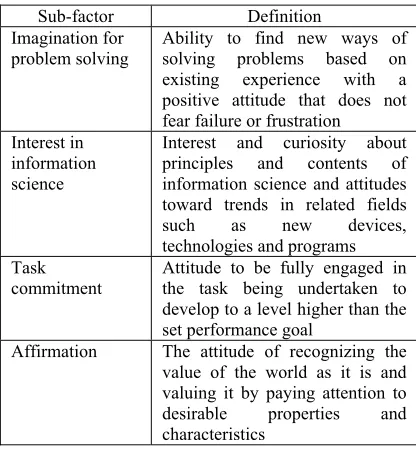
Table 6: The Sub-factor and Definition of the Information Science Creative Personality Test (Jin, 2012)
Sub-factor Definition Imagination for
problem solving Ability to find new ways of solving problems based on existing experience with a positive attitude that does not fear failure or frustration Interest in
information science
Interest and curiosity about principles and contents of information science and attitudes toward trends in related fields such as new devices, technologies and programs Task
commitment Attitude to be fully engaged in the task being undertaken to develop to a level higher than the set performance goal
Affirmation The attitude of recognizing the value of the world as it is and valuing it by paying attention to desirable properties and characteristics
The overall reliability of this test was Cronbach α = .91, which was highly reliable. The reliability of the sub-factors ranged from .76 to .84 and was acceptable or highly reliable.
In this study, we conducted a satisfaction survey on students who participated in the experiment in addition to the information science creative personality test. The contents of the questionnaire were composed of 8 items:
comparison with existing system, contribution to
communication, contribution to cooperative
learning, contribution to leveled learning,
satisfaction with content delivery, satisfaction with
response time, participation in the class,
suggestions and feelings.
A difference in mean values of between two groups in the post-test was analyzed via two-independent samples t-test and comparison of mean difference between pre and post-test within a group was analyzed via two-dependent samples t-test. The statistical software used in result analysis was IBM SPSS Statistics 21.
4.3 Results
4.3.1 Homogeneity test
In order to conduct a test of homogeneity between the controlled and experimental groups, results of the pre-test about computer learning attitude were analyzed using the independent-samples t-test. As a result, it showed p>.05 in all areas, which are presented in Table 7, indicating two groups were homogeneous in terms of information science creative personality.
Table 7:The Results of the Pre-tests between Groups (p<.05, C.G.: Controlled group, E.G.: Experimental
Group)
Sub-factor Group N M SD t p Imagination for
problem solving C.G. 16 2.96 .401 -E.G. 18 3.16 .412 1.284.211
Interest in information science
C.G. 16 3.57 .292 -.185 .855 E.G. 18 3.59 .261
Task commitment C.G. 16 3.19 .543 .070 .945 E.G. 18 3.18 .484
Affirmation C.G. 16 3.58 .427 -.202 .841 E.G. 18 3.61 .338
Total C.G. 16 3.31 .350 -.578 .568 E.G. 18 3.37 .302
4.3.2 The results of the post-tests between
groups
[image:8.612.312.524.429.595.2]The post-test results about information science creative personality of the controlled and experimental groups were analyzed via the independent-samples t-test (p<.05), which are presented in Table 8.
Table 8:The Results of the Pre-tests between Groups (p<.05, C.G.: Controlled group, E.G.: Experimental
Group)
Sub-factor Group N M SD t p Imagination for
problem solving C.G. 16 3.26 .481 -E.G. 18 3.44 .260 1.061.299
Interest in information
science C.G. 16 3.61 .311 -E.G. 18 3.85 .134 2.764.011*
Task commitment C.G. 16 3.31 .609
-.932 .360 E.G. 18 3.50 .452
Affirmation C.G. 16 3.46 .611
-2.160.041* E.G. 18 3.84 .452
Total C.G. 16 3.41 .620
-1.844.077 E.G. 18 3.66 .241
The results of the analysis showed that the overall mean score of the experimental group was 3.66, which was higher than that of the control group of 3.41, and the p value of .077 did not show any statistically significant difference (p< .05), but the p-value of the interest in information science
and affirmation factors of the test was .011 and .041,
1395
4.3.3 The results between the pre- and the
post-test of each group
The pre-post test results of the information science creative personality of each group were analyzed via the dependent-samples t-test (p<.05), which are presented in Table 9 and Table 10.
Table 9:The Results of the Pre- and the Post-test of the Controlled Group (p<.05)
Sub-factor Group N M SD t p Imagination for
problem solving
Pre 16 2.96 .401 -2.255
.044* Post 16 3.26 .783
Interest in information
science Post 16 3.61 .304 Pre 16 3.57 .288 -.474 .644
Task commitment Pre 16 3.19 .542 -.763 .460 Post 16 3.31 .611
Affirmation Pre 16 3.58 .423 .645 .531 Post 16 3.46 .622
Total Pre 16 3.31 .352 -1.045
.317 Post 16 3.41 .431
As a result of comparing the pre-post test with the information science creative personality of the controlled group, the post-test total mean score was 3.41, which was higher than the pre-test total mean score of 3.31, but the p-value was .317, which was not statistically significant.
However, in the imagination for problem
solving sub-factor of test, showed statistically
significant difference.
Table 10:The Results of the Pre- and the Post-test of the Controlled Group (p<.05)
Sub-factor Group N M SD t p Imagination for
problem solving Post 18 3.44 .431 Pre 18 3.16 .411 -2.064.060
Interest in information science
Pre 18 3.59 .252 -3.328
.005** Post 18 3.85 .118
Task commitment Pre 18 3.18 .472 -1.972
.070 Post 18 3.50 .441
Affirmation Pre 18 3.61 .344 -1.910
.079 Post 18 3.84 .241
Total Pre 18 3.37 .301 -2.776
.016* Post 18 3.67 .257
As a result of comparing the pre-post test with the information science creative personality of the experimental group, the post-test total mean score was 3.67, which was higher than the pre-test total mean score of 3.37 and the p-value was .016,
which indicated statistically significant difference (p<.05). In addition, in the interest in information
science, p-value showed statistically significant
difference as .005. In the other sub-sectors, the p-values were 0.60, 0.70, and 0.79, respectively, but they were close to the significance level.
4.3.4 The results of the satisfaction survey
All of the students who participated in this study were students who had experience in cyber teaching and learning in the existing system. This survey was conducted on 14 students of experimental group who participated in cyber project learning using smart learning system. Table 11 is the contents of questionnaire and response type.
Table 11: The Contents of Satisfaction Questionnaire and Response Type
Contents of questionnaire Question No. Response type
Comparison with existing system 1 Descriptive type
Contribution Contribution to
communication 2 Selective type (5-point scale) Contribution to
cooperative learning
3
Contribution to leveled learning
4
Satisfaction Satisfaction with content delivery
5
Satisfaction with response time 6 Participation in the class 7
Suggestions and feelings 8 Descriptive type
In the selective items, to quantify the results the 5-point isometric scale was used: 5 points for 'strongly agree' and 1 point for 'do not agree very much’. Table 12 shows the results of selective questions.
Table 12: The Result of Selective Questions
1396 As a result of analyzing these items, it was found that the gifted students using the smart learning system showed more than 4 points in the all questions, and satisfaction with the cooperative learning of the system was 4.93, which was close to 'agree very much'.
The analysis results of the responses of the descriptive items are as follows. For the smart learning system created through this study compared with the existing system, students suggested that it was convenient to keep confidentiality of the group activities in the group space, to participate in classes on smart devices, to utilize various functions, to utilize a user interface with simple contents and attachments. In addition, we were able to observe seven (50%) opinions that students felt a sense of accomplishment and confidence that they could do anything beyond space constraints in the responses of the last question.
5 DISCUSSION
In this study, we redefined the smart learning system after investigating related researches that have been done by now on the educational learning system. Based on the result, we developed and applied a smart learning system which reflects the requirements of users. In the previous research, the definition of the smart learning system and the necessity of it were discussed theoretically [16][17][18], whereas in this study, the actual requirements of it were derived. Further, the novel web technology was used to implement it, and the new system was applied to actual field and compared with the existing PC-based e-learning system. In addition, we extracted the appropriate functions reflecting the specific instructional model, and it can be the foundation of the follow-up study on the system development based on the instructional model.
We applied the new smart learning system to informatics gifted students in cyber project learning situation by using information science learning contents. If such a system can be extended to general students, it would be very helpful to the general school field. To this end, further research is required to verify whether such a smart learning system can have a positive effect on learners in various subjects in which general students participate.
In the smart learning system developed through our research, the independent group space was provided respectively for group collaboration learning. The satisfaction of this group space was
found to be very high after the satisfaction survey of this study, and gifted students actually performed active communication activities using the space. In addition, to analyze the detailed effectiveness of collaboration in group collaboration learning on our system, it is necessary to develop a measurement tool that can evaluate the degree and aspect of collaboration in the group learning situation.
6 CONCLUSION
In this study we developed a responsive web-based smart learning system through analysis on the requirements of the system needed in cyber project learning of informatics gifted education and we applied the system to the cyber project class of informatics gifted education. The present system is currently applying to the gifted education field.
The results of application show that when smart learning system is applied to cyber project learning of informatics gifted, it has a statistically significant effect on interest in information science
and affirmation of students' information science
creative personality. And the results of satisfaction survey showed that the learning environment of the smart learning system has many potential possibilities to be used in the class, and it should be developed continuously including the functions applicable to the actual class and reflecting the instructional model and the needs of the learners.
The smart learning system developed in this study utilized the technology of HTML5 which is a new web standard such as responsive web, web socket, and multimedia streaming, and so on. This technology is still developing, and further study is needed to develop smart learning contents and systems for education so that various HTML5 technologies can be utilized widely in the future of smart learning.
This study has the following limitation. The participants of our experiment were 34 informatics gifted students, which might be limited in generalization of research results. However, the results of this study are quantitatively validated by comparing the results before and after the experiments and qualitatively verifying the content of the participants' testimonies and outputs to secure validity.
ACKNOWLEDGEMENTS
1397
REFRENCES:
[1] World Economic Forum, “The Fourth Industrial Revolution: what it means, how to respond”, 2016, https://www.weforum.org/agenda/2016/01/the- fourth-industrial-revolution-what-it-means-and-how-to-respond/
[2] Department for Education in U.K., “The National Curriculum in England”, 2013, https://www.gov.uk/government/collections/nati onal-curriculum
[3] Computer Science Teachers Association, “CSTA K-12 Computer Science Standards Progressions Chart”, 2017, https://www.csteachers.org/page/standards [4] Korean Educational Development Institute,
“Gifted Education Database System”, 2017, http://ged.kedi.re.kr.
[5] S. Oh, “The Definition and the Discrimination
System of the Computer Gifted Students”,
master’s thesis, Sungkyunkwan University (South Korea), 2002.
[6] H. Lee, H. Kang, “A Study on the Present State of Informatics Gifted Education for Elementary Students”, Journal of Inje Research, 2004, Vol.
19, No. 1, pp. 479-502.
[7] H. Kim, “A Study on Teaching and Learning Strategies through Analysis of Learning Style of Informatics Gifted Students”, Master’s thesis, Gyeongin National University of Education (South Korea), 2008.
[8] C. Hong, “A Development of a Teaching-Learning Model for Cyber Education of the Elementary Information Science Gifted”, Master’s thesis, Gyeongin National University of Education (South Korea), 2009.
[9] S. Cha, “Extract the Characteristics of the IT Gifted Students and Presentation of Discriminant Standards”, Master’s thesis, Korea University (South Korea), 2006.
[10] S. Kang, S. Jo, M. Keum, “The Plausibility of Cyber Gifted Education”, Journal of Korean Association for Educational Information and
Media, Vol. 6, No. 1, 2000, pp. 49-70.
[11] B. H. Kahn, “Web-Based instruction(WBI) : an introduction”, Educational Media International,
Vol. 35, No. 2, 1998, pp. 24-32.
[12] D. Kim, K. Wang, K. Lee, E. Lee, “The Operation of Project Learning”, Seoul (Korea): Hakjisa, ISBN : 9788975483356.
[13] J. Harris, “Organizing and Facilitating Tele-collaborative Projects”, The Computing Teacher,
Vol. 22. No.5, 1995, pp. 66-69.
http://lrs.ed.uiuc.edu/mining/february95-tct.html.
[14] J. Levin, “Educational Network Project Planning assistant, 1997, http://lrs.ed.uiuc.edu/network-project-guide/ [15] E. Marcotte, “Responsive Web Design”, 2010,
https://alistapart.com/article/responsive-web-design.
[16] J. Lee, Y. Kim, S. Lee, J. Choi, T. Kim, “Mobile Augmented Reality for Smart Learning System”, Convergence Security Journal, Vol.
11, No 6, 2011, pp. 17-23.
[17] S. Min, S. Yang, “Strategy for Developing Smart Learning System under Mobile
Environment”, Proceedings of Korean
Information Science Association Conference , Vol. 38, No. 1, 2011, pp.16-19.
[18] Y. Choi, “ Development and application of WOE-based smart learning system for improving written problem ability of students with learning disabilities”, Master’s thesis, Seoul National University of Education (South Korea), 2011.
[19] Institute of Electrical and Electronics Engineers, “IEEE P1484.1/D9, A Draft Standard for Learning Technology - Learning Technology Systems Architecture (LTSA)”, 2001, http://grouper.ieee.org/groups/ltsc/wg1/files/IE EE_1484_01_D09_LTSA.pdf.