Full Length Research Article
COMPARATIVE STUDY OF THE EFFECT OF VANADIUM AND SULFATE ON THE PERFORMANCE OF
MOLYBDENUM-TITANIUM CO-PILLARED CLAY FOR SELECTIVE CATALYTIC REDUCTION OF
NO BY AMMONIA
1
Rejeb, R., *
,1Khalfallah Boudali, L. and
2Delahay, G.
1
University of Tunis El Manar, Laboratory of Materials Chemistry and Catalysis, Department of Chemistry,
Faculty of Sciences of Tunis, Campus of Farhat Hached, 1060 Tunis, Tunisia
2
Charles Gerhardt Institute in Montpellier, UMR 5253, CNRS-UM-UM-ENSCM, Team MACS, National School of
Chemistry, 8 rue Ecole Normale, 34296 Montpellier, Cedex 5, France
ARTICLE INFO ABSTRACT
A series of vanadium supported on molybdenum and titanium co-pillared montmorillonite, for use in the selective catalytic reduction (SCR) of NO by ammonia, were prepared and characterized with different technique. The surface properties of the samples were compared to the support prepared in absence and in presence of sulphate groups. The catalysts are porous solids and the support (MoTi-PILC) prepared in absence of sulfate shows highest surface area and number of acid sites. The experimental results showed that the addition of different amount of vanadium to the support affects the textural, acid and redox properties as well as the NO removal efficiency for the selective catalytic reduction of NO by ammonia. However, the best catalytic activity is obtained for MoTi-PILC which is correlated to the highest acid sites of this catalyst. The excellent performance of MoTi-PILC is attributed to the combination of the better porous structure, the good dispersion of the actives phases mainly arising by molybdenum species well dispersed on the high surface area and to the appropriate blend of redox with acid sites.
Copyright©2016, Rejeb et al. This is an open access article distributed under the Creative Commons Attribution License, which permits unrestricted use, distribution, and reproduction in any medium, provided the original work is properly cited.
INTRODUCTION
Nitrogen oxide emitted from the stationary plants and mobile sources are the major air pollutants in urban areas causing serious damages to human health and environment. The nitrogen oxide penetrates deeply into sensitive parts of the lungs and can cause or worsen respiratory disease, such as emphysema and bronchitis, and can aggravate existing heart disease, leading to increased hospital admissions and premature death. Currently, the reduction of nitrogen oxide by ammonia is considered as the best available technology for the abatement of this dangerous gas emitted from the stationary sources like incineration plants, oil refinery, etc. The selective catalytic reduction (SCR) of nitrogen oxide (NO) in presence of ammonia, has been extensively studied and developed as a potential technology for the abattement of this gas. In this process, NO contained in the flue gases is reduced by injected
*Corresponding author: Khalfallah Boudali, L.
University of Tunis El Manar, Laboratory of Materials Chemistry and Catalysis, Department of Chemistry, Faculty of Sciences of Tunis, Campus of Farhat Hached, 1060 Tunis, Tunisia.
NH3 to produce nitrogen and water. It was reported that
vanadia supported on many oxides have been investigated for the NO abatement but V2O5 supported on TiO2 remains
favored due to its better stability and its high catalytic activity (Busca et al., 1998). On the other hand, the use of titanium oxide as support for vanadium is limited by its low resistance to sintering, high cost and its low surface area. Thus, considerable efforts have been made by many researchers from the laboratories of the world to investigate the substitution of conventional TiO2 by an efficient catalyst support with low
cost and operating at industrial high temperatures (300-450°C). Recently, various reports have attracted attention to a new class of porous solids by pillaring clay with titanium or others metals. The pillaring process consists of converting layered clay into highly porous structure material by exchanging the compensating cations (between layers) with large variety of Ti-cations or metal-cations. The process requires a thermal treatment in order to transform the polycations inserted between the clay layers into rigid pillars, linking permanently the silicates sheets. The obtained samples,
ISSN: 2230-9926
International Journal of Development Research
Vol. 06, Issue, 09, pp.9370-9375, September,2016
DEVELOPMENT RESEARCH
Article History: Received 28th June, 2016
Received in revised form 19th July, 2016
Accepted 26th August, 2016
Published online 30th September, 2016
Key Words:
recognized pillared inter layered clays (PILC), have found a wide range of potential applications in catalytic processes (Simiao et al., 2016; Long et al., 2000; Chae et al., 2004; Ho Jeong et al., 2011). In our previous work, we have demonstrated that 2% of vanadium are sufficient to obtain a good catalyst after doping the sulfated titanium pillared clay (Khalfallah Boudali et al., 2005, 2006; Arfaoui et al., 2008, 2009) and mixed WTi-PILC (Ferjani et al., 2016). So far, there has not been any published work studying the effect of vanadium supported on molybdenum titanium pillared clay (MoTi-PILC) or discussing their physico-chemical properties nor examining their catalytic activities in the selective catalytic reduction of NO by ammonia. In this work, vanadium supported on MoTi-pillared clays were prepared with different vanadium content (2 and 4%) then characterized by different techniques and tested as catalysts in the selective catalytic reduction of NO by ammonia. The surface properties of the samples containing vanadium are compared to the support (MoTi-PILC) prepared in absence and in presence of the sulphate groups.
MATERIALS AND METHODS
In this work, the samples are prepared using a commercial Bentonite provided by Sigma Aldrich. The Mo-solution is prepared by dissolving ammonium heptamolybdate ((NH4)6Mo7O24, 4H2O) in distilled water. The Ti-solution is
prepared by hydrolysis of TiCl4 with HCl (6M). The vanadium
solution was prepared at room temperature by dissolving ammonia vanadate (NH4VO3) in aqueous solution of oxalic
acid (1M). For molybdenum and titanium co-pillared montmorillonite, the Mo-solution and the Ti-solution were simultaneously added to the starting clay dispersed in distilled water (2g clay/0.5L water) under vigorous stirring at room temperature. In this condition, 10% of molybdenum and Ti/clay = 10 mmol g-1 was obtained. After 16 h stirring, the solid fraction was separated by centrifugation, then washed several times with distilled water and finally dried at room temperature. This sample (MoTi-clay) was used for V-doping. The Vanadium supported on the MoTi-clay was prepared at room temperature under vigorous stirring by incipient wetness impregnation of the support with the vanadium solution. The sample were dried at 80 °C for 20h then calcined at 450 °C with a heating rate 1 °C min-1 for 2h under air flow. The catalysts containing different vanadium amounts were referenced V(x)MoTi-PILC, in which x is equal to 2 and 4% of
vanadium. In the case of the samples without vanadium, the solid (MoTi-clay) was calcined at 400°C for 3h under a flow of air (1mL min-1) then referenced MoTi-PILC. For the synthesis of the sulfated sample (SMoTi-PILC), the TiCl4 was
hydrolysed by H2SO4 (3M) instead of HCl (6M) during the
preparation.
Characterization
The textural properties are determined by N2-physisorption
using a Micromeritics ASAP 2020 instrument. The total acidity is evaluated by ammonia temperature programmed desorption (NH3-TPD) using an AUTOCHEM 2910
(Micromeritics). The temperature programmed reduction by hydrogen (H2-TPR) is performed to examine the redox ability
of the catalyst using the Micromeritics AUTOCHEM 2920.
The catalytic tests are performed in a continuous flow bed fixed microreactor operating at an atmospheric pressure. The catalyst (0,050g) is activated in situ at 450°C under He then, is cooled at room temperature. A feed gas stream containing NO (1000 ppm), NH3 (1000 ppm), and O2 (3%) in He as a balance
gas is supplied to the micro reactor through mass flow controllers. The reaction products are analysed by on line sampling with a quadruple mass spectrometer (Pfeiffer Omnistar), calibrated with standard mixtures and in the following masses: NO (30), N2 (28), N2O (44), NO2 (46), NH3
(17), O2 (32) and H2O (18).
RESULTS AND DISCUSSION
[image:2.595.310.557.400.447.2]The BET surface area of the starting clay is 34m2 g-1 with no porosity. It is well known that the increase of the specific surface area, the micropore surface area and the microporous volume indicate a successful incorporation of the pillars between the clay layers therefore a success of pillaring process. The specific surface area of the sample MoTi-PILC is clearly higher than those of the samples containing vanadium (VMoTi-PILC) or prepared in presence of sulfate groups, SMoTi-PILC, (Table 1). The micropore surface area resulted from a creation of some micro and/or mesopores between the pillars in inter laminar space of the clay. The micropore in the pillared clay resulted by the distance between the clay layers and the distance between the pillars.
Table 1. Textural properties of the calcined samples
Samples SBET (m2 g-1) Sµp (m2 g-1) Vp (cm3 g-1) Vµp (cm3 g-1)
MoTi-PILC 160 36 0.100 0.013
SMoTi-PILC 154 32 0.068 0.012
V(2)MoTi-PILC 157 48 0.081 0.021
V(4)MoTi-PILC 120 9 0.147 0.002
Specific surface area (SBET), micropore surface area (Sµp), total pore volume
(Vp), micropore volume (Vµp)
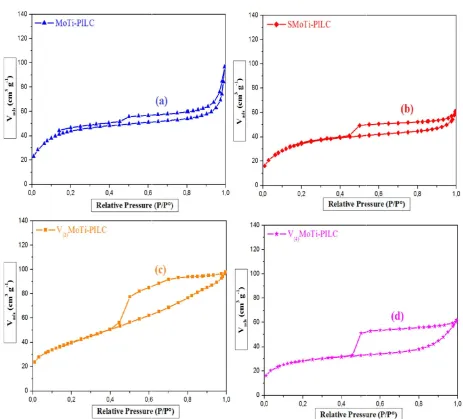
The N2-isotherms of all samples are type IV characteristic for
mesoporous materials according to the IUPAC classification. A gradual increase in N2-adsorption observed at low partial
pressure (P/P0 < 0.3) suggests the presence of micropores and
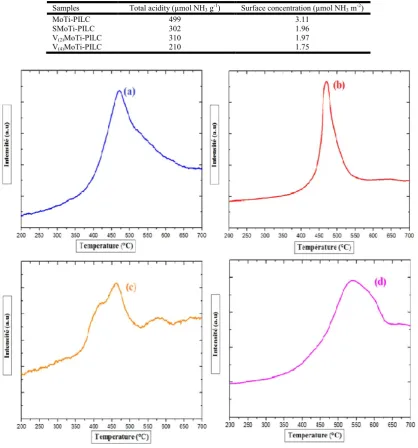
small mesopores. An increase in adsorbed volume observed at higher partial pressures could be related to larger mesopores. This effect is more pronounced for the V-samples. The hysteresis loops due to capillary condensation in the mesopores, which generally associated with the filling and emptying of mesopores, could be qualified to the H4 type (Fig. 1). The BJH pore size distribution (Fig. 2) shows a mono modal distribution of mesopores with a diameter of about 38 Å. The part of small mesporoes is significantly decreased after vanadium doping. It should be noticed that the surface acidity is one of the important properties required on the material for the selective catalytic reduction of NO by ammonia. TPD of ammonia provides information on the total acidity of the investigated pillared clays (Table 2). It was assumed that one NH3 molecule reacts with one acid site. A significant surface
concentration of acid sites exists on MoTi-PILC which is much higher than those present in the samples VMoTi-PILC and SMoTi-PILC. The results reveal that molybdenum in MoTi-PILC contributes to the improvement of the number of acid sites on the catalyst surface.
Fig. 1. N2-Adsorption-desorption isotherms of the samples: (a) MoTi
Fig. 2. Pore size distribution of the samples
desorption isotherms of the samples: (a) MoTi-PILC; (b) SMoTi-PILC; (c) V and (d) V(4)MoTi-PILC
Pore size distribution of the samples (a) MoTi-PILC; (b) SMoTi-PILC; (c) V(2)MoTi-PILC and (d) V
PILC; (c) V(2)MoTi-PILC
[image:3.595.164.445.533.743.2]Table 2. TPD of ammonia from the surface of the investigated samples
Samples Total acidity (µmol NH3 g-1) Surface concentration (µmol NH3 m-2)
MoTi-PILC 499 3.11
SMoTi-PILC 302 1.96
V(2)MoTi-PILC 310 1.97
V(4)MoTi-PILC 210 1.75
Fig. 3. H2-TPR profiles over the investigated samples: (a) MoTi-PILC; (b) SMoTi-PILC; (c) V(2)MoTi-PILC and (d) V(4)MoTi-PILC
Fig. 4. SCR of NO by NH3 over the investigated samples: (a) MoTi-PILC; (b) SMoTi-PILC; (c) V(2)MoTi-PILC
and (d) V(4)MoTi-PILC
[image:4.595.182.407.566.742.2]The unexpected acidity of the samples VMoTi-PILC or SMoTi-PILC can be explained by the diffusion limitation of NH3, due probably to the accumulation of vanadium species or
sulfate groups, respectively, covering some acid sites arising by molybdenum which restricts the available acid sites for adsorption of NH3. The results are in agreement with those
reported by Ferjani et al., 2016, who claimed that the high microporosity arising by the well distribution of WTi-pillars between the clay sheets as well as the existence of a moderate acidity on the catalyst surface is responsible of the highest activity in the SCR of NO by ammonia. The H2-TPR profiles
of the samples are shown in Fig. 3. The TPR profile of MoTi-PILC shows a weak peak at 470 °C which is attributed to the reduction of molybdenum (Guillermo et al., 2015). Therefore, the intensity of this peak became more predominant after sulphate addition, indicating that the reduction of sulfate species occurs in the same temperature range. In our previous work, we demonstrated that the reduction of sulfate to essentially SO2 occurs with few H2S formation over sulfated
titanium pillared clay (Khalfallah Boudali et al., 2006).
The H2-TPR profile of V(2)MoTi-PILC shows three peaks of
H2 consumption centered at about 420, 470 and 575 °C. The
first peak is mainly due to reduction of monomeric Vanadium species, the second peak to reduction of molybdenum as observed for MoTi-PILC and the third peak to reduction of vanadium polymeric species (Khalfallah Boudali et al., 2006; Dmitri et al., 2002). Referring to the literature of V2O5/TiO2
catalyst (Dmitri et al., 2002), three types of species were detected with the maximum peak temperatures as follows: isolated monomeric species (497–507 °C), polymeric species (537 °C), and bulk amorphous V2O5 (579 °C). The
V-monomeric was the easiest to reduce. In this case, for VMoTi-PILC, the increase of vanadium content from 2% to 4% induces the formation of multilayer of vanadium atoms and probably to bigger vanadia particles that may cover the molybdenum therefore the peak of Mo-reduction at 475°C disappeared. For the sample V(4)MoTi-PILC, the reduction of
polymeric vanadium species and the bulk amorphous V2O5
occurred mainly in the temperature range 520-625°C as observed in the V2O5/TiO2 (Dmitri et al., 2002). The activity
of each sample is tested in the selective catalytic reduction of NO by ammonia (Fig.4). In our prior works (Rejeb et al., 2016).), it was demonstrated that Ti-PILC was no active in the SCR-NO and the Ti-pillars do not play a role in the SCR-NO at high temperature. However, in the present work and in all cases, the NO conversion begins at 200 °C then increases with temperature reaching the highest maximum at 450°C. The unexpected results for VMoTi-PILC, prepared with different vanadium content 2 and 4%, is probably due to the difficult diffusion of the reactants in the pores and to highly constraint formation of the products. The low NO conversion over these samples is partly related to the conglomeration of vanadia species on the surface covering the strong acid sites arising by molybdenum and to partial pore blocking due to the accumulation of vanadium species, which restricts the available active sites for the reduction of NO. Furthermore the superior acidity arising by molybdenum which is well dispersed on the high surface area of MoTi-PILC is responsible of its good activity at high temperature. The results of this work are totally different of our previous work (Khalfallah Boudali et al., 2005) in which we have observed
an increase of NO conversion with vanadium content (1.5, 3 and 5%) supported on sulfated Ti-PILC and also different of those reported in ref. (Long et al., 2000) in which the authors claimed that 4.4%V supported on Ti-PILC are sufficient to obtain a solid (VTi-PILC) more active than the commercial catalyst. The acidity and reducibility of the oxides catalysts like WO3/TiO2 or MoO3/TiO2 are well known as the key
factors of the activity in the SCR-NO by ammonia (Busca
et al., 1998). However, in the case of the MoTi-PILC catalyst,
we discover that the micropore strucxture generated by co-pillaring process and the acidity arising by molybdenum play a major role in the catalytic activity for the SCR-NO by NH3.
Conclusion
This is the first work reporting a comparative study of the effect of vanadium content in molybdenum titanium co-pillared montmorillonite. The experimental results showed that the addition of different amount of vanadium (2 and 4%) to the support (MoTi-PILC) affects the textural, acid and redox properties as well as the NO removal efficiency for the selective catalytic reduction of NO by ammonia. The highest NO conversion at 450°C over the MoTi-PILC catalyst is directly related to the combination of the highest surface area, the microporous structure and the appropriate blend of redox with greater acidity. These first results reveal that MoTi-pillared clay catalyst can trigger future research on other chemical reactions requiring strong surface acidity.
REFERENCES
Arfaoui, J., Khalfallah, Boudali, L., Ghorbel, A., and Delahay, G. 2008. Influence of the nature of titanium source and of vanadia content on the properties of titanium-pillared montmorillonite. J. Phy. Chem.Sol., 69, pp. 1121-1124.
Arfaoui, J., Khalfallah, Boudali, L., Ghorbel, A., and Delahay, G. 2009. Effect of vanadium on the behaviour of unsulfated and sulfated Ti-pillared clay catalysts in the SCR of NO by NH3. Catal. Today, 142, pp. 234-238.
Busca, G., Lietti, L., Ramis, G. and Berti, F. 1998. Chemical and mechanistic aspects of the selective catalytic reduction of NO x by ammonia over oxide catalysts. A review : Appl.
Catal. B 18, pp. 1-36.
Chae, H. J., Nam, I. S., Ham, S. W., and Hong, S. B. 2004. Characteristics of vanadia on the surface of V2O5/Ti-PILC
catalyst for the reduction of NOx by NH3. Appl. Catal. B
53, pp117-126.
Dmitri, B. A., Kiwi-Minsker, L., Rainone, F., and Renken, A. 2002. Characterization of Surface Vanadia Forms on V/Ti– Oxide Catalyst via Temperature-Programmed Reduction in Hydrogen and Spectroscopic Methods. J. Catal., 205, pp. 115-122.
Ferjani, W., Khalfallah, Boudali, L., Delahay, G., and Petitto, C. (2016) Reduction of Nitrogen Oxide by Ammonia over Vanadium Supported on Mixed Tungsten–Titanium-pillared Clays. Chem Lett., In press 2016.
Ho, Jeong, C., In-Sik, N., Sung-Won, H., and Suk, Bong, H. 2011. Selective catalytic oxidation of H2S over V2O5
supported on TiO2-pillared clay catalysts in the presence of
water and ammonia. Appl. Catal. Sci., 53, pp. 204–211 Khalfallah, Boudali, L. Ghorbel, A., Grange, P. 2006. SCR of
NO by NH3 over V2O5 supported sulfated Ti-pillared clay
reactivity and reducibility of catalysts. Appl. Catal. A, 305, pp. 7–14.
Khalfallah, Boudali, L., Ghorbel, A., Grange, P., and Figueras, F. 2005. Selective catalytic reduction of NO with ammonia over V2O5 supported sulfated titanium-pillared clay
catalysts: influence of V2O5 content. Appl Catal B, 59, pp.
105–111.
Long, R.Q., and Yang, R.T. 2000. Performance of activated carbonsupported noble metal catalysts in the hydrogenolysis of CCl3F. Appl. Catal. B. 24, pp. 13-22.
Rejeb, R., Khalfallah, Boudali, L., Delahay, G., Petitto, C. 2016. Effect of Molybdenum on the Behavior of Sulfated and Non-sulfated Titanium Pillared Clay in the Selective Catalytic Reduction of NO by Ammonia Topics in Catal. 59, pp. 1-7.
Simiao, Z., Guizhen, Z., Wenge, Q., Liyun, S., Ran, Z., and Hong, He, 2016. Resistance to SO2 poisoning of
V2O5/TiO2‐PILC catalyst for the selective catalytic
reduction of NO by NH3. Chinese Journal of Catalysis, 37,
pp. 888–897.