ISSN: 1992-8645 www.jatit.org E-ISSN: 1817-3195
E-COMMERCE ADOPTION IN PENINSULAR MALAYSIA:
PERCEIVED STRATEGIC VALUE AS MODERATOR IN THE
RELATIONSHIP BETWEEN PERCEIVED BARRIERS,
ORGANIZATION READINESS AND COMPETITOR
PRESSURE
1SENG CHEE LIM, 2AHMAD SUHAIMI BAHARUDIN, 3RONG QUAN LOW
1,2
Wawasan Open University, School of Science & Technology, 54 Jalan Sultan Ahmad Shah,10500 Penang, Malaysia
2
Universiti Sains Malaysia, School of Computer Sciences, 11800 USM, Penang. Malaysia
3
Segi College Penang, Wisma Green Hall, 43 Green Hall, 10200, Penang. Malaysia E-mail: [email protected], [email protected], [email protected]
ABSTRACT
This research proposed a parsimony model by combined two streams of theories: technological organizational environmental framework and perceived strategic value to seek more information to explain the e-commerce adoption phenomena in Peninsular Malaysia. Three predictor variables namely: Perceived Barriers, Organization Readiness and Competitor pressure and three moderators namely: operational support, managerial productivity, and strategic decision to investigate e-Commerce adoption. A total of 1200 survey questionnaires were sent to target audiences. After 3 months, 300 datasets were returned, and 217 datasets are useful. SmartPLS and SPSS tools used to perform data analysis. Perceived Barriers is not significant for small and medium sized enterprises. Perceived strategic value does not has any influence on small sized enterprises but it has a strong influence to medium sized enterprises to adopt e-Commerce. Three research questions used to guide for the research: (i) What is the level of e-Commerce adoption, (ii) Do perceived barriers, organization readiness and competitor pressure have relationship with e-Commerce adoption and (iii) Do perceive strategic value has moderation effects on the relationship between predictor variables and dependent variable.
Keywords: Adoption, Small Medium Enterprises, Perceived Strategic Value, E-Commerce
1. INTRODUCTION
There are many researchers define the term of e-commerce to suit for their research studies. As a result, electronic commerce or e-Commerce has many definitions, and it depends on which perspective view from researchers, academicians, practitioners. Although, e-commerce has difference definition from various point of view, but it has two necessary elements to most definition, first, e-commerce focuses on business activities that through electronic medium such as sharing information, promoting business product, customer services, and other related activities [1]. The second important element is technology applications such as e-mail, web portal, online bank, electronic fund transfer, payment gateway that support these business activities.
E-Commerce helps small medium business to achieve successful businesses especially in
developed countries. There is a significant growth of e-commerce in developing countries for past two decades. The successful of technology adoption is relies on the adopter used and this turn in is affected by the fit between the technology and the adopter[2][3]. In developing countries, people fails to obtain benefits from e-commerce [4]. There are many literature reviews claimed e-Commerce brings benefits, it is true statement for developed countries, but not for developing countries. As a result, many adoption & diffusion researches in developing countries had identified factors as motivator factors to successful technology adoption.
ISSN: 1992-8645 www.jatit.org E-ISSN: 1817-3195
countries are demand for some e-commerce application transaction capabilities to support their business. Furthermore, the SME owners and managers especially in developing countries are not aware of strategic value of e-commerce, moreover top management enthusiasm and compability between e-Commerce and current work will be additional challenge toward adoption. The contribution of this study will bridge the research gaps between technology organization framework [5] and perceived strategic value (PSV) [6], to seek more information about innovation adoption.
There are three research questions guide for this study: RQ(i) What is the level of e-Commerce adoption, RQ(ii) Do perceived barriers, organization readiness and competitor pressure have relationship with e-Commerce adoption and RQ(iii) Do perceive strategic value has moderation effects on the relationship between predictor variables and dependent variable.
The nt structure for this paper as following: section 1.0 is about introduction overview of e-Commerce, followed by section 2.0 literature review, background study of the context. Section 2.2 is theoretical framework and hypotheses development. Section 3.0 discussed about research methodologies, followed by section
4.0 Data analysis and Data Finding. Section 5 discussed about Discussion and Conclusion about the entire research.
2. LITERATURE REVIEWS
2.1 Background information
[image:2.612.83.527.421.548.2]In the most of the developing countries, small medium sized enterprises are important to country’s economic. In Malaysia, the Small Medium Enterprise (SME) constitutes the majority of the business establishments in Malaysia at 99.2%[7]. SMEs contribute about 32% of GDP and 59% of total employment [8] and 19% of exports [7]. The successful story of e-commerce technologies had drawn the focuses from the global. Fundamental e-commerce technologies are widely adopted such as e-mail, website, portal facilitates the communication process, when moving up to the next level which involved more technical incentive and skills, and investment, therefore, SMEs are risk-averse to operate their business. Table 1 illustrates the SME definition for respective SMEs based on number of employees and total sales turnover.
Table 1: SME definition[7]
Category Small sized Medium sized
Manufacturing Sales turnover from RM 300,000 to less than RM15 million or full-time employees from 5 to less than 75
Sales turnover from RM 15 million to not exceeding RM 40 million or full time employees from 75 to not exceeding 200
Service & Other sector Sales turnover from RM 300,000 to less than RM 3 million or full time employees from 5 to less than 30
Sales turnover from RM 3 million to not exceeding RM 20 million or full time employees from 30 to not exceeding 75
2.2 Theoretical Framework And Hypotheses Development
There are two major dominant theories for adoption research: diffusion of innovation (DOI) [9] and technology acceptance model (TAM) [10]. In DOI, there are five innovative characteristics: relative advantages, compatibility, complexity, Trialability, and Observability. Diffusion of Innovation is popular because it able to explain how, why, and what rate new ideas and technology throughout the communication medium.
Secondly, technology acceptance model (TAM) is derived from theory reasoned action[11] and theory of planned behavior[12] by omitted
social norm because it unable to explain behavioral intention. In technology acceptance model, there are two necessary elements, perceived ease of use and perceived usefulness. The TAM model receives attention from the researcher because it is parsimony, and explains to behavioral intention toward new innovation.
ISSN: 1992-8645 www.jatit.org E-ISSN: 1817-3195
of the successful technology adoption, but it unable to 70% of the unknown variable[13]. Furthermore, the units of analysis for DOI and TAM models are locked on individual, and end users, therefore, it difficult to explain the organization top managements’ perception on IT. Furthermore, the decisions to adopt innovative technologies into organization are based on the consensus of board of the members of organization not individual user.
In small sized organization, the decision making process is easy compared to medium size organization. In micro or small organization, the decision maker is business owner, therefore they can made decision easily. However, in medium sized organization, the decision making process are bureaucratic and depend type of decision such as collective decision, opinion decision, or authority decisions[14].
Technology Organization Environment (T.O.E) framework[5] is used to investigate Information System studies, it has three important pillars, namely technology context:- describes both the internal and external technologies relevant to the firm. This includes current practices and equipment internal to the firm, as well as the set of available technologies external to the firm, second, organization context:-refers to descriptive measure about the organization such as scope, size and managerial structure. Third, environment context:-management support, organizational readiness, government support, and pressures from partners, customers and competition. The dependent variable of TOE framework can be served as acceptance, adoption, receptivity, business performance, business value, or combination of other related variables[15]. Moreover, this framework is consistence with diffusion of innovation[5], [16], it not only explain on technology characteristic but, it also looks into organization context and external environment context.
Perceived Barriers are negative perceptions about technology implementation which discourage to adopt innovation technology. When technology is getting complex, perceived obstacle is relevant, during the adoption process maybe complicated and costly to implement [17]. There are many concepts about perceived barriers, for example, in the study conducted by Khestri[4], barriers are separated into 3 groups: economic barriers, socio politic barriers, and cognitive barriers that influence to e-Commerce adoption in developing countries. The other barriers concepts conducted by chiliya[18] is based on anticipated technologies related issues fitted into their study. This study followed chiliya’s concepts by examine
technologies related issues to the e-Commerce adoption such as barriers to technological adoption: lack of security, lack of privacy, lack of IT personnel are major technical issues, Inadequate knowledge, difficult to measurement of return of investment (ROI), lack of standards and procedures from Government, benefits identification. The postulate hypothesis statement as following:
H1a: Perceived Barriers has negative influence to small sized enterprises to adopt e-Commerce.
H1b: Perceived Barriers has negative influence to medium sized enterprises to adopt e-Commerce.
The term of organization readiness was defined by Iacovou[19] as the availability of the needed of resource for adoption. It has two necessary elements: financial resource and technology resources. Organization readiness reflects the organization’s capabilities to implement innovative technologies. There are some organization readiness concepts to suit for specific study, for instance, Mehrtens[20] omitted financial componement, it measure on technical readiness such as the level of IT knowledge among the IT professional, the level of IT knowledge among the non-IT professional and the level of IT use within the organization. Most of the prior adoption studies followed the Iacovou’s organization readiness concepts such as EDI adoption [21],[22]. In this study, iacovou’s organization readiness concepts are adopted. Lack of financial and technical resources are identified as inhibitor factor to adoption [23]. The hypothesis statement as following:
H2a: Organization readiness has positive influence to small sized enterprises to adopt e-Commerce.
H2b: Organization readiness has positive influence to medium sized enterprises to adopt e-Commerce.
ISSN: 1992-8645 www.jatit.org E-ISSN: 1817-3195
There also limited study about perceived strategic value, that enables people to have more understand about the perception from the top management to know the strategic value by implement innovative technologies. The postulate hypothesis statements as following:
H3a: Competitor Pressure has positive influence to medium sized enterprises to adopt e-Commerce.
H3b: Competitor Pressure has positive influence to medium sized enterprises to adopt e-Commerce.
The CEO’s perception on IT is importance that had strong effects and influence toward the progressive use IT in the firm[6]. Subramanian and Nosek (2001) is the first person who introduce perceived strategic value framework. In this framework, it has 3 important facets. First, operational support to reap operational efficiency benefits and aid operational strategy through cost reduction, improved customer service, improved support to operations, and other related strategies. Secondly, managerial productivity provide better access to information, help in the management of time, provide a means to use generic methods and models in decision making, and improve communication among managers through the use of electronic calendars, electronic mail, project management tools, or access to internal and external databases. Third, strategic decision information system tools used to support strategic decision. In the e-commerce adoption study of small business in US, Grandon and Pearson (2004) had conducted a study by combined 2 streams of theories, technology acceptance model and perceived strategic value. In their research, 4 variables influence to e-Commerce adoption: organizational readiness, external pressure, perceived ease of use, perceived usefulness. Perceived strategic value has influence to the manager’ attitude toward e-commerce adoption. The postulate hypotheses statements as following:
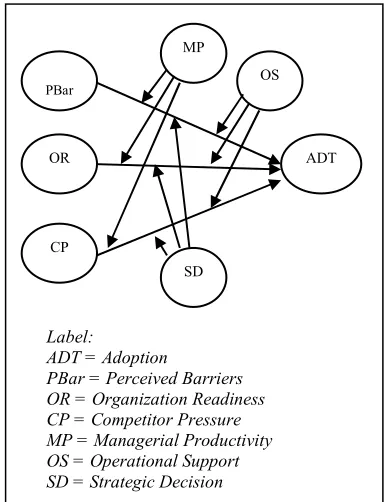
H4: The relationship between perceived barrier and e-Commerce adoption will be strengthen when managerial productivity is increase.
H5: The relationship between organization readiness and e-Commerce adoption will be strengthen when operational support is increase.
[image:4.612.326.520.126.377.2]H6 The relationship between competitor pressure will be strengthen when strategic decision is increase.
Figure 1 depicts the conceptual framework for this study.
Label:
ADT = Adoption
PBar = Perceived Barriers OR = Organization Readiness CP = Competitor Pressure MP = Managerial Productivity OS = Operational Support SD = Strategic Decision
Figure 1: Conceptual Model
3. RESEARCH METHODOLOGY
There are 1200 sets of data were sent to small medium enterprises located in peninsular Malaysia. The sources of SME information are retrieved from government agency SME Corporation Malaysia and SMEInfo website. The unit of analysis is focus on manufacture sector, which turned the raw materials into commercial products. The minimum sample size of study can be range from 5:1 ratio of the number of predictor variables[27]. Ten to one ratio is used to gather data. In this model, there are 7 variables available, therefore, the minimum required sample size for this research is 70 [27]. The number of sample size for marketing research indicated 7 predictor variables require 82 data sets[28]. The data collection process takes up 3 months. There are approximate 300 data were return. After applied some filter criteria such as non-adopter, potential-adopter, non related sectors such as service, retails, general business and so on were excluded due to it not relevant to the study. As a result, only 217 data are valid.
Kaiser-Mayer-Olkin (KMO) and Bartlett’s Test of Sphericity used to test the adequate of sample size for this study. Table 2 illustrate the result of KMO and Bartlett’s test. The KMO index is
PBar
OR
CP
ADT MP
OS
ISSN: 1992-8645 www.jatit.org E-ISSN: 1817-3195
[image:5.612.90.296.203.297.2]recommended when the cases to variable ratio are less than 1:5. The KMO index ranges from 0 to 1, with 0.50 considered suitable for factor analysis[29]. The score of Bartlett's Test of Sphericity should be significant (p<.05) and suitable for factor analysis[30]. Based on the KMO and barlett’s test result, the sample size is sufficient for the study.
Table 2: KMO & Barlett’s Test
Construct
Kaiser-Mayer-Olkin (KMO)
Test
Bartlett's Test of Sphericity
Predictor(s):
PBar, OR, CP .892 .000
Dependent
Adoption .888 .000
Moderator
MP, OS, SD .756 .000
4. DATA ANALYSIS & DATA FINDING
Table 3 shows the descriptive data for variables: adoption, organization readiness, competitor pressures, operational support, managerial productivity and strategic decision. The mean value is range from 4.593 to 5.222. Among these 7 variables, managerial scored highest value, 5.222. This indicated the top management believed by using innovative technologies that can enhance and boost up the volume of activity and productivity. The mean value for independent value is 4.611 indicated the SMES’ attitude toward e-commerce adoption are passive.
Table 3: Summary of Descriptive Data on Variables.
Variable Mean Std
Dev Max Min
Adoption 4.611 1.157 7.000 1.375
P. Barriers 4.449 1.188 7.000 1.000 O. Readiness 4.653 1.186 7.000 1.000 C. Pressure 4.593 1.010 7.000 1.000 M. Productivity 5.222 1.010 7.000 1.000 O. Support 5.221 1.131 7.000 1.000 S. Decision 5.135 1.065 7.000 1.000
4.1 Convergent Validity
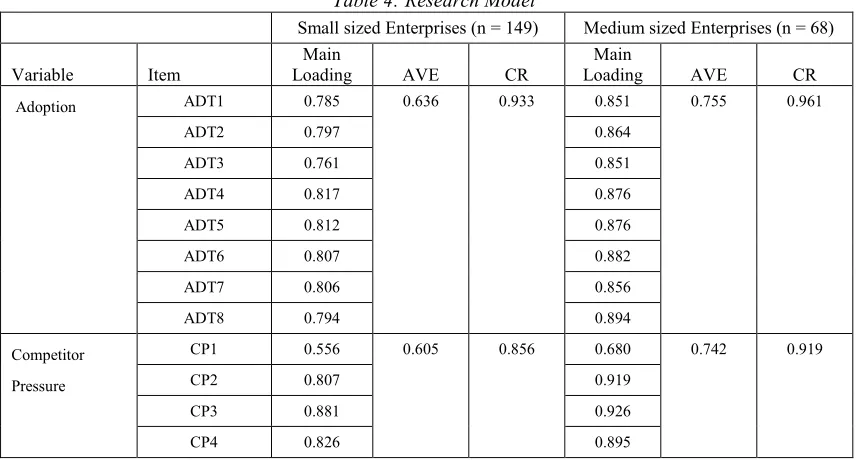
[image:5.612.89.517.493.723.2]Table 4 illustrate the research model, there are three important elements used to access the convergent validity, factor loadings, composite reliability (CR) and average variance extracted (AVE). The benchmark value for AVE value and main loading value must be 0.5 and above, higher value is preferred[31]. The composite reliability value must at least 0.7 and above, which indicate the internal consistency of data within measurement [15]. Based on the table 2, an item named PBar10 from small sized enterprises category is removed due to the item not meet the minimum requirements. The AVE value for small sized enterprises category is range from 0.594 to 0.838; on the other hand the AVE value for medium sized enterprises category is range from 0.697 to 0891. The CR value for both categories are surpassed the benchmark value.
Table 4: Research Model
Small sized Enterprises (n = 149) Medium sized Enterprises (n = 68)
Variable Item
Main
Loading AVE CR
Main
Loading AVE CR
Adoption ADT1 0.785 0.636 0.933 0.851 0.755 0.961
ADT2 0.797 0.864
ADT3 0.761 0.851
ADT4 0.817 0.876
ADT5 0.812 0.876
ADT6 0.807 0.882
ADT7 0.806 0.856
ADT8 0.794 0.894
Competitor CP1 0.556 0.605 0.856 0.680 0.742 0.919
Pressure CP2 0.807 0.919
CP3 0.881 0.926
ISSN: 1992-8645 www.jatit.org E-ISSN: 1817-3195
Organization OR1 0.907 0.838 0.954 0.946 0.891 0.970
Readiness OR2 0.922 0.947
OR3 0.916 0.953
OR4 0.917 0.928
Perceived PBar1 0.759 0.594 0.929 0.779 0.697 0.958
Barriers Pbar2 0.755 0.810
Pbar3 0.804 0.863
Pbar4 0.873 0.863
Pbar5 0.839 0.883
Pbar6 0.743 0.843
Pbar7 0.631 0.808
Pbar8 0.784 0.813
Pbar9 0.723 0.841
Pbar10 - 0.843
Managerial PSV_MP1 0.843 0.712 0.925 0.832 0.767 0.943
Productivity PSV_MP2 0.856 0.907
PSV_MP3 0.867 0.876
PSV_MP4 0.825 0.873
PSV_MP5 0.827 0.889
Operational PSV_OS1 0.818 0.763 0.951 0.866 0.789 0.957
Support PSV_OS2 0.791 0.850
PSV_OS3 0.892 0.900
PSV_OS4 0.912 0.907
PSV_OS5 0.911 0.934
PSV_OS6 0.908 0.869
Strategic PSV_SD1 0.919 0.781 0.955 0.889 0.794 0.959
Decision PSV_SD2 0.873 0.901
PSV_SD3 0.902 0.894
PSV_SD4 0.924 0.887
PSV_SD5 0.833 0.883
PSV_SD6 0.848 0.893
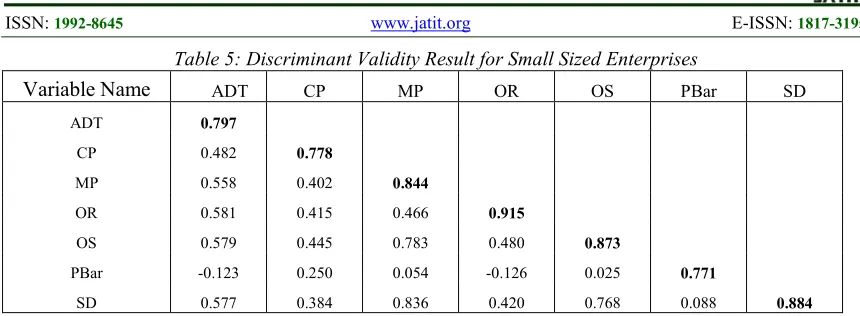
4.2 Discriminant Validity
Table 5 and table 6 show the discriminate validity for respective categories. There are two important criteria to assess the model. First, the diagonal value of squared root of AVE must be 0.5 and above, second, the diagonal value in term of row
[image:6.612.91.519.71.579.2]ISSN: 1992-8645 www.jatit.org E-ISSN: 1817-3195 Table 5: Discriminant Validity Result for Small Sized Enterprises
Variable Name ADT CP MP OR OS PBar SD
ADT 0.797
CP 0.482 0.778
MP 0.558 0.402 0.844
OR 0.581 0.415 0.466 0.915
OS 0.579 0.445 0.783 0.480 0.873
PBar -0.123 0.250 0.054 -0.126 0.025 0.771
SD 0.577 0.384 0.836 0.420 0.768 0.088 0.884
*
Bold Text represent squared root of AVE valueTable 6: Discriminant Validity Result for Medium Sized Enterprises
Variable Name ADT CP MP OR OS PBar SD
ADT 0.869
CP 0.640 0.861
MP 0.651 0.559 0.876
OR 0.548 0.459 0.562 0.944
OS 0.749 0.602 0.790 0.408 0.888
PBar -0.259 -0.066 -0.229 -0.225 -0.120 0.835
SD 0.688 0.593 0.837 0.485 0.850 -0.110 0.891
* Bold Text represent squared root of AVE value
4.3.1 Direct Effects
Table 7 illustrates the relationship between predictor variables: Perceived Barriers, Organization Readiness, Competitor Pressures and independent variable, adoption for small sized enterprises and medium sized enterprises. The R squared value (R2) for small sized enterprises is 0.538, which indicated this model can be explained 54% with two variables, competitor pressure and
organization readiness. On the other hand, the R squared value for medium sized enterprises is 0.680 with two supported variables: competitor pressure and organization readiness. In the small sized enterprises, organization readiness obtained highest t-value, 7.130, meanwhile competitor pressures scored highest value in medium sized enterprises category.
Table 7: Path Analysis and t-test Result
Small sized Enterprises Medium sized Enterprises
Path Beta Std Err t-value Result Beta Std Err t-value Result
CP -> ADT 0.349 0.071 4.907 ** 0.4988 0.1232 4.050 **
OR -> ADT 0.420 0.059 7.130 ** 0.285 0.1496 1.905 *
PBar -> ADT -0.158 0.130 1.215 - -0.1612 0.1027 1.570 -
Significant Level: * p< 0.05 , ** p < 0.01
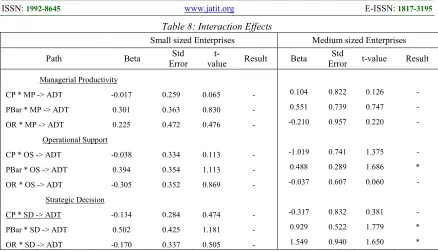
4.3.2 Interaction Effects
Table 8 illustrates the interaction effects between the predictor variables and dependent variable for small and medium sized enterprises. From small sized enterprises’ perspective view, the managerial productivity, operational support, and strategic decision do not have interaction effects on
ISSN: 1992-8645 www.jatit.org E-ISSN: 1817-3195 Table 8: Interaction Effects
Small sized Enterprises Medium sized Enterprises
Path Beta Std
Error
t-value Result Beta
Std
Error t-value Result
Managerial Productivity
CP * MP -> ADT -0.017 0.259 0.065 - 0.104 0.822 0.126 -
PBar * MP -> ADT 0.301 0.363 0.830 - 0.551 0.739 0.747 -
OR * MP -> ADT 0.225 0.472 0.476 - -0.210 0.957 0.220 -
Operational Support
CP * OS -> ADT -0.038 0.334 0.113 - -1.019 0.741 1.375 -
PBar * OS -> ADT 0.394 0.354 1.113 - 0.488 0.289 1.686 *
OR * OS -> ADT -0.305 0.352 0.869 - -0.037 0.607 0.060 -
Strategic Decision
CP * SD -> ADT -0.134 0.284 0.474 - -0.317 0.832 0.381 -
PBar * SD -> ADT 0.502 0.425 1.181 - 0.929 0.522 1.779 *
OR * SD -> ADT -0.170 0.337 0.505 - 1.549 0.940 1.650 *
Significant Level: * p< 0.05 , ** p < 0.01
5.0 DISCUSSION & CONCLUSION
The three research objectives are achieved. The parsimony conceptual model with 3 variables: perceived barriers, organization readiness, competitor pressure manage to explain the e-commerce adoption phenomena with an average 60.9% for small and medium sized enterprises in Peninsular Malaysia. It proved that T.O.E framework is suitable to assess factors influence e-commerce adoption in developing countries.
Based on the calculated result, it shows that perceived barriers does not has influence to adoption. It is not surprise, SMEs are aware of importance of ecommerce technologies. Most of the SMEs use fundamental of e-commerce technologies[32] such as email, website, portal to conduct business activities[33].
Organization Readiness is significant for both small and medium sized enterprises. Unlike medium sized enterprises, small sized enterprises have highly significant level. It indicated small sized enterprises are facing scarcity of resources such as financial, human resources. Therefore, resource allocation topic is important issues to small sized enterprises.
Competitor Pressure is another significant factor influence to e-commerce adoption. In order to gain some competitor advantages, SMEs have to invest some financial to built IT infrastructure in their organization. Hence, it also will increase some business reputations in the same industries to get a better position in the market.
From the statistical result, it is very surprise that managerial productivity, operational support, and strategic decision do not have any influence to e-Commerce adoption for small sized enterprises. From the opposite position, operational support and strategic decision have some influence to e-Commerce adoption for medium sized enterprises. Only managerial productivity does not has any influence. Managerial productivity helps managers to assess various kind of information with available tools. However when the organization move up to the next level of e-commerce, it requires more technical knowledge and skills, hence it will increased the technical barriers and challenge to the organization.
The ideal of Operational support is to bring benefits such as improve customer services, support related business activities from operational. E-mail and website considered as favour application in the fundamental level of e-commerce, which is favour by most of SMEs. It is important at the early stage of adoption, which is used to link with their customers, suppliers, and stakeholders. When moving up to the next stages of e-Commerce, it will need more resources, man power, time, money to implement, at the same time it will burden the organization, because e-commerce considered as incremental innovation, involved broad of application, and it is a continuum process.
ISSN: 1992-8645 www.jatit.org E-ISSN: 1817-3195
available information. Website and e-mail are favour e-commerce applications that applied by SMEs. In fact they are demand tools that support monetary transaction capabilities [34] and can be easily integrated into their business.
Lastly, PSV reveals the technical weakness encountered by most of SMEs when they are move to the next level of e-Commerce development. In order to boost up e-Commerce usage and activities, the private sectors need to collaborate with government agencies, higher institution, IT consultancies, Skilled training center to organize more seminars, conferences, technical trainings are requires to enhance organization’s computer technical skills and increase their computer self-efficacy. This research has some limitations, the finding result may not applicable to Borneo Malaysia. There is an opportunity to revise on the perceived barriers in Malaysia and developing countries context. In the future, research should be comparison between the adopter and non-adopter in the economy transitional phase. Besides that, by introducing mediator will helps to seeking more adoption information.
ACKNOWLEDGMENTS
The authors would like to thank the School of Computer Sciences, Universiti Sains Malaysia (USM) as this research has been supported from the Research University Grant (RUI) [Account Number: 1001/PKOMP/811251] and from the Short Term Research Grant [Account Number: 304/PKOMP/6312103] from the Universiti Sains Malaysia.
REFRENCES:
[1] N. A. Hashim, “E - Commerce And SMEs—The Need for Caution,”
Prometheus, vol. 27, no. 2, pp. 125–140, 2009.
[2] S. Kurnia, “SISC_developing countries_Final,” The University of Melbourne, 2006. .
[3] B. Ulhelkar, “Understanding the impact of cultural issues in global e-business alliances,” in Proceedings of We-B Conference with Edith Cowan University, 2003, no. April.
[4] N. Kshetri, “Barriers to E-Commerce and Competitive Business Models in Developing Countries: A Case Study,”
Electron. Commer. Res. Appl., vol. 6, no. 4, pp. 443–452, 2007.
[5] L. G. Tornatzky and M. Fleischer, The processes of Technology Innovation. Lexington Books, 1990.
[6] G. H. Subramanian and J. T. Nosek, “An Empirical Study of The Measurement And Instrument Validation of Perceived Strategy Value of Information Systems,” J. Comput. Inf. Syst., vol. 41, no. 3, pp. 64–70, 2001. [7] NSDC, “Guideline for New SME
Definition,” 2014. [Online]. Available: http://www.smecorp.gov.my/vn2/sites/defa ult/files/Guideline_for_New_SME_Definiti on_7Jan2014.pdf. [Accessed: 30-Mar-2015].
[8] S. Y. Teng, SMI SME Business Directory, 11th ed. SMI SME Business Directory, 2012.
[9] Everett M. Rogers, Diffusion of innovations, 5th ed. New York: Free Press, 2003.
[10] F. D. Davis, “Perceived Usefulness, Perceived Ease of Use, and User Acceptance of Information Technology,”
MIS Q., vol. 13, no. 3, pp. 319–340, 1989. [11] I. Ajzen and M. Fishbein,
“Attitude-Behavior Relations: A Theoretical Analysis and Review of Empirical Research,”
Psychol. Bull., vol. 84, pp. 888–918, 1977. [12] I. Ajzen, “The Theory of Planned
Behavior,” Organ. Behav. Hum. Decis. Process, vol. 50, no. 2, pp. 179–211, 1991. [13] N. D. Oye, N. Iahad, and N. Rahim, “The
history of UTAUT model and its impact on ICT acceptance and usage by academicians,” J. Educ. Inf. Technol., pp. 1–20, 2012.
[14] E. M. Rogers and F. F. Shoemaker,
Communication of Innovation: A Cross Culture Approach, 2nd ed. The Free Press, 1971.
[15] P. Ifinedo, “Internet/E-Business Technologies Acceptance in Canada’s SMEs: Focus on Organizational and Environmental Factors,” in E-Business – Applications and Global Acceptance, 2012, pp. 1–18.
[16] M. Ghobakhloo, D. Arias-Aranda, and J. Benitez-Amado, “Adoption of E-commerce Applications in SMEs,” Ind. Manag. Data Syst., vol. 111, no. 8, pp. 1238–1269, 2011. [17] M. F. O. Martins and T. Oliveira,
ISSN: 1992-8645 www.jatit.org E-ISSN: 1817-3195
[18] N. Chiliya, C. K. Chikandiwa, and B. Afolabi, “Factors Affecting Small Micro Medium Enterprises’ (SMMEs) Adoption of E-Commerce In The Eastern Cape Province Of South Africa,” Int. J. Bus. Manag., vol. 6, no. 10, pp. 28–36, 2011. [19] C. L. Iacovou, I. Benbasat, and A. S.
Dexter, “Electronic Data Interchange and Small Organizations: Adoption and Impact of Technology,” MIS Q., vol. 19, no. 4, pp. 465–485, 1995.
[20] J. Mehrtens, P. B. Cragg, and A. M. Mills, “A Model of Internet Adoption by SMEs,”
J. Inf. Manag., vol. 39, no. 3, pp. 165–176, 2001.
[21] K. K. Y. Kuan and P. Y. K. Chau, “A Perception Based Model for EDI Adoption in Small Business Using A Technology Organization Environment Framework,” J. Inf. Manag., vol. 38, no. 8, pp. 507–521, 2001.
[22] M. S. Musawa and E. Wahab, “The Adoption of Electronic Data Interchange (EDI) Technology by Nigerian SMEs: A Conceptual Framework,” J. Bus. Manag. Econ., vol. 3, no. 2, pp. 55–68, 2012. [23] B. Ramdani, P. Kawalek, and O. Lorenzo,
“Predicting SMEs’ Adoption of Enterprise Systems,” J. Enterp. Inf. Manag., vol. 22, no. 1/2, pp. 10–24, 2009.
[24] P. Ifinedo, “An Empirical Analysis of Factors Influencing Internet/E-Business Technologies Adoption By SMEs in Canada,” Int. J. Inf. Technol. Decis. Mak., vol. 10, no. 4, pp. 731–766, 2011.
[25] M. M. Poorangi, E. W. S. Khin, S. Nikoonejad, and A. Kardevani, “E-Commerce Adoption in Malaysian Small and Medium Enterprises Practitioner Firms: A Revisit on Rogers’ model,” Ann. Brazilian Acad. Sci., vol. 85, no. 4, pp. 1593–1604, 2013.
[26] E. Grandon and J. M. Pearson, “Electronic Commerce Adoption: An Empirical Study of Small and Medium US Businesses,” J. Inf. Manag., vol. 42, no. 1, pp. 197–216, 2004.
[27] J. R. Joseph F. Hair, R. E. Anderson, R. L. Tatham, and W. C. Black, Multivariate Data Analysis With Readings. New York: Macmillian Publishing Company, 1992.
[28] K. Kwong and K. Wong, “Partial Least Squares Structural Equation Modeling (PLS-SEM) Techniques Using SmartPLS,”
Mark. Bull., vol. 24, no. 1, pp. 1–32, 2013. [29] S. S. Alam and M. Noor Mohd Kamal,
“ICT Adoption in Small And Medium Enterprises: An Empirical Evidence of Service Sectors in Malaysia,” Int. J. Bus. Manag., vol. 4, no. 2, pp. 112–125, 2009. [30] B. Williams, T. Brown, and A. Onsman,
“Exploratory factor analysis: A five-step guide for novices,” J. Emerg. Prim. Heal. Care (JEPHC, vol. 8, no. 3, pp. 1–12, 2010. [31] J. R. Joseph F. Hair, G. T. M. Hult, C. M. Ringle, and M. Sarstedt, A Primer on Partial Least Squares Structural Equation Modeling (PLS-SEM). Los Angeles / London / New Delhi / Singapore / Washington: SAGE Publication, 2014. [32] T. M. Insider, “E-commerce potential still
low, despite rapid growth, says minister,”
The Malaysian Insider, 2015. [Online]. Available:
http://www.themalaysianinsider.com/malay sia/article/e-commerce-potential-still-low-despite-rapid-growth-says-minister. [Accessed: 10-Oct-2015].
[33] A. Omar, T. Ramayah, L. B. Lin, and M. Marimuthu, “Determining Factors For The Usage Of Web-Based Marketing Applications By Small And Medium Enterprises (SMEs) In Malaysia,” J. Mark. Dev. Compet., vol. 5, no. 2, pp. 70–86, 2011.
[34] N. A. Hashim and S. M. Noor, “An Investigation of Key Adoption of E-Commerce in Smes in Malaysia,” in
![Table 1: SME definition[7]](https://thumb-us.123doks.com/thumbv2/123dok_us/8908199.957873/2.612.83.527.421.548/table-sme-definition.webp)