ORIGINAL RESEARCH ARTICLE
PROPOSAL OF MODELING OF PROTOTYPES OF A MOBILE APPLICATION USING GERONTECHNOLOGY:
AN APPROACH IN THE EXERCISE OF BODYBUILDING
1
Leonardo L. S. Santos,
2Leandro B. Santos and
3Uedson S. Reis
1
Bachelor in Information Systems, School of Exact Sciences - Metropolitan Union of Teaching and Research
(UNIME), Av. Luiz Tarquínio - Centro - Lauro de Freitas - Ba – Brazil, ZIP 42700-000
2
Adjunct Professor, Bom Jesus da Lapa Multidisciplinary Center of the Federal University of Western Bahia
(UFOB), 1100, Av. Dr. Manoel Novaes, 1028, Bom Jesus da Lapa - Ba – Brazil, ZIP 47600-000
3
Professor, School of Management and Business (FGN), Av. Tamburugy, 88 - Patamares,
Salvador - Ba – Brazil, ZIP 41680-020
ARTICLE INFO ABSTRACT
This article has as the main goal to explain the modeling of prototypes of a mobile application for the management of physical activities practiced by the elderly. Starting from gerontechnology principles, it was first identified the needs and peculiarities in the management of bodybuilding physical activities practiced by the elderly; soon after, a comparative study of the functionalities and applications resources was carried out. From that onward, software engineering and its techniques as a definition of functionalities and screen prototypes for modeling were used. As a result of the comparative study, a small number of mobile applications intended for the elderly and functional gaps that addressed the needs of bodybuilding exercises of this audience were identified. This way, all prototype modeling of the proposed mobile application is explained, and its main screenings are presented.
Copyright © 2019,Leonardo L. S. Santos, Leandro B. Santos and Uedson S. Reis. This is an open access article distributed under the Creative Commons Attribution License, which permits unrestricted use, distribution, and reproduction in any medium, provided the original work is properly cited.
INTRODUCTION
Humanity is undergoing a growing process of the aging population. Such phenomenon is also observed in Brazil: according to data from IBGE (2013, 2000, 2017), Brazilian life expectancy reached the mark of 75.44 years in 2015, a number which, in 1991, was 68.6 years. Based on this information, it is possible to identify that the population with 65 years or older, previously represented by 5.61% of the total population in the year 2000, was represented by 8.46% in 2017, with the projection of reaching 13.44% by the year of 2030. In this context, in addition to the increase in life expectancy of the
Brazilian population, the elderly proportion grows
quantitatively each year, being of fundamental importance the adoption of public policies and the creation of tools that help to guarantee life quality for this age group. Several studies directly relate the practice of physical activities to the life quality of the elderly.
*Corresponding author: Leonardo L. S. Santos,
Bachelor in Information Systems, School of Exact Sciences - Metropolitan Union of Teaching and Research (UNIME), Av. Luiz Tarquínio - Centro - Lauro de Freitas - Ba – Brazil, ZIP 42700-000
According to Argento (2010), the practice of physical activities by the elderly can provide them with greater autonomy in the performance of physical activities and a better quality of life. Petroski (1997) concluded that regular physical activities by the elderly should promote their autonomy for bodily cleanliness, physical activity, locomotion, leisure and so on. Scientific evidence clearly indicates that participation in physical activity programs is an independent way to reduce and/or prevent a number of functional declines associated with
aging (Maciel 2010); (Vogel et al., 2009); (Nelson et al.,
2007); (Organization et al., 2005). Also noteworthy is the
recent increase in the use of technology among the elderly, since research carried out by the Internet Steering Committee in Brazil (2015) indicated a 13% increase in the share of individuals over 60 who used the internet on the mobile phone in 2015. This indicator in 2014 was of 6%. Thus, it is possible to infer the increase in the use of mobile phones and smartphones by the elderly. In this context, this article aims to explain the modeling of prototypes of a mobile application for the management of physical activities practiced by the elderly. As a specific goal, a comparative study of the functionalities
ISSN: 2230-9926
International Journal of Development Research
Vol. 09, Issue, 03, pp.26435-26439, March, 2019
Article History:
Received 04th December, 2018
Received in revised form 08th January, 2019
Accepted 11th February, 2019
Published online 31st March, 2019
Available online at http://www.journalijdr.com
Key Words:
Gerontechnology, Physical activities, Mobile application,
Elderly people.
Citation: Leonardo L. S. Santos, Leandro B. Santos and Uedson S. Reis, 2019. “Proposal of modeling of prototypes of a mobile application using
gerontechnology: an approach in the exercise of bodybuilding”, International Journal of Development Research, 10, (03), 26435-26439.
and features of the main applications available on mobile platforms is carried out. Section 1 contains this introduction. As materials and methods, in section 2, a brief study of gerontechnology was first carried out, where justifications and particularities were sought in the prescription of the physical activities program for the elderly, after which a comparative study is presented on the existing applications. In the results (in section 3) we explain the modeling of prototypes of the mobile application, with indication based on software engineering techniques: technological structure, functionalities and an initial version with screen prototypes. Finally, in discussion in section 4, the difficulties and events on the subject are exposed as hideous.
MATERIALS AND METHODS
Two initial stages of research were carried out: the first one studied the peculiarities in the management of the physical activities practiced by the elderly, as well as technology applicability in this area; in the second, a comparative study of the applications available in the platform stores was carried out. It was investigated whether or not they met the particularities identified, thus resulting in the targeting of a new proposal.
Gerontechnology: The term "gerontechnology" is formed by two words: gerontology - the scientific study of aging and the elderly, and technology - research and development of various techniques and products. The term was coined in 1980 by Jan A.M. Graafmans and Wiebo H. Brower, from the Technical
University of Eindhoven in the Netherlands (Odebrecht et al.,
2008). Gerontechnology is defined as the study of the process and needs coming from the aging process, seeking technology
solutions to improve the daily life of the elderly (Odebrecht et
al., 2008); (Bouma 1992). In practice, gerontology, besides
passing through the applicability of technology in the study of the physiological effects caused by the aging of individuals, such as physical, cognitive, psychological or motor alterations, also involves the technological use to minimize these effects, which can often cause inconveniences.
According to the literature (from Nóbrega et al., 1999), the objectives of gerontechnology are listed below:
Improve research on the aging process;
Prevention;
Improvements or Adaptations;
Compensation.
Once the objectives have been defined, it is worth highlighting the definition in which this article is based: prevention (b), which is defined by Vercruyssen (1996) as the greatest possibility of effective use of technology for human aging, especially in the declines in strength, flexibility, resistance, and others such as age-related skills and abilities. Technology has a role in primary prevention (avoiding losses to health) and secondary prevention (avoid undesirable consequences of these losses) (Vercruyssen 1996). From this point, under the view of physical activities, it can be concluded that these can be used as an active mechanism in both primary preventions, avoiding losses to health, and secondary prevention, in order to avoid the undesirable consequences of these losses. The prescription of physical activities in the third age should act in such a way that it will fight the declines caused by aging and
will not compromise health, thus promoting life quality. In order to guarantee safety and real benefits in the practice of these activities, authors indicate that, prior to any exercise program, the individual should undergo a medical evaluation that allows diagnosing comorbidities and attesting physical
condition (de Nóbrega et al., 1999). According to authors
(from Nóbrega et al., 1999), in order to ensure the best risk/benefit ratio, the main variables to be observed in the prescription are modality, duration, frequency, intensity, and mode of progression. However, it is emphasized that besides taking into account personal preferences and possibilities of the elderly, depending on the results of the pre-evaluation, there are modalities that can be contraindicated due to diseases found in the individuals (da Nóbrega et al. 1999).
The planning of the exercises that compose the physical activities should be prescribed in an individualized manner, taking into account the results of the physical evaluation and the comorbidities (limitations) present (da Nóbrega et al., 1999). In these explanations, it is possible to perceive the direct correlation between limitations and comorbidities with the prescription of physical activities. Based on the definitions and principles presented in the previous paragraphs, it is possible to identify that the creation of a technological solution that meets the requirements listed below, would help the elderly in the plenty enjoyment of activities in a safe and sound environment, physical training professions working on planning and suggestion of modalities, as well as in prescription of exercises and the management, as a whole, of the physical activities practiced by the elderly.
To store information about the limitations/
comorbidities of the individuals obtained in the medical evaluation;
To store clinical data obtained in medical evaluation;
To ensure the history of the information listed in items
a and b;
To link modalities to limitations/comorbidities;
To link exercises to limitations/comorbidities;
To indicate, in the act of prescription, if the exercise or
modality is contraindicated for the individual, based on their limitations/comorbidities;
Comparative study: On this, it was considered to propose a mobile application that meets the objectives listed at the end of section 2.1. However, it is necessary to carry out a previous study to collect and compare the functionalities of available applications. It was also aimed at their adherence to the requirements listed in the aforementioned section. After completing this step, the proposal will begin to be developed. The survey was carried out between April 26, 2017, and May
9, 2017, in the official stores of Android (Google 2017) and
iOS (Apple, 2017) platforms. The choice of the respective
operating systems is justified by their coverage on the world market. According to Gartner (2017) data, in the last quarter of
2016, Android and iOS dominated 99.57% of worldwide
smartphone sales, as shown in Table 1.
Among those tested, only 5% were specific for the elderly, 92% were for the general public and 3% for the female audience.
Table 1. Worldwide sales of smartphones to end-users per operating system, last quarter of 2016. Source: (Gartner 2017)
Operational System Amount (in thousands) Market share (%)
Android 352,669.9 81.72
iOS 77,038.9 17.85
Windows 1,092.2 0.25
BlackBerry 207.9 0.05
Others 530.4 0.12
TOTAL 431,539.3 100
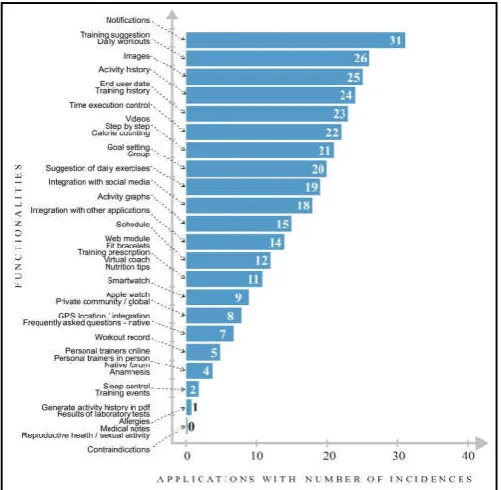
It was found that the applications that covered the information storage functionality of the individual, focused on recording measurements and body composition, such as weight, fat rate, arm measurement, waist and etc., of the total, 5 allowed insertion of information from medical evaluation and, within this amount, only 4 allowed the prescription of an exercise program. There was also a gap in the number of applications focused on bodybuilding exercises. As previously mentioned, the main objective of this study was to search for mobile applications that could meet the requirements listed at the end of section 2.1. Within this context, a total of 41 functionalities were identified, including:
New ones, those that were not listed;
Attended, those that were listed and identified in the
comparative study;
Unattended, those that were previously listed, but were
not identified among the applications of the comparative study.
Figure 1 shows a graph of functionalities x applications. The horizontal axis indicates the 40 mobile applications tested, while the vertical axis represents the 41 functionalities identified. Each bar demonstrates the incidence record of the functionality; at the top it is noticed that the "notification" is the most common one, having incidence in 31 applications among the total. Below, in the chart, with no incidence record, one of the features is initially prospected in the section above, which is identified by the signaling or warning of "contraindications" in the prescription of some exercise or modality.
At least one application that fully met the proposed
requirements were not found;
The number of applications for the elderly is reduced;
The number of applications focused on bodybuilding
exercises is reduced;
There is no information on contraindications for the
exercises or modalities;
There is a lack of applications that promote the
multiprofessional interaction between physical
educators, physiotherapists, and physicians with the elderly.
RESULTS
Once the foundation and presentation of the justifications have been completed, the task of developing the mobile application proposal started. However, it is worth mentioning that this is
only one of the components that integrate the technological structure of the computational model, composed by:
Figure 1. Bar chart of functionalities X applications, with number of incidences. Source: The author
The data repository, responsible for storing the
information;
Web service, responsible for providing operations in the
repository;
Application, responsible for consuming the Web
service and promoting interaction with the end user.
The consolidation of the technological structure was based on sources that show the use of Web services as promising and advantageous in the development of mobile and web applications. Advantages such as access to services in a standardized way and independent of programming language can be arranged when using web services (Lecheta 2015). In the proposed technological structure, the application (iii) requests a Web service (ii), which in turn performs a query in the data repository (i) and returns to the application (iii) what was requested. For example a list of exercises, or given user data. In view of the focus of this article, only component (iii) will be explained in the following sections.
Screens: Interface prototype is a software engineering device used to create early versions of a future system (Martins 2007). Based on this, the construction of screen prototypes of the proposed application began. For this purpose, the tool
Balsamiq Mockup was used, which allows the prototyping of
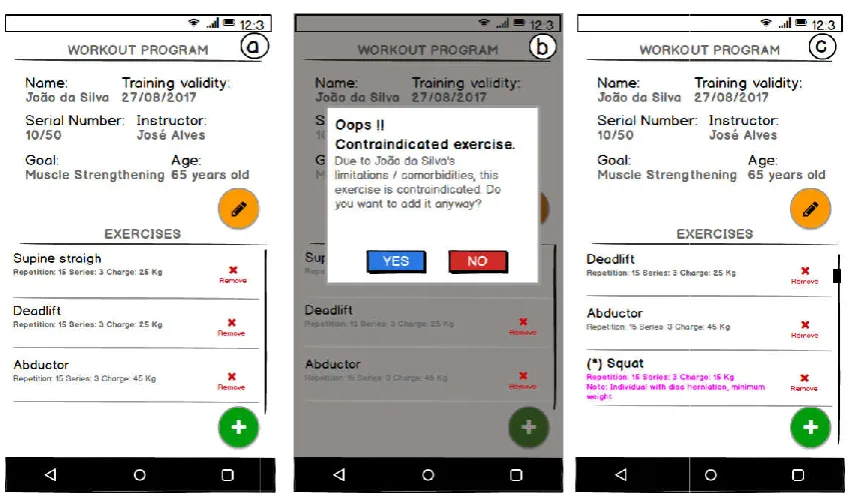
screens of a desktop, web or mobile system. The main functionality explained in this article is given in the contraindication alert in the prescription of a certain exercise. Thus, based on the previous register of comorbidities/ limitations of the individual, the application should, at the time of adding the exercise to the exercise program, check if it is contraindicated for the user. After verification, in case of positive answer, the mobile application will have to alert the user that performs the prescription procedure, asking if he wants to add it anyway. If the answer is yes, the exercise will be added.
[image:3.595.45.278.130.200.2]However, it will be necessary to inform the observation immediately. After this, the exercise will be added to the exercise program and should be displayed highlighted in bold type with a (*), so that the previously entered observation is displayed. To facilitate understanding of the flow described above, the screens (a), (b) and (c) are illustrated in figure 2. On screen (a) it is possible to observe the floating button "+" to add a new exercise to the program, in (b) the issuing of the alert regarding the contraindication, and in (c) the highlighted exercise followed by its observation. The application should not act in an inhibitive way, giving the physical educator user autonomy to prescribe a certain exercise, regardless of whether it is contraindicated or not. This conclusion was reached based on Kopiler (1997), who does not recommend the
restriction of exercises. However, as this is a contraindicated exercise, the insertion of the observation mentioned above will be mandatory. Finally, the authors stress the need to promote a more independent life for the elderly (Argento 2010); (Maciel 2010); (Kopiler 1997). Many of them define this independence as a fundamental factor in the quality of life of such audience since it makes them more autonomous and free. In this way, the proposed mobile application should enable the elderly to access and follow their exercise program. The prominent display rule for the contraindicated exercise should be maintained for the elderly.
DISCUSSION
This work reported the modeling of prototypes of a mobile application directed to the prescription of physical e
bodybuilding. Concepts of gerontechnology
[image:4.595.85.512.53.301.2]in the prescription of physical activities for the elderly were studied, performing a comparative study of the existing resources in the main applications available in mobile platforms. After this step, we explained the modeling of prototypes of functionality identified as a gap in the applications recognized in the study. Screen prototypes were widely used to propose an early version of the mobile application. As a consideration of this article, it is believed that the development of this proposal addresses possible gaps
Figure 2. Exercise program prescription screen (a); Contraindication alert (b); Exercise highlighted in the exercise
However, it will be necessary to inform the observation immediately. After this, the exercise will be added to the and should be displayed highlighted in bold type with a (*), so that the previously entered observation is displayed. To facilitate understanding of the flow described above, the screens (a), (b) and (c) are illustrated in figure 2. On ssible to observe the floating button "+" to add a new exercise to the program, in (b) the issuing of the alert regarding the contraindication, and in (c) the highlighted The application should way, giving the physical educator user autonomy to prescribe a certain exercise, regardless of whether it is contraindicated or not. This conclusion was reached based on Kopiler (1997), who does not recommend the absolute restriction of exercises. However, as this is a contraindicated exercise, the insertion of the observation mentioned above will stress the need to promote a more independent life for the elderly (Argento 2010); (Maciel 010); (Kopiler 1997). Many of them define this independence as a fundamental factor in the quality of life of such an since it makes them more autonomous and free. In this way, the proposed mobile application should enable the d follow their exercise program. The prominent display rule for the contraindicated exercise should
This work reported the modeling of prototypes of a mobile application directed to the prescription of physical exercises of and particularities in the prescription of physical activities for the elderly were studied, performing a comparative study of the existing resources in the main applications available in mobile we explained the modeling of identified as a gap in the Screen prototypes were widely used to propose an early version of the mobile his article, it is believed that the development of this proposal addresses possible gaps
identified in the prescription of bodybuilding exercises for the elderly. However, for the efficiency and effectiveness of the proposal of this article, it is necessary to study the adherence and motivation of the elderly to the regular practice of physical activities. Another factor to consider is the adhesion by this public to the proposed mobile
majority is still considered technophobic or presents difficulties in the use of new technologies.
emphasize is the need to carry out and maintain medical evaluations to identify and/or
or limitations. These may change over time, either in a positive or negative frame. Thus, the initial survey and subsequent maintenance of these evaluations
feasibility of the proposal of this article.
considerable relevance since researchers in the field of health informatics can obtain from this comparative study a mapping of features and functionalities that have been tested. Thus, this research contributes to the modeling of other pr
future work, it is suggested to implement the proposed mobile application. It is recommended to carry out an experimental study because it is necessary to obtain authorization from the ethics and research committee with humans. Another point is the feasibility of adding to the proposal the multidisciplinary focus, thus promoting a multiprofessional
physical educators, physiotherapists, physicians, systems analysts and the elderly, as well as the development of an algorithm to predict if a given exercise can be contraindicated for certain limitation or comorbidity.
Human Research Ethics Committee is required to conduct an evaluation of programming with senior citizens in an environment controlled by a phy
Acknowledgments: First author thanks UNIME, the second author thanks UFOB and the third author thanks FGN.
REFERENCES
Apple. 2017. Apple - App Store (BR).
Argento, R. de S. V. 2010. Benefícios da atividade físicas na saúde e qualidade de vida do idoso.
de Campinas.
Exercise program prescription screen (a); Contraindication alert (b); Exercise highlighted in the exercise program (c). Source: The author
identified in the prescription of bodybuilding exercises for the However, for the efficiency and effectiveness of the proposal of this article, it is necessary to study the adherence and motivation of the elderly to the regular practice of physical activities. Another factor to consider is the adhesion by this the proposed mobile application since a significant majority is still considered technophobic or presents difficulties in the use of new technologies. Another point to emphasize is the need to carry out and maintain medical monitor possible comorbidities or limitations. These may change over time, either in a positive or negative frame. Thus, the initial survey and subsequent maintenance of these evaluations are paramount for the feasibility of the proposal of this article. This article has since researchers in the field of health informatics can obtain from this comparative study a mapping of features and functionalities that have been tested. Thus, this research contributes to the modeling of other proposals. As future work, it is suggested to implement the proposed mobile application. It is recommended to carry out an experimental because it is necessary to obtain authorization from the ethics and research committee with humans. Another point is the feasibility of adding to the proposal the multidisciplinary multiprofessional interaction between physical educators, physiotherapists, physicians, systems analysts and the elderly, as well as the development of an predict if a given exercise can be contraindicated
for certain limitation or comorbidity. Authorization from the
Human Research Ethics Committee is required to conduct an of programming with senior citizens in an environment controlled by a physical education professional.
First author thanks UNIME, the second author thanks UFOB and the third author thanks FGN.
App Store (BR).
2010. Benefícios da atividade físicas na
saúde e qualidade de vida do idoso. Universidade Estadual
Balsamiq. 2017. Balsamiq Mockups.
Bouma, H. 1992. Gerontechnology: Making technology
relevant for the elderly. Gerontechnology, 3, 1.
Comitê Gestor da Internet no Brasil. 2015. Pesquisa sobre o
uso das tecnologias de informação e comunicação nos
domícilios brasileiros. CGI. Retrieved from www.cgi.br
da Nóbrega, A. C. L., de Freitas, E. V., de Oliveira, M. A. B., Leitão, M. B., Lazzoli, J. K., Nahas, R. M., … De, E. H. 1999. Posicionamento Oficial da Sociedade Brasileira de Medicina do Esporte e da Sociedade Brasileira de Geriatria
e Gerontologia : Atividade Física e Saúde no Idoso. Rev
Bras Med Sport, 5(6), 207-211. https://doi.org/Rev Bras
Med Sport _ Vol. 5, No 6 - Nov/Dez, 1999
Gartner. 2017. Gartner Says Worldwide Sales of Smartphones Grew 7 Percent in the Fourth Quarter of 2016.
Google. 2017. Google Play (BR).
IBGE. 2000. Evolução da Mortalidade - 2000 - Brasil. IBGE - Instituto Brasileiro de Geografia e Estatística. Retrieved
from http://www.ibge.gov.br/home/estatistica/populacao/
tabuadevida/evolucao_da_mortalidade.shtm
IBGE. 2017. IBGE | Projeção da população. Retrieved from http://www.ibge.gov.br/apps/populacao/projecao/
IBGE. 2013. IBGE Brasil em síntese | população | esperanças de vida ao nascer. Retrieved April 21, 2017, from http://brasilemsintese.ibge.gov.br/populacao/esperancas-de-vida-ao-nascer.html
Kopiler, D. A. 1997. Atividade física na terceira idade. Revista
Brasileira de Medicina Do Esporte, 3, 108–112.
Lecheta, R. R. 2015. Web Services RESTful: Aprenda a criar web services RESTful em Java na nuvem do Google (p. 19). Novatec Editora.
Maciel, M. 2010. Atividade física e funcionalidade do idoso.
Motriz, 1024–1032. https://doi.org/http://dx.doi.org/
10.5016/1980-6574.2010v16n4p1024
Martins, J. C. C. 2007. Técnicas para gerenciamento de
projetos de software. Brasport.
Nelson, M. E., Rejeski, W. J., Blair, S. N., Duncan, P. W., Judge, J. O., King, A. C., … Castaneda-Sceppa, C. 2007. Physical activity and public health in older adults. Recommendation from the American College of Sports
Medicine and the American Heart Association.
Circulation.
Odebrecht, C., Gonçalves, L., & Sell, I. 2008. Da Gerontologia
{à} Gerontecnologia. Portal Do Envelhecimento. Consult,
20.
Organization, W. H., & others. 2005. Envelhecimento ativo:
uma política de saúde. Brasilia: Organização
Pan-Americana Da Saúde.
Petroski, E. C. 1997. Efeitos de um programa de atividades
físicas na terceira idade. Petroski, Elio Carlos.
Vercruyssen, M. 1996. Gerontechnology, Encyclopedia of Gerontology, Vol. 2,593 - 604. Acadelnic Press.
Vogel, T., Brechat, P.-H., Leprêtre, P.-M., Kaltenbach, G., Berthel, M., & Lonsdorfer, J. 2009. Health benefits of
physical activity in older patients: a review. International
Journal of Clinical Practice, 63(2), 303–320.