BIROn - Birkbeck Institutional Research Online
Metel, M. and Barnes, Jacqueline (2011) Peer-group support for bereaved
children: a qualitative interview study. Child and Adolescent Mental Health
16 (4), pp. 201-207. ISSN 1475-357X.
Downloaded from:
Usage Guidelines:
Please refer to usage guidelines at or alternatively
BIROn
-
B
irkbeck
I
nstitutional
R
esearch
On
line
Enabling open access to Birkbeck’s published research output
Peer-group support for bereaved children: a qualitative
interview study
Journal Article
http://eprints.bbk.ac.uk/5622
Version: Accepted (Refereed)
Citation:
© 2011 Wiley
Publisher Version
______________________________________________________________
All articles available through Birkbeck ePrints are protected by intellectual property law, including copyright law. Any use made of the contents should comply with the relevant law.
______________________________________________________________
Deposit Guide
Contact: [email protected]
Birkbeck ePrints
Birkbeck ePrints
Metal, M.; Barnes, J. (2011)
Peer-group support for bereaved children: a qualitative interview study
Left running head: Monika Metel & Jacqueline Barnes
Right running head: Peer-Group Support for Bereaved Children
In press. Child and Adolescent Mental Health.
Peer-Group Support for Bereaved Children: A Qualitative Interview Study
Monika Metel & Jacqueline Barnes
Institute for the Study of Children, Families and Social Issues, Department of
Psychological Sciences, Birkbeck, University of London, 7 Bedford Square, London
WC1B 3RA, UK. E-mail: [email protected]
Background: While it has been shown that bereaved children can experience
emotional or behavioural problems, the evidence is inconclusive regarding which
children would benefit from support and the kind of support to offer. This study aimed
to obtain children’s and parents’ views on their experiences following bereavement
and the usefulness of a peer-group support programme. Method: Thirty-nine families
who had attended a community-based peer-group bereavement support programme
within the previous 4 years were approached. Of the 23 with confirmed contact
details, 17 agreed to participate. Qualitative interviews were conducted with 23
children (range 8 to 17 years) and 17 parents. Results: Children were concerned about
experiences of bereavement in the group. Parents were concerned about lack of
communication within the home about the bereavement, which continued after the
group. Most children and parents would have liked more support, either more groups
or an ongoing link. Conclusions: Referral to peer-group support may have the
potential to improve bereaved children experiencing feelings of social isolation and
help them develop coping strategies. Other family-focused support may also be
needed for some children.
Key Practitioner Message:
Opinions differ about services for bereaved children, with sparse evidence to
support any particular type of service and few studies using open-ended
methods with children
Bereaved children may withdraw from social interactions with friends from
school or the neighbourhood
Peer-group support from similarly bereaved children can provide the
opportunity to shares feelings and issues openly with other children, which
may enhance well-being
Lack of communication within the home about the bereavement was not said
to be improved following the group support for most families interviewed
Keywords: Bereavement; social isolation; support groups; well-being; peers
Introduction
About 20% of bereaved children are likely to show higher than expected levels of
psychiatric difficulties that needed specialist services, particularly depression
(Dowdney et al., 1999). Experts have debated whether counselling for bereaved
effective forms of service (Black, 1996; Harrington, 1996; Wilkinson, 2001). Child
bereavement services available in the UK are predominantly family work (86%) or
individual child support (62%); they are less likely to be family groups (53%) or child
groups (45%; Rolls, 2007). Decisions about the nature and extent of support to offer
may be based on what is available locally, with many services provided by the third
sector(Rolls & Payne, 2003).
Making informed decisions can be problematic (Braund & Rose, 2001) and
clinicians need a good evidence base (Wilkinson, 2001) but the task of evaluating
child bereavement services is complexand ethical issues have been raised about RCT
studies(McWhinney, Bass, & Donner, 1994). Only one RCT has been conducted with
bereaved children(Sandler et al., 2003)while other attempts have failed(Croy et al.,
2004; McWhinney et al., 1994). The Sandler et al. trial, conducted in Phoenix
Arizona, compared a 12-session manualised group service to self-study of some of the
materials. Participants were solicited volunteers and outcomes were structured
questionnaires on parental behaviour, discipline, parental and child mental health
problems and coping strategies. Improvements were identified in parenting, coping
and caregiver mental health, and there were also reductions in mental health problems
for girls who had displayed more at the outset.
Evidence-based decision making is further complicated by the diversity of the
services examined in existing research, including: one to one sessions and support
groups (Sandler et al., 2003; Tonkins & Lambert, 1996; Williams et al., 1998;
Zambelli & De Rosa, 1992); residential camps(Stokes, Wyers, & Crossley, 1997);
music therapy(Register & Hilliard, 2008); and home sessions(Black & Urbanowicz,
1987). Evaluation methods are also diverse, including case studies(Zambelli & De
self-report questionnaires(Sandler et al., 2003; Tonkins & Lambert, 1996).
Qualitative methodologies have been recommendedto explore factors that may be
pertinent to support(Dowdney, 2000). Post-intervention data on ‘what helped’ and
‘what has changed’ are said to be missing(Rolls, 2007).
Group work, which could be a cost effective option when resources are
limited, is gaining in popularity (Sandler et al., 2003; Christ et al., 2000). Children
are said to benefit from meeting others in a similar situation (Stokes et al., 1997),with
reduction in emotional problems(Kitchener & Pennells, 1990; Williams et al., 1998),
but most studies have not provided detailed feedback from the children themselves.
The current study used semi-structured qualitative interviews with children and
parents to explore the perceived impact of bereavement on children of a
community-based bereavement peer-group support service.
Method
Ethical approval
Ethical approval was received from Birkbeck College School of Psychological
Sciences Research Ethics Committee and then from the executive committee
managing the bereavement support service. Parents first gave verbal consent on the
telephone for a home visit, having spoken to children and ensuring their interest in
participation. Written consent was then obtained from parents and children at the
home visit. They were assured of confidentiality both in a written information sheet
and again prior to signing the consent form. Jigsaw4U agreed to arrange for clinical
support if any child was identified during the research as becoming distressed, though
The intervention
Jigsaw4U (http://www.jigsaw4u.org.uk/) is a community-based charity that offers
peer-groups for bereaved families, with separate groups for children under 10 and
over 10 years, and parents meeting separately. Each group is run by a paid Jigsaw
staff member helped by trained adult volunteers. The ratio in children’s groups is on
average 1 adult: 2 children; parent groups are run either by two staff members or one
staff member and a volunteer. Child group size varies depending on intake from 3-8
members. Groups take place on a week-day evening, last 90 minutes, and run over
approximately 6-8 weeks, with a residential weekend in the middle. At the end of
each session the leaders of children’s groups give general feedback to the parent
group on what the children were doing and how the session went, keeping
confidential what the children were sharing.
Each child session is structured around an activity designed to open and facilitate
communication and to help the participants get in touch with and express their grief.
Adults do some of the same activities as the children but with more discussion and
sharing of experience and feelings. Examples of activities:
1) Memory boxes: participants cut pictures from magazines and use stickers to
decorate boxes to celebrate the memory of the deceased person. They are
encouraged to bring something that belongs to or is associated with that person
to the next session, when they share what they have put on and inside the
boxes.
2) Salt jars: children and adults are asked to think of different memories and
times with the person who died and give each a colour (e.g. yellow for
holiday, blue for football matches, white for skiing), then rub coloured chalks
3) Anger wall: participants make a list of things they feel angry about or write a
letter, then attach it to a tarpaulin wall and are given wet pieces of clay to
throw at it until their list falls down. They can scream if they wish.
4) Tesco Tantrum: modeled on children’s tantrums in supermarkets, all are
encouraged to lie on the carpet, think of something they are angry about,
punch their fists and stamp their feet and scream at the top of their voices until
they feel they have had enough.
Participants
Recruitment. Eligible families had children currently between 8 and 17 years who had
experienced the death of a parent or sibling and had used the programme between
January 2004 and May 2008. Families attend a minimum of 6 months after
bereavement and were considered eligible if they had finished the programme at least
6 months prior to the study. To maintain confidentiality, the programme approached
them by letter, with follow-up phone calls after 2 weeks. If they were interested their
name was passed to the researcher who telephoned to make an appointment to
describe the study and ask for written consent. Of the 39 meeting the criteria, 4
responded positively to the letter. Of the remaining 35, 19 telephone numbers were
available and a further 13 agreed to participate, while 6 refused. Reasons for refusal
were: wanting to move on; not re-opening old wounds; or lack of time. Thus the final
group of 17 represented 74% of those with complete contact details and 44% of the
identified eligible group. While modest, this compares with other studies of bereaved
families. For example Sandler et al. (2003) recruited 36% of eligible families to their
study. The majority without current telephone numbers had used the programme 3 or
confidentiality no background information was made available about the families who
were approached but who did not take part other than the date that they had used the
programme.
Study population
Seventeen families with 25 children (15 girls and 10 boys) participated; 17 parents
were interviewed (14 mothers, 3 fathers) and 23 children. At the request of their
parents, two children, both 9 years old, were not interviewed. The mean child age was
12.5 (range 8 to 17). For 16 families children experienced the death of a parent (13
fathers, 3 mothers) and in one case the death was of a much older sibling. Causes of
death were: cancer (7); sudden death (8; e.g. brain aneurysm, stroke, heart attack); one
drug overdose and one suicide. The mean time since the bereavement was 2.7 years,
with all but two between 1 and 5 years. Two of the older children had experienced
the bereavement 8 years previously, but had only attended the bereavement service
recently, approximately one year before the interviews in each case. The time since
taking part in the support ranged from 6 months to 4 years, with a mean of 2.0 years.
Systematic information about referral reasons was not made available but, based on
information provided spontaneously in interviews, referrals came from various
sources, including schools, social workers, local churches, or were self-referrals by
parents who had heard of the support through word of mouth or by Internet search.
The families were predominantly middle class or professional (12) with 5 parents in
Interviews
Open-ended interviews were conducted separately with children and parents except
for two families where parents wished to be present for the child interviews. All were
conducted by the same interviewer (MM) who had recently received the training to be
a volunteer for the programme and was also trained in the conduct of qualitative
interviews. She had not taken part in the support provided to the respondents.
Schedules for children and parents were developed by both authors based on existing
literature and covered prompts about the same topics: school functioning;
relationships with peers; emotional or behavioural problems; self-esteem; family life;
and the relevance of the group support to any of these. Questions were simple so that
they could be used with children across the age range and included such ones as: ‘Has
Jigsaw4U been helpful for the time you spend at school or with friends?’ ‘Has it been
helpful for anything about home life?’ They were asked about any other support
received either before or after the groups, and their recommendations for modifying
the Jigsaw4U support. All interviews were recorded and transcribed.
Analysis
Interpretative phenomenological analysis (Smith & Osborn, 2008) was conducted
jointly by the authors to identify emerging themes. Transcripts were read and the
left-hand margin used to identify emergent themes. Themes are modified as each
transcript is read and, where relevant, clustered together. Emergent themes were
discussed and refined to arrive at consensus for a final coding framework covering the
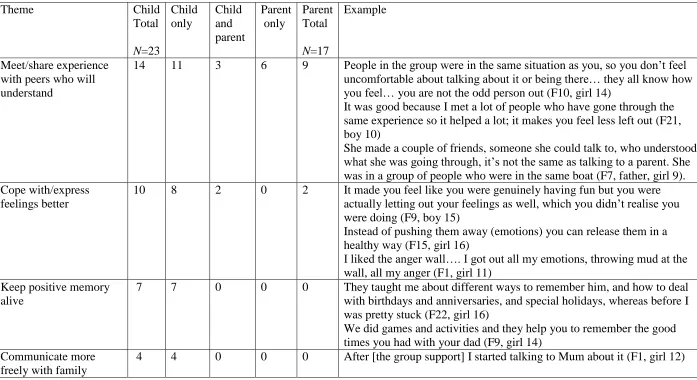
impact of the bereavement and the impact of the support service (see Tables 1 and 2).
presence of remarks pertaining to each theme at least once in each child and parent
interviews. Given the small sample size the results are not considered in relation to
child gender or child age. However, respondents are identified after quotes by:
Family ID (1 to 17); the respondent (mother, father, girl, boy); and the child’s age at
the time of being interviewed (see Tables 1 and 2). To ensure confidentiality the
child’s age at the time of the bereavement is not given.
Results
Perceived impact of bereavement
Socio-emotional problems: Reflecting previous research, a substantial number of the
children (18, 78%) described socio-emotional difficulties subsequent to their
bereavement, noted also by three-quarters of their parents (13, 76%) (see Table 1).
Anger or aggression was the most frequently mentioned problem, by both children
and parents was. Depression or sadness was more often reported by children but not
parents and similarly, but less often, feelings of guilt or blame were more likely to be
mentioned by children (see Table 1).
Table 1 about here
Poor communication at home
Limited or no communication between parent and child at home about the
bereavement was noted by almost two-thirds of the parents (11, 65%) and by just over
one-third of the children (9, 39%) (see Table 1). Some parents described this as the
reason they had gone to the support service. A similar proportion of parents (12, 71%)
commented on the child not showing distress at the time of the bereavement, also
encourage talk could reportedly lead to children indicating that they had no wish to
discuss their bereavement. Several children commented that the main reason they did
not talk about their bereavement at home was to avoid upsetting the remaining parent
and that they did not have strategies for dealing with the distress that might ensue.
Isolation from peers
Almost half the bereaved children interviewed said they had experienced problems
with their peers (11, 48%) (see Table 1), that bereavement had left them feeling ‘set
apart’ from peers who had not experienced the death of a family member, resulting in
the avoidance of or awkwardness in social interactions: ‘Part of me wanted to tell
everyone but part of me didn’t, just in case I got upset or made other people feel
worse’ (F10, girl 14). It also proved difficult when other children talked about their
own families and enjoyable family events. The fact that peers who had not
experienced bereavement were avoided could result in a strong sense of isolation.
Withholding information from peers was not always known about at home, being
mentioned by only one-third of parents (6, 35%). One mother discovered that her sons
had not discussed their bereavement at school when she explained to another parent
why she was asking her to give them a ride home. A small number of children (3,
13%) also mentioned that they had experienced bullying from peers after the
bereavement (see Table 1).
Perceived impact of the intervention
Share experiences with peers who understand. Half of the children (14, 52%)
mentioned that the main benefit of the group support for them was meeting other
feel less isolated (see Table 2). A similar proportion of the parents (9, 53%) also
identified this as an important outcome of the group support (see Table 2).
[Table 2 about here]
Develop strategies for dealing with emotions
Another frequently reported outcome, mentioned by just under half the children (10,
43%; see Table 2), was developing strategies to deal with their emotions and being
more open about their feelings regarding bereavement. Some specifically mentioned
the way that it had helped them express anger, a key focus of many of the activities.
Keep a positive memory alive
Almost one-third of the children (7, 30%) mentioned that the group support helped
them to think in a positive way about the deceased parent and to recall good times that
they had shared, which was a particular issue for some if their parent had been ill for
many years. Parents did not mention this at all.
Communicate more freely at home
Only a small number of children (4, 17%) said they talked more freely to family
members after the support, and no parent mentioned this as an outcome of the support
(see Table 2). If it did occur, it was perceived to be important, as illustrated by a girl
who had been bereaved 8 years earlier: ‘We opened up to each other a lot more, we
dealt with our problems and I think are now at the same level’ (F5, girl 17).
Some problems were said to have continued after the six sessions had ended. The
presence of ongoing feelings of anger was mentioned by two children and four parents
(see Table 2).
Programme not sufficient
The need for the programme to provide more contact was mentioned by just under
half the children (10, 43%) and by the majority of parents (14, 82%; see Table 2).
Suggestions included increasing the number of sessions or keeping to six sessions but
with the possibility of on-going contact as a ‘life-line’. They wanted to be weaned off
gradually, according to the children’s needs and progress, rather than being linked to a
programme cut-off point. Other suggestions were to have regular but more widely
spaced meetings (e.g. 3- or 6-monthly) or returning for further sessions after the
programme’s completion. Only two families indicated that the support had been
sufficient: ‘I think the course was good and it wasn’t too long, which is good, because
you don’t want to get tied down with constantly being reminded of what you have
gone through’ (F14, boy 14).
Discussion
The strength of this study is that young people were asked directly about their
experiences following bereavement and both they and their parents appeared to
appreciate talking freely. For the most part even the younger children were able to
talk about their experiences, although the open-ended interview technique is more
likely to elicit rich material from teenage children than younger ones.
Their descriptions of emotional and behavioural problems are not surprisingin
that these children had aroused concern and all had been referred to support services.
It is encouraging that many children reported that they developed ways of coping with
these difficulties through attending the group support. Nevertheless, reducing the
extent of adverse emotions was not reported as the primary outcome of the service for
most of the children, some of whom had received clinical services at some point for
socio-emotional problems.
The most common perceived benefit of the group, according to the children
and their parents, was the social interaction with other youngsters who had
experienced bereavement. These children were said to understand the thoughts and
feelings being described, were sometimes able to offer good advice about coping, but
most importantly, through their friendship, the children described feeling less isolated
and different. This confirms the findings of studies using structured questionnaires or
relying exclusively on parent report (Wilkinson et al., 2007; Williams et al., 1998).
The importance of peer relationships for children’s well-being in the context of other
family difficulties such as parental discord is well documented(Wasserstein & La
Greca, 1996) but in a circumstance such as the death of one’s parent the usual peer
group may not be able to provide the kind of relationship that could help a grieving
child.
Children indicated that opportunities to talk to their existing peer group about
their bereavement, or how they felt, were limited and they were likely to avoid social
interactions with friends. This peer-group support, currently not the most frequently
offered type of bereavement service for children (Rolls, 2007), provided them with
the opportunity to express some of their anxieties and stresses and to talk freely with
strategies to help them re-engage effectively with other peer groups at school or in
their neighbourhoods.
It is important to note the perceived limitation of group support in relation to
family communication. The intervention was said not to have made much of an
impact on child-parent communication about the bereavement or on children
expressing distress freely at home despite many parents mentioning it as a concern;
indeed, for some, the primary reason for attending the service. Black and Urbanowicz
(1987)found that a favourable outcome following bereavement in terms of mental
health was related to children having cried and talked about the deceased person. The
activities presented in these group sessions encourage children to express their
emotions freely in this relatively safe setting with similarly affected peers and they
describe doing so. However, joint sessions with parents – either in groups or as
families – may help parents and children express their strong emotions together.
Parents described being more attuned to children’s anger than to their sadness and a
number of the activities focus on releasing anger. Over the long term, far more
openness about a range of emotions, particularly sadness or depression, may allow
parents to provide the ongoing support that their children are likely to need, and ways
to foster this may have to be developed.
Most of the respondents indicated that the provision of support had been too
brief and the service lacked the capacity to keep open a means of ‘touching base’
should a difficulty arise. Keeping to a relatively low number of sessions reflects, in
part, third sector provision that is reliant on funding that may fluctuate (Rolls &
Payne, 2003). A brief intervention can be made available to more children and
families. However, other bereavement support is also time-limited so that the
with other aspects of their lives. The remarks made by these children and parents
indicated that this was sometimes a challenge.
This study has several limitations. The group is selective in that all had been
referred to and then taken up the offer of group support from one particular service
and, typical of other research with bereaved families (Sandler et al., 2003; Wilkinson
et al., 2007), the proportion agreeing to be interviewed was less than half those
eligible. Those who declined either directly or indirectly by not responding to the
letter may have different ideas about the intervention. It must also be kept in mind
that bereaved children are a heterogeneous group, and for many this kind of
experience may not be necessary or useful. Those not referred may have different
needs or be coping well without any service.
The number of interviews is small, although this is not uncommon for this
type of analysis (Smith & Osborn, 2008), focussing on the perceptions and
understanding of a particular group. One final limitation is the variable amount of
time that had elapsed since the support, and since the bereavement. All the families
were recruited from one location so it was necessary to recruit from groups that took
place over several years. The respondents had varying amounts of time to process
their thoughts, but this does reflect families coming to this type of service, who do not
all enter the support soon after bereavement, some coming 6 or 7 years after the death.
The limitations notwithstanding, this study heard from the children directly and in
detail and can provide useful insights into the kind of difference that this form of
peer-group support can and cannot provide. Their comments highlight the impact that
bereavement can have on children’s social interactions with peers. Future research
might explore why family communication appeared to be relatively unaffected by this
For example, peer-group support could be offered in rigorous trials as a stand-alone
service or with individual and family support so that the most effective range of
bereavement services can be made available for those children who need them.
Acknowledgements
We are indebted to the Jigsaw 4U bereavement support service for their collaboration
in this research and to all the parents and children who took the time to talk about
their experiences of both bereavement and of the support they received. The
interviews were conducted by the first author in partial fulfilment of a BSc in
Psychology at Birkbeck, University of London and she was supported in part by a
bursary from the Richard Reeve’s Foundation.
References
Black, D. (1996). Childhood bereavement: Distress and long-term sequelae can be
lessened by early intervention. British Medical Journal, 312, 1496.
Black, D., & Urbanowicz, M. (1987). Family intervention with bereaved children.
Journal of Child Psychology andPsychiatry, 28, 467-476.
Braund, J., & Rose, J. (2001). Bereavement education for childcare professionals.
Journal of Child Health Care, 5, 66-70.
Christ, G., Raveis, V., Siegel, K., Karus, D., & Christ, A. (2000). Evaluation of a
preventive intervention for bereaved children. Journal of Social Work and End
Life Palliative Care, 1, 57-81.
Croy, P., Wilkinson, S., Barnes, J., & King, M. (2004). A prospective evaluation of a
new child bereavement support service. London: Report to the Health
Dowdney, L. (2000). Annotation: Childhood bereavement following parental death.
Journal of Child Psychology and Psychiatry, 41, 819-830.
Dowdney, L., Wilson, R., Maughan, B., Allerton, M., Schofield, P., & Skuse, D.
(1999). Bereaved children: Psychological disturbance and service provision.
British Medical Journal, 319, 354-357.
Harrington, R. (1996). Childhood bereavement: Bereavement is painful but does not
necessarily make children ill. British Medical Journal, 313, 822.
Kitchener, S., & Pennells, M. (1990). Bereavement group for children. Bereavement
Care, 19, 30-31.
McWhinney, I.R., Bass, M.J., & Donner, A. (1994). Evaluation of a palliative care
service: Problems and pitfalls. British Medical Journal, 309, 1340-1342.
Register, D.M., & Hilliard, R.E. (2008). Using Orff-based techniques in children’s
bereavement groups: A cognitive-behavioral music therapy approach. The Arts
in Psychotherapy, 35, 162-170.
Rolls, L. (2007). Mapping evaluation of UK childhood bereavement services:
Executive summary. Cheltenham: University of Gloucester.
http://www.childhoodbereavementnetwork.org.uk/documents/RollsExecutiveS
ummary.pdf accessed November 2009
Rolls, L., & Payne, S. (2003). Childhood bereavement services: A survey of UK
provision. Palliative Medicine, 17, 423-432.
Sandler, I., Ayers, T., Wolchick, S., Tein, J-Y., Kwok. O-M., Haine, R., et al. (2003).
The family bereavement program: Efficacy evaluation of a theory-based
prevention program for parentally bereaved children and adolescents. Journal
of Consulting and Clinical Psychology, 71, 587-600.
Smith, J.A., & Osborn, M. (2008). Interpretative phenomenological analysis. In J.A.
Smith (Ed.), Qualitative psychology: A practical guide to research methods
(pp. 53-80). London: Sage.
Stokes, J., Wyer, S., & Crossley, D. (1997). The challenge of evaluating a child
bereavement programme. Palliative Medicine, 1, 179-190.
Tonkins, S.M., & Lambert, M. (1996). A treatment outcome study of bereavement
groups for children. Child and Adolescent Social Work Journal, 13, 3-21.
Wasserstein, S.B., & La Greca, A.M. (1996). Can peer support buffer against
behavioral consequences of parental discord? Journal of Clinical Child and
Adolescent Psychology, 25, 177-182.
Williams, J., Chaloner, J., Bean, D., & Tyler, S. (1998). Coping with loss: The
development and evaluation of a children’s bereavement project. Journal of
Child Health Care, 2, 58-65.
Wilkinson, S. (2001). How best to support bereaved children. International Journal of
Palliative Nursing, 7, 368.
Wilkinson, S., Croy, P., King, M., & Barnes, J. (2007). Are we getting it right?
Parents’ perceptions of hospice child bereavement support services. Palliative
Medicine, 21, 401-407.
Zambelli, G., & De Rosa, A. (1992). Bereavement support groups for school-age
children: Theory, intervention and case example. American Journal of
Table 1. Themes pertaining to the impact of the bereavement on the child
Major theme Minor theme Child
total N=23 Child only Child and parent Parent only Parent total N=17 Example Socio-emotional problems
18 6 12 1 13
Anger or aggression
13 6 7 2 9 I got angry and took it out on people,
sometimes I would start punching and kicking things. (F19, girl 9)
He would just kick and punch and cry … he would lash out. (F21, mother, boy 10) Sad or
depressed
9 7 2 1 3 I was very depressed [when she started the
support] I was just getting over
self-harming, I tried to commit suicide. (F5, girl 17)
At home she was desperately sad … sometimes she would be very angry and sometimes she would be overwhelmingly sad and cry (F15, mother, girl 16)
Guilt, feel to blame
4 4 0 1 1 Guilt is like finally realising something is
gone. And it’s like you want to say sorry that you couldn’t have done anything about it… like you were meant to do something about it (F10, girl 14)
He said to me ‘Mummy, Daddy had these dizzy spells, would he have died if I had told you?’ ….I think he holds guilt for not telling me (F20, mother, boy 12)
Little home communication
11 3 8 8 16
No talk of deceased or bereavement at home
9 4 5 6 11 I never knew what to say to her (F12, boy
14)
The reason we went to [support service] was that the children weren’t talking about anything to do with their mum, not even a passing comment (F13, father, boy 8 and girl 11)
[When I start a conversation] he will just walk out of the room or doesn’t say anything or tries to keep busy with something different (F8, mother, boy 12) Not show
distress
5 2 3 9 12 I didn’t really cry before, I didn’t talk about
it much (F1, girl 11)
My mum used to get very upset and cried if we mentioned dad so I did not want to upset her (F5, girl 17)
He said nothing at all, not talking, not crying (F8, mother, boy 12)
She kept a lot in, she didn’t cry very much, I think because she saw me keeping it in (F20, mother, girl 9)
Isolation from peers
Feel different from peers
6 4 2 0 2 I felt really alone, because when it happens
you feel like you’re the only person it’s happening to and I didn’t feel like anyone else was going through the same thing. No one else was able to understand (F14, boy 14)
You kind of have those raw emotions in your head …you think no one understands you…. you feel really lonely (F15, girl 16) Not talk to
peers
5 3 2 1 3 When my dad first died they didn’t know
how to talk to me because they thought I’d get all upset….so I felt quite uncomfortable when I went out with them [friends at school] (F4, boy 14)
Everyone tried not to talk about it but sometimes when people talk about their dad I find it hard (F21, girl 14)
Bullying, related to bereavement
3 2 1 1 2 My Mum saw that girl grab onto my
Table 2. Themes related to the perceived impact of group support
Theme Child
Total N=23 Child only Child and parent Parent only Parent Total N=17 Example Meet/share experience with peers who will understand
14 11 3 6 9 People in the group were in the same situation as you, so you don’t feel
uncomfortable about talking about it or being there… they all know how you feel… you are not the odd person out (F10, girl 14)
It was good because I met a lot of people who have gone through the same experience so it helped a lot; it makes you feel less left out (F21, boy 10)
She made a couple of friends, someone she could talk to, who understood what she was going through, it’s not the same as talking to a parent. She was in a group of people who were in the same boat (F7, father, girl 9). Cope with/express
feelings better
10 8 2 0 2 It made you feel like you were genuinely having fun but you were
actually letting out your feelings as well, which you didn’t realise you were doing (F9, boy 15)
Instead of pushing them away (emotions) you can release them in a healthy way (F15, girl 16)
I liked the anger wall…. I got out all my emotions, throwing mud at the wall, all my anger (F1, girl 11)
Keep positive memory alive
7 7 0 0 0 They taught me about different ways to remember him, and how to deal
with birthdays and anniversaries, and special holidays, whereas before I was pretty stuck (F22, girl 16)
We did games and activities and they help you to remember the good times you had with your dad (F9, girl 14)
Communicate more freely with family
Lack of impact 2 1 1 3 4 For the crying it [the support] helped a lot because I was crying constantly before, and knowing that I’d be able to talk about that was helpful, with the anger I’m not too sure really (F22, girl 16)
He worries me, I can’t put my finger on it, he’s just more angry; I wonder why he isn’t coming out of that… I often thought he needs more help [had counsellor who moved away] (F21, mother, boy 10)
Programme not sufficient
10 1 9 5 14 I thought I should have been twice a week, then you could get more time
into six weeks themselves, and instead of six sessions, 12 sessions (F9, girl 14).
It was after it finished that she… grieved, because it has gone. I felt it was far too brief for her. And she said she was quite angry it had finished (F19, mother, girl 9)